
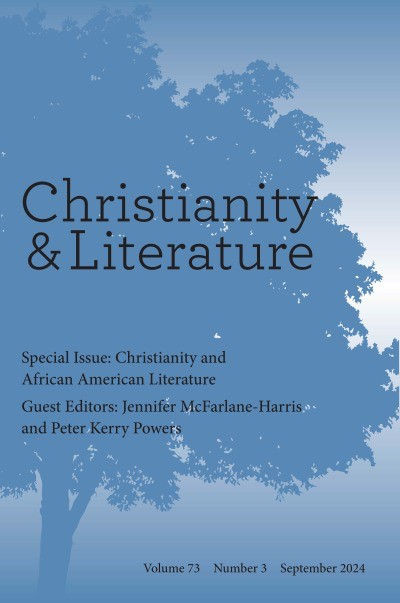
 This past week a special issue of Christianity & Literature that I co-edited with Jennifer McFarlane Harris hit newstands everywhere. Or, more likely, browsers of the somewhat interested since I think most scholarly reading of almost every sort takes place online anymore. I’m going to post a few things about this over the next several days just to give folks a taste of what’s in the special issue. To my own mind, our recent political history continues to speak to the need to attend carefully and creatively to the history and literature of African Americans, and it is one of the shortcomings of the various fields attending to questions of Christianity and culture, literature especially, that we attend to it as a minor sidelight rather than something that ought to reorient our thinking about Christianity and culture as a whole. A short excerpt from the introduction, co-written with Jennifer.
“As the headnote to this introduction from Arthur Schomburg suggests, the particular pressures on cultural and social history faced by African Americans have often created a unique urgency to the act of historical recovery, reclamation, redemption, and interpretation, a work which Schomburg, with others, fathered and mothered in the modern period.
In part, this signature concern with African American history is birthed from the present danger of its disappearance. The nameless millions who perished in the slave trade signify this danger, but so too do the continuing consequences of white supremacy to the present and the persistent and long-standing effort to erase Africans and African Americans from history as such. Most recently, this persistent erasure is seen in state-mandated silencing of discussions of America’s violent racial history in states from Oklahoma to Texas to Florida. Such political shenanigans may strike us as just the latest version of American know-nothingism—and it is that. Still, such silencing or erasure has been the common character of the European and European American intellectual history, from Kant to Jefferson, from Hegel to the Oxford don who scoffed at Henry Louis Gates Jr.’s desire to write his thesis on African American literature. To be Black, in the historically dominant discourses of white America, is to be without history, save as that history might reaffirm the place of whiteness at the center.
This history of erasure shapes African American scholarship in a variety of ways. Most fundamentally, to have an attitude toward history, one must first be written into it. Thus, one significant project among African American scholars has been recuperation or recovery of that which has been discarded or dismembered and scattered. From the efforts of Gates to discover, republish, and thus reestablish lost works of the African American literary tradition, to that of Alice Walker remembering the lost everyday artistry of women in the Jim Crow South, to the scholars included in this special issue, the first task is often to uncover or rediscover the past so that it can be seen and recognized, this so we might better understand our relationship to those who came before and our dependence on them. In a period grown skeptical of the metanarratives that canonicity depends upon, a good bit of African American scholarship remains concerned with who and what is included and who and what is excluded from our scholarly memory and concern, both within the broader story of American culture and society and within the continuously developing and changing canon of African American letters. Approaches vary, as do ideologies and genres, all affecting individual attitudes toward history. But this irreducible individuality should not obscure pervasive scholarly attention to the act of recovery that reaches after something lost or on the verge of being so. https://muse.jhu.edu/article/940452
 Peter Kerry Powers