The latest from Digital Harrisburg’s David Pettegrew
Leave a reply


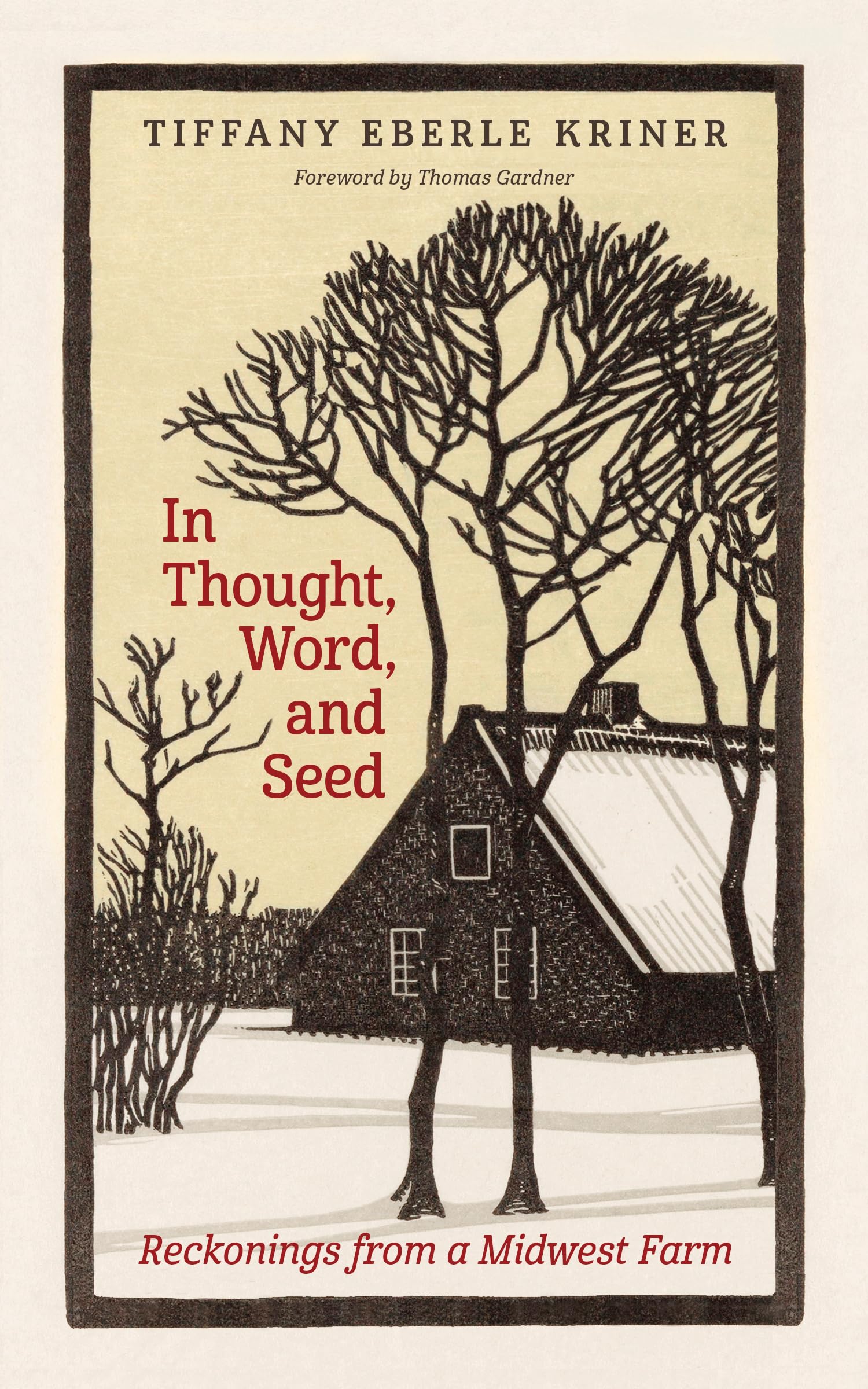 I was glad to see this review of Tiffany Kriner’s Thought, Word, Seed: Reckonings from a Midwest Farm appear in Christian Scholars Review. As is probably evident, I loved Tiffany’s work here. I found my multiple reads of it over the past year (on my own and with students) to be not only aesthetically satisfying but spiritually moving and transformative. Also a lot of food for thought about how one goes about writing about books and reading. As my colleague John Fea is wont to say, a little taste.
Tiffany Eberle Kriner teaches English at Wheaton College. She is also a mother, an organic farmer, a wife. She is a survivor of the pandemic, of cancer, of lesser deadly things like the tenure process. She is a writer. She is an anguished observer of the murder of George Floyd, a worrier that she may be a guilty bystander. She is a watcher of owls, a herder of sheep. She is, above all, a reader of books, of the Good Book and of the book of nature, of what we might call the book of the world. Charting how these selves and callings come together in one person on the Root and Sky Farm in rural Illinois during the pandemic and its aching aftermath is the subject of Kriner’s extraordinary memoir, In Thought, Word, and Seed: Reckonings from a Midwest Farm.
Thought, Word, and Seed is Kriner’s second book, following The Future of the Word: An Eschatology of Reading.2 It is, almost, hard to think of them coming from the same writer. The first is a provocative theoretical and theological interpretation of reading as an eschatological act, a means of making books live into the promise of the resurrection. It’s the kind of book academics reward with tenure and promotion and perhaps, if you are lucky, with footnotes and scholarly reviews.
However, in my own view, The Future of the Word is only prolegomenon to the achievement of In Thought, Word, and Seed. The second book is more memoir, more poetic. In a word, more “literary.” Yet, in some respects, Thought, Word, and Seed is a creative rereading of Future of the Word, making its ideas live in a different register, almost as if Kriner woke up one morning saying to herself, “Okay, if reading does the things I say it does, I need to write some other way, some new way, not that way.”
I hope you’ll enjoy Tiffany’s book as much as I did over the past year. As I say in the final line of the review, take up and read.
I was happy this week to have a new essay out in the newly minted journal Public Humanities, from Cambridge UP. It’s my own reflection on the importance of institutions to successful work in academia, and especially to the effort to sustain Public Humanities projects, which notoriously exist precariously on the blood, sweat and tears of a weary professor or two hoping they can beg, borrow, and steal enough funding for one more year. We live in an anti-institutional age. Perhaps we always have, though it has seemed particularly easy of late to think that sneering at institutions and their mores and traditions is a revolutionary act in and of itself, an attitude shared not only by not a few of the denizens of the current administration, but not a few professors on both ends of the political spectrum. The essay as a whole is what it looks like–a how to bit on ways to approach your institution so that your work can become just a little more of the day to day operation rather than the mad scramble for resources that academic life mostly is these days. The conclusion is a little bit more of a personal reflection on our inveterate suspicion of institutions in America an life and how managing that suspicion is as much a part of an intellectual project as any other aspect of what we do. I include that piece here, but hope you’ll look up the whole thing at your leisure.
I’ll conclude with encouragement to not just know and tell your institution’s story well. Be sure to know yourself. When I was first asked to do some writing and speaking on “institutionalizing public humanities programs,” I read the word “institutionalizing” with a sudden catch in my throat. My thoughts, unbeknownst to those who asked me to speak, went immediately to my father. Having been moved to a dementia care unit after he had descended some way into the fatal grip of Alzheimer’s, he had a conversation one day with my mother, the one family member whom he still recognized. My mom asked him if he knew what was happening to him. He replied, “Well, I know I’ve been institutionalized.”
This memory is personal, but it does speak to a larger discourse about which we remain uneasy. In our culture, the “institutional” man or woman is not the one who gets the romantic lead in books and movies. From Huck Finn to Animal House, from Invisible Man to Girl Interrupted, institutions and their operations can signify loss of freedom, loss of creativity, loss of passion, and loss, indeed, of identity. They signify death. Subconsciously, we assume that institutions restrain. Depending on them, we think, means losing something more vibrant and visionary than what we would do if given the time and resources, especially if we were left to our own devices. Sometimes, lurking unacknowledged beneath the question of how our important projects can become institutional priorities lies the unstated question, “How can I get the resources to do what I want to do and be left alone to do it in the way I think it ought to be done?”
My disappointingly short answer to that question is, “You can’t.” One part of institutionalizing our passions is a long-term negotiation, not just with our institutions but with ourselves. Successful programs are born, not least, through a process of giving up some measure of control, and some measure even of our own dreams, in the hope that they can become something larger. Institutionalizing what we do is, in part, figuring out how our stories, practices, and passions can be meshed with–and sometimes substantially altered by–the stories, practices, and desires of these entities we call institutions. Institutionalization means coming to terms with the fact that our individual dreams will not be realized through institutions. But dreams of various sorts can be realized and sustained as they are manifested through collaboration with our institutions, our community partners, our students, fellow faculty, and many others on the road to becoming realized as a public humanities project. That project will not be what we originally imagined it might be, but perhaps, in the end, it will be more than we could have hoped.
Powers PK. How to Institutionalize Public Humanities Projects. Public Humanities. 2025;1:e46. doi:10.1017/pub.2024.64
 This past week a special issue of Christianity & Literature that I co-edited with Jennifer McFarlane Harris hit newstands everywhere. Or, more likely, browsers of the somewhat interested since I think most scholarly reading of almost every sort takes place online anymore. I’m going to post a few things about this over the next several days just to give folks a taste of what’s in the special issue. To my own mind, our recent political history continues to speak to the need to attend carefully and creatively to the history and literature of African Americans, and it is one of the shortcomings of the various fields attending to questions of Christianity and culture, literature especially, that we attend to it as a minor sidelight rather than something that ought to reorient our thinking about Christianity and culture as a whole. A short excerpt from the introduction, co-written with Jennifer.
“As the headnote to this introduction from Arthur Schomburg suggests, the particular pressures on cultural and social history faced by African Americans have often created a unique urgency to the act of historical recovery, reclamation, redemption, and interpretation, a work which Schomburg, with others, fathered and mothered in the modern period.
In part, this signature concern with African American history is birthed from the present danger of its disappearance. The nameless millions who perished in the slave trade signify this danger, but so too do the continuing consequences of white supremacy to the present and the persistent and long-standing effort to erase Africans and African Americans from history as such. Most recently, this persistent erasure is seen in state-mandated silencing of discussions of America’s violent racial history in states from Oklahoma to Texas to Florida. Such political shenanigans may strike us as just the latest version of American know-nothingism—and it is that. Still, such silencing or erasure has been the common character of the European and European American intellectual history, from Kant to Jefferson, from Hegel to the Oxford don who scoffed at Henry Louis Gates Jr.’s desire to write his thesis on African American literature. To be Black, in the historically dominant discourses of white America, is to be without history, save as that history might reaffirm the place of whiteness at the center.
This history of erasure shapes African American scholarship in a variety of ways. Most fundamentally, to have an attitude toward history, one must first be written into it. Thus, one significant project among African American scholars has been recuperation or recovery of that which has been discarded or dismembered and scattered. From the efforts of Gates to discover, republish, and thus reestablish lost works of the African American literary tradition, to that of Alice Walker remembering the lost everyday artistry of women in the Jim Crow South, to the scholars included in this special issue, the first task is often to uncover or rediscover the past so that it can be seen and recognized, this so we might better understand our relationship to those who came before and our dependence on them. In a period grown skeptical of the metanarratives that canonicity depends upon, a good bit of African American scholarship remains concerned with who and what is included and who and what is excluded from our scholarly memory and concern, both within the broader story of American culture and society and within the continuously developing and changing canon of African American letters. Approaches vary, as do ideologies and genres, all affecting individual attitudes toward history. But this irreducible individuality should not obscure pervasive scholarly attention to the act of recovery that reaches after something lost or on the verge of being so. https://muse.jhu.edu/article/940452
One of the things I’m proudest of from my time as dean is the really strong work we were able to develop in exploring the history of Harrisburg–work that is ongoing. Our public humanities fellows blog semi-regularly about their work and I’m going to repost here just so you can see soem of it for yourself. Always great to work with great students and great colleagues.
Glad to see that this review finally came out in Christian Scholars Review. Just a bit….
“Geoffrey Galt Harpham has argued that conversation about crisis is fundamental to the humanities in the United States, an insight I extend to the liberal arts more generally.1 Certainly, crisis-talk has spanned my own career. From internal academic anxiety over the wrecking ball of poststructuralism, to the cognate cultural wars of the eighties and nineties, to their present echoes with book bans, cancel culture, and semi-authoritarian interventions in higher education; from depression over the depressed state of hiring in the liberal arts, to hand-wringing over the elimination of liberal arts majors as students vote with their feet for other disciplines; and, not least, the serious concerns about the financial sustainability of liberal arts colleges: crises have been the norm, as have been arguments about them.
“The Liberating Arts is a new entry in this always earnest, often angsty conversation defending the liberal arts. The book joins this conversation, it seems to me, with a view toward providing accessible responses to popular perceptions of the liberal arts. This outward-facing plain speaking is the strength of the collection. ….”
I’ve become something of a fan of this writers poetry very recently, so I was somewhat disappointed that the compelling premise in the end seemed undermined by the delivery. There may be a connection between the two reactions since I often felt like I was reading a long, extremely and sometimes tediously long, prose poem that tried to carry off the lyric style of a shorter poem in the more discursive interweaving of narrative prose. There were probably 2 dozen great lyric poems in here somewhere but that didn’t add up to a narrative lyricism, or a very good story. It reminded me at times of something like Gertrude Stein, another writer I admire but who tries to make long and opaque lyric poems masquerade as narrative.
To some degree it seems to me that this book is not really about a kidnapping at all, though that is how it is advertised. It is really much more about the impossibility and uncertainty and yet necessity of memory, as well as the impossibility, uncertainty and yet necessity of articulating those memories, contradictions that the prose style mirrors. The dominant mode is the subjunctive, which could be fine but in the end, everything is possible, or in doubt, and nothing seems really secure. The poetics of uncertainty finally makes it impossible to care about the author as a character in his own narrative, or to really feel much of anything for his kidnappers. Indeed, so extensive is the sense of doubt and uncertainty about memory and even the capacity of language that I found myself speculating on whether he had really been kidnapped at all. Being precise about one’s own lack of certainty, about one’s own sense of how even to speak about oneself, in the end can carry the reader for a few pages or 20, but not for an entire book. It’s too bad, because McCrae as a poet seems like an imagination to contend with.
This past weekend I was asked to come in and give a plenary address to a group working through the second cohort of the CIC’s “Humanities Research for the Public Good” initiative. Messiah was in the first cohort and I served as a team member, though in truth almost all the work was done by David Pettegrew, Jean Corey, students, and our community partners working on the Commonwealth Monument project. In the course of our efforts, I think the CIC became aware of all the many good things we do here in Public Humanities work, so I was glad to be able to share with them a little about what we do and how we’ve managed to do it and sustain it over time. Slides from the presentation are available at slideshare, and embedded at the end of this post.
What follows are a few snippets from my presentation—the parts that were a little more written out rather than just talked through extemporaneously.
=========================================================
In preparing for this talk, Phil and Anne gave me about two pages of possible things to address in my talk, things like
I admit that as we were developing this list I was saying to myself “I really hope that Phil and Anne will be able to find someone who can come and answer these questions, because I sure as heck can’t” I say that only partially in jest, because the truth is that institutionalization does not mean what it used to mean, especially in an era when higher ed institutions of our sort are themselves under constant threat and nowhere more than in the areas of the humanities and no where more than in the kinds of institutions supported by the CIC. All of us are in a scramble to get one more student in the door so that they can keep our doors open. To some degree “institutionalization” means you are at least welcome to stay in the scramble. Uncomfortable, yes, but in an era where History and English and Philosophy and Religion and Language majors are being discontinued and de-institutionalized, it does mean that institutionalization is an ongoing and iterative process rather than something that is finally and for all time achieve.
However, I’m going to start whacking a way at this a bit by telling you a bit of our story, not because we have come up with the absolutely best ways of doing these things or answering these question. Rather, my primary claim today is that the most important aspect of institutionalization is story-telling. This may be one area in which we have some distinct advantages because we are, most of us, story tellers of one sort or another. I am fond of saying to my dean and provost colleagues that whatever we read in the best administrators’ handbooks, we aren’t really data-driven. Institutions are story-driven and data informed. Data in itself does not tell us what to value, aspire after, regret, champion, mourn, and envision. Our stories do that. Thus, as you all well know, the stories you can tell about your projects are important. But perhaps even more important for the processes we call institutionalization are the stories you know and can tell effectively about your institutions. Our project stories AND institutional stories, are the most valuable resources you can bring to the table.
[What followed was an extemporaneous discussion of our primary nodes of public humanities work at Messiah University, which I defined as the following: The Digital Humanities Initiative; The Center for Public Humanities; Thriving Together: Congregations for Racial Justice.]
That’s a little of the story of our projects, but I think a little more important for our purposes here is the story of Messiah University as a whole. If I had to declare a rule one for institutionalizing your work, it would be similar to the first rule of fundraising; that is make sure that your pitch is not about you or only about you but is about the person whose attention and affections (and resources) you are trying to win. Too often in seeking the favor of our institutions or donors we end up like the date who spends the evening talking exclusively about himself, to the grief of his partner’s evening. And we end up thinking that either we just need to get better at telling our story to the institution or else the institution just doesn’t get how valuable and important our story is. Instead we need to realize that the most important thing we can do is hear and understand and value our institution’s story, and figure out how our story can possibly fit with what is, in the eyes of the institution, going to be a much larger and more important story. What we are doing when we are asking to have our work “institutionalized” is that we are not asking for “resources”; we are asking that the story we care about can become a part of our institution’s story. Insofar as an institution is concerned, your program qua program is always only a small part of a much bigger and more complex story, and in its own mind it’s own is the much more important story. This is true even if you are making great progress on solving world hunger, on understanding the cultural effects of climate change, or are developing plans for capturing the oral histories of Ukranian refugees. No matter how big your story as an idea, insofar as it is as a program within your institution, the institution’s story is always going to be bigger and more important. Figuring out how your story is or can become part of that story is fundamental.
So, the first thing I’m going to say in that vein may seem somewhat over obvious, but know your mission, it is the foundation stone of your institution’s story and sense of self. Messiah University’s mission and identity statement makes the following claims
“Messiah University is a Christian university of the liberal and applied arts and sciences. The University is committed to an embracing evangelical spirit rooted in the Anabaptist, Pietist and Wesleyan traditions of the Christian Church. Our mission is to educate men and women toward maturity of intellect, character and Christian faith in preparation for lives of service, leadership and reconciliation in church and society.”
On the one hand, such mission and identity statements tend to be bland and even banal affairs, claiming to be original while pretty much saying what everyone else is saying in one way or another. On the other hand, they are portals into your institution’s story and its meanings and values. They are teleological claims that the leaders of your institution take with an earnest seriousness. Within institutions, each bland and seemingly innocuous statement carries a penumbra of interlocking meanings that are embodied in the various workings of your institution, including its planning and decision-making processes. Most institutions, and certainly effective institutions, attempt to find their own way through the thicket of troubles that is higher education by means of its guiding stories, metaphors, and rituals, most typically embodied at the highest order in a sense of mission and a sense of identity.
For instance, Messiah is a University of the applied and liberal arts. In the jargon of higher education, this indicates merely that we are a so-called “comprehensive institution,” with a balanced array of liberal arts and professional programs. In our institutional history, however, it represents and affirms that we were not simply or only a liberal arts college but that we were interested in providing an education that makes a practical difference in the world. In one of my first conflicts with a University President as a young faculty member, I was chastised for comparing what we did to Dickinson College. I was very firmly told that was not a good comparison and that form of a liberal arts college was not something we should aspire to, that we were more like places like Valparaiso another comprehensive institution, or perhaps we could aspire to be like Bucknell. In our instance, the student’s ability to apply and use the education that they receive, most particularly in service to others, is a paramount value.
This practical orientation is reinforced by an identity that calls attention to our roots in the “Anabaptist, Pietist, and Wesleyan” traditions of the Christian faith. This story of origins signals particular kinds of Christian allegiance with particular kinds of values. In our case, the rootedness in these traditions reinforces the preference for practice and the experiential that colors the entirety of our educational ethos. Anabaptists and Pietists, and even to some degree Wesleyans, are notable for their emphasis on practice of the Christian faith rather than reflection on Christian faith. Theological and philosophical traditions of learning and speculation springing from these traditions are notoriously thin when compared with the Catholic intellectual tradition or the robust emphasis on philosophy and theology and the other liberal arts springing from the Reformed churches. Nevertheless, these traditions of the Christian faith remain robust due to an undying commitment to values such as the practice of community life together, the pursuit of justice for and service to others, the personal experience of divine presence, and the pursuit of right living as a result of that experience. These traditions ask less fewer questions such as “What is the world for?” and more questions like “What can we do to make the world better?” This, finally, is reflected in our mission statement that puts a premium on education to specific ends that, again, all have resonance with the idea of practical and fruitful forms living, and especially living together: service, leadership and reconciliation.
Now, this practical and service-oriented ethos is often a burr in the backside of our traditional humanities disciplines, as some of you can probably imagine As an institution, we are not as robustly equipped as some sister liberal arts institutions to counter narratives of impracticality and uselessness in the humanities. Nevertheless, our stories have also been our doorway into a variety of valuable distinctives in our humanities programs, and most particularly for what we have been able to accomplish in public humanities forms of research. The justifications for our programs have relied significantly on the real-world difference such programs would make for our students and for the world at large. While I have often found myself wishing that we had a more traditionally oriented liberal arts ethos on campus, I have mostly felt that it is part of my job to figure out how to create a humanities that works in this place and within this particular set of values, respecting and working with the culture and values of the world in which I have found myself, culture and values expressed at the highest level by a statement of mission and identity.
This attachment to mission happens at a fairly high and abstract level. Practically speaking, I would also encourage to know your strategic plan well and know why it exists and what it is shooting for. I will say that if there are things more bland and less unique than an institution’s mission statement they are probably an institution’s vision statement and strategic plan. Nevertheless, as an internal ritual of storytelling and vision casting, strategic planning is more or less a road map. This is who we are, this is what we would like to become. If you are lucky, it might be that your particular project actually gets in on the ground floor and is central to the strategic plan. This has never really happened for me. More likely, you are going to have to be nimble and plan on every four or five years to have to retell at least part of your story of what you are doing in terms of those large if somewhat bland statements of vision coming out of the strategic planning processes. There is, frankly, not a VP in the country who is going to stand in front of their president and say “I know the strategic plan says we ought to be doing X, but I decided to do Y instead.” Such a VP might (MIGHT!) say to the same president, “We’re working to fulfill Educational goal 3 of Theme 4 in our strategic plan that relates to engaging the public about our value to the region. I’ve got this interesting new public humanities project that I think it might be worth investing a few thousand dollars in and I’d like to ask the development office to write some grants to generate further support.”
In our case at Messiah University this kind of nimble shifting of gears and recasting of our story in terms of the strategic planning process has happened on multiple occasions.
[What followed at this point was an extended extemporaneous discussion of the ways in which we’ve connected public humanities work of various sort to important strategic initiative at the University, if not gaining large sums of money then at least riding the coattails of a general momentum in particular directions. I also briefly discussed the ways we had made use of various kind of policies at the institution to the benefit of our programming, and finally how we had invested in people to achieve some of these ends. I concluded with the following reflection on taking stock of oneself and what it meant to want to have one’s own story institutionalized.]
When I sat down to zoom with Phil Katz and Ann Valk a few weeks ago to discuss what I might talk about, my section in the draft program that Phil shared in our call was named “institutionalizing public humanities”. I admit I read that word “institutionalizing” with a sudden clutch in my gut and catch in my throat. Somewhere in my alligator brain I heard a voice say “EEWW, who would want to be institutionalized?” It does not take much thinking to realize that the institutional man or woman is not usually the one that gets the romantic lead in books and movies. From Huck Finn to Animal House to Invisible Man, to Girl Interrupted, to Shawshank Redemption, institutions, their operations and their representatives are taken to signal the loss of freedom, loss of creativity, loss of passion, loss, indeed, of identity. In our subconscious we assume that institutions mean restraint, the loss of something more real and vibrant and visionary and alive than what we would really be able to do if given the time, opportunity and resources, and especially if we were left to our own devices. Sometimes, lurking unacknowledged beneath the question that asks how our important projects can become institutionalized or become an institutional priority lies the unstated question “How can I get the resources to do what I want to do and be left alone to do it in the way I think it ought to be done.”
My disappointingly short answer to that is “You Can’t.” Part of institutionalizing our passions is a long-term negotiation, not just with our institutions, but with ourselves and our own stories, practices, and desires. Institutionalizing what we do is in part figuring out how our stories practices, and passions must be altered in order to be meshed with the stories and practices and ambitions of these things we call institutions. One of the hardest things about institutionalizing your work, is coming to embrace the fact that it is no longer really your story, or at least not solely your story. At least part of my discussion today implies that one part of the process of institutionalization is coming to term with the fact that our individual dreams will not be realized through institutions, at least not as we had dreamed them. But our dreams of various sorts will be realized and sustained as we give them up, at least in part, to our institutions, our community partners, our students, and many, many others on the way to something we call a public humanities project. That something that results will not be what we originally imagined, but, perhaps, in the end, more than we could have asked or hoped for.
I wrote the short piece for our Provost’s Newsletter. Though a little in-house for broader dissemination, I do think it’s important that people know how hard and how well faculty and students and working during what has been an extraordinary 9 month period. And also important to recognize that creativity and community aren’t reserved for times of leisure. Now more than ever we need to be artists with our own lives and be committing ourselves to community with others and common good for all.
Mundanely titled: “Good News Around Campus”
In the mad rush we have come to call “COVID-time,” I’m used to describing my own life or hear others describe their lives as “busy” or “frantic.” We’re all “dog-paddling” or keeping our collective “nose out of the water.” Always rushed during the school year, COVID seems to have added an extra gear that gets the wheel of our days spinning yet more rapidly, even as we wait endlessly for a Thanksgiving, a day that the seems, like a point in Zeno’s paradox, to be ever closer and yet just as far away as ever.
Even so, when I’ve had a minute to pause and observe in the middle of all piles of things I must get done, I’ve also been struck by the ways our lives seem to be continuously marked by two other, less frantic words: creativity and connection. Although COVID has been an experience of tremendous and widespread loss—of our normal ways of doing things at which we excelled, of our usual times of rest or worship, and even for many of us the loss of friends or family–it has also given opportunities for newness and, surprisingly, for connection. As I observe faculty and students at work I am constantly impressed with adaptability and creativity in their finding new things to do or their efforts to do old things in new ways. In the Department of Communication, faced with the inability to cover sports events in his photojournalism class, David Dixon, co-chair of the department, has assigned his students to cover seasonal changes and campus beauty as a different form of journalism. In English, students in Young Adult Literature are using digital tools to explore the moral universe of Young Adult texts, and in Writing for Social Change students are developing digital writing campaigns to promote learning about issues such as mass incarceration, immigration, and gender in the church.
I’ve perhaps been most impressed with the ways in which faculty and students have creatively promoted human connection and community even in the midst of a world of social distancing. Kudos to Valerie Lemmon, Professor of Psychology and Assistant Dean of Business, Education, and Social Sciences for working with Stephanie Patterson to develop and alternative form of a school meeting so that faculty to greet each other, talk with each other pray for one another outside the normal confines of a business meeting. The Department of Education has celebrated the new book just published by Obed Mfum Mensah via zoom. The Messiah Council on Family Relations from HDFS sponsored a cooking show featuring student Tariah Rozier demonstrating her skills at cooking Halloween treats. The COMM department bridged the curriculum and social connection by having the Event Planning class create virtual events for students and faculty that would promote community in the department. Education students have been stepping up to fill critical substitute teacher needs in the region, an effort that helps our local schools and their students and teachers while also enhancing their experience as teachers.
There are, to be sure, so many ways in which we may find COVID-time constraining, preventing us from doing what we might otherwise prefer to be doing. But I also discern enabling constraints, all the ways in which the difficulties of our moment are pushing us to a creativity, and to a community, that we might not have otherwise realized. In all these ways and many, many more, I see faculty and students responding to constraints with creativity that sustains community. A blessing even in the midst of busyness.
 Peter Kerry Powers