Ok, I’ve been away from this so long that I feel I owe somebody an explanation, although I think my blog stats suggest that no one really cares that I haven’t been posting for more than two months. I’ve got a lot of really good excuses. First would be I’ve been REALLY REALLY BUSY. But I was busy before, so that one doesn’t wash entirely. Though, to be frank, it is the case that administrative work takes more takes more time and energy than I ever used to have to give to anything. Still, I think it’s really more the case that I just lost some of my blogging mojo, not really thinking I had much worthwhile to say and not really having much interest in saying it. This is a poor excuse since i started out thinking of this thing as just an interesting way to keep writing even if a lot of it was really bad and pointless. It is however, the best excuse I have.
In any case, on to my totally impossible and pointless new year’s resolutions. My first goal is to make resolutions I know will be impossible to keep because I will then feel less bad about breaking them.
I Resolve to Write on my Blog at least once a week–Actually this seems doable. Why not. No one says I have to be original or even interesting.
I Resolve to lose 60 pounds–Ok, this is what Oprah and I really need to do, but is beyond the realm of reality. Still, maybe if I say sixty I’ll actually get to thirty.
I Resolve to read one book a week–totally implausible, but why not fanatasize.
I Resolve to be a better husband and father–this one is really safe because if my kids refuse to say that I have achieved this goal I can cut off their allowance and send them to bed without supper. Ok, they are far too big for me to send them to bed without supper, but I could threaten. As for my wife, well, maybe she will humour me.
I Resolve to regularly attend church–always good to have a resolution that you are already achieving.
I Resolve to give up smoking–always good to have a resolution to give up something that you don’t actually do.
Ok, enough. Some good things that I have done in the past two months–
1. Wept on election night in November while watching the victory speech.
2. Wept several days thereafter upon watching reruns of the victory speech.
3. Read several books–maybe I’ll talk more about them later.
4. Visited Pagosa Springs Colorado–in fact, I’m sitting in the Albuquerque airport at the moment writing this blog.
5. Started working out again after a two month hiatus–makes me feel better about overeating. Also makes me feel better about going to the gym on January 2nd. I won’t have to feel like one of those folks that joins the gym in January and lasts for two week
There’s more, but that’s all I can come up with for now.
I had the pleasure a couple of weeks ago to read my colleague Paul Rego’s new book on Teddy Roosevelt. Although I’m a little more critical of Roosevelt than Paul is, his book seems very timely, and does a good job of pointing our Roosevelt’s continuing relevance. Even this week John McCain morphed into a Roosevelt Republican taking on the Titans of Wall Street. Whether McCain was convincing in doing so is another matter, but it was in line with Paul’s insight that Roosevelt remains a touchstone figure for many contemporary presidents and presidential aspirants.
I thought I was supposed to do a full-blow review/critical response to Paul’s book at a reception in his honor, but I had the honor of introducing him instead. What follows are my meandering scribbles on Paul’s book, titled, by the way “American Ideal: Theodore Roosevelt’s Search for American Individualism.” These don’t quite amount to a review since they’re mostly notes for a talk, but I thought I’d post them here anyway.
In some respects, Paul’s book focuses on the irony of his subtitle:Roosevelt’s search for an American individualism.Though an intellectual biography, Paul seems to suggest that Roosevelt doesn’t arrive atsettled substantive positions so much as he grapples mightily with antinomies of American thought, practice and culture—the most important of these being the split between the pluribus and the unum in the American psyche.Born out of the Enlightenment, American politics and culture has never rested easily with the earlier notion of an individual as being one member of a group.Instead, the individual and the society are necessarily in tension with one another, if not actively opposed to one another.On this view, the individual is society’s other, not matter how much we may say that society’s could not be conceived of without individuals and vice-versa.On this reading, a search for an American individualism is a quixotic quest—my reading, not Paul’s—since to be an American is to be a part of a collective, but one which only defines itself through the exaltation of the individual. Nevertheless, however impossible the project, the struggle to reconcile these opposing forces gives Roosevelts work much of its energy and contemporary relevance, no matter that he didn’t completely succeed in his quest.
I especially like Paul’s tracing of the opposition between progressivism and individualism.For one thing, those people in American literature who pay any attention to Roosevelt tend to emphasize his individualism, and so Paul’s attention to Roosevelt’s progressivism was enlightening.Moreover, I learned a lot in Paul’s argument that at the turn of the twentieth century, progressivism was imagining largely in collectivist terms and was in some respects seen as anti-individualism.The complexities involved suggest, as Paul explicitly attempts to do, that politics of the early 21st century continues to bear the marks of the discourses of a century ago.Liberals still rocket uneasily between individual empowerment and government regulation and intervention, while conservative ideals of the self-made man and the destructive energies of capitalism collide, sometimes violently with the conservative values of community, family, and tradition.If Roosevelt has not solved the problem of the pluribus and the unum, neither, really, have we.
Paul doesn’t really take up the gendered elements of Roosevelts thought, and I think they are important on various levels.Roosevelts view of individualism is, in my view, deeply masculine, verging on masculinist, and one reason for the popularity of his books lay in his idealization of masculine activities—war, hunting, camping, and the like—as a remedy for the feminizing forces of culture.Ironically, of course, many conservatives perceived the government as just such a ‘feminizing” force, wherein a man had to give up his manly individualism in favor of the will of the collective.The identification of progressivism with the feminization ofAmerican culture is everywhere in Americanliterature at least, and finds it’s way even in to contemporary politics.Think, for instance, of the fairly popular conservative dismissal of the liberal “nanny state,” and the preference that men pull themselves up by their own bootstraps.Paul argues that Roosevelt was willing to use the powers of the state in order to enable the possibility of individual achievement.Whether this is genius or hopeless contradictory may depend upon your politics, but I’m struck by the way in which this structure is represented in one of Roosevelt’s signature achievements—the establishment of the National Park system.One reason, though not the only one, that it was brought in to existence was so a place where men could test their mettle against the forces of nature could be preserved in a rapidly urbanizing society.
Paul recognizes Roosevelt’s racism and makes the argument that he must be understood as a man of his time, and I think Paul also successfully shows that Roosevelt’s understanding of individualism did not exclude African Americans, making room for those of the race who in some sense transcended the handicaps associated with racial oppression.To some degree, this is a common argument made about someone like Lincoln—who Roosevelt took as an ideal.By modern standards would clearly be understood as a racist, but his thinking was supple enough to imagine the possibility of transcending the racial categories of his days.
Nevertheless, I wonder if some of the issues surrounding race as well as gender don’t go closer to the root of the problem Roosevelt faced, which would be in how the individual is imagined as an individual.That is, the political conception of the individual in American history is always imagined in raceless terms;however, in our conceptualization of race until very recently, only white people can be raceless.To be black is to be raced; in other words to be inherently marked as identified with a collectivity.By contrast, whiteness is more usually understood as the sign of individualism, of being unbounded by tribe, history, tradition and society.In short, to be free. The great literary essay on this idea remains Achebe’s meditation of Heart of Darkness, where he rightly points out that the travails of Conrad’s white characters depend upon the facelessness and inarticulate jabbering of the black mass that makes them stand out as individuals.In other words, however much room we may make in our conceptualization of individualization for specific black people, this is very easily transmuted in to the understanding that others can become individuals by becoming just like me—in which case they are no longer clearly other in terms of race.
This having been said, I tend to agree with Paul that the structure of this thinking can’t be blamed on Roosevelt, since it is part of the structure of American thinking per se.He did not invent it, nor is it completely clear how he could have escaped it.Instead I think it points to the notion that perhaps the reason these issues cannot be reconciled is that they begin with a deeply flawed notion of what it means to be an individual, however attractive that ideal may continue to be.
Over at A Historian’s Craft, rachel leow has a really neat little project going on, mapping out and annotating the travels of Marco Polo as she reads The Travels of Marco Polo. Of course, it would be really creative if she mapped out the travels of Marco Polo while reading The Travels of William Bartram, but who’s complaining.
Rachel is also the curator of a lovely series of photos entitled BookPorn. This is one of the latest from Lankester Antiques and Books.
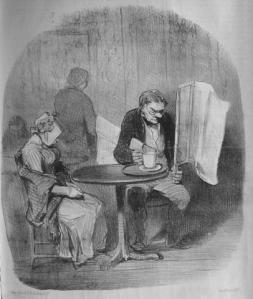
There’s a lovely online exhibition devoted to Honore Daumier’s representations of reading in his work as the kind of grand pere of editorial cartooning. I’m struck by the way in which Daumier represents reading as a
Not now, dearest, I'm Reading
social activity. Of course, there are a number of representations of reading as something that draws people into isolation. As, for instance, this piece on what appears to be man and wife together in a cafe. This seems to fit what I’ve often taken to be the individualistic character of reading in the modern world (and, to be frank, this doesn’t seem all that different from someone sitting at a table texting or reading email while ignoring his wife or girlfriend or friends; reading draws us elsewhere, so all the fretting that goes on about the internet damaging our social relationships may be nothing new)
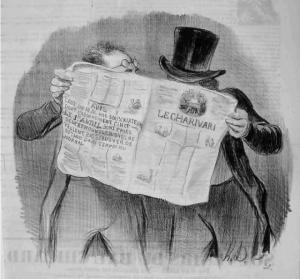
On the other hand, I’m struck by the number of Daumier pieces that emphasize what I would describe as the sociality of reading, the ways in which reading is an occasion for bringing people together. For instance, this piece with two men reading the paper together:
She did What????!!!
There are actually more of these kinds of images in the exhibit, suggesting that reading becomes a kind of occasion for sociality rather than isolation. (Of course, it’s France, right? Hard to know if similar images could have played in Peoria). Still, I’m intrigued by the ways in which reading becomes a social event. I’ve suggested in some of my work in progress that book readers in contemporary society represent a kind of social subculture with a variety of signs and forms of cultural currency. Are you reading, what are your reading, with whom are you reading, where are you reading. All these form a system of signification that allows readers to form a kind of social sub-group within and around their taste for books. Far from being individualistic, reading is a cultural practice with its own distinct forms of sociality.
I don’t use this blog to flack for businesses (I think it’s illegal on WordPress anyway). However, I thought I’d point to this program that Holiday Inn Express helps sponsor that supports Reading is Fundamental. (I’ve elsewhere complained that reading isn’t really fundamental in any precise sense, but who’s complaining).
Too bad I didn’t know that my recent stay at HIE in Philadelphia could have helped the readers of tomorrow.
Side note: The Holiday Inn Express in midtown philly was really an exceptionally nice stay. Great and friendly service, good breakfast, comfortable rooms, everything really close. And they aren’t even paying me to say this.
I am a sucker for brainless Bruce Willis vehicles, but I’ll blame Tears of the Sun on my son, Colin. (Ok, I admit it was my money that rented it). Tears of the Sun falls in to the general time honored genre of films and novels that are set in the context of racial difference but really serve to obsess over the continuing moral drama of whiteness and its discontents. Think Kevin Costner in Dances with Wolves, or Dustin Hoffman in Little Big Man, or Leonardo Dicarpio in Blood Diamond, or for that matter Conrad, Kipling, and Fenimore Cooper. What gets me about these films, and Tears of the Sun seems especially egregious, is that all the moral wrestling with the curse of whiteness becomes, SURPRISE, yet another occasion for championing the moral ascendancy of white people. As if we say to ourselves “Look how hard I’m trying to be good, and humble, and true, and right, and how hard I am trying to atone for past racial sins; I must really be better than everyone else after all.”
Ok, I will admit that I liked the shoot-em-up scenes as much as any good war movie, and overall I can’t complain about the entertainment. But basically this movie was The Searchers (or maybe The Last of the Mohicans) dressed up in anti-racist drag. Bruce Willis and his band of commandos go to save the white missionaries and doctors caught in a Nigerian war zone. Predictably the doctor is gorgeously beautiful (and apparently French, perhaps a gesture toward globalization but more likely a gesture toward cross-national white solidarity), and we know that she and Bruce Willis will sleep together when they get back to base (which they don’t, actually, but we see them fly off together into the sunset on a helicopter. Let your imagination go to work). The film tries to develop a moral drama in which Bruce Willis “does the right thing” by risking himself and his men to disobey orders and try to rescue the Nigerian refugees in the doctor’s charge, one of whom, SURPRISE!, just happens to be a Nigerian prince who is being sought by rebel leaders of the coup d’etat. (The coup d’etat, generally, is a trope for Africanity in the American cinematic imagination). American individualism and rejection of authority becomes the source for global redemption.
I can live with all this since I like a good hokey story as much as the next guy (witness my oft-stated delight in Uncle Tom’s Cabin). But like Uncle Tom’s Cabin, the film’s moral center becomes not really despair that attends a decade long civil war in Africa, or even a meditation on the variously subtle ways in which Western powers have contributed to the violence and instability of African nations. It becomes instead a meditation on the gloriously self-sacrifical superiority of white people. When, at the end of the film, the lead African female actor weepily looks into Bruce Willis’s bloodied face and repeatedly tells him how much God loves him and will bless him, I half expected the Nigerian nationals to pull out their American flags and start singing God Bless America. The film seemed to suggest that moral and ethical choices are occasions for narcissistic self-display. It also struck me as a propaganda piece for American interventionism. Released in 2003, perhaps we were still on the edge of believing that our guns and our good intentions could make the world a better place. Cf Iraq.
These things aside, I still like a good shoot-em-up, and I’m still a sucker for brainless Bruce Willis vehicles. Against all my better instincts.
I found this strolling along the “Freedom Trail” in Boston today, from Benjamin Franklin:
“Experience keeps a dear school, but fools will learn in no other.”
—-Benjamin Franklin
Refreshing for me since American responses to education are so deeply anti-intellectual (even pragmatism– our only real contribution to philosophy–doubts the efficacy of learning. Anyway, experience too often is another name for prejudice, a form of justification that verges on narcissism, believing that if it isn’t true to my own experience it isn’t true at all. The dream of reading, true or false, has at least sometimes included the notion that we can see beyond our own experience into the experience of others, that my own experience may be a starting point, but left in it I am left to my own limitations.
Side note: I have to say I love Boston. I’ve never spent more than a few hours in the city itself, once on a visit years ago after graduating from college, and then a few years ago for an afternoon with my parents. A school on every street corner, it seems. A place where walking is its own entertainment.
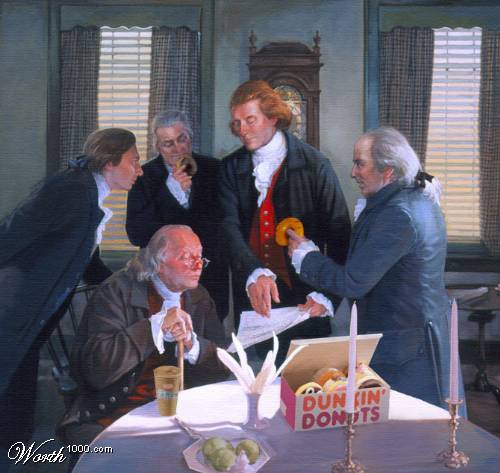
Advent of Revolution
One question, what is the deal with Dunkin Donuts? Did they start here? There are more dunkin donuts than pictures of patriots, and that’s saying something. According to boston.com “there are 1100 Dunkin’ Donuts within a 50-mile radius of Boston. So far as I can tell it doesn’t affect the waistlines, but watch out Boston.
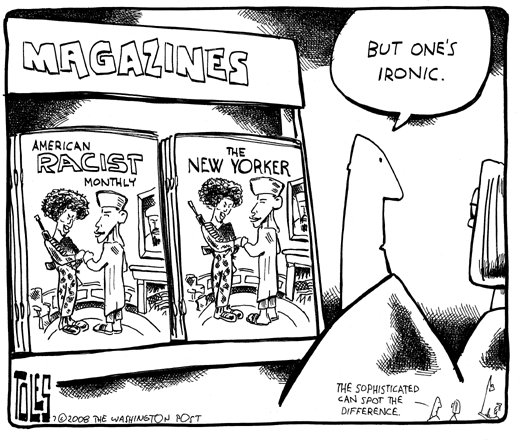
The problem is that the cartoon accurately portrays a ridiculous real-life caricature that exists as literal fact in the minds of some people, and it portrays it in terms that are absolutely true to that caricature. An analogous instance would have been a cartoon without commentary appearing in a liberal Northern newspaper in the 1920s — a time when Southern violence against blacks was unabated — that showed a black man raping a white woman while eating a watermelon. The effect of accurately reproducing such a ridiculous image that dwelled unridiculously in the minds of some people would have been merely to broaden its vicious reach. The adherents of that image would have gone unsatirized and untouched.
In satire, absurdity achieves its rationality through moral perspective — or it remains simply incoherent or malign absurdity. The New Yorker represented the right-wing caricature of the Obamas while making the fatal error of not also caricaturing the right wing. It is as though Daumier had drawn figures besotted by stupidity and disfigured by genetic deficiencies — what might have been a corrupt 19th-century politician’s image of his victims — rather than the corrupt politicians themselves, whom he of course portrayed as swollen to ridiculous physical proportions by mendacity and greed.
But if that very same New Yorker cover had been drawn in a balloon over the head of a deranged citizen — or a ruthless political operative — it would have appeared as plausible only in the mind of that person. The image would have come across as absurd and unjust — a version of reality exaggerated to the point of madness.
By presenting a mad or contemptible partisan sentiment as a mainstream one, by accurately reproducing it and by neglecting to position the target of a slur — the Obamas — in relation to the producers of the slur, The New Yorker seems to have unwittingly reiterated the misconception it meant to lampoon.
Well, Siegel is more literate than I am since I can barely conjure anything at all to mind associated with the name Daumier. Good thing we have Wikipedia. And Google. The internet as a collective memory machine. In any case, Siegel’s point seems not so very far from my own when I said:
We could, of course, satirize the reader of the The New Yorker because the reader is at the scene of reading and so, in viewing the image, would view something grotesquely true about themselves. Instead, the New Yorker cover tries to laugh at someone else without referencing that someone else anywhere in the image. Thus the image seems to be “about” Obama even when we pause and have to say “No, it really can’t be.”
Come to think of it Siegel begins his piece by noting how wonderful it is that the world is obsessed with things normally reserved for literary scholars, kind of like my own notation that I’m thrilled that the world is abuzz with cultural theory. Or not. Is this a case of great minds–in this case my own and Siegel’s–thinking alike? Or is it possible that Lee Siegel is a secrete devotee and admirer of Read Write Now. And could it be a case of internet plagiarism. And does such a thing exist. INQUIRING MINDS WANT TO KNOW!
[Side note: Thanks to Monda over at “Theres just no telling” and to Jon Vaitl at “I have an Idea “for their comments yesterday. Monda, I actually just resubscribed to The New Yorker so I guess I haven’t given up on them yet, though I am tempted. Jon, I don’t actually think irony is always smug. As a literary device irony can depend upon the speaker knowing something that either his hearers or his subject do not, but it can also depend upon readers understanding a doubleness within a discourse that is not self-evident to the speaker. For instance, Satan’s effort to tempt Jesusare ironic because he is tempting Jesus to doubt his status, and also attempting through that doubt to displace Jesus as the central focus of the world’s story. The reader perceives the irony of this situation, however, in noting that Jesus demonstrates his heroism not by overt demonstrations of power, but through the simplicity of resistance. Satan’s temptation becomes the occasion for Jesus demonstrating his strength through weakness, a central feature of the the gospel narratives. Satan does not seem to perceive this, even when the reader does, or can. Similar kinds of doubleness exist throughout Christian stories: Joseph’s being sold into slavery as an act of evil by his brothers and an act of goodness by God; the story of the crucifixion as an act of evil by human beings and an act of love by God. Redemption, in this sense, is always ironic. I’ve wondered whether irony is present in unique ways in the Western World because of the centrality of the Jewish and Christian narratives. Rheinold Niebuhr’s notion of th irony of history might suggest so, but I’m not enough of an expert on how irony functions in non-Western cultures to say with any security.
I’m not much convinced that The New Yorker cover works as satire (more on that below), but I think the guys over at JibJab have another hit with this take on the political campaign.
More later on why I think this works and the New Yorker cover fails, but first I have to say I’m so glad that the world is abuzz with cultural theory! Ok, not so much. But the New Yorker’s ill-fated attempt at satire has the chattering classes hard at work trying to parse questions of genre, reader response, aesthetic taste and various other kinds of folderol. If it was satire, would people get it? If people didn’t get it, could it really be considered satire. Does the message of the image depend upon it’s intended audience as David Remnick
Satire or New Yorker inbreeding? You Decide
seems to suggest it does when he asserts that it’s intended, after all for “Readers-of-the-New-Yorker,” that snooty bunch. But is the meaning of the visual text here determined by the intention of the artists and the reading capabilities of an intended-and-oh-so-sophisticated-audience? In this day an age? When ANY text has no chance of being targeted exclusively at an intended audience because it will immediately be spewed endlessly into the blogosphere. What is an intended audience in such a world?
I’m impressed by the degree to which the discourse has revolved around criticisms of readings and possible readings. Maureen Dowd–I liked her much more when she was being smug and condescending about Hillary Clinton–smirks that obama is prissy and humourless and should just realize that COME ON, everyone in New York knows its just a joke. This seems just like the kind of answer a New Yorker would give, believing as they do, and apparently Maureen does, that the world is their oyster.
On “Saturday Night Live,” a sketch in which Michelle Obama tossed the flag in the fireplace and Barack Obama took off the pinstripes to reveal a flowing white robe would be seen as outrageous — and funny. Print cartoonists, unfortunately, find themselves working in an oxygen-free environment that is increasingly akin to the atmosphere of academia, or PBS. Cable television makes print seem like something ancient and sacred, a rule-bound sanctum fraught with the ever-present risk of sacrilege. Print is becoming a strange land where the solitary reader might easily go astray.
“People say, well, I get it, but I’m afraid that so-and-so is not going to get it,” said a mildly exasperated Remnick.
Which is to say that even as we pride ourselves on our media sophistication, as debunkers and decoders of the visual, we fret about the power of the printed image to circulate beyond the comforting control of television’s continuous interpretation and contextualization. In the age of YouTube — where for the most part we can still laugh at each other and ourselves — we are increasingly becoming print-humor iconoclasts, terrified that someone might be worshiping images in the wrong way.
I can really only go part way with him on this. Do we really think print is sacred. Just the other day in my reflections on Hard Times I was suggesting that we are so super saturated with “print”–broadly considered–that print has lost it’s aura. I think the same applies to the image.
It may, of course, be that a good number of lefties have been holding Obama sacred, and The New Yorker cover doesn’t work for the same reason that jokes about Jesus mother don’t play in the Vatican.
But really, I don’t think the real issue is that all the Obamabots are humorless. I thought the JibJab video was hysterical–and not just because it’s skewers are equal opportunity. It’s because the satire reveals and revels in something that is kind of really true about Obama, who is the subject of the piece. By contrast, the real subject of the satire on the New Yorker cover is nowhere to be seen–and, to be honest, nowhere in consciousness. We could, of course, satirize the reader of the The New Yorker because the reader is at the scene of reading and so, in viewing the image, would view something grotesquely true about themselves. Instead, the New Yorker cover tries to laugh at someone else without referencing that someone else anywhere in the image. Thus the image seems to be “about” Obama even when we pause and have to say “No, it really can’t be.”
This is not a lack of irony on the part of readers, as Remnick and others have lamented. Rather, the image is not ironic at all, playing off a doubleness contained within the image or within the readers’ experience of themselves viewing the image. Instead, it is a kind of postmodern archness which is anything but ironic. Indeed, I think it’s kind of smug.
On the other hand, the JibJab video really does reveal something that’s kind of true about Obama, as much as I love him. If stretched and distorted and made into a grotesque–which is what satire does, witness Swift–then you really feel the truth of the criticism that Obama is just a little too good to be true, and that too good to be trueness depends heavily on a lack of specificity that lets us project our fairy tales on to him. He will inevitable disappoint (witness Dowd’s grouchiness). In this sense, the video becomes not only about something that seems vaguely real about the Obama candidacy, it becomes about us as the viewers of the video (and more specifically as viewers of Obama). We see the truth about ourselves and our fantasies in ways that make us uncomfortable but also make us want to laugh.
None of this necessarily makes me happy, about the New Yorker, I mean. I used to think that The New Yorker was the repository of all that was smart and superior and intelligent in the world. But the guys over at JibJab are way smarter. Score another one for video. Where the smart people are.