Ok, maybe not. Still, Obama has the literary vote all but wrapped up, at least in San Francisco, or at least maybe in the Creative Writing program at Berkeley. Or maybe at least with students hoping to get an A on some other basis than their sparkling prose. I’m sure, however, that the .0000000001% of the electorate who have even heard of Chabon will be impressed with this endorsement.
Chabon’s endorsement–already much pondered over by the press–mainly in their saying, “Who is this guy anyway?” –can be viewed below.
The New York Times today gives a serious turn to all the random speculation that Hillary’s tears—or more precisely, near tears—may have played a role in her victory in New Hampshire.
“Short, emotionally charged narratives — story fragments, of a certain kind — can travel through a population faster than any virus and alter behavior on a dime, they say. Under certain conditions, this behavior is especially infectious, research suggests, and anyone eager to play Monday morning quarterback on the New Hampshire vote should take them into account.
“’Any story that is short and powerful and throws into relief exactly the sort of issues people are thinking about at the moment they’re making a decision can have enormous impact,’ said Francesca Polletta, a sociologist at the University of California at Irvine who analyzed the effect of personal stories on the civil rights movement in her book It Was Like a Fever: Storytelling in Protest and Politics.
“Mrs. Clinton’s emotional reaction to a question about how she was holding up under the pressure was not only genuine, many voters apparently decided, but it formed a powerful response to an incident during the most recent debate, when her rival John Edwards sided with Mr. Obama in a pointed exchange to one of her questions. A mininarrative was born.”
The story goes on to show statistically that more undecided women voters lurched toward Hillary in the immediate aftermath of the debate. I hate to say “I told you so,” but in the aftermath I said that I thought the tears would give an immediate 5% bump to Hillary’s poll numbers, this despite seeing all the discussion among women and having a couple of personal conversations with others who were appalled and felt that Hillary had shown an unacceptable weakness that “put women back.”
You don’t need to have a degree in social pscyhology to understand this. You just need to have an elementary grasp of gender narratives in Western culture, and perhaps to pay attention to your immediate emotional instincts before worrying about what people might think if they knew you were feeling. I felt the pull of those tears. (And I’m not even a woman. Imagine.) Leaning toward Obama, and still leaning I must say, I felt that moment pull me back, and to some degree still pulling me back at least to the degree that I’m still willing to listen to what Hillary has to say.
I still think there’s a double standard in play here, and not the one typically assigned to political divisions between men and women. The sympathy vote for Hillary goes to her because, apparently, people thought Edwards and Obama were ganging up on her. I want to say, “Oh, Boo Hoo.” Edwards’s decision to gang up on Clinton was a political calculation that she had all the money, she had a lot of the establishment power, and if he were to have a chance she would have to go. In other words he treated her like he would treat any other man in the race. But many, mostly women, read it as two men ganging up unfairly on a woman. No doubt this could have been in play. But Republicans were ganging up on Romney because he had all the money, a lot of the establishment power, and he seemed vulnerable and open to attack because of the Mormon factor (a calculation for Huckabee at least) and the flip-flop factor (a calculation for everyone). Now if, as he sat down for coffee with potential voters, Mitt had let his voice quaver the next day about how difficult it all was, do we imagine he would be getting a sympathy vote. Somehow I doubt it, but not from women, and certainly not from men. Perhaps from Mormons and those with money. Or those given to changing their minds.
The reaction provoked by Hillary’s tears spoke to very deep gender stereotypes. I just got done performing the role of Alfredo in Verdi’s La Traviata. At one point late in the opera Alfredo publicly berates and shames the diva Violetta—basically calling her a wanton whore (important difference from the cultured courtesan she actually is). In our staging, during this moment Violetta breaks down in tears. All the men and all the women rush or lean in the direction of Violetta even as they shout Alfredo down.
[Hey, isn’t this a fabulous rendition of me singing one of the most difficult pieces in the repetoire (heh, heh).]
Anyway, it seems to me that something similar happened with at least some significant percentage of the undecided vote in New Hampshire. The combination of Obama and Edwards tag teaming and Hillary’s next day tears provoked a rush of female sisterhood and, probably to some degree, male instinct to protect the endangered female. I don’t know if it was planned or not, but the masterstroke of the Clinton campaign was to turn a feminine stereotype in to a political strength.
Still, all that aside, I am actually really interested in the important role of emotion in this election, and in our lives generally. I actually think it was fine that Clinton teared up, and that Obama gets the citizenry’s adrenaline flowing, if not their hormones. In dismissing Barack as a kid who is purveying fairy tales Bill Clinton misses—and bizarrely so, given his history as a politician—that human beings don’t live by reason alone, or by bread. (Besides outraging the black community–read the blogs, Hillary, the black community doesn’t need Barack to fan anything in to flames)
It’s not just the economy stupid. It’s not just the most rational man or woman for the job. [If this were so, surely Gore would have won in a runaway, the rationalist in me says]. Human beings need to be inspired, they need to be moved, they need to transcend the instrumentalism that dominates their lives day to day and see that such day-to-dayness can be connected to something bigger than themselves. Obama does this seemingly by breathing. Hillary’s tears connected undecided women to some sense of transcendent sisterhood—and, of course, it helped tremendously that the Clinton folks had superior organization in the end.
[Insert huge unjustified conceptual leap of associational logic here]
Ok, well, what does this have to do with English studies? Probably absolutely nothing, I guess. But I’ve been reading a lot lately about the crisis in the discipline, the decline of English majors, the lost sense of purpose, etcetera ad nauseum. There are various things going on here, multiple forms of causation and so forth. Still, I sense a very big disconnect between the normative passions of the profession and the passions and desires of the electorate…er, rather, student body and prospective student body.
Indeed, the idea of talking about the passions of the profession seems to be almost an oxymoron. Isn’t passion the opposite of professionalism? I remember a meeting early in my graduate career at Duke where Stanley Fish said something on the order of “If you think you are pursuing a graduate degree in English because you love literature, you are in the wrong profession.” Well, there is a certain sense in which, as with so many things, Fish is precisely right in this formulation—but perhaps disastrously so.
The professionalism of the discipline functions at odds with the very things that brought people to the discipline in the first place. The profession, seeking the dignity of professionalism and the seriousness accorded academic subjects, necessarily negates the passions associated with literature. Think, for instance, of how readily we talk about having a passion for teaching, and how rare it would be to hear someone at the MLA conference talk about their passion for literature. Good reason for this. We in the academy generally think teaching is for amateurs, and thus something that you can love and be passionate about. Besides the fact that it wins you points with search committees–at least at some schools–whereas being passionate about literature gains you nothing. (“You’re Passionate about literature??? That’s sooo 1950s.”)
Students, however, and prospective students especially in this context, consider our majors not because it will make them better lawyers or middle-level managers, or because they want to be sophisticated cultural critics. In 7 years of running sessions for prospective students I regularly ask them why they are there, why they are even bothering to think about studying literature. In 7 years I have never had a student say even once that they are going to study literature because they want to be a literary critic or literary theorist, I have never once had a student say they are going to study literature because they want to have a dispassionate and philosophical grasp of the semiotic status of nose hair in Jane Austen, and I have never once had a student say they are going to study literature because they hope to study the conflicts in interpretation represented by contemporary cultural theory. Never once. Imagine.
They all say they want to study literature because they love it. Asked why they love it they say because it changed some part of their lives, because it helped them understand others, because it helped them understand themselves, and on and on. All the reasons that we, in our dispassionate dismissing of youthful idealism, have learned to sneer at secretly in our faculty lounges. By some miraculous and unimaginable twist of fate, such 17 and 18 years old had learned to read and get something out of literature and to somehow think it would make a difference to the world if they read more of it. Young people want to be inspired and to be moved, and at our peril I think we’ve dismissed that desire as beneath importance in our quest for professional status.
A couple of examples. As an undergraduate I was a history major and bored to tears by my history profs. Then I had Joe McClatchey, an unknown to almost anyone who didn’t have him as a student or who didn’t work with him at Wheaton College, but the person to whom I dedicated my first book.
Out of Western World Lit I, I remember almost nothing about the books we read (more at some later date on Pierre Bayard’s take on whether books we’ve forgotten can actually be counted as having been read). What I do remember is the day Joe McClatchey showed slides of various satyrs and other vaguely evil beings from Roman mythology. He suddenly shuddered visibly, turned away from the screen, and whispered “Unnatural!” He wasn’t acting. Now, all this is laughable to sophisticates in the current academy. But I was profoundly moved that there was something important to care about in books.
Another day McClatchey was reading Milton describing the fall of Adam in Paradise Lost. In the middle of the passage, Joe McClatchey teared up like Hillary Clinton and said, “I can’t go on.” He closed his book and leaving papers and books behind, fled the room. Again, incredulous laughter from the contemporary sophisticate, but we were all in awe. What it said to me as an undergraduate was, “Wow, there’s something more important going on here than getting a grade, and something more important than taking a class so I can get in to law school.”
Assess that, o ye provosts of the world.
At this stage of the game, of course, we’ve become so sophisticated that we’ve about decided that there is no such thing as “literature” and we have lost an object of critical investigation. May be. But I think we would do better, even in these late days of the English crisis, to recover our first love. To figure out why these things that we can only call “literature” with quotation marks to sanitize our embarrassment, somehow nevertheless move us and change us and teach us, all without and well beyond the teaching that comes from the latest theoretical or critical fad. We need more teachers with a passion for literature, a passion for reading that will match their passion for teaching.
It will, of course, take a great deal more than tears and shuddering to repair the condition of the humanities in the world. But by rediscovering that first love we might discover that our passion leads to conviction, which leads to action and changes in ourselves and in others. We might even discover that students can think that literature rather than our theories about it is relevant to the world.
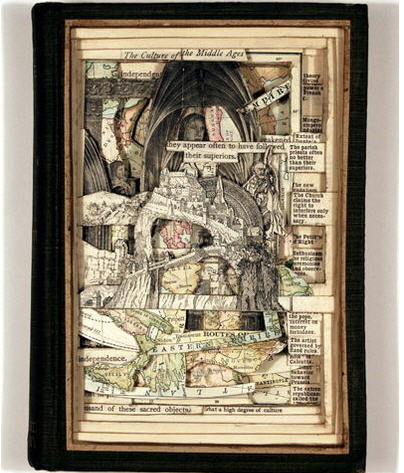
I’ve seen a variety of things like this in recent years, and I suspect to some degree that seeing the book as a form of art is tied to a sense of its demise. As things die, they become works of art, perhaps? The Freudians have already covered this, I’m sure. In the infancy of books, of course, books were also thought of as treasurers to be handled like works of art or other revered objects. Books in general were far too expensive for the masses to obtain, and as a general rule this continued for a very long time. Owning books, as much as reading them, signified your cultural and class superiority. This all changed gradually over centuries after Gutenberg, but changed with a vengeance with the invention of the paperback.
Perhaps now that television and the internet have taken on most of the cultural purposes of the paperback and the newspaper—cheap entertainment and ready information for the masses—books are again left to become objects of art, treasures indulged in primarily by a small coterie of collectors. Strikes me as depressing, just a bit, but I still love these photos.
Leslie Fiedler. Who?
I couldn’t help but notice Scott’s post on Friday noted a new book by the late Leslie Fiedler, whom Scott admits he didn’t know. Alas, how far the mighty have fallen. I used to want to be Leslie Fiedler. He made cultural criticism seem romantic. Now cultural criticism has all the romance of oral dentistry or working at Chic-Fil-a. (Does anyone know why they spell it this way?)
Seriously though, Fiedler was one of the few critics I’ve ever known whose work aspired to and in some instances could be called literary. This despite the much vaunted declarations that criticism and theory were literary genres, these made by literary theorists who could not write. Roland Barthes, who I think came up with the idea, also comes close to this ideal in some of his work. But declaration is not achievement. Fiedler and people like Barthes—Fiedler more than Barthes–are to be thanked for showing us that cultural criticism could actually care about and love language, that how it communicates can mesh with what it does communicate.
Clintons continue attack on literature…er…Obama.
By now, I guess, everyone has heard that Bill Clinton and hip-mate Hillary Clinton—or is it the other way around—got in trouble for deriding Obama as a purveyor of fairy-tales and fantasy. In some future post I think I’ll take up the idea that the Clintons who once represented the hopeful face of baby-boomerism, now represent the craggy and toothless grin of what to expect as baby-boomers start using canes and walkers. “No hope for you, people, you silly and naïve young whippersnappers.” My general sense is that the Clinton approach demonstrates again and again that they are part of the system, so broken by it that they have to replicate it, like dogs licking the hands of an abusive master. Trouble is they may be right. Systems persist for a good reason, the gradually wear down the hopes of those who would change them and they are impervious to appeals from those outside their own logic. The smart money still goes with Clinton, but for the moment I feel like I’m still young enough to hope.
But my real issue with all this is the Clinton’s perfidious campaign against the imagination and literature. (Beware those who use the term “perfidious” wantonly). As I pointed out in earlier posts, Clinton has all the literary imagination of a manual on how to fix my furnace. Hillary works too hard to have time for literature. Now they are using a perfectly wonderful and culturally important literary form as a derogatory epithet. As Vladimir Propp could tell them, fairy tales make us what we are.
Do those of us who are reading for our lives, an increasingly aggrieved and marginalized minority who must struggle against the glass ceiling of…well, something I’m sure…set in place by the billions of non-readers in the world, really need the Clintons piling on with their anti-literary epithets?
I think enough is enough. We need to stand up against unthinking and derogatory stereotypes of reading culture.
In the final 24 hour run-up to Hillary Clinton’s victory this evening, seduction was in the air. Literally, actually, as a word used in repeated reference to Barack Obama by Clinton supporters interviewed in the street. I somehow remember Hillary herself or someone from her campaign using the word, but it may be a false memory. I can’t find a reference anywhere on the net, in any case. This a different kind of jab at Obama’s eloquence than those I’ve noted over the past couple of days, but one still freighted with gender and the politics and history of race in the United States.
Just out of curiosity, I googled “Barack Obama” and various versions of the word “seduce.” Seduction, Seducer, Seduced. I came up with about 70,000 instances. Discount the ubiquitous advertisements for sex aids and dating services and you’ve still got a healthy discourse of Barack Obama, the seducer of our political souls.
According to one news service, “Obama woos women,” and describes Obama as “not just attracting scores of young voters, but also seducing women and independents ahead of Tuesday’s primary.” A blogger on the Huffington Post tells us the that “The mere idea of someone who can write (and presumably therefore think) in a complex yet compelling fashion is almost irresistibly seductive” .
Main stream news outlets use the term, and the discourse extends overseas. The Brits especially seem a bit dismayed by Obama’s overly sexualized politics. The Economist says that at a typical campaign rally “Mr Obama eventually moseys onto the stage and starts massaging the crowd with his seductive baritone.” Barack Obama, political call boy.
(And “moseys”? Do the Brits even know what “mosey” means? Having grown up in Oklahoma where people really do mosey, I can testify that Obama does not do mosey. My general sense is that Kenyans, Hawaiians, and Indonesians–the cultures which Obama grew up around–don’t do “mosey.” Chicago? I have my doubts.)
What role is the representation of language, especially as it plays out in relationship to race and gender, serving in this campaign. The emphasis on Obama as a seducer makes his eloquence—his greatest political asset—a net negative. The seducer, almost always a man, uses language to deceive others, almost always vulnerable women, for his own nefarious ends. The image of Obama as seducer in some ways “hypermasculinizes” his use of language, over and against the femininizing implications of using flowery rhetoric that I parsed yesterday. In either instance, though, language, especially as used by a man, is empty and suspect.
There’s a long tradition of being suspicious of language in the West. Satan was, if nothing else, a good rhetorician. In the American context, the Puritan plain style that dominated American letters from the Puritans to Hemingway and on to latter day inheritors like Raymond Carver was deeply suspicious of ornament and rhetorical figure. This tradition was, in practice, deeply masculinist. The real man, like Raymond Chandler’s heroes, used words sparingly if at all, and the words he used were to be direct and to the point. Girls, by contrast, talk too much and use language too well.
The figure of the seducer, then, embodies an interesting conflation of hypersexualized masculinity and a failure of manliness. I say “failure” both because the seducer depends upon language–a “feminine” and suspect tool–and also because the purposes to which that language is put fall short of various images of manly integrity.
The portrait of Obama as a seducer leaves me a tad uncomfortable in terms of the discourse of race, especially as it has been applied to Obama’s appeal to young white women. In some ways Clinton has positioned herself as the maternal protector of the virtue of the nation, and of women especially, sounding cautionary notes to all those wayward and impressionable young 18 to 30 somethings who are in danger of being swept off their feet, swooning in the arms of a grinning black lothario.
I suggested yesterday that Obama’s literary persona blunted fears of a black male planet; but it is intriguing to me how the rhetoric of seduction plays in to and enhances those very same fears. In the New York Times yesterday, Gloria Steinem all but explicitly cast down the challenge to white women to stand up to the black male threat—pointing out that black men have always gotten ahead before women.
The specific of race, class and gender make Steinem’s claims dubious in themselves. Look at things like the life expectancy or class status of white women and black men and ask whose shoes you’d like to be in on average. More, Steinem conveniently glosses over the fact that many white feminists in the nineteenth century actively opposed black male enfranchisement on the basis of racial superiority. I don’t think Steinem goes quite that far, but I don’t like the smell.
The image of Obama as a seducer may not be being actively promoted by political operatives. It may even be true. And I’m not sure it has had that much of a political effect. Clinton won because she worked hard–as is her wont–and because New Hampshire voters troubled by the economy thought she would do a better job. Not, I think, because she mocked Obama’s use of language.
I was pretty harsh on Hillary yesterday and today she goes and cries. I’m sure there’s a connection.
I’m fascinated by the media’s decision to say that she didn’t cry; her eyes merely filled with tears. (What? They are going to zoom in on her face and, if one of those brimming tears falls, suddenly she’s weak?? ) Somehow too, this made her miraculously human for the reporters in the room. I’m not mocking it. I felt it too. After 35 years of hard work it finally seemed like maybe it was just a little too much. Indeed, I was appalled that some in the media questioned whether the tears were pre-planned. Probably a reflex action from a campaign that has seemed buttoned down and machine-like from the beginning. I suspect she’ll get a five point bounce in the polls. Not to be cynical about her tears, but this is the kind of thing that was missing from her candidacy—the sense of spontaneous humanity that Obama pulls from the air with the greatest of ease.
In a just world, perhaps hard work would be all that matters. Not our world, I’m afraid.
Picking up on yesterday’s post, I’m also struck by the way this stuff is so thoroughly gendered. It is almost absolutely impossible to imagine Obama getting away with tears in reflecting on how hard it is to campaign. Or even the brink of tears. We could forgive Edwards if he got brimming eyes while talking about his wife’s cancer, and probably even if he watered up while talking about a young girl who couldn’t get a liver transplant. But if he started dripping over how hard it is to fight the fight, you can be sure his fight would be over. Hillary, of course, doesn’t have it easy; she’s expected to be hard and tough and a man among men, but she’s also got to be soft, got to reassure us that she hasn’t lost the woman within even while she’s going toe to toe with the bad guys. Tears do it for her.
Men would not be forgiven it, as Ed Muskie wasn’t. Men have to show their humanity in different ways. By playing bass guitar for a rock band at the local bar. By reading books that suggest depth but not weirdness. By hunting for geese in Iowa in below zero wind chill.
Let it be said now. Barack Obama channels Walt Whitman.
Nevertheless, something there is in a political woman that doesn’t like poetry in a man. MSNBC reports today that Hillary has chosen to attack Obama by mocking his eloquence. She’s been stumping in New Hampshire, saying “You campaign in poetry, you govern in prose.” One of many jabs that Hillary uses to demonstrate her superior manliness to Obama and his fluff, the quote comes originally from Mario Cuomo. Another Clinton favorite: “I’m a doer, not a talker.”
May be. Though it does seem to me that Hillary is a little tone deaf on this one. She is, after all, campaigning and not governing, as if she has forgotten that she has to campaign after all. I’m also not so sure it’s a wonderful move to deride the citizenry for having false hopes. (Who does she have writing this stuff?) All of this is of a piece of Hillary’s general effort to demonstrate that she has the cojones to be president. And that her own cojones…among other things…are a lot bigger than Edwards or Obama.
Indeed, I was fascinated with the way last night’s debate among the Democrats degenerated toward a variety of male stereotypes—as if we can’t get past the masculine image even at this moment when the stereotypical image of masculine leadership seems to be less stable than ever.
In one corner, we had Edwards the pugilist, who seems bound and determined to be fighting everyone and everything. “You can’t nice these people.” Another jab at Obama’s apparently suspect masculinity. I wished someone would give Edwards some valium, or else a good book to read. In another corner we had Richardson the affable elder statesman (who, in my estimation, pushed himself a notch closer to the vice presidency). Clinton played the hardnosed greybeard realist with her nose to the grindstone. She’s apparently been working non-stop for 35 years. Does it occur to her that when she says this most Americans say “Why don’t you take a vacation. I would. In fact, I’ll be glad to give you one.”
Which left Obama to be….What?….again, something that seemed new, that didn’t seem to quite fit in.
Still, I’m getting far afield from my original purpose. I’m intrigued by the role that literary metaphors are playing in the political campaign so far, and especially in Hillary’s latest attacks. The Huffington Post had a much quoted blog a few weeks ago to the effect that Obama was poetry and Clinton was prose. Hillary’s attack picks up on this dichotomy and falls into typical masculine stereotypes that men who like poetry are just a little too effeminate for comfort, at least for political comfort. Hillary’s attacks called to my mind Maureen Dowd’s skewering in the New York Times of John Kerry in two different op-ed pieces because he not only read but also wrote poetry. Didn’t this signify somehow, Dowd seemed to imply, that Kerry was too unreliable, too unserious, or at least not serious in the right ways, to play with the big boys. See June 8 2003 and March 7, 2004 in the New York Times.
Picking up on my post from yesterday, I’m intrigued with how the candidates use literature as a means of communicating something about themselves, and whether what they reveal about their literary tastes and interests says anything about them. I went on the respective candidates’ Facebook pages to see just what it said about their literary interests.
About Hillary I discovered….zilch, zero, nada. Indeed, Hillary’s Facebook page offers absolutely nothing about her personal interests at all. As if in playing out the traditional masculine split between public and private, she has to absolutely deny that she has any personal interests whatsoever. Or maybe it is just that her personal interests only extend to becoming president of the United States.
Of all the candidates, Obama’s is the most extensive, the most diverse, and the most dominated by literary texts. He names Moby Dick, Toni Morrison’s Song of Solomon, The Tragedies of Shakespeare, Taylor Branch’s biography of Martin Luther King Jr. Parting the Waters, Gilead by Marilynne Robinson, Self-Reliance by Emerson, The Bible, Lincoln’s Collected Writings.
My God, the guy actually reads. I mean, I have no doubt that these pages are massaged and picked over by staff for the kinds of messages that might be sent. (More on Mitt Romney’s choice of Huckleberry Finn—an apparently quick correction from an earlier choice of a novel by L. Ron Hubbard that earned guffaws from the blogosphere last year– and Mike Huckabee’s choice of The Holy Bible in another day or two). But Obama has to have actually read this stuff, and he has to actually read books for his own interest. Having read Gilead by Marilynne Robinson not only helps him with the literary crowd—he doesn’t really need the help, they’ll mostly vote for him anyway—it also helps him with moderate and educated evangelicals who found Robinson’s novel immensely complex and moving, testimony yet again that the connections between literature and religion are hardly dead. They’re just quiet.
By comparison, I guess I was disappointed at the fact that Hillary didn’t list anything at all. I dug around for awhile—unscientific word searches on Google—and finally found a reference at the NEA where Hillary suggests her favorite book as a child was “Goodnight Moon.” A lovely choice. I read it ad nauseum to my kids, but am now far enough removed from the cuteness that I get warm fuzzies at the sound of the title.
Has she read anything since? She did not list a favorite adult book on the NEA. I also just found a blog on the same topic at Huffington Post that says Hillary chooses Little Women and The Poisonwood Bible. However, I can’t find anything else readily available that confirms these choices. Still, I think they are worthy choices if true. John Lundberg finds them too predictable. I’m not sure that I agree but they do suggest a certain prepackaged quality of control and safeness to me. The bitter attack on fundamentalism in the Poisonwood Bible won’t win her fans with the hardest core of fundamentalists, but, again, they wouldn’t vote for her anyway.
I admit to disappointment in having to dig so hard to find out anything about Hillary’s literary tastes. Whereas Obama strikes me as a person to have in your book group. What a great conversation that would be after eight years of a president who can’t be bothered by literature. Too much nose to the grindstone for the imagination to have much play for Hillary. Somehow it says something to me that Obama is presenting himself as a literary man while I have to dig and dig to figure out if Hillary reads anything other than the bible she apparently carries with her everywhere—and which still does nothing for her with the biblically literate electorate.
Still, I’m wondering if Hillary’s graybeard, workaholic, no-time-for novels, approach to this political campaign will really win out in the end. America famously honors novels more in the breach than in reality. Real men—and Hillary in some ways has to prove that she’s man enough for the job—have no time for literary folderol. Obama’s depth and complexity run the risk of seeming, well, wimpy, something both Clinton and Edwards have keyed in on.
I’ll take a risk here and say that Obama can get away with it because he’s …black. Odd leap, I realize, but bear with me. In white America’s racial codes, black men are portrayed as hypermasculinized, all body and no mind. There’s a lot of scholarly material out there on the historical fears that white Americans have of black American masculinity (I’ve drawn on some of this and use it in my book on masculinity and religion in the Harlem renaissance—freely admitting that “book” is a hopeful word for the 400+ pages that now sit in my computer, just starting as we are to sniff around for a publisher). Obama’s literariness and his lyrical eloquence serve to humanize him for a white audience that, while improving, is not so very far removed from the appeals of Willie Horton ads. Henry Louis Gates, after all, has pointed out that historically blacks used literacy—the ability to read and write literature—to demonstrate their full humanity to white audiences. I don’t think it’s a great leap to say that Obama’s literary card softens residual white fears of a black male planet.
Obama’s poetry, his admirably diverse literary interests, serve the purposes of showing him once again as a uniter, someone who brings all things together. He brings black and white together. He brings Herman Melville and Marilynne Robinson and Toni Morrison and Shakespeare together. He brings male and female together. He brings his hard political and his soft literary sides together.
Obama’s literariness strikes me as genuine and authentic—though I realize that in this day and age even authenticity is pre-packaged. His literariness quite clearly matches and even enhances his political imaginary. Obama’s literary “softness,” deadly to men like John Kerry and John Edwards–and perhaps deadly, too, for political women like Hillary Clinton–plays to the idea that he can be all things.
He is large. He contains multitudes.
He too sings America.
Side note: I’ve added Liz Laribee’s blog, peaceamillion, to my blogroll. Liz is one of the funniest, and best, young writers that I know. Of course, I don’t know that many young writers. Sorry, Liz. The truth will out. No seriously. Everyone should go delight in Lizworld.

 Peter Kerry Powers