Tag Archives: Books

Reading as Mapping: Or, Who are the Well-Read? And Does Anyone Really Care?

My son is a seventh grader who plays up a grade on an eighth grade basketball team. They make the Bad News Bears look talented. I was talking with a friend whose daughter plays on a high school team that’s also been struggling, and I asked him if it was as bad as our eighth graders. “Worse,” he said, “because at least there’s hope.”

How true. With absolutely low expectations and little hope of victory, we can be thrilled when the eighth grade boys manage to keep the game within 30 points. By contrast, our boys’ high school basketball team has lost a dozen games by less than five points, and the girls’ team has played well below expectations, their dismal records depressing by virtue of what might have been.

I feel a little bit the same way about Pierre Bayard’s How to Talk About Books You Haven’t Read.Despite my disparagement of Bayard in yesterday’s post, it’s fair to say that Bayard has 15 pages of very provocative insights. But his tendency to extend them to absurd extremes, to make mind-bending leaps of illogic without sufficient evidence, and his willingness to bury those insights beneath pages of mind-numbingly dull and uninventive reading—to say nothing of his generally flippant tone—leads me to dislike the book all the more despite the important things it might have to say. What might have been, I want to say. What might have been.

For me, Bayard raises the question of what we must mean when we imagine being well read—a class of persons that seems increasingly rarified and relatively unimportant, but which bears a residual level of cultural respect, if not capital, in any case. In America, the Well-Read are something like the British Royal family: ceremonial but without any real power.

Bayard points out that given the tens, the hundreds, of thousands of books that we could possibly imagine being worth reading, there is some literal sense in which all of us will have always read almost nothing at all. He tells the story from Robert Musil’s Man Without Qualities wherein the hero walks through a library of 3 and a half million books and realized that, were he to read a book a day, he would have to live ten thousand years to read them all. I am reminded of my favorite professor in college, Joe McClatchey, whom we saw walking across campus one day, a troubled look on his face. Asked what was wrong, he said with some intense sadness that he had just realized how many great books there were that he would never have the chance to read.

I am reminded of Thomas Merton’s dictum for Christians that in comparison to the love and wisdom of God, Christians must begin each day realizing they are starting over as infants. None of us is ever really well-read in this quantitative sense, and so being well-read means something other than or different than “reading everything” or even “reading a lot.” It has nothing, in fact, to do with an amount of reading whatsoever.

The traditional canonical arguments would suggest that it means reading “the best” that has been thought and written, while canonical revisionists would, of course, seek to change or alter what is contained on this list of “bests,” or else challenge and change what is meant by “best.” I am unimpressed by this quest for the right list of “bests”; even were we to agree on what the category entails, it seems to me there are too many very good books out there to read, even in the relatively narrow field defined problematically as “literature”–leave alone philosophy, history, theology, social theory, and etcetera–for us to ever imagine something like a comprehensive literacy.

Bayard takes things in an intriguingly different direction. Being well read is not a matter of what you read at all. Being well read is not a matter of assimilating a particular number of titles. Indeed, for Bayard, being well read has nothing to do with reading particular books at all. Instead, being well read is a function of understanding the relationships between books, an understanding that, once mastered, allows someone to place books with only the most cursory understanding of their contents.

To some degree with is a literacy of location—thus the title of this blog, reading as mapping. To read a single book is a little like examining the details of a single city block. I could read a hundred different titles on a great books list, but if I am only wrapped up in the reading of individual texts, what I will come away with is an intimate knowledge of 100 different city blocks.

For Bayard, by contrast, being well-read is not achieved through the intimate, rigorous, and close reading of discrete texts, but through understanding the map of texts, the way texts and their properties fit together, cohere, differ, contrast. As Bayard puts it:

“As cultivated people know (and, to their misfortune, uncultivated people do not), culture is above all a matter of orientation. Being cultivated is a matter not of having read any book in particular, but of being able to find your bearings within books as a system, which requires you to know that they form a system and to be able to locate each element in relation to the others. The interior of the book is less important than its exterior, or, if you prefer, the interior of the book is its exterior, since what counts in a book is the books alongside it.

“It is, then, hardly important if a cultivated person hasn’t read a given book, for though he has no exact knowledge of its content, he may still know its location, or in other words how it is situated in relation to other books. This distinction between the content of a book and its location is fundamental, for it is this that allows those unintimidated by culture to speak without trouble on any subject” (10-11)

Before questioning this, I want to affirm how very true it really is, and how important it might be for thinking through what we might mean by cultural literacy. I am often poignantly struck by students who come to me for a list of books they ought to read. I always tell them, read authors they like, and then read what those writers liked, and then read writers who liked those writers. I’m not quite saying the same thing as Bayard, but I am trying to suggest to students that reading a particular list of books is not going to be that helpful.

I think Bayard pushes me a little further here in making me see that I’m also trying to get students in to some kind of system of relationship between texts. Who influences whom, and why does it matter. This is one way of mapping—probably not a very good one. What professors know that students do not are not just individual texts. What professors know is how to read the maps of texts that students don’t even really comprehend exist. The championing of “native knowledges” and reading preferences of students as is common in some pedagogies is of limited use if we don’t see that we are leaving students impotent in understanding how maps of reading work in culture. How can they map their own preferences on to the map of literature—or, how can they challenge whatever maps currently exist.

In a particular sense it seems to me that what Bayard is doing is applying the insights of structural linguistics to the world of books. Imagine each book as a word. Understanding the word by itself is not important, and indeed, if a person only knew one word we justifiably and correctly call such a person an idiot (clinical definition, a person who can do only one thing or speak to only himself—kind of like writing this blog).

However, the structural linguists rightly point out that the meaning of any word is only functional within the entire system of words, and that it is important to understand the shape of that system, that discourse, in some ways more important to understand that than to understand discrete words themselves—a logical impossibility in the thinking of structural linguists since there is no word “in itself”. To apply a Wittgensteinian take on this rather than a structural linguistic take, we rightly note that the meaning of a word is in its use. We can often determine or broadly guess the meaning of a particular word we have never heard before by hearing the word in use, in a particular context. And in any case we come to understand a word not by getting definitions but by learning how the word is put in to use in the systems of language.

Bayard is saying something very similar about what it means to be culturally literate. Cultural literacy is not the grasping of lists of facts or texts—as E.D. Hirsch or Allan Bloom would have had it back in the 80s. Literacy is understanding how the system of books work so that, even when we have not read a particular book, we can determine without too much trouble its general place in the system of books as a whole.

On the whole, I think Bayard underplays the significance of reading particular texts, and the particular kind of sophistication that come through these local knowledges. Bayard’s assertions that it is more important to know the map than to have visited the locations on the map, bears a certain truth. But it’s not clear that a person who reads a map, but who has never seen a mountain or who has never walked through a city block, or who has never viewed the sea, can properly be said to understand a map at all.

Imagine a person who grows up in a closed room and is taught only to read maps, and he becomes thoroughly familiar with maps and the relationships between them. It’s not clear, however, that such a person can really read a map if, when taken out of his room, he cannot recognize a city street. Instead the person is merely reading hieroglyphics without any sense of the relationship of those hieroglyphics to the cultural life in which they are embedded. In other words, a certain level of extended close reading is necessary for the reading of book maps to make any sense at all. Reading of individual books is necessary to the possibility of reading maps in a way we simply take for granted. On the other hand, this having been said, it’s not clear we can really understand our own geography in the fullest ways possible, without understanding the ways that geography is related to other geographies.

In other words, we need to both read the maps and walk the streets. The relationship between the two elements is far more dynamic and interactive than Bayard seems to allow. The knowledge of individual books is only coherent by understanding how to map the book to a particular bookish geography. However, maps only make sense to us at all if we have some knowledge and understanding about at least some, and preferably many, individual books. We can only understand relationship through understanding things being related. Relationship itself, as Kierkegaard well understood, is the most abstract and insubstantial—yet unavoidable and necessary—of philosophical concepts. To get at the ways in which books relate, we have to grasp at least some things of book themselves.

Many more things to say here, but I think I’m going to stop for the night. Two main things on my mind. One, I think the multi-ethnic canon wars have often been fought over lists, and have thus been only marginally effective in challenging the most important thing: the way books are mapped. While we read a few new books, we mostly haven’t changed our understanding of how books relate to each other. We haven’t changed the map; we’ve just added heretofore-unacknowledged trees and rocky outcroppings, while leaving the basic contours of the geographic spaces of literature untouched. Second, and it might be related, but I’m not sure. I think we still do a better job of communicating to undergraduates the importance of the close reading of discrete texts than we do the importance of relationship between texts. Students come away with a strong sense of reading, but not a strong sense of how to map books in their experience.
Pierre Bayard, Guiltless: Or, Why do French Intellectuals Sound Like Clever American Adolescents?

I’ve finally finished reading Pierre Bayard’s How to Talk About Books You Haven’t Read, and thought I’d talk about it, perhaps for the next couple of days as I think through it.

The first thing to say is that every element of the sentence I just wrote is nonsensical in Bayard’s understanding of reading.

First, one can never really claim to having finished reading a book since, in fact, we don’t actually read books in the first place, though we sometimes fool ourselves into believing that we do. Bayard goes to great lengths to point out that every act of reading is foremost and always an act of forgetting; even as we turn the page—indeed, even as we leave one sentence behind for another—we engage in a gradual process of forgetting most of the details of what we have read. What we retain is not so much the book as an image of the book that corresponds to our general sense of books as such, of the vast panoply of possible and actual books in their real and imagined relations. Every book we have read is, in some fashion, an act and creation of the imagination. We, therefore do not really finish books so much as we use books to engage with this great library of the imagination that lurks within.

Second, and following on the first thesis, I could not really claim to have read Pierre Bayard’s book since in Bayard’s conception we do not really read things that are exterior to ourselves, and we fall in to desperate traps when we let books lead us into thinking that we do. He is much taken in the beginning and end of his book by Oscar Wilde’s great essays “To read, or not to read” and the seminal “The Critic as Artist”–essays that Bayard seems, against the implications of his own theory, to have read closely and been affected by deeply. For Wilde, of course, criticism is not so much a secondary act of reading a prior text as it is an independent creation more on the order of autobiography. (Side note: Bayard would be much intrigued by my use of the phrase “of course” in the sentence just finished) Thus, in spinning out these musings on Bayard, I am in fact engaging more properly and obviously in an extended act of autobiography than in any actual reading of Bayard in and of himself. To some degree this is Roland Barthes lite, especially in his essay “The Death of the Author” wherein Barthes champions reading not as an engagement with the prior authority of an author but an act of creation that celebrates the creative capacities of readers.

Third, and following on this second point, I could not really be talking about Bayard’s book, though, of course, I may fool myself into believing that I am Instead, we are always only talking about books we haven’t read. Much in the spirit of Stanley Fish’s discussion of free speech—There’s no such thing as free speech, and it’s a good thing too—we hear Bayard saying. There’s no such thing as reading books, and it’s a good thing too.

Finally, if all this is true, I cannot really be thinking through Bayard’s book since I will mostly, in fact, be thinking through the activity of my own imagination in the first place.

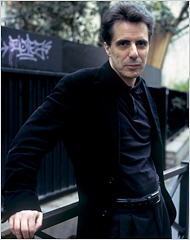
[A pic of Pierre Bayard looking like an insouciant American teenager. No, wait, it’s a photo Pierre Bayardof an American teenager attempting to look like an insouciant French intellectual. No, wait, Bayard attempting to reflect the idealized image American adolescents have of French intellectuals. No, wait….]
There’s a lot to say about Bayard’s book—or rather about the play of my own imagination—and I hope to get to a few of them over the next day or two. But the first thing I want to note is that though this book has been a splash in the United States, it is a thoroughly French book. In saying this, I am exercising one of Bayard’s dicta that understanding the place of a book within the universe of books is more important than reading it. Be that as it may, it seems to me that this book is more important for the French than it is for Americans, but if this is so, how should we account for its popularity, or at least its press, in the United States.

First, what do I mean by the statement that it is a thoroughly French book? Witness Bayard speaking somewhat self-indulgently of his own courageousness in facing down constraints against admitting the real character of our reading.

“The first of these constraints might be called the obligation to read. We still live in a society, on the decline though it may be, where reading remains the object of a kind of worship. This worship applies particularly to a number of canonical texts—the list varies according to the circles you move in—which it is practically forbidden not to have read if you want to be taken seriously.

“The second constraint, similar to the first but nonetheless distinct, might be called the obligation to read thoroughly. If it’s frowned upon not to read, it’s almost as bad to read quickly or to skim, and especially to say so. For example, it’s virtually unthinkable for literary intellectuals to acknowledge that they have flipped through Proust’s work without having read it in its entirety—though this is certainly the case for most of them.

“The third constraint concerns the way we discuss books. There is a tacit understanding in our culture that one must read a book in order to talk about it with any precision. In my experience, however, it’s totally possible to carry on an engaging conversation about a book you haven’t read—including, and perhaps especially, with someone else who hasn’t read it either. ” (xiv-xv)

It’s possible, of course, to imagine certain narrow circles in the United States where people still feel the obligation to have read, and especially to have read certain texts. However, this surely reflects the educated classes of France far more than the U.S., places where literature still really bears a distinct form of cultural capital. But can that be said of any but the narrowest intellectual circles in the United States? With no apparent compunction, Steve Jobs dismissed the idea of developing an e-book reader, simply on the basis that it is a bad business model. No one reads in the United States anymore, so why bother. This hardly sounds like a man worried about the fact that reading is still worshipped in his culture of reference.

Even with academic circles in the United States, the fragmentation of cultural knowledges means that academics simply accept the fact that they will read a great deal that no one else around them will have read. And the increasingly arcane specialization of literary studies means that even those texts we abstractly share as “Must Reads”–say something from Shakespeare–are hardly shared as forms of cultural capital. My having read Hamlet gets me no points with my colleague who is an expert in Shakespeare—so what, he says, have you read the latest biography theorizing the importance of Shakespeare’s lesbian grandmother? My having read or not read Hamlet gives me no cultural capital with my fellow specialists in African American literature. Haven’t read Hamlet? Good riddance. Americans live in a country where presidents glory in their non-reading and have no shame in their literary ignorance. Indeed, such ignorance can be a badge of honor. The crisis of guilt Bayard pretends to address could only be a foreign crisis of little interest to the actual scene of reading in the United States.

This having been disposed of, the inconsequence of Bayard’s second and third constraints on the American scene must be quite clear. In the United States, we are generally pleased if people read at all, so we could hardly care if they read thoroughly—except for the short and inconsequential spaces of time that students spend within English classes. (Even here, I find most English profs are simply relieved if their students have read the texts at all, much less whether they have read them thoroughly) Finally, of course, we don’t generally talk about books anyway except in very narrow circles that have cult-like characteristics, with the fortunate bonus that they are easily escaped. If I get tired of my book-loving pals in the United States, I can go….well….almost anywhere to find people who think that booklovers are a bit queer, in both the old and new senses of the word.  The guilt that Bayard hopes to rid us of is, in the United States, hard to find.

Why then his book’s splash in all the reviews? I think in part this is because the reviews are the last places in America where people seem to care whether Americans read or not, and where what you have read has some consequence. So Bayard is speaking to that increasingly narrow segment of the American population that bothers to read book reviews of academic books and thinks they are worth thinking about. Secondly, however, the book comes just at that moment when we have had an uptick in media concern with the status of reading generally. While Bayard is attempting to unmask the hidden practices of reading in France where reading continues to carry the force of cultural capital, in the United States he speaks not to our guilt but to our self-affirmation. Oh, we’re not really reading books at all even when we are reading them. Good thing I wasn’t pretending in the first place.

Whereas Bayard’s book functions to unmask an ideology of reading in France, it mostly reaffirms the practice of most 18 year olds in general education literature courses. Haven’t read the book. No problem. Read Spark Notes and bullshit your way through. Bullshitting as a valuable adolescent form of creative self-display.

More later, but first a confession. I haven’t really finished Bayard’s book. I have ten pages to go. I’m wondering why I didn’t follow his advice in the first place.

Miscellany: More Literary Politics, Teleread.org, arbiters of celebrity, Technomyth 101

Stephen King, Kingmaker?

The literary sweepstakes continue. News reports tell us that Stephen King has thrown his very considerable weight behind Obama.

This may be a good thing. Barack’s rather weighty reading list, his endorsement by His Weirdness Michael Chabon and by Her Highness Oprah Winfrey, and his rather stunning eloquence have left him in distinct danger of not being pegged as a “regular guy.”

Given that I doubt Obama is going to be out stomping through a field with a 12 gauge in his hand, it’s probably a good thing that a literary celebrity known for mayhem, murder and mystery has his back. Stephen King is the everyman’s literary favorite, and Obama doesn’t even have to read him. (Personal aside: I think King is one of the most interesting and bizarre self-reflexive writers on the pathologies of writing and reading. I hope to have a chapter on him in the book I am currently fantasizing about).

Teleread makes me a star.

Teleread.org’s David Rothman has proven once again why he is one of the smartest people out there writing about the current state of digital books and literature. Primarily because he gave my blog about the pathologization of solitude and its effect on reading a big plug. My blog stats—not that I pay ANY attention to them–nearly doubled. Nice to get in to double figures (heh, heh).

Seriously though, there are literally thousands of sites out there devoted to books and reading in one way or another, many of them very good. So I have been pretty choosey about what I put on my blogroll—only the things about books and reading I actually bother to read regularly set alongside a few close friends who write about various and sundry. Teleread is, I think, one of the best sites for trying to think through—and listen to others think through—the issues and news surrounding e-books and digital literacy generally. There seems to be a sensible assumption that reading books online is not going away, but the site isn’t clogged with folks I sometimes derisively call digital utopians. There’s an effort to be self-critical, and comments that question ruling assumptions about digital books or internet culture generally are welcome. It’s very much worth a look.

Techno myths go to school.

In his most recent blog, Mark Bauerlein calls attention to the huge gap between the mythology that kids can now basically teach themselves on the internet and the actual facts about kids ability to judge and assimilate online materials. He cites an ETS study that gives a rather grim picture of students ability to sort through the waves of things they find on the net:

The report concluded: “Few test takers demonstrated key ICT literacy skills” (ICT is short for Information and Communications Technology). Only 35 percent of the subjects could narrow an overly broad search properly, and only 40 percent of them chose the right terms to tailor a search effectively. In constructing a slide presentation, only 12 percent of them stuck to relevant information.

Among some other things in the report that Bauerlein doesn’t cite is the following:

When asked to evaluate a set of
Web sites for objectivity, authority and timeliness . . .

– 52% judged the objectivity of the sites correctly
– 65% judged the authority of the sites correctly
– 72% judged the timeliness of the site correctly
– Overall, only 49% of test-takers identified the one
website that met all criteria

Even allowing for some margin of error, it still seems we’re a good ways away from the possibility of doing away with teachers entirely. And of course, this says very little about the ability of students to interpret and assimilate such materials into writing of their own—something that the testimony of writing in intro composition classes suggests might be very dismal indeed.

This speaks again to my general sense that the argument offered by digital utopians that people are reading just as much as ever, they’re just reading on the web, isn’t really an argument, it’s a platitude. We need to be thinking about what students are reading, how they are reading it, in what contexts, and how they put that reading to use. We would then be in a better place to judge what we are gaining and losing by the fact that students are no longer reading or wanting to read traditional long form texts.

In Praise of Shyness, Solitude, and Oppositional Defiant Disorder (And All Other Personality Disorders Associated with Reading): Or, What’s Wrong With Being Disconnected?

A review posted on spiked-online.com, “Humanity, Though Art Sick,” discusses Christopher Lane’s new book Shyness: How Normal Behaviour Became a Sickness. Among other things it appears that Lane discusses the exponential pathologization of the human race at the hands of the American Psychiatric Association, with particular emphasis on the way shyness or a tendency toward introversion has gradually come to be seen as a deviation from human normality.

A couple of excerpts from Helene Guldberg’s review:

‘In my mother’s generation, shy people were seen as introverted and perhaps a bit awkward, but never mentally ill.’

So writes the Chicago-based research professor, Christopher Lane, in his fascinating new book Shyness: How Normal Behaviour Became a Sickness. ‘Adults admired their bashfulness, associated it with bookishness, reserve, and a yen for solitude. But shyness isn’t just shyness any more. It is a disease. It has a variety of over-wrought names, including “social anxiety” and “avoidant personality disorder”, afflictions said to trouble millions’, Lane continues.….

Lane writes: ‘Beginning in 1980, with much fanfare and confidence in its revised diagnoses, the American Psychiatric Association added “social phobia”, “avoidant personality disorder”, and several similar conditions to the third edition of its massively expanded Diagnostic and Statistical Manual of Mental Disorders. In this 500-page volume… the introverted individual morphed into the mildly psychotic person whose symptoms included being aloof, being dull, and simply “being alone”.’ Shyness now allegedly almost rivals depression in magnitude, a ‘sickness’ for which ‘almost 200million prescriptions are filled every year’ in the USA. Apparently, social phobia – shyness – ‘has become a pandemic’, says Lane….

The sad consequence of this state of affairs is that the range of ‘healthy behaviour’ is being increasingly narrowed. ‘Our quirks and eccentricities – the normal emotional range of adolescence and adulthood – have become problems we fear and expect drugs to fix’, Lane writes. ‘We are no longer citizens justifiably concerned about our world, who sometimes need to be alone. Our affiliations are chronic anxiety, personality or mood disorders; our solitude is a marker for mild psychosis; our dissent, a symptom of Oppositional Defiant Disorder; our worries, chemical imbalance that drugs must cure.’

In general this book—at least based on the review—seems simpatico with the recent essay by Eric Wilson in the Chronicle of Higher education (Yes, the essay that I generally dissed in an earlier post, but which I still think was topically interesting. According to Wilson:

A recent poll conducted by the Pew Research Center shows that almost 85 percent of Americans believe that they are very happy or at least pretty happy. The psychological world is now abuzz with a new field, positive psychology, devoted to finding ways to enhance happiness through pleasure, engagement, and meaning. Psychologists practicing this brand of therapy are leaders in a novel science, the science of happiness. Mainstream publishers are learning from the self-help industry and printing thousands of books on how to be happy. Doctors offer a wide array of drugs that might eradicate depression forever. It seems truly an age of almost perfect contentment, a brave new world of persistent good fortune, joy without trouble, felicity with no penalty.

Why are most Americans so utterly willing to have an essential part of their hearts sliced away and discarded like so much waste? What are we to make of this American obsession with happiness, an obsession that could well lead to a sudden extinction of the creative impulse, that could result in an extermination as horrible as those foreshadowed by global warming and environmental crisis and nuclear proliferation? What drives this rage for complacency, this desperate contentment?

I’m not sure that this amounts to a backlash, but anecdotally it does seem to me that there’s been a little more questioning of the notion that we ought to get rid of every hiccup in our emotional well-being. Recently a mother of one of my children’s friends told me they had taken their child off mood-altering medication. The child has responded with new confidence in class and by growing two inches in two months. Re. moods….Maybe there’s something OK about feeling that there’s something askew in a world where men and women are coming home maimed from a foreign war in which they’ve done far more maiming of women and children than our own country would ever politically endure in its wildest dreams or nightmares. Maybe it’s Ok for a teenager to feel that they don’t fit in so well with the in crowd. I think we think every such teenager is on the brink of Columbine. Maybe feeling a little disconnected will lead them to … read books. Hey, maybe it’s Ok to not feel wonderful, and maybe, just maybe it’s Ok to not want to join in with the gang all the time. Gangs, after all, are called gangs for good reason.

For my own purposes, I’m intrigued by the degree to which behaviours often associated with reading fall along the lines of…well…currently defined personality disorders. I mean, read the history of readers from Jean Toomer to Richard Rodriguez to Anna Quindlen. (To Pete Powers, if I had an autobiography out there that anyone would read). We are not, for the most part, the types who are great joiners. I mean, Joyce Carol Oates is one of my heroes. A person who spends her life alone in a room, apparently, about 14 hours a day, doing little more than disgorging words in to a computer.

Indeed, I remember as a college student reading an essay wherein Walker Percy says something like there’s nothing more alienating for a sad and lonely person than reading a book about happy people while sitting on a bus full of happy people. (Actually, I think there is something more alienating in my experience; attending a party full of happy people and not having anything at all on hand to read, not even a book about happy people). By contrast, the happiest thing in the world for such a person is to read a story about a sad and lonely person while sitting sad and lonely on a bus.

Percy didn’t make me want to go out and join a book group. He did make me smile and ask “How did he know?” I didn’t have to be with Walker Percy and share a hot toddy to know I was not alone, less alone than I often feel at parties with people sharing hot toddies. (Which, as I think of it, I never am since hot toddies are from Louisiana and I don’t think they know how to make them in Pennsylvania.)

This leap is full of logical fallacies, but it seems to me no accident that the apparent decline in reading of fiction and of levels of reading comprehension has accompanied the pathologization of solitude in American culture. It hasn’t just been the American Psychiatric Association. It’s been in business with business models that emphasize working groups rather than individual initiative. It’s been in religion and it’s been in the discussion of family values.

(Let me say that although I am a Democrat I nearly became nauseated when Barack Obama, Hillary Clinton, and John Edwards proclaimed in their last debate “We’re all family.” Good Grief. It’s enough to make one think again about John McCain. Anything to escape the cloying grip of politics family style. We aren’t a village or a family. We are a big beast of a country, largely run by a military-industrial complex intricately intertwined with a system of global finance and corporate capitalism that even leading economists admit that they can’t fully comprehend. I would like to believe that our politicians realize we don’t want the country run by our Aunt Joe or Uncle Sue. No accident that John McCain spent five years alone in a brutal cell. He learned something all the joiners may never figure out).

Above all things, of course, the ideology of the internet–with its relentless drumbeat of connection, connection, connection–teaches us that lonerdom is peculiar and worthy of suspicion . Ever faster, ever more omnipresent, ever more inescapable. The compulsion to “friend”–the ubiquitous and sad new verb of our era–utter strangers. Even those that critique the internet as not really connecting us at all—as Lee Siegel apparently does in in his newest book on internet culture—even these critics exalt the ideal of connectedness above all else. Internet connection is bad, not because connection is worthy of thought or criticism, but because the internet purportedly does not provide true and authentic connection and community. Everyone and their mother exalts community and connectedness. What new pill or what technology or what community reading program will get us there? Whereas dictatorships control readers and writers by shooting them, we control them by pathologizing the behaviours that might lead…horrors…to hours spent alone doing God knows what.

Indeed, why read anymore at all to confirm the importance of your own solitude and sadness. Take a pill, you’ll feel better in the morning. Or join a book group.

At moments like this I feel like becoming a back-to-the-lander.

Let it be said, maybe we are too connected. Maybe we need more solitude. Maybe we need more silence without the relentless need to hear (or see on screen) the clattering voices of someone else, as if we are too afraid to listen to the clattering voices in our own imagination.

In this spirit, I have to confess that I am less than thrilled with the advent of bookglutton.com (though, in the spirit of America the connected, I’m planning on joining up), which I discovered on a blog at teleread.org this morning. At Bookglutton, you read books collectively online with others, viewing their comments on every page as you go along. Every book a blog. No longer the absorbed attention that borders on the mystical that we experience in traditional intensive reading, caught up in the alternative world created by another’s imagination. Instead, now, even reading books will be like attending movies where one-third of the audience converses on cell phones, another third texts friends on the opposite side of the theater, and the final third feels compelled to engage everyone around them with their commentary–as if they were afraid they might be sitting alone in the dark.

Am I alone in thinking that there is something pathological about this need to connect? Is it possible that a people who has lost the capacity for contented solitude, or even discontented solitude, who has not learned to embrace its own loneliness, is it possible that such a people is maybe just a little bit sick?

Now that you have finished reading my blog, write me a comment. Please. I am feeling disconnected. And lonely. And Sad.

I think I’ll take a pill. Or find someone to friend.

More, and yet more

I think there’s something about the great sea of information that leaves one feeling perpetually belated. Or at least me. My increasing sense is that EVERYONE WHO IS ANYONE has already been in to books as art and I, like the nineteenth century rube showing up in town who marvels over flush toilets, am playing a pointless game of catchup.

(By the way, did you know that there’s actually a page on the web called “The History of the Flush Toilet.” Ain’t life grand.)

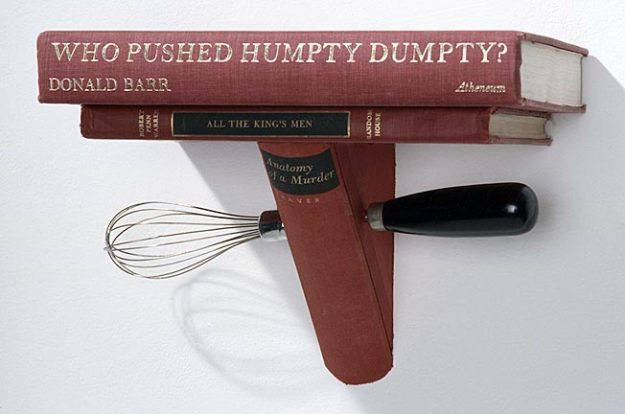
Tiffany Derewal posted a link on a comment, but I wanted to make sure it didn’t get buried. This great page shows the work of Jim Rosenau

A great shot from Rosenau’s page

Humpty Dumpty–Jim Rosenau

Rosenau’s bio page has this to say: “A third generation publishing executive (descended from two generations of Random House VP’s), Jim grew up in a household with over 5,000 books.”

This explains why he has so many of them to destroy.

I may write more later. At the moment I’m reading through Pierre Bayards “How to Talk About Books You Haven’t Read” and remain uncertain as to whether he is a genius or an ass. A certain measure of both , no doubt. More ass than genius. The genius part comes in how he managed to make this thing a best seller. His general advice is that we only talk about books we haven’t read, so I guess I’m disqualified.

Death, the Mother of All Beauty; and also of BookPorn

Ok, a morbid start. Still, I thought I’d recall my post from a few days ago when I speculated on the idea that books become art objects as their cultural life decays. Of course, I forgot that the romantics had already covered the ground where death begets beauty—which is not to say it’s false ground or can’t be re-covered in a new key. I was reminded of the romantics by Eric Wilson’s current essay in the Chronicle of Higher Education, “In Praise of Melancholy.”

One would think that Keats’s life would have fostered bitterness in him, but he remained generous in the face of his difficulties. He didn’t flee to the usual 19th-century escapes: Christianity or opium, drink or dreaming. Though he unsurprisingly underwent pangs of serious melancholia (who wouldn’t, faced with his disasters?), he nonetheless never fell into self-pity or self-indulgent sorrow. In fact, he consistently transformed his gloom, grown primarily from his experiences with death, into a vital source of beauty. Things are gorgeous, he often claimed, because they die. The porcelain rose is not as pretty as the one that decays. Melancholia over time’s passing is the proper stance for beholding beauty.

I thought I might blog more extensively on Wilson’s essay, but it ended up being less interesting than I had hoped. I’m wondering why, for an English prof, he seems so given to the vague and gauzy generalization over the vivid detail or anecdote. Still, credit for reminding me of those romantics. And my title of course is from the ubiquitous Wallace Stevens and what may be the most singularly beautiful poem in the American idiom, “Sunday Morning.”

Death is the mother of beauty; hence from her,
Alone, shall come fulfilment to our dreams
And our desires. Although she strews the leaves
Of sure obliteration on our paths—
The path sick sorrow took, the many paths
Where triumph rang its brassy phrase, or love
Whispered a little out of tenderness—
She makes the willow shiver in the sun
For maidens who were wont to sit and gaze
Upon the grass, relinquished to their feet.
She causes boys to bring sweet-smelling pears
And plums in ponderous piles. The maidens taste
And stray impassioned in the littering leaves.

In the words of the equally ubiquitous Stanley Fish, “Wow. Isn’t that just Great.”

Anyway, I launched into this not to talk about morbidity or about Stanley Fish but to return just briefly to my fascination with books as objet d’art. (I confess I’m not even entirely sure what this means in the Wittgensteinian sense that meaning is in the use. When do you use it? surely somehow differently than “art object” or people wouldn’t say it in French. Or maybe they’re just being pretentious.)

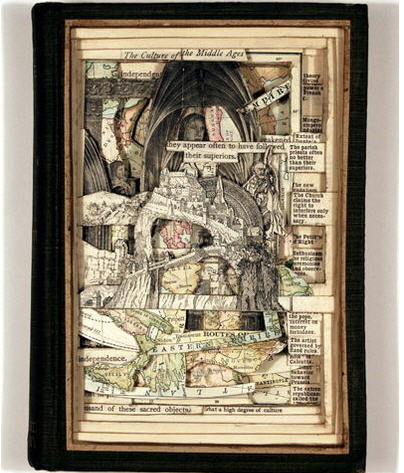
Courtesy of Scott Esposito at Conversational Reading, I again found some absolutely fabulous images of books as works of art at Signonsandiego. The artist, Aaron T. Stephan, has a new show at Quint Gallery entitled “Building Houses/Hiding Under Rocks.” As the website puts it, “he’s converted some 20,000 discarded books into … an artist’s Lincoln Logs.”.

One of my favorites:

Artist Aaron T. Stephan–Building Houses Hiding Under Rocks

Stephan’s website has more of this great stuff. I especially like the wrench made from pages of Immanuel Kant’s Critique of Judgement.

Courtesy of Scott McLemee’s column at Inside Higher Ed about the best academic blogs on the web, I came across Rachel Leow’s site Idlethink, though I think she also calls it A Historian’s craft . Rachel regularly posts her photos of books in a running series she calls BookPorn. These are found objects, I guess—I’m no art historian. A beauty she’s discovered in the everyday display of books rather than in the self-conscious manipulations of the book’s physicality. Still, they fall in with my general mulling over what strikes me as a relatively new interest in the book as plastic art.

One of my favorites from Rachel’s collection:

Rachel Leow at Shakespeare and Co

My good friend Julia Kasdorf has a book entitled , The Body and the Book reflecting on women’s roles as embodied readers and writers, among other kinds of embodiment. Rachel’s pieces and some of the others I’ve pointed to over the past couple of weeks make me think we need a book entitled “The Body of the Book.”

Not that I will write it. I can barely make my way around an essay.

(Sidenote: Rachel also had some helpful hints for blog protocols in using her work. So thanks, Rachel. As I say, I can barely make my way around an essay. So far, blogging is pretty much glorified typewriting with nifty pictures as a bonus in case people get bored. Or in case I do.)

Still, I think there is something very poignant about Rachel’s photos. Seeing these photos makes the heart ache. Or at least a booklovers heart ache. Ok, so I’m weird; they make my heart ache. And I think it is somehow tied to the fact that Rachel’s work and other work like it call attention to the materiality, and thus the fragility, of books.

For us, books have been ideologically tied to permanence. Like the old woman in Stevens’s “Sunday Morning” who can’t stand the flowing by of time, for us books have bespoken our longings for and reaching after an unchanging permanence. Turning books themselves in to art suggest that books, too—and the texts and human knowledge they contain???—are more akin to the beauty sown by death, strewn leaves “of sure oblivion.” All the more so because digital culture is proud of its ephemeral impermanence. Flowing as a position of no position.

There’s a tricky dynamic in Stevens’s world of beauty. It’s not that ephemera is beautiful in and of itself. Indeed, change and movement are only beautiful in the hoped for permanence they suggest and make impossible. Beauty is the shape of our desire, aroused only in the awareness of its fragility and passing.

Perhaps this is why the sight of old books—or any books, rightly rendered–makes me ache. They are the sign of all things.

Miscellany: Books as Plastic Art; Leslie Fiedler; Clinton’s Campaign Against Hope.

Book Sculpture

Many thanks to Scott Esposito at Conversational Reading for pointing me toward this really fascinating page on books as art objects.

A favorite image from the page:

2057160036_ec4b4ef2ba.jpg

I’ve seen a variety of things like this in recent years, and I suspect to some degree that seeing the book as a form of art is tied to a sense of its demise. As things die, they become works of art, perhaps? The Freudians have already covered this, I’m sure. In the infancy of books, of course, books were also thought of as treasurers to be handled like works of art or other revered objects. Books in general were far too expensive for the masses to obtain, and as a general rule this continued for a very long time. Owning books, as much as reading them, signified your cultural and class superiority. This all changed gradually over centuries after Gutenberg, but changed with a vengeance with the invention of the paperback.

Perhaps now that television and the internet have taken on most of the cultural purposes of the paperback and the newspaper—cheap entertainment and ready information for the masses—books are again left to become objects of art, treasures indulged in primarily by a small coterie of collectors. Strikes me as depressing, just a bit, but I still love these photos.

Leslie Fiedler. Who?

I couldn’t help but notice Scott’s post on Friday noted a new book by the late Leslie Fiedler, whom Scott admits he didn’t know. Alas, how far the mighty have fallen. I used to want to be Leslie Fiedler. He made cultural criticism seem romantic. Now cultural criticism has all the romance of oral dentistry or working at Chic-Fil-a. (Does anyone know why they spell it this way?)

Seriously though, Fiedler was one of the few critics I’ve ever known whose work aspired to and in some instances could be called literary. This despite the much vaunted declarations that criticism and theory were literary genres, these made by literary theorists who could not write. Roland Barthes, who I think came up with the idea, also comes close to this ideal in some of his work. But declaration is not achievement. Fiedler and people like Barthes—Fiedler more than Barthes–are to be thanked for showing us that cultural criticism could actually care about and love language, that how it communicates can mesh with what it does communicate.

Clintons continue attack on literature…er…Obama.

By now, I guess, everyone has heard that Bill Clinton and hip-mate Hillary Clinton—or is it the other way around—got in trouble for deriding Obama as a purveyor of fairy-tales and fantasy. In some future post I think I’ll take up the idea that the Clintons who once represented the hopeful face of baby-boomerism, now represent the craggy and toothless grin of what to expect as baby-boomers start using canes and walkers. “No hope for you, people, you silly and naïve young whippersnappers.” My general sense is that the Clinton approach demonstrates again and again that they are part of the system, so broken by it that they have to replicate it, like dogs licking the hands of an abusive master. Trouble is they may be right. Systems persist for a good reason, the gradually wear down the hopes of those who would change them and they are impervious to appeals from those outside their own logic. The smart money still goes with Clinton, but for the moment I feel like I’m still young enough to hope.

But my real issue with all this is the Clinton’s perfidious campaign against the imagination and literature. (Beware those who use the term “perfidious” wantonly). As I pointed out in earlier posts, Clinton has all the literary imagination of a manual on how to fix my furnace. Hillary works too hard to have time for literature. Now they are using a perfectly wonderful and culturally important literary form as a derogatory epithet. As Vladimir Propp could tell them, fairy tales make us what we are.

Do those of us who are reading for our lives, an increasingly aggrieved and marginalized minority who must struggle against the glass ceiling of…well, something I’m sure…set in place by the billions of non-readers in the world, really need the Clintons piling on with their anti-literary epithets?

I think enough is enough. We need to stand up against unthinking and derogatory stereotypes of reading culture.

READERS OF THE WORLD UNITE!

Or something.

Reading about reading about reading about….

I’ve been reading the winter issue of n+1. Smart people, smart and funny writing. I envy their youth. This issue’s take on The Intellectual Situation—a regular feature that’s a rambling blog-like essay more or less focused on a topic, or at least a loosely related series of themes, or united by a sort-of narrative—focused on the reading situation, among other things, noting especially the sudden prevalence of how-to books devoted to reading.

“Self help-style (sic) books about reading reappeared on the publishing scene in the last halcyon days of “Third Way” capitalism—when the world was embracing a kinder, gentler, freemarket as a solution to all our problems, including the problem of universal education. With that memorable 1999 title, How to Read and Why, Harold Bloom completed his transformation from the vatic close reader of The Anxiety of Influence to a lonely crusader against declining standards. In fact, he wasn’t so lonely: Bloom was preceded, barely, by cultural literacy proponent E.D. Hirsch in How to Read a Poem (19999), and he’s been followed, in recent years, by a number of tenured professors and established writers, and even the odd celebrity with time on his hands: there’s How Novels Work, How to Read Like a Writer, the deliberately parodic Ode Less Traveled, Oxford University Press’s Very Short Introduction series, which followed Penguin’s Complete Idiot’s Guide to Shakespeare and American Literature. Most of these now originate in Britain. Even radical-socialist Terry Eagleton has one called, er, How to Read a Poem.

They mention, too, John Sutherland’s How to Read a Novel: A User’s Guide, and the grandfather of this genre, Mortimer Adler’s How to Read a Book. Even then, n+1’s is a necessarily selective list. Others include How to Read Literature Like a Professor, Reading Like a Writer and Thirteen Ways of Looking at the Novel. I’ve just started the latest hot read on reading—or rather non-reading—How to Talk about Books You Haven’t Read by Pierre Bayard, which is a book about, among other things, how to not read a book. I would talk about it, but I haven’t read it yet. I did read the review.

Close cousin to these is a veritably new genre of literary non-fiction that I call the reading memoir, books by baby-boomers narrating the wonders of the books we are gradually leaving behind. Maureen Corrigan’s Leave Me Alone I’m Reading. Anna Quindlen’s testimonial How Reading Changed My Life. The industry that is Michael Dirda.

Indeed, too many to name them all, and these are merely the visible edge of a great tsunami of books on reading over the past twenty years. In fact, a quick WorldCat search shows 70,000 catalogued items published on the subject of reading from 1967-1987. Since 1987 we’ve been enlightened by approximately 105,000 new investigations of our crisis. With the publication of the NEA’s latest report, I’m sure we’ll see another 25,000 or so before the decade is out. I hope my own is among them.

This says nothing about the several million blog pages of persons chronicling their own reading habits, experiences, revelations, etcetera ad nauseum. (Who? Me, you say?) Reading is an industry of its own. Indeed, without the sea of books on reading, one suspects that the crisis in the publishing industry would be much more well-advanced. Anxious readers buy more and more and read less and less in the interest of understanding their own demise. Why, Oh Why?

The easy answer, and only one I have, is that this flurry of reading about reading is symptomatic of the very death of the book that we are gradually experiencing. In Verdi’s La Traviata, Violetta, dying of consumption, summons a last illusion of strength on the fantasy of her own resurrection. Like the diva dying on her sick bed, book culture summons a last illusion of strength by reading about it’s own demise. Reading lists are like bucket lists: great things to do before I die, or before books do. This is too easy, but it does seem to me that how-to books appear at those moments when a once dominant cultural practice moves from being necessity to option. Gardening manuals only make sense in a world where people don’t know how to and don’t have to grow their own food. Books on how to make a cabinet or how to wire a house are only for those who no longer learn it as a matter of course from a father or the guy next door. My favorite among books of this ilk is The Dangerous Book for Boys, which guards against the loss of our boyish past and our electronic future by teaching boys how to play…marbles. Reading books about reading is a sign of reading (at least reading books) having become a practice of clubs rather than a necessity of living. Some day perhaps courses in reading a novel will be offered at my local YMCA along with crocheting and scrap-booking. Oh, wait. They already are.

n+1 mocks the how-to books, rightly it seems to me. But their solution borders on the bizarre.

So maybe—is this a crazy idea?—reading needs to be taught, and taught well, rather than sold. Instead of writing more well-intentioned books, why don’t academics intervene directly in secondary school education? Let’s lend them out to state schools, public schools, and community colleges to teach for a few weeks a year. Morally, this is the equivalent of pro bono work in the legal profession. Let’s reward junior professors for community teaching rather than for publishing articles in academic journals. An extra sabbatical year could be offered, during which professors would work closely with young readers. Maybe this experience could actually change the way intellectuals think about literature. If a certain degree of literacy and appreciation for htte complexity of great books (or just good novels) is as necessary for a healthy and free society as we’ve often heard or said it is, then maybe the only way (not the “Third Way”) forward is a Maoist –style cultural revolution in reverse: “INTELLECTUALS: INTO THE SCHOOLS!”

Um…Ok, I appreciate the idealism. I really do. But…um…could it be any more obvious that the folks at n+1 only hang out with people who have gone to Ivy League or Ivy league wanna-bes, and went to the kind of high schools that got them in there. Or that they are too young to have kids in the secondary schools? Or that they are fundamentally out of touch with the economics of higher education. An EXTRA SABBATICAL YEAR??? I guess they’re maybe thinking that the moneyed interests at Harvard and Yale–the only places that can really afford extra sabbatical year–are going to come riding to our rescue. Chances are the cure would kill us. Maybe they could imagine Harold Bloom coming to their high schools to teach reading, but if Harold Bloom had come to my high school I would have been shooting rubber bands at his rather expansive posterior. Or falling asleep. Most academics have a hard time making themselves understood to one another, and we’re going to put them in high schools to teach 16 year olds to love to read???

Don’t get me wrong, I teach at a college where the focus is primarily on teaching, and I think that balance is about right. And a colleague runs a program at Penn State that gets grad students into the schools to do just this kind of thing with reading and writing. My own college runs continuing education programs for teachers to get them in touch with literary and other disciplines once again. We clearly need more connections between the colleges and the high schools, both so high schools can better prepare kids for what they’ll face in college and to help colleges understand where their freshmen are coming from. But let’s respect the expertise of teaching that a secondary school teacher has developed, and let’s help them as much as we possibly can.

Despite the naivete, n+1 is one of the best things going. Maybe because of the naivete. They haven’t yet joined those of us who are old and jaded by, among other things, too much reading.

Mitt Romney, Untrustworthy Literary Flip-Flopper

With my headline I just thought I’d try out my chops as a writer of currently high level American political discourse.

Seriously, though, Romney needs to lay hold of a literary position and dig in to the trenches rather than pandering to pundit expectations. This past summer the media exploded with disgust and disdain that Romney declared his favorite book to be L. Ron Hubbard’s Battlefield Earth, a book that I confess has yet to make it to the top of my pile but which John Dickerson at Slate says indicates “very deep levels of weird.” Sensing a scandal in the making, Romney—or rather Romney’s “people”—backpedaled quickly, declaring that Romney’s favorite book was really the Bible. As if we didn’t know that. Battlefield Earth is merely his favorite novel.

This seems to have done little to diminish the very high levels of weirdness the blogosphere detects in the choice of overly long fiction written by the founder of Scientology. My guess is that Romney would have done better to choose something that would overcome the Mormon factor, which for many people, rightly or wrongly, also signifies very high levels of weirdness. (On the other hand, anything sniffing of religion strikes many people in the media as highly weird, so this may not be saying much). Still, I don’t think Mitt’s people wanted the electorate going in to the voting booth with the image of the Romney family Bible stacked on the bedside table alongside the Book of Mormon and a novel by L. Ron Hubbard, especially since that novel focuses on the predatory practices of “hairy 9-foot high, 1000-pound sociopaths” called The Psychlos.

In the passing months, Romney and his people have apparently backpedaled yet further. A gander at Romney’s Facebook page now lists a dozen solid, not to say stolid, books with one novel—Mark Twain’s Huckleberry Finn. What Hemingway described as the foundation of modern American literature takes its place on the Romney bookshelf alongside a variety of business leadership manuals and scary books about the evils that face us: jihadism and Thomas Friedman’s flat world. The weirdness factor seems to be tamped down for good (though I admit I tend to find leadership manuals highly weird, my being a middle level manager in an academic institution notwithstanding).

L. Ron Hubbard has gone the way of all flesh. But so, apparently, has the Bible. The Book of Mormon still has yet to show its face and I really think that some intrepid reporter needs to ask Mitt why that may be. Just what, exactly, is he hiding? Religion is represented by Rick Warren’s The Purpose Driven Life. For many politicos, Warren is clearly much safer than the Bible. He is after all “a new evangelical,” which in our current political lexicon tends to mean an evangelical you could bring to fundraiser without worrying about whether you could offer him alcohol. Certainly Warren’s book can be brought up at a Republican cocktail party without raising eyebrows, something you can’t always say about the Bible. Depends on the cocktail party. I’m not sure that this says a lot for Rick Warren, or for how well people may be reading his book, but the image does go along with Romney’s well-coifed hair and perfectly massaged public image.

Last year I wrote a paper, still being revised, where I speculated a bit on the ways people used books to identify with others. We signal our desires, values, goals, interests through the kinds of books we read—or pretend to read—and how and where we read them. But what exactly is Mitt signaling with all this shelf-shuffling? Probably nothing, except that he wants to be president. I was prepared to write a few paragraphs on the peculiar choice of Huckleberry Finn as a boy who stood against the status quo, willing to give up his status and his standing—little as it was—to try and do the right thing. How different and odd that choice seemed given that Romney seemed mostly about status and the status quo. However, I suspect, frankly, that the leadership manuals are Romney’s real favorites and Huckleberry Finn is a book he remembers from his days as an undergraduate English major at BYU.

I actually think Mitt really likes Battlefield Earth, that this literary slip of the tongue was the real literary Mitt before he realized the weirdness quotient could do him in with the 1% of the electorate that actually cares about what he reads. I liked him better because of it. We all have our perverse reading pleasures. Things we get in to against our better natures. This devious pleasure-taking in the alternative world of literature is one of the great things literature affords us. I think of myself as a half-baked pacifist but I can’t get enough of war movies. Heaven forbid, but I sometimes prefer a vampire novel to the latest tome by Don Delillo or Philip Roth. I actually like the fact that Mitt Romney loves shlocky sci-fi novels that have been badly-written by a man a few pancakes short of a full stack. It suggests to me that Romney’s hair isn’t perfect when he gets out of bed in the morning, that maybe when he can’t sleep late at night he gets on a sci-fi chatroom and becomes Megalorg, laser scourge of the planet Kryl-9.

Or whatever.

Makes him human and interesting, a little like Hillary’s tears earlier today.

What I don’t like is that he seems to change his favorites at the first whiff of scandal. Too much like the guy in high school who always seemed to find a way to like whatever the cool kids liked. The guy held in contempt by even the people he calls friends.

Barack Obama Sings America

Let it be said now. Barack Obama channels Walt Whitman.

Nevertheless, something there is in a political woman that doesn’t like poetry in a man. MSNBC reports today that Hillary has chosen to attack Obama by mocking his eloquence. She’s been stumping in New Hampshire, saying “You campaign in poetry, you govern in prose.” One of many jabs that Hillary uses to demonstrate her superior manliness to Obama and his fluff, the quote comes originally from Mario Cuomo. Another Clinton favorite: “I’m a doer, not a talker.”

May be. Though it does seem to me that Hillary is a little tone deaf on this one. She is, after all, campaigning and not governing, as if she has forgotten that she has to campaign after all. I’m also not so sure it’s a wonderful move to deride the citizenry for having false hopes. (Who does she have writing this stuff?) All of this is of a piece of Hillary’s general effort to demonstrate that she has the cojones to be president. And that her own cojones…among other things…are a lot bigger than Edwards or Obama.

Indeed, I was fascinated with the way last night’s debate among the Democrats degenerated toward a variety of male stereotypes—as if we can’t get past the masculine image even at this moment when the stereotypical image of masculine leadership seems to be less stable than ever.

In one corner, we had Edwards the pugilist, who seems bound and determined to be fighting everyone and everything. “You can’t nice these people.” Another jab at Obama’s apparently suspect masculinity. I wished someone would give Edwards some valium, or else a good book to read. In another corner we had Richardson the affable elder statesman (who, in my estimation, pushed himself a notch closer to the vice presidency). Clinton played the hardnosed greybeard realist with her nose to the grindstone. She’s apparently been working non-stop for 35 years. Does it occur to her that when she says this most Americans say “Why don’t you take a vacation. I would. In fact, I’ll be glad to give you one.”

Which left Obama to be….What?….again, something that seemed new, that didn’t seem to quite fit in.

Still, I’m getting far afield from my original purpose. I’m intrigued by the role that literary metaphors are playing in the political campaign so far, and especially in Hillary’s latest attacks. The Huffington Post had a much quoted blog a few weeks ago to the effect that Obama was poetry and Clinton was prose. Hillary’s attack picks up on this dichotomy and falls into typical masculine stereotypes that men who like poetry are just a little too effeminate for comfort, at least for political comfort. Hillary’s attacks called to my mind Maureen Dowd’s skewering in the New York Times of John Kerry in two different op-ed pieces because he not only read but also wrote poetry. Didn’t this signify somehow, Dowd seemed to imply, that Kerry was too unreliable, too unserious, or at least not serious in the right ways, to play with the big boys. See June 8 2003 and March 7, 2004 in the New York Times.

Picking up on my post from yesterday, I’m intrigued with how the candidates use literature as a means of communicating something about themselves, and whether what they reveal about their literary tastes and interests says anything about them. I went on the respective candidates’ Facebook pages to see just what it said about their literary interests.

About Hillary I discovered….zilch, zero, nada. Indeed, Hillary’s Facebook page offers absolutely nothing about her personal interests at all. As if in playing out the traditional masculine split between public and private, she has to absolutely deny that she has any personal interests whatsoever. Or maybe it is just that her personal interests only extend to becoming president of the United States.

Of all the candidates, Obama’s is the most extensive, the most diverse, and the most dominated by literary texts. He names Moby Dick, Toni Morrison’s Song of Solomon, The Tragedies of Shakespeare, Taylor Branch’s biography of Martin Luther King Jr. Parting the Waters, Gilead by Marilynne Robinson, Self-Reliance by Emerson, The Bible, Lincoln’s Collected Writings.

My God, the guy actually reads. I mean, I have no doubt that these pages are massaged and picked over by staff for the kinds of messages that might be sent. (More on Mitt Romney’s choice of Huckleberry Finn—an apparently quick correction from an earlier choice of a novel by L. Ron Hubbard that earned guffaws from the blogosphere last year– and Mike Huckabee’s choice of The Holy Bible in another day or two). But Obama has to have actually read this stuff, and he has to actually read books for his own interest. Having read Gilead by Marilynne Robinson not only helps him with the literary crowd—he doesn’t really need the help, they’ll mostly vote for him anyway—it also helps him with moderate and educated evangelicals who found Robinson’s novel immensely complex and moving, testimony yet again that the connections between literature and religion are hardly dead. They’re just quiet.

By comparison, I guess I was disappointed at the fact that Hillary didn’t list anything at all. I dug around for awhile—unscientific word searches on Google—and finally found a reference at the NEA where Hillary suggests her favorite book as a child was “Goodnight Moon.” A lovely choice. I read it ad nauseum to my kids, but am now far enough removed from the cuteness that I get warm fuzzies at the sound of the title.

Has she read anything since? She did not list a favorite adult book on the NEA. I also just found a blog on the same topic at Huffington Post that says Hillary chooses Little Women and The Poisonwood Bible. However, I can’t find anything else readily available that confirms these choices. Still, I think they are worthy choices if true. John Lundberg finds them too predictable. I’m not sure that I agree but they do suggest a certain prepackaged quality of control and safeness to me. The bitter attack on fundamentalism in the Poisonwood Bible won’t win her fans with the hardest core of fundamentalists, but, again, they wouldn’t vote for her anyway.

I admit to disappointment in having to dig so hard to find out anything about Hillary’s literary tastes. Whereas Obama strikes me as a person to have in your book group. What a great conversation that would be after eight years of a president who can’t be bothered by literature. Too much nose to the grindstone for the imagination to have much play for Hillary. Somehow it says something to me that Obama is presenting himself as a literary man while I have to dig and dig to figure out if Hillary reads anything other than the bible she apparently carries with her everywhere—and which still does nothing for her with the biblically literate electorate.

Still, I’m wondering if Hillary’s graybeard, workaholic, no-time-for novels, approach to this political campaign will really win out in the end. America famously honors novels more in the breach than in reality. Real men—and Hillary in some ways has to prove that she’s man enough for the job—have no time for literary folderol. Obama’s depth and complexity run the risk of seeming, well, wimpy, something both Clinton and Edwards have keyed in on.

I’ll take a risk here and say that Obama can get away with it because he’s …black. Odd leap, I realize, but bear with me. In white America’s racial codes, black men are portrayed as hypermasculinized, all body and no mind. There’s a lot of scholarly material out there on the historical fears that white Americans have of black American masculinity (I’ve drawn on some of this and use it in my book on masculinity and religion in the Harlem renaissance—freely admitting that “book” is a hopeful word for the 400+ pages that now sit in my computer, just starting as we are to sniff around for a publisher). Obama’s literariness and his lyrical eloquence serve to humanize him for a white audience that, while improving, is not so very far removed from the appeals of Willie Horton ads. Henry Louis Gates, after all, has pointed out that historically blacks used literacy—the ability to read and write literature—to demonstrate their full humanity to white audiences. I don’t think it’s a great leap to say that Obama’s literary card softens residual white fears of a black male planet.

Obama’s poetry, his admirably diverse literary interests, serve the purposes of showing him once again as a uniter, someone who brings all things together. He brings black and white together. He brings Herman Melville and Marilynne Robinson and Toni Morrison and Shakespeare together. He brings male and female together. He brings his hard political and his soft literary sides together.

Obama’s literariness strikes me as genuine and authentic—though I realize that in this day and age even authenticity is pre-packaged. His literariness quite clearly matches and even enhances his political imaginary. Obama’s literary “softness,” deadly to men like John Kerry and John Edwards–and perhaps deadly, too, for political women like Hillary Clinton–plays to the idea that he can be all things.

He is large. He contains multitudes.

He too sings America.

Side note: I’ve added Liz Laribee’s blog, peaceamillion, to my blogroll. Liz is one of the funniest, and best, young writers that I know. Of course, I don’t know that many young writers. Sorry, Liz. The truth will out. No seriously. Everyone should go delight in Lizworld.