Tag Archives: culture

Printosaurus

There’s a funny and insightful piece from Leah McLaren at the Globe and Mail about being out of step with the times as a thirty something who still reads the newspaper. The occasion for her fretting is a recent piece in the New Yorker on the end of newspapers. An excerpt from McLaren’s ruminations on being an anachronism.

There’s nothing left to do but give up and donate myself to the Newseum of printPrintosaurus journalism, which is about to reopen in multimillion-dollar digs in Washington. They can encase me in glass, under a plaque that reads Female Printosaurus Rex, last known example of the now-extinct species: newspaper columnist.

But maybe the situation is not quite so bad. After all, it seems a bit ironic that all this agonizing about the death of our literary culture has occurred in the pages of newspapers, books and magazines. As Ursula Le Guin pointed out in her Harper’s rebuttal to the New Yorker piece, the haute bourgeoisie (also affectionately known, in Web generation parlance, as “white people”) have always revelled smugly in the knowledge that only an anointed minority enjoyed the same privileges they did. In fact, the only thing educated upper-middle-class white people seem to enjoy more than reading books and newspapers is discussing the fact that no one else but them appears to enjoy reading books and newspapers.

Well, I have to say that I take some comfort in the fact that being a paper junkie still links me to other generations. And in observing my kids, it seems to me that things are really not so absolutely definitive as technophobes or digital utopians would have it. To some degree this kind of either/or–either everyone will give up paper or everyone will eventually recognize that digital texts are a waste of good silicon–is a little like what passes for debate on Fox News. Get the most extreme positions imaginable since people seem to like conflicts between clearly defined goods and evils.

Still, my son, 13, gets up every morning and reads the sports page. He even goes out in the morning and gets the paper if his trusty dog…er, I mean his parents…haven’t brought it in yet. He also reads an extraordinary amount of old fashioned books, wedging it in around the extraordinary amount of time he spends skateboarding and watching YouTube videos. My daughter facebooks more than I care for her to, but she also reads quite a bit and enjoys good old fashioned books.

In some ways my kids are unusual, but they aren’t unique. I suspect that books–even good old fashioned print books– are going to end up somewhere on a continuum of entertainment and educational choices. No longer dominant but still important. Same for newspapers. Just as television didn’t bring movies to and end, and movies didn’t bring novels to an end. More a menu of choices rather than stark divisions.

I am interested in McLaren’s take on Ursula Le Guin. It does seem to me that the readers of “serious” fiction, alongside “serious” readers of fiction–two groups that are by no means coextensive–have always been an influential minority. Maybe what’s at stake in a reading crisis, then, is not so much the sense that no one will read books anymore, but that books are losing the aura of necessity. Even if serious reading has always been the province of a minority, book readers have had the pleasure of social prestige. People always felt like they should read more even if they didn’t. Now, however, that perception has passed.

Books as sign

In “Snoopers on Subway, Beware Digital Books,” Susan Dominus of the New York Times points to the ways in which books act as social signifiers and the ways in which Kindles and other e-book readers challenge that particular moder of signification.

Trying to get a read on people who are reading is one of those aimless but satisfying subway pleasures that may eventually go by the wayside, like scanning the liner notes on the way home from Tower Records. The Kindle, an Amazon electronic book reader, may make getting your hands on a book faster, but in the process, it could “make it a lot harder to indulge in the crucial cultural task of judging books — and the people who read them — by their covers,” wrote the columnist Meghan Daum in The Los Angeles Times last fall.

The Kindle may rob New Yorkers of a subway pastime that’s more specific to this city: judging people’s covers by their books. That young guy slouched in his seat, with the hoodie pulled tight over his head — his posture suggests sheer indifference. The book in his hand, “Egyptian Cosmology,” suggests something otherwise (to guess what, exactly, would require a passing familiarity with Egyptian cosmology).

This goes along with my general sense of reading as a signifying act in an of itself, and that books function socially to communicate much more than information. Most of the stuff championing e-books emphasizes their superiority at delivering information. That MAY be true. I’m reading Treasure Island on BookGlutton–admittedly not a dedicated e-book reader but an e-book nonetheless–and I’m not totally convinced. More on that in the future. When I actually manage to finish Treasure Island, that is.

Still, I think the emphasis on books as an information delivery system misses the point that these systems themselves function as cultural artifacts and so themselves enable certain forms of communication just by being, regardless of the information that they contain.

Dominus goes on to say:

Of course, the Kindle won’t stop people from reading in public, but it might make that potentially public act seem oddly private. And we risk stripping reading of the extra work it does, enlightening us about the curiosities of the people with whom we so often seem to share space and nothing else.

I think this is right in a peculiar way. I’ve mentioned on this space before my sense that I am the only person in the coffeeshop who reads books anymore. This lends itself to a particular sense of isolation that has nothing to do with the peculiarity of my activity. Buddhists meditating together are “isolated” in one sense, but the shared silence–or chanting–is a form of cultural communication nonetheless. I feel more distinctly isolated from a person on a laptop than I do from a person reading a book. This may be irrational, but is a fact nonetheless.

Computer use does not serve the purpose of bonding me to the people in my immediate vicinity in the way that reading a book in the library or the bookstore does, or at least seems to do. In a peculiar way, the computer connection homogenizes my cultural spaces. They are all equally points of connection elsewhere, as if the laptop turns everyplace in American into a strip mall–the strip mall that homogeneous space wherein every American can feel they are familiar but alienated.

Speeding and Reading

As luck would have it I stumbled over two good essays in the same day that seemed to speak to my general concerns (paranoia) at the state of the world. Mark Edmundson over at The Chronicle Review has an excellent piece on the speed with which American college students live their lives these days, a speed perhaps most emphatically symbolized by the Internet. Edmundson is a professor at the University of Virginia, and the author of the book Why Read, a book, among thousands of others, I haven’t had time to read yet.

Says Edmundson, beginning with a chance encounter with a student at the beginning of the school year:

We asked each other the usual question: What did you do over the summer? What he did, as I recall, was a brief internship at a well-regarded Internet publication, a six-country swing though Europe, then back to enjoy his family and home, reconnect with high-school friends, and work on recording a rock CD. What had I done? I had written five drafts of a chapter for a book on the last two years of Sigmund Freud’s life. I had traveled to Crozet, a few miles away, to get pizza. I’d sojourned overnight in Virginia Beach, the day after I woke up distressed because I couldn’t figure out how to begin my chapter. I’d driven to the beach, figured it out (I thought), and then I’d come home. My young friend looked at me with a mixture of awe and compassion. I felt a little like one of those aged men of the earth who populate Wordsworth’s poetry. One of them, the Old Cumberland Beggar, goes so slowly that you never actually see him move, but if you return to the spot where you first encountered him two hours past, lo, he has gone a little way down the road. The footprints are there to prove it.

=====

One day I tried an experiment in a class I was teaching on English and American Romanticism. We had been studying Thoreau and talking about his reflections (sour) on the uses of technology for communication. (“We are in great haste,” he famously said, “to construct a magnetic telegraph from Maine to Texas; but Maine and Texas, it may be, have nothing important to communicate.”) I asked the group, “How many places were you simultaneously yesterday — at the most?” Suppose you were chatting on your cellphone, partially watching a movie in one corner of the computer screen, instant messaging with three people (a modest number), and glancing occasionally at the text for some other course than ours — grazing, maybe, in Samuelson’s Economics rather than diving deep into Thoreau’s “Economy” — and then, also, tossing the occasional word to your roommate? Well, that would be seven, seven places at once. Some students — with a little high-spirited hyperbole thrown in, no doubt — got into double digits. Of course it wouldn’t take the Dalai Lama or Thoreau to assure them that anyone who is in seven places at once is not anywhere in particular — not present, not here now. Be everywhere now — that’s what the current technology invites, and that’s what my students aspire to do.

Edmundson’s essay is pretty wide-ranging, going on to link up with insightful discussion of the relevance of Byron, the natural of contemporary sex, and the laptop as an engine for infinitely expanding desire. Most interesting to me is that Edmundson rightly notes that higher education tends to respond to this situation by saying something like “There go my people, I must lead them” then rushing as fast as possible to make our classrooms and our curricula ever more multi-dimensional, multi-media, multi-tasking, multi-cultural, and multitudinous.

In part, the frantic and unrelenting—and perhaps unavoidable—drive for students as consumers leads us to “meet them where they are” rather than challenging and questioning the form of the culture we all necessarily inhabit.

Often times this argument is put in apolitical—and frankly just stupid—terms by casting it as old culture against new culture, or the culture of elders against the culture of youth. Edmundson points out that this generation of college students has had the internet since they were eight years old. My son has never known a time when we didn’t have an internet connection—even though we only managed to get off dialup a few months ago. How, one must ask, is an eight year old determining the contours of his or her culture. This is a culture that has been thrust upon them by mature adults who made the culture in which they must inevitably participate.

But to recognize that inevitability is not the same thing as having to endorse it or at least fail to recognize its limitations. The formidable speed and the wealth of information available at my internet connection is offered by denizens of the net as its greatest and most empowering aspect. It is also, perhaps, its most its most dehumanizing aspect.

Side note: who decided that more power—implied by the notion of empowerment—is always a good thing, always a humanizing thing. Ask Eliot Spitzer—awfully empowered. Not completely sure the quest for more empowerment results in better persons or better cultures.

Though, as I think about it, this isn’t really a sidenote. One traditional hack on traditional modes of reading (and traditional classrooms) are that they are disempowering. Too slow. The author/teacher is too much in control. Against this notion Edmundson suggests that the first task of teaching in such a world is not to speed up our classes, but to slow them down

For a student to be educated, she has to face brilliant antagonists. She has to encounter thinkers who see the world in different terms than she does. Does she come to college as a fundamentalist guardian of crude faith? Then two necessary books for her are Freud’s Future of an Illusion and Nietzsche’s The Anti-Christ. Once she’s weathered the surface insults, she may find herself in an intellectual version of paradise, where she can defend her beliefs or change them, and where what’s on hand is not a chance conversation, as Socrates liked to say, but a dialogue about how to live. Is the student a scion of high-minded liberals who think that religion is the OxyContin — the redneck heroin — of Redneck Nation? Then on might come William James and The Varieties of Religious Experience or Schopenhauer’s essays on faith. It’s this kind of dialogue, deliberate, gradual, thoughtful, that immersion in the manic culture of the Internet and Adderall conditions students not to have. The first step for the professor now is to slow his classroom down. The common phrase for what he wants to do is telling: We “stop and think.” Stop. Our students rarely get a chance to stop. They’re always in motion, always spitting out what comes first to mind, never challenging, checking, revising.

Not long ago a young man came to my office, plopped down, and looked at me with tired urgency. “Give me 10 minutes on Freud,” he said. “Convince me that he really has something important to tell me.” Despite appearances, this was a good moment. It was a chance to try to persuade him to slow it down. Get one of Freud’s books — Civilization and Its Discontents is usually the best place to start — read it once and again, then let’s talk.

=====

As to our students, all honor to them: They may have much to teach the five-drafter. By their hunger for more life they convey hope that the world is still in some measure a splendid place, worth seeing and appreciating. Into spontaneity they can liberate us. But life is more than spontaneity and whim. To live well, we must sometimes stop and think, and then try to remake the work in progress that we currently are. There’s no better place for that than a college classroom where, together, we can slow it down and live deliberately, if only for a while.

Yes, I think this is it precisely, and I appreciate Edmundson’s effort to find a balance between the culture of speed and the culture of reflection. But I also think he’s right that our students don’t need from us how to be taught to speed through a course of study; they do that well enough already.

Along these lines, I do think one of the greatest challenges facing English departments—if not the culture as a whole–is the deliberateness and singularly absorbed attention that traditional intensive reading requires.

There is a particular sense in which this kind of attention, this kind of slowing down, is “disempowering” in a particular and commonplace use of that term. I willingly subject myself to the book and surrender my consciousness to the authority of the text, my imagination to the primacy of another imagination. I am in some very real sense possessed and my consciousness of self temporarily dissolved into another world created not by the clicking finger of my desire—though my desire may not be suspended—but created by another will.

This is why romantics from Emerson to Byron to Barthes have hated reading (I say this even though Barthes is sometimes taken as a romantic of the reader. Or because of it. He can only imagine reading as a positive act if reading is reimagined as a form of writing, not a form of self-abnegation.)

My terms here verge on the spiritual, which leads to a second essay I read from Nancy Malone, but I’ve gone on too long already and will try to get to this later. Reading, or at least some kinds of reading, as a form of contemplative practice, one who’s desired goal the self-aggrandizing expansion of desire, but dissolution of the desiring self in any straightforward sense.

What does Einstein know, anyway?

I picked this quotation up from by jan on freedom.

“Reading, after a certain age, diverts the mind too much from its creative pursuits. Any man who reads too much and uses his own brain too little falls into lazy habits of thinking.”
–Albert Einstein

Ha! Well, Einstein lived in a different age than ours, that’s for sure. I’m more worried that my students’ lives are so frantic and busy–who am I kidding, I KNOW my own life is so frantic and busy–that I hardly have time to read and reflect. I have to schedule the time in my calendar. Reading as task. Indeed, people who manage to find time for reading may be the most industrious among us. Seriously though, I have a big sense that the so-called reading crisis has less to do with television and the internet than it does with our frantic American sense of having to get things done.

Or, given the realities of workplace “efficiency”–a code for fewer people doing more work–it’s not just the frantic “sense” its the frantic “reality” of having to get stuff done. Or else.

At the end of the day, who has the energy for the work reading requires. Much easier to curl up with American Idol.

My blog is better than your blog: literature and evaluation on the net

Sebastian Mary over at if:book has a new post that takes up some more about the problematics of trying to “do literature” on the web. Among many other things, Mary says the following:

‘Literature’ here evokes a well-rooted (if not always clearly-defined) ideology. When I say ‘literary’ I mean things fitting a loose cluster of – sometimes self-contradictory – ideas including, but not limited to:

the importance of traceable authorship
the value of ‘proper’ language
the idea that some kinds of writing are better than others
that some kinds of publishing are better than others
that there is a hierarchy of literary quality

And so on. If examined too closely, these ideas tend to complicate and undermine one another, always just beyond the grasp. But they endure. And they remain close to the core of why many people write. Write, as an intransitive verb (Barthes), because another component of the ideology of ‘literary’ is that it’s a broadcast-only model. If you don’t believe me, check out any writers’ community and see how much keener would-be Authors are to post their own work than to critique or review that of others. ‘Literary’ works talk to one another, across generations, but authors talk to readers and readers don’t – or at least have never been expected – to talk back. (Feel free, by the way, to roll your own version of this nexus, or to disagree with mine. One of the reasons it’s so pervasive as a set of ideas is because it’s so damn slippery.)

============

Obviously plenty of print books have no literary value. But the ideology of ‘literary’ is inseparable from print. Authorship is necessary and value-laden at least partly because with no authorship there’s no copyright, and no-one gets paid. The novel packs a massive cultural punch – but arguably 60,000 words just happens to make a book that is long enough to sell for a decent price but short enough to turn out reasonably cheaply. Challenge authorship, remove formal constraints – or create new ones: as O’Reilly’s guides to creating appealing web content will tell you, your online readership is more likely to lose interest if asked to scroll below the fold. Will the forms stay the same? My money says they won’t. And hence much of what’s reified as ‘literary’, online, ceases to carry much weight.

I like a lot of what Mary is groping after here, but I would offer a few caveats. The notion of the “literary” is not coextensive with the creation of books, but came in to being much later than books came in to being. You could trace the notion of the literary to the development of Gutenberg’s press, but even that would be a bit anachronistic. Our current use of the term “literary” doesn’t really fully develop until late in the eighteenth, early in the nineteenth century, and only becomes a full-blow ideology in the middle and late nineteenth century. Cf Raymond Williams in Marxism and Literature.

This suggests that simply doing away with our sense of the literary might not do away with our sense of the need to categorize and create hierarchies. Criticism is as inevitable as breathing, said T.S. Eliot, and he’s right. Even as you read this blog you are evaluating and criticizing, if only to say that this blog is or is not worth the reading time. Cf Barbara herrnstein Smith in Contingencies of Value. To be sure, the methods and means by which we come to determine what is worth doing is very different on the web than it was in Eliot’sSamuel Johnson London, but that doesn’t mean it doesn’t happen. Indeed, literary criticism as we know it began with Samuel Johnson and others who were trying to figure out, among other things, what was worth their time to read.

One response to this, typical on the web, is to say “Well, I can read anything I damn well please. And who are you to think differently?” But this kind of attitude doesn’t hold up for very long. Of course, anyone CAN read anything they want to read, just as people CAN sit in their barcaloungers and drink beer all day. But we constantly evaluate and imagine human activities in terms of what kinds of social worlds they make possible. To admit this isn’t to be an elitist. To do otherwise is to imagine a world where I could care less if Bob down the street never bothers to learn to read a book more difficult than “See Dick Run” since, after all, its his personal preference or part of his culture. That’s fine, but if his kids and grandkids imitate him, we’ve got not a personal preference but a social problem. At least in any society that we are currently living in.

All of this is merely an aside to say criticism happens. And it is and will continue to happen on the web. For instance, this week’s New York Review of Books contains an excellent article, a review of John Broughton’s Wikipedia, The Missing Manual. The review suggests that Wikipedia is entering a mature middle age. One sign of that middle age is a developing set of rules and hierarchies. NicholsonThe Missing manual Baker writes of the chaotic creative destruction–and destructive creativity–that characterized wikipedia in the early days, before going on:

At least, that’s how it used to be. Now there’s a quicker path to proficiency: John Broughton’s Wikipedia: The Missing Manual, part of the Missing Manual series, overseen by The New York Times‘s cheery electronics expert, David Pogue. “This Missing Manual helps you avoid beginners’ blunders and gets you sounding like a pro from your first edit,” the book says on the back. In his introduction, Broughton, who has himself made more than 15,000 Wikipedia edits, putting him in the elite top 1,200 of all editors—promises “the information you absolutely need to avoid running afoul of the rules.” And it’s true: this manual is enlightening, well organized, and full of good sense. Its arrival may mark a new, middle-aged phase in Wikipedia’s history; some who read it will probably have wistful longings for the crazy do-it-yourself days when the whole proj-ect was just getting going. In October 2001, the first Wikipedian rule appeared. It was:

Ignore all rules: If rules make you nervous and depressed, and not desirous of participating in the wiki, then ignore them entirely and go about your business.

The “ignore all rules” rule was written by co-founder Larry Sanger and signed by co-founder Jimbo Wales, along with WojPob, AyeSpy, OprgaG, Invictus, Koyaanis Qatsi, Pinkunicorn, sjc, mike dill, Taw, GWO, and Enchanter. There were two dissenters listed, tbc and AxelBoldt.

Nowadays there are rules and policy banners at every turn—there are strongly urged warnings and required tasks and normal procedures and notability guidelines and complex criteria for various decisions—a symptom of something called instruction creep: defined in Wikipedia as something that happens “when instructions increase in number and size over time until they are unmanageable.” John Broughton’s book, at a mere 477 pages, cuts through the creep. He’s got a whole chapter on how to make better articles (“Don’t Suppress or Separate Controversy”) and one on “Handling Incivility and Personal Attacks.”

To be sure, these rules and hierarchies function differently than they did elsewhere, but they function nonetheless. Among the consequences of these rules and hierarchies is that some things that are written endure in ways that some other things do not. If not forever, then at least for a while.

I think, then, that we might say that we just haven’t developed our understanding yet of what might be possible with the net, and so we haven’t developed aesthetic categories appropriate to writing literature on the net.

The other thing to say here is that Sebastian Mary seems to assume that the inherent and necessary character of the net is the interactive elements of Web 2.0. I’m not sure why we need to make this leap. It is like saying that because something can be done, then doing that thing is the only appropriate thing to do. I kind of buy Mary’s assertion that the literary is about the completed object. But it’s not clear why we can’t imagine the web as a space that has both completed objects and never completed interactive spaces.

Indeed, blogs function in some respects as aspects of both, and I’m intrigued by how this could be a clue to a literature of the future. A blog post is, in some respects a completed object. Admittedly, i go back and rewrite and change things here and there, but at somepoint that kind of revision comes to an end. And in some ways it’s no different than the kind of endless revision that Whitman did, but eventually stopped doing on leaves of grass.

Commentary, however, doesn’t have to come to an end. I’m still getting responses to some of the first blog posts I wrote. Theoretically, these posts could remain objects for commentary for…well…forever. I’m not so vain as to believe that these posts are worth that, but it’s possible to imagine creating a literature that would be more or less permanent and fixed that is accompanied by a commentary that is endless. In this sense, the text would be both fixed and endlessly changing to the degree that people would read not only my fantasized literary post, but also the months, years, decades, centuries…who knows…of commentary that would accompany it.

Thus, I think I disagree with mary’s assumption that the web is inherently interactive and thus opposed to the literary for a variety of reasons, even while I agree that we haven’t quite figured out how to bridge the gap between what’s been in place related to that term, and what may be coming in to being.

Illuminations and Illustrations; Videowriting for the future

One thing that always struck me as a bit odd in the Harry Potter movies is the moving illustrations of books and newspapers. Odd because, set in the present, there’s a sense in which the internet is already a great deal more magical than that. As things go, indeed, Harry Potter is peculiarly a-chronic, living in the modern world as if he’s never seen a computer. Still, those video books are, in some sense, a continuation and enhancement of the tradition of illuminated manuscript–great textual form of the world of Gothic witches and warlocks.

The attached video I got in my email today reminded me of this, one of many announcements about writing contests that I get as an English professor. This one came with a twist since it’s promoting the use of YouTube as a resource and as a media for creative writing. I checked out the details as much as I could–writing contests are famously cash-cows for journals, requiring entrants to pay anywhere from a 10 to 50 dollar reading fee for what ends up being a one in a thousand chance of being published. Not a con exactly; just a grim fact of how literary culture has to support itself in our society. This looks decently legit, and no fees that I can find.

I’m struck by two things I see here. One is the idea of YouTube as a medium for or at least an enhancement William Blake illuminated manuscriptto traditional creative writing. I’m not much taken by the idea of embedding text in video format–I’ve seen work like this before on the net in multi-media forms of poetry. Touted as an “interactive” form of reading that values the reader, this kind of thing really ends up wresting a lot of control from the reader by controlling how and when the reader will see the text the reader sees.

On the other hand, I am taken by the idea of embedding video in stories. In literary circles we’ve traditionally seen books as opposed to film in some respects, with film usually inferior. But books traditionally have made great use of visuals as supplements to the text. Illuminated manuscripts, of course, but also extensive illustrations in nineteenth century novels. Graphic novels, of course, subordinate the text to the visual, so it’s not quite the same animal, but at least you could say that the exclusively alphabetic text absent all illustration is mostly a 20th century phenomenon.

So I’m wondering how video might make room for an new kind of illuminated text. The video commenting on and enhancing the text rather than being a redaction of it–as occurs so often in films about novels. I’m not familiar with anything like this, so if someone knows about stuff for me to look at, I’d love to see it. Again, one of my pet topics; the visuality of books.

The other thing that strikes me in this is the way that internet culture is changing the culture of books in general. I’ve lamented in the past–and still do lament, to be honest–the ways in which computer culture is gradually fracturing and dispossessing the traditional sites of book culture. Places where readers Uncle Tom’s Beatinggather are increasingly becoming places where computer users gather, clicking away in their separate universes.

On the other hand, it is the case that the internet creates new cultures for readers–and not only in chat rooms and forums devoted to literature. In online book clubs I can chat with authors–at least I assume I can; I’m always wondering if it’s the author on the other end or a poorly paid graduate student doing her best to imitate the voice and interests of the latest author plugged by Barnes and Nobles. Online readings don’t yet substitute for readings in person, but I can imagine them becoming the norm. Already as a department chair I’m seeking the permission of authors to record their readings for replay on our web site. The Lunch Poetry series at UC Berkley is a good example of this on the web. I don’t think it substitutes for the great pleasure of gathering together with other readers, but who could complain that this kind of thing exists.

Of Bloggers, Bookworms, and Bibliomaniacs

Because I’ve been teaching Ralph Waldo Emerson’s essays, “The Poet” and “The American Scholar,” I’ve been spending a good bit of time over at rwe.org, which describes itself as “The Internet’s Complete Guide to the Life and Works of Ralph Waldo Emerson.” The description is awfully modest for a site devoted to a thinker whom literary theorist Harold Bloom described as “God,” but it is also awfully accurate. Indeed, every time I visit rwe.org, I find myself thinking wistfully, “What if everything on the web devoted to literature were actually this good, this complete, this organized, this useful?”

EmersonWould that it were so, but the net’s strength tends to be volume while quality, completeness, and organization are hit and miss. Of course, a lot of these things depend on not only copyright laws, but also on attracting a devoted following willing to do the work necessary. By every evidence, and not just that of Harold Bloom, the cult of Emerson remains strong. The Emersonians over at rwe.org have clearly done a great work for all of us by creating a digital monument to this most seminal of American thinkers.

Which is itself an irony and an occasion for thought. In the first place, Emerson wasn’t much given to monuments or to being monumental. In the second place, what exactly would this thinker who believed immersion in nature was the first responsibility of “Man Thinking” think about our dependence on technology, our bleary-eyed devotion to the glowing screen, our aching backs as we bend over our keyboards, our pasty complexions that testify that we have all but forgotten the existence of the sun.

My first guess is that he would be appalled by both his own monumentuality, and by our unnatural lives. Though, at the same time, it isn’t impossible to imagine Emerson as the God of not only Harold Bloom, but the first progenitor of netizens everywhere.

My sense of Emerson’s displeasure centers on Emerson’s general disease with reading. This from “The American Scholar”:

The theory of books is noble. The scholar of the first age received into him the world around; brooded thereon; gave it the new arrangement of his own mind, and uttered it again. It came into him, life; it went out from him, truth. It came to him, short-lived actions; it went out from him, immortal thoughts. It came to him, business; it went from him, poetry. It was dead fact; now, it is quick thought. It can stand, and it can go. It now endures, it now flies, it now inspires. Precisely in proportion to the depth of mind from which it issued, so high does it soar, so long does it sing.

Yet hence arises a grave mischief. The sacredness which attaches to the act of creation, — the act of thought, — is transferred to the record. The poet chanting, was felt to be a divine man: henceforth the chant is divine also. The writer was a just and wise spirit: henceforward it is settled, the book is perfect; as love of the hero corrupts into worship of his statue. Instantly, the book becomes noxious: the guide is a tyrant. The sluggish and perverted mind of the multitude, slow to open to the incursions of Reason, having once so opened, having once received this book, stands upon it, and makes an outcry, if it is disparaged. Colleges are built on it. Books are written on it by thinkers, not by Man Thinking; by men of talent, that is, who start wrong, who set out from accepted dogmas, not from their own sight of principles. Meek young men grow up in libraries, believing it their duty to accept the views, which Cicero, which Locke, which Bacon, have given, forgetful that Cicero, Locke, and Bacon were only young men in libraries, when they wrote these books.

Hence, instead of Man Thinking, we have the bookworm. Hence, the book-learned class, who value books, as such; not as related to nature and the human constitution, but as making a sort of Third Estate with the world and the soul. Hence, the restorers of readings, the emendators, the bibliomaniacs of all degrees.

(From RWE.org – The Works of Ralph Waldo Emerson)

I wish I had thought of the name “Bibliomaniac” when I was getting my personal blog started. The description is apt. Though for Emerson, of course, a sign of damnation. He would have detested the accompanying image from Northwestern University’s Library, however much I love it. But really, isn’t this more or less the image of not just ManBookworm Northwestern Reading Books, but also Man Reading Computer Screen? (Or even Man Blogging?) Through my devotion to the thoughts and words of others, I drift gradually from my own authenticity, my own innate and good self-expression, my personal experience of the Over-Soul. To be derivative is to be damned, and the only sure way to avoid derivation is to not read at all.

Well, to be sure, Emerson doesn’t go quite this far. But he was suspicious of the obeisance we give to thinkers of old. Written when he was a relatively young man, he probably didn’t give a lot of thought to the fact that he, like all flesh living, was on the way to becoming a thinker of old. And he could not have imagined me poring over and ingesting his words like a bookworm as I prepare to teach a class on him as one of the monumental literary theorist of the nineteenth century.

(Sidebar: What metaphor must we now use in place of bookworm in the world of pixels? A computer virus? Another term like “typewriter” that my someday-grandchildren will not recollect and will marvel at as an index of my age and lack of cool. Who am I kidding—my son already marvels at these things. Of course, if we give up reading altogether, spending all our time blogging, we won’t have to worry about having a different word. )

But there is a place for good reading in Emerson, and as I’ve suggested elsewhere, it has something to do with reading as a creative act. Says Emerson.

I would not be hurried by any love of system, by any exaggeration of instincts, to underrate the Book. We all know, that, as the human body can be nourished on any food, though it were boiled grass and the broth of shoes, so the human mind can be fed by any knowledge. And great and heroic men have existed, who had almost no other information than by the printed page. I only would say, that it needs a strong head to bear that diet. One must be an inventor to read well. As the proverb says, “He that would bring home the wealth of the Indies, must carry out the wealth of the Indies.” There is then creative reading as well as creative writing. When the mind is braced by labor and invention, the page of whatever book we read becomes luminous with manifold allusion. Every sentence is doubly significant, and the sense of our author is as broad as the world. We then see, what is always true, that, as the seer’s hour of vision is short and rare among heavy days and months, so is its record, perchance, the least part of his volume. The discerning will read, in his Plato or Shakspeare, only that least part, — only the authentic utterances of the oracle; — all the rest he rejects, were it never so many times Plato’s and Shakspeare’s.

I think this kind of thing, along with Emerson’s deeply felt sense of the interconnections of the immediate world with a world beyond—and with everything else in the world–is where people get the idea that Emerson was some kind of ancient God of the blogosphere. Indeed, Christopher Lydon a few years back said just this thing in an extended blog post called “A God for Bloggers.” The post at its original site is long gone, but is copied in full here . In part, Lydon argues:

Here’s my point. When we talk about this Internet and this
blogging software, this techno-magic that encourages each of us to be
expressive voices in an open, universal network of across-the-board
conversation, we are speaking of an essentially Emersonian device for
an essentially Emersonian exercise. Starting with the
electronics. “Invent a better mousetrap,” as Emerson wrote, “and the
world will beat a path to your door.”

There’s a part of me that thinks Emerson would have loved the fact that Lydon’s post had disappeared, or almost disappeared. This is the perfect condition of reading as far as Emerson is concerned: let the book/blog have its say and go away.

To Lydon’s actual content, I want to say….yeah, kind of….but not really. In the first place, there’s a way in which the technology of blogging and reading blogs tethers us to society—Emerson’s worst dirty word—in a way that books did not, this despite the aura of freedom that surrounds computerworld.

Even with the magnificence of access, I am struck by how physically limited I am in terms of my mode of access. My computer needs a proximate cord and electricity and connections—electricity even if I have a wireless connection, and reliable wireless connections are still hard to come by. Because I know next to nothing about the workings of this machine I’m writing on, because I can do nothing to control my internet connection, because I have to have access to various levels of anonymous administrators and their vast electronic resources, I am in some sense even more dependent, more inescapably tethered to society and its mores and its conventions than Emerson could have ever imagined.

We have the lovely illusion of independent creativity in our isolation, in our loggorhea of the keyboard, in our incessant speech. It’s a little like cocaine makes the addict think he’s an all powerful sex machine. The real power is the man who provides the fix. Or doesn’t. In this case, my internet administrator, or more dumbly, the squirrel that gets itself electrocuted in the router box or powerline.

By comparison, a book is a model of self-reliance, even compared to e-books with megabatteries. I can drop my copy of Ulysses in a lake, and if I’m quick enough I can probably set it by a fire, let it dry for a while, and be just fine. Then again, if not I have a new and ready supply of toilet paper, Kleenex, and firestarter.

By comparison my daughter’s ipod died irreparably after sitting next to a sweating water bottle for thirty minutes. Sitting in the sauna today, I was wondering—can an e-book stand the heat, stand those rivers of sweat that dripped off my nose into the creases of the cheap newsprint I was perusing. Could be, but I would be afraid to try. If I ruin my newspaper I’m out three bucks. If I ruin my dedicated e-reader—the one I will supposedly buy someday—I would be out 400 plus however many hundreds of dollars of books I stored up. Emerson might well look at bloggers and e-books and the like and see not evidence of infinite expressibility, but of cows in a pen.

Not saying he would be right, but he would have reason. This cow says.

Similarly, I have my doubts about the idea that blogging, simply because it is a form of expression, is the kind of expressiveness that Emerson had in mind. Indeed, for Emerson the deadliest thing for individual authenticity was repetition, was convention. And yet, does it take very much time on the web to realize just how repetitive blogging really is, just how much of it is reaction rather than response. How much of it is profane ejaculation rather than creative reading Indeed, I’m often bemused by how many blogs are largely cut and paste jobs of other blogs. Bloggers not only don’t come up with words of their own, they explicitly and joyfully use the words of others as a substitute for words of their own.

By comparison my own blog is a paen to self-indulgence. I actually write these things myself. Mostly.

At least all this lack of originality orginates with me.

In other words, there’s a part of the net’s emphasis on collaboration and connectivity that speaks to Emerson’s optimistic view of the interconnectivity of all things. There’s another part of it that speaks to Emerson’s sense of “the sluggish and perverted mind of the multitude” , where people let groups think for them rather than thinking, and speaking, for themselves.

You don’t, of course, have to rely on me for this. Rely on yourself…and on the administrators at RWE.org, and on your computer engineer, and on your electrical grid, and on your software engineer… and on…and on. Well you get my drift.

Go over to the folks at RWE.org and read Emerson for yourself.

Writing by numbers: Who needs an audience?

A colleague who is a librarian and shares a lot of my interests in writing and reading sent me the following from a friends blog:

In a previous post my daughter blew me away with her use of eLocker to access her school files from home. Last night my son used MyAccess to write an essay online. Big whoop – right? Get this – it analyzed and graded it in an instant. Took about 3 seconds tops and he was looking at a score that broke out scoring elements not only in spelling and grammar (Word can do that) – things like content and delivery, organization, completeness of development. It was like having my 5th grade English teacher right there – red pen in hand. It saves all of his essays and projects and graphs out a cumulative progression over time, showing improvements and areas to work on. Incredible.

Here’s a snip from the site :

“With MY Access!®, students are motivated to write more and attain higher scores on statewide writing assessments. By using MY Access! in the classroom, teachers can provide students with the practice they need to improve their writing skills. The program’s powerful scoring engine grades students’ essays instantly and provides targeted feedback, freeing teachers from grading thousands of papers by hand and giving them more time to conduct differentiated instruction and curriculum planning.”

I wish I could share the enthusiasm, but I am more than a little skeptical. It may be the science/humanities divide in play, but there is no getting past the fact that a lot of this represents some of the absolutely worst things that are happening with writing in our secondary schools. And we continue to wonder why our kids can’t write and prefer to do anything but read. When we treat writing like filling in the blanks on a mindless test, and treat reading as a mechanical process that any computer can do for us, what message can our kids get but that language is something to be dispensed with as efficiently as possible, rather than one of the essential elements of our being human in the world. Something to be treasured and embraced and explored and played with; not something to slot in to the appropriate input on a machine

Just to be sure I wouldn’t go off on a completely uninformed screed (who would care? this is a blog after all), I did take some time to visit the MyAccess web site and go through the student demonstration. It is clearly more sophisticated than such programs used to be, and it does go beyond simple grammar and spell checkers. Still, it’s clearly caught up in a formal approach to writing that completely removes writing from the intentions and language of the writer, as well as from the interests and concerns of any particular reader or audience. The site makes a point of saying that it will grade for development and organization–as if these elements of writing existed somehow independently of the particular concerns and creativity of the writer, and as if we could address all audiences in a similar fashion. These folks claim that they grade “more accurately” than human readers. What could this possibly mean in grading a persuasive essay? How can a computer be more accurately persuaded than a human being. Absurdity.

One thing that the program grades for is sentence variation, vocabulary, and paragraph length. I admit this makes me nauseated. My daughter, a decent writer in part because she has learned to read a lot in our household, is asked by her teachers to write ten sentence paragraphs. If she has one sentence too many or too few she is graded down. This is done explicitly because of expectations of standardized tests–which I am sure will soon be graded by computer programs like MyAccess, to ensure that we are all standardized. There is no such thing as an acceptable length for a well-developed paragraph, and paragraph length in general is dependent upon genre and media. One of my big problems as a blogger and emailer is that I’ve learned to write for paper and ink, and my paragraphs are impossibly long for this particular media. Similarly, when I write for newspapers, I’m consistently reminded to keep my paragraphs in bounds. Same things go for sentences and sentence variations. First year students are stunned when I tell them a three word sentence can be perfectly OK. or that you can use a fragment. For effect, people, for effect. As if you were a human being instead of a machine. Some of them have actually been told by teachers to not use short sentences at all, and certainly never two in a row. Sentence variation depends deeply upon the kinds of emotional effects you are trying to achieve with readers, not on an abstract calculus that can tell you your sentence variation is good because you have X number of short sentences, X number of complex sentences, X number of such and so.

As for vocabulary. Students seem surprised when I tell them clever words can’t substitute for good writing. They assume a thesaurus indicated sophistication. I tell them to be sophisticated with the language that they know, and read and read and read to become sophisticated in the language that they don’t.

To some degree, indeed, I think this kind of write by numbers approach is designed to bypass the simple fact that kids no longer read enough–if they ever did–to become sophisticated writers and thinkers. Rather than give them the linguistic tools they need to become writers, we give them a formula to make sure they become the machines they are intended to be in this society. MyAccess isn’t part of the solution. It’s a sign of the problem.

(Bizarre sidenote: MyAccess tries to sell itself by saying it will provide 24 hour tutors at a low cost. Does anyone stop to think that in the world of the internet you can get free 24 hour “tutors” in online writing communities–or, if you really want to you can pay for it. At least you’ll be writing for other human beings rather than believing a computer program can substitute for someone that actually uses the language with which you have to communicate).

This ‘n That

I’m working on a little longer piece on Emerson, again, but thought I’d just put up a collection of unrelated stuff in the interim.


Me On Teleread

I actually don’t remember if I said anything about this, but I should have if I didn’t. Dave Rothman over at teleread.org was kind enough to ask me to blog on his space. David says he wants the perspective of a humanist to complement all the techies. He was kind enough to not say “I want someone who doesn’t know jack about technology.” In any case, my first post over there went up last week. I may have forgotten it because I posted a version of it over here as well. Still, I’m very interested in the conjunction of technology and reading, so teleread is a good place for me to further that thinking.

On Being Healthy

The Canadian Council on Learning tells us that daily reading is better for you than fiber. Oh, wait…I think we just found out that fiber doesn’t do anything for you except forestall diarrhea. (For more on diarrhea, see my completely fascinating post on this topic.) In any case, I’m happy to discover the following.

Reading each day can keep the doctor away, says a report that concludes sifting through books, newspapers and the Internet — on any topic — is the best way to boost “health literacy” skills such as deciphering pill bottles and understanding medical diagnosis.

Daily reading, not education levels, has the “single strongest effect” on the ability to acquire and process health information, the Canadian Council on Learning said Wednesday.

=====

The learning council reported Canadians aged 16 to 65, who said they read daily, scored up to 38 per cent higher than the average on the health literacy analysis.

Daily readers over 65 years old scored as much as 52 per cent higher than the average for their age.

“Although it may not be a panacea, this report makes a compelling case that reading each day helps keep the doctor away,” said the report.

I think it’s wise to have a tad bit of skepticism about stats like this. I wonder if there are correlations between regular reading and social class, for instance, and if so is the relationship to health a function of reading or a more general issue of access to health care, material resources, and knowledge itself. Still, why look a gift horse in the mouth. At this rate I am going to live a good long time. Actually, I better stop blogging because it’s definitely cutting in to my reading time. (Who am I kidding, I just don’t watch TV anymore.)

Reading More or Reading Better

A blog over at Metafilter raises the typical objections to the notion that we’re in a reading crisis. So what if we’re reading less literature; we’re reading more than ever on the web, right?! On the other hand, they also point out that Americans ability to read at all seems to be declining, pointing to the following study at the National Center for Education Statistics:

On average, U.S. students scored lower than the OECD average (the mean of the 30 OECD countries) on the combined science literacy scale (489 vs. 500).

The average score for U.S. students was:

  • higher than the average score in 22 education systems (5 OECD countries and 17 non-OECD education systems)
  • lower than the average score in 22 education systems (16 OECD countries and 6 non-OECD education systems)
  • not significantly different from the score in 12 education systems (8 OECD countries and 4 non-OECD education systems)

Ummm….One big problem, guys. Science and Math literacy is not the same thing as reading and writing literacy. And so I’m not quite sure what this has to do with whether people are reading literature any more or not. Though I’m sure Dana Gioia over at the NEA would be glad to claim that reading Moby Dick helps people with their algebra. Of course, it could be that reading skills have declined so far that the folks can’t even tell what science and math literacy really is.

Links:

A number of people have been kind enough to comment about the blog or link to my blog in various ways over the past several weeks. A few of them:

Free listens: A blog of reviews about audiobooks. What a great thing. I’ve said that I wish there were more sorting and evaluating of some of the free stuff on the web. Heresy of heresies, I don’t think massing blog stats necessarily tells me much about quality. I mean, videos of Brittany Spears’ pudenda are among the most popular on the web. Does that really tell us anything…about the quality of the video, I mean. Not about the state of America… or the state of Brittany Spears body parts. I haven’t had a chance yet to listen to the audiobooks to see if I agree with the judgments, but I’m glad someone is taking up the flag to do such a thing.

The Reading Experience: Daniel Green has me on his blogroll, and I’ve had The Reading Experience on mine from the beginning. I think Daniel is a little narrower in his literary judgments and tastes than am I, but I admire anyone immensely who has left academe and made it on his own. His blog is always thoughtful and often provocative.

There’s Just No Telling: “Monda” has commented on my blog before, and has a lovely sight devoted to reading and writing. From what I gather she is a teacher of creative writing, who all deserve to be sainted.

Brad’s Reader: Brad lists me as an interesting read. And I didn’t even have to pay him.

There are others that I’ve missed, and I’ve got to stop somewhere in any case. So if you’ve linked to me and I’ve missed you, let me know. I’ll keep you in mind next time I do this.

John McCain–Happy Hemingway or Hillary Redux

This in from the NYTimes evaluating last night’s victories by John McCain and Barack Obama:

On the Republican side, Senator John McCain of Arizona won a commanding victory over Mike Huckabee in the Wisconsin contest and led by a wide margin in Washington State. All but assured of his party’s nomination, Mr. McCain immediately went after Mr. Obama during a rally in Ohio, deriding “eloquent but empty” calls for change.

Umm…I’m wondering. Why does McCain think he can make this line work any better than Hillary has made it work for the past three months? Still, McCain comes at it from a slightly different angle. If, as I suggested a couple of weeks ago, Hillary is trying to protect the legions of naive American innocents from from the seductive Black Lothario, it seems to me that McCain is invoking more directly the masculine resistance to beautiful words that has dominated white male experience in the United States for the past 150 years or so.

No accident that McCain’s favorite novel is Hemingway’s For Whom the Bell Tolls. This from Vanity Fair:

The enduring question about John McCain is what, finally, he is willing to do to win. His favorite novel is For Whom the Bell Tolls, Hemingway’s story of an idealistic American, Robert Jordan, who goes to fight for the Loyalists in the Spanish Civil War. Jordan is willing to risk his life but never his honor, and his dying meditation, that “the world is a fine place and worth the fighting for,” gave McCain’s second memoir its title.

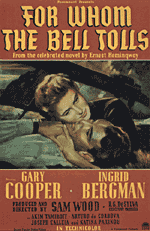
Indeed, McCain has more than his share of doomed to dutyFor Whom the Bell Tolls poster integrity that characterized Hemingway’s public persona. The title of Hemingway’s book, of course, refers to an ultimate destiny in death and the unflinching effort of the real man to face that inevitable destiny with something like grace. A characteristic effort of Heminway’s heroes, even when they mostly fail the chance. There’s a way, of course, in which McCain clearly does live out the Hemingway mythology. The prisoner of war refusing to bend the knee to his enemies, the maverick political independent, the loyalty to Bush on principle regarding the war, even when in his heart of hearts I think McCain finds Bush despicable. Even McCain’s political story this primary seasons unfolds like that of a Hemingway hero, the man willing to do what he believes in without resources. The belief that a man should stand up and do the right thing even in the face of overwhelming odds and the inevitable odds of death. As the Times suggested a couple of days ago, he doesn’t even pander well, which is precisely what makes him attractive to so many. Even I like McCain, and I disagree with him about almost everything. Proof again that policy statements and knowing the ropes may be important things for a Senator, but it’s not so clear that this kind of political minutiae is what will get people to follow you.

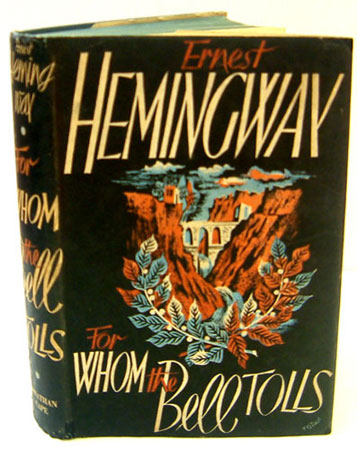
[Ironic side bar: The title of Hemingway’s novel is drawn from John Donne’s MeditationFor Whom the Bell Tolls First Edition number XVII, republished as the following poem:

‘No Man is an Island’ MEDITATION XVII, Devotions upon Emergent Occasions

No man is an island entire of itself; every man
is a piece of the continent, a part of the main;
if a clod be washed away by the sea, Europe
is the less, as well as if a promontory were, as
well as any manner of thy friends or of thine
own were; any man’s death diminishes me,
because I am involved in mankind.
And therefore never send to know for whom
the bell tolls; it tolls for thee.

I say “ironic” because Donne’s meditation is primarily about the unity of mankind, “No man is an island.” We are all part and parcel of one another, involved in all mankind. Sounds positively Obamian. We are the hope we’ve been waiting for. We are the world. We are the children.

In Hemingway’s hands the solitary confrontation with death is a chance for the man to test one’s mettle against the worst that nature offers, like the bullfighter in the ring. Finally we do this alone. I can’t quite see McCain with Donne. Maybe if he stood up and said, “any man’s death diminishes me…except that of Saddam Hussein, Osama bin Laden, and various and other choice enemies who would be better gotten rid of.”]

Nevertheless, even if McCain runs on this Hemingwayesque idealism, he’ll give Obama a better run for his money that Clinton is right now. On the other hand, if he tries to tell the American people that they are naive for hoping that the world can be different than thepolitical world the baby boomers created …well…politicians don’t get so far telling people they are stupid. The irony of McCain is that he was, in some respects, the Obama of the last political season. If he goes against the instincts that made him a winner in the past, he’ll just be another old guy that Obama will blow out of the water.

Side bar number two: Obama might well be saying, it’s morning in America. Hillary could learn more than one lesson from Ronald Reagan.

Side bar number three: I’m not so sure Obama isn’t more ruthless and politically savvy than Clinton gives him credit for. He appeared on television in the middle of Clinton’s speech last night, and every station in the country dropped Hillary to hear what he had to say. Why does Clinton think Obama is so unable to handle tough as nails and ruthless Republicans? He’s shown every ability to handle tough as nails and ruthless Democrats like, umm, Bill and Hillary Clinton.