Tag Archives: Reading

Stanley Fish Pleasures Himself, Yet Again

Fish returned again today to his continued probing of the rationale for the humanities, concluding—surprise!—there is no such rationale, at least not one that anyone will bother to pay for. Fish’s arguments change, somewhat, this time around but he’s mostly sticking to familiar territory, unconvinced by the hundreds of readers who mustered the energy to respond before the Times cut off the opportunity to comment.

Fish begins with an interesting and powerful disquisition on the nature of humanistic investigations.

“In a poem titled ‘Matins,’ the 17th century Anglican poet George Herbert says to God, If you will ‘teach me thy love to know . . . Then by a sunbeam I will climb to thee.’ But the dynamics of the proffered bargain – if you do X, I’ll do Y – are undercut by the line that proposes it, and especially by the double pun in ‘sunbeam.’

“‘Sun’ is a standard pun on Son; it refers to Jesus Christ; ‘beam’ means not only ray of light, but a piece of wood large enough to support a structure; it refers to the cross on which a crucified Christ by dying takes upon himself and redeems (pays the price for) the sins of those who believe in him. So while ‘by a sunbeam’ seems to specify the means by which the poem’s speaker will perform a certain act – ‘I will climb to thee’ – the phrase undercut his claim to be able to do so by reminding us (not him) that Christ has already done the climbing and thereby prevented (in the sense of anticipating) any positive act man mistakenly thinks to be his own. If the speaker climbs to God, he does so by means of God, and cannot take any personal credit for what he ‘does.’ If he truly knows God’s love, he will know that as an unconditional and all-sufficing gift it has disabled him as an agent.

“This brief analysis of a line of poetry that simultaneously reports a resolution and undermines it is an example of the kind of work and teaching I have done for almost five decades. It is the work of a humanist, that is, someone employed in a college to teach literary, philosophical and historical texts. The questions raised in my previous column and in the responses to it are: what is the value of such work, why should anyone fund it, and why (for what reasons) does anyone do it?”

This is Fish the quintessential close reader, to my mind demonstrating once again that whatever the peregrinations he and we may have made through high theory, our debt as a discipline to the New Critics remains in some sense unexceedable. What we do, he rightly says, what we always return to, what we inevitably affirm whatever our allegiances to history or whatever our convictions about the possibility and impossibility of meaning, is this activity, the simple and yet difficult act of attending, of reading what the flow of language tempts us always to miss.
For Fish, again, this is its own pleasure and its own rationale. It serves no larger purpose. And, as he now comes out frankly in his final paragraphs and asserts, it’s not clear that there is any justification in being paid for it.

“One final point. Nguyen Chau Giao asks, ‘Dr. Fish, when was the last time you read a poem . . . that so moved you to take certain actions to improve your lot or others?’ To tell the truth, I can’t remember a single time. But I can remember countless times when I’ve read a poem (like Herbert’s “Matins”) and said ‘Wow!’ or ‘Isn’t that just great?’ That’s more than enough in my view to justify the enterprise of humanistic study, but I cannot believe, as much as I would like to, that the world can be persuaded to subsidize my moments of aesthetic wonderment.”

To some degree I’ve already argued with Fish’s position here in my post last Thursday. However, I want to point out today that there’s a very long distance between his opening disquisition and his late affirmation of aesthetic wonderment. In between, Fish again makes the case that the study of literature does absolutely nothing in the world. However, I think his own example may suggest otherwise.

Fish continues to imagine the bases of the discipline in the triumph of literature, he is stuck in noting the division between the production—and perhaps usefulness—of great art and the uselessness of studying it. However although this self-substantive view of literature has been at the center of English studies for the past century, it seems to me that we need not be captive to this particular image of what it is we do and why.

Fish the rhetorician surely knows that an older rationale for study of literature is that it teaches us about how language works and how it can be used. Literature is not an icon that exists apart from the world in a separate sphere; Literature subsists in language, and by studying literature seriously we come to understand better how language works in the world, no small thing to accomplish. Indeed, the skill that Fish ably demonstrates in his opening is not a natural but a learned skill, one that requires substantial practice and study.

I have suggested with some colleagues for some time now that English studies needs to return to or reemphasize it’s roots in rhetoric and philology. The study of literature is only one, but one very good way to study how language has worked in the past and what its possibilities might be for the future. As a corollary, writing studies needs to be rescued from it’s marginal status in most English departments. Unless one believes that imitation is useless, the study of how works of literature achieve their effects in the present—or how they achieved similar or different effects in the past—can be a doorway in to understanding how the written word can function effectively in the present.

I realize this only applies to English studies; the rest of the humanities will have to fend for themselves. However would my suggestions satisfy Fish even as to the study of literature. I doubt it. But that’s because he has narrowly defined his pleasures over and against utility. Perhaps Fish has studied a bit too much of the Milton the Puritan. It is, perhaps, one of the great blessings of literary study, that pleasure and utility can be achieved in the same fertile moment, rather than existing in futile opposition.
Miscellany: Books as Plastic Art; Leslie Fiedler; Clinton’s Campaign Against Hope.

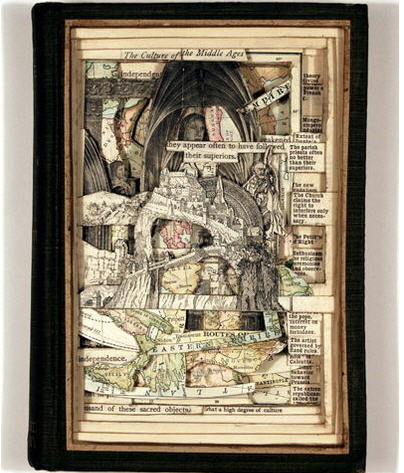
Book Sculpture

Many thanks to Scott Esposito at Conversational Reading for pointing me toward this really fascinating page on books as art objects.

A favorite image from the page:

2057160036_ec4b4ef2ba.jpg

I’ve seen a variety of things like this in recent years, and I suspect to some degree that seeing the book as a form of art is tied to a sense of its demise. As things die, they become works of art, perhaps? The Freudians have already covered this, I’m sure. In the infancy of books, of course, books were also thought of as treasurers to be handled like works of art or other revered objects. Books in general were far too expensive for the masses to obtain, and as a general rule this continued for a very long time. Owning books, as much as reading them, signified your cultural and class superiority. This all changed gradually over centuries after Gutenberg, but changed with a vengeance with the invention of the paperback.

Perhaps now that television and the internet have taken on most of the cultural purposes of the paperback and the newspaper—cheap entertainment and ready information for the masses—books are again left to become objects of art, treasures indulged in primarily by a small coterie of collectors. Strikes me as depressing, just a bit, but I still love these photos.

Leslie Fiedler. Who?

I couldn’t help but notice Scott’s post on Friday noted a new book by the late Leslie Fiedler, whom Scott admits he didn’t know. Alas, how far the mighty have fallen. I used to want to be Leslie Fiedler. He made cultural criticism seem romantic. Now cultural criticism has all the romance of oral dentistry or working at Chic-Fil-a. (Does anyone know why they spell it this way?)

Seriously though, Fiedler was one of the few critics I’ve ever known whose work aspired to and in some instances could be called literary. This despite the much vaunted declarations that criticism and theory were literary genres, these made by literary theorists who could not write. Roland Barthes, who I think came up with the idea, also comes close to this ideal in some of his work. But declaration is not achievement. Fiedler and people like Barthes—Fiedler more than Barthes–are to be thanked for showing us that cultural criticism could actually care about and love language, that how it communicates can mesh with what it does communicate.

Clintons continue attack on literature…er…Obama.

By now, I guess, everyone has heard that Bill Clinton and hip-mate Hillary Clinton—or is it the other way around—got in trouble for deriding Obama as a purveyor of fairy-tales and fantasy. In some future post I think I’ll take up the idea that the Clintons who once represented the hopeful face of baby-boomerism, now represent the craggy and toothless grin of what to expect as baby-boomers start using canes and walkers. “No hope for you, people, you silly and naïve young whippersnappers.” My general sense is that the Clinton approach demonstrates again and again that they are part of the system, so broken by it that they have to replicate it, like dogs licking the hands of an abusive master. Trouble is they may be right. Systems persist for a good reason, the gradually wear down the hopes of those who would change them and they are impervious to appeals from those outside their own logic. The smart money still goes with Clinton, but for the moment I feel like I’m still young enough to hope.

But my real issue with all this is the Clinton’s perfidious campaign against the imagination and literature. (Beware those who use the term “perfidious” wantonly). As I pointed out in earlier posts, Clinton has all the literary imagination of a manual on how to fix my furnace. Hillary works too hard to have time for literature. Now they are using a perfectly wonderful and culturally important literary form as a derogatory epithet. As Vladimir Propp could tell them, fairy tales make us what we are.

Do those of us who are reading for our lives, an increasingly aggrieved and marginalized minority who must struggle against the glass ceiling of…well, something I’m sure…set in place by the billions of non-readers in the world, really need the Clintons piling on with their anti-literary epithets?

I think enough is enough. We need to stand up against unthinking and derogatory stereotypes of reading culture.

READERS OF THE WORLD UNITE!

Or something.

Who’s Reading Now? Or, Crises Ad Nauseum

Trolling around The New York Times I came across this gem.

Ok, so only someone thinking about writing a book on reading would think it’s a gem, but I’ve got to write about something today. Everything’s material.

“The measure of all worth seems to be the question, “does it pay?” The attitude of the vast majority of the American people is distinctly inimical to the pursuit of culture for its own sake, and there are few men who read habitually after leaving college, simply because they are compelled to devote all their time and energies to the making of money in order that they may be regarded as of importance among their fellow-men. “How much is he worth?” That is the question by which the majority of people decide the value of a man….

“[As] long as the money-making ability of a man is taken as the true measure of his worth (and there are many who argue earnestly that it should be,) reading for culture, which is the highest form of reading, will be at a discount, whether among college-bred men or others. Nevertheless we think it highly probably that if an investigation could be made with accuracy, it would be found that the percentage of men who read entirely aside from the professional demands and purely for the sake of culture, would be found to be larger among university men than others.”

The language probably betrays that this isn’t the NEA’s study on the decline of reading, though it’s equally as earnest. It’s from 1900, an article titled “How Reading Does Not Pay” responding to and extending an earlier article that recounted the surprising decline of reading by undergraduates at Princeton University. Of course, all things are relative. I traced down the earlier article, “Reading of University Men,” and it appears that in 1900 20 percent of male Princetonians–the only kind of Princetonians there were, actually–had read Sartor Resartus, 30 percent had read Boswell’s Life of Johnson and nearly 80 percent had read Milton’s Paradise Lost.

I include the links to Project Gutenberg because…well…who knows if anyone reads these works anymore. I did as an English major two and a half decades ago, but most of the students in our department graduate without having read these particular texts and many others that an earlier generation considered necessary. Necessary for what, I leave unstated.

I would mostly be glad if I could just get 80% of the students at my college to read a newspaper, online or no. I did a survey of reading at my college as part of a class a couple of years ago and found that about a 1/3 of the students read even one book a year that was not assigned for a course. Survey’s being what they are, I suspect the statistics are inflated.

We could probably argue about what this suggests about the reality of our own “reading crisis,” such as it is. Digital utopians would, I know, point feverishly to the fact that students now spend a lot of time reading, and writing! New forms of literacy. To which I might say, “Yes, they punch text messages into their 2 by 3 inch phone screens and cackle maniacally at the latest picture with two sentence caption posted to their Facebook pages.” This is a little like giving folks credit for using the English language. Ok, I’m cranky, but also half serious. I do agree with the thesis that a lot of what passes for writing and reading on the web is more like conversation than writing–with all the good and bad things that implies. I don’t think writing has ever been simply a substitution for talking, and the forms of mental and imaginative engagement required by older forms of reading are significantly different than those necessary for conversation.

Still, I’m a little more interested in the rhetoric of concern that motivates discussions about reading. I’m struck by both the familiar and the distinctive flavors of this particular reading crisis at the turn of the last century. On the one hand the lamentation of reading’s decline, and the sense of some relationship between reading and cultural leadership. Readers are rightfully the big men on the Princeton campus aren’t they, these articles seem to assume, just as, in the NEA’s vision at least, Readers are the movers and shakers and thinkers we need to be competitive in the global economy.

Readers as Big Men on campus? Well, here is the flavor of difference. I doubt this is true at Princeton anymore, if it was then. Indeed, the account registers mostly the fear that this isn’t the case, that the rightful place of the cultivated man has been diminished. And what counts as a big man on campus is, more and more, the very capacity to make money that these late Victorians think of as polluting the superior man who should read only for culture, a more high-faluting version of the NEA’s concern with reading for pleasure. Mostly, in fact, our own reading crises are put in the explicit language of political and economic profits and deficits. The failure to read will damage the economy and damage our civic life. The triumph of business in higher education is nowhere more clearly registered than in our efforts to justify reading on the basis that it will help create better middle level managers. The idea of reading for culture alone is not even on the radar, except perhaps in its professionalized version in the mind of Stanley Fish.

More tomorrow on other varieties of reading crises I’ve stumbled over the last couple of days. Sometimes these are seized on by digital utopians as evidence that the NEA is crying wolf. I think they raise a more interesting question. Why is reading always in crisis? And how do the shape of these crises–which I’m willing to say are to a very large degree creations of discourse–and the rhetorical forms through which they are articulated suggest changing cultural values? And why do we choose to narrate cultural crises through crises in reading.

This isn’t at all intuitive to me. The terms change, the cultural positions morph and realign, but what is it about reading that leads folks to assume repeatedly and ad nauseum that we are in a crisis. We seem to have reading crises with the approximate frequency of menstrual cycles. What is it about the nature of reading that leads us to fret over its fragility?

Articles Cited:

How Reading Does Not Pay
New York Times. June 16, 1900
Section: SATURDAY REVIEW OF BOOKS AND ART, Page BR16, 622 words

READING OF UNIVERSITY MEN.
June 2, 1900
Section: The New York Times SATURDAY REVIEW OF BOOKS AND ART, Page BR8, 641 words

Reading about reading about reading about….

I’ve been reading the winter issue of n+1. Smart people, smart and funny writing. I envy their youth. This issue’s take on The Intellectual Situation—a regular feature that’s a rambling blog-like essay more or less focused on a topic, or at least a loosely related series of themes, or united by a sort-of narrative—focused on the reading situation, among other things, noting especially the sudden prevalence of how-to books devoted to reading.

“Self help-style (sic) books about reading reappeared on the publishing scene in the last halcyon days of “Third Way” capitalism—when the world was embracing a kinder, gentler, freemarket as a solution to all our problems, including the problem of universal education. With that memorable 1999 title, How to Read and Why, Harold Bloom completed his transformation from the vatic close reader of The Anxiety of Influence to a lonely crusader against declining standards. In fact, he wasn’t so lonely: Bloom was preceded, barely, by cultural literacy proponent E.D. Hirsch in How to Read a Poem (19999), and he’s been followed, in recent years, by a number of tenured professors and established writers, and even the odd celebrity with time on his hands: there’s How Novels Work, How to Read Like a Writer, the deliberately parodic Ode Less Traveled, Oxford University Press’s Very Short Introduction series, which followed Penguin’s Complete Idiot’s Guide to Shakespeare and American Literature. Most of these now originate in Britain. Even radical-socialist Terry Eagleton has one called, er, How to Read a Poem.

They mention, too, John Sutherland’s How to Read a Novel: A User’s Guide, and the grandfather of this genre, Mortimer Adler’s How to Read a Book. Even then, n+1’s is a necessarily selective list. Others include How to Read Literature Like a Professor, Reading Like a Writer and Thirteen Ways of Looking at the Novel. I’ve just started the latest hot read on reading—or rather non-reading—How to Talk about Books You Haven’t Read by Pierre Bayard, which is a book about, among other things, how to not read a book. I would talk about it, but I haven’t read it yet. I did read the review.

Close cousin to these is a veritably new genre of literary non-fiction that I call the reading memoir, books by baby-boomers narrating the wonders of the books we are gradually leaving behind. Maureen Corrigan’s Leave Me Alone I’m Reading. Anna Quindlen’s testimonial How Reading Changed My Life. The industry that is Michael Dirda.

Indeed, too many to name them all, and these are merely the visible edge of a great tsunami of books on reading over the past twenty years. In fact, a quick WorldCat search shows 70,000 catalogued items published on the subject of reading from 1967-1987. Since 1987 we’ve been enlightened by approximately 105,000 new investigations of our crisis. With the publication of the NEA’s latest report, I’m sure we’ll see another 25,000 or so before the decade is out. I hope my own is among them.

This says nothing about the several million blog pages of persons chronicling their own reading habits, experiences, revelations, etcetera ad nauseum. (Who? Me, you say?) Reading is an industry of its own. Indeed, without the sea of books on reading, one suspects that the crisis in the publishing industry would be much more well-advanced. Anxious readers buy more and more and read less and less in the interest of understanding their own demise. Why, Oh Why?

The easy answer, and only one I have, is that this flurry of reading about reading is symptomatic of the very death of the book that we are gradually experiencing. In Verdi’s La Traviata, Violetta, dying of consumption, summons a last illusion of strength on the fantasy of her own resurrection. Like the diva dying on her sick bed, book culture summons a last illusion of strength by reading about it’s own demise. Reading lists are like bucket lists: great things to do before I die, or before books do. This is too easy, but it does seem to me that how-to books appear at those moments when a once dominant cultural practice moves from being necessity to option. Gardening manuals only make sense in a world where people don’t know how to and don’t have to grow their own food. Books on how to make a cabinet or how to wire a house are only for those who no longer learn it as a matter of course from a father or the guy next door. My favorite among books of this ilk is The Dangerous Book for Boys, which guards against the loss of our boyish past and our electronic future by teaching boys how to play…marbles. Reading books about reading is a sign of reading (at least reading books) having become a practice of clubs rather than a necessity of living. Some day perhaps courses in reading a novel will be offered at my local YMCA along with crocheting and scrap-booking. Oh, wait. They already are.

n+1 mocks the how-to books, rightly it seems to me. But their solution borders on the bizarre.

So maybe—is this a crazy idea?—reading needs to be taught, and taught well, rather than sold. Instead of writing more well-intentioned books, why don’t academics intervene directly in secondary school education? Let’s lend them out to state schools, public schools, and community colleges to teach for a few weeks a year. Morally, this is the equivalent of pro bono work in the legal profession. Let’s reward junior professors for community teaching rather than for publishing articles in academic journals. An extra sabbatical year could be offered, during which professors would work closely with young readers. Maybe this experience could actually change the way intellectuals think about literature. If a certain degree of literacy and appreciation for htte complexity of great books (or just good novels) is as necessary for a healthy and free society as we’ve often heard or said it is, then maybe the only way (not the “Third Way”) forward is a Maoist –style cultural revolution in reverse: “INTELLECTUALS: INTO THE SCHOOLS!”

Um…Ok, I appreciate the idealism. I really do. But…um…could it be any more obvious that the folks at n+1 only hang out with people who have gone to Ivy League or Ivy league wanna-bes, and went to the kind of high schools that got them in there. Or that they are too young to have kids in the secondary schools? Or that they are fundamentally out of touch with the economics of higher education. An EXTRA SABBATICAL YEAR??? I guess they’re maybe thinking that the moneyed interests at Harvard and Yale–the only places that can really afford extra sabbatical year–are going to come riding to our rescue. Chances are the cure would kill us. Maybe they could imagine Harold Bloom coming to their high schools to teach reading, but if Harold Bloom had come to my high school I would have been shooting rubber bands at his rather expansive posterior. Or falling asleep. Most academics have a hard time making themselves understood to one another, and we’re going to put them in high schools to teach 16 year olds to love to read???

Don’t get me wrong, I teach at a college where the focus is primarily on teaching, and I think that balance is about right. And a colleague runs a program at Penn State that gets grad students into the schools to do just this kind of thing with reading and writing. My own college runs continuing education programs for teachers to get them in touch with literary and other disciplines once again. We clearly need more connections between the colleges and the high schools, both so high schools can better prepare kids for what they’ll face in college and to help colleges understand where their freshmen are coming from. But let’s respect the expertise of teaching that a secondary school teacher has developed, and let’s help them as much as we possibly can.

Despite the naivete, n+1 is one of the best things going. Maybe because of the naivete. They haven’t yet joined those of us who are old and jaded by, among other things, too much reading.

Mitt Romney, Untrustworthy Literary Flip-Flopper

With my headline I just thought I’d try out my chops as a writer of currently high level American political discourse.

Seriously, though, Romney needs to lay hold of a literary position and dig in to the trenches rather than pandering to pundit expectations. This past summer the media exploded with disgust and disdain that Romney declared his favorite book to be L. Ron Hubbard’s Battlefield Earth, a book that I confess has yet to make it to the top of my pile but which John Dickerson at Slate says indicates “very deep levels of weird.” Sensing a scandal in the making, Romney—or rather Romney’s “people”—backpedaled quickly, declaring that Romney’s favorite book was really the Bible. As if we didn’t know that. Battlefield Earth is merely his favorite novel.

This seems to have done little to diminish the very high levels of weirdness the blogosphere detects in the choice of overly long fiction written by the founder of Scientology. My guess is that Romney would have done better to choose something that would overcome the Mormon factor, which for many people, rightly or wrongly, also signifies very high levels of weirdness. (On the other hand, anything sniffing of religion strikes many people in the media as highly weird, so this may not be saying much). Still, I don’t think Mitt’s people wanted the electorate going in to the voting booth with the image of the Romney family Bible stacked on the bedside table alongside the Book of Mormon and a novel by L. Ron Hubbard, especially since that novel focuses on the predatory practices of “hairy 9-foot high, 1000-pound sociopaths” called The Psychlos.

In the passing months, Romney and his people have apparently backpedaled yet further. A gander at Romney’s Facebook page now lists a dozen solid, not to say stolid, books with one novel—Mark Twain’s Huckleberry Finn. What Hemingway described as the foundation of modern American literature takes its place on the Romney bookshelf alongside a variety of business leadership manuals and scary books about the evils that face us: jihadism and Thomas Friedman’s flat world. The weirdness factor seems to be tamped down for good (though I admit I tend to find leadership manuals highly weird, my being a middle level manager in an academic institution notwithstanding).

L. Ron Hubbard has gone the way of all flesh. But so, apparently, has the Bible. The Book of Mormon still has yet to show its face and I really think that some intrepid reporter needs to ask Mitt why that may be. Just what, exactly, is he hiding? Religion is represented by Rick Warren’s The Purpose Driven Life. For many politicos, Warren is clearly much safer than the Bible. He is after all “a new evangelical,” which in our current political lexicon tends to mean an evangelical you could bring to fundraiser without worrying about whether you could offer him alcohol. Certainly Warren’s book can be brought up at a Republican cocktail party without raising eyebrows, something you can’t always say about the Bible. Depends on the cocktail party. I’m not sure that this says a lot for Rick Warren, or for how well people may be reading his book, but the image does go along with Romney’s well-coifed hair and perfectly massaged public image.

Last year I wrote a paper, still being revised, where I speculated a bit on the ways people used books to identify with others. We signal our desires, values, goals, interests through the kinds of books we read—or pretend to read—and how and where we read them. But what exactly is Mitt signaling with all this shelf-shuffling? Probably nothing, except that he wants to be president. I was prepared to write a few paragraphs on the peculiar choice of Huckleberry Finn as a boy who stood against the status quo, willing to give up his status and his standing—little as it was—to try and do the right thing. How different and odd that choice seemed given that Romney seemed mostly about status and the status quo. However, I suspect, frankly, that the leadership manuals are Romney’s real favorites and Huckleberry Finn is a book he remembers from his days as an undergraduate English major at BYU.

I actually think Mitt really likes Battlefield Earth, that this literary slip of the tongue was the real literary Mitt before he realized the weirdness quotient could do him in with the 1% of the electorate that actually cares about what he reads. I liked him better because of it. We all have our perverse reading pleasures. Things we get in to against our better natures. This devious pleasure-taking in the alternative world of literature is one of the great things literature affords us. I think of myself as a half-baked pacifist but I can’t get enough of war movies. Heaven forbid, but I sometimes prefer a vampire novel to the latest tome by Don Delillo or Philip Roth. I actually like the fact that Mitt Romney loves shlocky sci-fi novels that have been badly-written by a man a few pancakes short of a full stack. It suggests to me that Romney’s hair isn’t perfect when he gets out of bed in the morning, that maybe when he can’t sleep late at night he gets on a sci-fi chatroom and becomes Megalorg, laser scourge of the planet Kryl-9.

Or whatever.

Makes him human and interesting, a little like Hillary’s tears earlier today.

What I don’t like is that he seems to change his favorites at the first whiff of scandal. Too much like the guy in high school who always seemed to find a way to like whatever the cool kids liked. The guy held in contempt by even the people he calls friends.

Barack Obama Sings America

Let it be said now. Barack Obama channels Walt Whitman.

Nevertheless, something there is in a political woman that doesn’t like poetry in a man. MSNBC reports today that Hillary has chosen to attack Obama by mocking his eloquence. She’s been stumping in New Hampshire, saying “You campaign in poetry, you govern in prose.” One of many jabs that Hillary uses to demonstrate her superior manliness to Obama and his fluff, the quote comes originally from Mario Cuomo. Another Clinton favorite: “I’m a doer, not a talker.”

May be. Though it does seem to me that Hillary is a little tone deaf on this one. She is, after all, campaigning and not governing, as if she has forgotten that she has to campaign after all. I’m also not so sure it’s a wonderful move to deride the citizenry for having false hopes. (Who does she have writing this stuff?) All of this is of a piece of Hillary’s general effort to demonstrate that she has the cojones to be president. And that her own cojones…among other things…are a lot bigger than Edwards or Obama.

Indeed, I was fascinated with the way last night’s debate among the Democrats degenerated toward a variety of male stereotypes—as if we can’t get past the masculine image even at this moment when the stereotypical image of masculine leadership seems to be less stable than ever.

In one corner, we had Edwards the pugilist, who seems bound and determined to be fighting everyone and everything. “You can’t nice these people.” Another jab at Obama’s apparently suspect masculinity. I wished someone would give Edwards some valium, or else a good book to read. In another corner we had Richardson the affable elder statesman (who, in my estimation, pushed himself a notch closer to the vice presidency). Clinton played the hardnosed greybeard realist with her nose to the grindstone. She’s apparently been working non-stop for 35 years. Does it occur to her that when she says this most Americans say “Why don’t you take a vacation. I would. In fact, I’ll be glad to give you one.”

Which left Obama to be….What?….again, something that seemed new, that didn’t seem to quite fit in.

Still, I’m getting far afield from my original purpose. I’m intrigued by the role that literary metaphors are playing in the political campaign so far, and especially in Hillary’s latest attacks. The Huffington Post had a much quoted blog a few weeks ago to the effect that Obama was poetry and Clinton was prose. Hillary’s attack picks up on this dichotomy and falls into typical masculine stereotypes that men who like poetry are just a little too effeminate for comfort, at least for political comfort. Hillary’s attacks called to my mind Maureen Dowd’s skewering in the New York Times of John Kerry in two different op-ed pieces because he not only read but also wrote poetry. Didn’t this signify somehow, Dowd seemed to imply, that Kerry was too unreliable, too unserious, or at least not serious in the right ways, to play with the big boys. See June 8 2003 and March 7, 2004 in the New York Times.

Picking up on my post from yesterday, I’m intrigued with how the candidates use literature as a means of communicating something about themselves, and whether what they reveal about their literary tastes and interests says anything about them. I went on the respective candidates’ Facebook pages to see just what it said about their literary interests.

About Hillary I discovered….zilch, zero, nada. Indeed, Hillary’s Facebook page offers absolutely nothing about her personal interests at all. As if in playing out the traditional masculine split between public and private, she has to absolutely deny that she has any personal interests whatsoever. Or maybe it is just that her personal interests only extend to becoming president of the United States.

Of all the candidates, Obama’s is the most extensive, the most diverse, and the most dominated by literary texts. He names Moby Dick, Toni Morrison’s Song of Solomon, The Tragedies of Shakespeare, Taylor Branch’s biography of Martin Luther King Jr. Parting the Waters, Gilead by Marilynne Robinson, Self-Reliance by Emerson, The Bible, Lincoln’s Collected Writings.

My God, the guy actually reads. I mean, I have no doubt that these pages are massaged and picked over by staff for the kinds of messages that might be sent. (More on Mitt Romney’s choice of Huckleberry Finn—an apparently quick correction from an earlier choice of a novel by L. Ron Hubbard that earned guffaws from the blogosphere last year– and Mike Huckabee’s choice of The Holy Bible in another day or two). But Obama has to have actually read this stuff, and he has to actually read books for his own interest. Having read Gilead by Marilynne Robinson not only helps him with the literary crowd—he doesn’t really need the help, they’ll mostly vote for him anyway—it also helps him with moderate and educated evangelicals who found Robinson’s novel immensely complex and moving, testimony yet again that the connections between literature and religion are hardly dead. They’re just quiet.

By comparison, I guess I was disappointed at the fact that Hillary didn’t list anything at all. I dug around for awhile—unscientific word searches on Google—and finally found a reference at the NEA where Hillary suggests her favorite book as a child was “Goodnight Moon.” A lovely choice. I read it ad nauseum to my kids, but am now far enough removed from the cuteness that I get warm fuzzies at the sound of the title.

Has she read anything since? She did not list a favorite adult book on the NEA. I also just found a blog on the same topic at Huffington Post that says Hillary chooses Little Women and The Poisonwood Bible. However, I can’t find anything else readily available that confirms these choices. Still, I think they are worthy choices if true. John Lundberg finds them too predictable. I’m not sure that I agree but they do suggest a certain prepackaged quality of control and safeness to me. The bitter attack on fundamentalism in the Poisonwood Bible won’t win her fans with the hardest core of fundamentalists, but, again, they wouldn’t vote for her anyway.

I admit to disappointment in having to dig so hard to find out anything about Hillary’s literary tastes. Whereas Obama strikes me as a person to have in your book group. What a great conversation that would be after eight years of a president who can’t be bothered by literature. Too much nose to the grindstone for the imagination to have much play for Hillary. Somehow it says something to me that Obama is presenting himself as a literary man while I have to dig and dig to figure out if Hillary reads anything other than the bible she apparently carries with her everywhere—and which still does nothing for her with the biblically literate electorate.

Still, I’m wondering if Hillary’s graybeard, workaholic, no-time-for novels, approach to this political campaign will really win out in the end. America famously honors novels more in the breach than in reality. Real men—and Hillary in some ways has to prove that she’s man enough for the job—have no time for literary folderol. Obama’s depth and complexity run the risk of seeming, well, wimpy, something both Clinton and Edwards have keyed in on.

I’ll take a risk here and say that Obama can get away with it because he’s …black. Odd leap, I realize, but bear with me. In white America’s racial codes, black men are portrayed as hypermasculinized, all body and no mind. There’s a lot of scholarly material out there on the historical fears that white Americans have of black American masculinity (I’ve drawn on some of this and use it in my book on masculinity and religion in the Harlem renaissance—freely admitting that “book” is a hopeful word for the 400+ pages that now sit in my computer, just starting as we are to sniff around for a publisher). Obama’s literariness and his lyrical eloquence serve to humanize him for a white audience that, while improving, is not so very far removed from the appeals of Willie Horton ads. Henry Louis Gates, after all, has pointed out that historically blacks used literacy—the ability to read and write literature—to demonstrate their full humanity to white audiences. I don’t think it’s a great leap to say that Obama’s literary card softens residual white fears of a black male planet.

Obama’s poetry, his admirably diverse literary interests, serve the purposes of showing him once again as a uniter, someone who brings all things together. He brings black and white together. He brings Herman Melville and Marilynne Robinson and Toni Morrison and Shakespeare together. He brings male and female together. He brings his hard political and his soft literary sides together.

Obama’s literariness strikes me as genuine and authentic—though I realize that in this day and age even authenticity is pre-packaged. His literariness quite clearly matches and even enhances his political imaginary. Obama’s literary “softness,” deadly to men like John Kerry and John Edwards–and perhaps deadly, too, for political women like Hillary Clinton–plays to the idea that he can be all things.

He is large. He contains multitudes.

He too sings America.

Side note: I’ve added Liz Laribee’s blog, peaceamillion, to my blogroll. Liz is one of the funniest, and best, young writers that I know. Of course, I don’t know that many young writers. Sorry, Liz. The truth will out. No seriously. Everyone should go delight in Lizworld.

Reading Entrails

Can you tell anything about a person by what they read? On some level I guess I have to say yes, though I’ve become a bit more suspicious of the general principle and a bit more judicious in the application of any judgment than I used to be. I grew up in a religious tradition that assumed “garbage in, garbage out” was an axiological principle. Thus you absorbed and in some way became what you read. You are what you read, much as you are what you eat. As a result, reading matter was rigorously monitored and, in practice, severely restricted. “Bad books”—stuff that didn’t clearly support our Christian world view—were regularly described as various forms of poison or at least junk food. Things that would destroy the spiritual and psychological body. I wasn’t allowed to read J.D. Salinger while the rest of my junior class in high school gloried in the high literary profanity of Catcher in the Rye. I was morose, perhaps a sign I didn’t think the unwashed were so unwashed after all. You can read my slightly maudlin reminiscence of my youthful reading experiences in the introduction to my book, Recalling Religions (Tennessee 2001). Currently ranked 3,605,185 on Amazon.com! I excerpt just a bit below:

[In] my imagination, the story of this book’s motivations, interests, and point of view threads back to my first encounters with literature, which always seemed to be troublesome encounters with religion as well. My earliest memories of something that might be called “literature” had nothing to do with Twain or Fenimore Cooper or other authors of “boys’ books” that serious young readers were supposed to read. Indeed, I barely knew of their existence. What I did know was tangled with agonized parental debates—probably exaggerated in my memory—as to what was appropriate for a young boy from a holiness church to read. As late as eighth grade, I remember stading alone and wistful at my homeroom window watching my classmates board a bus for the local theater to see Robert Redford in The Great Gatsby. The chances of attending the film had been slim in the first place, since our church forbade movies along with dancing and drinking as contrary to holy living. Still, I had my hopes. School, combined with the responsibility my parents felt to help their smart children be successful in the world, had always been a slick oil with which I could slip through the narrowest confines of home. The Great Gatsby was a classic novel, or so I assured my parents that the teacher had assured me. Such appeals to the greatness of Western culture lost what little cachet they possessed when my mother discovered that in Fitzgerald’s novel a woman’s breast is torn off by a car.

My mother wanted her son seeing neither breasts nor violence. And so, when I pull my copy of The Great Gatsby off the shelf—a book I did not read until my years as an English major at a Christian College—it is this rather self-pitying memory of me at a window that I see most clearly. For the most part, the dead white male writers and their cinematic representations remained far too worldly for a young holiness boy threatened on every side by the corruption of suburban Oklahoma City.

For a while, education underway and then complete, I thought I had grown out of this attitude, but now I’m not so sure. At least I retained the sense that what you read somehow automatically signified something about who you were. The only difference now was that it had a more elitist and sophisticated cast. Heaven forbid that you indulged in pulp fiction, whether romance or mystery. The chosen people were signified by the ability to parse Faulkner or Morrison, or Eliot or Pound or Dickinson or Whitman. By disdaining books sold in grocery stores. Later, as I became deeply involved in ethnic studies, reading Faulkner, Eliot or Pound–for any reason other than showing their faulty white male-ness–was a profound index of intellectual morality, my own ineffable intellectual and political purity made evident in my reading Toni Morrison, James Baldwin, and Leslie Marmon Silko.This is not the same kind of religious discrimination that shaped my youth, but it did involve a kind of puritanical pulling up of the skirts from the unwashed of the world. Different unwashed, different skirts, same shrinking. Over time I’ve come to think that perhaps it’s not exactly what you read so much as how you read that’s important. Though, to be honest, the values I assign to the “how” are deeply influenced by the what. The average Harlequin romance or pulp western doesn’t bear up to the attentive, critical and imaginative reading that I think signifies something about a person’s mind and imagination. This kind of reading probably is encouraged by certain kinds of books and not by others, even though, having developed this way of reading, it can be applied almost anywhere on the fly, from Desperate Housewives to Coetzee or Lessing. Thus, my general sense that cultural studies is dependent on forms of reading associated with literature, even while literature itself is falling in to disrepair.

The real occasion for this rumination is that on a lark and in the spirit of the political season, I visited the facebook pages of the leading presidential candidates. Just to see, what these people are reading, and whether I could perform a literary psychopolitical biographical reading of their reading. It’s interesting, but I think I’ll stop for the moment and come back to the literary preferences of Barack, Hillary and Mitt in a later post tomorrow.

Fresh Start

I suppose I should just start by saying that I’ve never blogged before, and really only got started reading blogs recently. I spent an hour trying to figure out what template to use, and am still not quite sure I’m happy. I’m not sure what to anticipate about readers of this blog, or whether I would be distressed if the only people who read it are family who feel obligated or students curious about their prof. Nevertheless, I spent an inordinate amount of time trying to think of “what looked best.” After getting the page up, I read somewhere that choosing generic terms like “Read” or “Write” for a title and domain name is also a bad idea. So I’m off to a poor start.

Still, I guess what I’m interested in is the peculiar shape of those everyday things people do without thinking, like reading and writing. In Michel de Certeau’s phrase, The Practice of Everyday Life. So if the title is banal, perhaps at least I’ll figure out some mildly interesting things to say about these banal topics.In part my new interest in blogging springs from being a teacher and trying to think about how my students communicate, the media through which they read and write, and how that media affects the way they read and write.

All of this is, I realize, old hat to experts in the field of electronic communication. But I guess one thing that’s intrigued me about the world of blogs is how things like expertise count and do not count. Do degrees and essays published and lectures given and promotions received–all the typical means of accruing status and clout in the traditional worlds of academe and even print more generally–do these things really count for much in a world of blogs? I guess it would be naïve to say that they don’t count at all, but my general sense is that people don’t read an academic’s blog because she is an intellectual. When an academic accrues some status on the web (how “status” is determined on the web is an intriguing side interest) I think it’s because she reads and writes well, does it in some kind of imaginative and effective way. The triumph, again, of rhetoric, if in a very different shape and form. This I’m interested in exploring.Thus the title of this blog: “Read, Write, Now.” I’m interested in what’s happening with reading first, and then secondarily how that’s related to writing. I got interested in the topic first with the general explosion of interest in the so-called “reading crisis.” I say so-called not to indicate a cynical disregard for the concerns being raised by the NEA and so many others. Indeed, I really do think that something critical is going on with reading, and I’m not so convinced as digital utopians that what’s happening is all to the good. I’ve snuck a look at my daughter’s Facebook page and those of a number of my students. If this is reading, it’s not hard to imagine why reading comprehension shrinks apace, as does the tolerance for a text even so long as the one I’m now writing. I wonder about the possibilities of democracy in a culture where educated persons have difficulty giving sustained attention to a document as long as the Declaration of Independence (a text I used to require as a short assignment). Still, the nature of what’s happening and its consequences are unclear to me and I want to figure that out and reflect on some of those issues over the course of the next year or so. Additionally, one of the things that fascinates me most is the way reading is imagined in the present. Not so much what reading is, but how the idea and image of reading is functioning in our current cultural climate. Finally, I admit it, “Read” is broad and vague and all-encompassing enough to let me join the millions of others who write about books they like or don’t like.

“Write” probably follows naturally from read. Until very recently I’ve considered myself a writer first—a self-definition I’ve discarded in favor of “Reader”, if for no other reason to poke fun at my students who claim they really love to write but hate to read. Let’s give readers the prestige for once. I’m interested in the interaction of reading and writing. How what we’re reading shapes what we write, and perhaps just as importantly, how the way we write affects the way we read. I finished an MFA at the University of Montana, and I’m still convinced these many years later that it did more for me as a reader than my later graduate studies at Duke.

“Now” may be least important—or too hopelessly vague as a topic–but I guess I’m primarily interested in the shape of reading and writing in the present. How are we different from previous generations, and should we care? Given that the title puns on an imperative—Read right now—I hope, too, that the “now” reflects my own sense of urgency, my sense that reading is important and not to be taken for granted.“Now” also means I can talk about whatever the heck I want, just in case I get bored with reading and writing. Or in case you do.