Tag Archives: Reading

Ethics of Reading

Published the following letter to the editor in this week’s Chronicle of Higher Education. Yes, I am becoming “that guy.” You know, the odd ball, slightly unkempt if not unwashed, who writes letters to the editor. As I think of it, blogging is a bit like letters to the editor on roids. Roid rage and all.

=========

Deconstruction and Reading

To the Editor:

Peter Brooks begins “The Ethics of Reading” (The Chronicle Review, February 8) by noting his dismay at J.M. Coetzee’s association of torture with the reading practices of “the academy of the humanities in its postmodernist phase.” Coetzee’s association is less surprising than Brooks’s shock; the link between reading and violence is nothing new.

The purported existence of links between how we read and ethical corruption or political violence is a commonplace in complaints about contemporary theory. Indeed, the link between reading and moral corruption goes back much further than this, found as it is throughout Western history — especially since Gutenberg. Faust is, after all, nothing if not a reader.

The opening line of Brooks’s essay points to a peculiar construal of both reading and ethics — one that, I think, can be found in a variety of other “ethics of reading” theories, particularly that of J. Hillis Miller. Says Brooks, “I’ve long been invested in the notion that teaching to read literature carefully, seriously, reflectively can be an ethical act.” Reading here seems to be conceived of primarily as a procedure or a technique; rigorously following correct procedures ensures or at least encourages an ethical outcome.

Brooks casts about to find an appropriate place to lay the blame for reading practices that have led to the infamous memo on torture allegedly written by John Yoo. He comes up with inept graduate students, or perhaps just people who didn’t attend Yale: “It must be admitted that the lessons of deconstruction in the wrong hands — less adept than its original practitioners — led to facile untetherings of meaning.” Ironically, he then points to Paul de Man as a practitioner of “essentially ethical” reading in his attempts “to understand how texts mean and how language works.”

To be fair, Brooks is pointing yet further back to Reuben Brower, de Man’s own mentor in the skills of reading. However, I have my doubts that de Man’s close reading skills did much to save him from his own readings of Jewish existence in Europe.

I have no interest in attacking de Man’s character or revisiting his history. But maybe part of the problem is, in fact, how he taught us to imagine reading. Why would we begin to imagine that pursuing a rigorous technique to its endpoint is inherently ethical? Fascists were certainly champions of the rigorous pursuit of techniques and industrious in their pursuit of efficiency.

While the ability to read closely and industriously and with technical proficiency may further the ends of people seeking to do good, it seems just as plausible that the ability to do so can serve the ends of those who seek to do ill. We accept that great artists may not be great people, and that their art may even serve both good and bad ends at the same time. Why should we believe differently about great readers?

http://chronicle.com
Section: The Chronicle Review
Volume 54, Issue 26, Page B29

Freedom and Submission; or, the reading fetishist

One very big advantage of wireless networks. I can sit here and do this blog while I simultaneously watch American Idol. Yes, I am only partially ashamed to admit that I watch American Idol with my family every week. Listening to Simon disrespect singers for their “monumental lack of personality” is my great guilty pleasure.

Probably goes along with my general sense that we are too tenderfooted in declaring that some things are better than other things.

Thus, one way the net has it all over reading books. I mean I couldn’t sit here and read my new edition of War and Peace while listening to several people sing off key while displaying their lack of personality. Multi-tasking rules. (Who am I kidding; I don’t have a new edition of War and Peace or even an old one. I have no time.)

But today’s blog has nothing to do with that.

Ben Vershbow over at if:book posted a very interesting piece reviewing Hypertextopia, a free web space for writers wanting to explore the possibilities of hypertext for fiction. Says Vershbow:


The site is gorgeously done, applying a fresh coat of Web 2.0 paint to the creaky concepts of classical hypertext. I find myself strangely conflicted, though, as I browse through it. Design-wise, it is a triumph, and really gets my wheels spinning w/r/t the possibilities of online writing systems….


Lovely as it all is though, it doesn’t convince me that hypertext is any more viable a literary form now, on the Web, than it was back in the heyday of Eastgate and Storyspace. Outside its inner circle of devotees, hypertext has always been more interesting in concept than in practice. A necessary thought experiment on narrative’s deconstruction in a post-book future, but not the sort of thing you’d want to read for pleasure.


But those are the days I wish we could put the net back in the box and forget it ever happened. I get a bit of that feeling with literary hypertext — insofar as it reifies the theoretical notion of the death of the author, it is not necessarily doing the reader any favors.

Hypertext’s main offense is that it is boring, in the same way that Choose Your Own Adventure stories are fundamentally boring. I know that I’m meant to feel liberated by my increased agency as reader, but instead I feel burdened. What are offered as choices — possible pathways though the maze — soon start to weigh like chores. It feels like a gimmick, a cheap trick, like it doesn’t really matter which way you go (that the prose tends to be poor doesn’t help). There’s a reason hypertext never found an audience.


Hurrah! And Again. Hurrah. Vershbow has the courage to say that the king has no clothes.

That is, it’s not hip and cool to say, well, frankly, that this is all just a bit dull. But really, it is. It really, really is.

And hypertext fictions are boring in a way that the surfing the internet in general really isn’t. And the way old fashioned books are not. Almost as if the “planned” surprise or randomness or multiplicity of hypertext fictions are more controlling and in some fashion disrespectful of readers than traditional narratives ever were. And less surprising than the almost true randomness of the text or internet.


[Intertext I: Simon Cowell has just determined that the latest singer is “completely forgettable.” She is, she really, really is. Just like almost every hypertext fiction ever written.]

[Intertext II: I have definitely decided that Paula Abdul is irredeemably vapid. Not, I hope, like this post]


Vershbow is right to tie this to a peculiar failure of concept in postmodern views of reading and writing. I have to say that I love reading Roland Barthes. But his understanding of reading in “Death of an Author” completely misses the point of what is most pleasurable and imaginatively enlarging about the reading experience. That is, our self loss, our self-forgetfulness.


I don’t deny the general idea that reading is or can be a creative act. But Barthes tendency to turn every reader into a writer, every reading in to a writing, misses that the great glory of reading is transcendence of the self through loss, transcendence through the dissolution of the ego’s boundary, transcendence through the very submission of the imagination that Barthese hopes to forestall.


As if he were empowering readers by putting them in control. Perhaps he forgets that, as I learned on CSI, the passive partner in an S&M team is always the one who’s really in control, despite appearances.

Finally, equating freedom and creativity with control is….boring. Anyone who has written knows that the most exciting times aren’t those moments when you’re exercising authority over the text, but those when you aren’t. When the words say things you didn’t know or mean.

Reading as control is boring for the same reason hypertext fictions are boring. By giving the reader a job we’re confined by the randomness of our own choices, rather than freed and liberated from ourselves by the prisonhouse of someone else’s language.


Masochism, you say! So be it.

Submit yourselves to the discipline of the text…and be free.

Unless the grain of seed shall die. And so forth.

Fetishists of the text unite!


[Intertext III: Simon thought the last singer was “completely predictable,” but thought Brooke White was great. Paula Abdul says that Brooke White’s song was “really here.” What does that mean? What in the name of all that is good and true does that mean?]


Previews: I’ve gotten a lot of good responses to things lately that I just haven’t been able to get to. What I really hope to get to soon, but in case I don’t, just treat it like a movie that failed its test screening.

Sam Miller, one of my readers (that sounds pretentious, but I’ll say it anyway)has a new essay out at Conversational Quarterley that looks pretty good, but I need to read it more closely before I say more.

My good friend Julia Kasdorf has been up to her usual good stuff with reading and writing up at Penn State.

I’ve also managed to get the folks at MyAccess royally po’d. I think they’ve marshalled their hit squad of professional MyAccess users.

Also passed my two month anniversary as a blogger 3500+ page hits. And some of them are not even from the students I am paying to click through my pages (heh! heh!) Have got to talk about the compulsive addiction to write that is occasioned by anonymous readers.

But all that is for the future. After American Idol is over.


Boys and Their Toys

Mark Bauerlein, blogging for the Chronicle of Higher Education, posted some interesting reflections on boys and reading this past week . He’s reflecting on the iPulp Fiction Library, which is probably worth a blog in itself. The library, run by a friend of Bauerlein’s, exists to promote reading, especially though not exclusively for boys, by reinvigorating the tradition of the dime novel by providing free onlineipulp fiction.

A few excerpts from Bauerlein’s blog:

Five years ago I would have written back with something like, “C’mon, can’t we push a little Melville and Swift instead?”

Not anymore. Books of any kind compete with so many digital diversions that just about any fiction that encourages long reading hours is worth a look — pulp or sports or Western or murder mystery or classic novel. Reading researchers believe that sheer volume of reading plays a large role in the acquisition of basic literacy skills and vocabulary, and that print matter of even child-oriented books can be more verbally challenging than some of the best television shows. (Read this entire article and note its far-reaching findings.)

Furthermore, I believe, the boy reading problem is reflected in the growing achievement gap between girls and boys. Admissions officers see this every year. At my old school, UCLA, the entering class last year was 59 percent female. Across town at Cal State-LA, the undergraduate population is 63 percent female. And officials expect the discrepancy to increase.

===============


Real Men Don’t Read

Bauerlein is touching on one of my pet concerns, partly because I have a son who reads a great deal, while also trying to maintain his coolness quotient in being a basketball and soccer player. While being further concerned with enhancing his growing reputation as a lady killer. Lady killers not found in libraries as a general rule.

“Real Men Don’t Read” could probably be a slogan on a best-selling adolescent t-shirt, is my general guess. Boys learn mostly to impress girls by carrying their books, not by reading them. I also feel this poignant sense of protectiveness for the few men who wander in to my literature classrooms. Among English majors nationally, women outnumber men 3 to 1.

(Side note: a quick google search calls up 5180 pages with some version of the phrase Real Men Don’t’ Read. Fewer than I might have thought, but the idea is out there.)

So, I mostly agree with Bauerlein here. It is surely a truism by now in higher education that there’s a problem with young men and higher education. Indeed, it’s fair to say that more and more colleges are starting to treat them like an underrepresented minority.

(And, incidentally, I see more and more posts from women—including a response to Bauerlein’s blog–that, in a different context, would sound just like white people ridiculing the supposedly inherent inferiority of black people. Along the lines of “If boys weren’t so stupid, there wouldn’t be a problem.”).

The reports from the NEA emphasize just how drastic the non-reading problem is for men as opposed to women. This, in fact, is one of the main reasons I’m dubious of those defensive responses that suggest reading on the net is just as good as any other kind of reading. Studies used to suggest, at least, the higher levels of comfort boys had with the net and all things digital, but that is long past. Even if men are now spending all their time reading online, it apparently isn’t doing them any good. They score consistently far lower than women on all kinds of tests for reading comprehension and language abilities. Indeed, studies suggest that girls now spend more time online and post more written content than boys. Boys dominate in only one area—video content:

Girls continue to dominate most elements of content creation. Some 35% of all teen girls blog, compared with 20% of online boys, and 54% of wired girls post photos online compared with 40% of online boys. Boys, however, do dominate one area – posting of video content online. Online teen boys are nearly twice as likely as online girls (19% vs. 10%) to have posted a video online somewhere where someone else could see it.

All of this goes to show why my daughter thinks it’s weird that I blog, and my son ignores it entirely. I am, no doubt, working out of my feminine side, or perhaps my inner 17-year-old female child.

In any case, generally speaking, I have my doubts that boys are making up for their lack of reading books with a lot of reading and writing on the net.

==========


What Should Big Boys Read?

I think that not a lot of attention has been given to reading material especially for boys in schools. I’ve mentioned Jon Sciezka on this blog before, and I think the work he’s doing with boys’ reading is important. A colleague seemed flummoxed when I suggested to her that for a lot of boys, maybe most boys, The Great Gatsby is the equivalent of a chick flick, as is most of Shakespeare, Hawthorne, and most of the others we call greats. Generally speaking, though, I agree with the following post: “Why Hemingway is Chick Lit.” Among other things the post gives us the following completely unscientific but telling anecdote:

“When women stop reading, the novel will be dead,” declared Ian McEwan in the Guardian last year. The British novelist reached this rather dire conclusion after venturing into a nearby park in an attempt to give away free novels. The result?

Only one “sensitive male soul” took up his offer, while every woman he approached was “eager and grateful” to do the same.

We can talk about patriarchal power all we want, but in general patriarchal power is exercised on the playground by those boys who make fun of Shakespeare, not those who actually bothered to read something other than the Spark notes.

Still, I’m a little hesitant. It’s not clear to me that reading a lot of anything is by itself a great thing for reading or a great thing for boys. n+1 famously argued that we’re so obsessed with a reading crisis that we think we should praise everything that’s written and praise anyone who reads the morning paper. I’m not sure that reading a dime novel is in and of itself superior to a film or even a complex video game; better, probably, for developing vocabulary to some degree, but not better for other kinds of developments–assuming that a film and a video game develop different kinds of competencies and visual literacies. It would be important to understand reading on a continuum. What builds the habit of reading in boys, and what makes reading seem like just another drudge assignment?

===========


Can Reading Make You Cool?

More from Bauerlein’s blog

More leisure reading might help, and books like iPulp Fiction Library’s appeal to boys a lot more than the “problem stories” and identity narratives that fill Young Adult shelves in the libraries and bookstores. Back in high school, I remember boys passing around books as a kind of cool underground connection — including jocks and “stoners” (as they were called then). I was hit hard by The Brothers Karamazov and The Sound and the Fury when I was 18, but those didn’t catch on. What did was Ball Four, a knuckleballer’s diary of a season with the Seattle Pilots; North Dallas Forty, a novel about a receiver for an NFL team; Erica Jong’s Fear of Flying (yes, really); and someone snagged a copy of The Happy Hooker, too.

Do these kinds of secret reading networks still exist? We have Harry Potter, of course, but that’s a different thing, a juggernaut of popularity. Also, there is little evidence that Harry Potter has made many teenage boys read a lot of other books besides Rowling’s. We read the books above not because everybody else did, but because they met a curiosity, or a need, or insecurity, or humor, or heroism that we felt inside, or wanted to. Some of them had some good writing in them, too.

Bauerlein looks like he must be about my age, and the list above confirms it. I never actually got around to Fear of Flying and The Happy Hooker. Much too repressed. On the other hand, Ball Four and North Dallas Forty…Yes, god, yes… Also the Brothers K. Must have been the in book with high school administrative poohbahs in the 70s.

I’ve reflected in the past on the idea that books function as signs to other readers as much or more than as stories that are to be read. The person that—in an earlier generation—carried Catcher in the Rye or On the Road in his hip pocket or who sat sullenly under a tree reading a book while dragging on a cigarette was making a kind of public statement.

To some degree I think this is still true, but I wonder if its been permanently displaced by digital culture. People make a statement by having old-fashioned books at all, not the specific texts that mark them off from readers of other books.

Of course, secret reading networks do exist. One wants to ask Bauerlein if he’s ever been online. But partly that’s the point. They exist facelessly on far flung digital networks rather than being part of the identity formation of groups within industrial-sized high schools.

Also, they have now mostly been displaced by video games. My son and his friends are sorted in two different ways: those who read books and those who don’t, and those who play Halo and those who don’t. The difference is important. Book readers are lumped together regardless of content of what they read—whereas in an earlier age of adolescene boys might have sorted themselves by whether they read Ken Kesey, Isaac Asimov, or Herman Melville. Gamers discriminate among themselves assiduously, marking themselves as belonging to different groups by the games they play and their competence at their choices.

To some degree I wonder how this works with e-book readers. The e-book itself shapes every text to a common and universal appearance. Thus, reading my e-book in the local coffeeshop, I can make a statement about myself as an e-book reader that will draw the attention of others and show my solidarity with others who are technologically sophisticated. But I can’t display the title of the individual book. The dividing line is not between Peyton Place and Moby Dick, but between digital and non-digital, with little room for specific self-display.

Nevertheless, none of this I think gainsays Bauerlein’s general opinion that iPulp is probably a very good thing in general. I browsed over the site. Not generally my cup of tea, but it should be right up the alley of the alienated middle schooler who likes that kind of thing. It looks to me that the site is set up for use on ipods and iphones, but I couldn’t figure out anyway to load to any other kind of reader or even to download to a computer.

Of course, that may itself be only a sign of my general unhip uncoolness when it comes to digital illiteracy. I’ll have to ask my 13 year old how to do it.

After he gets past teaching me how to play Call of Duty.

And Halo.

And Gears of War.

And…

Illuminations and Illustrations; Videowriting for the future

One thing that always struck me as a bit odd in the Harry Potter movies is the moving illustrations of books and newspapers. Odd because, set in the present, there’s a sense in which the internet is already a great deal more magical than that. As things go, indeed, Harry Potter is peculiarly a-chronic, living in the modern world as if he’s never seen a computer. Still, those video books are, in some sense, a continuation and enhancement of the tradition of illuminated manuscript–great textual form of the world of Gothic witches and warlocks.

The attached video I got in my email today reminded me of this, one of many announcements about writing contests that I get as an English professor. This one came with a twist since it’s promoting the use of YouTube as a resource and as a media for creative writing. I checked out the details as much as I could–writing contests are famously cash-cows for journals, requiring entrants to pay anywhere from a 10 to 50 dollar reading fee for what ends up being a one in a thousand chance of being published. Not a con exactly; just a grim fact of how literary culture has to support itself in our society. This looks decently legit, and no fees that I can find.

I’m struck by two things I see here. One is the idea of YouTube as a medium for or at least an enhancement William Blake illuminated manuscriptto traditional creative writing. I’m not much taken by the idea of embedding text in video format–I’ve seen work like this before on the net in multi-media forms of poetry. Touted as an “interactive” form of reading that values the reader, this kind of thing really ends up wresting a lot of control from the reader by controlling how and when the reader will see the text the reader sees.

On the other hand, I am taken by the idea of embedding video in stories. In literary circles we’ve traditionally seen books as opposed to film in some respects, with film usually inferior. But books traditionally have made great use of visuals as supplements to the text. Illuminated manuscripts, of course, but also extensive illustrations in nineteenth century novels. Graphic novels, of course, subordinate the text to the visual, so it’s not quite the same animal, but at least you could say that the exclusively alphabetic text absent all illustration is mostly a 20th century phenomenon.

So I’m wondering how video might make room for an new kind of illuminated text. The video commenting on and enhancing the text rather than being a redaction of it–as occurs so often in films about novels. I’m not familiar with anything like this, so if someone knows about stuff for me to look at, I’d love to see it. Again, one of my pet topics; the visuality of books.

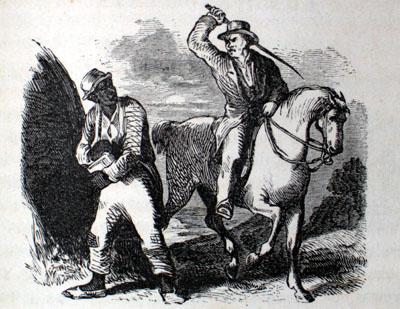
The other thing that strikes me in this is the way that internet culture is changing the culture of books in general. I’ve lamented in the past–and still do lament, to be honest–the ways in which computer culture is gradually fracturing and dispossessing the traditional sites of book culture. Places where readers Uncle Tom’s Beatinggather are increasingly becoming places where computer users gather, clicking away in their separate universes.

On the other hand, it is the case that the internet creates new cultures for readers–and not only in chat rooms and forums devoted to literature. In online book clubs I can chat with authors–at least I assume I can; I’m always wondering if it’s the author on the other end or a poorly paid graduate student doing her best to imitate the voice and interests of the latest author plugged by Barnes and Nobles. Online readings don’t yet substitute for readings in person, but I can imagine them becoming the norm. Already as a department chair I’m seeking the permission of authors to record their readings for replay on our web site. The Lunch Poetry series at UC Berkley is a good example of this on the web. I don’t think it substitutes for the great pleasure of gathering together with other readers, but who could complain that this kind of thing exists.

Of Bloggers, Bookworms, and Bibliomaniacs

Because I’ve been teaching Ralph Waldo Emerson’s essays, “The Poet” and “The American Scholar,” I’ve been spending a good bit of time over at rwe.org, which describes itself as “The Internet’s Complete Guide to the Life and Works of Ralph Waldo Emerson.” The description is awfully modest for a site devoted to a thinker whom literary theorist Harold Bloom described as “God,” but it is also awfully accurate. Indeed, every time I visit rwe.org, I find myself thinking wistfully, “What if everything on the web devoted to literature were actually this good, this complete, this organized, this useful?”

EmersonWould that it were so, but the net’s strength tends to be volume while quality, completeness, and organization are hit and miss. Of course, a lot of these things depend on not only copyright laws, but also on attracting a devoted following willing to do the work necessary. By every evidence, and not just that of Harold Bloom, the cult of Emerson remains strong. The Emersonians over at rwe.org have clearly done a great work for all of us by creating a digital monument to this most seminal of American thinkers.

Which is itself an irony and an occasion for thought. In the first place, Emerson wasn’t much given to monuments or to being monumental. In the second place, what exactly would this thinker who believed immersion in nature was the first responsibility of “Man Thinking” think about our dependence on technology, our bleary-eyed devotion to the glowing screen, our aching backs as we bend over our keyboards, our pasty complexions that testify that we have all but forgotten the existence of the sun.

My first guess is that he would be appalled by both his own monumentuality, and by our unnatural lives. Though, at the same time, it isn’t impossible to imagine Emerson as the God of not only Harold Bloom, but the first progenitor of netizens everywhere.

My sense of Emerson’s displeasure centers on Emerson’s general disease with reading. This from “The American Scholar”:

The theory of books is noble. The scholar of the first age received into him the world around; brooded thereon; gave it the new arrangement of his own mind, and uttered it again. It came into him, life; it went out from him, truth. It came to him, short-lived actions; it went out from him, immortal thoughts. It came to him, business; it went from him, poetry. It was dead fact; now, it is quick thought. It can stand, and it can go. It now endures, it now flies, it now inspires. Precisely in proportion to the depth of mind from which it issued, so high does it soar, so long does it sing.

Yet hence arises a grave mischief. The sacredness which attaches to the act of creation, — the act of thought, — is transferred to the record. The poet chanting, was felt to be a divine man: henceforth the chant is divine also. The writer was a just and wise spirit: henceforward it is settled, the book is perfect; as love of the hero corrupts into worship of his statue. Instantly, the book becomes noxious: the guide is a tyrant. The sluggish and perverted mind of the multitude, slow to open to the incursions of Reason, having once so opened, having once received this book, stands upon it, and makes an outcry, if it is disparaged. Colleges are built on it. Books are written on it by thinkers, not by Man Thinking; by men of talent, that is, who start wrong, who set out from accepted dogmas, not from their own sight of principles. Meek young men grow up in libraries, believing it their duty to accept the views, which Cicero, which Locke, which Bacon, have given, forgetful that Cicero, Locke, and Bacon were only young men in libraries, when they wrote these books.

Hence, instead of Man Thinking, we have the bookworm. Hence, the book-learned class, who value books, as such; not as related to nature and the human constitution, but as making a sort of Third Estate with the world and the soul. Hence, the restorers of readings, the emendators, the bibliomaniacs of all degrees.

(From RWE.org – The Works of Ralph Waldo Emerson)

I wish I had thought of the name “Bibliomaniac” when I was getting my personal blog started. The description is apt. Though for Emerson, of course, a sign of damnation. He would have detested the accompanying image from Northwestern University’s Library, however much I love it. But really, isn’t this more or less the image of not just ManBookworm Northwestern Reading Books, but also Man Reading Computer Screen? (Or even Man Blogging?) Through my devotion to the thoughts and words of others, I drift gradually from my own authenticity, my own innate and good self-expression, my personal experience of the Over-Soul. To be derivative is to be damned, and the only sure way to avoid derivation is to not read at all.

Well, to be sure, Emerson doesn’t go quite this far. But he was suspicious of the obeisance we give to thinkers of old. Written when he was a relatively young man, he probably didn’t give a lot of thought to the fact that he, like all flesh living, was on the way to becoming a thinker of old. And he could not have imagined me poring over and ingesting his words like a bookworm as I prepare to teach a class on him as one of the monumental literary theorist of the nineteenth century.

(Sidebar: What metaphor must we now use in place of bookworm in the world of pixels? A computer virus? Another term like “typewriter” that my someday-grandchildren will not recollect and will marvel at as an index of my age and lack of cool. Who am I kidding—my son already marvels at these things. Of course, if we give up reading altogether, spending all our time blogging, we won’t have to worry about having a different word. )

But there is a place for good reading in Emerson, and as I’ve suggested elsewhere, it has something to do with reading as a creative act. Says Emerson.

I would not be hurried by any love of system, by any exaggeration of instincts, to underrate the Book. We all know, that, as the human body can be nourished on any food, though it were boiled grass and the broth of shoes, so the human mind can be fed by any knowledge. And great and heroic men have existed, who had almost no other information than by the printed page. I only would say, that it needs a strong head to bear that diet. One must be an inventor to read well. As the proverb says, “He that would bring home the wealth of the Indies, must carry out the wealth of the Indies.” There is then creative reading as well as creative writing. When the mind is braced by labor and invention, the page of whatever book we read becomes luminous with manifold allusion. Every sentence is doubly significant, and the sense of our author is as broad as the world. We then see, what is always true, that, as the seer’s hour of vision is short and rare among heavy days and months, so is its record, perchance, the least part of his volume. The discerning will read, in his Plato or Shakspeare, only that least part, — only the authentic utterances of the oracle; — all the rest he rejects, were it never so many times Plato’s and Shakspeare’s.

I think this kind of thing, along with Emerson’s deeply felt sense of the interconnections of the immediate world with a world beyond—and with everything else in the world–is where people get the idea that Emerson was some kind of ancient God of the blogosphere. Indeed, Christopher Lydon a few years back said just this thing in an extended blog post called “A God for Bloggers.” The post at its original site is long gone, but is copied in full here . In part, Lydon argues:

Here’s my point. When we talk about this Internet and this
blogging software, this techno-magic that encourages each of us to be
expressive voices in an open, universal network of across-the-board
conversation, we are speaking of an essentially Emersonian device for
an essentially Emersonian exercise. Starting with the
electronics. “Invent a better mousetrap,” as Emerson wrote, “and the
world will beat a path to your door.”

There’s a part of me that thinks Emerson would have loved the fact that Lydon’s post had disappeared, or almost disappeared. This is the perfect condition of reading as far as Emerson is concerned: let the book/blog have its say and go away.

To Lydon’s actual content, I want to say….yeah, kind of….but not really. In the first place, there’s a way in which the technology of blogging and reading blogs tethers us to society—Emerson’s worst dirty word—in a way that books did not, this despite the aura of freedom that surrounds computerworld.

Even with the magnificence of access, I am struck by how physically limited I am in terms of my mode of access. My computer needs a proximate cord and electricity and connections—electricity even if I have a wireless connection, and reliable wireless connections are still hard to come by. Because I know next to nothing about the workings of this machine I’m writing on, because I can do nothing to control my internet connection, because I have to have access to various levels of anonymous administrators and their vast electronic resources, I am in some sense even more dependent, more inescapably tethered to society and its mores and its conventions than Emerson could have ever imagined.

We have the lovely illusion of independent creativity in our isolation, in our loggorhea of the keyboard, in our incessant speech. It’s a little like cocaine makes the addict think he’s an all powerful sex machine. The real power is the man who provides the fix. Or doesn’t. In this case, my internet administrator, or more dumbly, the squirrel that gets itself electrocuted in the router box or powerline.

By comparison, a book is a model of self-reliance, even compared to e-books with megabatteries. I can drop my copy of Ulysses in a lake, and if I’m quick enough I can probably set it by a fire, let it dry for a while, and be just fine. Then again, if not I have a new and ready supply of toilet paper, Kleenex, and firestarter.

By comparison my daughter’s ipod died irreparably after sitting next to a sweating water bottle for thirty minutes. Sitting in the sauna today, I was wondering—can an e-book stand the heat, stand those rivers of sweat that dripped off my nose into the creases of the cheap newsprint I was perusing. Could be, but I would be afraid to try. If I ruin my newspaper I’m out three bucks. If I ruin my dedicated e-reader—the one I will supposedly buy someday—I would be out 400 plus however many hundreds of dollars of books I stored up. Emerson might well look at bloggers and e-books and the like and see not evidence of infinite expressibility, but of cows in a pen.

Not saying he would be right, but he would have reason. This cow says.

Similarly, I have my doubts about the idea that blogging, simply because it is a form of expression, is the kind of expressiveness that Emerson had in mind. Indeed, for Emerson the deadliest thing for individual authenticity was repetition, was convention. And yet, does it take very much time on the web to realize just how repetitive blogging really is, just how much of it is reaction rather than response. How much of it is profane ejaculation rather than creative reading Indeed, I’m often bemused by how many blogs are largely cut and paste jobs of other blogs. Bloggers not only don’t come up with words of their own, they explicitly and joyfully use the words of others as a substitute for words of their own.

By comparison my own blog is a paen to self-indulgence. I actually write these things myself. Mostly.

At least all this lack of originality orginates with me.

In other words, there’s a part of the net’s emphasis on collaboration and connectivity that speaks to Emerson’s optimistic view of the interconnectivity of all things. There’s another part of it that speaks to Emerson’s sense of “the sluggish and perverted mind of the multitude” , where people let groups think for them rather than thinking, and speaking, for themselves.

You don’t, of course, have to rely on me for this. Rely on yourself…and on the administrators at RWE.org, and on your computer engineer, and on your electrical grid, and on your software engineer… and on…and on. Well you get my drift.

Go over to the folks at RWE.org and read Emerson for yourself.

Insomniac dreams; boys who love language

I’m not sure blogging is good for insomnia, but when I lay awake at night I find myself thinking of things to blog about. So why waste all those synapses firing in a haze of sleep-deprived wakefulness. Following up on my post of earlier this evening where I despaired of the new (or not so old, perhaps ancient?) mechanistic view of both reading and writing that seemed, well, deadly, I remembered the following video that I stumbled over at Hopping Into Puddles.

Here at least language is not a machine. I realize that if these kids were older it would play right in to Gilbert and Gubar’s thesis that language, in the hands of men and boys at least, is a phallus. Which also calls all kinds of other things to mind. Still, better this than the dead metaphors of language as a tool, a medium, an interface. If it is, let’s at least say that language is the vehicle of the heart, the hands of one soul reaching out to another.

As Michael over at Hopping Into Puddles observes, this classroom too exemplifies a lot of what could be stereotypically wrong with an educational setting. The teacher reading that private speech aloud says that the only thing the classroom is for is the instrumentality of public speech. Any word that passes sideways is called in to public account. No doubt some techie out there would like a computer to grade this young Romeo’s note for word choice, sentence variation and paragraph length.

Anything so we forget that language is first and foremost a means of touching. My pen is the tongue of a ready scribe. Indeed.

One of my great failed experiments as a teacher of composition was to ask my students to go home and write the most beautiful sentence they could muster and come back prepared to tell why they experienced it as beautiful.

I had forgotten these kids attended high schools in America. Ah well. I’ve also learned not to assign a particularly beautiful bit of prose to my composition classes and ask them to comment on what makes it an effective or ineffective piece of prose. To a man or woman they destroy my icons by describing them as “wordy,” “unclear,” clogged with long sentences, or damaged by short sentences.

My question is, who damages kids this way, having dulled their imaginations, their inner ears into insensitivity to language? It can’t be their fault, surely. They are only 17 or 18 at the most. Too young to think the only thing important in the world is getting the job done as efficiently as possible. Or probably not. This is why we send them to school no doubt.

The boys especially struggle with this assignment, confirming my general sense that the literary theories emphasizing the masculinist and misogynistic biases of language have never been around a teenaged boy who loved poetry. This is a love won at the cost–society tells him–of his manhood, not a way of winning it. What the video above leaves out is the mocking laughter the boy will face at recess, no less from girls than from the boys. And why? Words expose, exposure disarms, potentially humiliates. James Baldwin truly believed that confession of one’s hidden self was the surest way to freedom, but it’s not clear that this wasn’t a romantic dream after all. The Hemingways and Norman Mailers of the world are not exceptions that prove the rule. They are more like men so unsure of their own sexuality they have to posture and preen; their viciousness with words reassures them that, loving words, they are men none the less for that.

Writing by numbers: Who needs an audience?

A colleague who is a librarian and shares a lot of my interests in writing and reading sent me the following from a friends blog:

In a previous post my daughter blew me away with her use of eLocker to access her school files from home. Last night my son used MyAccess to write an essay online. Big whoop – right? Get this – it analyzed and graded it in an instant. Took about 3 seconds tops and he was looking at a score that broke out scoring elements not only in spelling and grammar (Word can do that) – things like content and delivery, organization, completeness of development. It was like having my 5th grade English teacher right there – red pen in hand. It saves all of his essays and projects and graphs out a cumulative progression over time, showing improvements and areas to work on. Incredible.

Here’s a snip from the site :

“With MY Access!®, students are motivated to write more and attain higher scores on statewide writing assessments. By using MY Access! in the classroom, teachers can provide students with the practice they need to improve their writing skills. The program’s powerful scoring engine grades students’ essays instantly and provides targeted feedback, freeing teachers from grading thousands of papers by hand and giving them more time to conduct differentiated instruction and curriculum planning.”

I wish I could share the enthusiasm, but I am more than a little skeptical. It may be the science/humanities divide in play, but there is no getting past the fact that a lot of this represents some of the absolutely worst things that are happening with writing in our secondary schools. And we continue to wonder why our kids can’t write and prefer to do anything but read. When we treat writing like filling in the blanks on a mindless test, and treat reading as a mechanical process that any computer can do for us, what message can our kids get but that language is something to be dispensed with as efficiently as possible, rather than one of the essential elements of our being human in the world. Something to be treasured and embraced and explored and played with; not something to slot in to the appropriate input on a machine

Just to be sure I wouldn’t go off on a completely uninformed screed (who would care? this is a blog after all), I did take some time to visit the MyAccess web site and go through the student demonstration. It is clearly more sophisticated than such programs used to be, and it does go beyond simple grammar and spell checkers. Still, it’s clearly caught up in a formal approach to writing that completely removes writing from the intentions and language of the writer, as well as from the interests and concerns of any particular reader or audience. The site makes a point of saying that it will grade for development and organization–as if these elements of writing existed somehow independently of the particular concerns and creativity of the writer, and as if we could address all audiences in a similar fashion. These folks claim that they grade “more accurately” than human readers. What could this possibly mean in grading a persuasive essay? How can a computer be more accurately persuaded than a human being. Absurdity.

One thing that the program grades for is sentence variation, vocabulary, and paragraph length. I admit this makes me nauseated. My daughter, a decent writer in part because she has learned to read a lot in our household, is asked by her teachers to write ten sentence paragraphs. If she has one sentence too many or too few she is graded down. This is done explicitly because of expectations of standardized tests–which I am sure will soon be graded by computer programs like MyAccess, to ensure that we are all standardized. There is no such thing as an acceptable length for a well-developed paragraph, and paragraph length in general is dependent upon genre and media. One of my big problems as a blogger and emailer is that I’ve learned to write for paper and ink, and my paragraphs are impossibly long for this particular media. Similarly, when I write for newspapers, I’m consistently reminded to keep my paragraphs in bounds. Same things go for sentences and sentence variations. First year students are stunned when I tell them a three word sentence can be perfectly OK. or that you can use a fragment. For effect, people, for effect. As if you were a human being instead of a machine. Some of them have actually been told by teachers to not use short sentences at all, and certainly never two in a row. Sentence variation depends deeply upon the kinds of emotional effects you are trying to achieve with readers, not on an abstract calculus that can tell you your sentence variation is good because you have X number of short sentences, X number of complex sentences, X number of such and so.

As for vocabulary. Students seem surprised when I tell them clever words can’t substitute for good writing. They assume a thesaurus indicated sophistication. I tell them to be sophisticated with the language that they know, and read and read and read to become sophisticated in the language that they don’t.

To some degree, indeed, I think this kind of write by numbers approach is designed to bypass the simple fact that kids no longer read enough–if they ever did–to become sophisticated writers and thinkers. Rather than give them the linguistic tools they need to become writers, we give them a formula to make sure they become the machines they are intended to be in this society. MyAccess isn’t part of the solution. It’s a sign of the problem.

(Bizarre sidenote: MyAccess tries to sell itself by saying it will provide 24 hour tutors at a low cost. Does anyone stop to think that in the world of the internet you can get free 24 hour “tutors” in online writing communities–or, if you really want to you can pay for it. At least you’ll be writing for other human beings rather than believing a computer program can substitute for someone that actually uses the language with which you have to communicate).

This ‘n That

I’m working on a little longer piece on Emerson, again, but thought I’d just put up a collection of unrelated stuff in the interim.


Me On Teleread

I actually don’t remember if I said anything about this, but I should have if I didn’t. Dave Rothman over at teleread.org was kind enough to ask me to blog on his space. David says he wants the perspective of a humanist to complement all the techies. He was kind enough to not say “I want someone who doesn’t know jack about technology.” In any case, my first post over there went up last week. I may have forgotten it because I posted a version of it over here as well. Still, I’m very interested in the conjunction of technology and reading, so teleread is a good place for me to further that thinking.

On Being Healthy

The Canadian Council on Learning tells us that daily reading is better for you than fiber. Oh, wait…I think we just found out that fiber doesn’t do anything for you except forestall diarrhea. (For more on diarrhea, see my completely fascinating post on this topic.) In any case, I’m happy to discover the following.

Reading each day can keep the doctor away, says a report that concludes sifting through books, newspapers and the Internet — on any topic — is the best way to boost “health literacy” skills such as deciphering pill bottles and understanding medical diagnosis.

Daily reading, not education levels, has the “single strongest effect” on the ability to acquire and process health information, the Canadian Council on Learning said Wednesday.

=====

The learning council reported Canadians aged 16 to 65, who said they read daily, scored up to 38 per cent higher than the average on the health literacy analysis.

Daily readers over 65 years old scored as much as 52 per cent higher than the average for their age.

“Although it may not be a panacea, this report makes a compelling case that reading each day helps keep the doctor away,” said the report.

I think it’s wise to have a tad bit of skepticism about stats like this. I wonder if there are correlations between regular reading and social class, for instance, and if so is the relationship to health a function of reading or a more general issue of access to health care, material resources, and knowledge itself. Still, why look a gift horse in the mouth. At this rate I am going to live a good long time. Actually, I better stop blogging because it’s definitely cutting in to my reading time. (Who am I kidding, I just don’t watch TV anymore.)

Reading More or Reading Better

A blog over at Metafilter raises the typical objections to the notion that we’re in a reading crisis. So what if we’re reading less literature; we’re reading more than ever on the web, right?! On the other hand, they also point out that Americans ability to read at all seems to be declining, pointing to the following study at the National Center for Education Statistics:

On average, U.S. students scored lower than the OECD average (the mean of the 30 OECD countries) on the combined science literacy scale (489 vs. 500).

The average score for U.S. students was:

  • higher than the average score in 22 education systems (5 OECD countries and 17 non-OECD education systems)
  • lower than the average score in 22 education systems (16 OECD countries and 6 non-OECD education systems)
  • not significantly different from the score in 12 education systems (8 OECD countries and 4 non-OECD education systems)

Ummm….One big problem, guys. Science and Math literacy is not the same thing as reading and writing literacy. And so I’m not quite sure what this has to do with whether people are reading literature any more or not. Though I’m sure Dana Gioia over at the NEA would be glad to claim that reading Moby Dick helps people with their algebra. Of course, it could be that reading skills have declined so far that the folks can’t even tell what science and math literacy really is.

Links:

A number of people have been kind enough to comment about the blog or link to my blog in various ways over the past several weeks. A few of them:

Free listens: A blog of reviews about audiobooks. What a great thing. I’ve said that I wish there were more sorting and evaluating of some of the free stuff on the web. Heresy of heresies, I don’t think massing blog stats necessarily tells me much about quality. I mean, videos of Brittany Spears’ pudenda are among the most popular on the web. Does that really tell us anything…about the quality of the video, I mean. Not about the state of America… or the state of Brittany Spears body parts. I haven’t had a chance yet to listen to the audiobooks to see if I agree with the judgments, but I’m glad someone is taking up the flag to do such a thing.

The Reading Experience: Daniel Green has me on his blogroll, and I’ve had The Reading Experience on mine from the beginning. I think Daniel is a little narrower in his literary judgments and tastes than am I, but I admire anyone immensely who has left academe and made it on his own. His blog is always thoughtful and often provocative.

There’s Just No Telling: “Monda” has commented on my blog before, and has a lovely sight devoted to reading and writing. From what I gather she is a teacher of creative writing, who all deserve to be sainted.

Brad’s Reader: Brad lists me as an interesting read. And I didn’t even have to pay him.

There are others that I’ve missed, and I’ve got to stop somewhere in any case. So if you’ve linked to me and I’ve missed you, let me know. I’ll keep you in mind next time I do this.

John McCain–Happy Hemingway or Hillary Redux

This in from the NYTimes evaluating last night’s victories by John McCain and Barack Obama:

On the Republican side, Senator John McCain of Arizona won a commanding victory over Mike Huckabee in the Wisconsin contest and led by a wide margin in Washington State. All but assured of his party’s nomination, Mr. McCain immediately went after Mr. Obama during a rally in Ohio, deriding “eloquent but empty” calls for change.

Umm…I’m wondering. Why does McCain think he can make this line work any better than Hillary has made it work for the past three months? Still, McCain comes at it from a slightly different angle. If, as I suggested a couple of weeks ago, Hillary is trying to protect the legions of naive American innocents from from the seductive Black Lothario, it seems to me that McCain is invoking more directly the masculine resistance to beautiful words that has dominated white male experience in the United States for the past 150 years or so.

No accident that McCain’s favorite novel is Hemingway’s For Whom the Bell Tolls. This from Vanity Fair:

The enduring question about John McCain is what, finally, he is willing to do to win. His favorite novel is For Whom the Bell Tolls, Hemingway’s story of an idealistic American, Robert Jordan, who goes to fight for the Loyalists in the Spanish Civil War. Jordan is willing to risk his life but never his honor, and his dying meditation, that “the world is a fine place and worth the fighting for,” gave McCain’s second memoir its title.

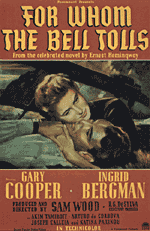
Indeed, McCain has more than his share of doomed to dutyFor Whom the Bell Tolls poster integrity that characterized Hemingway’s public persona. The title of Hemingway’s book, of course, refers to an ultimate destiny in death and the unflinching effort of the real man to face that inevitable destiny with something like grace. A characteristic effort of Heminway’s heroes, even when they mostly fail the chance. There’s a way, of course, in which McCain clearly does live out the Hemingway mythology. The prisoner of war refusing to bend the knee to his enemies, the maverick political independent, the loyalty to Bush on principle regarding the war, even when in his heart of hearts I think McCain finds Bush despicable. Even McCain’s political story this primary seasons unfolds like that of a Hemingway hero, the man willing to do what he believes in without resources. The belief that a man should stand up and do the right thing even in the face of overwhelming odds and the inevitable odds of death. As the Times suggested a couple of days ago, he doesn’t even pander well, which is precisely what makes him attractive to so many. Even I like McCain, and I disagree with him about almost everything. Proof again that policy statements and knowing the ropes may be important things for a Senator, but it’s not so clear that this kind of political minutiae is what will get people to follow you.

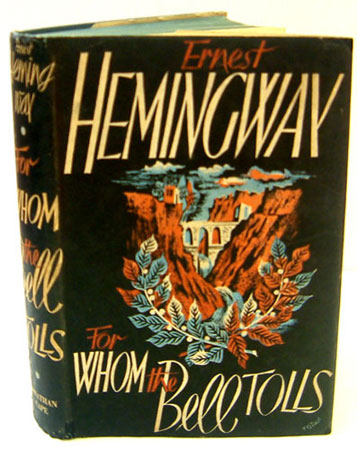
[Ironic side bar: The title of Hemingway’s novel is drawn from John Donne’s MeditationFor Whom the Bell Tolls First Edition number XVII, republished as the following poem:

‘No Man is an Island’ MEDITATION XVII, Devotions upon Emergent Occasions

No man is an island entire of itself; every man
is a piece of the continent, a part of the main;
if a clod be washed away by the sea, Europe
is the less, as well as if a promontory were, as
well as any manner of thy friends or of thine
own were; any man’s death diminishes me,
because I am involved in mankind.
And therefore never send to know for whom
the bell tolls; it tolls for thee.

I say “ironic” because Donne’s meditation is primarily about the unity of mankind, “No man is an island.” We are all part and parcel of one another, involved in all mankind. Sounds positively Obamian. We are the hope we’ve been waiting for. We are the world. We are the children.

In Hemingway’s hands the solitary confrontation with death is a chance for the man to test one’s mettle against the worst that nature offers, like the bullfighter in the ring. Finally we do this alone. I can’t quite see McCain with Donne. Maybe if he stood up and said, “any man’s death diminishes me…except that of Saddam Hussein, Osama bin Laden, and various and other choice enemies who would be better gotten rid of.”]

Nevertheless, even if McCain runs on this Hemingwayesque idealism, he’ll give Obama a better run for his money that Clinton is right now. On the other hand, if he tries to tell the American people that they are naive for hoping that the world can be different than thepolitical world the baby boomers created …well…politicians don’t get so far telling people they are stupid. The irony of McCain is that he was, in some respects, the Obama of the last political season. If he goes against the instincts that made him a winner in the past, he’ll just be another old guy that Obama will blow out of the water.

Side bar number two: Obama might well be saying, it’s morning in America. Hillary could learn more than one lesson from Ronald Reagan.

Side bar number three: I’m not so sure Obama isn’t more ruthless and politically savvy than Clinton gives him credit for. He appeared on television in the middle of Clinton’s speech last night, and every station in the country dropped Hillary to hear what he had to say. Why does Clinton think Obama is so unable to handle tough as nails and ruthless Republicans? He’s shown every ability to handle tough as nails and ruthless Democrats like, umm, Bill and Hillary Clinton.

Let’s get together and read

I ran across this somewhere, probably through another blog, though I don’t remember now. Anyway, now we have the ability to connect with people anywhere in the world who may be reading Shakespeare at this particular moment. As I write this post, 242 people are reading Shakespeare, and I even know that 23 are reading Hamlet, mostly in the United States and Europe, but I have seen several readers of Shakespeare in Japan and China over the past few days. Of course, that’s only people who are intrigued enough by this service to sign up.

I’m vaguely interested in the forms of socialization that are associated with web world. Although it comes across as very individualizing–a place of me doing my own thing–in a different way it can be very clubby and group-think oriented, like a group of high school girls who can’t go to the bathroom without four friends. I see this to some degree in what happens with online reading. Over at Book Glutton–so far as I can tell it has yet to take off, but this is the concept in any case–the idea is to read along through a text with a group of friends, giving you the capacity to read together in real time.

I don’t think there’s anything particularly wrong with this per se. Indeed, it’s sometimes a very good exercise to have a group of students sit together and read the same book silently. It can be a weirdly interesting bonding experience. But rather than being the exception, it’s almost like reading the same thing at the same time as someone else becomes a need in the culture of the web.

Not sure if that’s quite the case, but I can see it everywhere. My daughter is only satisfied being on Facebook if she is at the same time chatting with a dozen of her friends online.  WordPress let’s me know how many people are blogging “right now.” I wonder what need this feeds? Are they trying to reassure me that I am not alone here sitting in front of my computer, despite all evidence to the contrary. We’re all in this together.

Does it make a difference to how people read or write, or even affect their interest in reading and writing? I finally got around to joining up at BookGlutton because I thought it would be an interesting experiment in online reading. Trouble was, I couldn’t find groups that were reading anything I was interested in reading. So I didn’t read at all, despite the fact that there were a lot of different books to choose from. Now this is not a hack on BookGlutton–some few of the folks over at Librivox are still PO’d at me for treading on their territory. (Unintended, but nevertheless quite good for the blog stats). At Book Glutton I have the option of trying to form my own group with other people, just didn’t have the time or inclination. But I also wonder whether services like Book Glutton or other things like this will transform the way reading is practiced as a social experience, even affecting what people choose to read. I would bet that something like Amazon’s Kindle will develop similar kinds of capacities in future incarnations. As a consequence, I can easily imagine people choosing not to read a book because no one happens to be reading it at the same moment. No one there to chat with while I read. Five years ago I would have thought this was a fantasy; I’m not so sure it isn’t a present and growing reality.

There’s some historical precedent; in the classical period, reading often took place at social gatherings of the elite, a necessary corollary to reading aloud. What goes around comes around. Maybe fifty years from now reading alone will seems as odd to our culture as reading-as-online-chat seems to me today.