Monthly Archives: January 2008

In Praise of Shyness, Solitude, and Oppositional Defiant Disorder (And All Other Personality Disorders Associated with Reading): Or, What’s Wrong With Being Disconnected?

A review posted on spiked-online.com, “Humanity, Though Art Sick,” discusses Christopher Lane’s new book Shyness: How Normal Behaviour Became a Sickness. Among other things it appears that Lane discusses the exponential pathologization of the human race at the hands of the American Psychiatric Association, with particular emphasis on the way shyness or a tendency toward introversion has gradually come to be seen as a deviation from human normality.

A couple of excerpts from Helene Guldberg’s review:

‘In my mother’s generation, shy people were seen as introverted and perhaps a bit awkward, but never mentally ill.’

So writes the Chicago-based research professor, Christopher Lane, in his fascinating new book Shyness: How Normal Behaviour Became a Sickness. ‘Adults admired their bashfulness, associated it with bookishness, reserve, and a yen for solitude. But shyness isn’t just shyness any more. It is a disease. It has a variety of over-wrought names, including “social anxiety” and “avoidant personality disorder”, afflictions said to trouble millions’, Lane continues.….

Lane writes: ‘Beginning in 1980, with much fanfare and confidence in its revised diagnoses, the American Psychiatric Association added “social phobia”, “avoidant personality disorder”, and several similar conditions to the third edition of its massively expanded Diagnostic and Statistical Manual of Mental Disorders. In this 500-page volume… the introverted individual morphed into the mildly psychotic person whose symptoms included being aloof, being dull, and simply “being alone”.’ Shyness now allegedly almost rivals depression in magnitude, a ‘sickness’ for which ‘almost 200million prescriptions are filled every year’ in the USA. Apparently, social phobia – shyness – ‘has become a pandemic’, says Lane….

The sad consequence of this state of affairs is that the range of ‘healthy behaviour’ is being increasingly narrowed. ‘Our quirks and eccentricities – the normal emotional range of adolescence and adulthood – have become problems we fear and expect drugs to fix’, Lane writes. ‘We are no longer citizens justifiably concerned about our world, who sometimes need to be alone. Our affiliations are chronic anxiety, personality or mood disorders; our solitude is a marker for mild psychosis; our dissent, a symptom of Oppositional Defiant Disorder; our worries, chemical imbalance that drugs must cure.’

In general this book—at least based on the review—seems simpatico with the recent essay by Eric Wilson in the Chronicle of Higher education (Yes, the essay that I generally dissed in an earlier post, but which I still think was topically interesting. According to Wilson:

A recent poll conducted by the Pew Research Center shows that almost 85 percent of Americans believe that they are very happy or at least pretty happy. The psychological world is now abuzz with a new field, positive psychology, devoted to finding ways to enhance happiness through pleasure, engagement, and meaning. Psychologists practicing this brand of therapy are leaders in a novel science, the science of happiness. Mainstream publishers are learning from the self-help industry and printing thousands of books on how to be happy. Doctors offer a wide array of drugs that might eradicate depression forever. It seems truly an age of almost perfect contentment, a brave new world of persistent good fortune, joy without trouble, felicity with no penalty.

Why are most Americans so utterly willing to have an essential part of their hearts sliced away and discarded like so much waste? What are we to make of this American obsession with happiness, an obsession that could well lead to a sudden extinction of the creative impulse, that could result in an extermination as horrible as those foreshadowed by global warming and environmental crisis and nuclear proliferation? What drives this rage for complacency, this desperate contentment?

I’m not sure that this amounts to a backlash, but anecdotally it does seem to me that there’s been a little more questioning of the notion that we ought to get rid of every hiccup in our emotional well-being. Recently a mother of one of my children’s friends told me they had taken their child off mood-altering medication. The child has responded with new confidence in class and by growing two inches in two months. Re. moods….Maybe there’s something OK about feeling that there’s something askew in a world where men and women are coming home maimed from a foreign war in which they’ve done far more maiming of women and children than our own country would ever politically endure in its wildest dreams or nightmares. Maybe it’s Ok for a teenager to feel that they don’t fit in so well with the in crowd. I think we think every such teenager is on the brink of Columbine. Maybe feeling a little disconnected will lead them to … read books. Hey, maybe it’s Ok to not feel wonderful, and maybe, just maybe it’s Ok to not want to join in with the gang all the time. Gangs, after all, are called gangs for good reason.

For my own purposes, I’m intrigued by the degree to which behaviours often associated with reading fall along the lines of…well…currently defined personality disorders. I mean, read the history of readers from Jean Toomer to Richard Rodriguez to Anna Quindlen. (To Pete Powers, if I had an autobiography out there that anyone would read). We are not, for the most part, the types who are great joiners. I mean, Joyce Carol Oates is one of my heroes. A person who spends her life alone in a room, apparently, about 14 hours a day, doing little more than disgorging words in to a computer.

Indeed, I remember as a college student reading an essay wherein Walker Percy says something like there’s nothing more alienating for a sad and lonely person than reading a book about happy people while sitting on a bus full of happy people. (Actually, I think there is something more alienating in my experience; attending a party full of happy people and not having anything at all on hand to read, not even a book about happy people). By contrast, the happiest thing in the world for such a person is to read a story about a sad and lonely person while sitting sad and lonely on a bus.

Percy didn’t make me want to go out and join a book group. He did make me smile and ask “How did he know?” I didn’t have to be with Walker Percy and share a hot toddy to know I was not alone, less alone than I often feel at parties with people sharing hot toddies. (Which, as I think of it, I never am since hot toddies are from Louisiana and I don’t think they know how to make them in Pennsylvania.)

This leap is full of logical fallacies, but it seems to me no accident that the apparent decline in reading of fiction and of levels of reading comprehension has accompanied the pathologization of solitude in American culture. It hasn’t just been the American Psychiatric Association. It’s been in business with business models that emphasize working groups rather than individual initiative. It’s been in religion and it’s been in the discussion of family values.

(Let me say that although I am a Democrat I nearly became nauseated when Barack Obama, Hillary Clinton, and John Edwards proclaimed in their last debate “We’re all family.” Good Grief. It’s enough to make one think again about John McCain. Anything to escape the cloying grip of politics family style. We aren’t a village or a family. We are a big beast of a country, largely run by a military-industrial complex intricately intertwined with a system of global finance and corporate capitalism that even leading economists admit that they can’t fully comprehend. I would like to believe that our politicians realize we don’t want the country run by our Aunt Joe or Uncle Sue. No accident that John McCain spent five years alone in a brutal cell. He learned something all the joiners may never figure out).

Above all things, of course, the ideology of the internet–with its relentless drumbeat of connection, connection, connection–teaches us that lonerdom is peculiar and worthy of suspicion . Ever faster, ever more omnipresent, ever more inescapable. The compulsion to “friend”–the ubiquitous and sad new verb of our era–utter strangers. Even those that critique the internet as not really connecting us at all—as Lee Siegel apparently does in in his newest book on internet culture—even these critics exalt the ideal of connectedness above all else. Internet connection is bad, not because connection is worthy of thought or criticism, but because the internet purportedly does not provide true and authentic connection and community. Everyone and their mother exalts community and connectedness. What new pill or what technology or what community reading program will get us there? Whereas dictatorships control readers and writers by shooting them, we control them by pathologizing the behaviours that might lead…horrors…to hours spent alone doing God knows what.

Indeed, why read anymore at all to confirm the importance of your own solitude and sadness. Take a pill, you’ll feel better in the morning. Or join a book group.

At moments like this I feel like becoming a back-to-the-lander.

Let it be said, maybe we are too connected. Maybe we need more solitude. Maybe we need more silence without the relentless need to hear (or see on screen) the clattering voices of someone else, as if we are too afraid to listen to the clattering voices in our own imagination.

In this spirit, I have to confess that I am less than thrilled with the advent of bookglutton.com (though, in the spirit of America the connected, I’m planning on joining up), which I discovered on a blog at teleread.org this morning. At Bookglutton, you read books collectively online with others, viewing their comments on every page as you go along. Every book a blog. No longer the absorbed attention that borders on the mystical that we experience in traditional intensive reading, caught up in the alternative world created by another’s imagination. Instead, now, even reading books will be like attending movies where one-third of the audience converses on cell phones, another third texts friends on the opposite side of the theater, and the final third feels compelled to engage everyone around them with their commentary–as if they were afraid they might be sitting alone in the dark.

Am I alone in thinking that there is something pathological about this need to connect? Is it possible that a people who has lost the capacity for contented solitude, or even discontented solitude, who has not learned to embrace its own loneliness, is it possible that such a people is maybe just a little bit sick?

Now that you have finished reading my blog, write me a comment. Please. I am feeling disconnected. And lonely. And Sad.

I think I’ll take a pill. Or find someone to friend.
Support Kenya

Friends, given the disaster that is ongoing in Kenya, I decided to create a new page, “Support Kenya,” that would allow folks to get involved (the few dozen of you who visit this page, that is:)). There’s a link on that page from folks at AVAAZ.org that will allow you to contact Secretary of State Condoleeza Rice to urge more decisive diplomatic intervention on the part of the United States.

More, and yet more

I think there’s something about the great sea of information that leaves one feeling perpetually belated. Or at least me. My increasing sense is that EVERYONE WHO IS ANYONE has already been in to books as art and I, like the nineteenth century rube showing up in town who marvels over flush toilets, am playing a pointless game of catchup.

(By the way, did you know that there’s actually a page on the web called “The History of the Flush Toilet.” Ain’t life grand.)

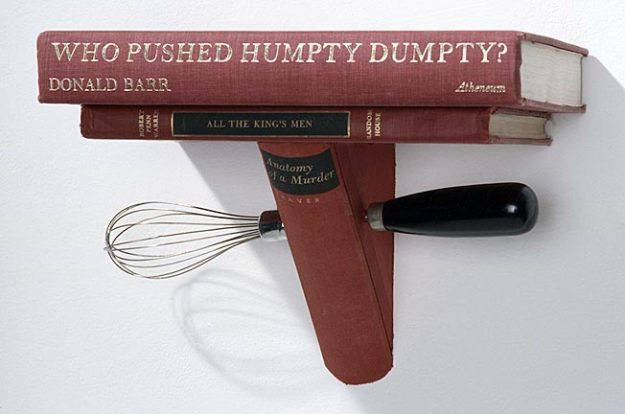
Tiffany Derewal posted a link on a comment, but I wanted to make sure it didn’t get buried. This great page shows the work of Jim Rosenau

A great shot from Rosenau’s page

Humpty Dumpty–Jim Rosenau

Rosenau’s bio page has this to say: “A third generation publishing executive (descended from two generations of Random House VP’s), Jim grew up in a household with over 5,000 books.”

This explains why he has so many of them to destroy.

I may write more later. At the moment I’m reading through Pierre Bayards “How to Talk About Books You Haven’t Read” and remain uncertain as to whether he is a genius or an ass. A certain measure of both , no doubt. More ass than genius. The genius part comes in how he managed to make this thing a best seller. His general advice is that we only talk about books we haven’t read, so I guess I’m disqualified.

Death, the Mother of All Beauty; and also of BookPorn

Ok, a morbid start. Still, I thought I’d recall my post from a few days ago when I speculated on the idea that books become art objects as their cultural life decays. Of course, I forgot that the romantics had already covered the ground where death begets beauty—which is not to say it’s false ground or can’t be re-covered in a new key. I was reminded of the romantics by Eric Wilson’s current essay in the Chronicle of Higher Education, “In Praise of Melancholy.”

One would think that Keats’s life would have fostered bitterness in him, but he remained generous in the face of his difficulties. He didn’t flee to the usual 19th-century escapes: Christianity or opium, drink or dreaming. Though he unsurprisingly underwent pangs of serious melancholia (who wouldn’t, faced with his disasters?), he nonetheless never fell into self-pity or self-indulgent sorrow. In fact, he consistently transformed his gloom, grown primarily from his experiences with death, into a vital source of beauty. Things are gorgeous, he often claimed, because they die. The porcelain rose is not as pretty as the one that decays. Melancholia over time’s passing is the proper stance for beholding beauty.

I thought I might blog more extensively on Wilson’s essay, but it ended up being less interesting than I had hoped. I’m wondering why, for an English prof, he seems so given to the vague and gauzy generalization over the vivid detail or anecdote. Still, credit for reminding me of those romantics. And my title of course is from the ubiquitous Wallace Stevens and what may be the most singularly beautiful poem in the American idiom, “Sunday Morning.”

Death is the mother of beauty; hence from her,
Alone, shall come fulfilment to our dreams
And our desires. Although she strews the leaves
Of sure obliteration on our paths—
The path sick sorrow took, the many paths
Where triumph rang its brassy phrase, or love
Whispered a little out of tenderness—
She makes the willow shiver in the sun
For maidens who were wont to sit and gaze
Upon the grass, relinquished to their feet.
She causes boys to bring sweet-smelling pears
And plums in ponderous piles. The maidens taste
And stray impassioned in the littering leaves.

In the words of the equally ubiquitous Stanley Fish, “Wow. Isn’t that just Great.”

Anyway, I launched into this not to talk about morbidity or about Stanley Fish but to return just briefly to my fascination with books as objet d’art. (I confess I’m not even entirely sure what this means in the Wittgensteinian sense that meaning is in the use. When do you use it? surely somehow differently than “art object” or people wouldn’t say it in French. Or maybe they’re just being pretentious.)

Courtesy of Scott Esposito at Conversational Reading, I again found some absolutely fabulous images of books as works of art at Signonsandiego. The artist, Aaron T. Stephan, has a new show at Quint Gallery entitled “Building Houses/Hiding Under Rocks.” As the website puts it, “he’s converted some 20,000 discarded books into … an artist’s Lincoln Logs.”.

One of my favorites:

Artist Aaron T. Stephan–Building Houses Hiding Under Rocks

Stephan’s website has more of this great stuff. I especially like the wrench made from pages of Immanuel Kant’s Critique of Judgement.

Courtesy of Scott McLemee’s column at Inside Higher Ed about the best academic blogs on the web, I came across Rachel Leow’s site Idlethink, though I think she also calls it A Historian’s craft . Rachel regularly posts her photos of books in a running series she calls BookPorn. These are found objects, I guess—I’m no art historian. A beauty she’s discovered in the everyday display of books rather than in the self-conscious manipulations of the book’s physicality. Still, they fall in with my general mulling over what strikes me as a relatively new interest in the book as plastic art.

One of my favorites from Rachel’s collection:

Rachel Leow at Shakespeare and Co

My good friend Julia Kasdorf has a book entitled , The Body and the Book reflecting on women’s roles as embodied readers and writers, among other kinds of embodiment. Rachel’s pieces and some of the others I’ve pointed to over the past couple of weeks make me think we need a book entitled “The Body of the Book.”

Not that I will write it. I can barely make my way around an essay.

(Sidenote: Rachel also had some helpful hints for blog protocols in using her work. So thanks, Rachel. As I say, I can barely make my way around an essay. So far, blogging is pretty much glorified typewriting with nifty pictures as a bonus in case people get bored. Or in case I do.)

Still, I think there is something very poignant about Rachel’s photos. Seeing these photos makes the heart ache. Or at least a booklovers heart ache. Ok, so I’m weird; they make my heart ache. And I think it is somehow tied to the fact that Rachel’s work and other work like it call attention to the materiality, and thus the fragility, of books.

For us, books have been ideologically tied to permanence. Like the old woman in Stevens’s “Sunday Morning” who can’t stand the flowing by of time, for us books have bespoken our longings for and reaching after an unchanging permanence. Turning books themselves in to art suggest that books, too—and the texts and human knowledge they contain???—are more akin to the beauty sown by death, strewn leaves “of sure oblivion.” All the more so because digital culture is proud of its ephemeral impermanence. Flowing as a position of no position.

There’s a tricky dynamic in Stevens’s world of beauty. It’s not that ephemera is beautiful in and of itself. Indeed, change and movement are only beautiful in the hoped for permanence they suggest and make impossible. Beauty is the shape of our desire, aroused only in the awareness of its fragility and passing.

Perhaps this is why the sight of old books—or any books, rightly rendered–makes me ache. They are the sign of all things.

Fish Redux

A response of mine to Fish’s latest arguments about the Humanities was posted today in the comments section of the Times at Fish’s blog. I think I’m going to write my parents and tell them I’ve now been published in the New York Times! However, they think it’s a liberal rag. I doubt they will mention it to their friends at church. (Side note:  What exactly is a liberal rag in digital world–liberal pixels?  liberal electrons?  Maybe an e-rag.  I like it.)
My comment ran as follows:

I wonder whether the refutation of Dr. Fish’s position lies within the framework of his own argument, at least insofar as English studies is concerned. He begins with a marvelous disquisition on the way language works and means–or does not mean what we think it means–in Herbert’s poem. He ends by saying “I can remember countless times when I’ve read a poem (like Herbert’s ‘Matins’) and said ‘Wow!’ or ‘Isn’t that just great?’”

The rhetorical shape of his argument–to say nothing of its length–makes us conflate these two moments, and we find ourselves agreeing with him when he says, “I cannot believe, as much as I would like to, that the world can be persuaded to subsidize my moments of aesthetic wonderment.”

However, these are two very different moments of response, two very different pleasures, we might say. In the final instance, who, after all, would pay for us to say to one another “Gee whiz, isn’t literature grand.” The first instance, however, is an exemplary instance of close reading learned through a substantial amount of reading,training, and practice (in both reading and writing). Fish’s close reading points to the particular role that literary studies can play–though it often fails to play–in understanding the nature, history and possibilities of written language.

If I am right about this, a rationale for this kind of study lies not in Fish’s aesthetic wonderment, but in rhetoric and philology. Surely the way written language works in the world deserves the kind of careful scrutiny we give to bacteria and to economics. We don’t need to think of the utility of this kind of study in immediate terms. The study of pure science or mathematics, for instance, proceeds without any clear sense of it’s immediate utility, and students are required to study chemistry even when the day to day practice of their lives rarely requires it’s application.

Similary, we might say the careful study of how written language works need not be justified by it’s immediate application, but by a general sense that it is better to have human beings in the modern world educated in the ways language has functioned and can function and may function. A related gesture would be to return to a recognition that the study of literature can exist in part to create better writers–something that most English departments these days choose to see as beneath the seriousness of their enterprise. However, undergraduates that have understood the textual dimensions of complex, dense, and difficult texts may be in a better position to apply that understanding to their own writing in the future.

This might be a pleasure worth paying for.

Michael Chabon and Ghost of Wallace Stevens in Political Slug Fest!

Ok. Again. Not. However, I remain fascinated by the rhetorical irresponsibility that blogging makes possible.

In keeping with the literary politics of the season, the New York Times reports this morning that there’s a new book out with women writers reflecting on Hillary Clinton. The title, Thirty Ways of Looking at Hillary Clinton, recalls Wallace Stevens “Thirteen Ways of Looking at a Black Bird.” The choice apparently reflects the content of the book since Stevens’s poem is all about how perspective makes and in some sense is the object of our reflection.

I

Among twenty snowy mountains,
The only moving thing
Was the eye of the blackbird.

II

I was of three minds,
Like a tree
In which there are three blackbirds.

III

The blackbird whirled in the autumn winds.
It was a small part of the pantomime.

Ok, I hope you have a better time making sense of this than I do with my students. After saying “This poem is about perspective” conversation mostly comes to an end and we twiddle our thumbs for fifty minutes. Nevertheless, the blackbird, and apparently Hillary, are nothing apart from how we construct them in our imaginations.

Kakutani isn’t terribly impressed, but I have to say that I find Kakutani too often follows the unacknowledged dictum of many contemporary book and movie reviewers: Slander everything unless you find it absolutely impossible not to. Finding fault too often substitutes for seriousness.

The following is from the introduction by Susan Morrison:

“On a shelf in my kitchen is a campaign button that I picked up during the 1992 presidential race. Over a photo of Hillary (bangs and headband phase—which was basically my look then, too) are the words ‘Elect Hillary’s Husband.’ Back then, the slogan produced a kind of giddy frisson: not only was the candidate just like someone I could have gone to college with—a baby boomer—but his wife was, too. And she had a job! I had only known first ladies as creaky battleaxes who sat under hairdryers and wore brooches. The thrill associated with that button feels far away now, and it’s hard to know exactly why. There’s no doubt that the rinky-dink scandals of the Clinton administration and the dismal parade of special prosecutors took the gleam off the fresh start that the Clintons brought with them to Washington. But that doesn’t quite explain how now, fifteen years later, there is not more simple exuberance at the idea that we may be about to elect our first woman president.
….
“No other politician inspires such a wide range of passionate responses, and this is particularly true among women. As I talked with women about their reactions to Hillary, some themes came up again and again. Many women were divided within themselves as to how they feel about her, and I noticed a familiar circle of guilt: these women believe they should support Hillary as a matter of solidarity. But, because they expect her to be different from (that is, better than) the average male politician, she invariably disappoints them; then they feel guilty about their ambivalence. Some feel competitive with her. Having wearily resigned themselves to the idea that ‘having it all’ is too much to hope for, they view Hillary as a rebuke: how did she manage to pull it off—or, at least, to appear to pull it off? Other women say they want to like her but are disturbed by the anti-feminist message inherent in the idea of the first woman president getting to the White House on her husband’s coattails. Then there are women, like the late playwright Wendy Wasserstein, who are queasy over the way Clinton’s popularity spiked only after she was perceived as a victim. When it became clear that Hillary was going to stand by her man after the Lewinsky fracas, Wasserstein wrote a disheartened Op-ed piece in the New York Times. ‘The name Hillary Rodham Clinton no longer stands for self-determination, but for the loyal, betrayed wife,’ she wrote. ‘Pity and admiration have become synonymous.’

Side note: Morrison’s text is one of many that echo Stevens’s poem. Gates’s Thirteen Ways of Looking at a Black Man, Smiley’s Thirteen Ways of Looking at a Novel. A quick Google search shows 44,600 references to the phrase “Thirteen Ways of Looking.” There are, I guess 17 extra ways of looking at the prismatic Hillary Clinton. I find Wallace Stevens resilient popularity and influence on our culture a bit boggling. Maybe it’s because most of us are leading the dull lives of insurance salesman and long to release our inner poets.

Thus the popularity of blogging? Anyone can be a poet now. Everyone is.

So much for craft.

Stanley Fish Pleasures Himself, Yet Again

Fish returned again today to his continued probing of the rationale for the humanities, concluding—surprise!—there is no such rationale, at least not one that anyone will bother to pay for. Fish’s arguments change, somewhat, this time around but he’s mostly sticking to familiar territory, unconvinced by the hundreds of readers who mustered the energy to respond before the Times cut off the opportunity to comment.

Fish begins with an interesting and powerful disquisition on the nature of humanistic investigations.

“In a poem titled ‘Matins,’ the 17th century Anglican poet George Herbert says to God, If you will ‘teach me thy love to know . . . Then by a sunbeam I will climb to thee.’ But the dynamics of the proffered bargain – if you do X, I’ll do Y – are undercut by the line that proposes it, and especially by the double pun in ‘sunbeam.’

“‘Sun’ is a standard pun on Son; it refers to Jesus Christ; ‘beam’ means not only ray of light, but a piece of wood large enough to support a structure; it refers to the cross on which a crucified Christ by dying takes upon himself and redeems (pays the price for) the sins of those who believe in him. So while ‘by a sunbeam’ seems to specify the means by which the poem’s speaker will perform a certain act – ‘I will climb to thee’ – the phrase undercut his claim to be able to do so by reminding us (not him) that Christ has already done the climbing and thereby prevented (in the sense of anticipating) any positive act man mistakenly thinks to be his own. If the speaker climbs to God, he does so by means of God, and cannot take any personal credit for what he ‘does.’ If he truly knows God’s love, he will know that as an unconditional and all-sufficing gift it has disabled him as an agent.

“This brief analysis of a line of poetry that simultaneously reports a resolution and undermines it is an example of the kind of work and teaching I have done for almost five decades. It is the work of a humanist, that is, someone employed in a college to teach literary, philosophical and historical texts. The questions raised in my previous column and in the responses to it are: what is the value of such work, why should anyone fund it, and why (for what reasons) does anyone do it?”

This is Fish the quintessential close reader, to my mind demonstrating once again that whatever the peregrinations he and we may have made through high theory, our debt as a discipline to the New Critics remains in some sense unexceedable. What we do, he rightly says, what we always return to, what we inevitably affirm whatever our allegiances to history or whatever our convictions about the possibility and impossibility of meaning, is this activity, the simple and yet difficult act of attending, of reading what the flow of language tempts us always to miss.
For Fish, again, this is its own pleasure and its own rationale. It serves no larger purpose. And, as he now comes out frankly in his final paragraphs and asserts, it’s not clear that there is any justification in being paid for it.

“One final point. Nguyen Chau Giao asks, ‘Dr. Fish, when was the last time you read a poem . . . that so moved you to take certain actions to improve your lot or others?’ To tell the truth, I can’t remember a single time. But I can remember countless times when I’ve read a poem (like Herbert’s “Matins”) and said ‘Wow!’ or ‘Isn’t that just great?’ That’s more than enough in my view to justify the enterprise of humanistic study, but I cannot believe, as much as I would like to, that the world can be persuaded to subsidize my moments of aesthetic wonderment.”

To some degree I’ve already argued with Fish’s position here in my post last Thursday. However, I want to point out today that there’s a very long distance between his opening disquisition and his late affirmation of aesthetic wonderment. In between, Fish again makes the case that the study of literature does absolutely nothing in the world. However, I think his own example may suggest otherwise.

Fish continues to imagine the bases of the discipline in the triumph of literature, he is stuck in noting the division between the production—and perhaps usefulness—of great art and the uselessness of studying it. However although this self-substantive view of literature has been at the center of English studies for the past century, it seems to me that we need not be captive to this particular image of what it is we do and why.

Fish the rhetorician surely knows that an older rationale for study of literature is that it teaches us about how language works and how it can be used. Literature is not an icon that exists apart from the world in a separate sphere; Literature subsists in language, and by studying literature seriously we come to understand better how language works in the world, no small thing to accomplish. Indeed, the skill that Fish ably demonstrates in his opening is not a natural but a learned skill, one that requires substantial practice and study.

I have suggested with some colleagues for some time now that English studies needs to return to or reemphasize it’s roots in rhetoric and philology. The study of literature is only one, but one very good way to study how language has worked in the past and what its possibilities might be for the future. As a corollary, writing studies needs to be rescued from it’s marginal status in most English departments. Unless one believes that imitation is useless, the study of how works of literature achieve their effects in the present—or how they achieved similar or different effects in the past—can be a doorway in to understanding how the written word can function effectively in the present.

I realize this only applies to English studies; the rest of the humanities will have to fend for themselves. However would my suggestions satisfy Fish even as to the study of literature. I doubt it. But that’s because he has narrowly defined his pleasures over and against utility. Perhaps Fish has studied a bit too much of the Milton the Puritan. It is, perhaps, one of the great blessings of literary study, that pleasure and utility can be achieved in the same fertile moment, rather than existing in futile opposition.

Michael Chabon Swings Election for Obama!!!!!

Ok, maybe not. Still, Obama has the literary vote all but wrapped up, at least in San Francisco, or at least maybe in the Creative Writing program at Berkeley. Or maybe at least with students hoping to get an A on some other basis than their sparkling prose. I’m sure, however, that the .0000000001% of the electorate who have even heard of Chabon will be impressed with this endorsement.

Chabon’s endorsement–already much pondered over by the press–mainly in their saying, “Who is this guy anyway?” –can be viewed below.

Seriously, though, Chabon is a very good writer and I think his Amazing Adventures of Kavalier and Clay is one of the best novels of the past decade. Whatever that counts for as a literary endorsement.

Passion, Politics, and English Studies; Or, What Hillary’s Tears Can Teach English Departments.

The New York Times today gives a serious turn to all the random speculation that Hillary’s tears—or more precisely, near tears—may have played a role in her victory in New Hampshire.

“Short, emotionally charged narratives — story fragments, of a certain kind — can travel through a population faster than any virus and alter behavior on a dime, they say. Under certain conditions, this behavior is especially infectious, research suggests, and anyone eager to play Monday morning quarterback on the New Hampshire vote should take them into account.

“’Any story that is short and powerful and throws into relief exactly the sort of issues people are thinking about at the moment they’re making a decision can have enormous impact,’ said Francesca Polletta, a sociologist at the University of California at Irvine who analyzed the effect of personal stories on the civil rights movement in her book It Was Like a Fever: Storytelling in Protest and Politics.

“Mrs. Clinton’s emotional reaction to a question about how she was holding up under the pressure was not only genuine, many voters apparently decided, but it formed a powerful response to an incident during the most recent debate, when her rival John Edwards sided with Mr. Obama in a pointed exchange to one of her questions. A mininarrative was born.”

The story goes on to show statistically that more undecided women voters lurched toward Hillary in the immediate aftermath of the debate. I hate to say “I told you so,” but in the aftermath I said that I thought the tears would give an immediate 5% bump to Hillary’s poll numbers, this despite seeing all the discussion among women and having a couple of personal conversations with others who were appalled and felt that Hillary had shown an unacceptable weakness that “put women back.”

You don’t need to have a degree in social pscyhology to understand this. You just need to have an elementary grasp of gender narratives in Western culture, and perhaps to pay attention to your immediate emotional instincts before worrying about what people might think if they knew you were feeling. I felt the pull of those tears. (And I’m not even a woman. Imagine.) Leaning toward Obama, and still leaning I must say, I felt that moment pull me back, and to some degree still pulling me back at least to the degree that I’m still willing to listen to what Hillary has to say.

I still think there’s a double standard in play here, and not the one typically assigned to political divisions between men and women. The sympathy vote for Hillary goes to her because, apparently, people thought Edwards and Obama were ganging up on her. I want to say, “Oh, Boo Hoo.” Edwards’s decision to gang up on Clinton was a political calculation that she had all the money, she had a lot of the establishment power, and if he were to have a chance she would have to go. In other words he treated her like he would treat any other man in the race. But many, mostly women, read it as two men ganging up unfairly on a woman. No doubt this could have been in play. But Republicans were ganging up on Romney because he had all the money, a lot of the establishment power, and he seemed vulnerable and open to attack because of the Mormon factor (a calculation for Huckabee at least) and the flip-flop factor (a calculation for everyone). Now if, as he sat down for coffee with potential voters, Mitt had let his voice quaver the next day about how difficult it all was, do we imagine he would be getting a sympathy vote. Somehow I doubt it, but not from women, and certainly not from men. Perhaps from Mormons and those with money. Or those given to changing their minds.

The reaction provoked by Hillary’s tears spoke to very deep gender stereotypes. I just got done performing the role of Alfredo in Verdi’s La Traviata. At one point late in the opera Alfredo publicly berates and shames the diva Violetta—basically calling her a wanton whore (important difference from the cultured courtesan she actually is). In our staging, during this moment Violetta breaks down in tears. All the men and all the women rush or lean in the direction of Violetta even as they shout Alfredo down.

[Hey, isn’t this a fabulous rendition of me singing one of the most difficult pieces in the repetoire (heh, heh).]

Anyway, it seems to me that something similar happened with at least some significant percentage of the undecided vote in New Hampshire. The combination of Obama and Edwards tag teaming and Hillary’s next day tears provoked a rush of female sisterhood and, probably to some degree, male instinct to protect the endangered female. I don’t know if it was planned or not, but the masterstroke of the Clinton campaign was to turn a feminine stereotype in to a political strength.

Still, all that aside, I am actually really interested in the important role of emotion in this election, and in our lives generally. I actually think it was fine that Clinton teared up, and that Obama gets the citizenry’s adrenaline flowing, if not their hormones. In dismissing Barack as a kid who is purveying fairy tales Bill Clinton misses—and bizarrely so, given his history as a politician—that human beings don’t live by reason alone, or by bread.  (Besides outraging the black community–read the blogs, Hillary, the black community doesn’t need Barack to fan anything in to flames)

It’s not just the economy stupid. It’s not just the most rational man or woman for the job. [If this were so, surely Gore would have won in a runaway, the rationalist in me says]. Human beings need to be inspired, they need to be moved, they need to transcend the instrumentalism that dominates their lives day to day and see that such day-to-dayness can be connected to something bigger than themselves. Obama does this seemingly by breathing. Hillary’s tears connected undecided women to some sense of transcendent sisterhood—and, of course, it helped tremendously that the Clinton folks had superior organization in the end.

[Insert huge unjustified conceptual leap of associational logic here]

Ok, well, what does this have to do with English studies? Probably absolutely nothing, I guess. But I’ve been reading a lot lately about the crisis in the discipline, the decline of English majors, the lost sense of purpose, etcetera ad nauseum. There are various things going on here, multiple forms of causation and so forth. Still, I sense a very big disconnect between the normative passions of the profession and the passions and desires of the electorate…er, rather, student body and prospective student body.

Indeed, the idea of talking about the passions of the profession seems to be almost an oxymoron. Isn’t passion the opposite of professionalism? I remember a meeting early in my graduate career at Duke where Stanley Fish said something on the order of “If you think you are pursuing a graduate degree in English because you love literature, you are in the wrong profession.” Well, there is a certain sense in which, as with so many things, Fish is precisely right in this formulation—but perhaps disastrously so.

The professionalism of the discipline functions at odds with the very things that brought people to the discipline in the first place. The profession, seeking the dignity of professionalism and the seriousness accorded academic subjects, necessarily negates the passions associated with literature. Think, for instance, of how readily we talk about having a passion for teaching, and how rare it would be to hear someone at the MLA conference talk about their passion for literature. Good reason for this. We in the academy generally think teaching is for amateurs, and thus something that you can love and be passionate about. Besides the fact that it wins you points with search committees–at least at some schools–whereas being passionate about literature gains you nothing. (“You’re Passionate about literature??? That’s sooo 1950s.”)

Students, however, and prospective students especially in this context, consider our majors not because it will make them better lawyers or middle-level managers, or because they want to be sophisticated cultural critics. In 7 years of running sessions for prospective students I regularly ask them why they are there, why they are even bothering to think about studying literature. In 7 years I have never had a student say even once that they are going to study literature because they want to be a literary critic or literary theorist, I have never once had a student say they are going to study literature because they want to have a dispassionate and philosophical grasp of the semiotic status of nose hair in Jane Austen, and I have never once had a student say they are going to study literature because they hope to study the conflicts in interpretation represented by contemporary cultural theory. Never once. Imagine.

They all say they want to study literature because they love it. Asked why they love it they say because it changed some part of their lives, because it helped them understand others, because it helped them understand themselves, and on and on. All the reasons that we, in our dispassionate dismissing of youthful idealism, have learned to sneer at secretly in our faculty lounges. By some miraculous and unimaginable twist of fate, such 17 and 18 years old had learned to read and get something out of literature and to somehow think it would make a difference to the world if they read more of it. Young people want to be inspired and to be moved, and at our peril I think we’ve dismissed that desire as beneath importance in our quest for professional status.

A couple of examples. As an undergraduate I was a history major and bored to tears by my history profs. Then I had Joe McClatchey, an unknown to almost anyone who didn’t have him as a student or who didn’t work with him at Wheaton College, but the person to whom I dedicated my first book.

Out of Western World Lit I, I remember almost nothing about the books we read (more at some later date on Pierre Bayard’s take on whether books we’ve forgotten can actually be counted as having been read). What I do remember is the day Joe McClatchey showed slides of various satyrs and other vaguely evil beings from Roman mythology. He suddenly shuddered visibly, turned away from the screen, and whispered “Unnatural!” He wasn’t acting. Now, all this is laughable to sophisticates in the current academy. But I was profoundly moved that there was something important to care about in books.

Another day McClatchey was reading Milton describing the fall of Adam in Paradise Lost. In the middle of the passage, Joe McClatchey teared up like Hillary Clinton and said, “I can’t go on.” He closed his book and leaving papers and books behind, fled the room. Again, incredulous laughter from the contemporary sophisticate, but we were all in awe. What it said to me as an undergraduate was, “Wow, there’s something more important going on here than getting a grade, and something more important than taking a class so I can get in to law school.”

Assess that, o ye provosts of the world.

At this stage of the game, of course, we’ve become so sophisticated that we’ve about decided that there is no such thing as “literature” and we have lost an object of critical investigation. May be. But I think we would do better, even in these late days of the English crisis, to recover our first love. To figure out why these things that we can only call “literature” with quotation marks to sanitize our embarrassment, somehow nevertheless move us and change us and teach us, all without and well beyond the teaching that comes from the latest theoretical or critical fad. We need more teachers with a passion for literature, a passion for reading that will match their passion for teaching.

It will, of course, take a great deal more than tears and shuddering to repair the condition of the humanities in the world. But by rediscovering that first love we might discover that our passion leads to conviction, which leads to action and changes in ourselves and in others. We might even discover that students can think that literature rather than our theories about it is relevant to the world.

Miscellany: Books as Plastic Art; Leslie Fiedler; Clinton’s Campaign Against Hope.

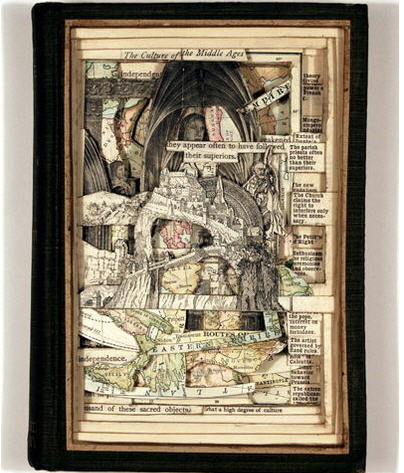
Book Sculpture

Many thanks to Scott Esposito at Conversational Reading for pointing me toward this really fascinating page on books as art objects.

A favorite image from the page:

2057160036_ec4b4ef2ba.jpg

I’ve seen a variety of things like this in recent years, and I suspect to some degree that seeing the book as a form of art is tied to a sense of its demise. As things die, they become works of art, perhaps? The Freudians have already covered this, I’m sure. In the infancy of books, of course, books were also thought of as treasurers to be handled like works of art or other revered objects. Books in general were far too expensive for the masses to obtain, and as a general rule this continued for a very long time. Owning books, as much as reading them, signified your cultural and class superiority. This all changed gradually over centuries after Gutenberg, but changed with a vengeance with the invention of the paperback.

Perhaps now that television and the internet have taken on most of the cultural purposes of the paperback and the newspaper—cheap entertainment and ready information for the masses—books are again left to become objects of art, treasures indulged in primarily by a small coterie of collectors. Strikes me as depressing, just a bit, but I still love these photos.

Leslie Fiedler. Who?

I couldn’t help but notice Scott’s post on Friday noted a new book by the late Leslie Fiedler, whom Scott admits he didn’t know. Alas, how far the mighty have fallen. I used to want to be Leslie Fiedler. He made cultural criticism seem romantic. Now cultural criticism has all the romance of oral dentistry or working at Chic-Fil-a. (Does anyone know why they spell it this way?)

Seriously though, Fiedler was one of the few critics I’ve ever known whose work aspired to and in some instances could be called literary. This despite the much vaunted declarations that criticism and theory were literary genres, these made by literary theorists who could not write. Roland Barthes, who I think came up with the idea, also comes close to this ideal in some of his work. But declaration is not achievement. Fiedler and people like Barthes—Fiedler more than Barthes–are to be thanked for showing us that cultural criticism could actually care about and love language, that how it communicates can mesh with what it does communicate.

Clintons continue attack on literature…er…Obama.

By now, I guess, everyone has heard that Bill Clinton and hip-mate Hillary Clinton—or is it the other way around—got in trouble for deriding Obama as a purveyor of fairy-tales and fantasy. In some future post I think I’ll take up the idea that the Clintons who once represented the hopeful face of baby-boomerism, now represent the craggy and toothless grin of what to expect as baby-boomers start using canes and walkers. “No hope for you, people, you silly and naïve young whippersnappers.” My general sense is that the Clinton approach demonstrates again and again that they are part of the system, so broken by it that they have to replicate it, like dogs licking the hands of an abusive master. Trouble is they may be right. Systems persist for a good reason, the gradually wear down the hopes of those who would change them and they are impervious to appeals from those outside their own logic. The smart money still goes with Clinton, but for the moment I feel like I’m still young enough to hope.

But my real issue with all this is the Clinton’s perfidious campaign against the imagination and literature. (Beware those who use the term “perfidious” wantonly). As I pointed out in earlier posts, Clinton has all the literary imagination of a manual on how to fix my furnace. Hillary works too hard to have time for literature. Now they are using a perfectly wonderful and culturally important literary form as a derogatory epithet. As Vladimir Propp could tell them, fairy tales make us what we are.

Do those of us who are reading for our lives, an increasingly aggrieved and marginalized minority who must struggle against the glass ceiling of…well, something I’m sure…set in place by the billions of non-readers in the world, really need the Clintons piling on with their anti-literary epithets?

I think enough is enough. We need to stand up against unthinking and derogatory stereotypes of reading culture.

READERS OF THE WORLD UNITE!

Or something.