Yearly Archives: 2011

Conrad’s Typhoon: or, An Ode to My iPad

Joseph Conrad

Typhoon by Conrad, Joseph

My rating: 4 of 5 stars

Conrad’s Typhoon: or, An Ode to My iPad

I think one reason I don’t write and publish more than I do is because I am far too slow on the trigger. The ubiquity of blogging hasn’t helped this any since I usually find that someone else much more intelligent and articulate than I has blogged on what I think of as MY SUBJECT in a manner far more perspicacious, acute and interesting than I could manage. Take Charles Simic’s meditation on boredom during the recent power outages along the east coast, blogged over at the NYRB. I had several of those, Yes-that-is-exactly-what-was-on-the-tip-of-my-tongue moments reading lines like these:

“We sit with our heads bowed as if trying to summon spirits, while in truth struggling to see what’s on our dinner plates. Being temporarily unable to use the technology we’ve grown dependent on to inform ourselves about the rest of the world, communicate with others, and pass the time, is a reminder of our alarming dependence on them.”

Of course, these words weren’t actually on the tip of my tongue, but by imagining that the poet is only telling us what we have always known but could not say so well, we are able to give ourselves credit for a lot of intelligence and imagination that we don’t actually possess. Simic goes on to talk about the notable demise of reading and other delights like radio in the fact of our ubiquitous gadgets. Now, of course, reading books on a rainy afternoon or listening to a radio show has the faint reek of quaintness when we can’t manage to champion with a straight face these distractions as relics of authenticity. Simic reminds us that reading too was a form of distraction as surely as an i-phone.

“All of this reminded me of the days of my youth when my family, like so many others, lived in a monastic solitude when the weather was bad, since we had no television. It wasn’t in church, but on dark autumn days and winter nights that I had an inkling of what they meant when they spoke about eternity. Everyone read in order to escape boredom. I had friends so addicted to books, their parents were convinced they were going crazy with so many strange stories and ideas running like fever through their brains, not to mention becoming hard of hearing, after failing to perform the simplest household chores like letting the cat out.

“Living in a quiet neighborhood made it even worse. Old people stared out of windows at all hours, when they were not staring at the walls. There were radios, but their delights—with the exception of a few programs—were reserved for the grownups only. Thousands died of ennui in such homes. Others joined the navy, got married, or moved to California. Even so, looking back now, I realize how much I owe to my boredom. Drowning in it, I came face to face with myself as if in a mirror.”

Be that as it may, I lived out this boredom during the last hurricane by taking up Conrad’s Typhoon, the Project Gutenberg version, on the recommendation I received via my facebook friending of the New Yorker Magazine. (Let’s be frank, folks.  Oprah’s book club is absolutely yesterday).  Too dark to read, yes, but unlike the youthful Simic I had one gadget in hand that bore its own light to me in hand, my trusty iPad, fully charged and functioning.

When I began blogging three years ago at Read, Write, Now (a title I have come to detest, so future bloggers choose carefully), I had a suspicious and doubtful mindset about e-books, e-readers, and many things e-in-general. To be sure, I saw the advantages of blogging as a means of immediate intellectual self-gratification, and even then I think I felt that a great deal of writing and reading, especially in the academic world, would migrate effectively online. But I could not imagine, then, that an electronic gadget could take the place of paper. I wrote about the fact that I freely took my paper books in to saunas and bathtubs, that I could find my way through paper books more quickly and simply than with a scrolling sidebar, that I didn’t have to worry about whether it was sunny outside. And the smell, the smell, the smell. E-books were sterile, it seemed to me. In a word inauthentic.

I may still believe some of this, but I believe it less than I used to, largely due to my i-Pad. To come back to the
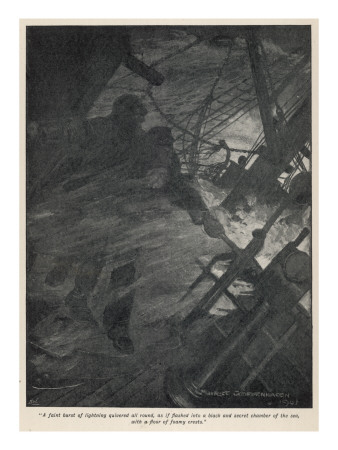
The steamer Nan Shan in the Storm

ostensible purpose of this review, Conrad’s Typhoon, it was the first full book I had read on my IPad, if a novella of 100 some odd pages can be thought of as a full book. And the verdict is that it was like reading…well…a book. The interface felt book like, I can adjust the light to the needs of my aging eyes, and can read more clearly than I could have managed by candlelight. I’ve always worried about the ability to personalize the texts, but iBooks lets me underline, and if anything I personalized the text more than I might have some others since my handwriting is unreadable and my notes in paperbooks cryptic and unintelligible. By contrast, the marginalia tool in iBooks is clean and my notes copious. Perhaps above all, I loved my iPad for remaining charged and working when everything else failed, leaving in the dark and to my own devices. Scary what I might find in that mirror. I read the entire book undistracted by facebook or my email apps, but I took comfort in knowing they were available for my distraction should I need them.

Now as to Typhoon itself. I want to say “Yes,” with qualifications. The story is gripping and intense, a naturalist drama of man against nature that becomes a kind of paean to stoic and pedestrian endurance, though one that is ironic and complicated in the end. The main human character is Captain MacWhirr, whose name betokens a machine-like efficiency. He is a man of small intellect, little imagination, and no intellectual curiosity. Because of this it is hard to describe him as actually courageous in the teeth of the hurricane. While a more imaginative man might have hidden his response to the terrors of the outrageous sea in cryptic understatement, MacWhirr is mostly just given to small emotion and small imagination.

Captain MacWhirr was trying to do up the top button of his oilskin coat with unwonted haste. The hurricane, with its power to madden the seas, to sink ships, to uproot trees, to overturn strong walls and dash the very birds of the air to the ground, had found this taciturn man in its path, and, doing its utmost, had managed to wring out a few words. Before the renewed wrath of winds swooped on his ship, Captain MacWhirr was moved to declare, in a tone of vexation, as it were: “I wouldn’t like to lose her.”

One doesn’t come away from this novel feeling grand and heroic and triumphant about human beings. On the other hand, one doesn’t come away feeling like human beings are small and accidental as you do, for instance in reading Stephen Crane’s “The Open Boat”. Instead endurance seems something to be achieved, and we end up happy for MacWhirr that he has achieved it, knowing we’d rather have him dull and unimaginative, but steady, were we caught in the writhing seas ourselves.

The story as a whole is gripping and seems to reveal something about both our human frailty and our strength and complexity, making it more than just a good adventure story. If I had read it first, I’m sure I would say that The Perfect Storm reminded me of it in being only partly a book about humans against the storm, and as much or more about humans against themselves.

One thing keeps me from a whole hearted endorsement. It really is the case that the depictions of Chinese in the book are deeply troubling. Passages in which Chinese are cast a jabbering animals or as writhing forces of nature are offensive and hard to find a way to redeem. I have always thought the criticism of Heart of Darkness was perhaps unearned since the thesis of that book had always seemed to me to be the evils of imperialism. But there is no redeeming theme that I can find for the representation of the Chinese coolies as brutes, and I found myself less inclined to defend Conrad, either here or for Heart of Darkness than I was before I began. To say this is not to say that the book is not worth reading, since there is no good human thing that is free of the scent of corruption, but it is to say that the goodness in the book does not overcome that corruption and reminds this reader at least that human beings are mixed creations, leaving us to admire and cringe in the same moment.

View all my reviews

The Devil’s Party

My continuing devotion to The New York Review of Books probably signifies nothing so much as my being an archaic throwback, born out of sync with my time. In a way, it seems to me that NYRB has become countercultural in part simply by just staying the same. The world has passed it by–who has time, after all, for a thought that requires an argument?–but in so doing I wonder whether we won’t long at last for just its kind of sober and articulate seriousness that tries to comprehend our troubles, tiring finally of the jokey popculturism of the web that seems mostly content to glide glibly along our surfaces, troubles merely another occasion for self display.

NYRB seems to revel in this archaic status, reprinting as it does forgotten masterpieces through its press and classic articles for it’s archives, apparently insisting pugnaciously that literature and thought really do remain news against the ephemera of what passes for the hot things of the moment.

Of course, it does this on the web now too, like everyone else. Most recently I picked up “A Modern Master by Paul de Man”  off the Facebook page that I have “liked.” A good “classic” essay on Borges, though as with a lot of deconstructionists it becomes impossible to know whether I am supposed to appreciate what de Man is saying or the prolix way in which he goes about saying it. And, of course, it’s sometimes hard to know with these guys whether I’m learning something about Borges or about Paul de Man reading Borges. De Man is primarily interested in the thesis that villainy becomes in some sense a poetic and aesthetic principle for Borges, one that he explores and unfolds throughout his career.

It is true that, especially in his earlier works, Borges writes about villains: The collection History of Infamy (Historia universal de la infamia, 1935) contains an engaging gallery of scoundrels. But Borges does not consider infamy primarily as a moral theme; the stories in now way suggest an indictment of society or of human nature or of destiny. Nor do they suggest the lighthearted view of Gide’s Nietzschean hero Lafcadio. Instead, infamy functions here as an aesthetic, formal principle. The fictions literally could not have taken shape but for the presence of villainy at their very heart. Many different worlds are conjured up—cotton plantations along the Mississippi, pirate-infested South seas, the Wild West, the slums of New York, Japanese courts, the Arabian desert, etc.—all of which would be shapeless without the ordering presence of a villain at the center.

A good illustration can be taken from the imaginary essays on literary subjects that Borges was writing at the same time as the History of Infamy. Borrowing the stylistic conventions of scholarly critical writing, the essays read like a combination of Empson, Paulhan, and PMLA, except that they are a great deal more succinct and devious. In an essay on the translations of The Thousand and One Nights, Borges quotes an impressive list of examples showing how translator after translator mercilessly cut, expanded, distorted, and falsified the original in order to make it conform to his own and his audience’s artistic and moral standards. The list, which amounts in fact to a full catalogue of human sins, culminates in the sterling character of Enna Littmann, whose 1923-1928 edition is scrupulously exact: “Incapable, like George Washington, of telling a lie, his work reveals nothing but German candor.” This translation is vastly inferior, in Borges’s eyes, to all others. It lacks the wealth of literary associations that allows the other, villainous translators to give their language depth, suggestiveness, ambiguity—in a word, style. The artist has to wear the mask of the villain or order to create a style.

So far, so good. All of us know that the poet is of the devil’s party and that sin makes for better stories than virtue. It takes some effort to prefer La nouvelle Héloise to Les liaisons dangereuses or, for that matter, to prefer the second part of the Nouvelle Héloise to the first. Borges’s theme of infamy could be just another form of fin-de-siècle aestheticism, a late gasp of romantic agony. Or, perhaps worse, he might be writing out of moral despair as an escape from the trappings of style. But such assumptions go against the grain of a writer whose commitment to style remains unshakable; whatever Borges’s existential anxieties may be, they have little in common with Sartre’s robustly prosaic view of literature, with the earnestness of Camus’s moralism, or with the weighty profundity of German existential thought. Rather, they are the consistent expansion of a purely poetic consciousness to its furthest limits.

The line “the poet is of the devil’s party” stood out to me, even though de Man’s “All of us know” sets it up sniffily as a throwaway line that demarcates the star-bellied sneeches from their know-nothing cousins. In part I think I seized on this line because it suddenly struck me that it really is the case that everyone I’ve know has mostly assumed that poet’s were of the devil’s party. It’s an issue I’ve thought about for a very long time, maybe for as long as I’ve engaged literature. As I wrote in my book, encountering literature has been, for me, always been fraught with the question of whether or not I was encountering the devil’s party in some metaphorical sense or another. From the time my parents forbid me to go to see The Great Gatsby with friends, or the year I was not allowed to read The Catcher in the Rye along with all my classmates. In some longer range and more significant way, this idea goes all the way back to Plato’s restriction of the poet from the Republic in the belief that poets served merely to inflame the passions, the devil’s party for the rationalist Greek. In my literary theory and other classes, I’ve often invoked the authority of Augustine’s notion of the felix peccatum, the happy fall, to suggest the notion that literature depends on the fact of fallenness, the fact of evil. If the poet is not of the devil’s party, he is at least secretly glad–along with all his readers–that the devil had his way if only for a moment.

An unsettling notion, that our pleasures, even our highest intellectual and aesthetic pleasures depend in some deep sense upon our and the world’s brokenness and violence. At the deepest level, I think this speaks to something unsettling about literature and art in general, something that goes beyond the question of offensiveness, and may go deeper than PLato’s concerns with the surface manifestations of inflamed aesthetic passions. Literature–perhaps other arts, but literature especially–unsettles because it depends so thoroughly and obviously and completely on brokenness and struggle and conflict and, yes, sometimes, violence as a condition of its existence. And it is most unsettling in that it makes takes these and makes them pleasurable, moving, beautiful. I think this is unsettling not on the simple level that we feel moralistically that literature shouldn’t do this, but the fact that it does do this has the force of revelation, showing us something about how we are built to experience the world. We exclude the poet from the city walls because by her fictions she shows us the fictions of our virtues.

As tiresome as I often find the deconstructionists–the tendency to find an infinity in a phrase often being nothing more than making a mountain our of a molehill–it still seems to me that this conundrum is something they troubled over endlessly and rightly.

Crime and Punishment, The Soundtrack

This article from Julie Bosman at the New York Times convinces me again that the future of books will be as multi-media, multi-layered artifacts rather than script-exclusive texts. Says Bosman:

In the film versions of “Pride and Prejudice” the music jumps and swells at all the right moments, heightening the tension and romance of that classic Jane Austen novel.

Will it do the same in the e-book edition?

Booktrack, a start-up in New York, is planning to release e-books with soundtracks that play throughout the books, an experimental technology that its founders hope will change the way many novels are read.

Its first book featuring a soundtrack is “The Power of Six,” a young-adult novel published by HarperCollins, soon to be followed by “The Adventures of Huckleberry Finn,” “Jane Eyre,” “Romeo and Juliet” and “The Three Musketeers.”

In September and October, Booktrack will release editions of the short stories “In the South,” by Salman Rushdie, and “Solace,” by Jay McInerney.

“It makes a new and engaging way to read and really enhances the experience and enhances your imagination and keeps you in the story longer,” Paul Cameron, Booktrack’s 35-year-old co-founder and chief executive, said in an interview. “And it makes it fun to read again. If you’re not reading all the time, it might help you rediscover reading.”

Elsewhere in the article Bosman points out that this is an extension of the increasingly common expectation that e-books will have embedded images and even videos, and perhaps come with addition documentary footage like DVDs. The linking of text and image and sound is ancient, of course. Think illuminated manuscripts and chanted psalms. To say nothing of the fact that the Homeric odes were probably originally sung. Still, I find myself wondering about our cultures inability to tolerate silence. Distracted from distraction by distraction, as Eliot said a hundred years ago. I think he may have imagined poetry as a cure. He could not have known that someone somewhere was going to enhance our experience Burnt Norton with mood music.

Be that as it may, it seems to me that my colleagues and I at Messiah College and elsewhere who teach students to write had better get used to the fact that we will have to train not only their linguistic sensibilities, but their aural and visual sensibilities as well.

Now, what sound track should we put to Burnt Norton?

Don Delillo: Point Omega

Point OmegaPoint Omega by Don DeLillo

My rating: 5 of 5 stars

I’m learning to trust my son’s literary taste in the same way I do his musical acumen. That is, at 16 he is far hipper and knowing than I have the energy to even try to be, knowing I would fail. He’s also several years past insistently recommending the latest animal fable from Brian Jacques. (A guilty father’s admission: I don’t think I could have taken many more years of toiling through the literally untranslatable renditions of ferrets speaking in what appears to be a working class Scottish brogue.) This faith in my son’s judgment was rewarded again a couple of weeks ago as we were flying out together to see my parents in Oklahoma City. He finished Point Omega on the leg from Cincinnati to Dallas, and said I really needed to read it before we got home.

That the book is readable on a plane flight into flyover country says nothing about the substance, though I will say that there are times Delillo is getting away with being Delillo. Not least is the fact that he can disguise a novella as a novel with large print and widely spaced lines and still get away with charging novel prices. More importantly, I thought the first third to a half of this very short book required a lot of patience, with the reader saying, “I know this must be good; it’s Don Delillo.” The first third is filled with the exceedingly detached and ruminant monologue of a documentary film maker and his subject, an academician who has lent his talents to the government to justify a war. The book as a whole is on one level a meditation on the mystifications that led us to prosecuting the war in Iraq.

“I’ll tell you this much. War creates a closed world and not only for those in combat but for th eplotters, the strategists. Except their war is acronyms, projections, contingencies, methodologies.”

He chanted the words, he intoned liturgically.

“They become paralyzed by the systems at their disposal. Their war is abstract. they think they’re sending an army into a place on a map.”

He was not one of the strategists, he said unnecessarily. I knew what he was, or what he was supposed to be, a defense intellectual, without the usual credentials, and when I used the term it made him tense his jaw with a proud longing for the early weeks and months, before he began to understand that he was occupying an empty seat.

“There were times when no map existed to match the reality we were trying to create.”

“What reality?”

“This is something we do with every eyeblink. Human perception is a saga of created reality. But we were devising entities beyond the agreed-upon limits of recognition or interpretation. Lying is necessary. The state has to lie. There is no lie in war or in preparation for war that can’t be defended. We went beyond this. We tried to create new realities overnight, careful sets of words that resmble advertising slogans in memorability and repeatability. These were words that would yield pictures eventually and then become three-dimensional. The reality stands, it walks, it squats. Except when it doesn’t.”

This is vintage Delillo in a lot of ways, but I’m not sure this dry detachment would have born up for another fifty pages. We get it pretty quickly, the immorality of the abstracted intellectual. What makes the story go, finally, is his having to come face to face with flesh and blood loss, forced in to a recognition that he had become so abstracted from his life that he had only experienced it and those who he should have been caring about as an absence.

Ultimately in novels we care first about relationships and not ideas. Or, rather, we only care about ideas to the degree that they bear the weight of relationships or corrupt relationships or get fleshed out in relationships. And so Raskolnikov, the man of ideas in Crime and Punishment, fascinates not so much because of his ideas but because he makes them flesh and blood and bone. With an axe. What makes Dickens live is not the sociological abstraction of oppressive class circumstance, but the orphaning of Little Nell. Delillo follows in that line in that what makes the novel work is not ultimately the grand ideas of the abstracted intellectual but the ways in which those grand ideas fracture man and wife, father and daughter, man from himself.

That is not in itself profoundly new; if that were as far as Delillo’s book went we’d have to say it was an interesting enough take on the villany of intellectuals. We’ve had that since Faust. But as the book concludes, we recognize that the violence of abstraction is not so much a property of intellectuals as of all living in this twilight of the western world, all those of us who watch the unfolding of images on the screen of our lives, substituting the slow motion replay of dropping bombs and exploding lives for the event, experiencing that violence as an aesthetic object worthy of our repeated fascination, image abstracted from meaning, until the death of others becomes indistinguishable from other means of entertainment in an entertaining world.

Delillo ultimately is a moral visionary. The darkness of his vision is not simply that he sees a world gone bad–though he indeed sees that. Rather it is that one root of that badness lies in the violence we visit on the world through our ways of looking at it. It is in the looking that we can’t escape our own complicity.

View all my reviews

Remember reading?

An interesting piece from Slate referencing research on the difference between reading online and reading print versions of newspapers.  According to Jack Shafer:

“The researchers found that the print folks “remember significantly more news stories than online news readers”; that print readers “remembered significantly more topics than online newsreaders”; and that print readers remembered “more main points of news stories.” When it came to recalling headlines, print and online readers finished in a draw.”

I’m sure the arguments will be trotted out that people read differently now, not better or worse. But shouldn’t that difference include getting the main point and remembering what you read after you read it?

Scott Cairns: Recovered Body

Recovered BodyMy rating: 4 of 5 stars

I admired these poems more than I loved them. Though that may say more about me than about the poems. Believing with the Konstanz school that the work of art is an event occurring only when an object is encountered, reviewers should probably preface what they have to say with self-critique, admitting that, after all, every act of criticism is disguised autobiography, or at least disguised desire. (How else to account for the different ways a person takes a book in the course of a life—thrilled in youth and bemused or embarrassed in middle age that we took the time once to be enthused.) In that spirit I should say that I was tired when I read these poems, and more tired when I read through a second time. It also likely didn’t help matters that I had read through Marie Howe’s “What the Living Do” earlier this week, a collection that left me feeling shaken and undone, as if in counting her losses she had fingered the raw places left by mine. Finally, it may be that in the recesses of my brain I’m carrying the memory of Cairns visit to Messiah College several years ago, delivering a reading that I felt was both profound and down to earth, deeply serious while also good-humoured.

By comparison, these poems seemed to me this time around more accomplished than moving, as if written while attending more to other poems than to readers. This is not to say that there’s not a lot to admire or that there is not a great deal of accomplishment. Indeed, it a poet’s great advantage that if even half a dozen poems that strike the anvil, an entire collection will have been worth the reading. By comparison, fifty good pages in a novel otherwise full of dreck leave me infuriated that the promise in those pages had been such a tease. Cairns is at his best in taking the old, old stories and finding the new thing. His curiosity presses the “Why?” and “What if?” Why, after all, did Lot’s wife look back. Could it have been something like compassion? And, if we were truthful with ourselves, won’t we admit that we are, in the lurid eye of our imaginations, looking back too at smoldering Sodom? What if Jacob slew Isaac after all, the story of rams and angel a good tale to give God a little cover. Perhaps the most moving of these to me was his rendering of Joseph, long after the successes of his life and the moral triumphs of his forgiving spirit, never quite forgetting the terror of that adolescent grave he’d been assigned by his brothers:

“And in succeeding years, through their provocative turns of fortune—false accusations, a little stretch in prison, a developing facility with dreams—Joseph came gradually into his own, famously forgave his own, pretty much had the last laugh, save when, always as late in the day as he could manage, he gave in to sleep and to the return of that blue expanse, before which all accretion—accomplishment, embellishment, all likely interpretations—would drop away as he found himself again in the hollow of that well, naked, stunned, his every power spinning as he lay, and looked, and swam.”

This is old hat defamiliarization. But it is also really good stuff. How absolutely true it must be, or at least could have been, about Joseph. We want triumph without memory, and redemption without regrets. This and other poems like it tear Biblical and historical figures out of the thick mask of their necessary reputations, places where, as Cairns puts it in another poem, they are “all but veiled by chiaroscuro and the prominence.”

All of this is praise, and it may say something that I find myself admiring, and even liking, these poems the more I write about them in this review, writing, after all, an act of thought, an exercise of the imagination on the idea of poetry and literature and these poems and this literature. But in the reading I found all this just a little distancing, as if the manner of these poems was too far from my need. While the technology of the poetry was to make remote figures human for me again, to, as the title of the collection suggestion suggests, give testimony to the “recovered body,” the poems’ achievements seemed primarily intellectual or literary or interpretive, rather than visceral. Someone said they wanted poetry that made them feel as if the top of their heads had been taken off, and I tend to agree. But again, perhaps that only speaks to my own needs, my own place, my own embodiment, the facts of my father’s gradual descent in to dementia and my mother’s grappling with depression, that I miss and worry anxiously about my daughter away at school, or fret and feel tired already at the sense that the past summer never actually began and now it is all but ended. So perhaps it is not surprising that the poem I liked the most in the collection was also clearly the most lyric and personal. The one in which Cairns, remembering the death of his father, struck me as a person more than an imagination:

As we met around him
That last morning—none of us unaware
of what the morning would bring—I was struck
by how quickly he left us. And the room
emptied—comes to me now—far too quickly.
If impiety toward the dead were still
deemed sin, it was that morning our common
trespass, to have imagined too readily
his absence, to have all but denied him
as he lay, simply, present before us.

This poem–unlike the others, all occupying their own form of goodness–made me say Yes.

View all my reviews

Marie Howe: What the Living Do

Marie Howe

“What the Living Do” manages to give me an unsentimental but still deeply felt picture of the pain of living beyond loss.  The immediate occasion for these poems is the death of several friends and family members over what seems, in the context of this books at least, a relatively short period of time.  The real focus, however, is not so much on the dying–the psychic and physical pain of disease, the fear of a passage elsewhere–as it is on the poet herself, or at least her personae. These are not elegies then; or at least not elegies to the dead so much as elegies to who we imagine we must have been before the clefts and rifts that the loss of those we love opens in our lives, or perhaps elegies to the selves we imagine we might

What the Living Do

have become.  Finally, though, these are poems of hope.  I would not call them poems of overcoming.  Grief remains, and in some sense we become, as we age, people who remember the dead, in our voices and in our silences.  But poems of hope in that they recognize that we do go on.  This is what the living do:  they go on, carrying with them acts of remembrance such as these.

Joyce Carol Oates’s Man Crazy

Man CrazyMan Crazy by Joyce Carol Oates
My rating: 3 of 5 stars

Oates is often an artist of extremes. When it works it really, really works. When it doesn’t it can feel like there’s something manipulative going on, and something that feels too close to exploitation in her obsession with human degradation. I wavered throughout this book. The Satanic motorcycle gang feels cheap and obvious, and the resolution was too quick to be genuine. On the other hand, I found the writing compelling, and i care in the end about the lives of Ingrid and her mother, made crazy by the world of violent or inadequate men that they love or think they love.

View all my reviews

2010 in review

The stats helper monkeys at WordPress.com mulled over how this blog did in 2010, and here’s a high level summary of its overall blog health:

Healthy blog!

The Blog-Health-o-Meter™ reads This blog is on fire!.

Crunchy numbers

Featured image

The average container ship can carry about 4,500 containers. This blog was viewed about 20,000 times in 2010. If each view were a shipping container, your blog would have filled about 4 fully loaded ships.


In 2010, there were 8 new posts, growing the total archive of this blog to 140 posts. There were 5 pictures uploaded, taking up a total of 197kb.

The busiest day of the year was November 13th with 215 views. The most popular post that day was Treasure Island on Book Glutton: an invitation.

Where did they come from?

The top referring sites in 2010 were search.aol.com, mycrazyreader.info, en.wordpress.com, mariaozawa2u.blogspot.com, and search.conduit.com.

Some visitors came searching, mostly for toilet, obama, the happening, treasure island, and japan.

Attractions in 2010

These are the posts and pages that got the most views in 2010.

1

Treasure Island on Book Glutton: an invitation March 2008
2 comments

2

Tales of the Toilet; or, W(h)ither Fiction? May 2008
6 comments

3

Summer’s Guilty Pleasures: A Movie Miscellany July 2008

4

Naked Book Reading: An Idea Whose Time Has Come April 2008
6 comments

5

Reading, listening and memory February 2008
5 comments