Author Archives: Peter Kerry Powers

Unknown's avatar

About Peter Kerry Powers

Director, Center for Public Humanities Professor of English Messiah University

War and Community–Sebastian Junger’s “War”

Just got done reading Sebastian Junger’s new book, War.  The title is a little
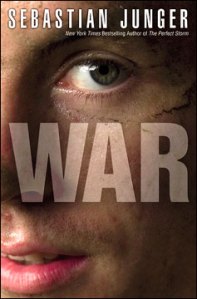
Sebastian Junger--"War"

grandiose since I don’t think Junger delivers the truth of War, but I do think it is a very good book and certainly the best thing, in a relatively limited sample, that I’ve read about the American experience in Afghanistan.

Junger avoids political pronouncements in preference for a close examination of the individual experience of the soldier at war, and even more particularly on the soldier in the combat zone.   Indeed, I think to some degree that the book might more appropriately have been titled “Combat,” since it is really focused not on the large scale strategy, tactics or mechanics of carrying out a war, but on the men at the point of the spear who live under fire or the threat of it.

I’m interested in a lot of things about this book, but most particularly on Junger’s concentration on the supremacy of the combat unit, the squad or platoon through whom the basic bloody work of military strategy is made real.  Junger emphasizes the fact that survival and success in combat depends on every individual soldier deciding repeatedly, if unconsciously, that the lives of other members of the team are more important than his own.  Indeed, in what was to my mind Junger’s most startling claim,  courage in battle must be understood first and foremost as a form of love:

Combat fog obscures your fate–obscures when and where you might die–and from the unknown is born a desperate bond between the men.  That bond is the core experience of combat and the only thing you can absolutely count on.  the army might screw you and your girlfriend might dump you and the enemy might kill you, but the shared commitment to safeguard one another’s lives is unnegotiable and only deepens with time.  The willingness to die for another person is a form of love that even religions fail to inspire, and the experience of it changes a person profoundly.  What the Army sociologists, with their clipboards and their questions and their endless metanalyses, slowly came to understand was that courage was love.  In war, neither could exist without the other, and that in a sense they were just different ways of saying the same thing.  According to their questionnaries, the primary motivation in combat (other than “ending the task”–which meant they all could go home was “solidarity with the group.”  that far outweighed self-preservation or idealism as a motivator” (239-230).

Junger connects this even to the solidarity of the group in the pursuit of killing.  Killing in war is not primarily about the hatred or dehumanization of the enemy, idealism about causes, patriotism for country.  It is more primordially about saving the lives of those you love.

Junger’s depictions and ruminations here are convincing to me, quite apart from my own convictions about personal or state violence, and they do give me pause over a particular conundrum.  American life is so thoroughly characterized by individualism and self-promotion.   And yet life in combat–which is in some ways also seen as quintessentially American–is by Junger’s accounting absolutely about self-effacement in some profound and existential way.  I was reminded of the controversy over The Hurt Locker

The Hurt Locker Poster

where veterans of bomb squads were deeply troubled by the individualistic and cowboy renegade image that was projected by the protagonist.  Reading Junger, I understand that complaint more clearly now.  The individualistic hero who strikes out on his or her own at apparently great risk to himself and others is a Hollywood figure, but one who, if univeralized, would very quickly mean the absolute destruction of a fighting the unit, the opposite of the kind of sacrificial heroism that Junger believes is a characteristic not of exceptional persons in combat, but the fundamental nature of what makes combat possible at all.

Reading Readers: Notes on Alberto Manguel–I

I’ve been reading Alberto Manguel‘s A Reader on Reading.  Some random thoughts:

A Reader On Reading Alberto manguel

x—“Over the years, my experience, my tastes, my prejudices have changed:  as the days go by, my memory keeps reshelving, cataloguing, discarding the volumes in my library;  my words and my world—except for a few constant landmarks—are never one and the same.  Heraclitus’s bon mot about time applies equally well to my reading:  “you never dip into the same book twice.””

–In my own experience, a central experience, if not THE central experience through which my tastes, prejudices and memories have changed has been the experience of reading itself.  That is, books, are not infinitely malleable pieces of dough to be made in to what the reader wants them to be at a whim—what seems to be Roland Barthes notion in The Death of the Author. On the other hand, neither do books show the same and constant aspect regardless of time and circumstance.   Rather books are agents of change, shaping me in to something different than what I was before.  I do not say, as might seem logical, that books shape us into the readers they need.  This might follow from something like Iser’s notion of the Implied Reader or the Holland’s theory of the Ideal reader.  I don’t think books have that kind of agency or that authors have that kind of knowingness.  But some books are like mountains that must be scaled, others like fires that must be endured, others streams to be forded.  A book’s agency is found in the kind of action it demands of me, and it’s nature changes for me to the degree that I am changed by the action it affords.  I may by turns and by age turn from the mountain as too daunting, gasp and crawl halfway up its face before giving up in or scale it with the ease of an Olympian.  In every case I am experience the mountain as it is, as it shows its face to me.  It is not that the Olympian truly knows the mountain for what it is, because the climber who scales its height without a second breath cannot see what is there to seen by the man crawling in exhaustion, his breath in the dirt.

x—“I believe there is an ethic of reading, a responsibility in how we read, a commitment that is both political and private in the act of turning the pages and following the lines.  And I believe that sometimes, beyond the author’s intentions and beyond the reader’s hopes, a book can make us better and wiser.”

–I wonder, if it is beyond the author’s intentions and the reader’s hopes,  how is it that books make us wiser?  We cannot say, I think, that the words on the page have a power unto themselves apart from their human utterance and reception.  Manguel ridicules this notion as a form of magical thinking elsewhere in the book.  But what is it then, in the experience of books that makes us wiser?  I agree with the sentiment, but can’t define the agency of such making.  Indeed, it often seems to me that when writers—fiction writers at least—set out to impart wisdom they more often  impart tedium and irritation.  Fiction writers should not be oracles; those who try would be better off becoming essayists or preachers.  Nor am I particular taken by readers who approach books as if they contain wisdom, as if Melville or Faulkner or Morrison were a secondary scripture.  If there is wisdom, it does seem to me that the wisdom might come as an accidental gift of the act of reading itself, not in what is read or who is reading or who is being read.  But at this point I may merely be trying to be oracular.

Ink Spilled, and spilled, and spilled

From Frank Donoghue in the April 10, 2010 Chronicle Review.

“Deborah L. Rhode, a professor of law at Stanford University, in her book In Pursuit of Knowledge: Scholars, Status, and Academic Culture, notes a study showing that only 2 percent of published scholarship in the humanities is ever cited.”

Looking back on our own age in academe, I suspect that archeologists of knowledge may remark that there has never been so much sweat and strain on the part of the many–academics that is–for the profit of so few.

Del Toro Takes Manhattan

I realize I now no longer have a claim to being a blogger.  Alas cruel fate.  I lost the time, some of the interest, and I didn’t like the sense I started developing that I owed something to my blog.  Just another task to complete.  Still, I just wrote up a quick review over on Good Reads after finishing Del Toro’s new book, The Strain, so I thought I might as well add it here.  Who knows, maybe I’ll find a way to do this again.  I’ve read a bunch of Dostoevsky since my post lo these many months ago.  Some of it is actually worth writing about.

Re. Del Toro’s The Strain.  Ok, I’m a sucker for a decent vampire thriller. I forced myself through the Twilight books as an act of solidarity with my infatuated daughter, so it was good to get back to the dark side with Del Toro’s book. If anything, Del Toro’s book reads a little too much like an immediate slap in the face at the Stephanie Meyer phenomenon. While Meyer’s Vampires are the pictures of life, health, and youth, Del Toro’s vampires are literally a kind of living cancer virus, consuming and transforming the host into undead animalistic killing machines. Clearly Del Toro the filmmaker is lurching back to Nosferatu, where the vampire is more animal than human, and hardly an exemplar of sexual seductiveness. And, indeed, there’s a lot of quotations of cinema–the armies of vampires are a little bit more like the zombies of Dawn of the Dead than the isolated and brooding quasi-intellectuals that have been a dominant strain since Stoker’s original. The bizarre but effective weaponry quotes from both Van Helsing and from Men in Black. The apocalypse that threatens Manhattan quotes from I Am Legend and from…well, almost every other movie that threatens the destruction of Manhattan. Mostly I like going with this and love it though I thought the nail gun that shot silver tipped nails was a little much and the connection to the Holocaust oddly original and overreaching at the same time–the Van Helsing of this book is a holocaust survivor on a hunt for metaphorical antisemites. And I thought a Dracula in Manhattan could have been a little more original than to have a literal coffin filled with soil, but what do I know. Still, I admit it was a good break after being very serious and thoughtful and intellectual as I made my way through Dostoevsky’s Crime and Punishment last week. I’ll look forward to reading the next

Dostoevsky. AGAIN!!

My best laid plans of blogging daily throughout the summer on my Dostoevsky experience is all for naught.  I had dreams of blogging a couple of pages a day on my thoughts, attitudes and experiences related to GREAT RUSSIAN.  In truth, however, if I stopped to write about my reading, I’d have no time to read at all, then what would I have to write about?  Nevertheless, since my last post on July 2, I’ve gorged on Dostoevsky–all/most of the early work and in to the middle period after the period in the labor camps.  What follows is the reading list and my three sentence reviews.

The Double–Absolute best of the early Dostoevsky.  A kafkaesque tale of a poor clerk’s descent into madness as he loses his station in life to a man who appears in every respect to be himself.  Which begs the question, why do we call Dostoevsky kafkaesque when we do not call Kafka Dostoevskian.

Netochka Nezvanova–Dostoevsky’s version of the stock poor orphan story of nineteenth century fiction.  Defenseless girls, brutal and unfeeling fathers, sickly mothers.  Haven’t we been here before?  Sometimes I feel like D. is trying to work against convention, which keeps things interesting, but it’s only a fragment and so impossible to tell what the achievement might ultimately have been.  For Dostoevsky addicts only.

“The Landlady” (a novella)–The early Dostoevsky makes me think he must be the master of the novella or short novel, at odds with my picture of him as the writer of the big book.  An eerie, nearly surreal tale in which our hero falls tragically for a young woman who is apparently in some kind of demonic sexual thrall to an elderly spiritualist.  The fallen woman as irresistably attractive is a feature of others of Dostoevsky’s early stories as well.   Then again, of what writer’s work is the fallen woman not a feature.

“Mr. Prokharchin” (short story)–too slight to remember.

“White Nights” (short story)–I ought to remember it but can’t.

The House of the Dead–Not really a novel, though presented as one.  More of a sociological study of life in the labor camps.  Competent and interesting, but probably only of interests to Dostoevsky fanatics.

Humiliated and Insulted–A Dickensian novel of the poor oppresssed — humiliated and insulted — by the rich.  Brings back Dostoevsky’s fascination with doubling, and for my taste ties things together all too neatly in the end.  I feel Dostoevsky trying to work agains the conventions of the sentimental novel, but not entirely successfully.  Still, a decently good read.  I see why some critics say D is too repetitive by half.

Well that’s it.  Hardly astutue observations, but I’ve done my duty.

One thing I’ve discovered during the last four weeks–it is indeed possible to read a book while doing the elliptical trainer at the Y and not fall flat on my back.  I’m sure D never imagined himself as reading material for the sweating set of baby boomers trying to beat back the flab and hold off impending old age.

I keep thinking about buying a Kindle.  But then, again, maybe not.  News of the Orwellian variety from NYTimes.

In George Orwell’s “1984,” government censors erase all traces of news articles embarrassing to Big Brother by sending them down an incineration chute called the “memory hole.”

On Friday, it was “1984” and another Orwell book, “Animal Farm,” that were dropped down the memory hole — by Amazon.com.

In a move that angered customers and generated waves of online pique, Amazon remotely deleted some digital editions of the books from the Kindle devices of readers who had bought them.

Librophilia; or, How I’d like to spend my retirement

As some of you know, I’ve occasionally posted links Rachel Loew’s BookPorn shots over at A Historian’s Craft.  I think Rachel may have a competitor for my attention.  The pics of libraries over at Curious Expeditions are just astonishing.  If I had the time and money for a world tour.  A sample:

Abbey Library St. Gallen, Switzerland

Abbey Library St. Gallen, Switzerland

Michael Jackson, Bookworm. Who Knew??

Just doing my bit to add to the overkill about Michael Jackson.  This bit from the LA Times.

Largely an autodidact, Jackson was quite well read, according to Jackson’s longtime lawyer. “We talked about psychology, Freud and Jung, Hawthorne, sociology, black history and sociology dealing with race issues,” Bob Sanger told the LA Weekly after the singer’s death. “But he was very well read in the classics of psychology and history and literature . . . Freud and Jung — go down the street and try and find five people who can talk about Freud and Jung.”

Hours after his death, Jackson’s 1988 autobiography, “Moonwalk,” despite being out of print, entered the Amazon bestseller list for biography and memoir at No. 25.

“I’ve always wondered if there was a library in Neverland,” Doug Dutton mused. Indeed there was — Sanger told LA Weekly that Jackson’s collection totaled 10,000 books.

Alas, I couldn’t find a single image of Michael reading a book, but maybe they are out there.


Intellectual Praise

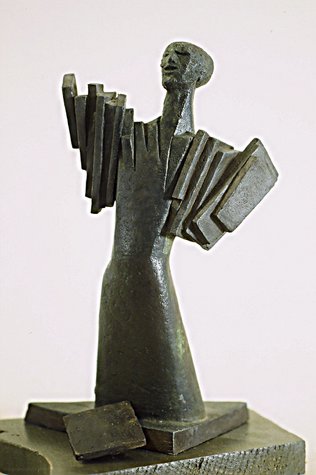
I really like this bronze from C. Malcolm Powers, an artist I don’t really

Intellectual Praise--C. Malcolm Powers

Intellectual Praise--C. Malcolm Powers

know much about, but then I don’t know much about contemporary artists at all.  I like how the arms are books, suggesting that intellectual work is a kind of praise, and it has a kind of angelic feel to it.  May be somewhat grandiose, but I like the notion that reading can be a form of praise.

Poor Folk Redux

In the last ten days I’ve read most of Dostoevsky written before his sojourn to the penal colony, and a little written in its immediate aftermath,  but just a couple of more words about Poor Folk.  I’m intrigued by two aspects of Dostoevsky’s work as an artist.  For a first novel it strikes me as being remarkably sophisticated in terms of it’s narrative technique.  His use of gaps and empty places where the reader has to fill in the blanks keeps the reader working.  In this sense it seems to me that reading Dostoevsky is a thoroughly active process, something quite different than the passivity that people sometimes attach to reading.  We’re constantly being given bits of information in the letters that imply a world of fact, of allusion to a life beyond the text (though, of course, that life is a fiction of the text) that the reader must construct and fill in in order to make sense of the text at hand,  the “narrative” then is a process between the reader and the text itself.  We understand the text both by reading what is there, and by filling in what isn’t there.  The reader’s active participation is necessary for making means.

I hope it’s not just a deconstructive turn of some sort on my part, but I’m struck by how Doestoevsky is obsessed with both reading and writing throughout this text.  To this degree it strikes a fairly common tone in first novels—we don’t know what else to write about, so let’s write about writing—Joyce’s kunstlerroman “Portrait of the Artist as a Young Man” being the exemplar here.  But I find it intriguing in Dostoevsky that this isn’t embedded in the life of a young man struggling to find a voice, but in the consciousness of a middle-aged and aging man who never found a voice, whose struggle with language will, by his own lights, has proven fruitless even while writing is his stock and trade as a kind of scrivener.

I know I that I can earn but little by my labors as a copyist;  yet even of that little I am proud, for it has entailed work, and has wrung sweat from my borw.  What harm is there in being a copyist?  “He is only an amanuensis,’ people say of me.  Bust what is there so disgraceful in that?  My writing is at least legible, neat, and pleasant to look upon – and his Excellency is satisfied withit.  Indeed, I trtanscribe many important documents.  At the same time, I know that my writing lacks style, which is why I have never risen in the service.  Even to you, my dear one, I write simply and without tricks, but just as a thought may happen to enter my head.  Yes, I know all this;  but if everyone were to become a fine writer, who would there be left to act as copyists?

Who indeed? I’ve commented somewhere else on this blog of the peculiar cultural imperialism of writing in our own day, but perhaps every day.  I increasingly get English majors who have no interest in reading, who even claim to dislike reading, but who are obsessed with writing.  Everyman his own author.  So much so I have no time left for reading Dostoevsky since one must keep busy updating one’s blog, twittering one’s feed, and textings one’s faves.

But this is beside my main point for the day, which is the fascination I find in Dostoevsky who turns in a first novel to Poor Folk as his subject, not because they have a superior or natural style—as Rousseau or Wordsworth or Whitman might suppose—but because they have no style at all.  His work doesn’t seem intent on disproving that claim.  At the end of this text, one isn’t led to declaim endlessly on the natural style of poor folk that Dostoevsky has managed to produce.

No.  What’s fascinating is that he has made interesting and plausible the story of two people who are not of their own accord self-consciously interesting or stylish.  I am not sure what lesson of the day to draw from this, but when I come away from Dostoevsky’s Poor Folk, I find that I respect them, but I do not admire them.  This is terribly politically correct these days, but it strikes me that it is pretty clear-minded.  I’m reminded, for some reason, of all those Christian artists who go about romanticizing the middle ages, and refuse to recognize that the life really was nasty brutish and short, even for most of the most exalted, and none of us would for one instance trade in our latte’s and air conditioning for smallpox, plague, and roast pig on a spit.

Well, I’m drifting now, but thought I should come back to this particular element of Poor Folk before moving on.