The literary sweepstakes continue. News reports tell us that Stephen King has thrown his very considerable weight behind Obama.
This may be a good thing. Barack’s rather weighty reading list, his endorsement by His Weirdness Michael Chabon and by Her Highness Oprah Winfrey, and his rather stunning eloquence have left him in distinct danger of not being pegged as a “regular guy.”
Given that I doubt Obama is going to be out stomping through a field with a 12 gauge in his hand, it’s probably a good thing that a literary celebrity known for mayhem, murder and mystery has his back. Stephen King is the everyman’s literary favorite, and Obama doesn’t even have to read him. (Personal aside: I think King is one of the most interesting and bizarre self-reflexive writers on the pathologies of writing and reading. I hope to have a chapter on him in the book I am currently fantasizing about).
Seriously though, there are literally thousands of sites out there devoted to books and reading in one way or another, many of them very good. So I have been pretty choosey about what I put on my blogroll—only the things about books and reading I actually bother to read regularly set alongside a few close friends who write about various and sundry. Teleread is, I think, one of the best sites for trying to think through—and listen to others think through—the issues and news surrounding e-books and digital literacy generally. There seems to be a sensible assumption that reading books online is not going away, but the site isn’t clogged with folks I sometimes derisively call digital utopians. There’s an effort to be self-critical, and comments that question ruling assumptions about digital books or internet culture generally are welcome. It’s very much worth a look.
Techno myths go to school.
In his most recent blog, Mark Bauerlein calls attention to the huge gap between the mythology that kids can now basically teach themselves on the internet and the actual facts about kids ability to judge and assimilate online materials. He cites an ETS study that gives a rather grim picture of students ability to sort through the waves of things they find on the net:
The report concluded: “Few test takers demonstrated key ICT literacy skills” (ICT is short for Information and Communications Technology). Only 35 percent of the subjects could narrow an overly broad search properly, and only 40 percent of them chose the right terms to tailor a search effectively. In constructing a slide presentation, only 12 percent of them stuck to relevant information.
When asked to evaluate a set of
Web sites for objectivity, authority and timeliness . . .
– 52% judged the objectivity of the sites correctly
– 65% judged the authority of the sites correctly
– 72% judged the timeliness of the site correctly
– Overall, only 49% of test-takers identified the one
website that met all criteria
Even allowing for some margin of error, it still seems we’re a good ways away from the possibility of doing away with teachers entirely. And of course, this says very little about the ability of students to interpret and assimilate such materials into writing of their own—something that the testimony of writing in intro composition classes suggests might be very dismal indeed.
This speaks again to my general sense that the argument offered by digital utopians that people are reading just as much as ever, they’re just reading on the web, isn’t really an argument, it’s a platitude. We need to be thinking about what students are reading, how they are reading it, in what contexts, and how they put that reading to use. We would then be in a better place to judge what we are gaining and losing by the fact that students are no longer reading or wanting to read traditional long form texts.
The New York Times reports today that five of the best selling novels in Japan last year were originally written on cell-phones to be read on cell phones.
Of last year’s 10 best-selling novels, five were originally cellphone novels, mostly love stories written in the short sentences characteristic of text messaging but containing little of the plotting or character development found in traditional novels.
What is more, the top three spots were occupied by first-time cellphone novelists, touching off debates in the news media and blogosphere.“Will cellphone novels kill ‘the author’?” a famous literary journal, Bungaku-kai, asked on the cover of its January issue. Fans praised the novels as a new literary genre created and consumed by a generation whose reading habits had consisted mostly of manga, or comic books. Critics said the dominance of cellphone novels, with their poor literary quality, would hasten the decline of Japanese literature.
I can’t really say anything about cell phone novels, never having read one. (I am not yet a disciple of Pierre Bayard). And so far they seem to primarily be a Japanese phenomenon, though Harlequin is trying to replicate Japanese success in Britain and the United States. Perhaps the genre better fits a Japanese culture where everything is cramped and hurried—no room for books while your being squashed on to the subway? No problem. Download the latest to your cellphone and read.
I’m intrigued with several aspects of the phenomenon. First, to my mind it confirms my sense that when we are talking about crises in books and reading we have to be more precise and talk about reading as a multiple and variegated phenomenon rather than a singular phenomenon. Most of the novels are apparently more or less romances in the Harlequin vein. With all appreciation for my colleagues who have made the case for the cultural seriousness of romance, the genre itself has hardly aspired to high cultural seriousness, and certainly hasn’t worried a great deal about linguistic complexity, semantic layering, or intricacies of plot.
Given this, what difference does it make that this kind of pleasure—or something like it–is delivered via a cell-phone, an ipod or something else. On the other hand, if this is the kind of thing that digital utopians have in mind when they talk about digital reading, I’m not sure I’m reassured. I remember n+1 ranting a while back that everyone is so obsessed with the reading crisis that we tend to laud folks for reading anything and everything. I tend to agree. If people want to entertain themselves with graphic novels, I have no problem with that. But let’s not imagine it as an experience that will develop their sense of the possibilities of language—or even the imagination generally—on the order of War and Peace or Toni Morrison’s Beloved.
The dominance of the romance genre is intriguing to me as regards to gender as well. Apparently most of the people reading and writing these things are women. What would it be about the romance genre, and about young female readers in Japan, that would make this particular media effective and important. This is a culturally important and interesting question apart from the question of whether such “novels” do anything for the mind or imagination beyond fill space while marking time. I suspect that young men are playing video games on their cell phones while young women are reading romance novels. Why is this stereotype of the male who reads nothing and the female who reads brain candy so prevalent, even in a digital world, and even in Japan. This is not an American phenomena, and it isn’t a legacy of Victorian England.
Last question would be about the enduring appeal of printed matter. Apparently it’s pretty common to put these cellphone novels out first via text messaging, but the goal for many of the young women writing them is to get in print. One young woman named Rin wrote her novel while commuting to her part time job, uploading text to an online service. She later sold it to a publisher and went to 400,000 copies in hard cover. Hmmm. I’m not sure what is going on with that, and I wonder what the distinction would be between experiencing the form in short bursts over a cell phone and then actually getting the thing between hard covers.
Something tells me that the media of a linguistic work of any kind determines, or at least significantly determines, its ultimate shape and the possibility of its reception. Certainly, of course, this is the case to the degree that cell phone novels are made up of short sentences and lack character development and plot development. (How to think of this as a novel is another question that I won’t bother trying to answer without actually reading one).
I only have instances going in the opposite direction. I joined up at DailyLit.com and trie to read Dostoevsky’s The Idiot via once a day email delivery of the equivalent of four or five pages a day. It may just be that I’m old fashioned, but I found the reading experience relatively frustrating, and felt that the book format—at least for this kind of work—was technologically superior to a digitized format regardless of all the bells and whistles my computer to bring to bear on the experience. If I forgot who a character was, or what had happened since I last looked at the email, it was annoying to have to search back through emails to find the last instance of a character doing something. And if I got really engaged with a scene, I either had to stop completely, or I had to interrupt the reading process, go to the website, and download the next installment. With a book format, reminding oneself of the book’s past is a simple matter of flipping a couple of pages back and saying, “Oh yeah, I remember now.” And to go on one….goes on.
Cellphone novels have evidently had some success in digitizing Japanese classics, but I suspect that formats like a cellphone will ultimately only succeed in new cultural forms they shape for this new media. The efforts to create digital book readers like the Kindle are efforts to create formats that replicate as closely as possible the experience of reading a traditional book while creating new possibilities for reading associated with new media. It may be that we can come up with one, and it may be that we will gradually come to appreciate older forms in this media. Many things that were once on scrolls we now read effectively in book form. However, a cellphone novel is not trying to replicate the traditional form at all.
I’m not holding my breath, but I probably need to download one of these novels and try it out before declaring that you can’t read War and Peace on a cellphone.
I think there’s something about the great sea of information that leaves one feeling perpetually belated. Or at least me. My increasing sense is that EVERYONE WHO IS ANYONE has already been in to books as art and I, like the nineteenth century rube showing up in town who marvels over flush toilets, am playing a pointless game of catchup.
Rosenau’s bio page has this to say: “A third generation publishing executive (descended from two generations of Random House VP’s), Jim grew up in a household with over 5,000 books.”
This explains why he has so many of them to destroy.
I may write more later. At the moment I’m reading through Pierre Bayards “How to Talk About Books You Haven’t Read” and remain uncertain as to whether he is a genius or an ass. A certain measure of both , no doubt. More ass than genius. The genius part comes in how he managed to make this thing a best seller. His general advice is that we only talk about books we haven’t read, so I guess I’m disqualified.
One would think that Keats’s life would have fostered bitterness in him, but he remained generous in the face of his difficulties. He didn’t flee to the usual 19th-century escapes: Christianity or opium, drink or dreaming. Though he unsurprisingly underwent pangs of serious melancholia (who wouldn’t, faced with his disasters?), he nonetheless never fell into self-pity or self-indulgent sorrow. In fact, he consistently transformed his gloom, grown primarily from his experiences with death, into a vital source of beauty. Things are gorgeous, he often claimed, because they die. The porcelain rose is not as pretty as the one that decays. Melancholia over time’s passing is the proper stance for beholding beauty.
I thought I might blog more extensively on Wilson’s essay, but it ended up being less interesting than I had hoped. I’m wondering why, for an English prof, he seems so given to the vague and gauzy generalization over the vivid detail or anecdote. Still, credit for reminding me of those romantics. And my title of course is from the ubiquitous Wallace Stevens and what may be the most singularly beautiful poem in the American idiom, “Sunday Morning.”
Death is the mother of beauty; hence from her,
Alone, shall come fulfilment to our dreams
And our desires. Although she strews the leaves
Of sure obliteration on our paths—
The path sick sorrow took, the many paths
Where triumph rang its brassy phrase, or love
Whispered a little out of tenderness—
She makes the willow shiver in the sun
For maidens who were wont to sit and gaze
Upon the grass, relinquished to their feet.
She causes boys to bring sweet-smelling pears
And plums in ponderous piles. The maidens taste
And stray impassioned in the littering leaves.
Anyway, I launched into this not to talk about morbidity or about Stanley Fish but to return just briefly to my fascination with books as objet d’art. (I confess I’m not even entirely sure what this means in the Wittgensteinian sense that meaning is in the use. When do you use it? surely somehow differently than “art object” or people wouldn’t say it in French. Or maybe they’re just being pretentious.)
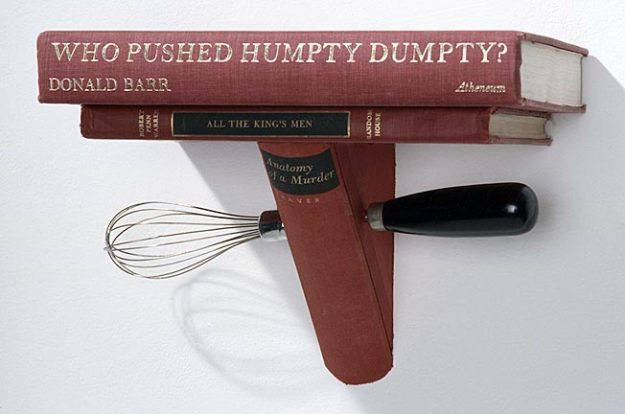
Courtesy of Scott Esposito at Conversational Reading, I again found some absolutely fabulous images of books as works of art at Signonsandiego. The artist, Aaron T. Stephan, has a new show at Quint Gallery entitled “Building Houses/Hiding Under Rocks.” As the website puts it, “he’s converted some 20,000 discarded books into … an artist’s Lincoln Logs.”.
One of my favorites:
Stephan’s website has more of this great stuff. I especially like the wrench made from pages of Immanuel Kant’s Critique of Judgement.
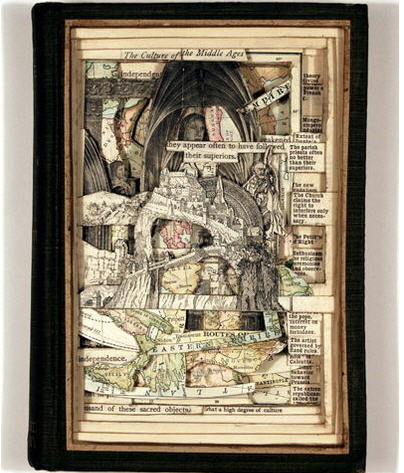
Courtesy of Scott McLemee’s column at Inside Higher Ed about the best academic blogs on the web, I came across Rachel Leow’s site Idlethink, though I think she also calls it A Historian’s craft . Rachel regularly posts her photos of books in a running series she calls BookPorn. These are found objects, I guess—I’m no art historian. A beauty she’s discovered in the everyday display of books rather than in the self-conscious manipulations of the book’s physicality. Still, they fall in with my general mulling over what strikes me as a relatively new interest in the book as plastic art.
One of my favorites from Rachel’s collection:
My good friend Julia Kasdorf has a book entitled , The Body and the Book reflecting on women’s roles as embodied readers and writers, among other kinds of embodiment. Rachel’s pieces and some of the others I’ve pointed to over the past couple of weeks make me think we need a book entitled “The Body of the Book.”
Not that I will write it. I can barely make my way around an essay.
(Sidenote: Rachel also had some helpful hints for blog protocols in using her work. So thanks, Rachel. As I say, I can barely make my way around an essay. So far, blogging is pretty much glorified typewriting with nifty pictures as a bonus in case people get bored. Or in case I do.)
Still, I think there is something very poignant about Rachel’s photos. Seeing these photos makes the heart ache. Or at least a booklovers heart ache. Ok, so I’m weird; they make my heart ache. And I think it is somehow tied to the fact that Rachel’s work and other work like it call attention to the materiality, and thus the fragility, of books.
For us, books have been ideologically tied to permanence. Like the old woman in Stevens’s “Sunday Morning” who can’t stand the flowing by of time, for us books have bespoken our longings for and reaching after an unchanging permanence. Turning books themselves in to art suggest that books, too—and the texts and human knowledge they contain???—are more akin to the beauty sown by death, strewn leaves “of sure oblivion.” All the more so because digital culture is proud of its ephemeral impermanence. Flowing as a position of no position.
There’s a tricky dynamic in Stevens’s world of beauty. It’s not that ephemera is beautiful in and of itself. Indeed, change and movement are only beautiful in the hoped for permanence they suggest and make impossible. Beauty is the shape of our desire, aroused only in the awareness of its fragility and passing.
Perhaps this is why the sight of old books—or any books, rightly rendered–makes me ache. They are the sign of all things.
A response of mine to Fish’s latest arguments about the Humanities was posted today in the comments section of the Times at Fish’s blog. I think I’m going to write my parents and tell them I’ve now been published in the New York Times! However, they think it’s a liberal rag. I doubt they will mention it to their friends at church. (Side note: What exactly is a liberal rag in digital world–liberal pixels? liberal electrons? Maybe an e-rag. I like it.)
My comment ran as follows:
I wonder whether the refutation of Dr. Fish’s position lies within the framework of his own argument, at least insofar as English studies is concerned. He begins with a marvelous disquisition on the way language works and means–or does not mean what we think it means–in Herbert’s poem. He ends by saying “I can remember countless times when I’ve read a poem (like Herbert’s ‘Matins’) and said ‘Wow!’ or ‘Isn’t that just great?’”
The rhetorical shape of his argument–to say nothing of its length–makes us conflate these two moments, and we find ourselves agreeing with him when he says, “I cannot believe, as much as I would like to, that the world can be persuaded to subsidize my moments of aesthetic wonderment.”
However, these are two very different moments of response, two very different pleasures, we might say. In the final instance, who, after all, would pay for us to say to one another “Gee whiz, isn’t literature grand.” The first instance, however, is an exemplary instance of close reading learned through a substantial amount of reading,training, and practice (in both reading and writing). Fish’s close reading points to the particular role that literary studies can play–though it often fails to play–in understanding the nature, history and possibilities of written language.
If I am right about this, a rationale for this kind of study lies not in Fish’s aesthetic wonderment, but in rhetoric and philology. Surely the way written language works in the world deserves the kind of careful scrutiny we give to bacteria and to economics. We don’t need to think of the utility of this kind of study in immediate terms. The study of pure science or mathematics, for instance, proceeds without any clear sense of it’s immediate utility, and students are required to study chemistry even when the day to day practice of their lives rarely requires it’s application.
Similary, we might say the careful study of how written language works need not be justified by it’s immediate application, but by a general sense that it is better to have human beings in the modern world educated in the ways language has functioned and can function and may function. A related gesture would be to return to a recognition that the study of literature can exist in part to create better writers–something that most English departments these days choose to see as beneath the seriousness of their enterprise. However, undergraduates that have understood the textual dimensions of complex, dense, and difficult texts may be in a better position to apply that understanding to their own writing in the future.
Fish returned again today to his continued probing of the rationale for the humanities, concluding—surprise!—there is no such rationale, at least not one that anyone will bother to pay for. Fish’s arguments change, somewhat, this time around but he’s mostly sticking to familiar territory, unconvinced by the hundreds of readers who mustered the energy to respond before the Times cut off the opportunity to comment.
Fish begins with an interesting and powerful disquisition on the nature of humanistic investigations.
“In a poem titled ‘Matins,’ the 17th century Anglican poet George Herbert says to God, If you will ‘teach me thy love to know . . . Then by a sunbeam I will climb to thee.’ But the dynamics of the proffered bargain – if you do X, I’ll do Y – are undercut by the line that proposes it, and especially by the double pun in ‘sunbeam.’
“‘Sun’ is a standard pun on Son; it refers to Jesus Christ; ‘beam’ means not only ray of light, but a piece of wood large enough to support a structure; it refers to the cross on which a crucified Christ by dying takes upon himself and redeems (pays the price for) the sins of those who believe in him. So while ‘by a sunbeam’ seems to specify the means by which the poem’s speaker will perform a certain act – ‘I will climb to thee’ – the phrase undercut his claim to be able to do so by reminding us (not him) that Christ has already done the climbing and thereby prevented (in the sense of anticipating) any positive act man mistakenly thinks to be his own. If the speaker climbs to God, he does so by means of God, and cannot take any personal credit for what he ‘does.’ If he truly knows God’s love, he will know that as an unconditional and all-sufficing gift it has disabled him as an agent.
“This brief analysis of a line of poetry that simultaneously reports a resolution and undermines it is an example of the kind of work and teaching I have done for almost five decades. It is the work of a humanist, that is, someone employed in a college to teach literary, philosophical and historical texts. The questions raised in my previous column and in the responses to it are: what is the value of such work, why should anyone fund it, and why (for what reasons) does anyone do it?”
This is Fish the quintessential close reader, to my mind demonstrating once again that whatever the peregrinations he and we may have made through high theory, our debt as a discipline to the New Critics remains in some sense unexceedable. What we do, he rightly says, what we always return to, what we inevitably affirm whatever our allegiances to history or whatever our convictions about the possibility and impossibility of meaning, is this activity, the simple and yet difficult act of attending, of reading what the flow of language tempts us always to miss.
For Fish, again, this is its own pleasure and its own rationale. It serves no larger purpose. And, as he now comes out frankly in his final paragraphs and asserts, it’s not clear that there is any justification in being paid for it.
“One final point. Nguyen Chau Giao asks, ‘Dr. Fish, when was the last time you read a poem . . . that so moved you to take certain actions to improve your lot or others?’ To tell the truth, I can’t remember a single time. But I can remember countless times when I’ve read a poem (like Herbert’s “Matins”) and said ‘Wow!’ or ‘Isn’t that just great?’ That’s more than enough in my view to justify the enterprise of humanistic study, but I cannot believe, as much as I would like to, that the world can be persuaded to subsidize my moments of aesthetic wonderment.”
To some degree I’ve already argued with Fish’s position here in my post last Thursday. However, I want to point out today that there’s a very long distance between his opening disquisition and his late affirmation of aesthetic wonderment. In between, Fish again makes the case that the study of literature does absolutely nothing in the world. However, I think his own example may suggest otherwise.
Fish continues to imagine the bases of the discipline in the triumph of literature, he is stuck in noting the division between the production—and perhaps usefulness—of great art and the uselessness of studying it. However although this self-substantive view of literature has been at the center of English studies for the past century, it seems to me that we need not be captive to this particular image of what it is we do and why.
Fish the rhetorician surely knows that an older rationale for study of literature is that it teaches us about how language works and how it can be used. Literature is not an icon that exists apart from the world in a separate sphere; Literature subsists in language, and by studying literature seriously we come to understand better how language works in the world, no small thing to accomplish. Indeed, the skill that Fish ably demonstrates in his opening is not a natural but a learned skill, one that requires substantial practice and study.
I have suggested with some colleagues for some time now that English studies needs to return to or reemphasize it’s roots in rhetoric and philology. The study of literature is only one, but one very good way to study how language has worked in the past and what its possibilities might be for the future. As a corollary, writing studies needs to be rescued from it’s marginal status in most English departments. Unless one believes that imitation is useless, the study of how works of literature achieve their effects in the present—or how they achieved similar or different effects in the past—can be a doorway in to understanding how the written word can function effectively in the present.
I realize this only applies to English studies; the rest of the humanities will have to fend for themselves. However would my suggestions satisfy Fish even as to the study of literature. I doubt it. But that’s because he has narrowly defined his pleasures over and against utility. Perhaps Fish has studied a bit too much of the Milton the Puritan. It is, perhaps, one of the great blessings of literary study, that pleasure and utility can be achieved in the same fertile moment, rather than existing in futile opposition.
The New York Times today gives a serious turn to all the random speculation that Hillary’s tears—or more precisely, near tears—may have played a role in her victory in New Hampshire.
“Short, emotionally charged narratives — story fragments, of a certain kind — can travel through a population faster than any virus and alter behavior on a dime, they say. Under certain conditions, this behavior is especially infectious, research suggests, and anyone eager to play Monday morning quarterback on the New Hampshire vote should take them into account.
“’Any story that is short and powerful and throws into relief exactly the sort of issues people are thinking about at the moment they’re making a decision can have enormous impact,’ said Francesca Polletta, a sociologist at the University of California at Irvine who analyzed the effect of personal stories on the civil rights movement in her book It Was Like a Fever: Storytelling in Protest and Politics.
“Mrs. Clinton’s emotional reaction to a question about how she was holding up under the pressure was not only genuine, many voters apparently decided, but it formed a powerful response to an incident during the most recent debate, when her rival John Edwards sided with Mr. Obama in a pointed exchange to one of her questions. A mininarrative was born.”
The story goes on to show statistically that more undecided women voters lurched toward Hillary in the immediate aftermath of the debate. I hate to say “I told you so,” but in the aftermath I said that I thought the tears would give an immediate 5% bump to Hillary’s poll numbers, this despite seeing all the discussion among women and having a couple of personal conversations with others who were appalled and felt that Hillary had shown an unacceptable weakness that “put women back.”
You don’t need to have a degree in social pscyhology to understand this. You just need to have an elementary grasp of gender narratives in Western culture, and perhaps to pay attention to your immediate emotional instincts before worrying about what people might think if they knew you were feeling. I felt the pull of those tears. (And I’m not even a woman. Imagine.) Leaning toward Obama, and still leaning I must say, I felt that moment pull me back, and to some degree still pulling me back at least to the degree that I’m still willing to listen to what Hillary has to say.
I still think there’s a double standard in play here, and not the one typically assigned to political divisions between men and women. The sympathy vote for Hillary goes to her because, apparently, people thought Edwards and Obama were ganging up on her. I want to say, “Oh, Boo Hoo.” Edwards’s decision to gang up on Clinton was a political calculation that she had all the money, she had a lot of the establishment power, and if he were to have a chance she would have to go. In other words he treated her like he would treat any other man in the race. But many, mostly women, read it as two men ganging up unfairly on a woman. No doubt this could have been in play. But Republicans were ganging up on Romney because he had all the money, a lot of the establishment power, and he seemed vulnerable and open to attack because of the Mormon factor (a calculation for Huckabee at least) and the flip-flop factor (a calculation for everyone). Now if, as he sat down for coffee with potential voters, Mitt had let his voice quaver the next day about how difficult it all was, do we imagine he would be getting a sympathy vote. Somehow I doubt it, but not from women, and certainly not from men. Perhaps from Mormons and those with money. Or those given to changing their minds.
The reaction provoked by Hillary’s tears spoke to very deep gender stereotypes. I just got done performing the role of Alfredo in Verdi’s La Traviata. At one point late in the opera Alfredo publicly berates and shames the diva Violetta—basically calling her a wanton whore (important difference from the cultured courtesan she actually is). In our staging, during this moment Violetta breaks down in tears. All the men and all the women rush or lean in the direction of Violetta even as they shout Alfredo down.
[Hey, isn’t this a fabulous rendition of me singing one of the most difficult pieces in the repetoire (heh, heh).]
Anyway, it seems to me that something similar happened with at least some significant percentage of the undecided vote in New Hampshire. The combination of Obama and Edwards tag teaming and Hillary’s next day tears provoked a rush of female sisterhood and, probably to some degree, male instinct to protect the endangered female. I don’t know if it was planned or not, but the masterstroke of the Clinton campaign was to turn a feminine stereotype in to a political strength.
Still, all that aside, I am actually really interested in the important role of emotion in this election, and in our lives generally. I actually think it was fine that Clinton teared up, and that Obama gets the citizenry’s adrenaline flowing, if not their hormones. In dismissing Barack as a kid who is purveying fairy tales Bill Clinton misses—and bizarrely so, given his history as a politician—that human beings don’t live by reason alone, or by bread. (Besides outraging the black community–read the blogs, Hillary, the black community doesn’t need Barack to fan anything in to flames)
It’s not just the economy stupid. It’s not just the most rational man or woman for the job. [If this were so, surely Gore would have won in a runaway, the rationalist in me says]. Human beings need to be inspired, they need to be moved, they need to transcend the instrumentalism that dominates their lives day to day and see that such day-to-dayness can be connected to something bigger than themselves. Obama does this seemingly by breathing. Hillary’s tears connected undecided women to some sense of transcendent sisterhood—and, of course, it helped tremendously that the Clinton folks had superior organization in the end.
[Insert huge unjustified conceptual leap of associational logic here]
Ok, well, what does this have to do with English studies? Probably absolutely nothing, I guess. But I’ve been reading a lot lately about the crisis in the discipline, the decline of English majors, the lost sense of purpose, etcetera ad nauseum. There are various things going on here, multiple forms of causation and so forth. Still, I sense a very big disconnect between the normative passions of the profession and the passions and desires of the electorate…er, rather, student body and prospective student body.
Indeed, the idea of talking about the passions of the profession seems to be almost an oxymoron. Isn’t passion the opposite of professionalism? I remember a meeting early in my graduate career at Duke where Stanley Fish said something on the order of “If you think you are pursuing a graduate degree in English because you love literature, you are in the wrong profession.” Well, there is a certain sense in which, as with so many things, Fish is precisely right in this formulation—but perhaps disastrously so.
The professionalism of the discipline functions at odds with the very things that brought people to the discipline in the first place. The profession, seeking the dignity of professionalism and the seriousness accorded academic subjects, necessarily negates the passions associated with literature. Think, for instance, of how readily we talk about having a passion for teaching, and how rare it would be to hear someone at the MLA conference talk about their passion for literature. Good reason for this. We in the academy generally think teaching is for amateurs, and thus something that you can love and be passionate about. Besides the fact that it wins you points with search committees–at least at some schools–whereas being passionate about literature gains you nothing. (“You’re Passionate about literature??? That’s sooo 1950s.”)
Students, however, and prospective students especially in this context, consider our majors not because it will make them better lawyers or middle-level managers, or because they want to be sophisticated cultural critics. In 7 years of running sessions for prospective students I regularly ask them why they are there, why they are even bothering to think about studying literature. In 7 years I have never had a student say even once that they are going to study literature because they want to be a literary critic or literary theorist, I have never once had a student say they are going to study literature because they want to have a dispassionate and philosophical grasp of the semiotic status of nose hair in Jane Austen, and I have never once had a student say they are going to study literature because they hope to study the conflicts in interpretation represented by contemporary cultural theory. Never once. Imagine.
They all say they want to study literature because they love it. Asked why they love it they say because it changed some part of their lives, because it helped them understand others, because it helped them understand themselves, and on and on. All the reasons that we, in our dispassionate dismissing of youthful idealism, have learned to sneer at secretly in our faculty lounges. By some miraculous and unimaginable twist of fate, such 17 and 18 years old had learned to read and get something out of literature and to somehow think it would make a difference to the world if they read more of it. Young people want to be inspired and to be moved, and at our peril I think we’ve dismissed that desire as beneath importance in our quest for professional status.
A couple of examples. As an undergraduate I was a history major and bored to tears by my history profs. Then I had Joe McClatchey, an unknown to almost anyone who didn’t have him as a student or who didn’t work with him at Wheaton College, but the person to whom I dedicated my first book.
Out of Western World Lit I, I remember almost nothing about the books we read (more at some later date on Pierre Bayard’s take on whether books we’ve forgotten can actually be counted as having been read). What I do remember is the day Joe McClatchey showed slides of various satyrs and other vaguely evil beings from Roman mythology. He suddenly shuddered visibly, turned away from the screen, and whispered “Unnatural!” He wasn’t acting. Now, all this is laughable to sophisticates in the current academy. But I was profoundly moved that there was something important to care about in books.
Another day McClatchey was reading Milton describing the fall of Adam in Paradise Lost. In the middle of the passage, Joe McClatchey teared up like Hillary Clinton and said, “I can’t go on.” He closed his book and leaving papers and books behind, fled the room. Again, incredulous laughter from the contemporary sophisticate, but we were all in awe. What it said to me as an undergraduate was, “Wow, there’s something more important going on here than getting a grade, and something more important than taking a class so I can get in to law school.”
Assess that, o ye provosts of the world.
At this stage of the game, of course, we’ve become so sophisticated that we’ve about decided that there is no such thing as “literature” and we have lost an object of critical investigation. May be. But I think we would do better, even in these late days of the English crisis, to recover our first love. To figure out why these things that we can only call “literature” with quotation marks to sanitize our embarrassment, somehow nevertheless move us and change us and teach us, all without and well beyond the teaching that comes from the latest theoretical or critical fad. We need more teachers with a passion for literature, a passion for reading that will match their passion for teaching.
It will, of course, take a great deal more than tears and shuddering to repair the condition of the humanities in the world. But by rediscovering that first love we might discover that our passion leads to conviction, which leads to action and changes in ourselves and in others. We might even discover that students can think that literature rather than our theories about it is relevant to the world.
I’ve seen a variety of things like this in recent years, and I suspect to some degree that seeing the book as a form of art is tied to a sense of its demise. As things die, they become works of art, perhaps? The Freudians have already covered this, I’m sure. In the infancy of books, of course, books were also thought of as treasurers to be handled like works of art or other revered objects. Books in general were far too expensive for the masses to obtain, and as a general rule this continued for a very long time. Owning books, as much as reading them, signified your cultural and class superiority. This all changed gradually over centuries after Gutenberg, but changed with a vengeance with the invention of the paperback.
Perhaps now that television and the internet have taken on most of the cultural purposes of the paperback and the newspaper—cheap entertainment and ready information for the masses—books are again left to become objects of art, treasures indulged in primarily by a small coterie of collectors. Strikes me as depressing, just a bit, but I still love these photos.
Leslie Fiedler. Who?
I couldn’t help but notice Scott’s post on Friday noted a new book by the late Leslie Fiedler, whom Scott admits he didn’t know. Alas, how far the mighty have fallen. I used to want to be Leslie Fiedler. He made cultural criticism seem romantic. Now cultural criticism has all the romance of oral dentistry or working at Chic-Fil-a. (Does anyone know why they spell it this way?)
Seriously though, Fiedler was one of the few critics I’ve ever known whose work aspired to and in some instances could be called literary. This despite the much vaunted declarations that criticism and theory were literary genres, these made by literary theorists who could not write. Roland Barthes, who I think came up with the idea, also comes close to this ideal in some of his work. But declaration is not achievement. Fiedler and people like Barthes—Fiedler more than Barthes–are to be thanked for showing us that cultural criticism could actually care about and love language, that how it communicates can mesh with what it does communicate.
Clintons continue attack on literature…er…Obama.
By now, I guess, everyone has heard that Bill Clinton and hip-mate Hillary Clinton—or is it the other way around—got in trouble for deriding Obama as a purveyor of fairy-tales and fantasy. In some future post I think I’ll take up the idea that the Clintons who once represented the hopeful face of baby-boomerism, now represent the craggy and toothless grin of what to expect as baby-boomers start using canes and walkers. “No hope for you, people, you silly and naïve young whippersnappers.” My general sense is that the Clinton approach demonstrates again and again that they are part of the system, so broken by it that they have to replicate it, like dogs licking the hands of an abusive master. Trouble is they may be right. Systems persist for a good reason, the gradually wear down the hopes of those who would change them and they are impervious to appeals from those outside their own logic. The smart money still goes with Clinton, but for the moment I feel like I’m still young enough to hope.
But my real issue with all this is the Clinton’s perfidious campaign against the imagination and literature. (Beware those who use the term “perfidious” wantonly). As I pointed out in earlier posts, Clinton has all the literary imagination of a manual on how to fix my furnace. Hillary works too hard to have time for literature. Now they are using a perfectly wonderful and culturally important literary form as a derogatory epithet. As Vladimir Propp could tell them, fairy tales make us what we are.
Do those of us who are reading for our lives, an increasingly aggrieved and marginalized minority who must struggle against the glass ceiling of…well, something I’m sure…set in place by the billions of non-readers in the world, really need the Clintons piling on with their anti-literary epithets?
I think enough is enough. We need to stand up against unthinking and derogatory stereotypes of reading culture.
I’ve been reading the winter issue of n+1. Smart people, smart and funny writing. I envy their youth. This issue’s take on The Intellectual Situation—a regular feature that’s a rambling blog-like essay more or less focused on a topic, or at least a loosely related series of themes, or united by a sort-of narrative—focused on the reading situation, among other things, noting especially the sudden prevalence of how-to books devoted to reading.
“Self help-style (sic) books about reading reappeared on the publishing scene in the last halcyon days of “Third Way” capitalism—when the world was embracing a kinder, gentler, freemarket as a solution to all our problems, including the problem of universal education. With that memorable 1999 title, How to Read and Why, Harold Bloom completed his transformation from the vatic close reader of The Anxiety of Influence to a lonely crusader against declining standards. In fact, he wasn’t so lonely: Bloom was preceded, barely, by cultural literacy proponent E.D. Hirsch in How to Read a Poem (19999), and he’s been followed, in recent years, by a number of tenured professors and established writers, and even the odd celebrity with time on his hands: there’s How Novels Work, How to Read Like a Writer, the deliberately parodic Ode Less Traveled, Oxford University Press’s Very Short Introduction series, which followed Penguin’s Complete Idiot’s Guide to Shakespeare and American Literature. Most of these now originate in Britain. Even radical-socialist Terry Eagleton has one called, er, How to Read a Poem.”
They mention, too, John Sutherland’s How to Read a Novel: A User’s Guide, and the grandfather of this genre, Mortimer Adler’s How to Read a Book. Even then, n+1’s is a necessarily selective list. Others include How to Read Literature Like a Professor, Reading Like a Writer and Thirteen Ways of Looking at the Novel. I’ve just started the latest hot read on reading—or rather non-reading—How to Talk about Books You Haven’t Read by Pierre Bayard, which is a book about, among other things, how to not read a book. I would talk about it, but I haven’t read it yet. I did read the review.
Close cousin to these is a veritably new genre of literary non-fiction that I call the reading memoir, books by baby-boomers narrating the wonders of the books we are gradually leaving behind. Maureen Corrigan’s Leave Me Alone I’m Reading. Anna Quindlen’s testimonial How Reading Changed My Life. The industry that is Michael Dirda.
Indeed, too many to name them all, and these are merely the visible edge of a great tsunami of books on reading over the past twenty years. In fact, a quick WorldCat search shows 70,000 catalogued items published on the subject of reading from 1967-1987. Since 1987 we’ve been enlightened by approximately 105,000 new investigations of our crisis. With the publication of the NEA’s latest report, I’m sure we’ll see another 25,000 or so before the decade is out. I hope my own is among them.
This says nothing about the several million blog pages of persons chronicling their own reading habits, experiences, revelations, etcetera ad nauseum. (Who? Me, you say?) Reading is an industry of its own. Indeed, without the sea of books on reading, one suspects that the crisis in the publishing industry would be much more well-advanced. Anxious readers buy more and more and read less and less in the interest of understanding their own demise. Why, Oh Why?
The easy answer, and only one I have, is that this flurry of reading about reading is symptomatic of the very death of the book that we are gradually experiencing. In Verdi’s La Traviata, Violetta, dying of consumption, summons a last illusion of strength on the fantasy of her own resurrection. Like the diva dying on her sick bed, book culture summons a last illusion of strength by reading about it’s own demise. Reading lists are like bucket lists: great things to do before I die, or before books do. This is too easy, but it does seem to me that how-to books appear at those moments when a once dominant cultural practice moves from being necessity to option. Gardening manuals only make sense in a world where people don’t know how to and don’t have to grow their own food. Books on how to make a cabinet or how to wire a house are only for those who no longer learn it as a matter of course from a father or the guy next door. My favorite among books of this ilk is The Dangerous Book for Boys, which guards against the loss of our boyish past and our electronic future by teaching boys how to play…marbles. Reading books about reading is a sign of reading (at least reading books) having become a practice of clubs rather than a necessity of living. Some day perhaps courses in reading a novel will be offered at my local YMCA along with crocheting and scrap-booking. Oh, wait. They already are.
n+1 mocks the how-to books, rightly it seems to me. But their solution borders on the bizarre.
So maybe—is this a crazy idea?—reading needs to be taught, and taught well, rather than sold. Instead of writing more well-intentioned books, why don’t academics intervene directly in secondary school education? Let’s lend them out to state schools, public schools, and community colleges to teach for a few weeks a year. Morally, this is the equivalent of pro bono work in the legal profession. Let’s reward junior professors for community teaching rather than for publishing articles in academic journals. An extra sabbatical year could be offered, during which professors would work closely with young readers. Maybe this experience could actually change the way intellectuals think about literature. If a certain degree of literacy and appreciation for htte complexity of great books (or just good novels) is as necessary for a healthy and free society as we’ve often heard or said it is, then maybe the only way (not the “Third Way”) forward is a Maoist –style cultural revolution in reverse: “INTELLECTUALS: INTO THE SCHOOLS!”
Um…Ok, I appreciate the idealism. I really do. But…um…could it be any more obvious that the folks at n+1 only hang out with people who have gone to Ivy League or Ivy league wanna-bes, and went to the kind of high schools that got them in there. Or that they are too young to have kids in the secondary schools? Or that they are fundamentally out of touch with the economics of higher education. An EXTRA SABBATICAL YEAR??? I guess they’re maybe thinking that the moneyed interests at Harvard and Yale–the only places that can really afford extra sabbatical year–are going to come riding to our rescue. Chances are the cure would kill us. Maybe they could imagine Harold Bloom coming to their high schools to teach reading, but if Harold Bloom had come to my high school I would have been shooting rubber bands at his rather expansive posterior. Or falling asleep. Most academics have a hard time making themselves understood to one another, and we’re going to put them in high schools to teach 16 year olds to love to read???
Don’t get me wrong, I teach at a college where the focus is primarily on teaching, and I think that balance is about right. And a colleague runs a program at Penn State that gets grad students into the schools to do just this kind of thing with reading and writing. My own college runs continuing education programs for teachers to get them in touch with literary and other disciplines once again. We clearly need more connections between the colleges and the high schools, both so high schools can better prepare kids for what they’ll face in college and to help colleges understand where their freshmen are coming from. But let’s respect the expertise of teaching that a secondary school teacher has developed, and let’s help them as much as we possibly can.
Despite the naivete, n+1 is one of the best things going. Maybe because of the naivete. They haven’t yet joined those of us who are old and jaded by, among other things, too much reading.



 Peter Kerry Powers