Category Archives: literacy

We’re all pre-professional now

I’ve been catching up this evening on backlog of reading I’ve stored on Instapaper.  (I’m thinking “backlog” might be the right word:  I don’t think you can have a “stack” on an iPad).  A few weeks back Cathy Davidson down at Duke University had an interesting piece on whether College is for everyone.  Davidson’s basic thesis, as the title suggests, is no.  Despite the nationalist rhetoric that attends our discussions of higher education–we will be a stronger America if every Tom Dick and Henrietta has a four year degree–maybe, Davidson suggests, maybe we’d have a better society if we attended to and nurtured the multiple intelligences and creativities that abound in our society, and recognized that many of those were best nurtured somewhere else than in a college or university:

The world of work — the world we live in — is so much more complex than the quite narrow scope of learning measured and tested by college entrance exams and in college courses. There are so many viable and important and skilled professions that cannot be outsourced to either an exploitative Third World sweatshop or a computer, that require face-to-face presence, and a bucketload of skills – but that do not require a college education: the full range of IT workers, web designers, body workers (such as deep tissue massage), yoga and Pilates instructors, fitness educators, hairdressers, retail workers, food industry professionals, entertainers and entertainment industry professionals, construction workers, dancers, artists, musicians, entrepreneurs, landscapers, nannies, elder-care professionals, nurse’s aides, dog trainers, cosmetologists, athletes, sales people, fashion designers, novelists, poets, furniture makers, auto mechanics, and on and on.

All those jobs require specialized knowledge and intelligence, but most people who end up in those jobs have had to fight for the special form their intelligence takes because, throughout their lives, they have seen never seen their particular ability and skill set represented as a discipline, rewarded with grades, put into a textbook, or tested on an end-of-grade exam. They have had to fight for their identity and dignity, their self-worth and the importance of their particular genius in the world, against a highly structured system that makes knowledge into a hierarchy with creativity, imagination, and the array of so-called “manual skills” not just at the bottom but absent.

Moreover, Davidson argues that not only is our current educational system not recognizing and valuing these kinds of skills on the front end, when we actually get students in to college we narrow students interests yet further:

All of the multiple ways that we learn in the world, all the multiple forms of knowing we require in order to succeed in a life of work, is boiled down to an essential hierarchical subject matter tested in a way to get one past the entrance requirements and into a college. Actually, I agree with Ken Robinson that, if we are going to be really candid, we have to admit that it’s actually more narrow even than that: we’re really, implicitly training students to be college professors. That is our tacit criterion for “brilliance.” For, once you obtain the grail of admission to higher ed, you are then disciplined (put into majors and minors) and graded as if the only end of your college work were to go on to graduate school where the end is to prepare you for a profession, with university teaching of the field at the pinnacle of that profession.

Which brings me to my title.  We’re all pre-professional now.  Since the advent of the university if not before there’s been a partisan debate between growing pre-professional programs and what are defined as the “traditional liberal arts,”  though in current practice given the cache of  science programs in the world of work this argument is sometimes really between humanities and the rest of the world.

Nevertheless, I think Davidson points out that in actual practice of the humanities in many departments around the country, this distinction is specious.  Many humanities programs conceive of themselves as preparing students for grad school.  In the humanities.  In other words, we imagine ourselves as ideally preparing students who are future professionals in our profession.  These are the students who receive our attention, the students we hold up as models, the students we teach to, and the students for whom we construct our curricula, offer our honors and save our best imaginations.  What is this, if not a description of a pre-professional program?  So captive are we to this conceptual structure that it becomes hard to imagine what it would mean to form an English major, History major, or Philosophy major whose primary implicit or explicit goal was not to reproduce itself, but to produce individuals who will work in the world of business–which most of them will do–or in non-profit organizations, or in churches and synagogues, or somewhere else that we cannot even begin to imagine.  We get around this with a lot of talk with transferable skills, but we actually don’t do a great deal to help our students understand what those skills are or what they might transfer to.  So I think Davidson is right to point this out and to suggest that there’s something wrongheaded going on.

That having been said, a couple of points of critique:

Davidson rightly notes these multiple intelligences and creativities, and she rightly notes that we have a drastically limited conception of society if we imagine a four year degree is the only way to develop these intelligences and creativities in an effective fashion.  But Davidson remains silent on the other roles of higher education, the forming of an informed citizenry being only one.  Some other things I’ve seen from Davidson, including her new book Now You See It, suggests she’s extremely excited about all the informal ways that students are educating themselves, and seems to doubt the traditional roles of higher education;  higher education’s traditional role as a producer and disseminator of knowledge has been drastically undermined.  I have my doubts.  It is unclear that a couple of decades of the internet have actually produced a more informed citizenry.  Oh, yes, informed in all kinds of ways about all kinds of stuff, like the four thousand sexual positions in the Kama Sutra, but informed in a way that allows for effective participation in the body politic?  I’m not so sure.

I think this is so because to be informed is not simply to possess information, but to be shaped, to be in-formed.  In higher education this means receiving a context for how to receive and understand information, tools for analysing, evaluating, and using information,  the means for creating new knowledge for oneself.  To be sure, the institutions of higher education are not the only place that this happens, but it is clear that this doesn’t just automatically happen willy-nilly just because people have a Fios connection.

What higher education can and should give, then, is a lot of the values and abilities that are associated with a liberal arts education traditionally conceived–as opposed to being conceived as a route to a professorship–and these are values, indeed, that everyone should possess.  Whether it requires everyone to have a four year degree is an open question.  It may be that we need to rethink our secondary educational programs in such a way that they inculcate liberal arts learning in a much more rigorous and effective way than they do now.  But I still doubt that the kind of learning I’m talking about can be achieved simply by 17 year olds in transformed high schools.  Higher education should be a place for the maturing and transformation of young minds toward a larger understanding of the world and their responsibilities to it, which it sometimes is today, but should be more often.

Humanities and the workplace: or, bodysurfing the Tsunami.

As I suggested in my last post on the demise of Borders, book lovers have lived in an eternal tension between the transcendent ideals their reading often fosters and the commercial realities upon which widespread literacy has depended. The same tension is broadly evident in the Humanities response to professional programs or just more broadly the question of career preparation. We are not wrong to say that an education in history or English is much more than career preparation; nor are we wrong to insist that a college education has to be about much more than pre-professional training. (Not least because most college graduates end up doing things a long distance from their original preparation, and we ought to see that humanities in combination with other knowledges in arts and sciences is at least as good at preparing students for the twists and turns of their eventual career, and perhaps even better, than fields focused on narrower practical preparations

However we are absolutely wrong to assume that questions of career are extraneous or ought to be secondary to our students or our thinking about how we approach curricula.

Daniel Everett, dean of Arts and sciences at Bentley University offers a provocative refection on the need to integrate humanities in to professional education. According to Everett

“Programs that take in students without proper concern for their future or provision for post-graduate opportunities — how they can use what they have learned in meaningful work — need to think about the ethics of their situation. Students no longer come mainly from the leisured classes that were prominent at the founding of higher education. Today they need to find gainful employment in which to apply all the substantive things they learn in college. Majors that give no thought to that small detail seem to assume that since the humanities are good for you, the financial commitment and apprenticeship between student and teacher is fully justified. But in these cases, the numbers of students benefit the faculty and particular programs arguably more than they benefit the students themselves. This is a Ponzi scheme. Q.E.D.”

These are harsh words, but worth considering. I tend to not like Bentley’s particular solutions to the degree that they reduce the humanities to an enriching complement to the important business of, well, business. However, I do think we need to think of new ways of creating our majors that will prepare students for the realities of 21st century employment. Majors that allowed for concentrations in digital humanities would prepare students to engage the changing nature of our disciplines while also gaining technical skills that could serve them well in business. New joint programs with the sciences like those found in medical humanities programs could prepare students in new ways for work in the health care industry. Everett warns of what may happen of humanities programs don’t creatively remake themselves to meet the changing needs of our contemporary world:

“If, like me, you believe that the humanities do have problems to solve, I hope you agree that they are not going to be solved by lamenting the change in culture and exhorting folks to get back on course. That’s like holding your finger up to stop a tidal wave. Thinking like this could mean that new buildings dedicated to the humanities will wind up as mausoleums for the mighty dead rather than as centers of engagement with modern culture and the building of futures in contemporary society.”

Again, I don’t like all of the particular responses Everett has advocated, but I do agree that there is a problem to be addressed that continued proclamations about transferable skills is unlikely to solve. What is sometimes called the applied humanities may be a way of riding the wave rather than being drowned by it.

Lolita’s Bedroom—Or why marketing directors should read more novels.

What young family wouldn’t hold out the image of a sexually precocious 12-year-old as the image they hope their young daughters will have dancing in their heads as those innocent heads hit the pillow at night. The London Times reports that Woolworths has had to pull a certain ill-named piece of bedroom furniture from the market after a widespread internet protest by offended mothers.Woolworth’s Lolita bed

“The Lolita Midsleeper Combi, a whitewashed wooden bed with pull-out desk and cupboard intended for girls aged about 6, was on sale on the Woolworths website for £395.”
……

“Whereas many mothers were familiar with Vladimir Nabokov and his famous novel, it seems that the Woolworths staff were not. At first they were baffled by the fuss. A spokesman for the company told The Times: “What seems to have happened is the staff who run the website had never heard of Lolita, and to be honest no one else here had either. We had to look it up on Wikipedia. But we certainly know who she is now.””

Lolita book cover full sizeAs my colleague, Matt Roth, suggests it’s hard to know which is worse, that they made the bed in the first place, or that they didn’t know about one of the iconic literary figures of the past half-century.

However, given the international state of our reading crisis, perhaps its worth asking how so many mothers even knew who Lolita was. I wonder if they read the book or saw the movie.

In any case, cultural illiteracy will get you nowhere.

Still, I’m just a tad bit suspicious about Woolworth’s protestations
According to the same Times article, the Brits business community has a penchant for salacious pitches to the preadolescent crowd:

“In 2006 Tesco was removed its pole-dancing kit from the toys and games section of its website after it was accused of destroying children’s innocence.”

A pole-dancing kit. What every nine-year old girl wants for Christmas.

Similarly the BBC reports the following:

“In 2005, WH Smiths came under fire for selling youngsters stationery bearing the Playboy bunny – a symbol of the pornography empire.

“Prior to that Bhs decided to withdraw its Little Miss Naughty range of padded bras and knickers for pre-teen girls after attracting criticism.

I’m not sure what’s naughty about knickers. I thought it was just a weird British word for underwear. And according to the grammar they were padded anyway. Sounds uncomfortable to me. Still, I draw the line at padded bras for pre-teens.

For the record, I did a Google search on women named Lolita. Turns out there are thousands of them. And not just Lolita Davidovitch. And most of them aren’t even on sex sites. I’m sure that the Woolworth’s bedrooms set was probably named after the owner’s great aunt Lolita in Birmingham. And after all, it’s not pole-dancing. Come on people, lighten up!

Anyway, though I’m appalled at the marketing division’s literary illiteracy, isn’t it a great thing to see literature making a difference in the world.

More solid evidence that the NEA is correct in saying readers are more likely to be social activists. 😉

Listening as Reading

Some more about audiobooks today.

I still remember my shock and dismay a couple of years ago when I clicked on to the New York Times book page and found an advertisement of much a younger, more handsome and vaguely Mediterranean-looking young man who oozed sex appeal as he looked out at me from the screen with headphones on his ears.

“Why Read?” asked the caption.

Surely this was the demise of Western Civilization as we knew it, to say nothing of being a poor marketing strategy for a newspaper industry increasingly casting about in vain for new readers.

Nevertheless, it seems to me that audiobooks have developed a generally sexy and sophisticated cache for literary types that other shorthand ways to literature typically lack. As an English professor, I’ve been intrigued lately that a number of colleagues around and about have told me they listen to audiobooks to “keep up on their reading.” To some degree I’ve always imagined this as a slightly more sophisticated version of “I never read the book, but I watched the movie,” which has itself been about on a par with reading Sparknotes.

However, as I mentioned in yesterday’s post, another colleague recently took issue with my general despairing sense that the reading of literature, at least, is on the decline, no matter the degree to which students may be now reading interactively on the web. “Yes,” she said, “but what about audiobooks?” She went on to cite the growth in sales over the past few years as evidence that interest in literature may not be waning after all.

My immediate response is a little bit like that of Scott Esposito over at Conversational reading. In a post a couple of years ago Scott responded to an advocate of audiobooks with the following:

Sorry Jim, but when you listen to a book on your iPod, you are no more reading that book than you are reading a baseball game when you listened to Vin Scully do play-by-play for the Dodgers.

It gets worse:

[Quoting Jim] But audio books, once seen as a kind of oral CliffsNotes for reading lightweights, have seduced members of a literate but busy crowd by allowing them to read while doing something else.

Well, if you’re doing something else then you’re not really reading, now are you? Listen Jim, and all other audiobookphiles out there: If I can barely wrap my little mind around Vollmann while I’m holding the book right before my face and re-reading each sentence 5 times each, how in the hell am I going to understand it if some nitwit is reading it to me while I’m brewing a cappuchino on my at-home Krups unit?

It’s not reading. It’s pretending that you give a damn about books when you really care so little about them that you’ll try to process them at the same time you’re scraping Pookie’s dog craps up off the sidewalk.

I have to grin because Scott is usually so much more polite. Nevertheless, I cite Scott at length because viscerally, in the deepest reaches of my id, I am completely with him and he said it better than I could anyway.

However, it’s worth pausing over the question of audiobooks a little further. I don’t agree with one of Scott’s respondents over at if:book, who describes listening to audiobooks as a kind of reading. But it is an experience related to reading, and so it’s probably worth parsing what kind of experience audiobooks actually provide and how that experience fits in with our understanding of what reading really is.

As I’ve said a couple of times, I think we lose sight of distinctions by having only one word, “reading,” that covers a host of activities. I don’t buy the notion that listening can be understood as the same activity as reading, though the if:book blog rightly points out the significance of audiobooks to the visually impaired. Indeed, one of my own colleagues has a visual disability and relies on audiobooks and other audio versions of printed texts to do his work. Even beyond these understandable exceptions, however, Scott’s definition of reading above privileges a particular model of deep reading that, in actual fact, is relatively recent in book history.

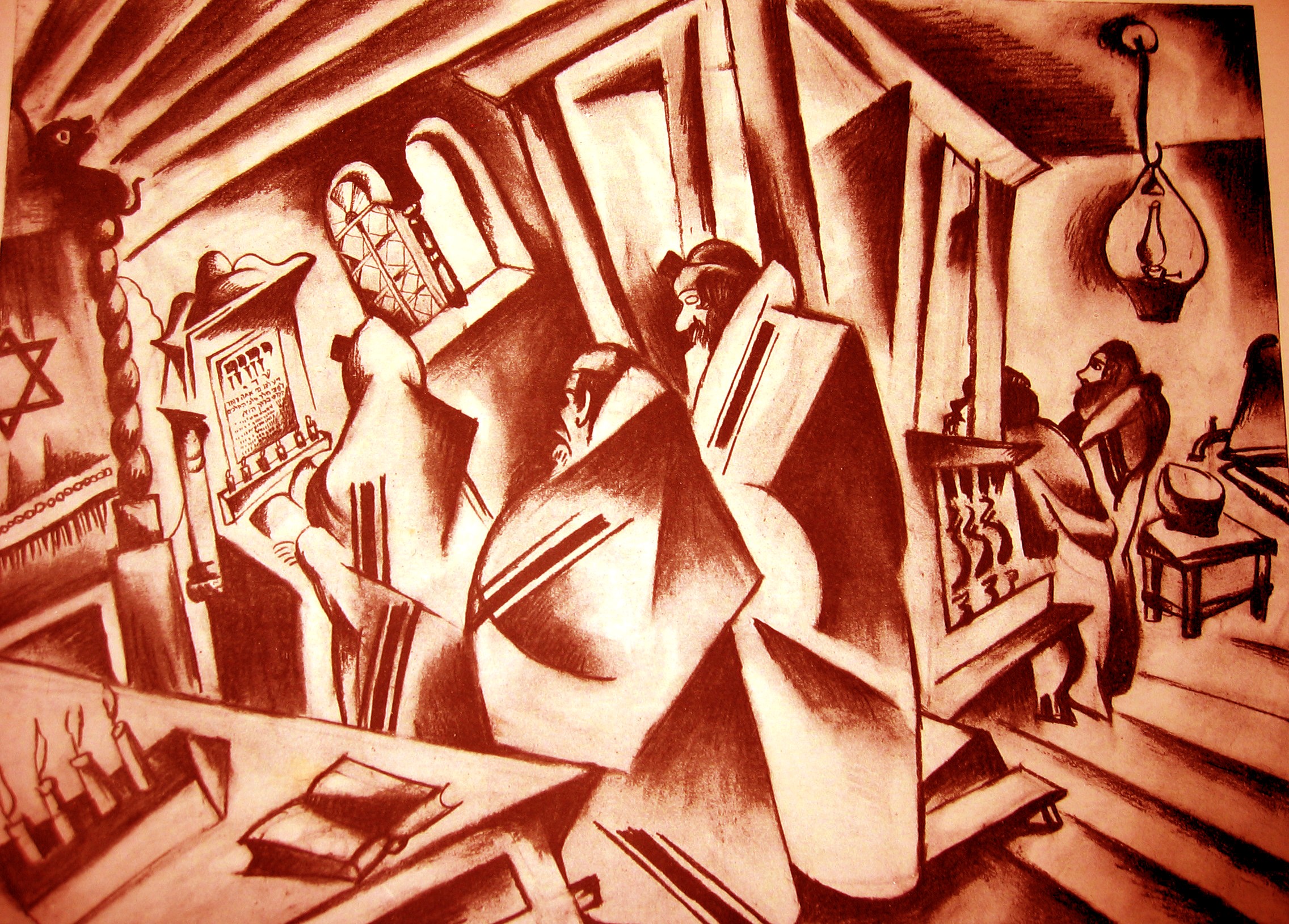
Indeed, going back to the beginnings of writing and reading, what we find is that very few people read books at all. Most people listened to books/scrolls/papyri being read. TheChrist reading in the synagogue temple reader and the town crier are the original of audiobooks and podcasts. In ancient Palestine, for instance, it’s estimated that in even so bibliocentric a culture as that of the Jewish people only 5 to 15% of the population could read at all, and the reading that went on often did not occur in deep intensive reading like that which Scott and I imagine when we think about what reading really is. Instead, much of the experience of reading was through ritual occasions in which scriptures would be read aloud as a part of worship. This is why biblical writers persistently call on people to “Hear the Word.” This model of reading persists in Jewish and Christian worship today, even when large numbers of the religious population are thoroughly literate. See Issachar Ryback’s “In Shul” for an interesting image from the history of Judaism.
Indeed, in the history of writing and reading, listening to reading is more the norm than not if we merely count passing centuries. It wasn’t until the aftermath of the Reformation that the model for receiving texts became predominantly focused on the individuals intense and silent engagement with the written word of the book. In this sense, we might say that the Hebrews of antiquity weren’t bibliocentric so much as logocentric—word-centered but not necessarily book-centered.

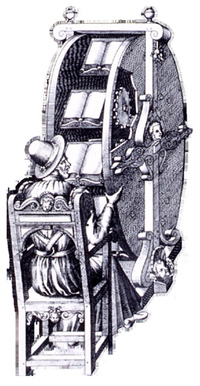
Along these lines, the model of intense engagement—what scholars of book history call “intensive reading”—is only one historical model of how reading should occur. Many scholars in the early modern period used “book wheels” in order to have several books open in front book wheelof them at the same time. This is not exactly the same thing as multi-tasking that Scott abhors in his post, and it’s not exactly internet hypertexting, but it is clearly not the singular absorption in a text that we’ve come to associate with the word “reading.” “Reading” is not just the all-encompassing absorption that I’ve come to treasure and long for in great novels and poems, or even in great and well-written arguments. Indeed, I judge books by whether they can provide this kind of experience. Nevertheless, “Reading” is many things.

But to recognize this is not exactly the same thing as saying “so what” to the slow ascendancy of audiobooks, and the sense that books, if they are to be read at all, will be read as part of a great multi-tasking universe that we now must live in. Instead, I think we need to ask what good things have been gained by the forms of intensive reading that Scott and I and others in the cult of book lovers have come to affirm as the highest form of reading. What is lost or missing if a person or a culture becomes incapable of participating in this kind of reading.

By the same token, we should ask what kinds of things are gained by audiobooks as a form of experience, even if I don’t want to call it a form of reading. I’ve spent some time recently browsing around Librivox.org, which I’ll probably blog about more extensively in a future post. It’s fair to say that a lot of it turns absolutely wonderful literature into mush, the equivalent of listening to your eight-year-old niece play Beethoven on the violin. On the other hand, it’s fair to say that some few of the readers on that service bring poetry alive for me in a way quite different than absorption in silence with the printed page. As I suggested the other day, I found Justin Brett’s renditions of Jabberwocky and Dover Beach, poems I mostly skim over when finding them in a book or on the web, absolutely thrilling, and I wanted to listen to everything I could possibly find that he had read.

This raises a host of interesting questions for a later day. What is “literature.” Is it somehow the thing on the page, or is it more like music, something that exists independently of its graphic representation with pen and ink (or pixel and screen). What is critical thinking and reading? I found myself thrilled by Brett’s reading, but frustrated that I couldn’t easily and in a single glance see how lines and stanzas fit together. I was, in some very real sense, at the mercy of the reader, no matter how much I loved his reading.

This raises necessary questions about the relationship between reader and listener. Could we tolerate a culture in which, like the ancient Greeks and Hebrews, reading is for the elite few while the rest of us listen or try to listen. At the mercy and good will of the literate elite—to say nothing of their abilities and deficiencies as oral interpreters of the works at hand.

More later