Category Archives: Uncategorized

Critical Thinking and Cultural Literacy: Or, Is Unmasking Shakespeare Productive Cultural Work?

Ok, a slightly lame way of doing the blog entry today, but I spent a lot of time commenting on Mark Bauerlein’s blog at the Chronicle today, so I thought I’d just copy some of that and expand just a bit on what I had to say there.

In sum, Bauerlein makes the argument that the arguments in favor of critical thinking as a raison d’etre for literary study are really only half the story for professors in the humanities, and perhaps especially in English. The other half is that we need to pass on an appreciation of a cultural tradition.

As a department chair, I’m used to giving the usual run-down on critical thinking in making arguments for English studies. They generally sell well with provosts and deans because they both seem to comport with traditional practices of the humanities while at the same time being a marketable skill to discuss with skeptical external constituencies. On the other hand, I’m not completely convinced that the humanities are the only place to get critical thinking skills. What, they aren’t doing critical thinking in the hard and social sciences? I think we sometimes assume that because different fields investigate different data sets, they are therefore not developing critical thinking. What is an economist doing but attempting to think critically about received wisdom as applied to sets of data in the economy?

Thus, I fully appreciate, while not going all the way with, Bauerlein’s argument that the humanities have to be about familiarizing students with a substantive subject matter and understanding its active or potential value in the world and for themselves. In my own terms, I think that English studies, especially, has to be more than a critical project; it has to be a constructive project as well.

My comments on Bauerlein’s blog were as follows:

I think the comments above that suggest an exclusive identification of literary or humanistic studies with critique has become strangely vacuous are right on the mark. And, in reality, it’s not clear that critique per se has changed very much over the course of the last two or three decades. This is because critique must always have an object of its attention and is therefore always dependent on some kind of received culture.

In an older form of literary study, criticism meant not simple-minded passing on, nor simple-minded tearing apart, but critical evaluation. That is, what is worth passing on, what is worth reading, and for what reasons? The literary academy and the humanities more broadly have almost entirely defaulted on this particular task because to make an affirmative act of construction is to lay oneself open to the, I guess, humiliating preference for deconstruction or other forms of political critique.

In our curriculum I teach both the courses on literary theory and a course on book reviewing, and in both attempt to get students to think in concrete and critical ways about what’s worth reading and why. I have to say that students find the classes incredibly important to them. Far from feeling like the web—with its massive democratization of product and opinion—has done away with the need for discussion of value, they really find it an important question. Why should I spend my time with this book rather than that book? With Mark Bauerlein’s blog instead of Moby Dick? These are theoretical questions, critical questions, and questions that involve themselves in the construction of traditions and cultures rather than simply critiquing them.

In my own view, I think the current explosion of textual matter on the web—whether blogs, or online fictions, or newspapers, or e-books—has created a critical situation very similar to that which existed after the invention of the printing press. In a certain sense, the invention of the press changes the function of criticism. Prior to widely accessible print and the expansion of both reading audience and authorship beyond the narrow confines of the clerisy and aristocracy, criticism more or less existed to catalogue and discuss the characteristics of good writing. This was not, properly speaking, an evaluative project. Things that were published and preserved were, by and large, already considered good. “Criticism,” such as it was, was more a taxonomic affair, describing the goodness that was already known to exist.

After Gutenberg, criticism became the task of defining what, out of the immense amount of material on hand that could be read, really should be read. What was worth preserving? What things being produced by the new class of writer/readers deserved a status similar to that of the ancients as worthy of being preserved? To some degree, we are still at the dawning moment of that part of the internet revolution. What is really worth reading? Even, what is really worth writing? Is a blog worth doing? Is it real writing or is it conversation. Is real thinking going on, or is it ephemeral. To some degree popularity sites like Technorati or Digg that try to apply the democratic impulses of the web to blogs and the like are trying to serve an evaluative function. The wisdom of crowds applied to the function of criticism. Will this work for the long term? I have my doubts. There’s always been a tendency to try to insist that “best-sellers” are those things that are really valuable, but their value hasn’t been sustainable for more than a generation or two. I suspect that we are still working out the function of criticism at the present time. What shape will criticism take? How will we decide what is worth reading and writing. How will we decide what being written—or perhaps we should now simply say, “being produced—on the web are the kinds of things that should be passed down to our children as we attempt the inevitable human activity of forging a common culture.

After a variety of comments for Bauerlein with varying levels of vitriol in play, I followed up on a comment that made the argument that we need to be teaching things that students are comfortable with, but also things that sting them with their unfamiliarity.

My response:

Tim, I wonder in this day and age whether reading almost anything longer than a blog will be, for many students, a de-familiarizing and unsettling experience. That is, one doesn’t have to buy in to all the hype about a reading crisis to recognize that the nature of reading is changing, and the ability to read extended and complex texts has been eroding among college graduates.

Because we are so habituated by our own reading practices and training, we often make deeply flawed assumptions about what students will find de-familiarizing. And, to be honest, we often default to simple-minded notions of unfamiliar cultural content. “De-familiarization” first developed among formalists as a conception of how literary language served to shock readers from their comfortable linguistic frames of reference. On that score, I think we often find that contemporary students find reading much of anything “literary” at all to be unfamiliar, defamiliarizing, and unsettling. Especially so in poetry, but in a different register in long novels and plays they no longer even bother to try and read. Rather than experiencing the sting of defamiliarization in Shakespeare’s Tempest, students are quite as likely to go get the Sparknotes so they can pass the test and even write their essays.

In this kind of reading context, it seems to me that discussions of how to upset the cultural applecart on the basis of whether folks read Shakespeare or not are increasingly arcane and disconnected from cultural realities in which long form reading is taking place. While I agree that the task can’t be a simple passing on of received tradition, I think the cultural situation does call for engaging students with the question of why certain forms of reading may be valuable, and thinking through what texts might be worth the time required for reading them. In other words, the philosophical conception of “The Good” surely can’t be “Whatever has always been.” But it also surely can’t be, “Whatever I decide might make my students talk in class,” or “Whatever an individual wants it to be.” To go this route is, I think, to give up on the question of “The Good” entirely, something I think most students are still unwilling to do.

This is something I find repeatedly in play among literary intellectuals. It’s almost as if we are so hermetically sealed within the discourses and practices of our discipline that we can’t conceive of a world where the fact of reading a book might be uncomfortable or unfamiliar for students. When I raise this problem at conferences, I repeatedly have professors reply by saying “Everyone I know reads.” I want to say “Duh. You work in an English department.”

This fact, I think, calls in to question some of the basic premises of the canon wars that preoccupied folks at Duke while I was there as a grad student in the late eighties and early nineties. In the world that we are entering and are now in, people who read literature as an important part of their cultural lives are a distinct minority group that all have more in common with one another regardless of ethnicity, sexual identity, religion or gender, than they do with other members of their various identity groups—at least insofar as reading is concerned. That is, reading books, and reading literature especially, marks them out as different, as Other from the culture they inhabit–whether we are thinking of an ethnic, a national, a religious or a sexual culture. We need to recognize that we are quickly entering a world, and are already in it, wherein the simple fact of reading Moby Dick or Shakespeare will be a stinging act of defamiliarization that unsettles the cultural life of students.

This doesn’t mean that Bauerlein is right that we need to be passing on a received tradition—though I think students value that more than we sometimes realize. But it certainly does mean that we have to be involved in a constructive project and not simply a critical project.

Reading as Mapping: Or, Who are the Well-Read? And Does Anyone Really Care?

My son is a seventh grader who plays up a grade on an eighth grade basketball team. They make the Bad News Bears look talented. I was talking with a friend whose daughter plays on a high school team that’s also been struggling, and I asked him if it was as bad as our eighth graders. “Worse,” he said, “because at least there’s hope.”

How true. With absolutely low expectations and little hope of victory, we can be thrilled when the eighth grade boys manage to keep the game within 30 points. By contrast, our boys’ high school basketball team has lost a dozen games by less than five points, and the girls’ team has played well below expectations, their dismal records depressing by virtue of what might have been.

I feel a little bit the same way about Pierre Bayard’s How to Talk About Books You Haven’t Read.Despite my disparagement of Bayard in yesterday’s post, it’s fair to say that Bayard has 15 pages of very provocative insights. But his tendency to extend them to absurd extremes, to make mind-bending leaps of illogic without sufficient evidence, and his willingness to bury those insights beneath pages of mind-numbingly dull and uninventive reading—to say nothing of his generally flippant tone—leads me to dislike the book all the more despite the important things it might have to say. What might have been, I want to say. What might have been.

For me, Bayard raises the question of what we must mean when we imagine being well read—a class of persons that seems increasingly rarified and relatively unimportant, but which bears a residual level of cultural respect, if not capital, in any case. In America, the Well-Read are something like the British Royal family: ceremonial but without any real power.

Bayard points out that given the tens, the hundreds, of thousands of books that we could possibly imagine being worth reading, there is some literal sense in which all of us will have always read almost nothing at all. He tells the story from Robert Musil’s Man Without Qualities wherein the hero walks through a library of 3 and a half million books and realized that, were he to read a book a day, he would have to live ten thousand years to read them all. I am reminded of my favorite professor in college, Joe McClatchey, whom we saw walking across campus one day, a troubled look on his face. Asked what was wrong, he said with some intense sadness that he had just realized how many great books there were that he would never have the chance to read.

I am reminded of Thomas Merton’s dictum for Christians that in comparison to the love and wisdom of God, Christians must begin each day realizing they are starting over as infants. None of us is ever really well-read in this quantitative sense, and so being well-read means something other than or different than “reading everything” or even “reading a lot.” It has nothing, in fact, to do with an amount of reading whatsoever.

The traditional canonical arguments would suggest that it means reading “the best” that has been thought and written, while canonical revisionists would, of course, seek to change or alter what is contained on this list of “bests,” or else challenge and change what is meant by “best.” I am unimpressed by this quest for the right list of “bests”; even were we to agree on what the category entails, it seems to me there are too many very good books out there to read, even in the relatively narrow field defined problematically as “literature”–leave alone philosophy, history, theology, social theory, and etcetera–for us to ever imagine something like a comprehensive literacy.

Bayard takes things in an intriguingly different direction. Being well read is not a matter of what you read at all. Being well read is not a matter of assimilating a particular number of titles. Indeed, for Bayard, being well read has nothing to do with reading particular books at all. Instead, being well read is a function of understanding the relationships between books, an understanding that, once mastered, allows someone to place books with only the most cursory understanding of their contents.

To some degree with is a literacy of location—thus the title of this blog, reading as mapping. To read a single book is a little like examining the details of a single city block. I could read a hundred different titles on a great books list, but if I am only wrapped up in the reading of individual texts, what I will come away with is an intimate knowledge of 100 different city blocks.

For Bayard, by contrast, being well-read is not achieved through the intimate, rigorous, and close reading of discrete texts, but through understanding the map of texts, the way texts and their properties fit together, cohere, differ, contrast. As Bayard puts it:

“As cultivated people know (and, to their misfortune, uncultivated people do not), culture is above all a matter of orientation. Being cultivated is a matter not of having read any book in particular, but of being able to find your bearings within books as a system, which requires you to know that they form a system and to be able to locate each element in relation to the others. The interior of the book is less important than its exterior, or, if you prefer, the interior of the book is its exterior, since what counts in a book is the books alongside it.

“It is, then, hardly important if a cultivated person hasn’t read a given book, for though he has no exact knowledge of its content, he may still know its location, or in other words how it is situated in relation to other books. This distinction between the content of a book and its location is fundamental, for it is this that allows those unintimidated by culture to speak without trouble on any subject” (10-11)

Before questioning this, I want to affirm how very true it really is, and how important it might be for thinking through what we might mean by cultural literacy. I am often poignantly struck by students who come to me for a list of books they ought to read. I always tell them, read authors they like, and then read what those writers liked, and then read writers who liked those writers. I’m not quite saying the same thing as Bayard, but I am trying to suggest to students that reading a particular list of books is not going to be that helpful.

I think Bayard pushes me a little further here in making me see that I’m also trying to get students in to some kind of system of relationship between texts. Who influences whom, and why does it matter. This is one way of mapping—probably not a very good one. What professors know that students do not are not just individual texts. What professors know is how to read the maps of texts that students don’t even really comprehend exist. The championing of “native knowledges” and reading preferences of students as is common in some pedagogies is of limited use if we don’t see that we are leaving students impotent in understanding how maps of reading work in culture. How can they map their own preferences on to the map of literature—or, how can they challenge whatever maps currently exist.

In a particular sense it seems to me that what Bayard is doing is applying the insights of structural linguistics to the world of books. Imagine each book as a word. Understanding the word by itself is not important, and indeed, if a person only knew one word we justifiably and correctly call such a person an idiot (clinical definition, a person who can do only one thing or speak to only himself—kind of like writing this blog).

However, the structural linguists rightly point out that the meaning of any word is only functional within the entire system of words, and that it is important to understand the shape of that system, that discourse, in some ways more important to understand that than to understand discrete words themselves—a logical impossibility in the thinking of structural linguists since there is no word “in itself”. To apply a Wittgensteinian take on this rather than a structural linguistic take, we rightly note that the meaning of a word is in its use. We can often determine or broadly guess the meaning of a particular word we have never heard before by hearing the word in use, in a particular context. And in any case we come to understand a word not by getting definitions but by learning how the word is put in to use in the systems of language.

Bayard is saying something very similar about what it means to be culturally literate. Cultural literacy is not the grasping of lists of facts or texts—as E.D. Hirsch or Allan Bloom would have had it back in the 80s. Literacy is understanding how the system of books work so that, even when we have not read a particular book, we can determine without too much trouble its general place in the system of books as a whole.

On the whole, I think Bayard underplays the significance of reading particular texts, and the particular kind of sophistication that come through these local knowledges. Bayard’s assertions that it is more important to know the map than to have visited the locations on the map, bears a certain truth. But it’s not clear that a person who reads a map, but who has never seen a mountain or who has never walked through a city block, or who has never viewed the sea, can properly be said to understand a map at all.

Imagine a person who grows up in a closed room and is taught only to read maps, and he becomes thoroughly familiar with maps and the relationships between them. It’s not clear, however, that such a person can really read a map if, when taken out of his room, he cannot recognize a city street. Instead the person is merely reading hieroglyphics without any sense of the relationship of those hieroglyphics to the cultural life in which they are embedded. In other words, a certain level of extended close reading is necessary for the reading of book maps to make any sense at all. Reading of individual books is necessary to the possibility of reading maps in a way we simply take for granted. On the other hand, this having been said, it’s not clear we can really understand our own geography in the fullest ways possible, without understanding the ways that geography is related to other geographies.

In other words, we need to both read the maps and walk the streets. The relationship between the two elements is far more dynamic and interactive than Bayard seems to allow. The knowledge of individual books is only coherent by understanding how to map the book to a particular bookish geography. However, maps only make sense to us at all if we have some knowledge and understanding about at least some, and preferably many, individual books. We can only understand relationship through understanding things being related. Relationship itself, as Kierkegaard well understood, is the most abstract and insubstantial—yet unavoidable and necessary—of philosophical concepts. To get at the ways in which books relate, we have to grasp at least some things of book themselves.

Many more things to say here, but I think I’m going to stop for the night. Two main things on my mind. One, I think the multi-ethnic canon wars have often been fought over lists, and have thus been only marginally effective in challenging the most important thing: the way books are mapped. While we read a few new books, we mostly haven’t changed our understanding of how books relate to each other. We haven’t changed the map; we’ve just added heretofore-unacknowledged trees and rocky outcroppings, while leaving the basic contours of the geographic spaces of literature untouched. Second, and it might be related, but I’m not sure. I think we still do a better job of communicating to undergraduates the importance of the close reading of discrete texts than we do the importance of relationship between texts. Students come away with a strong sense of reading, but not a strong sense of how to map books in their experience.

Death, the Mother of All Beauty; and also of BookPorn

Ok, a morbid start. Still, I thought I’d recall my post from a few days ago when I speculated on the idea that books become art objects as their cultural life decays. Of course, I forgot that the romantics had already covered the ground where death begets beauty—which is not to say it’s false ground or can’t be re-covered in a new key. I was reminded of the romantics by Eric Wilson’s current essay in the Chronicle of Higher Education, “In Praise of Melancholy.”

One would think that Keats’s life would have fostered bitterness in him, but he remained generous in the face of his difficulties. He didn’t flee to the usual 19th-century escapes: Christianity or opium, drink or dreaming. Though he unsurprisingly underwent pangs of serious melancholia (who wouldn’t, faced with his disasters?), he nonetheless never fell into self-pity or self-indulgent sorrow. In fact, he consistently transformed his gloom, grown primarily from his experiences with death, into a vital source of beauty. Things are gorgeous, he often claimed, because they die. The porcelain rose is not as pretty as the one that decays. Melancholia over time’s passing is the proper stance for beholding beauty.

I thought I might blog more extensively on Wilson’s essay, but it ended up being less interesting than I had hoped. I’m wondering why, for an English prof, he seems so given to the vague and gauzy generalization over the vivid detail or anecdote. Still, credit for reminding me of those romantics. And my title of course is from the ubiquitous Wallace Stevens and what may be the most singularly beautiful poem in the American idiom, “Sunday Morning.”

Death is the mother of beauty; hence from her,
Alone, shall come fulfilment to our dreams
And our desires. Although she strews the leaves
Of sure obliteration on our paths—
The path sick sorrow took, the many paths
Where triumph rang its brassy phrase, or love
Whispered a little out of tenderness—
She makes the willow shiver in the sun
For maidens who were wont to sit and gaze
Upon the grass, relinquished to their feet.
She causes boys to bring sweet-smelling pears
And plums in ponderous piles. The maidens taste
And stray impassioned in the littering leaves.

In the words of the equally ubiquitous Stanley Fish, “Wow. Isn’t that just Great.”

Anyway, I launched into this not to talk about morbidity or about Stanley Fish but to return just briefly to my fascination with books as objet d’art. (I confess I’m not even entirely sure what this means in the Wittgensteinian sense that meaning is in the use. When do you use it? surely somehow differently than “art object” or people wouldn’t say it in French. Or maybe they’re just being pretentious.)

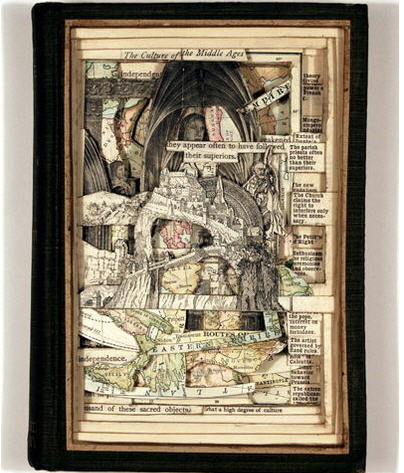
Courtesy of Scott Esposito at Conversational Reading, I again found some absolutely fabulous images of books as works of art at Signonsandiego. The artist, Aaron T. Stephan, has a new show at Quint Gallery entitled “Building Houses/Hiding Under Rocks.” As the website puts it, “he’s converted some 20,000 discarded books into … an artist’s Lincoln Logs.”.

One of my favorites:

Artist Aaron T. Stephan–Building Houses Hiding Under Rocks

Stephan’s website has more of this great stuff. I especially like the wrench made from pages of Immanuel Kant’s Critique of Judgement.

Courtesy of Scott McLemee’s column at Inside Higher Ed about the best academic blogs on the web, I came across Rachel Leow’s site Idlethink, though I think she also calls it A Historian’s craft . Rachel regularly posts her photos of books in a running series she calls BookPorn. These are found objects, I guess—I’m no art historian. A beauty she’s discovered in the everyday display of books rather than in the self-conscious manipulations of the book’s physicality. Still, they fall in with my general mulling over what strikes me as a relatively new interest in the book as plastic art.

One of my favorites from Rachel’s collection:

Rachel Leow at Shakespeare and Co

My good friend Julia Kasdorf has a book entitled , The Body and the Book reflecting on women’s roles as embodied readers and writers, among other kinds of embodiment. Rachel’s pieces and some of the others I’ve pointed to over the past couple of weeks make me think we need a book entitled “The Body of the Book.”

Not that I will write it. I can barely make my way around an essay.

(Sidenote: Rachel also had some helpful hints for blog protocols in using her work. So thanks, Rachel. As I say, I can barely make my way around an essay. So far, blogging is pretty much glorified typewriting with nifty pictures as a bonus in case people get bored. Or in case I do.)

Still, I think there is something very poignant about Rachel’s photos. Seeing these photos makes the heart ache. Or at least a booklovers heart ache. Ok, so I’m weird; they make my heart ache. And I think it is somehow tied to the fact that Rachel’s work and other work like it call attention to the materiality, and thus the fragility, of books.

For us, books have been ideologically tied to permanence. Like the old woman in Stevens’s “Sunday Morning” who can’t stand the flowing by of time, for us books have bespoken our longings for and reaching after an unchanging permanence. Turning books themselves in to art suggest that books, too—and the texts and human knowledge they contain???—are more akin to the beauty sown by death, strewn leaves “of sure oblivion.” All the more so because digital culture is proud of its ephemeral impermanence. Flowing as a position of no position.

There’s a tricky dynamic in Stevens’s world of beauty. It’s not that ephemera is beautiful in and of itself. Indeed, change and movement are only beautiful in the hoped for permanence they suggest and make impossible. Beauty is the shape of our desire, aroused only in the awareness of its fragility and passing.

Perhaps this is why the sight of old books—or any books, rightly rendered–makes me ache. They are the sign of all things.

Michael Chabon and Ghost of Wallace Stevens in Political Slug Fest!

Ok. Again. Not. However, I remain fascinated by the rhetorical irresponsibility that blogging makes possible.

In keeping with the literary politics of the season, the New York Times reports this morning that there’s a new book out with women writers reflecting on Hillary Clinton. The title, Thirty Ways of Looking at Hillary Clinton, recalls Wallace Stevens “Thirteen Ways of Looking at a Black Bird.” The choice apparently reflects the content of the book since Stevens’s poem is all about how perspective makes and in some sense is the object of our reflection.

I

Among twenty snowy mountains,
The only moving thing
Was the eye of the blackbird.

II

I was of three minds,
Like a tree
In which there are three blackbirds.

III

The blackbird whirled in the autumn winds.
It was a small part of the pantomime.

Ok, I hope you have a better time making sense of this than I do with my students. After saying “This poem is about perspective” conversation mostly comes to an end and we twiddle our thumbs for fifty minutes. Nevertheless, the blackbird, and apparently Hillary, are nothing apart from how we construct them in our imaginations.

Kakutani isn’t terribly impressed, but I have to say that I find Kakutani too often follows the unacknowledged dictum of many contemporary book and movie reviewers: Slander everything unless you find it absolutely impossible not to. Finding fault too often substitutes for seriousness.

The following is from the introduction by Susan Morrison:

“On a shelf in my kitchen is a campaign button that I picked up during the 1992 presidential race. Over a photo of Hillary (bangs and headband phase—which was basically my look then, too) are the words ‘Elect Hillary’s Husband.’ Back then, the slogan produced a kind of giddy frisson: not only was the candidate just like someone I could have gone to college with—a baby boomer—but his wife was, too. And she had a job! I had only known first ladies as creaky battleaxes who sat under hairdryers and wore brooches. The thrill associated with that button feels far away now, and it’s hard to know exactly why. There’s no doubt that the rinky-dink scandals of the Clinton administration and the dismal parade of special prosecutors took the gleam off the fresh start that the Clintons brought with them to Washington. But that doesn’t quite explain how now, fifteen years later, there is not more simple exuberance at the idea that we may be about to elect our first woman president.
….
“No other politician inspires such a wide range of passionate responses, and this is particularly true among women. As I talked with women about their reactions to Hillary, some themes came up again and again. Many women were divided within themselves as to how they feel about her, and I noticed a familiar circle of guilt: these women believe they should support Hillary as a matter of solidarity. But, because they expect her to be different from (that is, better than) the average male politician, she invariably disappoints them; then they feel guilty about their ambivalence. Some feel competitive with her. Having wearily resigned themselves to the idea that ‘having it all’ is too much to hope for, they view Hillary as a rebuke: how did she manage to pull it off—or, at least, to appear to pull it off? Other women say they want to like her but are disturbed by the anti-feminist message inherent in the idea of the first woman president getting to the White House on her husband’s coattails. Then there are women, like the late playwright Wendy Wasserstein, who are queasy over the way Clinton’s popularity spiked only after she was perceived as a victim. When it became clear that Hillary was going to stand by her man after the Lewinsky fracas, Wasserstein wrote a disheartened Op-ed piece in the New York Times. ‘The name Hillary Rodham Clinton no longer stands for self-determination, but for the loyal, betrayed wife,’ she wrote. ‘Pity and admiration have become synonymous.’

Side note: Morrison’s text is one of many that echo Stevens’s poem. Gates’s Thirteen Ways of Looking at a Black Man, Smiley’s Thirteen Ways of Looking at a Novel. A quick Google search shows 44,600 references to the phrase “Thirteen Ways of Looking.” There are, I guess 17 extra ways of looking at the prismatic Hillary Clinton. I find Wallace Stevens resilient popularity and influence on our culture a bit boggling. Maybe it’s because most of us are leading the dull lives of insurance salesman and long to release our inner poets.

Thus the popularity of blogging? Anyone can be a poet now. Everyone is.

So much for craft.

Miscellany: Books as Plastic Art; Leslie Fiedler; Clinton’s Campaign Against Hope.

Book Sculpture

Many thanks to Scott Esposito at Conversational Reading for pointing me toward this really fascinating page on books as art objects.

A favorite image from the page:

2057160036_ec4b4ef2ba.jpg

I’ve seen a variety of things like this in recent years, and I suspect to some degree that seeing the book as a form of art is tied to a sense of its demise. As things die, they become works of art, perhaps? The Freudians have already covered this, I’m sure. In the infancy of books, of course, books were also thought of as treasurers to be handled like works of art or other revered objects. Books in general were far too expensive for the masses to obtain, and as a general rule this continued for a very long time. Owning books, as much as reading them, signified your cultural and class superiority. This all changed gradually over centuries after Gutenberg, but changed with a vengeance with the invention of the paperback.

Perhaps now that television and the internet have taken on most of the cultural purposes of the paperback and the newspaper—cheap entertainment and ready information for the masses—books are again left to become objects of art, treasures indulged in primarily by a small coterie of collectors. Strikes me as depressing, just a bit, but I still love these photos.

Leslie Fiedler. Who?

I couldn’t help but notice Scott’s post on Friday noted a new book by the late Leslie Fiedler, whom Scott admits he didn’t know. Alas, how far the mighty have fallen. I used to want to be Leslie Fiedler. He made cultural criticism seem romantic. Now cultural criticism has all the romance of oral dentistry or working at Chic-Fil-a. (Does anyone know why they spell it this way?)

Seriously though, Fiedler was one of the few critics I’ve ever known whose work aspired to and in some instances could be called literary. This despite the much vaunted declarations that criticism and theory were literary genres, these made by literary theorists who could not write. Roland Barthes, who I think came up with the idea, also comes close to this ideal in some of his work. But declaration is not achievement. Fiedler and people like Barthes—Fiedler more than Barthes–are to be thanked for showing us that cultural criticism could actually care about and love language, that how it communicates can mesh with what it does communicate.

Clintons continue attack on literature…er…Obama.

By now, I guess, everyone has heard that Bill Clinton and hip-mate Hillary Clinton—or is it the other way around—got in trouble for deriding Obama as a purveyor of fairy-tales and fantasy. In some future post I think I’ll take up the idea that the Clintons who once represented the hopeful face of baby-boomerism, now represent the craggy and toothless grin of what to expect as baby-boomers start using canes and walkers. “No hope for you, people, you silly and naïve young whippersnappers.” My general sense is that the Clinton approach demonstrates again and again that they are part of the system, so broken by it that they have to replicate it, like dogs licking the hands of an abusive master. Trouble is they may be right. Systems persist for a good reason, the gradually wear down the hopes of those who would change them and they are impervious to appeals from those outside their own logic. The smart money still goes with Clinton, but for the moment I feel like I’m still young enough to hope.

But my real issue with all this is the Clinton’s perfidious campaign against the imagination and literature. (Beware those who use the term “perfidious” wantonly). As I pointed out in earlier posts, Clinton has all the literary imagination of a manual on how to fix my furnace. Hillary works too hard to have time for literature. Now they are using a perfectly wonderful and culturally important literary form as a derogatory epithet. As Vladimir Propp could tell them, fairy tales make us what we are.

Do those of us who are reading for our lives, an increasingly aggrieved and marginalized minority who must struggle against the glass ceiling of…well, something I’m sure…set in place by the billions of non-readers in the world, really need the Clintons piling on with their anti-literary epithets?

I think enough is enough. We need to stand up against unthinking and derogatory stereotypes of reading culture.

READERS OF THE WORLD UNITE!

Or something.

Who’s Reading Now? Or, Crises Ad Nauseum

Trolling around The New York Times I came across this gem.

Ok, so only someone thinking about writing a book on reading would think it’s a gem, but I’ve got to write about something today. Everything’s material.

“The measure of all worth seems to be the question, “does it pay?” The attitude of the vast majority of the American people is distinctly inimical to the pursuit of culture for its own sake, and there are few men who read habitually after leaving college, simply because they are compelled to devote all their time and energies to the making of money in order that they may be regarded as of importance among their fellow-men. “How much is he worth?” That is the question by which the majority of people decide the value of a man….

“[As] long as the money-making ability of a man is taken as the true measure of his worth (and there are many who argue earnestly that it should be,) reading for culture, which is the highest form of reading, will be at a discount, whether among college-bred men or others. Nevertheless we think it highly probably that if an investigation could be made with accuracy, it would be found that the percentage of men who read entirely aside from the professional demands and purely for the sake of culture, would be found to be larger among university men than others.”

The language probably betrays that this isn’t the NEA’s study on the decline of reading, though it’s equally as earnest. It’s from 1900, an article titled “How Reading Does Not Pay” responding to and extending an earlier article that recounted the surprising decline of reading by undergraduates at Princeton University. Of course, all things are relative. I traced down the earlier article, “Reading of University Men,” and it appears that in 1900 20 percent of male Princetonians–the only kind of Princetonians there were, actually–had read Sartor Resartus, 30 percent had read Boswell’s Life of Johnson and nearly 80 percent had read Milton’s Paradise Lost.

I include the links to Project Gutenberg because…well…who knows if anyone reads these works anymore. I did as an English major two and a half decades ago, but most of the students in our department graduate without having read these particular texts and many others that an earlier generation considered necessary. Necessary for what, I leave unstated.

I would mostly be glad if I could just get 80% of the students at my college to read a newspaper, online or no. I did a survey of reading at my college as part of a class a couple of years ago and found that about a 1/3 of the students read even one book a year that was not assigned for a course. Survey’s being what they are, I suspect the statistics are inflated.

We could probably argue about what this suggests about the reality of our own “reading crisis,” such as it is. Digital utopians would, I know, point feverishly to the fact that students now spend a lot of time reading, and writing! New forms of literacy. To which I might say, “Yes, they punch text messages into their 2 by 3 inch phone screens and cackle maniacally at the latest picture with two sentence caption posted to their Facebook pages.” This is a little like giving folks credit for using the English language. Ok, I’m cranky, but also half serious. I do agree with the thesis that a lot of what passes for writing and reading on the web is more like conversation than writing–with all the good and bad things that implies. I don’t think writing has ever been simply a substitution for talking, and the forms of mental and imaginative engagement required by older forms of reading are significantly different than those necessary for conversation.

Still, I’m a little more interested in the rhetoric of concern that motivates discussions about reading. I’m struck by both the familiar and the distinctive flavors of this particular reading crisis at the turn of the last century. On the one hand the lamentation of reading’s decline, and the sense of some relationship between reading and cultural leadership. Readers are rightfully the big men on the Princeton campus aren’t they, these articles seem to assume, just as, in the NEA’s vision at least, Readers are the movers and shakers and thinkers we need to be competitive in the global economy.

Readers as Big Men on campus? Well, here is the flavor of difference. I doubt this is true at Princeton anymore, if it was then. Indeed, the account registers mostly the fear that this isn’t the case, that the rightful place of the cultivated man has been diminished. And what counts as a big man on campus is, more and more, the very capacity to make money that these late Victorians think of as polluting the superior man who should read only for culture, a more high-faluting version of the NEA’s concern with reading for pleasure. Mostly, in fact, our own reading crises are put in the explicit language of political and economic profits and deficits. The failure to read will damage the economy and damage our civic life. The triumph of business in higher education is nowhere more clearly registered than in our efforts to justify reading on the basis that it will help create better middle level managers. The idea of reading for culture alone is not even on the radar, except perhaps in its professionalized version in the mind of Stanley Fish.

More tomorrow on other varieties of reading crises I’ve stumbled over the last couple of days. Sometimes these are seized on by digital utopians as evidence that the NEA is crying wolf. I think they raise a more interesting question. Why is reading always in crisis? And how do the shape of these crises–which I’m willing to say are to a very large degree creations of discourse–and the rhetorical forms through which they are articulated suggest changing cultural values? And why do we choose to narrate cultural crises through crises in reading.

This isn’t at all intuitive to me. The terms change, the cultural positions morph and realign, but what is it about reading that leads folks to assume repeatedly and ad nauseum that we are in a crisis. We seem to have reading crises with the approximate frequency of menstrual cycles. What is it about the nature of reading that leads us to fret over its fragility?

Articles Cited:

How Reading Does Not Pay
New York Times. June 16, 1900
Section: SATURDAY REVIEW OF BOOKS AND ART, Page BR16, 622 words

READING OF UNIVERSITY MEN.
June 2, 1900
Section: The New York Times SATURDAY REVIEW OF BOOKS AND ART, Page BR8, 641 words

Reading about reading about reading about….

I’ve been reading the winter issue of n+1. Smart people, smart and funny writing. I envy their youth. This issue’s take on The Intellectual Situation—a regular feature that’s a rambling blog-like essay more or less focused on a topic, or at least a loosely related series of themes, or united by a sort-of narrative—focused on the reading situation, among other things, noting especially the sudden prevalence of how-to books devoted to reading.

“Self help-style (sic) books about reading reappeared on the publishing scene in the last halcyon days of “Third Way” capitalism—when the world was embracing a kinder, gentler, freemarket as a solution to all our problems, including the problem of universal education. With that memorable 1999 title, How to Read and Why, Harold Bloom completed his transformation from the vatic close reader of The Anxiety of Influence to a lonely crusader against declining standards. In fact, he wasn’t so lonely: Bloom was preceded, barely, by cultural literacy proponent E.D. Hirsch in How to Read a Poem (19999), and he’s been followed, in recent years, by a number of tenured professors and established writers, and even the odd celebrity with time on his hands: there’s How Novels Work, How to Read Like a Writer, the deliberately parodic Ode Less Traveled, Oxford University Press’s Very Short Introduction series, which followed Penguin’s Complete Idiot’s Guide to Shakespeare and American Literature. Most of these now originate in Britain. Even radical-socialist Terry Eagleton has one called, er, How to Read a Poem.”

They mention, too, John Sutherland’s How to Read a Novel: A User’s Guide, and the grandfather of this genre, Mortimer Adler’s How to Read a Book. Even then, n+1’s is a necessarily selective list. Others include How to Read Literature Like a Professor, Reading Like a Writer and Thirteen Ways of Looking at the Novel. I’ve just started the latest hot read on reading—or rather non-reading—How to Talk about Books You Haven’t Read by Pierre Bayard, which is a book about, among other things, how to not read a book. I would talk about it, but I haven’t read it yet. I did read the review.

Close cousin to these is a veritably new genre of literary non-fiction that I call the reading memoir, books by baby-boomers narrating the wonders of the books we are gradually leaving behind. Maureen Corrigan’s Leave Me Alone I’m Reading. Anna Quindlen’s testimonial How Reading Changed My Life. The industry that is Michael Dirda.

Indeed, too many to name them all, and these are merely the visible edge of a great tsunami of books on reading over the past twenty years. In fact, a quick WorldCat search shows 70,000 catalogued items published on the subject of reading from 1967-1987. Since 1987 we’ve been enlightened by approximately 105,000 new investigations of our crisis. With the publication of the NEA’s latest report, I’m sure we’ll see another 25,000 or so before the decade is out. I hope my own is among them.

This says nothing about the several million blog pages of persons chronicling their own reading habits, experiences, revelations, etcetera ad nauseum. (Who? Me, you say?) Reading is an industry of its own. Indeed, without the sea of books on reading, one suspects that the crisis in the publishing industry would be much more well-advanced. Anxious readers buy more and more and read less and less in the interest of understanding their own demise. Why, Oh Why?

The easy answer, and only one I have, is that this flurry of reading about reading is symptomatic of the very death of the book that we are gradually experiencing. In Verdi’s La Traviata, Violetta, dying of consumption, summons a last illusion of strength on the fantasy of her own resurrection. Like the diva dying on her sick bed, book culture summons a last illusion of strength by reading about it’s own demise. Reading lists are like bucket lists: great things to do before I die, or before books do. This is too easy, but it does seem to me that how-to books appear at those moments when a once dominant cultural practice moves from being necessity to option. Gardening manuals only make sense in a world where people don’t know how to and don’t have to grow their own food. Books on how to make a cabinet or how to wire a house are only for those who no longer learn it as a matter of course from a father or the guy next door. My favorite among books of this ilk is The Dangerous Book for Boys, which guards against the loss of our boyish past and our electronic future by teaching boys how to play…marbles. Reading books about reading is a sign of reading (at least reading books) having become a practice of clubs rather than a necessity of living. Some day perhaps courses in reading a novel will be offered at my local YMCA along with crocheting and scrap-booking. Oh, wait. They already are.

n+1 mocks the how-to books, rightly it seems to me. But their solution borders on the bizarre.

So maybe—is this a crazy idea?—reading needs to be taught, and taught well, rather than sold. Instead of writing more well-intentioned books, why don’t academics intervene directly in secondary school education? Let’s lend them out to state schools, public schools, and community colleges to teach for a few weeks a year. Morally, this is the equivalent of pro bono work in the legal profession. Let’s reward junior professors for community teaching rather than for publishing articles in academic journals. An extra sabbatical year could be offered, during which professors would work closely with young readers. Maybe this experience could actually change the way intellectuals think about literature. If a certain degree of literacy and appreciation for htte complexity of great books (or just good novels) is as necessary for a healthy and free society as we’ve often heard or said it is, then maybe the only way (not the “Third Way”) forward is a Maoist –style cultural revolution in reverse: “INTELLECTUALS: INTO THE SCHOOLS!”

Um…Ok, I appreciate the idealism. I really do. But…um…could it be any more obvious that the folks at n+1 only hang out with people who have gone to Ivy League or Ivy league wanna-bes, and went to the kind of high schools that got them in there. Or that they are too young to have kids in the secondary schools? Or that they are fundamentally out of touch with the economics of higher education. An EXTRA SABBATICAL YEAR??? I guess they’re maybe thinking that the moneyed interests at Harvard and Yale–the only places that can really afford extra sabbatical year–are going to come riding to our rescue. Chances are the cure would kill us. Maybe they could imagine Harold Bloom coming to their high schools to teach reading, but if Harold Bloom had come to my high school I would have been shooting rubber bands at his rather expansive posterior. Or falling asleep. Most academics have a hard time making themselves understood to one another, and we’re going to put them in high schools to teach 16 year olds to love to read???

Don’t get me wrong, I teach at a college where the focus is primarily on teaching, and I think that balance is about right. And a colleague runs a program at Penn State that gets grad students into the schools to do just this kind of thing with reading and writing. My own college runs continuing education programs for teachers to get them in touch with literary and other disciplines once again. We clearly need more connections between the colleges and the high schools, both so high schools can better prepare kids for what they’ll face in college and to help colleges understand where their freshmen are coming from. But let’s respect the expertise of teaching that a secondary school teacher has developed, and let’s help them as much as we possibly can.

Despite the naivete, n+1 is one of the best things going. Maybe because of the naivete. They haven’t yet joined those of us who are old and jaded by, among other things, too much reading.

Justified by Fish Alone

In his most recent essay for the New York Times, Stanley Fish takes up the much exercised question of whether the study of the humanities can be justified. His answer, predictable for anyone who has followed his work, is “No, and it’s a good thing too.” Of late Fish’s growing irritation with literary and other humanistic disciplines has focused on the fruitless politicization of these disciplines, fruitless because such politicization seeks to change the world in ways that are demonstrably ineffective and that debase the professional status of the humanities in the bargain. Fish is always singular, but to some degree he is one of a large group of cranky elder statesmen who are none too happy with what the literary academy has become in the hands of their academic children and grandchildren. Men—and it is mostly men—like Harold Bloom, Terry Eagleton, and , to a somewhat less cranky degree, Gerald Graff. Fish’s argument in the Times concludes as follows:

Teachers of literature and philosophy are competent in a subject, not in a ministry. It is not the business of the humanities to save us, no more than it is their business to bring revenue to a state or a university. What then do they do? They don’t do anything, if by “do” is meant bring about effects in the world. And if they don’t bring about effects in the world they cannot be justified except in relation to the pleasure they give to those who enjoy them.

To the question “of what use are the humanities?”, the only honest answer is none whatsoever. And it is an answer that brings honor to its subject. Justification, after all, confers value on an activity from a perspective outside its performance. An activity that cannot be justified is an activity that refuses to regard itself as instrumental to some larger good. The humanities are their own good. There is nothing more to say, and anything that is said – even when it takes the form of Kronman’s inspiring cadences – diminishes the object of its supposed praise.

Fish followers will recognize the argument Stanley has been flogging for nigh on two decades. The professionalization of any discipline is it’s own justification. And in so many ways this is Fish at his inimitable best. Lucid and engaging, persuasive by the force of well-rendered prose alone. (Full disclosure, I had Stanley in a graduate seminar on Milton at Duke; I was and still am so intimidated that I will only call him “Stanley” in prose I am pretty sure he will never read. Professor Fish, always and forever). And there’s so much I want to agree with in Fish’s continuing obsession with this problem. The idea that literature or the study of literature could best be justified by the way it contributes to the revolution has increasingly struck me as excruciatingly reductive, this despite the fact that I’ve written one book and am nearly finished with another that examines literature from a political perspective.

Still, this is mostly an argument about justification that Fish can make largely because he is no longer a dean or department chair having to make justifications. Perhaps he now resents all the years he had to do all that justifying of something that appeared so obviously to him as the ultimate rendering of “The Good.” Indeed, Stanley Fish the institution needs no further justification. He is his own good.

However, Fish’s argument rests on a faulty assumption. When Fish says “Justification, after all, confers value on an activity from a perspective outside its performance,” and that “The humanities are their own good” one imagines that he lives in a metaphysical bubble. This is because, in fact, performance of any activity always depends in some shape or form on things outside its own performance. When I read a book, that personal and cultural good does not exist in an ether of its own making or its own perpetuation. It is made possible by an economy of other personal and cultural goods and other cultural and personal activities. To read the book I take time away from my kids. I refuse to be with my students for at least a spell. I depend on the destruction of trees or the electronic production of pixels, which means I depend upon an economy of human labor and leisure. I also live within the frame of an inevitable personal economy. If only by the fact that I am one body and not many, I do not participate in other demonstrable cultural and personal goods such as the effort to alleviate hunger or to heal the sick.

Any single one of these, of course, need not be the determinative activity that says my decision to read a book is justified or unjustified. But it does suggest that our activities absolutely never exist in a sphere where their own performance is all that counts. In short, the humanities exist within the world already and therefore have effects by the fact of their performance, even if only to the extent that pursuing them must take place within a human economy of means and ends. To “justify” then is simply to give an account of why this cultural good is worth pursuing in light of the world we live in. In the academy this takes the very obvious shape of places within curricula and claims upon the financial well-being of students and their parents. Why is the time and money necessary for a course in literature (or film or philosophy or history) justified? To say that the humanities are their own good is to imagine a humanities without students; indeed, a discipline without human beings. To imagine it so is, from one perspective, self-indulgent. From another it is to imagine nothing at all since there is no world in which such a humanities could possibly be pursued.

The other limitation of Fish’s argument is that he seems to assume justification is only achieved by a transcendental logic. That is, I must point to a foundational reason that will make the humanities (or the simple reading of my book) justifiable. Because I can’t come up with that foundational reason that is beyond dispute, it must be the case that my activity cannot be justified from a perspective outside itself. This is a fairly common deconstructive form of attack on almost anything. However, as Fish surely well knows, many theories of justified beliefs hardly take this form of transcendental logic. More typically, justification is not a form of transcendental logic, but a pragmatic form of argument, or even a network of stories demonstrating use and consequence. In other words, justification is usually much more like the kinds of arguments you have to make to a dean to justify new expenditures. No transcendent logic will work, but a series of stories demonstrating the connection of my activities with the logic and practice of other activities can be very compelling indeed. This justification is what the performance of my own humanistic endeavors depend upon. Why else would a college care to spend a lot of money to let me read books if I couldn’t justify the expense.

Fish’s persistent sense that there is simply no evidence of the usefulness of the humanities is, in fact, demonstrably false if we see each one of these reasons not as an absolute reason but as a thread in a network of argument, a scene in the story of the humanities.

One small example. This week The Guardian reported on the development of a new form of therapy called bibliotherapy. Reading books actually seems to play a role in helping the psychically damaged or depressed to begin a process of managing and even repairing their emotional problems. Brain studies demonstrate that the reading of poetry enlivens parts of the brain that reading non-fictional prose or watching TV does not. Studies in composition and rhetoric demonstrate the deep connection between reading facility and writing ability. Graduate schools in fields as diverse as Business, psychology, and law, repeatedly cite the study of English as a form of preparation. None of these things are exactly the same thing as talking about the deep meaning—or lack thereof—that can be found in literary works (and who, after all, said that this was the only performance that the discipline of literary studies could pursue). But it’s not quite clear that they are completely separate from these activities and many others. These performances are interpenetrating and mutually reinforcing.

We are not our own performance. We dance together or we die alone.

Reference: Maureen Dowd, My Hero

Actually not, since half the time I think Dowd substitutes irratibility for thoughtfulness. Still, I thought this article was an interesting reflection on some of the gender issues I’ve also been taking up the last couple of days. According to Dowd:

“There was a poignancy about the moment, seeing Hillary crack with exhaustion from decades of yearning to be the principal rather than the plus-one. But there was a whiff of Nixonian self-pity about her choking up. What was moving her so deeply was her recognition that the country was failing to grasp how much it needs her. In a weirdly narcissistic way, she was crying for us. But it was grimly typical of her that what finally made her break down was the prospect of losing. “

This strikes me as unfairly harsh. Clinton is a few country miles from Nixonian. But it does suggest that Clinton’s own construal of the gender war that’s going on over emotion is suspect. Clinton defended herself by saying male leaders are allowed to cry while women aren’t. All tears are not, in fact, equal, nor do they communicate similar things.

Men do, in fact, cry on the campaign trail. Strategically, no less. Cynically, no doubt. But the prospect of a man gaining points by crying because the trail is so hard and the people so unheeding is unfathomable.

Dowd goes on:

“Hillary sounded silly trying to paint Obama as a poetic dreamer and herself as a prodigious doer. “Dr. King’s dream began to be realized when President Johnson passed the Civil Rights Act,” she said. Did any living Democrat ever imagine that any other living Democrat would try to win a presidential primary in New Hampshire by comparing herself to L.B.J.? (Who was driven out of politics by Gene McCarthy in New Hampshire.)”

“Her argument against Obama now boils down to an argument against idealism, which is probably the lowest and most unlikely point to which any Clinton could sink. The people from Hope are arguing against hope.”

Author! Author! Of course, I’m always most impressed with Dowd’s brilliance when she agrees with my own brilliant opinions.

Mitt Romney, Untrustworthy Literary Flip-Flopper

With my headline I just thought I’d try out my chops as a writer of currently high level American political discourse.

Seriously, though, Romney needs to lay hold of a literary position and dig in to the trenches rather than pandering to pundit expectations. This past summer the media exploded with disgust and disdain that Romney declared his favorite book to be L. Ron Hubbard’s Battlefield Earth, a book that I confess has yet to make it to the top of my pile but which John Dickerson at Slate says indicates “very deep levels of weird.” Sensing a scandal in the making, Romney—or rather Romney’s “people”—backpedaled quickly, declaring that Romney’s favorite book was really the Bible. As if we didn’t know that. Battlefield Earth is merely his favorite novel.

This seems to have done little to diminish the very high levels of weirdness the blogosphere detects in the choice of overly long fiction written by the founder of Scientology. My guess is that Romney would have done better to choose something that would overcome the Mormon factor, which for many people, rightly or wrongly, also signifies very high levels of weirdness. (On the other hand, anything sniffing of religion strikes many people in the media as highly weird, so this may not be saying much). Still, I don’t think Mitt’s people wanted the electorate going in to the voting booth with the image of the Romney family Bible stacked on the bedside table alongside the Book of Mormon and a novel by L. Ron Hubbard, especially since that novel focuses on the predatory practices of “hairy 9-foot high, 1000-pound sociopaths” called The Psychlos.

In the passing months, Romney and his people have apparently backpedaled yet further. A gander at Romney’s Facebook page now lists a dozen solid, not to say stolid, books with one novel—Mark Twain’s Huckleberry Finn. What Hemingway described as the foundation of modern American literature takes its place on the Romney bookshelf alongside a variety of business leadership manuals and scary books about the evils that face us: jihadism and Thomas Friedman’s flat world. The weirdness factor seems to be tamped down for good (though I admit I tend to find leadership manuals highly weird, my being a middle level manager in an academic institution notwithstanding).

L. Ron Hubbard has gone the way of all flesh. But so, apparently, has the Bible. The Book of Mormon still has yet to show its face and I really think that some intrepid reporter needs to ask Mitt why that may be. Just what, exactly, is he hiding? Religion is represented by Rick Warren’s The Purpose Driven Life. For many politicos, Warren is clearly much safer than the Bible. He is after all “a new evangelical,” which in our current political lexicon tends to mean an evangelical you could bring to fundraiser without worrying about whether you could offer him alcohol. Certainly Warren’s book can be brought up at a Republican cocktail party without raising eyebrows, something you can’t always say about the Bible. Depends on the cocktail party. I’m not sure that this says a lot for Rick Warren, or for how well people may be reading his book, but the image does go along with Romney’s well-coifed hair and perfectly massaged public image.

Last year I wrote a paper, still being revised, where I speculated a bit on the ways people used books to identify with others. We signal our desires, values, goals, interests through the kinds of books we read—or pretend to read—and how and where we read them. But what exactly is Mitt signaling with all this shelf-shuffling? Probably nothing, except that he wants to be president. I was prepared to write a few paragraphs on the peculiar choice of Huckleberry Finn as a boy who stood against the status quo, willing to give up his status and his standing—little as it was—to try and do the right thing. How different and odd that choice seemed given that Romney seemed mostly about status and the status quo. However, I suspect, frankly, that the leadership manuals are Romney’s real favorites and Huckleberry Finn is a book he remembers from his days as an undergraduate English major at BYU.

I actually think Mitt really likes Battlefield Earth, that this literary slip of the tongue was the real literary Mitt before he realized the weirdness quotient could do him in with the 1% of the electorate that actually cares about what he reads. I liked him better because of it. We all have our perverse reading pleasures. Things we get in to against our better natures. This devious pleasure-taking in the alternative world of literature is one of the great things literature affords us. I think of myself as a half-baked pacifist but I can’t get enough of war movies. Heaven forbid, but I sometimes prefer a vampire novel to the latest tome by Don Delillo or Philip Roth. I actually like the fact that Mitt Romney loves shlocky sci-fi novels that have been badly-written by a man a few pancakes short of a full stack. It suggests to me that Romney’s hair isn’t perfect when he gets out of bed in the morning, that maybe when he can’t sleep late at night he gets on a sci-fi chatroom and becomes Megalorg, laser scourge of the planet Kryl-9.

Or whatever.

Makes him human and interesting, a little like Hillary’s tears earlier today.

What I don’t like is that he seems to change his favorites at the first whiff of scandal. Too much like the guy in high school who always seemed to find a way to like whatever the cool kids liked. The guy held in contempt by even the people he calls friends.