Rego on Roosevelt

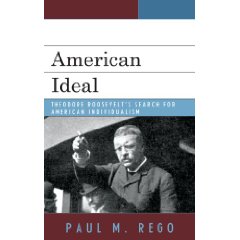
I had the pleasure a couple of weeks ago to read my colleague Paul Rego’s new book on Teddy Roosevelt.  Although I’m a little more critical of Roosevelt than Paul is, his book seems very timely, and does a good job of pointing our Roosevelt’s continuing relevance.  Even this week John McCain morphed into a Roosevelt Republican taking on the Titans of Wall Street.  Whether McCain was convincing in doing so is another matter, but it was in line with Paul’s insight that Roosevelt remains a touchstone figure for many contemporary presidents and presidential aspirants.

I thought I was supposed to do a full-blow review/critical response to Paul’s book at a reception in his honor, but I had the honor of introducing him instead.  What follows are my meandering scribbles on Paul’s book, titled, by the way “American Ideal:  Theodore Roosevelt’s Search for American Individualism.” These don’t quite amount to a review since they’re mostly notes for a talk, but I thought I’d post them here anyway.

In some respects, Paul’s book focuses on the irony of his subtitle: Roosevelt’s search for an American individualism. Though an intellectual biography, Paul seems to suggest that Roosevelt doesn’t arrive at settled substantive positions so much as he grapples mightily with antinomies of American thought, practice and culture—the most important of these being the split between the pluribus and the unum in the American psyche. Born out of the Enlightenment, American politics and culture has never rested easily with the earlier notion of an individual as being one member of a group. Instead, the individual and the society are necessarily in tension with one another, if not actively opposed to one another. On this view, the individual is society’s other, not matter how much we may say that society’s could not be conceived of without individuals and vice-versa. On this reading, a search for an American individualism is a quixotic quest—my reading, not Paul’s—since to be an American is to be a part of a collective, but one which only defines itself through the exaltation of the individual. Nevertheless, however impossible the project, the struggle to reconcile these opposing forces gives Roosevelts work much of its energy and contemporary relevance, no matter that he didn’t completely succeed in his quest.

I especially like Paul’s tracing of the opposition between progressivism and individualism. For one thing, those people in American literature who pay any attention to Roosevelt tend to emphasize his individualism, and so Paul’s attention to Roosevelt’s progressivism was enlightening. Moreover, I learned a lot in Paul’s argument that at the turn of the twentieth century, progressivism was imagining largely in collectivist terms and was in some respects seen as anti-individualism. The complexities involved suggest, as Paul explicitly attempts to do, that politics of the early 21st century continues to bear the marks of the discourses of a century ago. Liberals still rocket uneasily between individual empowerment and government regulation and intervention, while conservative ideals of the self-made man and the destructive energies of capitalism collide, sometimes violently with the conservative values of community, family, and tradition. If Roosevelt has not solved the problem of the pluribus and the unum, neither, really, have we.

Paul doesn’t really take up the gendered elements of Roosevelts thought, and I think they are important on various levels. Roosevelts view of individualism is, in my view, deeply masculine, verging on masculinist, and one reason for the popularity of his books lay in his idealization of masculine activities—war, hunting, camping, and the like—as a remedy for the feminizing forces of culture. Ironically, of course, many conservatives perceived the government as just such a ‘feminizing” force, wherein a man had to give up his manly individualism in favor of the will of the collective. The identification of progressivism with the feminization of American culture is everywhere in American literature at least, and finds it’s way even in to contemporary politics. Think, for instance, of the fairly popular conservative dismissal of the liberal “nanny state,” and the preference that men pull themselves up by their own bootstraps. Paul argues that Roosevelt was willing to use the powers of the state in order to enable the possibility of individual achievement. Whether this is genius or hopeless contradictory may depend upon your politics, but I’m struck by the way in which this structure is represented in one of Roosevelt’s signature achievements—the establishment of the National Park system. One reason, though not the only one, that it was brought in to existence was so a place where men could test their mettle against the forces of nature could be preserved in a rapidly urbanizing society.

Paul recognizes Roosevelt’s racism and makes the argument that he must be understood as a man of his time, and I think Paul also successfully shows that Roosevelt’s understanding of individualism did not exclude African Americans, making room for those of the race who in some sense transcended the handicaps associated with racial oppression. To some degree, this is a common argument made about someone like Lincoln—who Roosevelt took as an ideal. By modern standards would clearly be understood as a racist, but his thinking was supple enough to imagine the possibility of transcending the racial categories of his days.

Nevertheless, I wonder if some of the issues surrounding race as well as gender don’t go closer to the root of the problem Roosevelt faced, which would be in how the individual is imagined as an individual. That is, the political conception of the individual in American history is always imagined in raceless terms; however, in our conceptualization of race until very recently, only white people can be raceless. To be black is to be raced; in other words to be inherently marked as identified with a collectivity. By contrast, whiteness is more usually understood as the sign of individualism, of being unbounded by tribe, history, tradition and society. In short, to be free. The great literary essay on this idea remains Achebe’s meditation of Heart of Darkness, where he rightly points out that the travails of Conrad’s white characters depend upon the facelessness and inarticulate jabbering of the black mass that makes them stand out as individuals. In other words, however much room we may make in our conceptualization of individualization for specific black people, this is very easily transmuted in to the understanding that others can become individuals by becoming just like me—in which case they are no longer clearly other in terms of race.

This having been said, I tend to agree with Paul that the structure of this thinking can’t be blamed on Roosevelt, since it is part of the structure of American thinking per se. He did not invent it, nor is it completely clear how he could have escaped it. Instead I think it points to the notion that perhaps the reason these issues cannot be reconciled is that they begin with a deeply flawed notion of what it means to be an individual, however attractive that ideal may continue to be.

The Graphic Marco Polo

Over at A Historian’s Craft, rachel leow has a really neat little project going on, mapping out and annotating the travels of Marco Polo as she reads The Travels of Marco Polo. Of course, it would be really creative if she mapped out the travels of Marco Polo while reading The Travels of William Bartram, but who’s complaining.

Rachel is also the curator of a lovely series of photos entitled BookPorn. This is one of the latest from Lankester Antiques and Books.

Lankester Antiques and Books

Lankester Antiques and Books

Daumier on Reading

There’s a lovely online exhibition devoted to Honore Daumier’s representations of reading in his work as the kind of grand pere of editorial cartooning. I’m struck by the way in which Daumier represents reading as a

Not now, dearest, I'm reading

Not now, dearest, I'm Reading

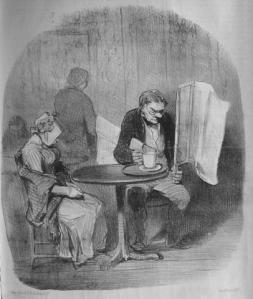
social activity. Of course, there are a number of representations of reading as something that draws people into isolation. As, for instance, this piece on what appears to be man and wife together in a cafe.  This seems to fit what I’ve often taken to be the individualistic character of reading in the modern world (and, to be frank, this doesn’t seem all that different from someone sitting at a table texting or reading email while ignoring his wife or girlfriend or friends;  reading draws us elsewhere, so all the fretting that goes on about the internet damaging our social relationships may be nothing new)

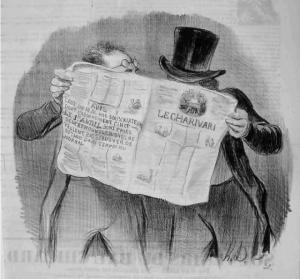
On the other hand, I’m struck by the number of Daumier pieces that emphasize what I would describe as the sociality of reading, the ways in which reading is an occasion for bringing people together.  For instance, this piece with two men reading the paper together:

She did What????!!!

She did What????!!!

There are actually more of these kinds of images in the exhibit, suggesting that reading becomes a kind of occasion for sociality rather than isolation.  (Of course, it’s France, right?  Hard to know if similar images could have played in Peoria).  Still, I’m intrigued by the ways in which reading becomes a social event.  I’ve suggested in some of my work in progress that book readers in contemporary society represent a kind of social subculture with a variety of signs and forms of cultural currency.  Are you reading, what are your reading, with whom are you reading, where are you reading.  All these form a system of signification that allows readers to form a kind of social sub-group within and around their taste for books.  Far from being individualistic, reading is a cultural practice with its own distinct forms of sociality.

Holiday Inn Priorities in Place

I don’t use this blog to flack for businesses (I think it’s illegal on WordPress anyway).  However, I thought I’d point to this program that Holiday Inn Express helps sponsor that supports Reading is Fundamental.  (I’ve elsewhere complained that reading isn’t really fundamental in any precise sense, but who’s complaining).

Too bad I didn’t know that my recent stay at HIE in Philadelphia could have helped the readers of tomorrow.

Side note:  The Holiday Inn Express in midtown philly was really an exceptionally nice stay.  Great and friendly service, good breakfast, comfortable rooms, everything really close.  And they aren’t even paying me to say this.

Summer’s Guilty Pleasures: Tears of the Sun

I am a sucker for brainless Bruce Willis vehicles, but I’ll blame Tears of the Sun on my son, Colin. (Ok, I admit it was my money that rented it). Tears of the Sun falls in to the general time honored genre of films and novels that are set in the context of racial difference but really serve to obsess over the continuing moral drama of whiteness and its discontents. Think Kevin Costner in Dances with Wolves, or Dustin Hoffman in Little Big Man, or Leonardo Dicarpio in Blood Diamond, or for that matter Conrad, Kipling, and Fenimore Cooper. What gets me about these films, and Tears of the Sun seems especially egregious, is that all the moral wrestling with the curse of whiteness becomes, SURPRISE, yet another occasion for championing the moral ascendancy of white people. As if we say to ourselves “Look how hard I’m trying to be good, and humble, and true, and right, and how hard I am trying to atone for past racial sins; I must really be better than everyone else after all.”

Ok, I will admit that I liked the shoot-em-up scenes as much as any good war movie, and overall I can’t complain about the entertainment. But basically this movie was The Searchers (or maybe The Last of the Mohicans) dressed up in anti-racist drag. Bruce Willis and his band of commandos go to save the white missionaries and doctors caught in a Nigerian war zone. Predictably the doctor is gorgeously beautiful (and apparently French, perhaps a gesture toward globalization but more likely a gesture toward cross-national white solidarity), and we know that she and Bruce Willis will sleep together when they get back to base (which they don’t, actually, but we see them fly off together into the sunset on a helicopter. Let your imagination go to work). The film tries to develop a moral drama in which Bruce Willis “does the right thing” by risking himself and his men to disobey orders and try to rescue the Nigerian refugees in the doctor’s charge, one of whom, SURPRISE!, just happens to be a Nigerian prince who is being sought by rebel leaders of the coup d’etat. (The coup d’etat, generally, is a trope for Africanity in the American cinematic imagination). American individualism and rejection of authority becomes the source for global redemption.

I can live with all this since I like a good hokey story as much as the next guy (witness my oft-stated delight in Uncle Tom’s Cabin). But like Uncle Tom’s Cabin, the film’s moral center becomes not really despair that attends a decade long civil war in Africa, or even a meditation on the variously subtle ways in which Western powers have contributed to the violence and instability of African nations. It becomes instead a meditation on the gloriously self-sacrifical superiority of white people. When, at the end of the film, the lead African female actor weepily looks into Bruce Willis’s bloodied face and repeatedly tells him how much God loves him and will bless him, I half expected the Nigerian nationals to pull out their American flags and start singing God Bless America. The film seemed to suggest that moral and ethical choices are occasions for narcissistic self-display. It also struck me as a propaganda piece for American interventionism. Released in 2003, perhaps we were still on the edge of believing that our guns and our good intentions could make the world a better place. Cf Iraq.

These things aside, I still like a good shoot-em-up, and I’m still a sucker for brainless Bruce Willis vehicles. Against all my better instincts.

For more of this summer’s guilty pleasures see:

Black Snake Moan–June 30th

A Movie Miscellany (Lars and the Real Girl, The Orphanage, and The Happening)–July 15

Hard Times with Hard Times–July 10

Summer’s Guilty Pleasures: A Movie Miscellany

Quote of the Day–July 27,2008

I found this strolling along the “Freedom Trail” in Boston today, from Benjamin Franklin:

“Experience keeps a dear school, but fools will learn in no other.”

—-Benjamin Franklin

Refreshing for me since American responses to education are so deeply anti-intellectual (even pragmatism– our only real contribution to philosophy–doubts the efficacy of learning.  Anyway,  experience too often is another name for prejudice, a form of justification that verges on narcissism, believing that if it isn’t true to my own experience it isn’t true at all.  The dream of reading, true or false, has at least sometimes included the notion that we can see beyond our own experience into the experience of others, that my own experience may be a starting point, but left in it I am left to my own limitations.

Side note:  I have to say I love Boston.  I’ve never spent more than a few hours in the city itself, once on a visit years ago after graduating from college, and then a few years ago for an afternoon with my parents.  A school on every street corner, it seems.  A place where walking is its own entertainment.

Advent of Revolution

Advent of Revolution

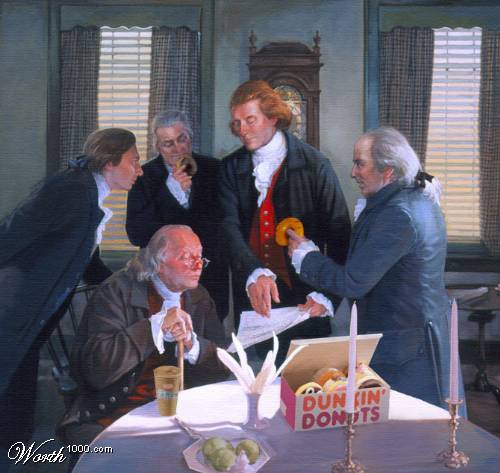
One question, what is the deal with Dunkin Donuts?  Did they start here?  There are more dunkin donuts than pictures of patriots, and that’s saying something.  According to boston.com “there are 1100 Dunkin’ Donuts within a 50-mile radius of Boston.  So far as I can tell it doesn’t affect the waistlines, but watch out Boston.

Quote of the Day–July 25, 2008

Picked up via Eugene Robinson at the Washington Post

“Luck is what happens when preparation meets opportunity.”

Seneca

“The harder I work, the luckier I get.”

Samuel Goldwyn

I tell students not to be fooled by the myth of inspiration. Handel may have written the Messiah in 3 weeks, and Faulkner may have written As I Lay Dying in eight, but this belies the hours and hours of blood, sweat, and practice, practice, practice that made enabled them to take advantage of inspiration when it came. And the average 18 year old wonders why I’m messing with their style.

Quote of the Day–July 24 2008

The following from Alice Walker

Perfection

Perfection

In nature nothing is perfect and everything is perfect. Trees can

be contorted, bend in weird ways, and they are still beautiful.

ALICE WALKER

This kind of thing reminds me why I liked her and actually included her in my book. However, by that time Walker was well along in her efforts to become an oracle instead of a writer. Too bad. She could have been a great writer, The Color Purple and a few other things attest. Instead she often sounds like a half-baked version of Shirley McLain. Which leaves her about quarter-baked, I guess.