April 4, 1968

Today is the anniversary of the assassination of Martin Luther King, Jr.

The video is a montage surrounding the Civil Rights Movement and the life of MLK with the speech by Robert F. Kennedy playing in the background.

I was in many ways too young to completely understand what was happening in 1968. But even now these words and these images move me.
Martin Luther King Jr. speakingThe words speak for themselves. Related to the general interests of this blog, they make me think of one thing very simply: Words Matter. Whether in the life and preaching of Dr. King, or the eloquence of RFK, summoned from the heart at the instant of crisis.

I think I am no sentimentalist to say that I find myself longing for a leader who could quote Aeschylus by heart, who did not hold words in contempt, who knew enough to see that eloquence isn’t empty. Through words we imagine a life we can’t yet see.

Death of the (Paid) Author?

The London Times reports a great deal of panic on the part of British writers as they contemplate the gradual demise of the longstanding business model associated with print books. E-books legitimate and illegitimate are apparently the main culprit, or at least the main cause of fear. Writers note that digital piracy is rampant, not unlike the problems that the artists associated with the music industry have been complaining about for several years.

Google is doing something that appears more legitimate since it’s pursued by a big company, but if the universal library is successful without any form of compensation for writers, it’s hard to see what incentive will continue to exist for compensating writers at all.

Of course, it’s hard to remember now, but the “professional” writer who makes his or her living by the word is a relatively new invention. Samuel Johnson was, perhaps, the first, and was a rarity then. Writers used to be people who did their work as moonlighting, or because they had the money and the time, or else as officials of the court. In a more ancient vein, poets were troubadours, making their money through performance rather than through commodities.

I wonder whether we are entering a period when the very idea of a professional writer is coming to an end. And I’m not sure whether to be sanguine about that or not. I’m not a member of the cult of the amateur, even though I value anyone writing whatever may be on their minds and imagination. Still, there’s something to be said about the tradition of craftsmanship, the guild of writers that, at its best, professionalization managed to maintain on some level. Of course, there’s always been a lot of crap out there, but I’m not certain that craftsmanship will maintain the same aura in digital forms.

Maybe. Maybe.

Books as sign

In “Snoopers on Subway, Beware Digital Books,” Susan Dominus of the New York Times points to the ways in which books act as social signifiers and the ways in which Kindles and other e-book readers challenge that particular moder of signification.

Trying to get a read on people who are reading is one of those aimless but satisfying subway pleasures that may eventually go by the wayside, like scanning the liner notes on the way home from Tower Records. The Kindle, an Amazon electronic book reader, may make getting your hands on a book faster, but in the process, it could “make it a lot harder to indulge in the crucial cultural task of judging books — and the people who read them — by their covers,” wrote the columnist Meghan Daum in The Los Angeles Times last fall.

The Kindle may rob New Yorkers of a subway pastime that’s more specific to this city: judging people’s covers by their books. That young guy slouched in his seat, with the hoodie pulled tight over his head — his posture suggests sheer indifference. The book in his hand, “Egyptian Cosmology,” suggests something otherwise (to guess what, exactly, would require a passing familiarity with Egyptian cosmology).

This goes along with my general sense of reading as a signifying act in an of itself, and that books function socially to communicate much more than information. Most of the stuff championing e-books emphasizes their superiority at delivering information. That MAY be true. I’m reading Treasure Island on BookGlutton–admittedly not a dedicated e-book reader but an e-book nonetheless–and I’m not totally convinced. More on that in the future. When I actually manage to finish Treasure Island, that is.

Still, I think the emphasis on books as an information delivery system misses the point that these systems themselves function as cultural artifacts and so themselves enable certain forms of communication just by being, regardless of the information that they contain.

Dominus goes on to say:

Of course, the Kindle won’t stop people from reading in public, but it might make that potentially public act seem oddly private. And we risk stripping reading of the extra work it does, enlightening us about the curiosities of the people with whom we so often seem to share space and nothing else.

I think this is right in a peculiar way. I’ve mentioned on this space before my sense that I am the only person in the coffeeshop who reads books anymore. This lends itself to a particular sense of isolation that has nothing to do with the peculiarity of my activity. Buddhists meditating together are “isolated” in one sense, but the shared silence–or chanting–is a form of cultural communication nonetheless. I feel more distinctly isolated from a person on a laptop than I do from a person reading a book. This may be irrational, but is a fact nonetheless.

Computer use does not serve the purpose of bonding me to the people in my immediate vicinity in the way that reading a book in the library or the bookstore does, or at least seems to do. In a peculiar way, the computer connection homogenizes my cultural spaces. They are all equally points of connection elsewhere, as if the laptop turns everyplace in American into a strip mall–the strip mall that homogeneous space wherein every American can feel they are familiar but alienated.

Bookporn in my idle hours

I’ve been away from the keyboard for a while. Although it’s spring break I’ve been swamped with work–mostly grading–and keeping up with the kids. I’m hoping to get back to some more regular posting in the next day or so, although I’ve also got a couple of conferences coming up. Never ending. I sometimes wonder if dedicated bloggers actually have real lives. Maybe they aren’t real people. Maybe they are committees that work feverishly to put stuff together.

Still, thought I’d just call attention to Rachel Leow’s newest editions of Bookporn (#28 & 29)over at a historian’s craft. I’ve said several times before how much I love these studies in books, so there’s not much more than I can say.

I’m not sure I like these quite as much as some in the past, but I really do enjoy her study of the blueSeminary Co-op Bookstore University of Chicago–Photo by Rachel Leow pipes winding their way through and around the Seminary Co-op Bookstore at the University of Chicago. I get a weird feeling of zen peace just contemplating these books molding themselves in to every nook and cranny of a building. Of course, in some of my other ruminations on e-books, this is not so much a thing of beauty but a sign of waste. So far in my engagement with e-books, this seems to be the biggest selling point for those who are their aficionados: efficiency. Especially storage efficiency. All those books are so…well…so wasteful. So much neater to have 400 books stored on my Kindle than have 400 books littering my room. Hmmm…something there is in me that says they just don’t get it. The sign of knowledge is a man or woman nearly lost in a labyrinth of books.

Speeding and Reading

As luck would have it I stumbled over two good essays in the same day that seemed to speak to my general concerns (paranoia) at the state of the world. Mark Edmundson over at The Chronicle Review has an excellent piece on the speed with which American college students live their lives these days, a speed perhaps most emphatically symbolized by the Internet. Edmundson is a professor at the University of Virginia, and the author of the book Why Read, a book, among thousands of others, I haven’t had time to read yet.

Says Edmundson, beginning with a chance encounter with a student at the beginning of the school year:

We asked each other the usual question: What did you do over the summer? What he did, as I recall, was a brief internship at a well-regarded Internet publication, a six-country swing though Europe, then back to enjoy his family and home, reconnect with high-school friends, and work on recording a rock CD. What had I done? I had written five drafts of a chapter for a book on the last two years of Sigmund Freud’s life. I had traveled to Crozet, a few miles away, to get pizza. I’d sojourned overnight in Virginia Beach, the day after I woke up distressed because I couldn’t figure out how to begin my chapter. I’d driven to the beach, figured it out (I thought), and then I’d come home. My young friend looked at me with a mixture of awe and compassion. I felt a little like one of those aged men of the earth who populate Wordsworth’s poetry. One of them, the Old Cumberland Beggar, goes so slowly that you never actually see him move, but if you return to the spot where you first encountered him two hours past, lo, he has gone a little way down the road. The footprints are there to prove it.

=====

One day I tried an experiment in a class I was teaching on English and American Romanticism. We had been studying Thoreau and talking about his reflections (sour) on the uses of technology for communication. (“We are in great haste,” he famously said, “to construct a magnetic telegraph from Maine to Texas; but Maine and Texas, it may be, have nothing important to communicate.”) I asked the group, “How many places were you simultaneously yesterday — at the most?” Suppose you were chatting on your cellphone, partially watching a movie in one corner of the computer screen, instant messaging with three people (a modest number), and glancing occasionally at the text for some other course than ours — grazing, maybe, in Samuelson’s Economics rather than diving deep into Thoreau’s “Economy” — and then, also, tossing the occasional word to your roommate? Well, that would be seven, seven places at once. Some students — with a little high-spirited hyperbole thrown in, no doubt — got into double digits. Of course it wouldn’t take the Dalai Lama or Thoreau to assure them that anyone who is in seven places at once is not anywhere in particular — not present, not here now. Be everywhere now — that’s what the current technology invites, and that’s what my students aspire to do.

Edmundson’s essay is pretty wide-ranging, going on to link up with insightful discussion of the relevance of Byron, the natural of contemporary sex, and the laptop as an engine for infinitely expanding desire. Most interesting to me is that Edmundson rightly notes that higher education tends to respond to this situation by saying something like “There go my people, I must lead them” then rushing as fast as possible to make our classrooms and our curricula ever more multi-dimensional, multi-media, multi-tasking, multi-cultural, and multitudinous.

In part, the frantic and unrelenting—and perhaps unavoidable—drive for students as consumers leads us to “meet them where they are” rather than challenging and questioning the form of the culture we all necessarily inhabit.

Often times this argument is put in apolitical—and frankly just stupid—terms by casting it as old culture against new culture, or the culture of elders against the culture of youth. Edmundson points out that this generation of college students has had the internet since they were eight years old. My son has never known a time when we didn’t have an internet connection—even though we only managed to get off dialup a few months ago. How, one must ask, is an eight year old determining the contours of his or her culture. This is a culture that has been thrust upon them by mature adults who made the culture in which they must inevitably participate.

But to recognize that inevitability is not the same thing as having to endorse it or at least fail to recognize its limitations. The formidable speed and the wealth of information available at my internet connection is offered by denizens of the net as its greatest and most empowering aspect. It is also, perhaps, its most its most dehumanizing aspect.

Side note: who decided that more power—implied by the notion of empowerment—is always a good thing, always a humanizing thing. Ask Eliot Spitzer—awfully empowered. Not completely sure the quest for more empowerment results in better persons or better cultures.

Though, as I think about it, this isn’t really a sidenote. One traditional hack on traditional modes of reading (and traditional classrooms) are that they are disempowering. Too slow. The author/teacher is too much in control. Against this notion Edmundson suggests that the first task of teaching in such a world is not to speed up our classes, but to slow them down

For a student to be educated, she has to face brilliant antagonists. She has to encounter thinkers who see the world in different terms than she does. Does she come to college as a fundamentalist guardian of crude faith? Then two necessary books for her are Freud’s Future of an Illusion and Nietzsche’s The Anti-Christ. Once she’s weathered the surface insults, she may find herself in an intellectual version of paradise, where she can defend her beliefs or change them, and where what’s on hand is not a chance conversation, as Socrates liked to say, but a dialogue about how to live. Is the student a scion of high-minded liberals who think that religion is the OxyContin — the redneck heroin — of Redneck Nation? Then on might come William James and The Varieties of Religious Experience or Schopenhauer’s essays on faith. It’s this kind of dialogue, deliberate, gradual, thoughtful, that immersion in the manic culture of the Internet and Adderall conditions students not to have. The first step for the professor now is to slow his classroom down. The common phrase for what he wants to do is telling: We “stop and think.” Stop. Our students rarely get a chance to stop. They’re always in motion, always spitting out what comes first to mind, never challenging, checking, revising.

Not long ago a young man came to my office, plopped down, and looked at me with tired urgency. “Give me 10 minutes on Freud,” he said. “Convince me that he really has something important to tell me.” Despite appearances, this was a good moment. It was a chance to try to persuade him to slow it down. Get one of Freud’s books — Civilization and Its Discontents is usually the best place to start — read it once and again, then let’s talk.

=====

As to our students, all honor to them: They may have much to teach the five-drafter. By their hunger for more life they convey hope that the world is still in some measure a splendid place, worth seeing and appreciating. Into spontaneity they can liberate us. But life is more than spontaneity and whim. To live well, we must sometimes stop and think, and then try to remake the work in progress that we currently are. There’s no better place for that than a college classroom where, together, we can slow it down and live deliberately, if only for a while.

Yes, I think this is it precisely, and I appreciate Edmundson’s effort to find a balance between the culture of speed and the culture of reflection. But I also think he’s right that our students don’t need from us how to be taught to speed through a course of study; they do that well enough already.

Along these lines, I do think one of the greatest challenges facing English departments—if not the culture as a whole–is the deliberateness and singularly absorbed attention that traditional intensive reading requires.

There is a particular sense in which this kind of attention, this kind of slowing down, is “disempowering” in a particular and commonplace use of that term. I willingly subject myself to the book and surrender my consciousness to the authority of the text, my imagination to the primacy of another imagination. I am in some very real sense possessed and my consciousness of self temporarily dissolved into another world created not by the clicking finger of my desire—though my desire may not be suspended—but created by another will.

This is why romantics from Emerson to Byron to Barthes have hated reading (I say this even though Barthes is sometimes taken as a romantic of the reader. Or because of it. He can only imagine reading as a positive act if reading is reimagined as a form of writing, not a form of self-abnegation.)

My terms here verge on the spiritual, which leads to a second essay I read from Nancy Malone, but I’ve gone on too long already and will try to get to this later. Reading, or at least some kinds of reading, as a form of contemplative practice, one who’s desired goal the self-aggrandizing expansion of desire, but dissolution of the desiring self in any straightforward sense.

What does Einstein know, anyway?

I picked this quotation up from by jan on freedom.

“Reading, after a certain age, diverts the mind too much from its creative pursuits. Any man who reads too much and uses his own brain too little falls into lazy habits of thinking.”
–Albert Einstein

Ha! Well, Einstein lived in a different age than ours, that’s for sure. I’m more worried that my students’ lives are so frantic and busy–who am I kidding, I KNOW my own life is so frantic and busy–that I hardly have time to read and reflect. I have to schedule the time in my calendar. Reading as task. Indeed, people who manage to find time for reading may be the most industrious among us. Seriously though, I have a big sense that the so-called reading crisis has less to do with television and the internet than it does with our frantic American sense of having to get things done.

Or, given the realities of workplace “efficiency”–a code for fewer people doing more work–it’s not just the frantic “sense” its the frantic “reality” of having to get stuff done. Or else.

At the end of the day, who has the energy for the work reading requires. Much easier to curl up with American Idol.

Treasure Island on Book Glutton: an invitation

I’ve decided to actually get around to reading a book on Book Glutton in honor of National Reading Month. Because my son is currently reading Treasure Island, IRobert Louis Stevenson, by Nerli thought I’d plunge in with that. This is an open invitation to any readers of this blog to come over to Book Glutton and join me in reading Stevenson for the next three or four weeks. (Ok, we’ll bleed over and make April National REading Month as well).

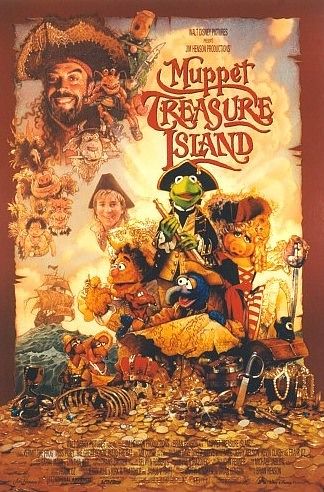
Create a login (it’s free), and search for Treasure Island. You can either Muppet Treasure Islandread as a member of the public or you can join my group. I’ll be honest and say I haven’t even figured out what difference it makes yet.

I’ll probably try to blog a bit about the experience since all I’ve said about it to this point has mostly been speculation about what it must be like to read on Book Glutton rather than actually spending a lot of time reading.

Anyway, Yo Ho Ho! And all that. I think there’s a National Speak Like a Pirate Day somewhere. Probably comes out of Stevenson, or Disney’s take on Stevenson, or Johnny Depp’s take on Disney.

Here’s to intertextuality. Hope you come along.

My blog is better than your blog: literature and evaluation on the net

Sebastian Mary over at if:book has a new post that takes up some more about the problematics of trying to “do literature” on the web. Among many other things, Mary says the following:

‘Literature’ here evokes a well-rooted (if not always clearly-defined) ideology. When I say ‘literary’ I mean things fitting a loose cluster of – sometimes self-contradictory – ideas including, but not limited to:

the importance of traceable authorship
the value of ‘proper’ language
the idea that some kinds of writing are better than others
that some kinds of publishing are better than others
that there is a hierarchy of literary quality

And so on. If examined too closely, these ideas tend to complicate and undermine one another, always just beyond the grasp. But they endure. And they remain close to the core of why many people write. Write, as an intransitive verb (Barthes), because another component of the ideology of ‘literary’ is that it’s a broadcast-only model. If you don’t believe me, check out any writers’ community and see how much keener would-be Authors are to post their own work than to critique or review that of others. ‘Literary’ works talk to one another, across generations, but authors talk to readers and readers don’t – or at least have never been expected – to talk back. (Feel free, by the way, to roll your own version of this nexus, or to disagree with mine. One of the reasons it’s so pervasive as a set of ideas is because it’s so damn slippery.)

============

Obviously plenty of print books have no literary value. But the ideology of ‘literary’ is inseparable from print. Authorship is necessary and value-laden at least partly because with no authorship there’s no copyright, and no-one gets paid. The novel packs a massive cultural punch – but arguably 60,000 words just happens to make a book that is long enough to sell for a decent price but short enough to turn out reasonably cheaply. Challenge authorship, remove formal constraints – or create new ones: as O’Reilly’s guides to creating appealing web content will tell you, your online readership is more likely to lose interest if asked to scroll below the fold. Will the forms stay the same? My money says they won’t. And hence much of what’s reified as ‘literary’, online, ceases to carry much weight.

I like a lot of what Mary is groping after here, but I would offer a few caveats. The notion of the “literary” is not coextensive with the creation of books, but came in to being much later than books came in to being. You could trace the notion of the literary to the development of Gutenberg’s press, but even that would be a bit anachronistic. Our current use of the term “literary” doesn’t really fully develop until late in the eighteenth, early in the nineteenth century, and only becomes a full-blow ideology in the middle and late nineteenth century. Cf Raymond Williams in Marxism and Literature.

This suggests that simply doing away with our sense of the literary might not do away with our sense of the need to categorize and create hierarchies. Criticism is as inevitable as breathing, said T.S. Eliot, and he’s right. Even as you read this blog you are evaluating and criticizing, if only to say that this blog is or is not worth the reading time. Cf Barbara herrnstein Smith in Contingencies of Value. To be sure, the methods and means by which we come to determine what is worth doing is very different on the web than it was in Eliot’sSamuel Johnson London, but that doesn’t mean it doesn’t happen. Indeed, literary criticism as we know it began with Samuel Johnson and others who were trying to figure out, among other things, what was worth their time to read.

One response to this, typical on the web, is to say “Well, I can read anything I damn well please. And who are you to think differently?” But this kind of attitude doesn’t hold up for very long. Of course, anyone CAN read anything they want to read, just as people CAN sit in their barcaloungers and drink beer all day. But we constantly evaluate and imagine human activities in terms of what kinds of social worlds they make possible. To admit this isn’t to be an elitist. To do otherwise is to imagine a world where I could care less if Bob down the street never bothers to learn to read a book more difficult than “See Dick Run” since, after all, its his personal preference or part of his culture. That’s fine, but if his kids and grandkids imitate him, we’ve got not a personal preference but a social problem. At least in any society that we are currently living in.

All of this is merely an aside to say criticism happens. And it is and will continue to happen on the web. For instance, this week’s New York Review of Books contains an excellent article, a review of John Broughton’s Wikipedia, The Missing Manual. The review suggests that Wikipedia is entering a mature middle age. One sign of that middle age is a developing set of rules and hierarchies. NicholsonThe Missing manual Baker writes of the chaotic creative destruction–and destructive creativity–that characterized wikipedia in the early days, before going on:
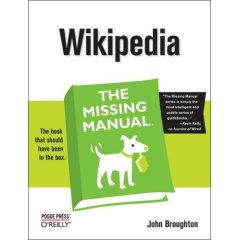
At least, that’s how it used to be. Now there’s a quicker path to proficiency: John Broughton’s Wikipedia: The Missing Manual, part of the Missing Manual series, overseen by The New York Times‘s cheery electronics expert, David Pogue. “This Missing Manual helps you avoid beginners’ blunders and gets you sounding like a pro from your first edit,” the book says on the back. In his introduction, Broughton, who has himself made more than 15,000 Wikipedia edits, putting him in the elite top 1,200 of all editors—promises “the information you absolutely need to avoid running afoul of the rules.” And it’s true: this manual is enlightening, well organized, and full of good sense. Its arrival may mark a new, middle-aged phase in Wikipedia’s history; some who read it will probably have wistful longings for the crazy do-it-yourself days when the whole proj-ect was just getting going. In October 2001, the first Wikipedian rule appeared. It was:

Ignore all rules: If rules make you nervous and depressed, and not desirous of participating in the wiki, then ignore them entirely and go about your business.

The “ignore all rules” rule was written by co-founder Larry Sanger and signed by co-founder Jimbo Wales, along with WojPob, AyeSpy, OprgaG, Invictus, Koyaanis Qatsi, Pinkunicorn, sjc, mike dill, Taw, GWO, and Enchanter. There were two dissenters listed, tbc and AxelBoldt.

Nowadays there are rules and policy banners at every turn—there are strongly urged warnings and required tasks and normal procedures and notability guidelines and complex criteria for various decisions—a symptom of something called instruction creep: defined in Wikipedia as something that happens “when instructions increase in number and size over time until they are unmanageable.” John Broughton’s book, at a mere 477 pages, cuts through the creep. He’s got a whole chapter on how to make better articles (“Don’t Suppress or Separate Controversy”) and one on “Handling Incivility and Personal Attacks.”

To be sure, these rules and hierarchies function differently than they did elsewhere, but they function nonetheless. Among the consequences of these rules and hierarchies is that some things that are written endure in ways that some other things do not. If not forever, then at least for a while.

I think, then, that we might say that we just haven’t developed our understanding yet of what might be possible with the net, and so we haven’t developed aesthetic categories appropriate to writing literature on the net.

The other thing to say here is that Sebastian Mary seems to assume that the inherent and necessary character of the net is the interactive elements of Web 2.0. I’m not sure why we need to make this leap. It is like saying that because something can be done, then doing that thing is the only appropriate thing to do. I kind of buy Mary’s assertion that the literary is about the completed object. But it’s not clear why we can’t imagine the web as a space that has both completed objects and never completed interactive spaces.

Indeed, blogs function in some respects as aspects of both, and I’m intrigued by how this could be a clue to a literature of the future. A blog post is, in some respects a completed object. Admittedly, i go back and rewrite and change things here and there, but at somepoint that kind of revision comes to an end. And in some ways it’s no different than the kind of endless revision that Whitman did, but eventually stopped doing on leaves of grass.

Commentary, however, doesn’t have to come to an end. I’m still getting responses to some of the first blog posts I wrote. Theoretically, these posts could remain objects for commentary for…well…forever. I’m not so vain as to believe that these posts are worth that, but it’s possible to imagine creating a literature that would be more or less permanent and fixed that is accompanied by a commentary that is endless. In this sense, the text would be both fixed and endlessly changing to the degree that people would read not only my fantasized literary post, but also the months, years, decades, centuries…who knows…of commentary that would accompany it.

Thus, I think I disagree with mary’s assumption that the web is inherently interactive and thus opposed to the literary for a variety of reasons, even while I agree that we haven’t quite figured out how to bridge the gap between what’s been in place related to that term, and what may be coming in to being.

Ethics of Reading

Published the following letter to the editor in this week’s Chronicle of Higher Education. Yes, I am becoming “that guy.” You know, the odd ball, slightly unkempt if not unwashed, who writes letters to the editor. As I think of it, blogging is a bit like letters to the editor on roids. Roid rage and all.

=========

Deconstruction and Reading

To the Editor:

Peter Brooks begins “The Ethics of Reading” (The Chronicle Review, February 8) by noting his dismay at J.M. Coetzee’s association of torture with the reading practices of “the academy of the humanities in its postmodernist phase.” Coetzee’s association is less surprising than Brooks’s shock; the link between reading and violence is nothing new.

The purported existence of links between how we read and ethical corruption or political violence is a commonplace in complaints about contemporary theory. Indeed, the link between reading and moral corruption goes back much further than this, found as it is throughout Western history — especially since Gutenberg. Faust is, after all, nothing if not a reader.

The opening line of Brooks’s essay points to a peculiar construal of both reading and ethics — one that, I think, can be found in a variety of other “ethics of reading” theories, particularly that of J. Hillis Miller. Says Brooks, “I’ve long been invested in the notion that teaching to read literature carefully, seriously, reflectively can be an ethical act.” Reading here seems to be conceived of primarily as a procedure or a technique; rigorously following correct procedures ensures or at least encourages an ethical outcome.

Brooks casts about to find an appropriate place to lay the blame for reading practices that have led to the infamous memo on torture allegedly written by John Yoo. He comes up with inept graduate students, or perhaps just people who didn’t attend Yale: “It must be admitted that the lessons of deconstruction in the wrong hands — less adept than its original practitioners — led to facile untetherings of meaning.” Ironically, he then points to Paul de Man as a practitioner of “essentially ethical” reading in his attempts “to understand how texts mean and how language works.”

To be fair, Brooks is pointing yet further back to Reuben Brower, de Man’s own mentor in the skills of reading. However, I have my doubts that de Man’s close reading skills did much to save him from his own readings of Jewish existence in Europe.

I have no interest in attacking de Man’s character or revisiting his history. But maybe part of the problem is, in fact, how he taught us to imagine reading. Why would we begin to imagine that pursuing a rigorous technique to its endpoint is inherently ethical? Fascists were certainly champions of the rigorous pursuit of techniques and industrious in their pursuit of efficiency.

While the ability to read closely and industriously and with technical proficiency may further the ends of people seeking to do good, it seems just as plausible that the ability to do so can serve the ends of those who seek to do ill. We accept that great artists may not be great people, and that their art may even serve both good and bad ends at the same time. Why should we believe differently about great readers?

http://chronicle.com
Section: The Chronicle Review
Volume 54, Issue 26, Page B29

Freedom and Submission; or, the reading fetishist

One very big advantage of wireless networks. I can sit here and do this blog while I simultaneously watch American Idol. Yes, I am only partially ashamed to admit that I watch American Idol with my family every week. Listening to Simon disrespect singers for their “monumental lack of personality” is my great guilty pleasure.

Probably goes along with my general sense that we are too tenderfooted in declaring that some things are better than other things.

Thus, one way the net has it all over reading books. I mean I couldn’t sit here and read my new edition of War and Peace while listening to several people sing off key while displaying their lack of personality. Multi-tasking rules. (Who am I kidding; I don’t have a new edition of War and Peace or even an old one. I have no time.)

But today’s blog has nothing to do with that.

Ben Vershbow over at if:book posted a very interesting piece reviewing Hypertextopia, a free web space for writers wanting to explore the possibilities of hypertext for fiction. Says Vershbow:


The site is gorgeously done, applying a fresh coat of Web 2.0 paint to the creaky concepts of classical hypertext. I find myself strangely conflicted, though, as I browse through it. Design-wise, it is a triumph, and really gets my wheels spinning w/r/t the possibilities of online writing systems….


Lovely as it all is though, it doesn’t convince me that hypertext is any more viable a literary form now, on the Web, than it was back in the heyday of Eastgate and Storyspace. Outside its inner circle of devotees, hypertext has always been more interesting in concept than in practice. A necessary thought experiment on narrative’s deconstruction in a post-book future, but not the sort of thing you’d want to read for pleasure.


But those are the days I wish we could put the net back in the box and forget it ever happened. I get a bit of that feeling with literary hypertext — insofar as it reifies the theoretical notion of the death of the author, it is not necessarily doing the reader any favors.

Hypertext’s main offense is that it is boring, in the same way that Choose Your Own Adventure stories are fundamentally boring. I know that I’m meant to feel liberated by my increased agency as reader, but instead I feel burdened. What are offered as choices — possible pathways though the maze — soon start to weigh like chores. It feels like a gimmick, a cheap trick, like it doesn’t really matter which way you go (that the prose tends to be poor doesn’t help). There’s a reason hypertext never found an audience.


Hurrah! And Again. Hurrah. Vershbow has the courage to say that the king has no clothes.

That is, it’s not hip and cool to say, well, frankly, that this is all just a bit dull. But really, it is. It really, really is.

And hypertext fictions are boring in a way that the surfing the internet in general really isn’t. And the way old fashioned books are not. Almost as if the “planned” surprise or randomness or multiplicity of hypertext fictions are more controlling and in some fashion disrespectful of readers than traditional narratives ever were. And less surprising than the almost true randomness of the text or internet.


[Intertext I: Simon Cowell has just determined that the latest singer is “completely forgettable.” She is, she really, really is. Just like almost every hypertext fiction ever written.]

[Intertext II: I have definitely decided that Paula Abdul is irredeemably vapid. Not, I hope, like this post]


Vershbow is right to tie this to a peculiar failure of concept in postmodern views of reading and writing. I have to say that I love reading Roland Barthes. But his understanding of reading in “Death of an Author” completely misses the point of what is most pleasurable and imaginatively enlarging about the reading experience. That is, our self loss, our self-forgetfulness.


I don’t deny the general idea that reading is or can be a creative act. But Barthes tendency to turn every reader into a writer, every reading in to a writing, misses that the great glory of reading is transcendence of the self through loss, transcendence through the dissolution of the ego’s boundary, transcendence through the very submission of the imagination that Barthese hopes to forestall.


As if he were empowering readers by putting them in control. Perhaps he forgets that, as I learned on CSI, the passive partner in an S&M team is always the one who’s really in control, despite appearances.

Finally, equating freedom and creativity with control is….boring. Anyone who has written knows that the most exciting times aren’t those moments when you’re exercising authority over the text, but those when you aren’t. When the words say things you didn’t know or mean.

Reading as control is boring for the same reason hypertext fictions are boring. By giving the reader a job we’re confined by the randomness of our own choices, rather than freed and liberated from ourselves by the prisonhouse of someone else’s language.


Masochism, you say! So be it.

Submit yourselves to the discipline of the text…and be free.

Unless the grain of seed shall die. And so forth.

Fetishists of the text unite!


[Intertext III: Simon thought the last singer was “completely predictable,” but thought Brooke White was great. Paula Abdul says that Brooke White’s song was “really here.” What does that mean? What in the name of all that is good and true does that mean?]


Previews: I’ve gotten a lot of good responses to things lately that I just haven’t been able to get to. What I really hope to get to soon, but in case I don’t, just treat it like a movie that failed its test screening.

Sam Miller, one of my readers (that sounds pretentious, but I’ll say it anyway)has a new essay out at Conversational Quarterley that looks pretty good, but I need to read it more closely before I say more.

My good friend Julia Kasdorf has been up to her usual good stuff with reading and writing up at Penn State.

I’ve also managed to get the folks at MyAccess royally po’d. I think they’ve marshalled their hit squad of professional MyAccess users.

Also passed my two month anniversary as a blogger 3500+ page hits. And some of them are not even from the students I am paying to click through my pages (heh! heh!) Have got to talk about the compulsive addiction to write that is occasioned by anonymous readers.

But all that is for the future. After American Idol is over.