Tag Archives: book review

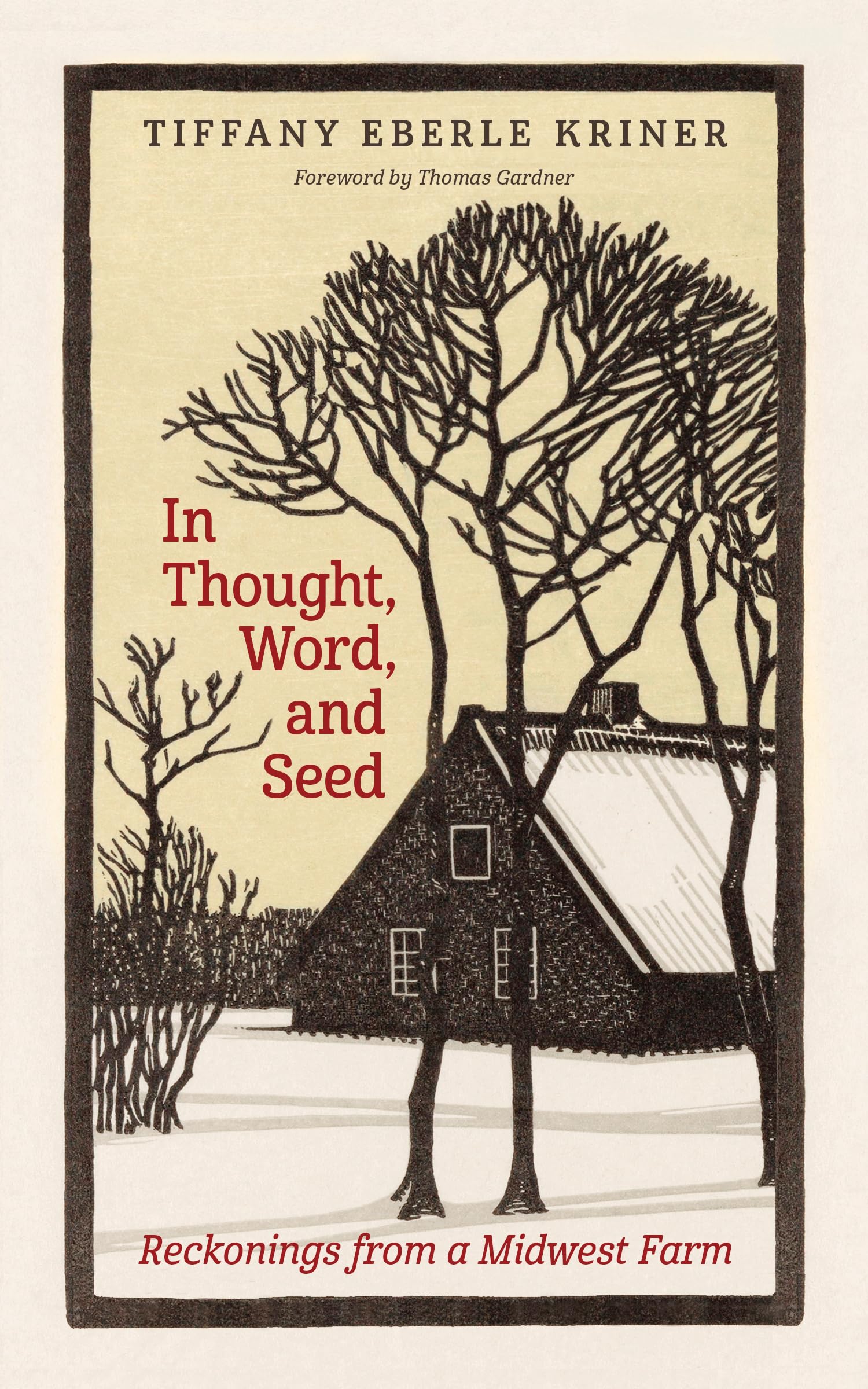
Review of Tiffany Eberle Kriner’s Thought, Word, and Seed

I was glad to see this review of Tiffany Kriner’s Thought, Word, Seed: Reckonings from a Midwest Farm appear in Christian Scholars Review. As is probably evident, I loved Tiffany’s work here. I found my multiple reads of it over the past year (on my own and with students) to be not only aesthetically satisfying but spiritually moving and transformative. Also a lot of food for thought about how one goes about writing about books and reading. As my colleague John Fea is wont to say, a little taste.

Tiffany Eberle Kriner teaches English at Wheaton College. She is also a mother, an organic farmer, a wife. She is a survivor of the pandemic, of cancer, of lesser deadly things like the tenure process. She is a writer. She is an anguished observer of the murder of George Floyd, a worrier that she may be a guilty bystander. She is a watcher of owls, a herder of sheep. She is, above all, a reader of books, of the Good Book and of the book of nature, of what we might call the book of the world. Charting how these selves and callings come together in one person on the Root and Sky Farm in rural Illinois during the pandemic and its aching aftermath is the subject of Kriner’s extraordinary memoir, In Thought, Word, and Seed: Reckonings from a Midwest Farm.


Thought, Word, and Seed is Kriner’s second book, following The Future of the Word: An Eschatology of Reading.2 It is, almost, hard to think of them coming from the same writer. The first is a provocative theoretical and theological interpretation of reading as an eschatological act, a means of making books live into the promise of the resurrection. It’s the kind of book academics reward with tenure and promotion and perhaps, if you are lucky, with footnotes and scholarly reviews.


However, in my own view, The Future of the Word is only prolegomenon to the achievement of In Thought, Word, and Seed. The second book is more memoir, more poetic. In a word, more “literary.” Yet, in some respects, Thought, Word, and Seed is a creative rereading of Future of the Word, making its ideas live in a different register, almost as if Kriner woke up one morning saying to herself, “Okay, if reading does the things I say it does, I need to write some other way, some new way, not that way.”

I hope you’ll enjoy Tiffany’s book as much as I did over the past year. As I say in the final line of the review, take up and read.

Dreaming of Sleep: Madison Smartt Bell’s Doctor Sleep

It’s a pleasure to pick up a novel and know from the first lines that it will be worth the read. We usually have to give more of ourselves over to novels than to other forms of writing–a problem in our frantic clickable age. With stuff that I remand to my Instapaper account, I can glance through the first paragraph and decide if I want to keep reading, and if I read three or four paragraphs and am not convinced it’s worth the time, there’s no point in agonizing about whether to keep on going. Same with a book of poetry: If I read the first three or four poems and there’s nothing there other than the authors reputation, I mostly put it aside–though I might admit that it is my failing and not the poets.

But novels are a different horse. A lot of novels require 50 pages and sometime more before we can get fully immersed in the writer’s imaginative world, feeling our way in to the nuances and recesses of possibility, caring enough about the characters or events or language or ideas (and preferably all four) to let the writer land us like netted fish. I think I’ve written before about the experience of reading yet one more chapter, still hoping and believing in the premise or the scenario or the author’s reputation. I’ve finished books that disappointed me, though my persistence was more like a teenaged boy fixed up on a date with with the best girl in school, pretending until the evening clicks to a close that he isn’t really bored to tears, things just haven’t gotten started yet.

But Madison Smartt Bell’s Doctor Sleep didn’t make me wait. I bought the book on reputation and topic. I loved Bell’s All Souls Rising, but got derailed by the follow-ups in his Haitian trilogy, never quite losing myself in the Caribbean madness that made the first book the deserved winner of an array of awards. Thus disappointed, I hadn’t really picked up Bell’s work since, though I vaguely felt I ought to. From the first sentences of the novel, his first, I was under the spell. The choice of words is purposeful since the book is about a hypnotherapist who, while helping others solve all manner of problems and difficulties through his particular gift at putting them under, cannot neither solve his own problems or put himself to sleep: He suffers from a crippling case of insomnia.

Like any good novel, the meanings are thickly layered. In some respects I found myself thinking of the Apostle Paul’s dictum that wretched man that he was, he knew what he should do, and he wanted to do it, but he could not do the very thing he knew to do, and, indeed, the very thing he did not want to do this was the very thing he did. The tale of all things human, the disjunction between knowledge and will, between thought and desire and act. The main character’s skills as a hypnotist are deeply related to his metaphysical wanderings amidst the mystics and heretics of the past, most particularly Giordano Bruno, burned at the stake because he claimed the church sought to promote good through force rather than through love. Ironically, the main character knows all this, knows in his head that love is the great mystic unity of which the mystics speak, and yet turns away from love in to abstraction, failing to love women because he cannot see them as human beings to whom he might be joined, seeing them instead as mystic abstractions through which he wants to escape the world.

In the end, accepting love means accepting death, which means accepting sleep–something that seems so natural to so many, but if you have suffered from insomnia as I do, you realize that surrendering to sleep is a strange act of grace, one that cannot be willed, but can only be received.

I think in some ways to there’s a lot of reflection in this book on the power of words and stories, their ability to put us under. So, perhaps inevitably, it is a book about writing and reading on some very deep level. Adrian, Doctor Sleep, takes people on a journey in to their unconscious through words, and his patients surrender to him willingly. Indeed, Adrian believes, with most hypnotists, that only those who want to be hypnotized actually can be. This is not so far from the notion of T.S. Eliot’s regarding the willing suspension of disbelief. I do not believe Adrian’s metaphysical mumbo-jumbo, but for the space of the novel I believe it utterly. We readers want to be caught. We want to lose ourselves at least for that space and that time, so that reading becomes a little like the gift of sleep, a waking dream.

Under the spell of writing we allow Bell to take us in to another world that is, surprisingly, like our own, one in which we see our own abstractedness, our own anxieties, our own petty crimes and misdemeanors, our own failures to love.

Tonguecat by Peter Verhelst

TonguecatTonguecat by Peter Verhelst

My rating: 3 of 5 stars

I admire this book more than I like it. That is, I understand that Verhelst is pulling off a kind of writerly virtuosity and I applaud appropriately. But I feel about it like I feel about a good bit of contemporary music that appeals to the musical theorist rather than the musical ear. It’s possible to feel intellectually compelled, but viscerally unmoved; that’s kind of where I end up with Verhelst and his cast of characters. The book recounts fantastical and horrific events in the aftermath of the apocalyptic end of an empire, but the books surfaces are icy, a little like the frigid ice age that descends on the countryside as a major event of the novel. The characters are frozen and statuesque, a little like the frozen corpses that litter the landscape. They remain untouchable, and so untouched and untouching. As a result, Verhlest’s story works like an allegory, but one from which I remain mostly removed and uncaring. I’m not sorry I read the book, but why go back. Given that the book is at least in part about terror, terrorism, empire, and totalitarianism, I’m not sure this is a great way to feel

View all my reviews