Tag Archives: education

Teaching (to the) Tests

I was a little appalled to find out last week that my son is spending multiple days taking PSSA standardized tests in his school, a ritual that he shrugs his shoulders and rolls his eyes at, a teenager’s damning assessment that says wordlessly that this-is-just-one-more-stupid-thing-adults-make-me-do-for-my-own-good.

Teenage boys are notoriously bored with school and sneer at book-learning.  Think Huckleberry Finn as only one great American example.  So I think my son’s attitude about school is not particularly new.  But whereas Twain’s hero, in a great romantic tradition, saw books themselves as corrupt and the learning they provided as a corrupter of virtuous instincts, nothing is further from the truth for  my son.  He reads ravenously, much more than I did at his age, which is saying quite a bit.  And the level and range of his interests astonish me, from jazz poetry and history, to hindu mysticism, to the thickest of contemporary literary novels like Delillo’s Mao II and David Foster Wallace’s Infinite Jest.  When he bought Wallace’s Infinite Jest he was nearly giddy with delight.  “It’s like a giant two-fisted hamburger” he said laughing, holding it up to his open mouth. “Something you can eat up.”  This same boy who sees learning as a feast when left to the devices of books and their authors and his own imagination, seems to experience school as an emotional and intellectual Waste Land, a place he finds dull and dulling.

I can’t blame his teachers.  They are talented and caring.  But I can’t help wondering with a chorus of others, whether something has gone badly wrong with our approaches to schooling, approaches that trap teachers as surely as they enervate students, or at least many male students.

I tend to agree with this blog from Diane Ravitch, who I find to be one of our most interesting commentators on education, if only because she has become so unpredictable and yet so incisive in her analyses. From the NYRB, “Flunking Arne Duncan”

Will Duncan’s policies improve public education?

No. Under pressure to teach to tests—which assess only English and math skills—many districts are reducing the time available for teaching the arts, history, civics, foreign languages, physical education, and other non-tested subjects. (Other districts are spending scarce dollars to create new tests for the arts, physical education, and those other subjects so they can evaluate all their teachers, not just those who teach reading and mathematics.) Reducing the time available for the arts, history, and other subjects will not improve education. Putting more time and money into testing reduces the time and money available for instruction. None of this promotes good education. None of this supports love of learning or good character or any other ideals for education. Such a mechanistic, anti-intellectual approach would not be tolerated for President Obama’s children, who attend an excellent private school. It should not be tolerated for the nation’s children, 90 percent of whom attend public schools. Grade: F.

Of course, I care about this for my son, and I am thankful to God that he is getting through his high school education before the ax has cleaved away programs in the arts and diminished offering in other areas.  But I also care about this as an educator and administrator in a college.  In the first place, it is impossible to imagine that we will have students who are effective writers if they have no historical sense, no understanding of the arts, less exposure to the civic virtues, and fewer opportunities to read and think in languages other than their own.  It is impossible to imagine that such students–even scoring better on a writing or a math exam–are better prepared for college than students from a generation ago, before we started worrying about their being left behind.  It is impossible to imagine that we are getting a better student simply because they can do a math problem successfully when they have never had to struggle to draw a picture or understand a symphony or reach in to the past to engage the worlds of the ancients before them.
If this is the education we are giving them, we are producing neither saints or scholars.  We may be producing a generation of students (perhaps boys especially) who are bored mindless and who will look for their learning in more likely places, like the cover of a book for which no one will think to devise a test.

Mark Sandel–The commodification of everything

I’ve enjoyed listening occasionally to Mark Sandel’s lectures in philosophy via iTunes.  He has an interesting new article in the April Atlantic focusing on the ways in which nearly everything in American life, at least, has been reduced to a market value.  Despite the admonition that money can’t buy me love, we are pretty sure that it can buy everything else, and that we are willing to sell just about anything, including body parts and personal dignity, for whatever the market will bear.

Sandel somewhat peculiarly to my mind traces this to a post-Cold War phenomenon.

WE LIVE IN A TIME when almost everything can be bought and sold. Over the past three decades, markets—and market values—have come to govern our lives as never before. We did not arrive at this condition through any deliberate choice. It is almost as if it came upon us.

As the Cold War ended, markets and market thinking enjoyed unrivaled prestige, and understandably so. No other mechanism for organizing the production and distribution of goods had proved as successful at generating affluence and prosperity. And yet even as growing numbers of countries around the world embraced market mechanisms in the operation of their economies, something else was happening. Market values were coming to play a greater and greater role in social life. Economics was becoming an imperial domain. Today, the logic of buying and selling no longer applies to material goods alone. It increasingly governs the whole of life.

The last gasp Marxists I studied with at Duke had a word for what Sandel sees and descries, commodification, and it didn’t mysterious just come upon us in the 1980s.  Commodification, the rendering of every bit of life as a commodity that can bought and sold, is the central thrust of capitalist economies in the 20th century, perhaps the central feature of capitalism per se.  The essential act of commodification is at the center of Marx’s understanding that the worker in some very real sense sells him or herself through selling his or her labor power.  Thus, human beings were commodified well before people became willing to sell tattoos on their foreheads to advertise products.  So Sandel’s perplexity and astonishment at this state of affairs in our contemporary economy strikes me as the perplexity of someone who has only recently awakened from a dream.

On the other hand, I do think Sandel is on to something.  It is the case that despite this thrust of capitalist economies (and, to be frank, I’m not sure that Marxist economies were all that different), there have been sectors of culture and their accompanying institutions that resisted their own commodification.  The edifice of modernism in the arts and literature is built on the notion that the arts could be a transcendent world apart from degradations of the social world, including perhaps especially its markets.  The difficulty and density of modern art and literature was built in part out of a desire that it not be marketable in any typical sense.  Modern art was sometimes ugly precisely to draw attention to the difficulty and difference of its aesthetic and intellectual properties.  It was meant not to sell, or at least not to sell too well.  Remember that the next time a Picasso sells for millions.  Similarly, the church and in a different way educational institutions retained a relative independence form the marketplace, or at least resisted the notion that they could be reduced to market forces.  Whether claiming to provide access to the sacred or to enduring human values, religious institutions and educational institutions served–even when they were corrupt or banal–to remind the culture that there was a world apart, something that called us to be better than ourselves, or at least reminded us that our present values were not all the values that there were.

Sandel rightly notes that that residue has all but disappeared, and the result has been an hollowing out of our public life, and a debasement of our humanity.

In hopes of avoiding sectarian strife, we often insist that citizens leave their moral and spiritual convictions behind when they enter the public square. But the reluctance to admit arguments about the good life into politics has had an unanticipated consequence. It has helped prepare the way for market triumphalism, and for the continuing hold of market reasoning.

In its own way, market reasoning also empties public life of moral argument. Part of the appeal of markets is that they don’t pass judgment on the preferences they satisfy. They don’t ask whether some ways of valuing goods are higher, or worthier, than others. If someone is willing to pay for sex, or a kidney, and a consenting adult is willing to sell, the only question the economist asks is “How much?” Markets don’t wag fingers. They don’t discriminate between worthy preferences and unworthy ones. Each party to a deal decides for him- or herself what value to place on the things being exchanged.

This nonjudgmental stance toward values lies at the heart of market reasoning, and explains much of its appeal. But our reluctance to engage in moral and spiritual argument, together with our embrace of markets, has exacted a heavy price: it has drained public discourse of moral and civic energy, and contributed to the technocratic, managerial politics afflicting many societies today.

Sandel wonders about a way to connect to some kind of moral discourse to inform public life, something that will reach beyond the reach of markets, but he clearly despairs that such a connection can be found.  I think there’s good reason.  Rapidly our educational institutions have become factories that shamelessly advertise themselves as places where people can make themselves in to better commodities than they were before, and which build programs designed to sell themselves to the highest number of student-customers possible.  Our religious institutions are floundering.  Only today I read in Time magazine that the rise of so-called “nones”–people who claim to have no religious affiliation–is one of the most notable developments in our spiritual culture.  Such people often seek to be spiritual but not religious on the grounds that religions are dogmatic and inflexible.  I have come to wonder whether that dogmatism and inflexibility points to the hard won truth that it is not good enough to just go along to get along.

One wonders, in fact, whether a spirituality based on getting along really provides a hard point of resistance to the tendency to see everything in life–whether my beliefs or my ethics–as an investment that must pay off if it is to be worth keeping.  I wonder, too, whether our educational systems and institutions are up to the task of providing an education that isn’t just another instance of the market.  As for art, writing, and literature.  Well, who knows?  Modernism was not always commodified, though it very quickly became  so.  I do find it intriguing that this point of hyper-commodification is also a time when there has been an explosion of free or relatively free writing and music on the internet.  There is a small return to the notion of the artist as a community voice, with musician and poets producing work for free on the internet, and making their living through performance or through other jobs–escaping or at least partially escaping the notion that we produce work primarily to sell it.  This is a small resistance, but worth thinking about.

I wonder if there are other ways our culture is equipped to resist in a larger collective fashion, the turning of our lives in to the image of a can of soup?

The Boy Problem

Boys and their problems may be the enduring cultural theme in what used to be called the west. Think Oedipus, Cain and Abel, Hamlet, or Huckleberry Finn. All on some level about disfunctional “boys” or half-men trying to function in a disfunctional world. Because the boy problem in education reflects the emotional contours of that story, we may be tempted to treat it as an enduring fiction rather than a broad issue of serious social concern as we really ought to do.

I’ve written elsewhere on this blog about the problem of boys and reading. I’ve also had some longstanding concern about the particular problem of engaging boys in the learning process. Thus it was with some interest that I read This piece from Inside Higher Ed on the latest social science regarding the problem of boys

The working paper, which uses data from the U.S. Census and the National Longitudinal Surveys of Youth, also notes a striking and substantial difference between the sexes in educational attainment, with women outpacing men in every demographic group. The largest gap between men and women in completing college is at the highest economic range, with women at a 13-percentage-point advantage over their male counterparts.

“It was surprising to us to find the female advantage is the largest among the highest quartile,” said Susan Dynarski, a co-author of the study and associate professor of public policy and of education at the University of Michigan. “When you hear about ‘the boy problem,’ you tend to hear about low-income groups.”

This last reflects my own intrigue as well. The disparate statistics are often dismissed as a function of class or racial differences with white boys from upper and middle income brackets being largely unaffected. Thus the disparity can be dismissed as being gender based in any crucial way. This study while hardly definitive, calls that in to question.

When the gender specific elements are not dismissed, it seems to me that they are very often interpreted in quasi-Victorian terms that either assume boys as a class are morally inferior–I.e. they are lazy and don’t want to work hard–or that assume boys are genetically inferior–I.e. boys are not wired in a way that encourages success in our collaborative information based culture.

Both these arguments–to be sure, there are other arguments– strike me as deeply problematic. Imagine if we applied the same terms to women or to race, assuming that failure to perform was the result of moral or genetic flaws rather the structure of social attitudes toward education or the social assumptions embedded within the educational process. additionally, and ironically, I think this tendency to blame boys for their problems is structured along typically masculinity lines. That is, in the stories of Oedipus and the others I mention above, boys are judged by their success or failure in overcoming their disfunction. They are judged–usually as to whether they are worthy of becoming men–by whether they individually overcome the corruption of the world around them (Huckleberry Finn) or overcome the cowardice within (Hamlet) or by whether they overcome the temptations to pride (Cain). But the point is, finally that they are judged. To be a boy is to be judged worthy or unworthy, however vague and indistinct the standards by which that worth is determined.

What would happen, I wonder, if we stopped judging boys and instead turned our eyes on a society and an educational system that facilitates their failure?

Create or Die: Humanities and the Boardroom

A couple of years ago when poet and former head of the NEA, Dana Gioia, came to Messiah College to speak to our faculty and the honors program, I asked him if he felt there were connections between his work as a poet and his other careers as a high-level government administrator and business executive.  Gioia hemmed and hawed a bit, but finally said no;  he thought he was probably working out of two different sides of his brain.

I admit to thinking the answer was a little uncreative for so creative  a person.  I’ve always been a bit bemused by and interested in the various connections that I make between the different parts of myself.  Although I’m not a major poet like Gioia, I did complete an MFA and continue to think of myself in one way or another as a writer, regardless of what job I happen to be doing at the time.  And I actually think working on an MFA for those two years back in Montana has had a positive effect on my life as an academic and my life as an administrator.  Some day I plan to write an essay on the specifics, but it is partially related to the notion that my MFA did something to cultivate my creativity, to use the title of a very good article in the Chronicle review by Steven Tepper and George Kuh.  According to Tepper and Kuh,

To fuel the 21st-century economic engine and sustain democratic values, we must unleash and nurture the creative impulse that exists within every one of us, or so say experts like Richard Florida, Ken Robinson, Daniel Pink, Keith Sawyer, and Tom Friedman. Indeed, just as the advantages the United States enjoyed in the past were based in large part on scientific and engineering advances, today it is cognitive flexibility, inventiveness, design thinking, and nonroutine approaches to messy problems that are essential to adapt to rapidly changing and unpredictable global forces; to create new markets; to take risks and start new enterprises; and to produce compelling forms of media, entertainment, and design.

Tepper and Kuh , a sociologist and professor education respectively, argue forcefully that creativity is not doled out by the forces of divine or genetic fate, but something that can be learned through hard work.  An idea supported by recent findings that what musical and other artistic prodigies share is not so much genetic markers as practice, according to Malcolm Gladwell 10,000 hours of it.  Tepper and Kuh believe the kinds of practice and discipline necessary for cultivating a creative mindset are deeply present in the arts, but only marginally present in many other popular disciplines on campus.

Granted, other fields, like science and engineering, can nurture creativity. That is one reason collaborations among artists, scientists, and engineers spark the powerful breakthroughs described by the Harvard professor David Edwards (author of Artscience, Harvard University Press, 2008); Xerox’s former chief scientist, John Seely Brown; and the physiologist Robert Root-Bernstein. It is also the case that not all arts schools fully embrace the creative process. In fact, some are so focused on teaching mastery and artistic conventions that they are far from hotbeds of creativity. Even so, the arts might have a special claim to nurturing creativity.

A recent national study conducted by the Curb Center at Vanderbilt University, with Teagle Foundation support, found that arts majors integrate and use core creative abilities more often and more consistently than do students in almost all other fields of study. For example, 53 percent of arts majors say that ambiguity is a routine part of their coursework, as assignments can be taken in multiple directions. Only 9 percent of biology majors say that, 13 percent of economics and business majors, 10 percent of engineering majors, and 7 percent of physical-science majors. Four-fifths of artists say that expressing creativity is typically required in their courses, compared with only 3 percent of biology majors, 16 percent of economics and business majors, 13 percent of engineers, and 10 percent of physical-science majors. And arts majors show comparative advantages over other majors on additional creativity skills—reporting that they are much more likely to have to make connections across different courses and reading; more likely to deploy their curiosity and imagination; more likely to say their coursework provides multiple ways of looking at a problem; and more likely to say that courses require risk taking.

Tepper and Kuh focus on the arts for their own purposes, and I realized that in thinking about the ways that an MFA had helped me I was thinking about an arts discipline in many respects.  However, the fact that the humanities is nowhere in their article set me to thinking.  How do the humanities stack up in cultivating creativity, and is this a selling point for parents and prospective students to consider as they imagine what their kids should study in college.  These are my reflections on the seven major “creative” qualities that Kepper and Kuh believe we should cultivate, and how the humanities might do in each of them.

  1. the ability to approach problems in nonroutine ways using analogy and metaphor;
    • I think the humanities excel in this area for a variety of reasons.  For some disciplines like English and Modern Languages, we focus on the way language works with analogy and metaphor and we encourage its effective use in writing.  But more than that, I think many humanities disciplines can encourage nonroutine ways of approaching problems—though, of course, many professors in any discipline can be devoted to doing the same old things the same old way.
  2. conditional or abductive reasoning (posing “what if” propositions and reframing problems);
    • Again, I think a lot of our humanities disciplines approach things in this fashion.  To some degree this is because of a focus on narrative.  One way of getting at how narrative works and understanding the meaning of a narrative at hand is to pose alternative scenarios.  What if we had not dropped the bomb on Japan?  What if Lincoln had not been shot?  How would different philosophical assumptions lead to different outcomes to an ethical problem.
  3. keen observation and the ability to see new and unexpected patterns;
    • I think we especially excel in this area.  Most humanities disciplines are deeply devoted to close and careful readings that discover patterns that are beneath the surface.  The patterns of imagery in a poem, the connections between statecraft and everyday life, the relationship between dialogue and music in a film.  And so forth.  Recognizing patterns in problems can lead to novel and inventive solutions.
  4. the ability to risk failure by taking initiative in the face of ambiguity and uncertainty;
    • I’m not sure if the humanities put a premium on this inherently or not.  I know a lot of professors (or at least I as a professor) prefer their students take a risk in doing something different on a project and have it not quite work than to do the predictable thing.  But I don’t know that this is something inherent to our discipline.  I do think, however, that our disciplines inculcate a high level of comfort with uncertainty and ambiguity.  Readings of novels or the complexities of history require us to not go for easy solutions but to recognize and work within the ambiguity of situations.
  5. the ability to heed critical feedback to revise and improve an idea;
    • Again, I would call this a signature strength, especially as it manifests itself in writing in our discipline and in the back and forth exchange between students and student and teacher.  Being willing to risk and idea or an explanation, have it critiqued, and then to revise one’s thinking in response to more persuasive arguments.
  6. a capacity to bring people, power, and resources together to implement novel ideas; and
    • I admit that on this one I kind of think the humanities might be weaker than we should be, at least as manifested in our traditional way of doing things.   Humanists in most of our disciplines are notorious individualists who would rather spend their time in libraries.  We don’t get much practice at gathering people together with the necessary resources to work collaboratively.  This can happen, but instinctively humanists often want to be left alone.  This is an area where I think a new attention to collaborative and project based learning could help the humanities a great deal, something we could learn from our colleagues in the sciences and arts like theatre and music.  I’m hopeful that some of the new attention we are giving to digital humanities at Messiah College will lead us in this direction.
  7. the expressive agility required to draw on multiple means (visual, oral, written, media-related) to communicate novel ideas to others.
    • A partial strength.  I do think we inculcate good expressive abilities in written and moral communication, and we value novel ideas.  Except for our folks in film and communication—as well as our cousins in art history—we are less good at working imaginatively with visual and other media related resources.  This has been one of my priorities as dean, but something that’s hard to generate from the ground up.

Well, that’s my take.  I wonder what others think?

We’re all pre-professional now

I’ve been catching up this evening on backlog of reading I’ve stored on Instapaper.  (I’m thinking “backlog” might be the right word:  I don’t think you can have a “stack” on an iPad).  A few weeks back Cathy Davidson down at Duke University had an interesting piece on whether College is for everyone.  Davidson’s basic thesis, as the title suggests, is no.  Despite the nationalist rhetoric that attends our discussions of higher education–we will be a stronger America if every Tom Dick and Henrietta has a four year degree–maybe, Davidson suggests, maybe we’d have a better society if we attended to and nurtured the multiple intelligences and creativities that abound in our society, and recognized that many of those were best nurtured somewhere else than in a college or university:

The world of work — the world we live in — is so much more complex than the quite narrow scope of learning measured and tested by college entrance exams and in college courses. There are so many viable and important and skilled professions that cannot be outsourced to either an exploitative Third World sweatshop or a computer, that require face-to-face presence, and a bucketload of skills – but that do not require a college education: the full range of IT workers, web designers, body workers (such as deep tissue massage), yoga and Pilates instructors, fitness educators, hairdressers, retail workers, food industry professionals, entertainers and entertainment industry professionals, construction workers, dancers, artists, musicians, entrepreneurs, landscapers, nannies, elder-care professionals, nurse’s aides, dog trainers, cosmetologists, athletes, sales people, fashion designers, novelists, poets, furniture makers, auto mechanics, and on and on.

All those jobs require specialized knowledge and intelligence, but most people who end up in those jobs have had to fight for the special form their intelligence takes because, throughout their lives, they have seen never seen their particular ability and skill set represented as a discipline, rewarded with grades, put into a textbook, or tested on an end-of-grade exam. They have had to fight for their identity and dignity, their self-worth and the importance of their particular genius in the world, against a highly structured system that makes knowledge into a hierarchy with creativity, imagination, and the array of so-called “manual skills” not just at the bottom but absent.

Moreover, Davidson argues that not only is our current educational system not recognizing and valuing these kinds of skills on the front end, when we actually get students in to college we narrow students interests yet further:

All of the multiple ways that we learn in the world, all the multiple forms of knowing we require in order to succeed in a life of work, is boiled down to an essential hierarchical subject matter tested in a way to get one past the entrance requirements and into a college. Actually, I agree with Ken Robinson that, if we are going to be really candid, we have to admit that it’s actually more narrow even than that: we’re really, implicitly training students to be college professors. That is our tacit criterion for “brilliance.” For, once you obtain the grail of admission to higher ed, you are then disciplined (put into majors and minors) and graded as if the only end of your college work were to go on to graduate school where the end is to prepare you for a profession, with university teaching of the field at the pinnacle of that profession.

Which brings me to my title.  We’re all pre-professional now.  Since the advent of the university if not before there’s been a partisan debate between growing pre-professional programs and what are defined as the “traditional liberal arts,”  though in current practice given the cache of  science programs in the world of work this argument is sometimes really between humanities and the rest of the world.

Nevertheless, I think Davidson points out that in actual practice of the humanities in many departments around the country, this distinction is specious.  Many humanities programs conceive of themselves as preparing students for grad school.  In the humanities.  In other words, we imagine ourselves as ideally preparing students who are future professionals in our profession.  These are the students who receive our attention, the students we hold up as models, the students we teach to, and the students for whom we construct our curricula, offer our honors and save our best imaginations.  What is this, if not a description of a pre-professional program?  So captive are we to this conceptual structure that it becomes hard to imagine what it would mean to form an English major, History major, or Philosophy major whose primary implicit or explicit goal was not to reproduce itself, but to produce individuals who will work in the world of business–which most of them will do–or in non-profit organizations, or in churches and synagogues, or somewhere else that we cannot even begin to imagine.  We get around this with a lot of talk with transferable skills, but we actually don’t do a great deal to help our students understand what those skills are or what they might transfer to.  So I think Davidson is right to point this out and to suggest that there’s something wrongheaded going on.

That having been said, a couple of points of critique:

Davidson rightly notes these multiple intelligences and creativities, and she rightly notes that we have a drastically limited conception of society if we imagine a four year degree is the only way to develop these intelligences and creativities in an effective fashion.  But Davidson remains silent on the other roles of higher education, the forming of an informed citizenry being only one.  Some other things I’ve seen from Davidson, including her new book Now You See It, suggests she’s extremely excited about all the informal ways that students are educating themselves, and seems to doubt the traditional roles of higher education;  higher education’s traditional role as a producer and disseminator of knowledge has been drastically undermined.  I have my doubts.  It is unclear that a couple of decades of the internet have actually produced a more informed citizenry.  Oh, yes, informed in all kinds of ways about all kinds of stuff, like the four thousand sexual positions in the Kama Sutra, but informed in a way that allows for effective participation in the body politic?  I’m not so sure.

I think this is so because to be informed is not simply to possess information, but to be shaped, to be in-formed.  In higher education this means receiving a context for how to receive and understand information, tools for analysing, evaluating, and using information,  the means for creating new knowledge for oneself.  To be sure, the institutions of higher education are not the only place that this happens, but it is clear that this doesn’t just automatically happen willy-nilly just because people have a Fios connection.

What higher education can and should give, then, is a lot of the values and abilities that are associated with a liberal arts education traditionally conceived–as opposed to being conceived as a route to a professorship–and these are values, indeed, that everyone should possess.  Whether it requires everyone to have a four year degree is an open question.  It may be that we need to rethink our secondary educational programs in such a way that they inculcate liberal arts learning in a much more rigorous and effective way than they do now.  But I still doubt that the kind of learning I’m talking about can be achieved simply by 17 year olds in transformed high schools.  Higher education should be a place for the maturing and transformation of young minds toward a larger understanding of the world and their responsibilities to it, which it sometimes is today, but should be more often.

Humanities and the workplace: or, bodysurfing the Tsunami.

As I suggested in my last post on the demise of Borders, book lovers have lived in an eternal tension between the transcendent ideals their reading often fosters and the commercial realities upon which widespread literacy has depended. The same tension is broadly evident in the Humanities response to professional programs or just more broadly the question of career preparation. We are not wrong to say that an education in history or English is much more than career preparation; nor are we wrong to insist that a college education has to be about much more than pre-professional training. (Not least because most college graduates end up doing things a long distance from their original preparation, and we ought to see that humanities in combination with other knowledges in arts and sciences is at least as good at preparing students for the twists and turns of their eventual career, and perhaps even better, than fields focused on narrower practical preparations

However we are absolutely wrong to assume that questions of career are extraneous or ought to be secondary to our students or our thinking about how we approach curricula.

Daniel Everett, dean of Arts and sciences at Bentley University offers a provocative refection on the need to integrate humanities in to professional education. According to Everett

“Programs that take in students without proper concern for their future or provision for post-graduate opportunities — how they can use what they have learned in meaningful work — need to think about the ethics of their situation. Students no longer come mainly from the leisured classes that were prominent at the founding of higher education. Today they need to find gainful employment in which to apply all the substantive things they learn in college. Majors that give no thought to that small detail seem to assume that since the humanities are good for you, the financial commitment and apprenticeship between student and teacher is fully justified. But in these cases, the numbers of students benefit the faculty and particular programs arguably more than they benefit the students themselves. This is a Ponzi scheme. Q.E.D.”

These are harsh words, but worth considering. I tend to not like Bentley’s particular solutions to the degree that they reduce the humanities to an enriching complement to the important business of, well, business. However, I do think we need to think of new ways of creating our majors that will prepare students for the realities of 21st century employment. Majors that allowed for concentrations in digital humanities would prepare students to engage the changing nature of our disciplines while also gaining technical skills that could serve them well in business. New joint programs with the sciences like those found in medical humanities programs could prepare students in new ways for work in the health care industry. Everett warns of what may happen of humanities programs don’t creatively remake themselves to meet the changing needs of our contemporary world:

“If, like me, you believe that the humanities do have problems to solve, I hope you agree that they are not going to be solved by lamenting the change in culture and exhorting folks to get back on course. That’s like holding your finger up to stop a tidal wave. Thinking like this could mean that new buildings dedicated to the humanities will wind up as mausoleums for the mighty dead rather than as centers of engagement with modern culture and the building of futures in contemporary society.”

Again, I don’t like all of the particular responses Everett has advocated, but I do agree that there is a problem to be addressed that continued proclamations about transferable skills is unlikely to solve. What is sometimes called the applied humanities may be a way of riding the wave rather than being drowned by it.

Quote of the Day–July 27,2008

I found this strolling along the “Freedom Trail” in Boston today, from Benjamin Franklin:

“Experience keeps a dear school, but fools will learn in no other.”

—-Benjamin Franklin

Refreshing for me since American responses to education are so deeply anti-intellectual (even pragmatism– our only real contribution to philosophy–doubts the efficacy of learning.  Anyway,  experience too often is another name for prejudice, a form of justification that verges on narcissism, believing that if it isn’t true to my own experience it isn’t true at all.  The dream of reading, true or false, has at least sometimes included the notion that we can see beyond our own experience into the experience of others, that my own experience may be a starting point, but left in it I am left to my own limitations.

Side note:  I have to say I love Boston.  I’ve never spent more than a few hours in the city itself, once on a visit years ago after graduating from college, and then a few years ago for an afternoon with my parents.  A school on every street corner, it seems.  A place where walking is its own entertainment.

Advent of Revolution

Advent of Revolution

One question, what is the deal with Dunkin Donuts?  Did they start here?  There are more dunkin donuts than pictures of patriots, and that’s saying something.  According to boston.com “there are 1100 Dunkin’ Donuts within a 50-mile radius of Boston.  So far as I can tell it doesn’t affect the waistlines, but watch out Boston.

Summer’s Guilty Pleasures: Hard Times with Hard Times

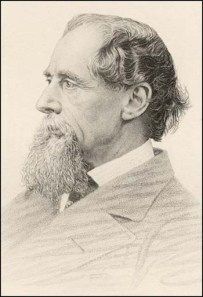
Charles Dickens

Charles Dickens

Hard Times is one of those books that English teachers make you feel bad about not liking.

Oh, I forgot. I am an English teacher. What to do that I found what some people call Dickens greatest novel so dull that it was not even engaging enough to be a soporific (Side note about falling asleep to books, books make us fall asleep best not when they are dull but when they are engaging enough that they take us to the edge of dreaming).

Seriously though, consider the first lines “Now, what I want is Facts. Teach these boys and girls nothing but Facts. Facts alone are wanted in life. Plant nothing else, and root out everything else.”

Isn’t it plain from this moment that the game is rigged. Who could not know that the speaker is a grind–well actually a Gradgrind–that he will get his comeuppance, and that the virtues of truth beauty and the imagination will out.

And, not to put too fine a point on it, that’s mostly what you get in this novel. The Gradgrinds, Bounderby, the Blackpool’s, they exist to tell us that industrialization has made the world go awry reducing everything to its material usefulness and leaving no room for the more spiritual world of the imagination embodied in things like–surprise!–imaginative literature. Of course there are details. Louisa Gradgrind marries the much older Mr. Bounderby on the basis of the practicalities of the facts and her father’s wishes, and we’re quite sure that she will be ground to nearly nothing, which she nearly is. She ameliorates her desperation by trying to help the laborer Stephen Blackpool and we’re nearly sure that Blackpool will die, which he nearly does. And then does. All parties concerned learn their lessons, including Mr. Gradgrind, who comes to realize that there’s more to life than facts, like his love for his daughter and his wayward son. Still, the love seems mostly to exist to make a point, and the point seems too familiar.
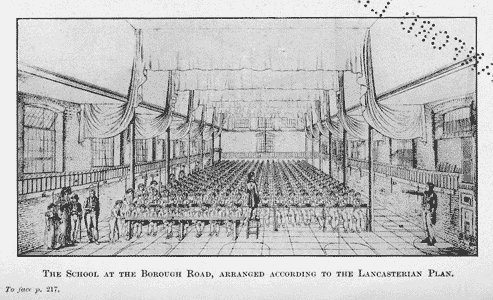
Industrialized Education

There’s nothing wrong with a thesis in a novel–I say this against all those who say novels don’t make points; I agree with those from Kenneth Burke to Wayne Booth who see fiction as a kind of rhetoric. But there is a problem with a novel whose thesis is baldly stated like an essay and whose thesis is never complicated, decomposed, challenged, reconfigured, or developed beyond what we can gather from the first sentence. (For that matter, there’s a problem with an essay written in a similar fashion).

I felt myself slogging along through the mud of the obvious and predictable, waking up just a bit when we finally get to the figure of Stephen Blackpool but descending again in to readerly despair when it’s obvious that Stephen is mostly a foil for the display of Louisa Bounderby’s sentimental charity, and later for the display of the pusillanimity and bourgeois moral corruption of Tom Gradgrind.

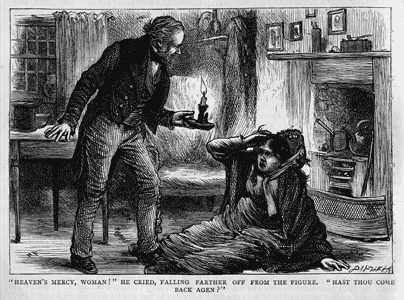
Stephen Blackpool and his mad wife

Stephen Blackpool and his mad wife

Stephen Blackpool, cog in Dickens’ sentimental machine.

On the other hand, I found myself wondering whether I found this all so predictable because so much has been built on a Dickensian edifice. In other words, would Dickens’ early readers have found his book dull and predictable or perhaps instead appalling, thrilling in its view of human degradation. Do we have a responsibility as readers to recover the shock of the new in classic works when they are no longer new?

I’m not sure. And I may be trying to cut Dickens too much of a break. I have read both Uncle Tom’s Cabin and Douglass’s Narrative a multitude of times, and both are rife with moral sentimentalism, obvious bad guys, and endings that surprise only in their predictability. Yet I never find them dull. I will still be moved to tears by sections of both. So what it is it about Hard Times that leaves me cold, in the grip of something I feel I already know and don’t need to learn again, while I can read Stowe and Douglass (and Faulkner, and Hemingway, and at least some of Toni Morrison) as I read the Psalms, an ever renewing source even when I know everything that will happen.

Side Note: An interesting bit from Hard Times about reading. From the chapter where the town is beginning to hunt the falsely accused Blackpool, believing him guilty of robbing Bounderby’s safe.

“The factory-bells had need to ring their loudest that morning to disperse the groups of workers who stood in the tardy daybreak, collected round the placards, devouring them with eager eyes of those who could not read. These people, as they listened to the friendly voice that read aloud–there was always some such ready to help them–stared at the characters which meant so much with a vague awe and respect that would have been half ludicrous, if any aspect of public ignorance could ever be otherwise than threatening and full of evil. Many ears and eyes were busy with a vision of the matter of these placards among turning spindles, rattling looms, and whirling wheels, for hours afterwards; and when the Hands cleared out again into the streets, there were still as many readers as before.”

Me and My Aura

This is perhaps a fairly typical view of oral reading that occurred with regularity up until the 20th century. Now the only people who sit and listen to someone else read are either children or tony types who attend poetry readings. Still, I’m struck by the mystical aura of the word, the mystery and power that written discourse must have held for the masses of the illiterate underclass. Perhaps still holds for that matter. Still, it seems to me that the ubiquity of print has been bought at the price of its own devaluation. Indeed, the inflated presence of the word everywhere around us, where everyone and their mother can write–and indeed, where everyone does write, so much and so often, that no one really has time left to read–this glut of written verbiage has been bought at the price of writing’s (and reading’s) triviality.

Not that this dismal view applies to my own blog, of course. It’s infinitely valuable and more than worth your time. I’m sure it even has an aura.

For More of my summer’s guilty pleasures, see

Summer’s Guilty Pleasures: Black Snake Moan–June 30th

Speeding and Reading

As luck would have it I stumbled over two good essays in the same day that seemed to speak to my general concerns (paranoia) at the state of the world. Mark Edmundson over at The Chronicle Review has an excellent piece on the speed with which American college students live their lives these days, a speed perhaps most emphatically symbolized by the Internet. Edmundson is a professor at the University of Virginia, and the author of the book Why Read, a book, among thousands of others, I haven’t had time to read yet.

Says Edmundson, beginning with a chance encounter with a student at the beginning of the school year:

We asked each other the usual question: What did you do over the summer? What he did, as I recall, was a brief internship at a well-regarded Internet publication, a six-country swing though Europe, then back to enjoy his family and home, reconnect with high-school friends, and work on recording a rock CD. What had I done? I had written five drafts of a chapter for a book on the last two years of Sigmund Freud’s life. I had traveled to Crozet, a few miles away, to get pizza. I’d sojourned overnight in Virginia Beach, the day after I woke up distressed because I couldn’t figure out how to begin my chapter. I’d driven to the beach, figured it out (I thought), and then I’d come home. My young friend looked at me with a mixture of awe and compassion. I felt a little like one of those aged men of the earth who populate Wordsworth’s poetry. One of them, the Old Cumberland Beggar, goes so slowly that you never actually see him move, but if you return to the spot where you first encountered him two hours past, lo, he has gone a little way down the road. The footprints are there to prove it.

=====

One day I tried an experiment in a class I was teaching on English and American Romanticism. We had been studying Thoreau and talking about his reflections (sour) on the uses of technology for communication. (“We are in great haste,” he famously said, “to construct a magnetic telegraph from Maine to Texas; but Maine and Texas, it may be, have nothing important to communicate.”) I asked the group, “How many places were you simultaneously yesterday — at the most?” Suppose you were chatting on your cellphone, partially watching a movie in one corner of the computer screen, instant messaging with three people (a modest number), and glancing occasionally at the text for some other course than ours — grazing, maybe, in Samuelson’s Economics rather than diving deep into Thoreau’s “Economy” — and then, also, tossing the occasional word to your roommate? Well, that would be seven, seven places at once. Some students — with a little high-spirited hyperbole thrown in, no doubt — got into double digits. Of course it wouldn’t take the Dalai Lama or Thoreau to assure them that anyone who is in seven places at once is not anywhere in particular — not present, not here now. Be everywhere now — that’s what the current technology invites, and that’s what my students aspire to do.

Edmundson’s essay is pretty wide-ranging, going on to link up with insightful discussion of the relevance of Byron, the natural of contemporary sex, and the laptop as an engine for infinitely expanding desire. Most interesting to me is that Edmundson rightly notes that higher education tends to respond to this situation by saying something like “There go my people, I must lead them” then rushing as fast as possible to make our classrooms and our curricula ever more multi-dimensional, multi-media, multi-tasking, multi-cultural, and multitudinous.

In part, the frantic and unrelenting—and perhaps unavoidable—drive for students as consumers leads us to “meet them where they are” rather than challenging and questioning the form of the culture we all necessarily inhabit.

Often times this argument is put in apolitical—and frankly just stupid—terms by casting it as old culture against new culture, or the culture of elders against the culture of youth. Edmundson points out that this generation of college students has had the internet since they were eight years old. My son has never known a time when we didn’t have an internet connection—even though we only managed to get off dialup a few months ago. How, one must ask, is an eight year old determining the contours of his or her culture. This is a culture that has been thrust upon them by mature adults who made the culture in which they must inevitably participate.

But to recognize that inevitability is not the same thing as having to endorse it or at least fail to recognize its limitations. The formidable speed and the wealth of information available at my internet connection is offered by denizens of the net as its greatest and most empowering aspect. It is also, perhaps, its most its most dehumanizing aspect.

Side note: who decided that more power—implied by the notion of empowerment—is always a good thing, always a humanizing thing. Ask Eliot Spitzer—awfully empowered. Not completely sure the quest for more empowerment results in better persons or better cultures.

Though, as I think about it, this isn’t really a sidenote. One traditional hack on traditional modes of reading (and traditional classrooms) are that they are disempowering. Too slow. The author/teacher is too much in control. Against this notion Edmundson suggests that the first task of teaching in such a world is not to speed up our classes, but to slow them down

For a student to be educated, she has to face brilliant antagonists. She has to encounter thinkers who see the world in different terms than she does. Does she come to college as a fundamentalist guardian of crude faith? Then two necessary books for her are Freud’s Future of an Illusion and Nietzsche’s The Anti-Christ. Once she’s weathered the surface insults, she may find herself in an intellectual version of paradise, where she can defend her beliefs or change them, and where what’s on hand is not a chance conversation, as Socrates liked to say, but a dialogue about how to live. Is the student a scion of high-minded liberals who think that religion is the OxyContin — the redneck heroin — of Redneck Nation? Then on might come William James and The Varieties of Religious Experience or Schopenhauer’s essays on faith. It’s this kind of dialogue, deliberate, gradual, thoughtful, that immersion in the manic culture of the Internet and Adderall conditions students not to have. The first step for the professor now is to slow his classroom down. The common phrase for what he wants to do is telling: We “stop and think.” Stop. Our students rarely get a chance to stop. They’re always in motion, always spitting out what comes first to mind, never challenging, checking, revising.

Not long ago a young man came to my office, plopped down, and looked at me with tired urgency. “Give me 10 minutes on Freud,” he said. “Convince me that he really has something important to tell me.” Despite appearances, this was a good moment. It was a chance to try to persuade him to slow it down. Get one of Freud’s books — Civilization and Its Discontents is usually the best place to start — read it once and again, then let’s talk.

=====

As to our students, all honor to them: They may have much to teach the five-drafter. By their hunger for more life they convey hope that the world is still in some measure a splendid place, worth seeing and appreciating. Into spontaneity they can liberate us. But life is more than spontaneity and whim. To live well, we must sometimes stop and think, and then try to remake the work in progress that we currently are. There’s no better place for that than a college classroom where, together, we can slow it down and live deliberately, if only for a while.

Yes, I think this is it precisely, and I appreciate Edmundson’s effort to find a balance between the culture of speed and the culture of reflection. But I also think he’s right that our students don’t need from us how to be taught to speed through a course of study; they do that well enough already.

Along these lines, I do think one of the greatest challenges facing English departments—if not the culture as a whole–is the deliberateness and singularly absorbed attention that traditional intensive reading requires.

There is a particular sense in which this kind of attention, this kind of slowing down, is “disempowering” in a particular and commonplace use of that term. I willingly subject myself to the book and surrender my consciousness to the authority of the text, my imagination to the primacy of another imagination. I am in some very real sense possessed and my consciousness of self temporarily dissolved into another world created not by the clicking finger of my desire—though my desire may not be suspended—but created by another will.

This is why romantics from Emerson to Byron to Barthes have hated reading (I say this even though Barthes is sometimes taken as a romantic of the reader. Or because of it. He can only imagine reading as a positive act if reading is reimagined as a form of writing, not a form of self-abnegation.)

My terms here verge on the spiritual, which leads to a second essay I read from Nancy Malone, but I’ve gone on too long already and will try to get to this later. Reading, or at least some kinds of reading, as a form of contemplative practice, one who’s desired goal the self-aggrandizing expansion of desire, but dissolution of the desiring self in any straightforward sense.

Ethics of Reading

Published the following letter to the editor in this week’s Chronicle of Higher Education. Yes, I am becoming “that guy.” You know, the odd ball, slightly unkempt if not unwashed, who writes letters to the editor. As I think of it, blogging is a bit like letters to the editor on roids. Roid rage and all.

=========

Deconstruction and Reading

To the Editor:

Peter Brooks begins “The Ethics of Reading” (The Chronicle Review, February 8) by noting his dismay at J.M. Coetzee’s association of torture with the reading practices of “the academy of the humanities in its postmodernist phase.” Coetzee’s association is less surprising than Brooks’s shock; the link between reading and violence is nothing new.

The purported existence of links between how we read and ethical corruption or political violence is a commonplace in complaints about contemporary theory. Indeed, the link between reading and moral corruption goes back much further than this, found as it is throughout Western history — especially since Gutenberg. Faust is, after all, nothing if not a reader.

The opening line of Brooks’s essay points to a peculiar construal of both reading and ethics — one that, I think, can be found in a variety of other “ethics of reading” theories, particularly that of J. Hillis Miller. Says Brooks, “I’ve long been invested in the notion that teaching to read literature carefully, seriously, reflectively can be an ethical act.” Reading here seems to be conceived of primarily as a procedure or a technique; rigorously following correct procedures ensures or at least encourages an ethical outcome.

Brooks casts about to find an appropriate place to lay the blame for reading practices that have led to the infamous memo on torture allegedly written by John Yoo. He comes up with inept graduate students, or perhaps just people who didn’t attend Yale: “It must be admitted that the lessons of deconstruction in the wrong hands — less adept than its original practitioners — led to facile untetherings of meaning.” Ironically, he then points to Paul de Man as a practitioner of “essentially ethical” reading in his attempts “to understand how texts mean and how language works.”

To be fair, Brooks is pointing yet further back to Reuben Brower, de Man’s own mentor in the skills of reading. However, I have my doubts that de Man’s close reading skills did much to save him from his own readings of Jewish existence in Europe.

I have no interest in attacking de Man’s character or revisiting his history. But maybe part of the problem is, in fact, how he taught us to imagine reading. Why would we begin to imagine that pursuing a rigorous technique to its endpoint is inherently ethical? Fascists were certainly champions of the rigorous pursuit of techniques and industrious in their pursuit of efficiency.

While the ability to read closely and industriously and with technical proficiency may further the ends of people seeking to do good, it seems just as plausible that the ability to do so can serve the ends of those who seek to do ill. We accept that great artists may not be great people, and that their art may even serve both good and bad ends at the same time. Why should we believe differently about great readers?

http://chronicle.com
Section: The Chronicle Review
Volume 54, Issue 26, Page B29