Tag Archives: literature

Freedom and Submission; or, the reading fetishist

One very big advantage of wireless networks. I can sit here and do this blog while I simultaneously watch American Idol. Yes, I am only partially ashamed to admit that I watch American Idol with my family every week. Listening to Simon disrespect singers for their “monumental lack of personality” is my great guilty pleasure.

Probably goes along with my general sense that we are too tenderfooted in declaring that some things are better than other things.

Thus, one way the net has it all over reading books. I mean I couldn’t sit here and read my new edition of War and Peace while listening to several people sing off key while displaying their lack of personality. Multi-tasking rules. (Who am I kidding; I don’t have a new edition of War and Peace or even an old one. I have no time.)

But today’s blog has nothing to do with that.

Ben Vershbow over at if:book posted a very interesting piece reviewing Hypertextopia, a free web space for writers wanting to explore the possibilities of hypertext for fiction. Says Vershbow:


The site is gorgeously done, applying a fresh coat of Web 2.0 paint to the creaky concepts of classical hypertext. I find myself strangely conflicted, though, as I browse through it. Design-wise, it is a triumph, and really gets my wheels spinning w/r/t the possibilities of online writing systems….


Lovely as it all is though, it doesn’t convince me that hypertext is any more viable a literary form now, on the Web, than it was back in the heyday of Eastgate and Storyspace. Outside its inner circle of devotees, hypertext has always been more interesting in concept than in practice. A necessary thought experiment on narrative’s deconstruction in a post-book future, but not the sort of thing you’d want to read for pleasure.


But those are the days I wish we could put the net back in the box and forget it ever happened. I get a bit of that feeling with literary hypertext — insofar as it reifies the theoretical notion of the death of the author, it is not necessarily doing the reader any favors.

Hypertext’s main offense is that it is boring, in the same way that Choose Your Own Adventure stories are fundamentally boring. I know that I’m meant to feel liberated by my increased agency as reader, but instead I feel burdened. What are offered as choices — possible pathways though the maze — soon start to weigh like chores. It feels like a gimmick, a cheap trick, like it doesn’t really matter which way you go (that the prose tends to be poor doesn’t help). There’s a reason hypertext never found an audience.


Hurrah! And Again. Hurrah. Vershbow has the courage to say that the king has no clothes.

That is, it’s not hip and cool to say, well, frankly, that this is all just a bit dull. But really, it is. It really, really is.

And hypertext fictions are boring in a way that the surfing the internet in general really isn’t. And the way old fashioned books are not. Almost as if the “planned” surprise or randomness or multiplicity of hypertext fictions are more controlling and in some fashion disrespectful of readers than traditional narratives ever were. And less surprising than the almost true randomness of the text or internet.


[Intertext I: Simon Cowell has just determined that the latest singer is “completely forgettable.” She is, she really, really is. Just like almost every hypertext fiction ever written.]

[Intertext II: I have definitely decided that Paula Abdul is irredeemably vapid. Not, I hope, like this post]


Vershbow is right to tie this to a peculiar failure of concept in postmodern views of reading and writing. I have to say that I love reading Roland Barthes. But his understanding of reading in “Death of an Author” completely misses the point of what is most pleasurable and imaginatively enlarging about the reading experience. That is, our self loss, our self-forgetfulness.


I don’t deny the general idea that reading is or can be a creative act. But Barthes tendency to turn every reader into a writer, every reading in to a writing, misses that the great glory of reading is transcendence of the self through loss, transcendence through the dissolution of the ego’s boundary, transcendence through the very submission of the imagination that Barthese hopes to forestall.


As if he were empowering readers by putting them in control. Perhaps he forgets that, as I learned on CSI, the passive partner in an S&M team is always the one who’s really in control, despite appearances.

Finally, equating freedom and creativity with control is….boring. Anyone who has written knows that the most exciting times aren’t those moments when you’re exercising authority over the text, but those when you aren’t. When the words say things you didn’t know or mean.

Reading as control is boring for the same reason hypertext fictions are boring. By giving the reader a job we’re confined by the randomness of our own choices, rather than freed and liberated from ourselves by the prisonhouse of someone else’s language.


Masochism, you say! So be it.

Submit yourselves to the discipline of the text…and be free.

Unless the grain of seed shall die. And so forth.

Fetishists of the text unite!


[Intertext III: Simon thought the last singer was “completely predictable,” but thought Brooke White was great. Paula Abdul says that Brooke White’s song was “really here.” What does that mean? What in the name of all that is good and true does that mean?]


Previews: I’ve gotten a lot of good responses to things lately that I just haven’t been able to get to. What I really hope to get to soon, but in case I don’t, just treat it like a movie that failed its test screening.

Sam Miller, one of my readers (that sounds pretentious, but I’ll say it anyway)has a new essay out at Conversational Quarterley that looks pretty good, but I need to read it more closely before I say more.

My good friend Julia Kasdorf has been up to her usual good stuff with reading and writing up at Penn State.

I’ve also managed to get the folks at MyAccess royally po’d. I think they’ve marshalled their hit squad of professional MyAccess users.

Also passed my two month anniversary as a blogger 3500+ page hits. And some of them are not even from the students I am paying to click through my pages (heh! heh!) Have got to talk about the compulsive addiction to write that is occasioned by anonymous readers.

But all that is for the future. After American Idol is over.

 

Boys and Their Toys

Mark Bauerlein, blogging for the Chronicle of Higher Education, posted some interesting reflections on boys and reading this past week . He’s reflecting on the iPulp Fiction Library, which is probably worth a blog in itself. The library, run by a friend of Bauerlein’s, exists to promote reading, especially though not exclusively for boys, by reinvigorating the tradition of the dime novel by providing free onlineipulp fiction.

A few excerpts from Bauerlein’s blog:

Five years ago I would have written back with something like, “C’mon, can’t we push a little Melville and Swift instead?”

Not anymore. Books of any kind compete with so many digital diversions that just about any fiction that encourages long reading hours is worth a look — pulp or sports or Western or murder mystery or classic novel. Reading researchers believe that sheer volume of reading plays a large role in the acquisition of basic literacy skills and vocabulary, and that print matter of even child-oriented books can be more verbally challenging than some of the best television shows. (Read this entire article and note its far-reaching findings.)

Furthermore, I believe, the boy reading problem is reflected in the growing achievement gap between girls and boys. Admissions officers see this every year. At my old school, UCLA, the entering class last year was 59 percent female. Across town at Cal State-LA, the undergraduate population is 63 percent female. And officials expect the discrepancy to increase.

===============


Real Men Don’t Read

Bauerlein is touching on one of my pet concerns, partly because I have a son who reads a great deal, while also trying to maintain his coolness quotient in being a basketball and soccer player. While being further concerned with enhancing his growing reputation as a lady killer. Lady killers not found in libraries as a general rule.

“Real Men Don’t Read” could probably be a slogan on a best-selling adolescent t-shirt, is my general guess. Boys learn mostly to impress girls by carrying their books, not by reading them. I also feel this poignant sense of protectiveness for the few men who wander in to my literature classrooms. Among English majors nationally, women outnumber men 3 to 1.

(Side note: a quick google search calls up 5180 pages with some version of the phrase Real Men Don’t’ Read. Fewer than I might have thought, but the idea is out there.)

So, I mostly agree with Bauerlein here. It is surely a truism by now in higher education that there’s a problem with young men and higher education. Indeed, it’s fair to say that more and more colleges are starting to treat them like an underrepresented minority.

(And, incidentally, I see more and more posts from women—including a response to Bauerlein’s blog–that, in a different context, would sound just like white people ridiculing the supposedly inherent inferiority of black people. Along the lines of “If boys weren’t so stupid, there wouldn’t be a problem.”).

The reports from the NEA emphasize just how drastic the non-reading problem is for men as opposed to women. This, in fact, is one of the main reasons I’m dubious of those defensive responses that suggest reading on the net is just as good as any other kind of reading. Studies used to suggest, at least, the higher levels of comfort boys had with the net and all things digital, but that is long past. Even if men are now spending all their time reading online, it apparently isn’t doing them any good. They score consistently far lower than women on all kinds of tests for reading comprehension and language abilities. Indeed, studies suggest that girls now spend more time online and post more written content than boys. Boys dominate in only one area—video content:

Girls continue to dominate most elements of content creation. Some 35% of all teen girls blog, compared with 20% of online boys, and 54% of wired girls post photos online compared with 40% of online boys. Boys, however, do dominate one area – posting of video content online. Online teen boys are nearly twice as likely as online girls (19% vs. 10%) to have posted a video online somewhere where someone else could see it.

All of this goes to show why my daughter thinks it’s weird that I blog, and my son ignores it entirely. I am, no doubt, working out of my feminine side, or perhaps my inner 17-year-old female child.

In any case, generally speaking, I have my doubts that boys are making up for their lack of reading books with a lot of reading and writing on the net.

==========


What Should Big Boys Read?

I think that not a lot of attention has been given to reading material especially for boys in schools. I’ve mentioned Jon Sciezka on this blog before, and I think the work he’s doing with boys’ reading is important. A colleague seemed flummoxed when I suggested to her that for a lot of boys, maybe most boys, The Great Gatsby is the equivalent of a chick flick, as is most of Shakespeare, Hawthorne, and most of the others we call greats. Generally speaking, though, I agree with the following post: “Why Hemingway is Chick Lit.” Among other things the post gives us the following completely unscientific but telling anecdote:

“When women stop reading, the novel will be dead,” declared Ian McEwan in the Guardian last year. The British novelist reached this rather dire conclusion after venturing into a nearby park in an attempt to give away free novels. The result?

Only one “sensitive male soul” took up his offer, while every woman he approached was “eager and grateful” to do the same.

We can talk about patriarchal power all we want, but in general patriarchal power is exercised on the playground by those boys who make fun of Shakespeare, not those who actually bothered to read something other than the Spark notes.

Still, I’m a little hesitant. It’s not clear to me that reading a lot of anything is by itself a great thing for reading or a great thing for boys. n+1 famously argued that we’re so obsessed with a reading crisis that we think we should praise everything that’s written and praise anyone who reads the morning paper. I’m not sure that reading a dime novel is in and of itself superior to a film or even a complex video game; better, probably, for developing vocabulary to some degree, but not better for other kinds of developments–assuming that a film and a video game develop different kinds of competencies and visual literacies. It would be important to understand reading on a continuum. What builds the habit of reading in boys, and what makes reading seem like just another drudge assignment?

===========


Can Reading Make You Cool?

More from Bauerlein’s blog

More leisure reading might help, and books like iPulp Fiction Library’s appeal to boys a lot more than the “problem stories” and identity narratives that fill Young Adult shelves in the libraries and bookstores. Back in high school, I remember boys passing around books as a kind of cool underground connection — including jocks and “stoners” (as they were called then). I was hit hard by The Brothers Karamazov and The Sound and the Fury when I was 18, but those didn’t catch on. What did was Ball Four, a knuckleballer’s diary of a season with the Seattle Pilots; North Dallas Forty, a novel about a receiver for an NFL team; Erica Jong’s Fear of Flying (yes, really); and someone snagged a copy of The Happy Hooker, too.

Do these kinds of secret reading networks still exist? We have Harry Potter, of course, but that’s a different thing, a juggernaut of popularity. Also, there is little evidence that Harry Potter has made many teenage boys read a lot of other books besides Rowling’s. We read the books above not because everybody else did, but because they met a curiosity, or a need, or insecurity, or humor, or heroism that we felt inside, or wanted to. Some of them had some good writing in them, too.

Bauerlein looks like he must be about my age, and the list above confirms it. I never actually got around to Fear of Flying and The Happy Hooker. Much too repressed. On the other hand, Ball Four and North Dallas Forty…Yes, god, yes… Also the Brothers K. Must have been the in book with high school administrative poohbahs in the 70s.

I’ve reflected in the past on the idea that books function as signs to other readers as much or more than as stories that are to be read. The person that—in an earlier generation—carried Catcher in the Rye or On the Road in his hip pocket or who sat sullenly under a tree reading a book while dragging on a cigarette was making a kind of public statement.

To some degree I think this is still true, but I wonder if its been permanently displaced by digital culture. People make a statement by having old-fashioned books at all, not the specific texts that mark them off from readers of other books.

Of course, secret reading networks do exist. One wants to ask Bauerlein if he’s ever been online. But partly that’s the point. They exist facelessly on far flung digital networks rather than being part of the identity formation of groups within industrial-sized high schools.

Also, they have now mostly been displaced by video games. My son and his friends are sorted in two different ways: those who read books and those who don’t, and those who play Halo and those who don’t. The difference is important. Book readers are lumped together regardless of content of what they read—whereas in an earlier age of adolescene boys might have sorted themselves by whether they read Ken Kesey, Isaac Asimov, or Herman Melville. Gamers discriminate among themselves assiduously, marking themselves as belonging to different groups by the games they play and their competence at their choices.

To some degree I wonder how this works with e-book readers. The e-book itself shapes every text to a common and universal appearance. Thus, reading my e-book in the local coffeeshop, I can make a statement about myself as an e-book reader that will draw the attention of others and show my solidarity with others who are technologically sophisticated. But I can’t display the title of the individual book. The dividing line is not between Peyton Place and Moby Dick, but between digital and non-digital, with little room for specific self-display.

Nevertheless, none of this I think gainsays Bauerlein’s general opinion that iPulp is probably a very good thing in general. I browsed over the site. Not generally my cup of tea, but it should be right up the alley of the alienated middle schooler who likes that kind of thing. It looks to me that the site is set up for use on ipods and iphones, but I couldn’t figure out anyway to load to any other kind of reader or even to download to a computer.

Of course, that may itself be only a sign of my general unhip uncoolness when it comes to digital illiteracy. I’ll have to ask my 13 year old how to do it.

After he gets past teaching me how to play Call of Duty.

And Halo.

And Gears of War.

And…

Illuminations and Illustrations; Videowriting for the future

One thing that always struck me as a bit odd in the Harry Potter movies is the moving illustrations of books and newspapers. Odd because, set in the present, there’s a sense in which the internet is already a great deal more magical than that. As things go, indeed, Harry Potter is peculiarly a-chronic, living in the modern world as if he’s never seen a computer. Still, those video books are, in some sense, a continuation and enhancement of the tradition of illuminated manuscript–great textual form of the world of Gothic witches and warlocks.

The attached video I got in my email today reminded me of this, one of many announcements about writing contests that I get as an English professor. This one came with a twist since it’s promoting the use of YouTube as a resource and as a media for creative writing. I checked out the details as much as I could–writing contests are famously cash-cows for journals, requiring entrants to pay anywhere from a 10 to 50 dollar reading fee for what ends up being a one in a thousand chance of being published. Not a con exactly; just a grim fact of how literary culture has to support itself in our society. This looks decently legit, and no fees that I can find.

I’m struck by two things I see here. One is the idea of YouTube as a medium for or at least an enhancement William Blake illuminated manuscriptto traditional creative writing. I’m not much taken by the idea of embedding text in video format–I’ve seen work like this before on the net in multi-media forms of poetry. Touted as an “interactive” form of reading that values the reader, this kind of thing really ends up wresting a lot of control from the reader by controlling how and when the reader will see the text the reader sees.

On the other hand, I am taken by the idea of embedding video in stories. In literary circles we’ve traditionally seen books as opposed to film in some respects, with film usually inferior. But books traditionally have made great use of visuals as supplements to the text. Illuminated manuscripts, of course, but also extensive illustrations in nineteenth century novels. Graphic novels, of course, subordinate the text to the visual, so it’s not quite the same animal, but at least you could say that the exclusively alphabetic text absent all illustration is mostly a 20th century phenomenon.

So I’m wondering how video might make room for an new kind of illuminated text. The video commenting on and enhancing the text rather than being a redaction of it–as occurs so often in films about novels. I’m not familiar with anything like this, so if someone knows about stuff for me to look at, I’d love to see it. Again, one of my pet topics; the visuality of books.

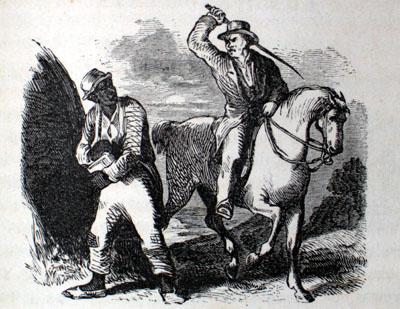
The other thing that strikes me in this is the way that internet culture is changing the culture of books in general. I’ve lamented in the past–and still do lament, to be honest–the ways in which computer culture is gradually fracturing and dispossessing the traditional sites of book culture. Places where readers Uncle Tom’s Beatinggather are increasingly becoming places where computer users gather, clicking away in their separate universes.

On the other hand, it is the case that the internet creates new cultures for readers–and not only in chat rooms and forums devoted to literature. In online book clubs I can chat with authors–at least I assume I can; I’m always wondering if it’s the author on the other end or a poorly paid graduate student doing her best to imitate the voice and interests of the latest author plugged by Barnes and Nobles. Online readings don’t yet substitute for readings in person, but I can imagine them becoming the norm. Already as a department chair I’m seeking the permission of authors to record their readings for replay on our web site. The Lunch Poetry series at UC Berkley is a good example of this on the web. I don’t think it substitutes for the great pleasure of gathering together with other readers, but who could complain that this kind of thing exists.

This ‘n That

I’m working on a little longer piece on Emerson, again, but thought I’d just put up a collection of unrelated stuff in the interim.


Me On Teleread

I actually don’t remember if I said anything about this, but I should have if I didn’t. Dave Rothman over at teleread.org was kind enough to ask me to blog on his space. David says he wants the perspective of a humanist to complement all the techies. He was kind enough to not say “I want someone who doesn’t know jack about technology.” In any case, my first post over there went up last week. I may have forgotten it because I posted a version of it over here as well. Still, I’m very interested in the conjunction of technology and reading, so teleread is a good place for me to further that thinking.

On Being Healthy

The Canadian Council on Learning tells us that daily reading is better for you than fiber. Oh, wait…I think we just found out that fiber doesn’t do anything for you except forestall diarrhea. (For more on diarrhea, see my completely fascinating post on this topic.) In any case, I’m happy to discover the following.

Reading each day can keep the doctor away, says a report that concludes sifting through books, newspapers and the Internet — on any topic — is the best way to boost “health literacy” skills such as deciphering pill bottles and understanding medical diagnosis.

Daily reading, not education levels, has the “single strongest effect” on the ability to acquire and process health information, the Canadian Council on Learning said Wednesday.

=====

The learning council reported Canadians aged 16 to 65, who said they read daily, scored up to 38 per cent higher than the average on the health literacy analysis.

Daily readers over 65 years old scored as much as 52 per cent higher than the average for their age.

“Although it may not be a panacea, this report makes a compelling case that reading each day helps keep the doctor away,” said the report.

I think it’s wise to have a tad bit of skepticism about stats like this. I wonder if there are correlations between regular reading and social class, for instance, and if so is the relationship to health a function of reading or a more general issue of access to health care, material resources, and knowledge itself. Still, why look a gift horse in the mouth. At this rate I am going to live a good long time. Actually, I better stop blogging because it’s definitely cutting in to my reading time. (Who am I kidding, I just don’t watch TV anymore.)

Reading More or Reading Better

A blog over at Metafilter raises the typical objections to the notion that we’re in a reading crisis. So what if we’re reading less literature; we’re reading more than ever on the web, right?! On the other hand, they also point out that Americans ability to read at all seems to be declining, pointing to the following study at the National Center for Education Statistics:

On average, U.S. students scored lower than the OECD average (the mean of the 30 OECD countries) on the combined science literacy scale (489 vs. 500).

The average score for U.S. students was:

  • higher than the average score in 22 education systems (5 OECD countries and 17 non-OECD education systems)
  • lower than the average score in 22 education systems (16 OECD countries and 6 non-OECD education systems)
  • not significantly different from the score in 12 education systems (8 OECD countries and 4 non-OECD education systems)

Ummm….One big problem, guys. Science and Math literacy is not the same thing as reading and writing literacy. And so I’m not quite sure what this has to do with whether people are reading literature any more or not. Though I’m sure Dana Gioia over at the NEA would be glad to claim that reading Moby Dick helps people with their algebra. Of course, it could be that reading skills have declined so far that the folks can’t even tell what science and math literacy really is.

Links:

A number of people have been kind enough to comment about the blog or link to my blog in various ways over the past several weeks. A few of them:

Free listens: A blog of reviews about audiobooks. What a great thing. I’ve said that I wish there were more sorting and evaluating of some of the free stuff on the web. Heresy of heresies, I don’t think massing blog stats necessarily tells me much about quality. I mean, videos of Brittany Spears’ pudenda are among the most popular on the web. Does that really tell us anything…about the quality of the video, I mean. Not about the state of America… or the state of Brittany Spears body parts. I haven’t had a chance yet to listen to the audiobooks to see if I agree with the judgments, but I’m glad someone is taking up the flag to do such a thing.

The Reading Experience: Daniel Green has me on his blogroll, and I’ve had The Reading Experience on mine from the beginning. I think Daniel is a little narrower in his literary judgments and tastes than am I, but I admire anyone immensely who has left academe and made it on his own. His blog is always thoughtful and often provocative.

There’s Just No Telling: “Monda” has commented on my blog before, and has a lovely sight devoted to reading and writing. From what I gather she is a teacher of creative writing, who all deserve to be sainted.

Brad’s Reader: Brad lists me as an interesting read. And I didn’t even have to pay him.

There are others that I’ve missed, and I’ve got to stop somewhere in any case. So if you’ve linked to me and I’ve missed you, let me know. I’ll keep you in mind next time I do this.

Reading, listening and memory

Pursuing some of my recent posts on the idea that listening and reading create different experiences–without making a judgment regarding superiority–a forum on myspace directed my attention to the following study from Carnegie Mellon demonstrating that listening and reading activate different parts of the brain, and especially that listening requires a great deal more working memory–what used to be called short-term memory–in order to do the semantic processing necessary for understanding.

“The brain constructs the message, and it does so differently for reading and listening. The pragmatic implication is that the medium is part of the message. Listening to an audio book leaves a different set of memories than reading does. A newscast heard on the radio is processed differently from the same words read in a newspaper,” said Carnegie Mellon Psychology Professor Marcel Just, co­author of the report that appears in this month’s issue of the journal Human Brain Mapping.

This seems to go along with my general perception in yesterday’s post that in reading to a text we are experiencing a different object of consciousness–in some sense a different work of literature–that we do when we listen to a text. I’m not exactly a phenomenologist, but we might be able to go with this to say that our experiences of texts are how they appear in consciousness. To the degree that listening and reading activate the brain differently, I would hypothesize that the conscious mind is experiencing two completely different “objects,” objects here understood to mean our mental experience of words and their meanings.

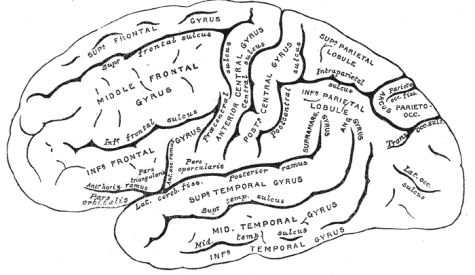
First, during reading, the right hemisphere was not as active as anticipated, which opens the possibility that there were qualitative differences inBrain image–Pars triangularis the nature of the comprehension we experience in reading versus listening. Second, while listening was taking place, there was more activation in the left ­hemisphere brain region called the pars triangularis (the triangular section), a part of Broca’s area that usually activates when there is language processing to be done or there is a requirement to maintain some verbal information in an active state (sometimes called verbal working memory). The greater amount of activation in Broca’s area suggests that there is more semantic processing and working memory storage in listening comprehension than in reading.

Because spoken language is so temporary, each sound hanging in the air for a fraction of a second, the brain is forced to immediately process or store the various parts of a spoken sentence in order to be able to mentally glue them back together in a conceptual frame that makes sense. “By contrast,” Just said, “written language provides an “external memory” where information can be re­read if necessary. But to re­play spoken language, you need a mental play­back loop, (called the articulatory­phonological loop) conveniently provided in part by Broca’s area.”

This makes a great deal of sense to me and is consonant with some other things that I’ve read about how literacy accompanies the general atrophy of personal and cultural memory. Oral cultures require much more prodigious uses of memory, and I would suspect that people who train themselves to listen well–perhaps like those who listen to audiobooks!–are also developing memory capacities. At least, following this study, the short term memory would have to become much more exercised and probably developed by the consistent effort to remember the passing sounds and having to fit them together into meaningful units of language.

(Side note along these lines, my colleague who is visually impaired has a prodigious memory of detail of what seems to me to be almost everything. By comparison, I remember vaguely that an idea is found somewhere in a particular part of a book that I underlined at one point).

Following this out, and thinking through my earlier statements that what we need is more careful consideration of what kinds of things are lost and what kinds of things are gained through certain kinds of reading (or listening), we might well say that if we are entering into what is called a secondary oral culture this could signal good things for memory.

At least this would be the case if the culture that’s developing is one that would put a high premium on listening skills. I’m not really sure that it is given the dominance of the visual on the internet and in film and television. Still, it’s and interesting idea. It would be interesting to figure out if people who listen to audiobooks in a regular and devoted fashion show more highly development memory capacity–either short or long term–than those of us who spend more time reading.

This would leave for further study the question of what reading develops in the brain. I suspect it would be something along the lines of analytical skills, but I’m not sure. It also may explain the stereotype of the absent-minded professor. Maybe we really are absent-minded because in being devoted to books our short-term memory has atrophied!

Reading, Listening, and Form: Or, where is literature?

Hugh Mcguire from over at Librivox (and also at hughmcguire.net) left some very good comments on a couple of my recent posts, and also posted them to an online forum over at Librivox. They’re well worth reading in their own right, as are the comments on the forum. You can see Hugh’s comments here and here, and also access the librivox forum for a variety of interesting and useful responses on the issues I’ve been taking up lately. I thought I’d go ahead and keep these up with a couple of continuing posts over the next couple of days on the issues that Hugh and the folks over at Librivox raise (at least raise for me).

When we listen to a book are we more or less experiencing the same literary phenomenon as when we read a book? In his responses earlier to me , Hugh seems to assume so (update–Hugh just sent me another post indicating this is not his position; that comment is accessible at the previous links), and certainly some of the folks in the Librivox forum state this more explicitly—in either case we’re experiencing the same literary work, yes? The reading historian and cultural critic in me—as well as the person who’s amateurishly interesting in the way language is processed in the brain—says…well…maybe. Our tendency to say “Of course it’s the same work of literature. It’s all words!” usually assumes that what is literary about literature is the content. One of the respondents in the forum is getting at something along these lines when he says what’s really important is what the words are pointing to, not the words themselves.

In other words form and media are just part of the delivery system. Who cares how it gets there, as long as it gets there, right?!

Maybe I can illustrate like this. John, Joan and Jimmy are traveling from point A on the east coast to point B on the west coast. They use a road that has a lane for cars, a lane for bicycles, and a lane for walking. John chooses to drive, Joan chooses to ride her bike, and Jimmy chooses to walk. The content theory of journeys would suggest that all three have had approximately the same experience because they have all traveled the same geographical terrain and have moved from point A to point B.

Most students of literature or linguistics would start pulling their hair out at this stage, since a basic tenet of what we do assumes that form matters. Those of us who believe in the centrality of form as well as the significance of time and context to experience would emphasize that John experienced a dramatically different journey in his car trip across country as compared to Jimmy or Joan, and not only because he got there faster. His environment was completely different, he noticed different things and processed them in different ways. A mountain that occupied a half hour of John’s attention, loomed in Jimmy’s pathway for perhaps four or five days. The mountain was a thing of beauty that John experienced from the distance of his car, while the mountain’s beauty was complicated for Jimmy by the fact that he had to walk up one side and down the other, that he worried about mountain lions rumoured to be in the hills, and by his knowledge that if it rained he was in for misery. So though the terrain is identical in one sense, we might well say these folks haven’t experienced the same thing at all.

We don’t have to assume that one journey is necessarily superior to the other—though, I don’t think the question of evaluation can be ruled out—but it’s not quite clear that John, Jimmy and Joan have experienced the same journey despite covering the same terrain. Because the delivery systems of their journies differed, the experience itself–in some sense even the terrain itself–was completely different.

Though the analogy is inexact, it seems to me that something similar applies to the journey we take through a text. It makes a difference whether we read it via scroll, papyri, book, e-book, e-mail, cell-phone, or audiobook–all methods of delivering text, of making the journey. Thus, I would say reading Huckleberry Finn and listening to Huckleberry Finn may not be the same experience delivered in different ways. I’m willing to say they might both be described as valuable cultural experiences, and we may want to even describe both experiences as literary. But it’s not clear that the same “work of literature” has been experienced regardless. In literary and in communication studies more broadly, media matters, in some respects matters at least as much as the content itself. Marshall McLuhan’s dicta that the media is the message gets at this idea. This doesn’t assume that reading is superior to listening; only that you aren’t experiencing the same literary thing when you listen as when you read.

A different take on this suggests how different media and different cultural contexts make it possible to process something as literature when it had never been literature before–which, presumably, might also mean that these same things could cease to be literature in a future cultural context (or that “literature” could cease to be a useful description for the experience of texts entirely.)

The one example I use in my earlier post is the Bible. Many parts of the Hebrew and Greek testaments were oral tradition prior to being written down. And when they were first written down they were written down on scrolls, which enable a particular kind of reading that is very different from that afforded by books. Now one way of talking about this would be to say that all of these things are merely different ways of delivering the same content. The cultural historian in me would point out that these different forms of the Bible led to and resulted in the Bible being read in very different ways and meaning very different things at different times. Protestantism is all but predicated on a particular mode of reading and receiving books that is probably unimaginable in an oral world or a world of scrolls.

(My saying things like this drives my fundamentalist brethren bonkers, but there you have it. When it comes to literature or the bible, most people are content-driven fundamentalists. A word is a word is a word is a word. It says what it means and it means what it says. And we literary theorists, poor dears, fold our hands and say, no, no its not…no, no it doesn’t).

The Bible is also a good example of the peculiar way in which media affects our understanding of what we are experiencing, and even shapes how we experience it. For instance, courses in the Bible as literature are primarily a modern development. People didn’t start talking about the Bible as a literary text until after Gutenberg; that is, right at the time when other books started taking their place alongside sacred texts as cultural authorities. Indeed, our entire concept of “literature” is really a development of the Gutenberg revolution, a result of the great mass of available things to read and the need to distinguish some things as really worth reading. Prior to Gutenberg, so few things were actually collected in to books that everything in print was, by definition, worth reading.

Thus, my qualified “maybe” to those who would say that in listening to a book you are experiencing the same “work of literature” as you experience in reading the same book. Indeed, we are already in a period that can probably usefully be described as post-literary—which includes, but means really much more than “a period when people don’t read books.” That is, we are probably in a period when the culture that needed the term “literature” to distinguish a particulary important form of cultural activity is in decline or has already passed. Ironically, though it is out of a love of “literature” that Librivox pursues its work and through which the devotees of audiobooks pursue their listening, the shift toward the aural/oral that such things signify may also point toward the end of literature as a usefully important concept in our cultural moment. And this may be so without making any judgment as to whether that is a good or bad thing. It may just be a different thing.

Emerson and the Umpires of taste

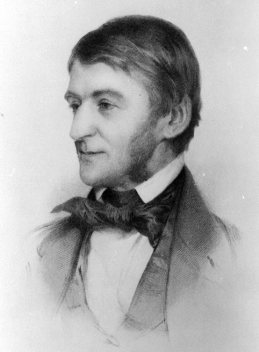
It’s not particular fashionable to admit that I love Emerson. Indeed, for as long as I’ve been in literary studies, Emerson and the other Romantics have been the arch-enemies that others have sought to dismiss, disparage, demote, decenter, damn, and deconstruct. Among other things. As an undergraduate this had a religious and an aesthetic cast. On a religious scale,Ralph Waldo Emerson Emerson was a heretic who could say in all seriousness that poets are liberating gods, that we are part and parcel of God, and that he was a transcendatal eyeball (or something like that) creating the universe through his imagination. And we all thought Mitt Romney’s Mormonism might be just a little bit odd. What need the consolations of Christ when the advent of the world came through the exercise of the individual imagination, consort of the Oversoul?


On an aesthetic scale, Emerson and the romantics were merely gauche, optimistic naifs willing to blather on about the state of their own souls when what was really needed was the hard and broken nose of modernism, which viewed the soul of the poet with only a little less scepticism than the machinations of the modern world. Both strains of anti-Romnticism came together in the aesthetic pieties and the pious aesthetics of T.S. Eliot. Odd mix for me, but I’d still rather read Eliot’s Waste Land than Emerson’s Poetry. But, too, I’d rather read any one of Emerson’s essays than any essay that Eliot ever wrote. They are a poetry of their own, and by that I mean they move me and change the way I see the world in some of the same ways that Eliot’s poetry moves and changes me.

(Unfashionable admission number two–I became a scholar of English during a semester in which I spent hours memorizing lines of T.S. Eliot’s Waste Land to deliver as part of an oral interpretation class. Who says it’s not a song?)

(Unfashiongable admission number three–I admit to the perversity of liking equally and in different ways the long, engorged, and lusty lines of breathy Walt Whitman and the Puritan and technical severity of Eliot’s poetry that tends to exist only on the page. The belief that you can only like one kind of thing, that we can’t like poetries that are polar opposites is, in the words of Emerson, a contradiction that is the hobgoblin on little minds. Read much. Love much. Contain multitudes.)

Which brings me to the “umpires of taste” who are the target of the first line of Emerson’s essay “The Poet.” Obviously Emerson has in mind the critics of his age, but my general interest is the way that Emerson looks at and understands reading. The umpires of reading are seeking to create rules for reading and writing, to arrive at a proper reading. What is the right thing to like, what is the best thing to read, what is the best way to read, what is the proper understanding of a text. This is the kind of reading that Emerson derides when he priviledges writing over reading, when he dismisses the reading of books for the making of books. He is, of course, suspicious of reading in general, as “The American Scholar” makes plain. However, there is a kind of reading that is a kind of poetry. Indeed, it’s not to much to say that writing is a kind of reading, and that reading is a kind of writing, if we understand that both can require the agency of the imagination.

There is, of course, a kind of reading that is purely instrumental. The gaining, processing, and storing of information. Too often, this is the kind of reading that we encourage in school, and the kind of reading that we think is the primary and first point of reading. Any other kind of reading only comes later, or is suspect if it doesn’t subject itself to this. The umpires of taste sniff at the inspiration, the personal connections, the new insights that readers bring to a text, sniff and subject such readings to the rules and requirements of reading properly.

Emerson reverses this academic privileging of analysis under reposed and quieted emotion.

“An imaginative book renders us much more service at first, by stimulating us through its tropes, than afterward when we arrive at the precise sense of the author. I think nothing is of any value in books excepting the transcendental and extraordinary. If a man is inflamed and carried away by his thought, to that degree that he forgets the authors and the public and heeds only this one dream that holds him like an insanity, let me read his paper, and you may have all the arguments and histories and criticism.”

Amen and Amen. The Discipline of English is often not ill-named a discipline, since it’s goal can often end up being to transform these wild and boggy responses to the chant of the universe to automatic responsa, with criticism as dull as memorized prayers.

Ok, I’ll be more composed and analytical tomorrow. But first I had to say that Emerson does a service by getting at why we chose to read in the first place. Before we had to read in order to write a disseration, or publish an essay, or teach a class. When we were lovers plain and simple.

I hope that isn’t the same thing as saying before we grew up.

Listening as Reading

Some more about audiobooks today.

I still remember my shock and dismay a couple of years ago when I clicked on to the New York Times book page and found an advertisement of much a younger, more handsome and vaguely Mediterranean-looking young man who oozed sex appeal as he looked out at me from the screen with headphones on his ears.

“Why Read?” asked the caption.

Surely this was the demise of Western Civilization as we knew it, to say nothing of being a poor marketing strategy for a newspaper industry increasingly casting about in vain for new readers.

Nevertheless, it seems to me that audiobooks have developed a generally sexy and sophisticated cache for literary types that other shorthand ways to literature typically lack. As an English professor, I’ve been intrigued lately that a number of colleagues around and about have told me they listen to audiobooks to “keep up on their reading.” To some degree I’ve always imagined this as a slightly more sophisticated version of “I never read the book, but I watched the movie,” which has itself been about on a par with reading Sparknotes.

However, as I mentioned in yesterday’s post, another colleague recently took issue with my general despairing sense that the reading of literature, at least, is on the decline, no matter the degree to which students may be now reading interactively on the web. “Yes,” she said, “but what about audiobooks?” She went on to cite the growth in sales over the past few years as evidence that interest in literature may not be waning after all.

My immediate response is a little bit like that of Scott Esposito over at Conversational reading. In a post a couple of years ago Scott responded to an advocate of audiobooks with the following:

Sorry Jim, but when you listen to a book on your iPod, you are no more reading that book than you are reading a baseball game when you listened to Vin Scully do play-by-play for the Dodgers.

It gets worse:

[Quoting Jim] But audio books, once seen as a kind of oral CliffsNotes for reading lightweights, have seduced members of a literate but busy crowd by allowing them to read while doing something else.

Well, if you’re doing something else then you’re not really reading, now are you? Listen Jim, and all other audiobookphiles out there: If I can barely wrap my little mind around Vollmann while I’m holding the book right before my face and re-reading each sentence 5 times each, how in the hell am I going to understand it if some nitwit is reading it to me while I’m brewing a cappuchino on my at-home Krups unit?

It’s not reading. It’s pretending that you give a damn about books when you really care so little about them that you’ll try to process them at the same time you’re scraping Pookie’s dog craps up off the sidewalk.

I have to grin because Scott is usually so much more polite. Nevertheless, I cite Scott at length because viscerally, in the deepest reaches of my id, I am completely with him and he said it better than I could anyway.

However, it’s worth pausing over the question of audiobooks a little further. I don’t agree with one of Scott’s respondents over at if:book, who describes listening to audiobooks as a kind of reading. But it is an experience related to reading, and so it’s probably worth parsing what kind of experience audiobooks actually provide and how that experience fits in with our understanding of what reading really is.

As I’ve said a couple of times, I think we lose sight of distinctions by having only one word, “reading,” that covers a host of activities. I don’t buy the notion that listening can be understood as the same activity as reading, though the if:book blog rightly points out the significance of audiobooks to the visually impaired. Indeed, one of my own colleagues has a visual disability and relies on audiobooks and other audio versions of printed texts to do his work. Even beyond these understandable exceptions, however, Scott’s definition of reading above privileges a particular model of deep reading that, in actual fact, is relatively recent in book history.

Indeed, going back to the beginnings of writing and reading, what we find is that very few people read books at all. Most people listened to books/scrolls/papyri being read. TheChrist reading in the synagogue temple reader and the town crier are the original of audiobooks and podcasts. In ancient Palestine, for instance, it’s estimated that in even so bibliocentric a culture as that of the Jewish people only 5 to 15% of the population could read at all, and the reading that went on often did not occur in deep intensive reading like that which Scott and I imagine when we think about what reading really is. Instead, much of the experience of reading was through ritual occasions in which scriptures would be read aloud as a part of worship. This is why biblical writers persistently call on people to “Hear the Word.” This model of reading persists in Jewish and Christian worship today, even when large numbers of the religious population are thoroughly literate. See Issachar Ryback’s “In Shul” for an interesting image from the history of Judaism.
Indeed, in the history of writing and reading, listening to reading is more the norm than not if we merely count passing centuries. It wasn’t until the aftermath of the Reformation that the model for receiving texts became predominantly focused on the individuals intense and silent engagement with the written word of the book. In this sense, we might say that the Hebrews of antiquity weren’t bibliocentric so much as logocentric—word-centered but not necessarily book-centered.

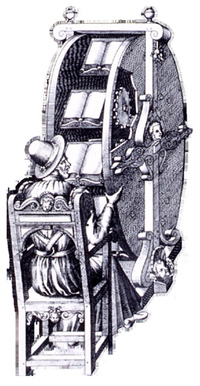
Along these lines, the model of intense engagement—what scholars of book history call “intensive reading”—is only one historical model of how reading should occur. Many scholars in the early modern period used “book wheels” in order to have several books open in front book wheelof them at the same time. This is not exactly the same thing as multi-tasking that Scott abhors in his post, and it’s not exactly internet hypertexting, but it is clearly not the singular absorption in a text that we’ve come to associate with the word “reading.” “Reading” is not just the all-encompassing absorption that I’ve come to treasure and long for in great novels and poems, or even in great and well-written arguments. Indeed, I judge books by whether they can provide this kind of experience. Nevertheless, “Reading” is many things.

But to recognize this is not exactly the same thing as saying “so what” to the slow ascendancy of audiobooks, and the sense that books, if they are to be read at all, will be read as part of a great multi-tasking universe that we now must live in. Instead, I think we need to ask what good things have been gained by the forms of intensive reading that Scott and I and others in the cult of book lovers have come to affirm as the highest form of reading. What is lost or missing if a person or a culture becomes incapable of participating in this kind of reading.

By the same token, we should ask what kinds of things are gained by audiobooks as a form of experience, even if I don’t want to call it a form of reading. I’ve spent some time recently browsing around Librivox.org, which I’ll probably blog about more extensively in a future post. It’s fair to say that a lot of it turns absolutely wonderful literature into mush, the equivalent of listening to your eight-year-old niece play Beethoven on the violin. On the other hand, it’s fair to say that some few of the readers on that service bring poetry alive for me in a way quite different than absorption in silence with the printed page. As I suggested the other day, I found Justin Brett’s renditions of Jabberwocky and Dover Beach, poems I mostly skim over when finding them in a book or on the web, absolutely thrilling, and I wanted to listen to everything I could possibly find that he had read.

This raises a host of interesting questions for a later day. What is “literature.” Is it somehow the thing on the page, or is it more like music, something that exists independently of its graphic representation with pen and ink (or pixel and screen). What is critical thinking and reading? I found myself thrilled by Brett’s reading, but frustrated that I couldn’t easily and in a single glance see how lines and stanzas fit together. I was, in some very real sense, at the mercy of the reader, no matter how much I loved his reading.

This raises necessary questions about the relationship between reader and listener. Could we tolerate a culture in which, like the ancient Greeks and Hebrews, reading is for the elite few while the rest of us listen or try to listen. At the mercy and good will of the literate elite—to say nothing of their abilities and deficiencies as oral interpreters of the works at hand.

More later

Audiobooks: Baritones do it Better

I’m having a little trouble keeping the eyelids open on humpday, so I’ll probably come back to this later. Still, I’ve been away for a couple of days, so I thought I’d ruminate for a few paragraphs.

A conversation with a colleague a couple of weeks back has had me contemplating the status of audiobooks. Conversation turned around the question of whether audiobooks constituted “reading,” an ameliorative factor to the generally dismal view of literary reading that’s been out there ever since the NEA report in 2004.

I’m not convinced, but I am intrigued by the general status of audiobooks and how they relate to the historical practices of reading and listening aloud. It’s worth saying that a characteristic of modern reading practices has idealized silent reading for oneself. Reading out loud, and worse, listening to others read, has largely been a sign of immaturity or deficiency.

But should it be? Not sure. Something I’ll have to come back to.

I recently stumbled across Librivox. Again, something I’m sure many people were already familiar with, but which seems brand new to me. Essentially an archive of open access recordings of various works of literature, the recordings done by volunteers.

Librivox has all the strengths and weaknesses of democratic webdom. I literally could not understand some of the poems I tried to listen to. Some readers sounded vaguely like adenoidal adolescents, slurred words together and substituted speed and volume for earnestness and emotion. Others started well, but seemed to get bored with the poems as they go along. It takes a lot of effort, evidently, to be sonorous and measured and musical, to have a voice worth listening to without making listeners hear the voice more than the poetry itself.

Still, I ran across Justin Brett after listening to about a half dozen recordings of Dover Beach, and immediately became a sucker for his resonant baritone and British accent. I could listen all day.

For several good recordings of Brett’s vocal work, listen to the following:

“Dover Beach”

“Jabberwocky”

“The Collar”

Is it reading? I still don’t think so, but I’ll come back to it. Is it literature? That’s an interestingly different question, that will also await another day. Is the experience of literature linked inextricably to the page, or is it in the word that the page “merely” symbolizes? Is whatever is literary about literature independent of the written word–ink or digital–just as we might think of music as essentially free of and even superior to the page upon which it is composed? I don’t think so, for now, but it’s worth thinking about.

Garrison Keillor and Toni Morrison Tag Team Angelou and Grisham

Garrison Keillor, a personal favorite, has broken for Obama. As I suspected a while back, Obama seems to be doing well with the literary crowd—gathering in Michael Chabon, Toni Morrison, Alice Walker, and now Garrison Keillor. There may be others, but I can’t find them in the five minutes I can afford looking around on the web. Still, it’s not a total lock. Maya Angelou and John Grisham have put in for Clinton, with Angelou putting forth with about as much sagacious pomposity as Morrison mustered for Obama. According to Angelou, embedded below, we should be attracted to Clinton because “she gives herself authority to be in her own skin… to be who she is.” We further discover that Hillary has the honesty to stand up and say “Yes, I am a woman.” And further that she is her mother and grandmother and an great grandmother and great greats. And all women. And she is even Maya Angelou.

Going to be a crowded Lincoln bedroom. And here we thought we were only going to get a two-fer with Hillary and Bill.

Seriously though, I have some trouble with the notion that women ought to vote for Hillary because she’s a woman, any more than a man ought to vote for Obama because he’s a man or because he’s black, or McCain because he’s a man or because he’s white. This being said, I know it happens, consciously and unconsciously. So I don’t have an absolute problem with Angelou being straightforward about it. What strikes me, however, is that Clinton supporters have been quite frank and straightforward in arguing that people ought to vote for Clinton because she’s a woman. I don’t see quite the same straightforward statement by any prominent black supporters of Obama. And of course it would be absolutely politically impossible for someone to get up and say they were voting for Obama or McCain or Huckabee because they were men. So the rhetorical strategies are still interesting. What’s allowed and what’s not allowed. My general sense, still, is that Obama is the wiser in playing down a unique appeal to a “natural” constituency. Can Clinton speak for and to everyone. She doesn’t really try to make that case, and I imagine it will cost her in a general election.

Back to Keillor. Much more understated as befits a Minnesotan. Though, it must be said that Keillor’s understatement is no less strategic or conventional the Angelou’s and Morrison’s self-inflation.

“I’m happy to support your candidacy, which is so full of promise for our country,” the best-selling author and humorist wrote in a letter declaring his support. “Seven years of a failed presidency is a depressing thing, and the country is pressing for a change and looking for someone with clear vision who is determined to break through the rhetorical logjam and find sensible ways to move our country forward. That’s you, friend.”

“And of course it will be exciting to have a president who can speak with grace and power to the American people,” Keillor wrote.

A war that’s left 10s of thousand dead or maimed, and has saddled our grandchildren with crippling debts has left Keillor depressed. Well, perhaps this is self-inflation of a very understated sort. From what I gather though, many things leave the good Lutheran depressed, and for the melancholy another thirty or forty thousand dead is par for the course in the scheme of things.

Keillor’s compliments to Obama’s rhetoric stand out. Obama couldn’t muster a great deal of grace and power in his response, however.

“I’ve been entertained and inspired by Garrison Keillor’s work through the years,” Obama said in a statement. “As president, I will wake up every day thinking about how I can help make life better in places like Lake Wobegon all across the country.”

Umm. Ok. This is EXACTLY why I thought Obama was running. To help all those good folks with white picket fences in the land that time forgot. It’s an interesting contrast, of course, since Keillor, despite his liberalism, has made his literary career on the examination of a white ethnic community as “typically American” in an era when it’s typicality has faded by the hour. Indeed, there is no measure of how atypical Lake Woebegon really is than the candidacy of Barack Obama.

Have they even seen black people in Lake Woebegon. I have my doubts. As much as I love the show. I can’t remember a single one.