Bodies and Books–II

I’ve continued reading Karin Littau’s Theories of Reading.  The second chapter is mostly a schematic History of Reading that will be familiar with anyone who’s read some stuff about that history.  Still, I was struck anew or again by two aspects of that history.

First, Littau rehearses the manifest distinctions between our own (gradually eroding??) views of textual authorship and those of earlier periods.  According to Littau there’s no real way to distinguish the copying of a text from the creation of a text in the Middle Ages (which makes me think that more than a few of our students would be more textually at home in the middle ages than in our contemporary academy).  According to Littau, one reason for the fluidity between “copying” and “creating”  was “‘the common classical and Christian view of poetic inspiration’, in accordance with which ‘the poet does not originate the poem but is the inspired channel for a divine act of creation’ (Selden 1988: 303).  In pre-print culture an author, or auctor, was therefore less a creator of a given work than its assembler, whose rights to the work extended merely to the physical object of the manuscript he or she had produced in the first instance rather than the text as the fruit of his or her private consciousness, as is the case in the copyright law now” (16).

The relationship to our own modes of electronic creation almost don’t bear pointing out.  How many blogs are simply compilations of materials generated elsewhere, and yet we still think of them as something we’ve somehow produced or written, unique only in their assemblage, not in creation?

Still, I’m more interested in the implications of the latter part of the quote.  I wonder especially whether this doesn’t reaffirm the notion that trying to get back to original intention springs from a god-like view of authorship.  However, in the ancient world, the idea that the words were divinely inspired allowed them to be disseminated endlessly into new texts and new assemblages, without worrying fastidiously about the point of historical origin in a particular writer in a particular time and place.  By contrast, our own view of the author as Godlike locates that divine authority in a specific moment of history, to which we have to return to the point of exhaustion.

I wonder how this plays out especially among Christian views of scriptural authority and inspiration.  Our own view of historicism insists that grappling with the historical uniqueness and situatedness of the point of creation–with the author is one can be determined–ironically discards a sense of authorship, authority, and inspiration that would have been common at these earlier points in history. To some degree we make the text captive to history, rather than releasing it to new and unforeseen forms of assemblage and creativity.

Well, this is too much for me to flesh out right now, and I’m not sure it would go anywhere anyway.

I, Celebrity blogger

Well, I’ve had my first interview as a result of my blogging, with the Pakistani Spectator, of all places.  Out of the blue, I hear from these folks saying they’d like to interview me and what I think about blogging.  Apparently it’s a group trying to make a go of blogging in Pakistan, with political and cultural commentary–a lot of it written in Urdu which i have no hope of reading.  It’s a bizarrely interesting site to my mind.  Advertisements for Pizza Hut and chances to meet Pakistani women ride alongside Islamic critiques of the Israeli war in Gaza (and, given that some of it’s in Urdu, who knows what else).  In any case, I’m sure you’ll want to check out my deep and profound commentary on the nature of blogging, as well as my admission that i know next to nothing about Pakistan.

We’re really getting desperate now

The Chronicle of Higher Education reports that a man walked into an English class at LeMoyne-Owen College in Memphis Tennessee and robbed 18 students at gunpoint.

Do thieves really have nothing better to do with their time than to rob a bunch of people who are learning how to read and write.  More, these folks will never make any money anyway, as amply demonstrated by their being English majors?

A theoretical side-note.  In my literary theory classes at Duke, I remember fellow students attempting to refute deconstruction by asking, “If someone held you at gunpoint, would you really sit there and deconstruct the gun?”  We may never know, but these students really have the opportunity!  I think the prof should take advantage.  This is one of those infamous “teachable moments,”  by which teachers usually mean “something uncomfortable and really unfortunate just happened, but let’s just turn it in to language!”

“How, John, did you see the gun–as a phenomenon in the moment of its appearance or as sign and symbol of our oppressive political dialectics…No thoughts?…Jane?…Jim…anyone?”

Bodies and Books

My good friend Julia Kasdorf wrote a book called “The Body and the Book,” broadly taking up the theme of contrast and connections between intellectuality/textuality and embodiment/materiality.  Karin Littau seems tolittau-theories-of-reading be mining a similar territory in Theories of Reading:  Books, Bodies and Bibliomania, a book I just started in on, though Littau is explicitly interested in reading as a bodily or material act, one in which affect more than cognition takes a center stage.
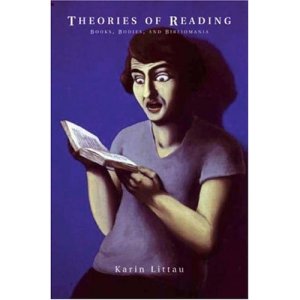
A couple of quotations and impressions from the early going:

Discussing early perspectives on novel reading on page 3–“William Wordsworth saw [the novel providing] ‘deluges of idle and extravagant stories.’ Insofar as ferocious novel reading also fostered disconnected and ‘higgledy-piggledy’ practices of reading (Schenda 1988: 60), it was thought that, ‘if persisted in’, it would have the effect of ‘enfeebling the minds of men and women, making flabby the fibre of their bodies and undermining the vigour of nations’ (Austin 1874: 251).  Like all addictions, those afflicted demanded more and more of the same:  more to read, more excitement, more tears, horror and thrills.  Bibliomania is therefore part of a larger cultural malaise specifically associated with modernity:  sensory overstimulation.  From the perspective of a theory of reading it shows that reading, insofar as it is either bad or good for the reader’s health, is in both instances conceived in physicalist terms.”

I think Littau is right here.  One of my commenters on yesterdays post apparently objected to the notion that we require permission to read.  But I really think I’m write about this for a big swath of Middle America.  There’s a long history of reading being seen as deleterious and slothful.  So in some sense we had to turn it in to a moral activity.  We had to quit reading for pleasure plain and simple and had to start reading for aesthetic experience, or meaning, or as a form or religion, or in order to improve ourselves.  This is deeply endemic to English deparments, and, I think, is one of our biggest failings;  we fail to account adequately for the grosser affective pleasures of narrative art which bring us our students in the first place.  Instead we have to imagine how literature improves their minds in order to justify our budgets.

I think that although I would grant Littau her premises here, that I would go beyond her simple statement of reading’s physicality to point out that these early and later continuing critiques of excessive reading have a moral dimension to them.  The sense that reading might have deleterious effects on the body, or, alternatively, that it awoke the passions and so had a deleterious effect upon self-control, both spoke to a much broader ethos than the simplistic enlightenment division between mind and body really captures.  There is a certain morality of the body associated with Christianity that isn’t captured in the simplistic notion that Christians despise the body.  Rather the body is to be situated and used and built up in particular kinds of ways because it is the temple of the holy spirit, and so forth.  Thus the physicality that Littau notes occasions a moral dilemma for the reader–one, frankly, that I still experience in a way.  Well, I’m reading, but I could really be out helping the homeless, or stumping for Obama, or doing other good works.  Or, more basically, I could be working out and trying to shave off all the pounds that I’ve put on over the course of my 49 years.  I truly suspect that if I read half as much and used the time to work out, I would be healthier (perhaps wealthier, perhaps wiser).  This is a judgment of relative goods, but the critique of reading isn’t as dumb and outmoded as it first appears.  How we use our time is an ethical conundrum, and so the fact of reading isn’t self-evidently justified, however many good moral benefits we may tend to attach to it as devotees of books.

From page 10–“Thus, the bulk of twentieth centiury reader-oriented theories, with some notable exceptions from within feminist theory, are concerned predominantly either with how readers make sense of a text (Culler, Fish, Iser, Jauss, Gadamer), how texts frustrate readers’ attempts at making sense (de Man, Miller, Hartmen, Bloom, Derrida), or how readers resist the meanings of certain texts (Fetterley, Radway, Bobo).  Thus, even when theorists turned away from an overly textualist approach to a more contextual, or politically engaged, approach, the production of meaning is still the primary concern.  By contrast, theories of reading before the twentieth century were also concerned with readers’ sensations.”

I think Littau is really on the mark here.  I remember sitting around with Jim Berger at a coffee shop called Kiari’s when I was teaching at George Mason University.  Jim and I would reflect on the fact that we didn’t know how to talk with students about the pleasure of literature, and didn’t quite know how to lead students into taking pleasure in more complicated and difficult texts.  I know that one of the great benefits of my undergraduate education was certain the ability to make and discover meaning in texts.  However, another huge benefit was learning how to take pleasure in things I could never before have imagined as pleasurable (Joyce’s Ulysses is NOT a natural taste).  I think we’ve shied away from pleasure as beneath the “serious” pursuit of ethical and metaphysical views of literature, but I wonder whether there isn’t an ethical dimension to the means and manner and ranges of our pleasure.  Finding ways to take pleasure in things that aren’t in our inherited bad of tricks is, it seems to me, a sign of growth and maturity and even, in some sense, an act of opening the self to otherness, a kind of ethical stance in and of itself.

I’m interested in how to take our pleasures seriously, how to learn our pleasures and how to learn from them.

Censorship in Nigeria

One of my former students, Carmen McCain, continues her great work in confronting censorship policies in Nigeria, policies which are at least partially attendant on the implementation of sharia law in Islamic areas of Nigeria.  Carmen graduated from Messiah several years ago, has been a fullbright scholar, a graduate student at Wisconsin, an actress, writer, and activist.  She was Messiah’s distinguished young alumnus a couple of years back.  If you can support her work in any way, there’s contact information at her blog.

Scott McClemee on Rene Girard on Reading and Writing

Scott McLemee cites the following from Rene Girard

“And yet our cultural world is a far cry from Elizabethan England or la cour et la ville in seventeenth-century France. There is a reason for this, so simple and yet so obvious that no one ever mentions it. At the time of Elizabeth and Louis, one percent, perhaps, of the educated people were producers, and ninety-nine percent were consumers. With us, the proportion is curiously reversed. We are supposed to live in a world of consumerism, but in the university there are only producers. We are under a strict obligation to write, and therefore we hardly have the time to read one another’s work. It is very nice, when you give a lecture, to encounter someone who is not publishing, because perhaps that person has not only enough curiosity but enough time to read your books.”

Yes, I think this is right, and perhaps not only in academe.  I’ve mentioned before that I get a fair number of students who are interested in writing stories or poems, but don’t have much interest in reading anything.  How this comes to pass is beyond me, and it seems vaguely narcissistic.  We want desperately to express ourselves–and thus the triumph of blogging–but we have little interest in the expression of others.

Happy Anniversary to Me

Ok, this really happened a couple of days ago since I think I started this blog on January 3rd, a year ago.  In the interim I’ve had a few more than 52,000 hits, well beyond my wildest dreams. I think starting out I was thrilled to get ten people a day dropping by.  Now I’m depressed when I have less than 100 hits, although I realize that 52,000 ain’t squat compared to a lot of people who blog.

Clearly the vast majority of my hits were interested in the politically oriented blogs, so it’s probably fair to say that people are much more interested in reading when it is being done by Barack Obama or John McCain than when it is being done by me.  Also, general browsers are very interested in movies, judging by the random hits I get off of Google.  I don’tknow if all of this confirms my general theses concerning reading in America, since I’m not absolutely sure I’ve my general theses, but there you have it anyway.

Totally Pointless New Year’s Resolutions

Ok, I’ve been away from this so long that I feel I owe somebody an explanation, although I think my blog stats suggest that no one really cares that I haven’t been posting for more than two months.  I’ve got a lot of really good excuses.  First would be I’ve been REALLY REALLY BUSY.  But I was busy before, so that one doesn’t wash entirely.  Though, to be frank, it is the case that administrative work takes more takes more time and energy than I ever used to have to give to anything.  Still, I think it’s really more the case that I just lost some of my blogging mojo, not really thinking I had much worthwhile to say and not really having much interest in saying it.  This is a poor excuse since i started out thinking of this thing as just an interesting way to keep writing even if a lot of it was really bad and pointless.  It is however, the best excuse I have.

In any case, on to my totally impossible and pointless new year’s resolutions.  My first goal is to make resolutions I know will be impossible to keep because I will then feel less bad about breaking them.

I Resolve to Write on my Blog at least once a week–Actually this seems doable.  Why not.  No one says I have to be original or even interesting.

I Resolve to lose 60 pounds–Ok, this is what Oprah and I really need to do, but is beyond the realm of reality.  Still, maybe if I say sixty I’ll actually get to thirty.

I Resolve to read one book a week–totally implausible, but why not fanatasize.

I Resolve to be a better husband and father–this one is really safe because if my kids refuse to say that I have achieved this goal I can cut off their allowance and send them to bed without supper.  Ok, they are far too big for me to send them to bed without supper, but I could threaten.  As for my wife, well, maybe she will humour me.

I Resolve to regularly attend church–always good to have a resolution that you are already achieving.

I Resolve to give up smoking–always good to have a resolution to give up something that you don’t actually do.

Ok, enough.  Some good things that I have done in the past two months–

1. Wept on election night in November while watching the victory speech.

2.  Wept several days thereafter upon watching reruns of the victory speech.

3. Read several books–maybe I’ll talk more about them later.

4. Visited Pagosa Springs Colorado–in fact, I’m sitting in the Albuquerque airport at the moment writing this blog.

5. Started working out again after a two month hiatus–makes me feel better about overeating.  Also makes me feel better about going to the gym on January 2nd.  I won’t have to feel like one of those folks that joins the gym in January and lasts for two week

There’s more, but that’s all I can come up with for now.

Rego on Roosevelt

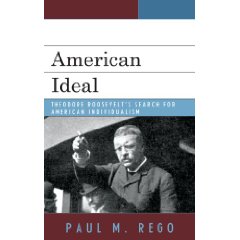
I had the pleasure a couple of weeks ago to read my colleague Paul Rego’s new book on Teddy Roosevelt.  Although I’m a little more critical of Roosevelt than Paul is, his book seems very timely, and does a good job of pointing our Roosevelt’s continuing relevance.  Even this week John McCain morphed into a Roosevelt Republican taking on the Titans of Wall Street.  Whether McCain was convincing in doing so is another matter, but it was in line with Paul’s insight that Roosevelt remains a touchstone figure for many contemporary presidents and presidential aspirants.

I thought I was supposed to do a full-blow review/critical response to Paul’s book at a reception in his honor, but I had the honor of introducing him instead.  What follows are my meandering scribbles on Paul’s book, titled, by the way “American Ideal:  Theodore Roosevelt’s Search for American Individualism.” These don’t quite amount to a review since they’re mostly notes for a talk, but I thought I’d post them here anyway.

In some respects, Paul’s book focuses on the irony of his subtitle: Roosevelt’s search for an American individualism. Though an intellectual biography, Paul seems to suggest that Roosevelt doesn’t arrive at settled substantive positions so much as he grapples mightily with antinomies of American thought, practice and culture—the most important of these being the split between the pluribus and the unum in the American psyche. Born out of the Enlightenment, American politics and culture has never rested easily with the earlier notion of an individual as being one member of a group. Instead, the individual and the society are necessarily in tension with one another, if not actively opposed to one another. On this view, the individual is society’s other, not matter how much we may say that society’s could not be conceived of without individuals and vice-versa. On this reading, a search for an American individualism is a quixotic quest—my reading, not Paul’s—since to be an American is to be a part of a collective, but one which only defines itself through the exaltation of the individual. Nevertheless, however impossible the project, the struggle to reconcile these opposing forces gives Roosevelts work much of its energy and contemporary relevance, no matter that he didn’t completely succeed in his quest.

I especially like Paul’s tracing of the opposition between progressivism and individualism. For one thing, those people in American literature who pay any attention to Roosevelt tend to emphasize his individualism, and so Paul’s attention to Roosevelt’s progressivism was enlightening. Moreover, I learned a lot in Paul’s argument that at the turn of the twentieth century, progressivism was imagining largely in collectivist terms and was in some respects seen as anti-individualism. The complexities involved suggest, as Paul explicitly attempts to do, that politics of the early 21st century continues to bear the marks of the discourses of a century ago. Liberals still rocket uneasily between individual empowerment and government regulation and intervention, while conservative ideals of the self-made man and the destructive energies of capitalism collide, sometimes violently with the conservative values of community, family, and tradition. If Roosevelt has not solved the problem of the pluribus and the unum, neither, really, have we.

Paul doesn’t really take up the gendered elements of Roosevelts thought, and I think they are important on various levels. Roosevelts view of individualism is, in my view, deeply masculine, verging on masculinist, and one reason for the popularity of his books lay in his idealization of masculine activities—war, hunting, camping, and the like—as a remedy for the feminizing forces of culture. Ironically, of course, many conservatives perceived the government as just such a ‘feminizing” force, wherein a man had to give up his manly individualism in favor of the will of the collective. The identification of progressivism with the feminization of American culture is everywhere in American literature at least, and finds it’s way even in to contemporary politics. Think, for instance, of the fairly popular conservative dismissal of the liberal “nanny state,” and the preference that men pull themselves up by their own bootstraps. Paul argues that Roosevelt was willing to use the powers of the state in order to enable the possibility of individual achievement. Whether this is genius or hopeless contradictory may depend upon your politics, but I’m struck by the way in which this structure is represented in one of Roosevelt’s signature achievements—the establishment of the National Park system. One reason, though not the only one, that it was brought in to existence was so a place where men could test their mettle against the forces of nature could be preserved in a rapidly urbanizing society.

Paul recognizes Roosevelt’s racism and makes the argument that he must be understood as a man of his time, and I think Paul also successfully shows that Roosevelt’s understanding of individualism did not exclude African Americans, making room for those of the race who in some sense transcended the handicaps associated with racial oppression. To some degree, this is a common argument made about someone like Lincoln—who Roosevelt took as an ideal. By modern standards would clearly be understood as a racist, but his thinking was supple enough to imagine the possibility of transcending the racial categories of his days.

Nevertheless, I wonder if some of the issues surrounding race as well as gender don’t go closer to the root of the problem Roosevelt faced, which would be in how the individual is imagined as an individual. That is, the political conception of the individual in American history is always imagined in raceless terms; however, in our conceptualization of race until very recently, only white people can be raceless. To be black is to be raced; in other words to be inherently marked as identified with a collectivity. By contrast, whiteness is more usually understood as the sign of individualism, of being unbounded by tribe, history, tradition and society. In short, to be free. The great literary essay on this idea remains Achebe’s meditation of Heart of Darkness, where he rightly points out that the travails of Conrad’s white characters depend upon the facelessness and inarticulate jabbering of the black mass that makes them stand out as individuals. In other words, however much room we may make in our conceptualization of individualization for specific black people, this is very easily transmuted in to the understanding that others can become individuals by becoming just like me—in which case they are no longer clearly other in terms of race.

This having been said, I tend to agree with Paul that the structure of this thinking can’t be blamed on Roosevelt, since it is part of the structure of American thinking per se. He did not invent it, nor is it completely clear how he could have escaped it. Instead I think it points to the notion that perhaps the reason these issues cannot be reconciled is that they begin with a deeply flawed notion of what it means to be an individual, however attractive that ideal may continue to be.

The Graphic Marco Polo

Over at A Historian’s Craft, rachel leow has a really neat little project going on, mapping out and annotating the travels of Marco Polo as she reads The Travels of Marco Polo. Of course, it would be really creative if she mapped out the travels of Marco Polo while reading The Travels of William Bartram, but who’s complaining.

Rachel is also the curator of a lovely series of photos entitled BookPorn. This is one of the latest from Lankester Antiques and Books.

Lankester Antiques and Books

Lankester Antiques and Books