Tag Archives: Books

The Great Ones Are Dying

I’m sure I was the last to hear, but John Updike died this morning of cancer at the age of 76.  I was thinking of Updike just last night, an early literary hero in mybook, thinking of how all that gorgeous and absolutely beautiful prose towers over the ephemera that passes for literary writing today.  I know all the complaints, and maybe later I’ll explain why they are all hogwash, but for now I just know that he will be missed, by me if by no one else.

My first published essay as an academic was on Updike.  Following is the first paragraph:

In trying to explain to a friend how I could be fascinated, even in love with so sexist, racist, and superficial a literary monstrosity as John Updike, I responded that Updike’s prose provoked in me intense moments of cultural recognition, that even if I recognized other writers as abstractly superior; even if I am more concerned with Reformed theological individualism; even if the racism is egregious and the pornography is too often tedious–still, Updike is a homeboy I cannot give up, his inadequacies and genteel perversities too much like those of a brother or sister or uncle with whom we must stand arm in arm for family portraits, frozen in an uneasy embrace.

From “Scribbling for a Life: Masculinity, Doctrine, and Style in John Updike.” Christianity and Literature. 43.3-4 (1994): 329-346.

The Solomon Scandals

David Rothman's New Novel

David Rothman's New Novel

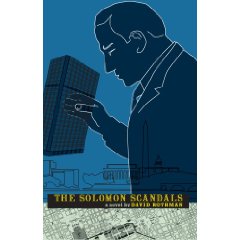
David Rothman over at teleread.org has just published his first novel,The Solomon Scandals, so many congratulations to David.  David gave me the chance to read a manuscript version of the novel, so I’m glad to have been some small part of this project. Maybe I’ll get around to writing a review.  Since David gives me an acknowledgment in the book, I can puff myself and David’s work at the same time.

Bodies and Books

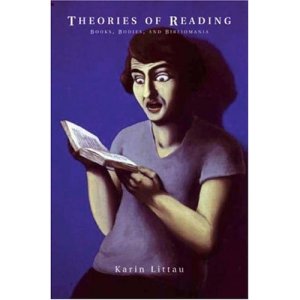
My good friend Julia Kasdorf wrote a book called “The Body and the Book,” broadly taking up the theme of contrast and connections between intellectuality/textuality and embodiment/materiality.  Karin Littau seems tolittau-theories-of-reading be mining a similar territory in Theories of Reading:  Books, Bodies and Bibliomania, a book I just started in on, though Littau is explicitly interested in reading as a bodily or material act, one in which affect more than cognition takes a center stage.

A couple of quotations and impressions from the early going:

Discussing early perspectives on novel reading on page 3–“William Wordsworth saw [the novel providing] ‘deluges of idle and extravagant stories.’ Insofar as ferocious novel reading also fostered disconnected and ‘higgledy-piggledy’ practices of reading (Schenda 1988: 60), it was thought that, ‘if persisted in’, it would have the effect of ‘enfeebling the minds of men and women, making flabby the fibre of their bodies and undermining the vigour of nations’ (Austin 1874: 251).  Like all addictions, those afflicted demanded more and more of the same:  more to read, more excitement, more tears, horror and thrills.  Bibliomania is therefore part of a larger cultural malaise specifically associated with modernity:  sensory overstimulation.  From the perspective of a theory of reading it shows that reading, insofar as it is either bad or good for the reader’s health, is in both instances conceived in physicalist terms.”

I think Littau is right here.  One of my commenters on yesterdays post apparently objected to the notion that we require permission to read.  But I really think I’m write about this for a big swath of Middle America.  There’s a long history of reading being seen as deleterious and slothful.  So in some sense we had to turn it in to a moral activity.  We had to quit reading for pleasure plain and simple and had to start reading for aesthetic experience, or meaning, or as a form or religion, or in order to improve ourselves.  This is deeply endemic to English deparments, and, I think, is one of our biggest failings;  we fail to account adequately for the grosser affective pleasures of narrative art which bring us our students in the first place.  Instead we have to imagine how literature improves their minds in order to justify our budgets.

I think that although I would grant Littau her premises here, that I would go beyond her simple statement of reading’s physicality to point out that these early and later continuing critiques of excessive reading have a moral dimension to them.  The sense that reading might have deleterious effects on the body, or, alternatively, that it awoke the passions and so had a deleterious effect upon self-control, both spoke to a much broader ethos than the simplistic enlightenment division between mind and body really captures.  There is a certain morality of the body associated with Christianity that isn’t captured in the simplistic notion that Christians despise the body.  Rather the body is to be situated and used and built up in particular kinds of ways because it is the temple of the holy spirit, and so forth.  Thus the physicality that Littau notes occasions a moral dilemma for the reader–one, frankly, that I still experience in a way.  Well, I’m reading, but I could really be out helping the homeless, or stumping for Obama, or doing other good works.  Or, more basically, I could be working out and trying to shave off all the pounds that I’ve put on over the course of my 49 years.  I truly suspect that if I read half as much and used the time to work out, I would be healthier (perhaps wealthier, perhaps wiser).  This is a judgment of relative goods, but the critique of reading isn’t as dumb and outmoded as it first appears.  How we use our time is an ethical conundrum, and so the fact of reading isn’t self-evidently justified, however many good moral benefits we may tend to attach to it as devotees of books.

From page 10–“Thus, the bulk of twentieth centiury reader-oriented theories, with some notable exceptions from within feminist theory, are concerned predominantly either with how readers make sense of a text (Culler, Fish, Iser, Jauss, Gadamer), how texts frustrate readers’ attempts at making sense (de Man, Miller, Hartmen, Bloom, Derrida), or how readers resist the meanings of certain texts (Fetterley, Radway, Bobo).  Thus, even when theorists turned away from an overly textualist approach to a more contextual, or politically engaged, approach, the production of meaning is still the primary concern.  By contrast, theories of reading before the twentieth century were also concerned with readers’ sensations.”

I think Littau is really on the mark here.  I remember sitting around with Jim Berger at a coffee shop called Kiari’s when I was teaching at George Mason University.  Jim and I would reflect on the fact that we didn’t know how to talk with students about the pleasure of literature, and didn’t quite know how to lead students into taking pleasure in more complicated and difficult texts.  I know that one of the great benefits of my undergraduate education was certain the ability to make and discover meaning in texts.  However, another huge benefit was learning how to take pleasure in things I could never before have imagined as pleasurable (Joyce’s Ulysses is NOT a natural taste).  I think we’ve shied away from pleasure as beneath the “serious” pursuit of ethical and metaphysical views of literature, but I wonder whether there isn’t an ethical dimension to the means and manner and ranges of our pleasure.  Finding ways to take pleasure in things that aren’t in our inherited bad of tricks is, it seems to me, a sign of growth and maturity and even, in some sense, an act of opening the self to otherness, a kind of ethical stance in and of itself.

I’m interested in how to take our pleasures seriously, how to learn our pleasures and how to learn from them.

The Graphic Marco Polo

Over at A Historian’s Craft, rachel leow has a really neat little project going on, mapping out and annotating the travels of Marco Polo as she reads The Travels of Marco Polo. Of course, it would be really creative if she mapped out the travels of Marco Polo while reading The Travels of William Bartram, but who’s complaining.

Rachel is also the curator of a lovely series of photos entitled BookPorn. This is one of the latest from Lankester Antiques and Books.

Lankester Antiques and Books

Lankester Antiques and Books

Schlockey Books or Schlockey Television

Today at the New York Times Gail Collins reflects on a series of novels for teenage girls called The Twilight Saga:

I read the first two Twilights, searching for the key to their success. (This is where the part about being not all that deep comes in handy.) The attraction is clearly the vampire hero, who is a perfect gentleman, eternally faithful and — as the author points out repeatedly — quite a hunk. (“He lay perfectly still in the grass, his shirt open over his sculpted, incandescent chest, his scintillating arms bare … A perfect statue, carved in some unknown stone, smooth like marble, glittering like crystal.”)

Before you make fun of this, I want you to seriously consider whether you’re interested in denigrating people who spend their leisure time actually reading books rather than watching “America’s Got Talent.”

A lot of times Collins makes me grimace.  I mean, just how long can one write for the New York Times and maintain the naive midwestern outsider pose.  On the other hand, this essay made me howl.  And she raises the interesting point that N+1 dismissed a couple of years back in its own analysis of our reading crises. According to N+1 we’ve been so obsessed with the reading crisis that we’re just thrilled people read anything at all, and they go on in good, and dare I say it snobby and Ivy-educated fashion, to dismiss the readerly pleasures of the hoi-polloi.

Still, I think Collins has a point.  The choice isn’t between the Twilight novels and Herman Melville, the choice is between Harry Potter and I Survived a Japanese Game show.  Given this choice, I’m glad my daughter chooses the Twilight novels–or their ilk.

(Side note:  A friend of mine who used to work regularly in Japan says Japanese regularly gather in parks to ridicule and laugh at American tourists.  Why do we even need a game show to accomodate them?)

Of course, I still hold out desperate hope that she’ll choose Melville or Shakespeare or Austen or Chopin or just anything that might get anthologized rather than forgotten.  But even if this hope is not delivered on, I still think there’s something better about having her read several ten thousands of words and exercise her imagination on the page than spend her time watching people consume cockroaches in the name of entertainment.

Cryptomnesia: Originality, thy name is plagiarism

For the past several years I’ve used the Footprints poem in my literary theory class to discuss theories evaluation and aesthetic quality. (For those of you unfamiliar with the Footprints poem, I want to say first, “What planet have you been living on?” There is, after all, no more popular item of American religious kitsch than the Footprints poem. My very conservative guess is that is has been shellacked to about 14 million pieces of 1X4 plank board pieces at Vacation Bible Schools across the country.–For those of you unfamiliar with Vacation Bible School…well…bear with me. This may be a my culture/your culture sort of thing. In any case, just enter Footprints poem in any search engine and prepare to be inundated.)

As I was saying, I’ve used this “poem”–in some versions it’s kind of more of a paragraph–to talk about theories of aesthetic distinction. My very good English majors are often aghast that there could be a serious debate about the aesthetic qualities of such a piece of tripe. On the other hand, they are often very chary of the notion that someone could tell them that some things are better than others. Good Americans all, their instincts tell them that it is elitist in a sad and undemocratic fashion to assert that Wagner is “better” muscially than Eminem, or that some things are just inherently better than other things. Brought home to them through Sunday School poetry, however, we deal with the question of why they believe that the Footprints poem is inferior. If it is inferior, what justification to we use for saying that some things are better than other things. Is making this claim an objective claim or is it merely a subjective preference they’ve developed through their years of being elitist English majors. If Hopkins really is better than the Footprints poem, should we take it upon ourselves to teach people that love the Footprints poem that they are really rotting their aesthetic brains and ought to be reading Gerard Manley Hopkins. And if we really believe people would be better off reading Hopkins, why is it such a leap to believe that Wagner really is better than LL Cool J, or that in general everyone would be better off listening to opera than to Country and Western or Rock and Roll.

Found out today that I can now use the Footprints poem to also teach about the philosophy and history of authorship, another main topic of the course. Hank Stuever over at the Washington Post has written a great piece on the contested authorship of the Footprints poem. Turns out that lawsuits abound, and that no less than 3 people are claiming ownership over the text, though one of them also claims to have written the words to a famous Beatles tune when she was a pre-teen. There are claims and counterclaims, with drafts and manuscripts and other forensic evidence.

And we only thought Shakespeare worthy of this attention.

One academic has even traced the basic essence of the poem back to a sermon in the 1880s and has asserted that it’s possible that nobody actually wrote the poem. Says Stuever:

Last fall, in an online article for the Poetry Foundation, a Brooklyn journalist and literary sleuth named Rachel Aviv traced elements of “Footprints” to a sermon delivered in 1880, and raised the tantalizing possibility that nobody really wrote “Footprints in the Sand.” Those who have claimed to, Aviv noted, may be suffering from the collective “accidental plagiarism” that Carl Jung explored in his paper “Cryptomnesia” more than a century ago.

Everyone knows a cryptomnesiast, of one sort or another. It’s your cousin who stood up at Peepaw’s funeral and tried to pass off the “Do not cry, I did not die” poem as his own; or those crafty tykes who keep submitting bits of Shel Silverstein as original verse to The Post’s kids’ poetry contest. It’s the woman who sends you a sympathy card after your dog dies, with her handwritten version of the (also disputed) fable about dogs waiting for their masters in Heaven. It’s your church pastor or corporate motivational speaker who keeps coming up with those amazing “I-recently-met-a-man-who” anecdotes to illustrate his point.

Something can be so profound, so true, (so “duh”) that the cryptomnesiast is sure she thought it up herself. There is very little you can buy at a crafts fair or in the self-help section at Barnes & Noble that doesn’t have a whiff of the unattributed.

This happens to me ALL the time. I’m always running across published stuff out there on the internet that I KNOW I came up with first. My brain is the great unacknowledged source of most of the intellectual creativity out there in the last couple of decades.

Ok, seriously though, I do have this experience of feverishly working out an idea only to discover someone else has already done it, and much better than I could even if given world enough and time. Cryptomnesia is apparently a specific form of memory in which you recall what you don’t know that you’ve forgotten and don’t remember ever learning or reading.

A new explanation for Borgeses story about the rewritten version of the Don Quixote.

I find, in fact, as I get older that I do this all the time. I was reading in the Chronicle of Higher Education earlier today, and ran across a blog about an aging professor who talks about how he downloaded an article and wrote feverish and exalted notes about it, thrilled at these new ideas and contributions to his own work until he discovered somewhat later that he had already read the article, and had written feverish and exalted notes about it thrilled at these new ideas and contributions to his own work.

Okay, I really have done this. And at 48 I don’t really consider myself aged. I’m reading Dicken’s Hard Times at the moment, and I keep having the nagging suspicion that I’ve read it before, but I can’t remember enough to know what is going to happen next. Does this count as a memory?

Although it’s laughable on one level to think of the many people wanting to claim ownership of the Footprints poem, I wonder if there’s not some more serious relationship between cryptomnesia and creativity. It’s not an original thing to say that creativity is primarily a matter of rearrangement, of finding creative connections between the many things that are rather than a discovery or manufacture of the absolutely new. There are people out there with absolutely unerring memories, who remember the details of their lives from many years ago–what they had for breakfast, how long it took to eat, whether they burped or sniffled after downing the last bit of egg. I suspect, though I cannot know, that such people would find it intensely difficult to be “original.” They would experience themselves self-consciously plagiarizing or replicating experiences all the time. If I could not forget that I had read something, I would find myself less free to combine it anew with other things that I have forgotten that I learned. Recombination is made possible by dislocation, by tearing something away from it’s original context. My guess is that Crypotmnesia makes that possible.

In the same fashion, we imagine ourselves as unique and original individuals until we awake in our forties to discover that we like the same kind of socks as our fathers, that we scratch our noses in the same way between sentences, that our lower lips protrude while thinking just like his, and that we roll our thumbs around one another in precisely the same annoying way that he rolled his thumbs when we were teenagers.

Not that any of that has ever happened to me. But I’m sure if we had to live in a constant awareness of all the ways our lives are imitative, we would never be able to allow ourselves to invent new contexts and meanings for all the things we’ve plagiarized from others.

But I’m sure that someone already said this better.

In the Valley of Elah; or suffer the little ones

I watched “In the Valley of Elah” on DVD last night. As with most things, I find the pace of my life puts me about 4 steps and six months behind the rest of the world, and most often my very long list of things I’m going to get to later ends up being a private fantansy. Still, I’m glad I actually did get to this film. Most of In the Valley of Elahthe commentary in the immediate aftermath of it’s release was relatively laudatory, especially of Tommy Lee Jones performance, but also noted the distaste of the American populace for hard and depressing films about the war. One wants to say, “duh.” This is unsurprising. Several reviews I’ve read since last night take Haggis to task for disjointed storytelling and for not making his references clear. A number of folks complain that the title of the movie makes no sense.

Au contraire.

I think what’s central to the film is not the question of David’s heroism against Goliath in the Valley of Elah. What’s central is that old men send children to fight their wars without armor and without weapons. The film is, of course, an essay against war in general and the war in Iraq in particular, and if you can’t stand films that have a thesis, however poignantly rendered, then you’re not likely to enjoy the film. But more specifically the film is a powerful meditation on the notion that old men start wars and young men, or children, fight them. Several reviewers comment on how old Tommy Lee Jones looked. Well, of course. He is, and magnificently so. But almost no one remarks on just how young and unprotected the soldiers look, childlike even when drunk and hanging out in topless bars and strip clubs. Perhaps the most chilling scene of the film isn’t anything to do with Iraq and the immediacy of its violence. The most chilling scene for me was watching the young man–who looked mostly like an all star blond high school quarterback–confess to killing Tommy Lee Jones’s son, Mike, and then laugh as he reflected on how Mike would torture prisoners by probing their open wounds, a practice that earned him the Menglesque nickname of “Doc”.

The point of the Valley of Elah is that the mythology of David and Goliath is a lie, that children do not destroy giants in war. They kill and maim and destroy one another, and in the process destroy themselves. We discover that in the first week of his tour of duty, Mike, had run down a small Iraqi boy who appears to be throwing a stone at his Humvee. And while there is a certain domestic delight in seeing Hank Deerfield tell Charlize Theron’s son the story of the story of David and Goliath, in the context of the film as a whole this is a terrifying scene, showing that the mythologies of domestic safety are actually the training ground of a violent imagination, one that would encourage this small boy to believe that he too, perhaps, could throw stone at Goliath, or at a Humvee, and emerge unscathed. The same imagination requires us, of course, to imagine that a small boy throwing stones at a Humvee is really a Goliath to be destroyed.

On this score, I think several people have misread the scene where Jones tries but fails to read “The Lion, The Witch, and the Wardrobe” to Charlize Theron’s son. It is yet another story where children are encouraged to believe that they should be at the forefront of the fight against evil. I’m not completely sure myself of what to make of that particular reference, but Hank Deerfield/Tommy Lee Jones does say he can’t Deerfield trying to read Lewisunderstand a word of it. In my own view, this book has a confused take on the role of violence in confronting evil–on the one hand insisting that Aslan self-sacrifice is the key to victory and on the other using his resurrection as a means of wreaking a satisfactory bloody end on all the evildoers. Still, in the context of the movie as a whole, I think what Hank Deerfield can’t read in the book is that Aslan would lie down on the altar to take the knife willingly, rather than take up a stone or a gun to destroy the White Witch. I’m not sure about this, again, because of the confused take on violence and self-sacrifice that I think is at the heart of the tale. Still, it does strike me that the book is a book about children at war, and yet it is a partially different take than that offered by the story of David and Goliath.

A final note, given that this blog is mostly about reading and writing. I was struck by the role of text and reading and visuality and orality in this film. Notably, the father and the son are in touch with each other less through words than through images. In the film itself, we are shown emails that we can’t really read (or at least I couldn’t), but the email is merely a pretext for the really important stuff, the images that the son sends to his father and through which he attempts to communicate with him. I was struck watching this film how much email and media files had changed the war film convention of the letter home from the front. Soldiers don’t send letters home, they call home, they email home, and most importantly in this film, they send images home.

The failure of text, and of language more generally, is a central trope of the film. Hank Deerfield can’t really talk with his son on the phone. The soldiers lie repeatedly. Deerfield can’t read The Lion, The Witch,and the Wardrobe–indeed, for a moment I wondered if Deerfield were really illiterate in some way, though I knew it was impossible given other moments in the film. On the other hand, it’s not clear that images are any better. The files are corrupted. They are without context. Deerfield can’t understand what to make of theDeerfield asks for an image to be explained pictures until he has some of Mike’s comrades explain them to him. The only genuine communication in the movie–or at least the appearance of communication–is in those moments when first Jones and then Theron are talking with the little boy about David and Goliath. And this communication itself is, in the context of the film as a whole, based on a lie that the rest of the film everywhere exposes.

In the end, Deerfield is left with what feels like a futile gesture (and to be honest, the only one in the film to my mind that was absolutely over thesis-like) when he hangs the American flag upside down on a local flag pole. Earlier in the film Deerfield told an El Salvadoran immigrant that hanging the flag upside down was the ultimate distress signal, a sign telling others that you were in “deep shit” with absolutely no way out unless someone came to get you. The film as a whole suggests that it is America itself that is in “deep shit” with no way out.

Who will see this sign and come to save us?

Treasure Island, Buried

As some may remember from the distant past of this blog, I set out to actually read a whole e-book from start to finish on Book Glutton, all this in honor of read a book month, or read an e-book month, or some other kind of month. Given that most Americans don’t even read one book a year, e or otherwise, I am so proud of myself for managing to fulfill my quota in a mere three weeks. Or so. Anyway, I finished Treasure Island about a couple of weeks ago, but have been too swamped with work (and my kids soccer games) to collect any thoughts. And, of course by now, given that I am uncomfortably close to my fiftieth birthday, I have actually forgotten most of the experience. So the comments that follow are no doubt not anywhere nearly an accurate reflection of my experiences but more a kind of fiction of what I construe could have happened in my reading experience. Pierre Bayard and Roland Barthes would be so proud.

First Treasure Island itself. What a romp! One consequence of being an academic is that works in my specialization I am always reading as an academic. Which probably means dully and ponderously. So when I read for pleasure…well, I never really do read for pleasure. But let’s just say that in order to re-activate the pleasure zones in my reading brain, I often have to get far away from stuff I have to teach or write about in my official capacities.

Treasure Island is surely a boys book in a certain sense of that word. For all the sturm and drang about about the dominance of masculine narratives in the canon, it’s worth saying that boys books aren’t much appreciated as boys books per se. They have to first be turned in to “LITERATURE.” That is, something ponderous and masculine rather than, well, rompish. If “rompish” even qualifies as a term of analysis. And much of what we talk about as literature–things like The Great Gatsby as exhibit A; things like The Scarlet Letter as exhibit B–are really chick flicks dressed up to go out on the town. No wonder boys don’t read.

But then there are boys books. Romps that lose their fun in becoming literature, or which are ignored because they seem resistant to literary seriousness. Huckleberry Finn used to be sold as a boys book, in fact, though now it is banned from high schools. For my money Melville’s most readable works are Typee, Omoo, and Redburn. Works written for adolescent boys, and adolescent men, who were looking for a little tittilation in thinking about naked polynesian breasts. Let’s be truthful folks. How many of us really truly loved Moby Dick. Confession of the week. I can’t bring myself to finish Pierre. And I did my master’s exams on Melville. I think I read the Cliff’s notes. Perhaps if either book did more to foreground Polynesian breasts I would get more interested.

In any case, Treasure Island, falls into the category of a boys book so stereotypical that we now can hardly feel it as anything but predictable. The boy in search of a father since he’s lost his own. And finding fathers in all the wrong places, especially among barely disguised pirates who everyone and their mother knows are pirates except apparently Jim Hawkins himself.

I was struck in reading it by how much Jim is the characteristic “good boy.” The loyal son to his mother. Although the novel is often described as a coming of age story, there’s a peculiar sense in which jim is already aged. He is already formed as the good man that he will become, protector of his mother becomes protector of his friends and ultimately, even, the protector of his erstwhile enemy, Long John Silver.

In other words, Jim is already his own father, a boy seeking for a father he doesn’t really need or want. Thus, explaining Jim’s constant penchant for running off for no good reason, whether in to the apple barrel or jumping ship to gain the Island ahead of the others, or stealing the ship out from under the noses of the pirates themselves. Jim is a boy who doesn’t need a father because he is a father already, the one who can save those even whom he despises. Sprung whole and righteous from his own loins. (This is, of course, also a description of Milton’s Satan, but I won’t press the point).

For my money, this makes Treasure Island more of an adventure story than a coming of age story or bildungsroman. Jim is already who he is or will become. He is threatened by evil, but he is not tempted by it. Huckleberry Finn could worry about whether he is going to hell, and he could play his pranks on the slave Jim on the raft for his own selfish ends and pleasures, but Jim Hawkins always chooses the good and we always know he will. And perhaps more importantly, he always knows he will. Thus the story is not about whether Jim will be good and will grow as a human being–he doesn’t grow at all. It is more about whether goodness will out. Does goodness pay off in the end? Is goodness the treasure that we can have without seeking.?Will goodness save our own necks from the noose, and perhaps the necks of Long John Silver as well?

Well Stevenson seemed to think so. I’m tempted to say it’s a vapid vision of the world, where the mutineers of the world exist not to tell me that I too might be one, but as foils for my own moral self-display. Nevertheless, this criticism is awfully literary and ponderous. So I’ll stop before I lose sight of the fact that I actually loved reading it.

Of course, I also weep when watching Brian’s Song. What does this prove?

More later about the actual experience of reading on book glutton.

The personal economy of Kindles: Or, “Say what????”

I admit I’ve been a little hesitant to buy a Kindle, not out of lack of interest or complete antipathy to e-books. Indeed, I’m kind of intrigued if not totally convinced. But the biggest thing stopping me has been the cost. When I realized this I just thought I should do a little mental calculating.

Professors aren’t as well off as people tend to think, but on the whole full-time professors–a diminishing breed–are still solidly middle class. My salary as a full professor with about 8 years of post collegiate education and 16 years of full time teaching experience is in the low 70s. And, to be honest, most professors, especially at small schools or third rank state schools make a lot less than I do. In general I make less than a high school teacher with similar experience and education; who, am I kidding, I make less than my plumber.

Yes, I’m griping, but I’m also realistic that this isn’t a bad life. I remember being thrilled a couple of years ago when I started realizing that I could afford to purchase hard cover books–it mattered not a whit to me that books were on their way out. Indeed, one of the reasons professors can be paid so little relative to their expertise and experience is that they are pleased with so little. Give me a book and four or five weeks clear of having to prepare for classes or other administrative work in the summer, and everything seems like gravy.

Still, I’ve hesitated on the Kindle. 400 bucks is at least an hour or two of my daughter’s prospective college education. Who knows, with interest I may be able to add an hour or two. And it makes me wonder just a bit about the business plan associated with dedicated e-book readers. I would be, I think, a prime candidate for an e-book reader. But on the other hand, I’m an absolutely atypical American when it comes to books purchasing. Most Americans say they buy five books a year and read four. My guess is the other sits on the shelf in order too look kind of impressive even though it’s never read. Reading as many as 12 books a year is considered being a dedicated reader by a lot of folks, and was the benchmark employed by the NEA in some of their recent pronouncements.

So let’s start with the typical American reading, or claiming to read, four books a year. For fun, I went to the Amazon web site. It’s not nearly as much fun a bricks and mortar store, but book lust may still be fed even online. I compared Kindle books prices to standard paperbacks, using the sale price for new books. I leave aside the fact that I could get the books much more cheaply via the Amazon sellers system. Let’s just be fair and try as much as possible to compare apples to apples, a new paperback versus a new e-book.

Roughly speaking I found that the e-books saved about three to four dollars on the e-book. I realize I could add to this if I considered shipping costs, but it’s not inconceivable that a person would buy four books at one time and have no shipping costs at all. Still four bucks. Not bad, you say. True. Who wouldn’t want to save four bucks when they can. This means that the average American book reader would save 16 bucks on the four books they read during the year–this is the best case scenario of assuming that all four of those books were actually purchased new instead of being borrowed from a friend–something hard to do with e-books–or borrowed from the library. Or shoplifted.

This means that it would take the typical American reader approximately…wait…I have to get my calculator. Yes, I wasn’t wrong. It would take the typical American reader about 25–that’s TWENTYFIVE!!!–years to pay off their 400 dollar investment in a Kindle.

But let’s be fair, there’s also a marginal cost of gas to drive the mile to Barnes and Noble, so let’s say it will take 24–that’s TWENTYFOUR!!!–years to pay off their 400 dollar investment in a Kindle.

Let’s assume that there are enough readers like me out there to sustain a Kindle investment. I probably buy about 25 books a year–whether I actually read them is another story. Many of them are hardbacks I get via Amazon resellers for a fraction of the original price, but let’s still go with the new paperback price, even though its more than I often pay for hardbacks in good condition. I won’t count the multitude of other books and journals I read or look at from the library, since, after all, I get them for free and I wouldn’t pay 400 dollars for something I now get gratis.

Assuming I buy 25 books a year and I can save 4 bucks a book–questionable, but let’s say it’s possible–I can payoff my Kindle in 4 years.

Now, I still have books on my shelf that I bought 30 years ago, and my parents still have books on their shelves that my grandfather bought and read 100 years ago. So far in my 20 year marriage we have gone through four computers and are on our fifth. That’s a new computer every four to five years. Can someone at Amazon promise me that I will get a brand new Kindle for free when mine wears out, or when I drop it in the lake, or when they upgrade so far that it can no longer read the e-book files which are created six years from now? Somehow I truly doubt it. This means that I’m likely looking at shelling out four or five hundred dollars every five years just to maintain my collection. That means the cost of my e-book purchase keeps increasing throughout the lifetime of the file, simply because I have to keep investing new money in order to maintain my e-books. (To be fair, this increasing cost will continue, but diminish if I maintain more and more books. But it will increase)

I freely admit that paperbacks have some similar marginal maintenance costs. A new book shelf every once in a while will cost me a 100 bucks–or 15 if I’m willing to have cinderblocks and boards–but on the whole, this cost is made up by the fact that I sell old books or donate them to charity, something I can’t do with Kindle books at all.

In other words, I actually think Steve Jobs is probably on to something when he says people don’t read anymore and so there’s no future in e-books. This isn’t quite literally correct, but it seems to me that the long term business model depends upon an extremely small demographic. People like me who read a lot of books, but also people like me who would be willing to shell out what is ultimately more money per book than the cost of a paperback.

And why exactly should I do this again??

Printosaurus

There’s a funny and insightful piece from Leah McLaren at the Globe and Mail about being out of step with the times as a thirty something who still reads the newspaper. The occasion for her fretting is a recent piece in the New Yorker on the end of newspapers. An excerpt from McLaren’s ruminations on being an anachronism.

There’s nothing left to do but give up and donate myself to the Newseum of printPrintosaurus journalism, which is about to reopen in multimillion-dollar digs in Washington. They can encase me in glass, under a plaque that reads Female Printosaurus Rex, last known example of the now-extinct species: newspaper columnist.

But maybe the situation is not quite so bad. After all, it seems a bit ironic that all this agonizing about the death of our literary culture has occurred in the pages of newspapers, books and magazines. As Ursula Le Guin pointed out in her Harper’s rebuttal to the New Yorker piece, the haute bourgeoisie (also affectionately known, in Web generation parlance, as “white people”) have always revelled smugly in the knowledge that only an anointed minority enjoyed the same privileges they did. In fact, the only thing educated upper-middle-class white people seem to enjoy more than reading books and newspapers is discussing the fact that no one else but them appears to enjoy reading books and newspapers.

Well, I have to say that I take some comfort in the fact that being a paper junkie still links me to other generations. And in observing my kids, it seems to me that things are really not so absolutely definitive as technophobes or digital utopians would have it. To some degree this kind of either/or–either everyone will give up paper or everyone will eventually recognize that digital texts are a waste of good silicon–is a little like what passes for debate on Fox News. Get the most extreme positions imaginable since people seem to like conflicts between clearly defined goods and evils.

Still, my son, 13, gets up every morning and reads the sports page. He even goes out in the morning and gets the paper if his trusty dog…er, I mean his parents…haven’t brought it in yet. He also reads an extraordinary amount of old fashioned books, wedging it in around the extraordinary amount of time he spends skateboarding and watching YouTube videos. My daughter facebooks more than I care for her to, but she also reads quite a bit and enjoys good old fashioned books.

In some ways my kids are unusual, but they aren’t unique. I suspect that books–even good old fashioned print books– are going to end up somewhere on a continuum of entertainment and educational choices. No longer dominant but still important. Same for newspapers. Just as television didn’t bring movies to and end, and movies didn’t bring novels to an end. More a menu of choices rather than stark divisions.

I am interested in McLaren’s take on Ursula Le Guin. It does seem to me that the readers of “serious” fiction, alongside “serious” readers of fiction–two groups that are by no means coextensive–have always been an influential minority. Maybe what’s at stake in a reading crisis, then, is not so much the sense that no one will read books anymore, but that books are losing the aura of necessity. Even if serious reading has always been the province of a minority, book readers have had the pleasure of social prestige. People always felt like they should read more even if they didn’t. Now, however, that perception has passed.