Tag Archives: Books

Of Bloggers, Bookworms, and Bibliomaniacs

Because I’ve been teaching Ralph Waldo Emerson’s essays, “The Poet” and “The American Scholar,” I’ve been spending a good bit of time over at rwe.org, which describes itself as “The Internet’s Complete Guide to the Life and Works of Ralph Waldo Emerson.” The description is awfully modest for a site devoted to a thinker whom literary theorist Harold Bloom described as “God,” but it is also awfully accurate. Indeed, every time I visit rwe.org, I find myself thinking wistfully, “What if everything on the web devoted to literature were actually this good, this complete, this organized, this useful?”

EmersonWould that it were so, but the net’s strength tends to be volume while quality, completeness, and organization are hit and miss. Of course, a lot of these things depend on not only copyright laws, but also on attracting a devoted following willing to do the work necessary. By every evidence, and not just that of Harold Bloom, the cult of Emerson remains strong. The Emersonians over at rwe.org have clearly done a great work for all of us by creating a digital monument to this most seminal of American thinkers.

Which is itself an irony and an occasion for thought. In the first place, Emerson wasn’t much given to monuments or to being monumental. In the second place, what exactly would this thinker who believed immersion in nature was the first responsibility of “Man Thinking” think about our dependence on technology, our bleary-eyed devotion to the glowing screen, our aching backs as we bend over our keyboards, our pasty complexions that testify that we have all but forgotten the existence of the sun.

My first guess is that he would be appalled by both his own monumentuality, and by our unnatural lives. Though, at the same time, it isn’t impossible to imagine Emerson as the God of not only Harold Bloom, but the first progenitor of netizens everywhere.

My sense of Emerson’s displeasure centers on Emerson’s general disease with reading. This from “The American Scholar”:

The theory of books is noble. The scholar of the first age received into him the world around; brooded thereon; gave it the new arrangement of his own mind, and uttered it again. It came into him, life; it went out from him, truth. It came to him, short-lived actions; it went out from him, immortal thoughts. It came to him, business; it went from him, poetry. It was dead fact; now, it is quick thought. It can stand, and it can go. It now endures, it now flies, it now inspires. Precisely in proportion to the depth of mind from which it issued, so high does it soar, so long does it sing.

Yet hence arises a grave mischief. The sacredness which attaches to the act of creation, — the act of thought, — is transferred to the record. The poet chanting, was felt to be a divine man: henceforth the chant is divine also. The writer was a just and wise spirit: henceforward it is settled, the book is perfect; as love of the hero corrupts into worship of his statue. Instantly, the book becomes noxious: the guide is a tyrant. The sluggish and perverted mind of the multitude, slow to open to the incursions of Reason, having once so opened, having once received this book, stands upon it, and makes an outcry, if it is disparaged. Colleges are built on it. Books are written on it by thinkers, not by Man Thinking; by men of talent, that is, who start wrong, who set out from accepted dogmas, not from their own sight of principles. Meek young men grow up in libraries, believing it their duty to accept the views, which Cicero, which Locke, which Bacon, have given, forgetful that Cicero, Locke, and Bacon were only young men in libraries, when they wrote these books.

Hence, instead of Man Thinking, we have the bookworm. Hence, the book-learned class, who value books, as such; not as related to nature and the human constitution, but as making a sort of Third Estate with the world and the soul. Hence, the restorers of readings, the emendators, the bibliomaniacs of all degrees.

(From RWE.org – The Works of Ralph Waldo Emerson)

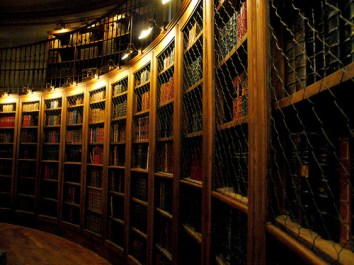
I wish I had thought of the name “Bibliomaniac” when I was getting my personal blog started. The description is apt. Though for Emerson, of course, a sign of damnation. He would have detested the accompanying image from Northwestern University’s Library, however much I love it. But really, isn’t this more or less the image of not just ManBookworm Northwestern Reading Books, but also Man Reading Computer Screen? (Or even Man Blogging?) Through my devotion to the thoughts and words of others, I drift gradually from my own authenticity, my own innate and good self-expression, my personal experience of the Over-Soul. To be derivative is to be damned, and the only sure way to avoid derivation is to not read at all.

Well, to be sure, Emerson doesn’t go quite this far. But he was suspicious of the obeisance we give to thinkers of old. Written when he was a relatively young man, he probably didn’t give a lot of thought to the fact that he, like all flesh living, was on the way to becoming a thinker of old. And he could not have imagined me poring over and ingesting his words like a bookworm as I prepare to teach a class on him as one of the monumental literary theorist of the nineteenth century.

(Sidebar: What metaphor must we now use in place of bookworm in the world of pixels? A computer virus? Another term like “typewriter” that my someday-grandchildren will not recollect and will marvel at as an index of my age and lack of cool. Who am I kidding—my son already marvels at these things. Of course, if we give up reading altogether, spending all our time blogging, we won’t have to worry about having a different word. )

But there is a place for good reading in Emerson, and as I’ve suggested elsewhere, it has something to do with reading as a creative act. Says Emerson.

I would not be hurried by any love of system, by any exaggeration of instincts, to underrate the Book. We all know, that, as the human body can be nourished on any food, though it were boiled grass and the broth of shoes, so the human mind can be fed by any knowledge. And great and heroic men have existed, who had almost no other information than by the printed page. I only would say, that it needs a strong head to bear that diet. One must be an inventor to read well. As the proverb says, “He that would bring home the wealth of the Indies, must carry out the wealth of the Indies.” There is then creative reading as well as creative writing. When the mind is braced by labor and invention, the page of whatever book we read becomes luminous with manifold allusion. Every sentence is doubly significant, and the sense of our author is as broad as the world. We then see, what is always true, that, as the seer’s hour of vision is short and rare among heavy days and months, so is its record, perchance, the least part of his volume. The discerning will read, in his Plato or Shakspeare, only that least part, — only the authentic utterances of the oracle; — all the rest he rejects, were it never so many times Plato’s and Shakspeare’s.

I think this kind of thing, along with Emerson’s deeply felt sense of the interconnections of the immediate world with a world beyond—and with everything else in the world–is where people get the idea that Emerson was some kind of ancient God of the blogosphere. Indeed, Christopher Lydon a few years back said just this thing in an extended blog post called “A God for Bloggers.” The post at its original site is long gone, but is copied in full here . In part, Lydon argues:

Here’s my point. When we talk about this Internet and this
blogging software, this techno-magic that encourages each of us to be
expressive voices in an open, universal network of across-the-board
conversation, we are speaking of an essentially Emersonian device for
an essentially Emersonian exercise. Starting with the
electronics. “Invent a better mousetrap,” as Emerson wrote, “and the
world will beat a path to your door.”

There’s a part of me that thinks Emerson would have loved the fact that Lydon’s post had disappeared, or almost disappeared. This is the perfect condition of reading as far as Emerson is concerned: let the book/blog have its say and go away.

To Lydon’s actual content, I want to say….yeah, kind of….but not really. In the first place, there’s a way in which the technology of blogging and reading blogs tethers us to society—Emerson’s worst dirty word—in a way that books did not, this despite the aura of freedom that surrounds computerworld.

Even with the magnificence of access, I am struck by how physically limited I am in terms of my mode of access. My computer needs a proximate cord and electricity and connections—electricity even if I have a wireless connection, and reliable wireless connections are still hard to come by. Because I know next to nothing about the workings of this machine I’m writing on, because I can do nothing to control my internet connection, because I have to have access to various levels of anonymous administrators and their vast electronic resources, I am in some sense even more dependent, more inescapably tethered to society and its mores and its conventions than Emerson could have ever imagined.

We have the lovely illusion of independent creativity in our isolation, in our loggorhea of the keyboard, in our incessant speech. It’s a little like cocaine makes the addict think he’s an all powerful sex machine. The real power is the man who provides the fix. Or doesn’t. In this case, my internet administrator, or more dumbly, the squirrel that gets itself electrocuted in the router box or powerline.

By comparison, a book is a model of self-reliance, even compared to e-books with megabatteries. I can drop my copy of Ulysses in a lake, and if I’m quick enough I can probably set it by a fire, let it dry for a while, and be just fine. Then again, if not I have a new and ready supply of toilet paper, Kleenex, and firestarter.

By comparison my daughter’s ipod died irreparably after sitting next to a sweating water bottle for thirty minutes. Sitting in the sauna today, I was wondering—can an e-book stand the heat, stand those rivers of sweat that dripped off my nose into the creases of the cheap newsprint I was perusing. Could be, but I would be afraid to try. If I ruin my newspaper I’m out three bucks. If I ruin my dedicated e-reader—the one I will supposedly buy someday—I would be out 400 plus however many hundreds of dollars of books I stored up. Emerson might well look at bloggers and e-books and the like and see not evidence of infinite expressibility, but of cows in a pen.

Not saying he would be right, but he would have reason. This cow says.

Similarly, I have my doubts about the idea that blogging, simply because it is a form of expression, is the kind of expressiveness that Emerson had in mind. Indeed, for Emerson the deadliest thing for individual authenticity was repetition, was convention. And yet, does it take very much time on the web to realize just how repetitive blogging really is, just how much of it is reaction rather than response. How much of it is profane ejaculation rather than creative reading Indeed, I’m often bemused by how many blogs are largely cut and paste jobs of other blogs. Bloggers not only don’t come up with words of their own, they explicitly and joyfully use the words of others as a substitute for words of their own.

By comparison my own blog is a paen to self-indulgence. I actually write these things myself. Mostly.

At least all this lack of originality orginates with me.

In other words, there’s a part of the net’s emphasis on collaboration and connectivity that speaks to Emerson’s optimistic view of the interconnectivity of all things. There’s another part of it that speaks to Emerson’s sense of “the sluggish and perverted mind of the multitude” , where people let groups think for them rather than thinking, and speaking, for themselves.

You don’t, of course, have to rely on me for this. Rely on yourself…and on the administrators at RWE.org, and on your computer engineer, and on your electrical grid, and on your software engineer… and on…and on. Well you get my drift.

Go over to the folks at RWE.org and read Emerson for yourself.
Writing by numbers: Who needs an audience?

A colleague who is a librarian and shares a lot of my interests in writing and reading sent me the following from a friends blog:

In a previous post my daughter blew me away with her use of eLocker to access her school files from home. Last night my son used MyAccess to write an essay online. Big whoop – right? Get this – it analyzed and graded it in an instant. Took about 3 seconds tops and he was looking at a score that broke out scoring elements not only in spelling and grammar (Word can do that) – things like content and delivery, organization, completeness of development. It was like having my 5th grade English teacher right there – red pen in hand. It saves all of his essays and projects and graphs out a cumulative progression over time, showing improvements and areas to work on. Incredible.

Here’s a snip from the site :

“With MY Access!®, students are motivated to write more and attain higher scores on statewide writing assessments. By using MY Access! in the classroom, teachers can provide students with the practice they need to improve their writing skills. The program’s powerful scoring engine grades students’ essays instantly and provides targeted feedback, freeing teachers from grading thousands of papers by hand and giving them more time to conduct differentiated instruction and curriculum planning.”

I wish I could share the enthusiasm, but I am more than a little skeptical. It may be the science/humanities divide in play, but there is no getting past the fact that a lot of this represents some of the absolutely worst things that are happening with writing in our secondary schools. And we continue to wonder why our kids can’t write and prefer to do anything but read. When we treat writing like filling in the blanks on a mindless test, and treat reading as a mechanical process that any computer can do for us, what message can our kids get but that language is something to be dispensed with as efficiently as possible, rather than one of the essential elements of our being human in the world. Something to be treasured and embraced and explored and played with; not something to slot in to the appropriate input on a machine

Just to be sure I wouldn’t go off on a completely uninformed screed (who would care? this is a blog after all), I did take some time to visit the MyAccess web site and go through the student demonstration. It is clearly more sophisticated than such programs used to be, and it does go beyond simple grammar and spell checkers. Still, it’s clearly caught up in a formal approach to writing that completely removes writing from the intentions and language of the writer, as well as from the interests and concerns of any particular reader or audience. The site makes a point of saying that it will grade for development and organization–as if these elements of writing existed somehow independently of the particular concerns and creativity of the writer, and as if we could address all audiences in a similar fashion. These folks claim that they grade “more accurately” than human readers. What could this possibly mean in grading a persuasive essay? How can a computer be more accurately persuaded than a human being. Absurdity.

One thing that the program grades for is sentence variation, vocabulary, and paragraph length. I admit this makes me nauseated. My daughter, a decent writer in part because she has learned to read a lot in our household, is asked by her teachers to write ten sentence paragraphs. If she has one sentence too many or too few she is graded down. This is done explicitly because of expectations of standardized tests–which I am sure will soon be graded by computer programs like MyAccess, to ensure that we are all standardized. There is no such thing as an acceptable length for a well-developed paragraph, and paragraph length in general is dependent upon genre and media. One of my big problems as a blogger and emailer is that I’ve learned to write for paper and ink, and my paragraphs are impossibly long for this particular media. Similarly, when I write for newspapers, I’m consistently reminded to keep my paragraphs in bounds. Same things go for sentences and sentence variations. First year students are stunned when I tell them a three word sentence can be perfectly OK. or that you can use a fragment. For effect, people, for effect. As if you were a human being instead of a machine. Some of them have actually been told by teachers to not use short sentences at all, and certainly never two in a row. Sentence variation depends deeply upon the kinds of emotional effects you are trying to achieve with readers, not on an abstract calculus that can tell you your sentence variation is good because you have X number of short sentences, X number of complex sentences, X number of such and so.

As for vocabulary. Students seem surprised when I tell them clever words can’t substitute for good writing. They assume a thesaurus indicated sophistication. I tell them to be sophisticated with the language that they know, and read and read and read to become sophisticated in the language that they don’t.

To some degree, indeed, I think this kind of write by numbers approach is designed to bypass the simple fact that kids no longer read enough–if they ever did–to become sophisticated writers and thinkers. Rather than give them the linguistic tools they need to become writers, we give them a formula to make sure they become the machines they are intended to be in this society. MyAccess isn’t part of the solution. It’s a sign of the problem.

(Bizarre sidenote: MyAccess tries to sell itself by saying it will provide 24 hour tutors at a low cost. Does anyone stop to think that in the world of the internet you can get free 24 hour “tutors” in online writing communities–or, if you really want to you can pay for it. At least you’ll be writing for other human beings rather than believing a computer program can substitute for someone that actually uses the language with which you have to communicate).

This ‘n That

I’m working on a little longer piece on Emerson, again, but thought I’d just put up a collection of unrelated stuff in the interim.


Me On Teleread

I actually don’t remember if I said anything about this, but I should have if I didn’t. Dave Rothman over at teleread.org was kind enough to ask me to blog on his space. David says he wants the perspective of a humanist to complement all the techies. He was kind enough to not say “I want someone who doesn’t know jack about technology.” In any case, my first post over there went up last week. I may have forgotten it because I posted a version of it over here as well. Still, I’m very interested in the conjunction of technology and reading, so teleread is a good place for me to further that thinking.

On Being Healthy

The Canadian Council on Learning tells us that daily reading is better for you than fiber. Oh, wait…I think we just found out that fiber doesn’t do anything for you except forestall diarrhea. (For more on diarrhea, see my completely fascinating post on this topic.) In any case, I’m happy to discover the following.

Reading each day can keep the doctor away, says a report that concludes sifting through books, newspapers and the Internet — on any topic — is the best way to boost “health literacy” skills such as deciphering pill bottles and understanding medical diagnosis.

Daily reading, not education levels, has the “single strongest effect” on the ability to acquire and process health information, the Canadian Council on Learning said Wednesday.

=====

The learning council reported Canadians aged 16 to 65, who said they read daily, scored up to 38 per cent higher than the average on the health literacy analysis.

Daily readers over 65 years old scored as much as 52 per cent higher than the average for their age.

“Although it may not be a panacea, this report makes a compelling case that reading each day helps keep the doctor away,” said the report.

I think it’s wise to have a tad bit of skepticism about stats like this. I wonder if there are correlations between regular reading and social class, for instance, and if so is the relationship to health a function of reading or a more general issue of access to health care, material resources, and knowledge itself. Still, why look a gift horse in the mouth. At this rate I am going to live a good long time. Actually, I better stop blogging because it’s definitely cutting in to my reading time. (Who am I kidding, I just don’t watch TV anymore.)

Reading More or Reading Better

A blog over at Metafilter raises the typical objections to the notion that we’re in a reading crisis. So what if we’re reading less literature; we’re reading more than ever on the web, right?! On the other hand, they also point out that Americans ability to read at all seems to be declining, pointing to the following study at the National Center for Education Statistics:

On average, U.S. students scored lower than the OECD average (the mean of the 30 OECD countries) on the combined science literacy scale (489 vs. 500).

The average score for U.S. students was:

  • higher than the average score in 22 education systems (5 OECD countries and 17 non-OECD education systems)
  • lower than the average score in 22 education systems (16 OECD countries and 6 non-OECD education systems)
  • not significantly different from the score in 12 education systems (8 OECD countries and 4 non-OECD education systems)

Ummm….One big problem, guys. Science and Math literacy is not the same thing as reading and writing literacy. And so I’m not quite sure what this has to do with whether people are reading literature any more or not. Though I’m sure Dana Gioia over at the NEA would be glad to claim that reading Moby Dick helps people with their algebra. Of course, it could be that reading skills have declined so far that the folks can’t even tell what science and math literacy really is.

Links:

A number of people have been kind enough to comment about the blog or link to my blog in various ways over the past several weeks. A few of them:

Free listens: A blog of reviews about audiobooks. What a great thing. I’ve said that I wish there were more sorting and evaluating of some of the free stuff on the web. Heresy of heresies, I don’t think massing blog stats necessarily tells me much about quality. I mean, videos of Brittany Spears’ pudenda are among the most popular on the web. Does that really tell us anything…about the quality of the video, I mean. Not about the state of America… or the state of Brittany Spears body parts. I haven’t had a chance yet to listen to the audiobooks to see if I agree with the judgments, but I’m glad someone is taking up the flag to do such a thing.

The Reading Experience: Daniel Green has me on his blogroll, and I’ve had The Reading Experience on mine from the beginning. I think Daniel is a little narrower in his literary judgments and tastes than am I, but I admire anyone immensely who has left academe and made it on his own. His blog is always thoughtful and often provocative.

There’s Just No Telling: “Monda” has commented on my blog before, and has a lovely sight devoted to reading and writing. From what I gather she is a teacher of creative writing, who all deserve to be sainted.

Brad’s Reader: Brad lists me as an interesting read. And I didn’t even have to pay him.

There are others that I’ve missed, and I’ve got to stop somewhere in any case. So if you’ve linked to me and I’ve missed you, let me know. I’ll keep you in mind next time I do this.

John McCain–Happy Hemingway or Hillary Redux

This in from the NYTimes evaluating last night’s victories by John McCain and Barack Obama:

On the Republican side, Senator John McCain of Arizona won a commanding victory over Mike Huckabee in the Wisconsin contest and led by a wide margin in Washington State. All but assured of his party’s nomination, Mr. McCain immediately went after Mr. Obama during a rally in Ohio, deriding “eloquent but empty” calls for change.

Umm…I’m wondering. Why does McCain think he can make this line work any better than Hillary has made it work for the past three months? Still, McCain comes at it from a slightly different angle. If, as I suggested a couple of weeks ago, Hillary is trying to protect the legions of naive American innocents from from the seductive Black Lothario, it seems to me that McCain is invoking more directly the masculine resistance to beautiful words that has dominated white male experience in the United States for the past 150 years or so.

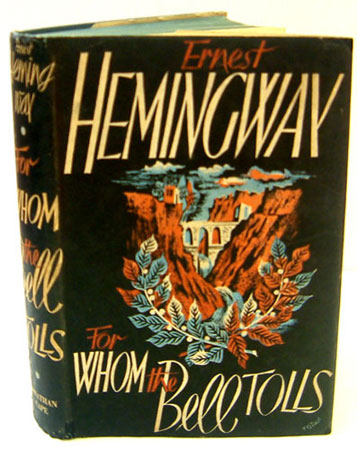
No accident that McCain’s favorite novel is Hemingway’s For Whom the Bell Tolls. This from Vanity Fair:

The enduring question about John McCain is what, finally, he is willing to do to win. His favorite novel is For Whom the Bell Tolls, Hemingway’s story of an idealistic American, Robert Jordan, who goes to fight for the Loyalists in the Spanish Civil War. Jordan is willing to risk his life but never his honor, and his dying meditation, that “the world is a fine place and worth the fighting for,” gave McCain’s second memoir its title.

Indeed, McCain has more than his share of doomed to dutyFor Whom the Bell Tolls poster integrity that characterized Hemingway’s public persona. The title of Hemingway’s book, of course, refers to an ultimate destiny in death and the unflinching effort of the real man to face that inevitable destiny with something like grace. A characteristic effort of Heminway’s heroes, even when they mostly fail the chance. There’s a way, of course, in which McCain clearly does live out the Hemingway mythology. The prisoner of war refusing to bend the knee to his enemies, the maverick political independent, the loyalty to Bush on principle regarding the war, even when in his heart of hearts I think McCain finds Bush despicable. Even McCain’s political story this primary seasons unfolds like that of a Hemingway hero, the man willing to do what he believes in without resources. The belief that a man should stand up and do the right thing even in the face of overwhelming odds and the inevitable odds of death. As the Times suggested a couple of days ago, he doesn’t even pander well, which is precisely what makes him attractive to so many. Even I like McCain, and I disagree with him about almost everything. Proof again that policy statements and knowing the ropes may be important things for a Senator, but it’s not so clear that this kind of political minutiae is what will get people to follow you.

[Ironic side bar: The title of Hemingway’s novel is drawn from John Donne’s MeditationFor Whom the Bell Tolls First Edition number XVII, republished as the following poem:
‘No Man is an Island’ MEDITATION XVII, Devotions upon Emergent Occasions

No man is an island entire of itself; every man
is a piece of the continent, a part of the main;
if a clod be washed away by the sea, Europe
is the less, as well as if a promontory were, as
well as any manner of thy friends or of thine
own were; any man’s death diminishes me,
because I am involved in mankind.
And therefore never send to know for whom
the bell tolls; it tolls for thee.

I say “ironic” because Donne’s meditation is primarily about the unity of mankind, “No man is an island.” We are all part and parcel of one another, involved in all mankind. Sounds positively Obamian. We are the hope we’ve been waiting for. We are the world. We are the children.

In Hemingway’s hands the solitary confrontation with death is a chance for the man to test one’s mettle against the worst that nature offers, like the bullfighter in the ring. Finally we do this alone. I can’t quite see McCain with Donne. Maybe if he stood up and said, “any man’s death diminishes me…except that of Saddam Hussein, Osama bin Laden, and various and other choice enemies who would be better gotten rid of.”]

Nevertheless, even if McCain runs on this Hemingwayesque idealism, he’ll give Obama a better run for his money that Clinton is right now. On the other hand, if he tries to tell the American people that they are naive for hoping that the world can be different than thepolitical world the baby boomers created …well…politicians don’t get so far telling people they are stupid. The irony of McCain is that he was, in some respects, the Obama of the last political season. If he goes against the instincts that made him a winner in the past, he’ll just be another old guy that Obama will blow out of the water.

Side bar number two: Obama might well be saying, it’s morning in America. Hillary could learn more than one lesson from Ronald Reagan.

Side bar number three: I’m not so sure Obama isn’t more ruthless and politically savvy than Clinton gives him credit for. He appeared on television in the middle of Clinton’s speech last night, and every station in the country dropped Hillary to hear what he had to say. Why does Clinton think Obama is so unable to handle tough as nails and ruthless Republicans? He’s shown every ability to handle tough as nails and ruthless Democrats like, umm, Bill and Hillary Clinton.

Let’s get together and read

I ran across this somewhere, probably through another blog, though I don’t remember now. Anyway, now we have the ability to connect with people anywhere in the world who may be reading Shakespeare at this particular moment. As I write this post, 242 people are reading Shakespeare, and I even know that 23 are reading Hamlet, mostly in the United States and Europe, but I have seen several readers of Shakespeare in Japan and China over the past few days. Of course, that’s only people who are intrigued enough by this service to sign up.

I’m vaguely interested in the forms of socialization that are associated with web world. Although it comes across as very individualizing–a place of me doing my own thing–in a different way it can be very clubby and group-think oriented, like a group of high school girls who can’t go to the bathroom without four friends. I see this to some degree in what happens with online reading. Over at Book Glutton–so far as I can tell it has yet to take off, but this is the concept in any case–the idea is to read along through a text with a group of friends, giving you the capacity to read together in real time.

I don’t think there’s anything particularly wrong with this per se. Indeed, it’s sometimes a very good exercise to have a group of students sit together and read the same book silently. It can be a weirdly interesting bonding experience. But rather than being the exception, it’s almost like reading the same thing at the same time as someone else becomes a need in the culture of the web.

Not sure if that’s quite the case, but I can see it everywhere. My daughter is only satisfied being on Facebook if she is at the same time chatting with a dozen of her friends online.  WordPress let’s me know how many people are blogging “right now.” I wonder what need this feeds? Are they trying to reassure me that I am not alone here sitting in front of my computer, despite all evidence to the contrary. We’re all in this together.

Does it make a difference to how people read or write, or even affect their interest in reading and writing? I finally got around to joining up at BookGlutton because I thought it would be an interesting experiment in online reading. Trouble was, I couldn’t find groups that were reading anything I was interested in reading. So I didn’t read at all, despite the fact that there were a lot of different books to choose from. Now this is not a hack on BookGlutton–some few of the folks over at Librivox are still PO’d at me for treading on their territory. (Unintended, but nevertheless quite good for the blog stats). At Book Glutton I have the option of trying to form my own group with other people, just didn’t have the time or inclination. But I also wonder whether services like Book Glutton or other things like this will transform the way reading is practiced as a social experience, even affecting what people choose to read. I would bet that something like Amazon’s Kindle will develop similar kinds of capacities in future incarnations. As a consequence, I can easily imagine people choosing not to read a book because no one happens to be reading it at the same moment. No one there to chat with while I read. Five years ago I would have thought this was a fantasy; I’m not so sure it isn’t a present and growing reality.

There’s some historical precedent; in the classical period, reading often took place at social gatherings of the elite, a necessary corollary to reading aloud. What goes around comes around. Maybe fifty years from now reading alone will seems as odd to our culture as reading-as-online-chat seems to me today.

Reading, listening and memory

Pursuing some of my recent posts on the idea that listening and reading create different experiences–without making a judgment regarding superiority–a forum on myspace directed my attention to the following study from Carnegie Mellon demonstrating that listening and reading activate different parts of the brain, and especially that listening requires a great deal more working memory–what used to be called short-term memory–in order to do the semantic processing necessary for understanding.

“The brain constructs the message, and it does so differently for reading and listening. The pragmatic implication is that the medium is part of the message. Listening to an audio book leaves a different set of memories than reading does. A newscast heard on the radio is processed differently from the same words read in a newspaper,” said Carnegie Mellon Psychology Professor Marcel Just, co­author of the report that appears in this month’s issue of the journal Human Brain Mapping.

This seems to go along with my general perception in yesterday’s post that in reading to a text we are experiencing a different object of consciousness–in some sense a different work of literature–that we do when we listen to a text. I’m not exactly a phenomenologist, but we might be able to go with this to say that our experiences of texts are how they appear in consciousness. To the degree that listening and reading activate the brain differently, I would hypothesize that the conscious mind is experiencing two completely different “objects,” objects here understood to mean our mental experience of words and their meanings.

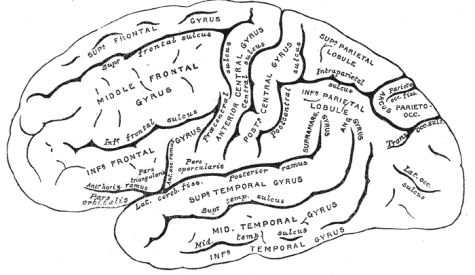
First, during reading, the right hemisphere was not as active as anticipated, which opens the possibility that there were qualitative differences inBrain image–Pars triangularis the nature of the comprehension we experience in reading versus listening. Second, while listening was taking place, there was more activation in the left ­hemisphere brain region called the pars triangularis (the triangular section), a part of Broca’s area that usually activates when there is language processing to be done or there is a requirement to maintain some verbal information in an active state (sometimes called verbal working memory). The greater amount of activation in Broca’s area suggests that there is more semantic processing and working memory storage in listening comprehension than in reading.

Because spoken language is so temporary, each sound hanging in the air for a fraction of a second, the brain is forced to immediately process or store the various parts of a spoken sentence in order to be able to mentally glue them back together in a conceptual frame that makes sense. “By contrast,” Just said, “written language provides an “external memory” where information can be re­read if necessary. But to re­play spoken language, you need a mental play­back loop, (called the articulatory­phonological loop) conveniently provided in part by Broca’s area.”

This makes a great deal of sense to me and is consonant with some other things that I’ve read about how literacy accompanies the general atrophy of personal and cultural memory. Oral cultures require much more prodigious uses of memory, and I would suspect that people who train themselves to listen well–perhaps like those who listen to audiobooks!–are also developing memory capacities. At least, following this study, the short term memory would have to become much more exercised and probably developed by the consistent effort to remember the passing sounds and having to fit them together into meaningful units of language.

(Side note along these lines, my colleague who is visually impaired has a prodigious memory of detail of what seems to me to be almost everything. By comparison, I remember vaguely that an idea is found somewhere in a particular part of a book that I underlined at one point).

Following this out, and thinking through my earlier statements that what we need is more careful consideration of what kinds of things are lost and what kinds of things are gained through certain kinds of reading (or listening), we might well say that if we are entering into what is called a secondary oral culture this could signal good things for memory.

At least this would be the case if the culture that’s developing is one that would put a high premium on listening skills. I’m not really sure that it is given the dominance of the visual on the internet and in film and television. Still, it’s and interesting idea. It would be interesting to figure out if people who listen to audiobooks in a regular and devoted fashion show more highly development memory capacity–either short or long term–than those of us who spend more time reading.

This would leave for further study the question of what reading develops in the brain. I suspect it would be something along the lines of analytical skills, but I’m not sure. It also may explain the stereotype of the absent-minded professor. Maybe we really are absent-minded because in being devoted to books our short-term memory has atrophied!

Reading, Listening, and Form: Or, where is literature?

Hugh Mcguire from over at Librivox (and also at hughmcguire.net) left some very good comments on a couple of my recent posts, and also posted them to an online forum over at Librivox. They’re well worth reading in their own right, as are the comments on the forum. You can see Hugh’s comments here and here, and also access the librivox forum for a variety of interesting and useful responses on the issues I’ve been taking up lately. I thought I’d go ahead and keep these up with a couple of continuing posts over the next couple of days on the issues that Hugh and the folks over at Librivox raise (at least raise for me).

When we listen to a book are we more or less experiencing the same literary phenomenon as when we read a book? In his responses earlier to me , Hugh seems to assume so (update–Hugh just sent me another post indicating this is not his position; that comment is accessible at the previous links), and certainly some of the folks in the Librivox forum state this more explicitly—in either case we’re experiencing the same literary work, yes? The reading historian and cultural critic in me—as well as the person who’s amateurishly interesting in the way language is processed in the brain—says…well…maybe. Our tendency to say “Of course it’s the same work of literature. It’s all words!” usually assumes that what is literary about literature is the content. One of the respondents in the forum is getting at something along these lines when he says what’s really important is what the words are pointing to, not the words themselves.

In other words form and media are just part of the delivery system. Who cares how it gets there, as long as it gets there, right?!

Maybe I can illustrate like this. John, Joan and Jimmy are traveling from point A on the east coast to point B on the west coast. They use a road that has a lane for cars, a lane for bicycles, and a lane for walking. John chooses to drive, Joan chooses to ride her bike, and Jimmy chooses to walk. The content theory of journeys would suggest that all three have had approximately the same experience because they have all traveled the same geographical terrain and have moved from point A to point B.

Most students of literature or linguistics would start pulling their hair out at this stage, since a basic tenet of what we do assumes that form matters. Those of us who believe in the centrality of form as well as the significance of time and context to experience would emphasize that John experienced a dramatically different journey in his car trip across country as compared to Jimmy or Joan, and not only because he got there faster. His environment was completely different, he noticed different things and processed them in different ways. A mountain that occupied a half hour of John’s attention, loomed in Jimmy’s pathway for perhaps four or five days. The mountain was a thing of beauty that John experienced from the distance of his car, while the mountain’s beauty was complicated for Jimmy by the fact that he had to walk up one side and down the other, that he worried about mountain lions rumoured to be in the hills, and by his knowledge that if it rained he was in for misery. So though the terrain is identical in one sense, we might well say these folks haven’t experienced the same thing at all.

We don’t have to assume that one journey is necessarily superior to the other—though, I don’t think the question of evaluation can be ruled out—but it’s not quite clear that John, Jimmy and Joan have experienced the same journey despite covering the same terrain. Because the delivery systems of their journies differed, the experience itself–in some sense even the terrain itself–was completely different.

Though the analogy is inexact, it seems to me that something similar applies to the journey we take through a text. It makes a difference whether we read it via scroll, papyri, book, e-book, e-mail, cell-phone, or audiobook–all methods of delivering text, of making the journey. Thus, I would say reading Huckleberry Finn and listening to Huckleberry Finn may not be the same experience delivered in different ways. I’m willing to say they might both be described as valuable cultural experiences, and we may want to even describe both experiences as literary. But it’s not clear that the same “work of literature” has been experienced regardless. In literary and in communication studies more broadly, media matters, in some respects matters at least as much as the content itself. Marshall McLuhan’s dicta that the media is the message gets at this idea. This doesn’t assume that reading is superior to listening; only that you aren’t experiencing the same literary thing when you listen as when you read.

A different take on this suggests how different media and different cultural contexts make it possible to process something as literature when it had never been literature before–which, presumably, might also mean that these same things could cease to be literature in a future cultural context (or that “literature” could cease to be a useful description for the experience of texts entirely.)

The one example I use in my earlier post is the Bible. Many parts of the Hebrew and Greek testaments were oral tradition prior to being written down. And when they were first written down they were written down on scrolls, which enable a particular kind of reading that is very different from that afforded by books. Now one way of talking about this would be to say that all of these things are merely different ways of delivering the same content. The cultural historian in me would point out that these different forms of the Bible led to and resulted in the Bible being read in very different ways and meaning very different things at different times. Protestantism is all but predicated on a particular mode of reading and receiving books that is probably unimaginable in an oral world or a world of scrolls.

(My saying things like this drives my fundamentalist brethren bonkers, but there you have it. When it comes to literature or the bible, most people are content-driven fundamentalists. A word is a word is a word is a word. It says what it means and it means what it says. And we literary theorists, poor dears, fold our hands and say, no, no its not…no, no it doesn’t).

The Bible is also a good example of the peculiar way in which media affects our understanding of what we are experiencing, and even shapes how we experience it. For instance, courses in the Bible as literature are primarily a modern development. People didn’t start talking about the Bible as a literary text until after Gutenberg; that is, right at the time when other books started taking their place alongside sacred texts as cultural authorities. Indeed, our entire concept of “literature” is really a development of the Gutenberg revolution, a result of the great mass of available things to read and the need to distinguish some things as really worth reading. Prior to Gutenberg, so few things were actually collected in to books that everything in print was, by definition, worth reading.

Thus, my qualified “maybe” to those who would say that in listening to a book you are experiencing the same “work of literature” as you experience in reading the same book. Indeed, we are already in a period that can probably usefully be described as post-literary—which includes, but means really much more than “a period when people don’t read books.” That is, we are probably in a period when the culture that needed the term “literature” to distinguish a particulary important form of cultural activity is in decline or has already passed. Ironically, though it is out of a love of “literature” that Librivox pursues its work and through which the devotees of audiobooks pursue their listening, the shift toward the aural/oral that such things signify may also point toward the end of literature as a usefully important concept in our cultural moment. And this may be so without making any judgment as to whether that is a good or bad thing. It may just be a different thing.

Miscellany: More Librivox, More Emerson, More Diarrhea

Ok, to get to Diarrhea, you have to read to the end of this post.


MORE LIBRIVOX

I got some very good comments from “Hugh” who is a poobah of some sort over at Librivox. You should go read his comments yourself at my post, “Listening as Reading,” but a couple of excerpts here since I want to think about what he has to say. (And, hey, it’s a cheap way to come up with a post when it’s late at night and I’m having trouble collecting my thoughts.

Says Hugh:

“in pre-radio/tv/recordings days, and when books were relatively expensive, many books were actually written to be read aloud – it was a form of family entertainment: the family & friends gathered around papa (or mama) who read at the fireplace. dickens is a particular example. of course an mp3 audio version read by a stranger isn’t the same thing, but it is another experience of literature, one that has it’s own particular richness, and weakness.”

Yes, a good thing to point out, continuous with my general observation that for the longest part of human history reading was primarily about reading aloud, not reading silently. I’m not quite sure I would go completely down the road that books in the nineteenth century were written to be read out loud. This misconstrues the case. But it is the case that they were commonly read out loud, and there was a great deal of fluidity between the oral presentation and the written. Dickens is a good representative of this fluidity. I’m not quite sure I would say Dicken’s wrote his books in order to read them out loud. He wrote them in order to get them published serially in magazines. But it is absolutely true that he often rewrote and rewrote passages over and over in order to achieve certain kinds of emotional effects in his listening audience. Thus there’s a deep connection between the orality of the word and the writtenness of the word. A fluid interchange of sorts. I still tell students they ought to read their work outloud to themselves in order to hear how things sound. This can be a good guide to the kind of rhetorical affects you are achieving.

Says Hugh again:

“-we are primarily a platform to help people record audiobooks (with an objective of making a complete audio library of public domain books); that the public can download and listen to our files is in a way just a fortunate by-product of what we do.

-and while our collection’s “quality” is, by design, all over the map, the volume of good and extraordinary recordings is daunting…it’s a matter of finding the good stuff. Here are some recommendations:

http://ask.metafilter.com/79067/Librivox-Recommendation”

This last is very helpful, though I wish the list was more organized. I clicked through some of the recommended readings and–on the basis of very short sampling–most of them are superior to some of the detritus I’ve waded through the past few times I’ve strolled through Librivox. I wish that Librivox would provide some kind of ratings system itself–at least one that recognized the popularity of different readings–though I suspect that this would counter the dream of pure democratic participationism that drives this kind of thing on the web.

As for Librivox being primarily about the readers and not the listeners, something Hugh tells me in a second comment, I’m not so sure. (I think Hugh didn’t think it was fair of me to criticize many of the readers for being…well…Dull. Or annoying. Or both). To some degree I think he’s suggesting that Librivox is really more like a blog service where readers can express themselves via recording. Well, OK. But the thrill of doing so is that people will listen in, yes? I mean, if it wasn’t for the fact that people might actually look at this blog, why not just keep it on my computer instead of publishing it for all the world to sneer at.

It’s also the case that in reading a published work, the reader puts himself/herself in the position of performer/artist who is interpreting the work of another artist. There are a lot of opera singers out there who really ought to spare the rest of us and restrict their renditions of Nessun Dorma to the safety of their shower stalls. On the other hand, I don’t begrudge them the right to perform for the world on YouTube. But if they do, I generally think we’ve got a right and responsibility to Puccini and to Pavorotti to say, “You know, that really stinks pretty badly.” There’s no inherent nobility in performing, contrary to what most Americans seem to think.

But enough. Mostly I’m on Hugh’s side here. I’m glad someone’s doing something like Librivox, even if I don’t want to listen to most of the people doing it.


MORE EMERSON:

I blogged a bit about Emerson today on the blog dedicated to my course on literary theory. Just a bit of that from a post I called “Emerson and the Gods of Reading”:

Along these lines, I think there’s a way in which Emerson’s notions of creative reading are embodied in the way we read now. For Emerson, reading was a threatening activity precisely because we were always tending toward submission and passivity, always on the brink of substituting someone else’s creativity or knowledge for our own. This would mean we had failed to be “The Poet” we were meant to be and in fact are if we would only realize it. Instead, reading only exists to a purpose if it inspires us to more writing of our own. Reading must always give forth in to new and different expression, or it is worthless. Reading that absorbs and doesn’t give forth in new creativity, reading that doesn’t come to an end in writing is destructive to rather than an enhancement of our humanity.

What is this if not the reading ethic of blogging. Emerson, the familiar spirit of Facebook culture. Reading for us now is only meaningful if it gives forth in self expression. Indeed, texts become primarily a means of further self-expression. I read other texts or find other materials on the internet in order to “blog” them. The verb in this sense means partly to write about them, but blogging something also connotes making it one’s own, making it an opportunity for self-expression, an opportunity to speak.

I don’t think I want to deride this outright. NPR had someone–maybe the founder of Facebook-?!-on today with a little piece on the glories of connectivity available through self-exposure. It seemed a little facile–by exposing my darkest secrets on the net I’ll be able to develop authentic relationships with people I’ve never met. Umm, maybe. If this were true, why not go expose yourself to your next door neighbor. Still, it is the case that kinds of connections are built through this incessant speaking. Ultimately, for Emerson, our seeking expression at the expense of reading was not a form of self-aggrandizement, though it’s often taken for that. It was ultimately a way of connecting to a broader world. In Emerson’s view, if all people would become The Poet they were meant to be, all the world would be saved and we would all be one. It’s ultimately a platonic evangelical Christian vision without Christ in some sense. If we’ll all individually get right with Jesus, we’ll all be one. The internet says something vaguely similar. If we would all just keep looking for ways of expressing ourselves through the texts of others, we will all be connected through what is, after all, the World Wide Web.

I have no idea if this makes any sense, but it seemed profound at the time. Parents are paying for this stuff. It better be.


MORE DIARRHEA

Ok, this doesn’t refer to the stinky liquid spew that this post is fast becoming. Or not only that.

I often tell my English students that there is a magazine about everything, so they can take their writing skills and find a job anywhere in the world. The last part is a department chair’s fantasy, but there really is a journal about everything in the world.

Witness “Dialogue On Diarrhea.” Yes, there is a journal covering everything you wanted to know about loose stools. Ok, I should say there used to be a journal. In the words of the web site:

Dialogue on Diarrhoea was an international newsletter on the control of diarrhoeal diseases published by Healthlink Worldwide (formerly AHRTAG), a UK-based non-governmental organisation.

The first issue was published in May 1980.The last of a total of 60 issues, during its 15 years, was published in May 1995.

Published four times a year, Dialogue on Diarrhoea offered clear, practical advice on preventing and treating diarrhoeal diseases. It also acted as a forum for readers to exchange ideas and share experiences.

Umm, just what kind of experiences are we sharing here exactly?

Anyway, the print newsletter is no more. And now instead we have “Dialogue On Diarrhea Online”. So the next time you have this problem, you’ll know where to head. Besides the bathroom. I mean.

And, as we think of it, doesn’t this point to the last important remaining geography in which print remains triumphant. Bathroom reading. It’s a bit tragic that the diarrheatics among us will now have to carry their Kindles to the bathroom in order to keep up on the latest and share their experiences. On the other hand, with laptop in hand they will now be able to share their experiences in a much more intimate and immediate way.

Ok, I’ll stop. I’m sure I’ve now insulted all the chronic diarrhea sufferers who regularly read this blog. And none of my students will ever get an internship with this website. That’s for sure.

Final note: I thought for sure I would be the only person on WordPress who used the word “diarrhea” in a tag. No. There are hundreds of us.

Isn’t the web a wonderful place?

Books in a material world–Bookporn and more

I was talking to a couple of students yesterday, one of whom wants to be a librarian because she loves “being around books.” A little bit of a Scrooge, I guess, I told her she better get used to being around computers since that was the real future of libraries, taking her back a bit with my revelation that the library budget at our own college had just been required to move $50,000 from book purchasing to database collections. Small change for a lot of places, but for my smallish college $50,000 is nothing to sneeze at. Indeed, I’ve already felt the squeeze just a bit since English used to depend on the general fund of the library to order contemporary novels and poetry–which we ordered gleefully and at will. Probably partly on the erroneous assumption that availability would somehow translate into their being taken off the shelf. Well, that fund hasn’t disappeared, but we’ve been asked to order not quite so gleefully, and not quite so at will. A concrete manifestation of how a response to a perceived technological need–real or not–will gradually determine or close the future of the book as we’ve known it.

Still, my student was not dissuaded. She feels that books will always be with us because we love their physicality. There’s that body of the book theme again, and there’s something real about it that has to be thought through. Reading is not simply a mental process of decoding letters, not simply a process of getting information off a page or screen and in to our brains. It’s a physical activity to which we attach all kinds of cultural and personal meanings, a kind of spiritual reverence that the attach to the being of books that we cannot yet attach to computers.

We imagine computers too much as tools, and emphasizing their efficiency does too little to address the tactile, even the olfactory meanings that we attach to book culture. The other student who was with us was very intrigued by Amazon’s Kindle, but even she paused and said, “I became an English major when I looked out from the balcony and saw the stacks and stacks of books.” The physicality of books inspires a reverence, whereas the efficiency of computers inspires…what?…a sense of efficiency?

Indeed, I’m intrigued by the growing tendency of laptop users to try and personalize their laptops–recreating their essential impersonality through a kind of personal graffiti. There’s a great newstory on this phenomenon at c/net, along with Personalized laptop.  One of my favorites. 

We do this with books, it seems to me, but not in the same way. We don’t feel compelled to personalize the cover of a book, and our markings in a text are more to memorialize a reading experience than to carve a human personality into what is, after all, a machine. Books are a technology, but at the least we have learned to experience them as extensions of the body rather than as tools.

Along these lines, I’ve been running in to a lot of images of books again. Rachel Leow over at A Historian’s Craft celebrates the one year anniversary of her blog with BookPorn #27, a couple of fabulous images of the Library of the Musee Guimet. Says Rachel:Library Musee Guimet

“There’s a kind of hushed atmosphere when you walk in: the lights are dim and people shuffle about, struck silent with reverence, or perhaps the disconcerting, all-pervading pinkness of the walls and columns. The books lie, untouchable, behind their wire cages, and the smell of old paper lingers about well after you step, blinking, back out into the fluorescent glare of the exhibition outside.”

Nice writing, Rachel. And happy birthday. It seems to me that Rachel gets at this notion of the importance of the physicality of books inspiring a kind of reverence, something I attach even to my tattered paperback crowded onto basement shelves, but which I don’t really attach to my computer. Like nearly everyone else, I’m sure I spend a great deal more time on my computer reading anymore than I do in actually reading books. Like most white collar workers I’m chained here all day, and then blog all night. But feeling reverence for my computer feels a little bit like feeling reverence for my screwdriver. Not impossible, I guess. I’m sure many a carpenter has a deep feeling for his screwdriver. But I also guess that mostly such carpenters are considered weird by everyone else.

Books are tools, but it’s a mistake to think that what counts in reading them is the toolishness. If we only focus on the instrumental qualities associated with text delivery, there is no question that the e-book-o-philes among us are right to scoff at fears of digital libraries. Still, culture is more than instrumental, and always has been.

Along these lines, there’s a humorous and very interesting Giuseppe Acrimboldo Librarianskewering of those of us who are book fetishists over at if:book. Chris Mead has written a song about the history of books along with a lot of great images. My favorite is this from Giuseppe Acrimboldo, “The Librarian.” I love it. The human is text, no a book, a library. What I’ve always thought anyway. I am my books. I don’t yet say, I am my computer. Will I ever.

Chris takes the opportunity to skewer the-sky-is-falling attitude that some of us bring to the changes that are going on

“words: written in silence, muttered in monasteries
have been sung, shouted, acted – now by digital industries

broadcast and mixed for our burgeoning multiculture,

but circled by many a gloom-laden vulture

crying “R.I.P. books: doomed to extinction
by some blinking e-inky, i-evil invention”.
The word spreads and
changes; that’s my belief.
What next for the book?
The future lies overleaf.

Very nice. Dr. Seussian. Ok, only almost. Still, Chris’s poem/song emphasizes an assumption that I think is flatly wrong. That the technology of reading is essentially inconsequential for the act of reading itself. This is clear explicitly in the opening part of his poem.

“Books are what a society carries its words in
and words have been written on stone, silk, slate, parchment,
wax, clay, screen and skin,”

This is superficially true, but the assumption seems to be that reading is only about decoding letters, and books–or parchments or scrolls or screens–are merely delivery systems that are more or less equal except in the efficiency with which they can deliver text to readers. This is flatly false, as any historian of books and reading could point out in half a breath. In some sense, when we went from reading scrolls to reading codexes and then books, the changing technology changed the meaning of the act of reading, not just the techniques of the act of reading. It is this changing meaning that is crucial to try and understand. Techniques of text delivery can merely be learned through users manuals. Meanings and their attendant ways of being human are less easily learned and unlearned. We ought to pay attention to what those changes might be.

Final note: I’m sure everyone’s familiar with this video, but it still makes me smile. It’s a reminder that all of the cultural associations we have with books had to be learned. There’s nothing natural about our sentimental attachments to books. As kids, we’re all in the position of the monk at a loss here, not knowing which way a book sets on the table, which way to turn the pages. Culture is learned. That doesn’t mean the demise of books should be sniffed at. But culture is learned.

Lolita’s Bedroom—Or why marketing directors should read more novels.

What young family wouldn’t hold out the image of a sexually precocious 12-year-old as the image they hope their young daughters will have dancing in their heads as those innocent heads hit the pillow at night. The London Times reports that Woolworths has had to pull a certain ill-named piece of bedroom furniture from the market after a widespread internet protest by offended mothers.Woolworth’s Lolita bed

“The Lolita Midsleeper Combi, a whitewashed wooden bed with pull-out desk and cupboard intended for girls aged about 6, was on sale on the Woolworths website for £395.”
……

“Whereas many mothers were familiar with Vladimir Nabokov and his famous novel, it seems that the Woolworths staff were not. At first they were baffled by the fuss. A spokesman for the company told The Times: “What seems to have happened is the staff who run the website had never heard of Lolita, and to be honest no one else here had either. We had to look it up on Wikipedia. But we certainly know who she is now.””

Lolita book cover full sizeAs my colleague, Matt Roth, suggests it’s hard to know which is worse, that they made the bed in the first place, or that they didn’t know about one of the iconic literary figures of the past half-century.

However, given the international state of our reading crisis, perhaps its worth asking how so many mothers even knew who Lolita was. I wonder if they read the book or saw the movie.

In any case, cultural illiteracy will get you nowhere.

Still, I’m just a tad bit suspicious about Woolworth’s protestations
According to the same Times article, the Brits business community has a penchant for salacious pitches to the preadolescent crowd:

“In 2006 Tesco was removed its pole-dancing kit from the toys and games section of its website after it was accused of destroying children’s innocence.”

A pole-dancing kit. What every nine-year old girl wants for Christmas.

Similarly the BBC reports the following:

“In 2005, WH Smiths came under fire for selling youngsters stationery bearing the Playboy bunny – a symbol of the pornography empire.

“Prior to that Bhs decided to withdraw its Little Miss Naughty range of padded bras and knickers for pre-teen girls after attracting criticism.

I’m not sure what’s naughty about knickers. I thought it was just a weird British word for underwear. And according to the grammar they were padded anyway. Sounds uncomfortable to me. Still, I draw the line at padded bras for pre-teens.

For the record, I did a Google search on women named Lolita. Turns out there are thousands of them. And not just Lolita Davidovitch. And most of them aren’t even on sex sites. I’m sure that the Woolworth’s bedrooms set was probably named after the owner’s great aunt Lolita in Birmingham. And after all, it’s not pole-dancing. Come on people, lighten up!

Anyway, though I’m appalled at the marketing division’s literary illiteracy, isn’t it a great thing to see literature making a difference in the world.

More solid evidence that the NEA is correct in saying readers are more likely to be social activists. 😉