Tag Archives: culture

Let’s get together and read

I ran across this somewhere, probably through another blog, though I don’t remember now. Anyway, now we have the ability to connect with people anywhere in the world who may be reading Shakespeare at this particular moment. As I write this post, 242 people are reading Shakespeare, and I even know that 23 are reading Hamlet, mostly in the United States and Europe, but I have seen several readers of Shakespeare in Japan and China over the past few days. Of course, that’s only people who are intrigued enough by this service to sign up.

I’m vaguely interested in the forms of socialization that are associated with web world. Although it comes across as very individualizing–a place of me doing my own thing–in a different way it can be very clubby and group-think oriented, like a group of high school girls who can’t go to the bathroom without four friends. I see this to some degree in what happens with online reading. Over at Book Glutton–so far as I can tell it has yet to take off, but this is the concept in any case–the idea is to read along through a text with a group of friends, giving you the capacity to read together in real time.

I don’t think there’s anything particularly wrong with this per se. Indeed, it’s sometimes a very good exercise to have a group of students sit together and read the same book silently. It can be a weirdly interesting bonding experience. But rather than being the exception, it’s almost like reading the same thing at the same time as someone else becomes a need in the culture of the web.

Not sure if that’s quite the case, but I can see it everywhere. My daughter is only satisfied being on Facebook if she is at the same time chatting with a dozen of her friends online.  WordPress let’s me know how many people are blogging “right now.” I wonder what need this feeds? Are they trying to reassure me that I am not alone here sitting in front of my computer, despite all evidence to the contrary. We’re all in this together.

Does it make a difference to how people read or write, or even affect their interest in reading and writing? I finally got around to joining up at BookGlutton because I thought it would be an interesting experiment in online reading. Trouble was, I couldn’t find groups that were reading anything I was interested in reading. So I didn’t read at all, despite the fact that there were a lot of different books to choose from. Now this is not a hack on BookGlutton–some few of the folks over at Librivox are still PO’d at me for treading on their territory. (Unintended, but nevertheless quite good for the blog stats). At Book Glutton I have the option of trying to form my own group with other people, just didn’t have the time or inclination. But I also wonder whether services like Book Glutton or other things like this will transform the way reading is practiced as a social experience, even affecting what people choose to read. I would bet that something like Amazon’s Kindle will develop similar kinds of capacities in future incarnations. As a consequence, I can easily imagine people choosing not to read a book because no one happens to be reading it at the same moment. No one there to chat with while I read. Five years ago I would have thought this was a fantasy; I’m not so sure it isn’t a present and growing reality.

There’s some historical precedent; in the classical period, reading often took place at social gatherings of the elite, a necessary corollary to reading aloud. What goes around comes around. Maybe fifty years from now reading alone will seems as odd to our culture as reading-as-online-chat seems to me today.

Reading, listening and memory

Pursuing some of my recent posts on the idea that listening and reading create different experiences–without making a judgment regarding superiority–a forum on myspace directed my attention to the following study from Carnegie Mellon demonstrating that listening and reading activate different parts of the brain, and especially that listening requires a great deal more working memory–what used to be called short-term memory–in order to do the semantic processing necessary for understanding.

“The brain constructs the message, and it does so differently for reading and listening. The pragmatic implication is that the medium is part of the message. Listening to an audio book leaves a different set of memories than reading does. A newscast heard on the radio is processed differently from the same words read in a newspaper,” said Carnegie Mellon Psychology Professor Marcel Just, co­author of the report that appears in this month’s issue of the journal Human Brain Mapping.

This seems to go along with my general perception in yesterday’s post that in reading to a text we are experiencing a different object of consciousness–in some sense a different work of literature–that we do when we listen to a text. I’m not exactly a phenomenologist, but we might be able to go with this to say that our experiences of texts are how they appear in consciousness. To the degree that listening and reading activate the brain differently, I would hypothesize that the conscious mind is experiencing two completely different “objects,” objects here understood to mean our mental experience of words and their meanings.

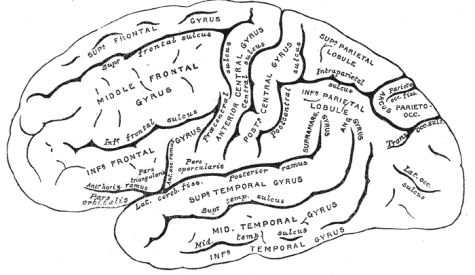
First, during reading, the right hemisphere was not as active as anticipated, which opens the possibility that there were qualitative differences inBrain image–Pars triangularis the nature of the comprehension we experience in reading versus listening. Second, while listening was taking place, there was more activation in the left ­hemisphere brain region called the pars triangularis (the triangular section), a part of Broca’s area that usually activates when there is language processing to be done or there is a requirement to maintain some verbal information in an active state (sometimes called verbal working memory). The greater amount of activation in Broca’s area suggests that there is more semantic processing and working memory storage in listening comprehension than in reading.

Because spoken language is so temporary, each sound hanging in the air for a fraction of a second, the brain is forced to immediately process or store the various parts of a spoken sentence in order to be able to mentally glue them back together in a conceptual frame that makes sense. “By contrast,” Just said, “written language provides an “external memory” where information can be re­read if necessary. But to re­play spoken language, you need a mental play­back loop, (called the articulatory­phonological loop) conveniently provided in part by Broca’s area.”

This makes a great deal of sense to me and is consonant with some other things that I’ve read about how literacy accompanies the general atrophy of personal and cultural memory. Oral cultures require much more prodigious uses of memory, and I would suspect that people who train themselves to listen well–perhaps like those who listen to audiobooks!–are also developing memory capacities. At least, following this study, the short term memory would have to become much more exercised and probably developed by the consistent effort to remember the passing sounds and having to fit them together into meaningful units of language.

(Side note along these lines, my colleague who is visually impaired has a prodigious memory of detail of what seems to me to be almost everything. By comparison, I remember vaguely that an idea is found somewhere in a particular part of a book that I underlined at one point).

Following this out, and thinking through my earlier statements that what we need is more careful consideration of what kinds of things are lost and what kinds of things are gained through certain kinds of reading (or listening), we might well say that if we are entering into what is called a secondary oral culture this could signal good things for memory.

At least this would be the case if the culture that’s developing is one that would put a high premium on listening skills. I’m not really sure that it is given the dominance of the visual on the internet and in film and television. Still, it’s and interesting idea. It would be interesting to figure out if people who listen to audiobooks in a regular and devoted fashion show more highly development memory capacity–either short or long term–than those of us who spend more time reading.

This would leave for further study the question of what reading develops in the brain. I suspect it would be something along the lines of analytical skills, but I’m not sure. It also may explain the stereotype of the absent-minded professor. Maybe we really are absent-minded because in being devoted to books our short-term memory has atrophied!

Miscellany: More Librivox, More Emerson, More Diarrhea

Ok, to get to Diarrhea, you have to read to the end of this post.


MORE LIBRIVOX

I got some very good comments from “Hugh” who is a poobah of some sort over at Librivox. You should go read his comments yourself at my post, “Listening as Reading,” but a couple of excerpts here since I want to think about what he has to say. (And, hey, it’s a cheap way to come up with a post when it’s late at night and I’m having trouble collecting my thoughts.

Says Hugh:

“in pre-radio/tv/recordings days, and when books were relatively expensive, many books were actually written to be read aloud – it was a form of family entertainment: the family & friends gathered around papa (or mama) who read at the fireplace. dickens is a particular example. of course an mp3 audio version read by a stranger isn’t the same thing, but it is another experience of literature, one that has it’s own particular richness, and weakness.”

Yes, a good thing to point out, continuous with my general observation that for the longest part of human history reading was primarily about reading aloud, not reading silently. I’m not quite sure I would go completely down the road that books in the nineteenth century were written to be read out loud. This misconstrues the case. But it is the case that they were commonly read out loud, and there was a great deal of fluidity between the oral presentation and the written. Dickens is a good representative of this fluidity. I’m not quite sure I would say Dicken’s wrote his books in order to read them out loud. He wrote them in order to get them published serially in magazines. But it is absolutely true that he often rewrote and rewrote passages over and over in order to achieve certain kinds of emotional effects in his listening audience. Thus there’s a deep connection between the orality of the word and the writtenness of the word. A fluid interchange of sorts. I still tell students they ought to read their work outloud to themselves in order to hear how things sound. This can be a good guide to the kind of rhetorical affects you are achieving.

Says Hugh again:

“-we are primarily a platform to help people record audiobooks (with an objective of making a complete audio library of public domain books); that the public can download and listen to our files is in a way just a fortunate by-product of what we do.

-and while our collection’s “quality” is, by design, all over the map, the volume of good and extraordinary recordings is daunting…it’s a matter of finding the good stuff. Here are some recommendations:

http://ask.metafilter.com/79067/Librivox-Recommendation”

This last is very helpful, though I wish the list was more organized. I clicked through some of the recommended readings and–on the basis of very short sampling–most of them are superior to some of the detritus I’ve waded through the past few times I’ve strolled through Librivox. I wish that Librivox would provide some kind of ratings system itself–at least one that recognized the popularity of different readings–though I suspect that this would counter the dream of pure democratic participationism that drives this kind of thing on the web.

As for Librivox being primarily about the readers and not the listeners, something Hugh tells me in a second comment, I’m not so sure. (I think Hugh didn’t think it was fair of me to criticize many of the readers for being…well…Dull. Or annoying. Or both). To some degree I think he’s suggesting that Librivox is really more like a blog service where readers can express themselves via recording. Well, OK. But the thrill of doing so is that people will listen in, yes? I mean, if it wasn’t for the fact that people might actually look at this blog, why not just keep it on my computer instead of publishing it for all the world to sneer at.

It’s also the case that in reading a published work, the reader puts himself/herself in the position of performer/artist who is interpreting the work of another artist. There are a lot of opera singers out there who really ought to spare the rest of us and restrict their renditions of Nessun Dorma to the safety of their shower stalls. On the other hand, I don’t begrudge them the right to perform for the world on YouTube. But if they do, I generally think we’ve got a right and responsibility to Puccini and to Pavorotti to say, “You know, that really stinks pretty badly.” There’s no inherent nobility in performing, contrary to what most Americans seem to think.

But enough. Mostly I’m on Hugh’s side here. I’m glad someone’s doing something like Librivox, even if I don’t want to listen to most of the people doing it.


MORE EMERSON:

I blogged a bit about Emerson today on the blog dedicated to my course on literary theory. Just a bit of that from a post I called “Emerson and the Gods of Reading”:

Along these lines, I think there’s a way in which Emerson’s notions of creative reading are embodied in the way we read now. For Emerson, reading was a threatening activity precisely because we were always tending toward submission and passivity, always on the brink of substituting someone else’s creativity or knowledge for our own. This would mean we had failed to be “The Poet” we were meant to be and in fact are if we would only realize it. Instead, reading only exists to a purpose if it inspires us to more writing of our own. Reading must always give forth in to new and different expression, or it is worthless. Reading that absorbs and doesn’t give forth in new creativity, reading that doesn’t come to an end in writing is destructive to rather than an enhancement of our humanity.

What is this if not the reading ethic of blogging. Emerson, the familiar spirit of Facebook culture. Reading for us now is only meaningful if it gives forth in self expression. Indeed, texts become primarily a means of further self-expression. I read other texts or find other materials on the internet in order to “blog” them. The verb in this sense means partly to write about them, but blogging something also connotes making it one’s own, making it an opportunity for self-expression, an opportunity to speak.

I don’t think I want to deride this outright. NPR had someone–maybe the founder of Facebook-?!-on today with a little piece on the glories of connectivity available through self-exposure. It seemed a little facile–by exposing my darkest secrets on the net I’ll be able to develop authentic relationships with people I’ve never met. Umm, maybe. If this were true, why not go expose yourself to your next door neighbor. Still, it is the case that kinds of connections are built through this incessant speaking. Ultimately, for Emerson, our seeking expression at the expense of reading was not a form of self-aggrandizement, though it’s often taken for that. It was ultimately a way of connecting to a broader world. In Emerson’s view, if all people would become The Poet they were meant to be, all the world would be saved and we would all be one. It’s ultimately a platonic evangelical Christian vision without Christ in some sense. If we’ll all individually get right with Jesus, we’ll all be one. The internet says something vaguely similar. If we would all just keep looking for ways of expressing ourselves through the texts of others, we will all be connected through what is, after all, the World Wide Web.

I have no idea if this makes any sense, but it seemed profound at the time. Parents are paying for this stuff. It better be.


MORE DIARRHEA

Ok, this doesn’t refer to the stinky liquid spew that this post is fast becoming. Or not only that.

I often tell my English students that there is a magazine about everything, so they can take their writing skills and find a job anywhere in the world. The last part is a department chair’s fantasy, but there really is a journal about everything in the world.

Witness “Dialogue On Diarrhea.” Yes, there is a journal covering everything you wanted to know about loose stools. Ok, I should say there used to be a journal. In the words of the web site:

Dialogue on Diarrhoea was an international newsletter on the control of diarrhoeal diseases published by Healthlink Worldwide (formerly AHRTAG), a UK-based non-governmental organisation.

The first issue was published in May 1980.The last of a total of 60 issues, during its 15 years, was published in May 1995.

Published four times a year, Dialogue on Diarrhoea offered clear, practical advice on preventing and treating diarrhoeal diseases. It also acted as a forum for readers to exchange ideas and share experiences.

Umm, just what kind of experiences are we sharing here exactly?

Anyway, the print newsletter is no more. And now instead we have “Dialogue On Diarrhea Online”. So the next time you have this problem, you’ll know where to head. Besides the bathroom. I mean.

And, as we think of it, doesn’t this point to the last important remaining geography in which print remains triumphant. Bathroom reading. It’s a bit tragic that the diarrheatics among us will now have to carry their Kindles to the bathroom in order to keep up on the latest and share their experiences. On the other hand, with laptop in hand they will now be able to share their experiences in a much more intimate and immediate way.

Ok, I’ll stop. I’m sure I’ve now insulted all the chronic diarrhea sufferers who regularly read this blog. And none of my students will ever get an internship with this website. That’s for sure.

Final note: I thought for sure I would be the only person on WordPress who used the word “diarrhea” in a tag. No. There are hundreds of us.

Isn’t the web a wonderful place?

Books in a material world–Bookporn and more

I was talking to a couple of students yesterday, one of whom wants to be a librarian because she loves “being around books.” A little bit of a Scrooge, I guess, I told her she better get used to being around computers since that was the real future of libraries, taking her back a bit with my revelation that the library budget at our own college had just been required to move $50,000 from book purchasing to database collections. Small change for a lot of places, but for my smallish college $50,000 is nothing to sneeze at. Indeed, I’ve already felt the squeeze just a bit since English used to depend on the general fund of the library to order contemporary novels and poetry–which we ordered gleefully and at will. Probably partly on the erroneous assumption that availability would somehow translate into their being taken off the shelf. Well, that fund hasn’t disappeared, but we’ve been asked to order not quite so gleefully, and not quite so at will. A concrete manifestation of how a response to a perceived technological need–real or not–will gradually determine or close the future of the book as we’ve known it.

Still, my student was not dissuaded. She feels that books will always be with us because we love their physicality. There’s that body of the book theme again, and there’s something real about it that has to be thought through. Reading is not simply a mental process of decoding letters, not simply a process of getting information off a page or screen and in to our brains. It’s a physical activity to which we attach all kinds of cultural and personal meanings, a kind of spiritual reverence that the attach to the being of books that we cannot yet attach to computers.

We imagine computers too much as tools, and emphasizing their efficiency does too little to address the tactile, even the olfactory meanings that we attach to book culture. The other student who was with us was very intrigued by Amazon’s Kindle, but even she paused and said, “I became an English major when I looked out from the balcony and saw the stacks and stacks of books.” The physicality of books inspires a reverence, whereas the efficiency of computers inspires…what?…a sense of efficiency?

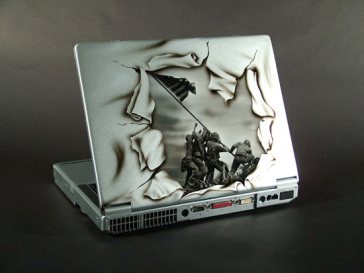
Indeed, I’m intrigued by the growing tendency of laptop users to try and personalize their laptops–recreating their essential impersonality through a kind of personal graffiti. There’s a great newstory on this phenomenon at c/net, along with Personalized laptop.  One of my favorites. 

We do this with books, it seems to me, but not in the same way. We don’t feel compelled to personalize the cover of a book, and our markings in a text are more to memorialize a reading experience than to carve a human personality into what is, after all, a machine. Books are a technology, but at the least we have learned to experience them as extensions of the body rather than as tools.

Along these lines, I’ve been running in to a lot of images of books again. Rachel Leow over at A Historian’s Craft celebrates the one year anniversary of her blog with BookPorn #27, a couple of fabulous images of the Library of the Musee Guimet. Says Rachel:Library Musee Guimet

“There’s a kind of hushed atmosphere when you walk in: the lights are dim and people shuffle about, struck silent with reverence, or perhaps the disconcerting, all-pervading pinkness of the walls and columns. The books lie, untouchable, behind their wire cages, and the smell of old paper lingers about well after you step, blinking, back out into the fluorescent glare of the exhibition outside.”

Nice writing, Rachel. And happy birthday. It seems to me that Rachel gets at this notion of the importance of the physicality of books inspiring a kind of reverence, something I attach even to my tattered paperback crowded onto basement shelves, but which I don’t really attach to my computer. Like nearly everyone else, I’m sure I spend a great deal more time on my computer reading anymore than I do in actually reading books. Like most white collar workers I’m chained here all day, and then blog all night. But feeling reverence for my computer feels a little bit like feeling reverence for my screwdriver. Not impossible, I guess. I’m sure many a carpenter has a deep feeling for his screwdriver. But I also guess that mostly such carpenters are considered weird by everyone else.

Books are tools, but it’s a mistake to think that what counts in reading them is the toolishness. If we only focus on the instrumental qualities associated with text delivery, there is no question that the e-book-o-philes among us are right to scoff at fears of digital libraries. Still, culture is more than instrumental, and always has been.

Along these lines, there’s a humorous and very interesting Giuseppe Acrimboldo Librarianskewering of those of us who are book fetishists over at if:book. Chris Mead has written a song about the history of books along with a lot of great images. My favorite is this from Giuseppe Acrimboldo, “The Librarian.” I love it. The human is text, no a book, a library. What I’ve always thought anyway. I am my books. I don’t yet say, I am my computer. Will I ever.

Chris takes the opportunity to skewer the-sky-is-falling attitude that some of us bring to the changes that are going on

“words: written in silence, muttered in monasteries
have been sung, shouted, acted – now by digital industries

broadcast and mixed for our burgeoning multiculture,

but circled by many a gloom-laden vulture

crying “R.I.P. books: doomed to extinction
by some blinking e-inky, i-evil invention”.
The word spreads and
changes; that’s my belief.
What next for the book?
The future lies overleaf.

Very nice. Dr. Seussian. Ok, only almost. Still, Chris’s poem/song emphasizes an assumption that I think is flatly wrong. That the technology of reading is essentially inconsequential for the act of reading itself. This is clear explicitly in the opening part of his poem.

“Books are what a society carries its words in
and words have been written on stone, silk, slate, parchment,
wax, clay, screen and skin,”

This is superficially true, but the assumption seems to be that reading is only about decoding letters, and books–or parchments or scrolls or screens–are merely delivery systems that are more or less equal except in the efficiency with which they can deliver text to readers. This is flatly false, as any historian of books and reading could point out in half a breath. In some sense, when we went from reading scrolls to reading codexes and then books, the changing technology changed the meaning of the act of reading, not just the techniques of the act of reading. It is this changing meaning that is crucial to try and understand. Techniques of text delivery can merely be learned through users manuals. Meanings and their attendant ways of being human are less easily learned and unlearned. We ought to pay attention to what those changes might be.

Final note: I’m sure everyone’s familiar with this video, but it still makes me smile. It’s a reminder that all of the cultural associations we have with books had to be learned. There’s nothing natural about our sentimental attachments to books. As kids, we’re all in the position of the monk at a loss here, not knowing which way a book sets on the table, which way to turn the pages. Culture is learned. That doesn’t mean the demise of books should be sniffed at. But culture is learned.

Lolita’s Bedroom—Or why marketing directors should read more novels.

What young family wouldn’t hold out the image of a sexually precocious 12-year-old as the image they hope their young daughters will have dancing in their heads as those innocent heads hit the pillow at night. The London Times reports that Woolworths has had to pull a certain ill-named piece of bedroom furniture from the market after a widespread internet protest by offended mothers.Woolworth’s Lolita bed

“The Lolita Midsleeper Combi, a whitewashed wooden bed with pull-out desk and cupboard intended for girls aged about 6, was on sale on the Woolworths website for £395.”
……

“Whereas many mothers were familiar with Vladimir Nabokov and his famous novel, it seems that the Woolworths staff were not. At first they were baffled by the fuss. A spokesman for the company told The Times: “What seems to have happened is the staff who run the website had never heard of Lolita, and to be honest no one else here had either. We had to look it up on Wikipedia. But we certainly know who she is now.””

Lolita book cover full sizeAs my colleague, Matt Roth, suggests it’s hard to know which is worse, that they made the bed in the first place, or that they didn’t know about one of the iconic literary figures of the past half-century.

However, given the international state of our reading crisis, perhaps its worth asking how so many mothers even knew who Lolita was. I wonder if they read the book or saw the movie.

In any case, cultural illiteracy will get you nowhere.

Still, I’m just a tad bit suspicious about Woolworth’s protestations
According to the same Times article, the Brits business community has a penchant for salacious pitches to the preadolescent crowd:

“In 2006 Tesco was removed its pole-dancing kit from the toys and games section of its website after it was accused of destroying children’s innocence.”

A pole-dancing kit. What every nine-year old girl wants for Christmas.

Similarly the BBC reports the following:

“In 2005, WH Smiths came under fire for selling youngsters stationery bearing the Playboy bunny – a symbol of the pornography empire.

“Prior to that Bhs decided to withdraw its Little Miss Naughty range of padded bras and knickers for pre-teen girls after attracting criticism.

I’m not sure what’s naughty about knickers. I thought it was just a weird British word for underwear. And according to the grammar they were padded anyway. Sounds uncomfortable to me. Still, I draw the line at padded bras for pre-teens.

For the record, I did a Google search on women named Lolita. Turns out there are thousands of them. And not just Lolita Davidovitch. And most of them aren’t even on sex sites. I’m sure that the Woolworth’s bedrooms set was probably named after the owner’s great aunt Lolita in Birmingham. And after all, it’s not pole-dancing. Come on people, lighten up!

Anyway, though I’m appalled at the marketing division’s literary illiteracy, isn’t it a great thing to see literature making a difference in the world.

More solid evidence that the NEA is correct in saying readers are more likely to be social activists. 😉

Listening as Reading

Some more about audiobooks today.

I still remember my shock and dismay a couple of years ago when I clicked on to the New York Times book page and found an advertisement of much a younger, more handsome and vaguely Mediterranean-looking young man who oozed sex appeal as he looked out at me from the screen with headphones on his ears.

“Why Read?” asked the caption.

Surely this was the demise of Western Civilization as we knew it, to say nothing of being a poor marketing strategy for a newspaper industry increasingly casting about in vain for new readers.

Nevertheless, it seems to me that audiobooks have developed a generally sexy and sophisticated cache for literary types that other shorthand ways to literature typically lack. As an English professor, I’ve been intrigued lately that a number of colleagues around and about have told me they listen to audiobooks to “keep up on their reading.” To some degree I’ve always imagined this as a slightly more sophisticated version of “I never read the book, but I watched the movie,” which has itself been about on a par with reading Sparknotes.

However, as I mentioned in yesterday’s post, another colleague recently took issue with my general despairing sense that the reading of literature, at least, is on the decline, no matter the degree to which students may be now reading interactively on the web. “Yes,” she said, “but what about audiobooks?” She went on to cite the growth in sales over the past few years as evidence that interest in literature may not be waning after all.

My immediate response is a little bit like that of Scott Esposito over at Conversational reading. In a post a couple of years ago Scott responded to an advocate of audiobooks with the following:

Sorry Jim, but when you listen to a book on your iPod, you are no more reading that book than you are reading a baseball game when you listened to Vin Scully do play-by-play for the Dodgers.

It gets worse:

[Quoting Jim] But audio books, once seen as a kind of oral CliffsNotes for reading lightweights, have seduced members of a literate but busy crowd by allowing them to read while doing something else.

Well, if you’re doing something else then you’re not really reading, now are you? Listen Jim, and all other audiobookphiles out there: If I can barely wrap my little mind around Vollmann while I’m holding the book right before my face and re-reading each sentence 5 times each, how in the hell am I going to understand it if some nitwit is reading it to me while I’m brewing a cappuchino on my at-home Krups unit?

It’s not reading. It’s pretending that you give a damn about books when you really care so little about them that you’ll try to process them at the same time you’re scraping Pookie’s dog craps up off the sidewalk.

I have to grin because Scott is usually so much more polite. Nevertheless, I cite Scott at length because viscerally, in the deepest reaches of my id, I am completely with him and he said it better than I could anyway.

However, it’s worth pausing over the question of audiobooks a little further. I don’t agree with one of Scott’s respondents over at if:book, who describes listening to audiobooks as a kind of reading. But it is an experience related to reading, and so it’s probably worth parsing what kind of experience audiobooks actually provide and how that experience fits in with our understanding of what reading really is.

As I’ve said a couple of times, I think we lose sight of distinctions by having only one word, “reading,” that covers a host of activities. I don’t buy the notion that listening can be understood as the same activity as reading, though the if:book blog rightly points out the significance of audiobooks to the visually impaired. Indeed, one of my own colleagues has a visual disability and relies on audiobooks and other audio versions of printed texts to do his work. Even beyond these understandable exceptions, however, Scott’s definition of reading above privileges a particular model of deep reading that, in actual fact, is relatively recent in book history.

Indeed, going back to the beginnings of writing and reading, what we find is that very few people read books at all. Most people listened to books/scrolls/papyri being read. TheChrist reading in the synagogue temple reader and the town crier are the original of audiobooks and podcasts. In ancient Palestine, for instance, it’s estimated that in even so bibliocentric a culture as that of the Jewish people only 5 to 15% of the population could read at all, and the reading that went on often did not occur in deep intensive reading like that which Scott and I imagine when we think about what reading really is. Instead, much of the experience of reading was through ritual occasions in which scriptures would be read aloud as a part of worship. This is why biblical writers persistently call on people to “Hear the Word.” This model of reading persists in Jewish and Christian worship today, even when large numbers of the religious population are thoroughly literate. See Issachar Ryback’s “In Shul” for an interesting image from the history of Judaism.

Indeed, in the history of writing and reading, listening to reading is more the norm than not if we merely count passing centuries. It wasn’t until the aftermath of the Reformation that the model for receiving texts became predominantly focused on the individuals intense and silent engagement with the written word of the book. In this sense, we might say that the Hebrews of antiquity weren’t bibliocentric so much as logocentric—word-centered but not necessarily book-centered.

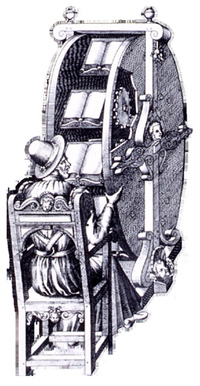
Along these lines, the model of intense engagement—what scholars of book history call “intensive reading”—is only one historical model of how reading should occur. Many scholars in the early modern period used “book wheels” in order to have several books open in front book wheelof them at the same time. This is not exactly the same thing as multi-tasking that Scott abhors in his post, and it’s not exactly internet hypertexting, but it is clearly not the singular absorption in a text that we’ve come to associate with the word “reading.” “Reading” is not just the all-encompassing absorption that I’ve come to treasure and long for in great novels and poems, or even in great and well-written arguments. Indeed, I judge books by whether they can provide this kind of experience. Nevertheless, “Reading” is many things.

But to recognize this is not exactly the same thing as saying “so what” to the slow ascendancy of audiobooks, and the sense that books, if they are to be read at all, will be read as part of a great multi-tasking universe that we now must live in. Instead, I think we need to ask what good things have been gained by the forms of intensive reading that Scott and I and others in the cult of book lovers have come to affirm as the highest form of reading. What is lost or missing if a person or a culture becomes incapable of participating in this kind of reading.

By the same token, we should ask what kinds of things are gained by audiobooks as a form of experience, even if I don’t want to call it a form of reading. I’ve spent some time recently browsing around Librivox.org, which I’ll probably blog about more extensively in a future post. It’s fair to say that a lot of it turns absolutely wonderful literature into mush, the equivalent of listening to your eight-year-old niece play Beethoven on the violin. On the other hand, it’s fair to say that some few of the readers on that service bring poetry alive for me in a way quite different than absorption in silence with the printed page. As I suggested the other day, I found Justin Brett’s renditions of Jabberwocky and Dover Beach, poems I mostly skim over when finding them in a book or on the web, absolutely thrilling, and I wanted to listen to everything I could possibly find that he had read.

This raises a host of interesting questions for a later day. What is “literature.” Is it somehow the thing on the page, or is it more like music, something that exists independently of its graphic representation with pen and ink (or pixel and screen). What is critical thinking and reading? I found myself thrilled by Brett’s reading, but frustrated that I couldn’t easily and in a single glance see how lines and stanzas fit together. I was, in some very real sense, at the mercy of the reader, no matter how much I loved his reading.

This raises necessary questions about the relationship between reader and listener. Could we tolerate a culture in which, like the ancient Greeks and Hebrews, reading is for the elite few while the rest of us listen or try to listen. At the mercy and good will of the literate elite—to say nothing of their abilities and deficiencies as oral interpreters of the works at hand.

More later

Body of Knowledge

Since getting started on this blog I’ve been thinking a lot about how we image reading, and more broadly knowledge. The classic picture of a man or woman, body slumped in a chair or reclining on a bed or laying under a tree, head inclined in to a book. This is our sense of what reading is, and in a larger sense of how knowledge is gained and demonstrated.

It’s a difficult image in some respects because, in fact, we can’t really tell whether reading is going on at all simply from the fact of its physical representation. For all we know the person who seems as if they are half-asleep may in fact be half-asleep. Think of the association of reading fiction with being in dream worlds. The act of reading itself, especially silent reading, is in some respects unimage-able. We can’t see the translations that occur between marks on a page that become letters and words and then are associated with meanings in the mind. We accept on trust that the student with her book open in the back of the room is, in fact, reading, rather than drifting into a half-world as we lecture on at the front of the room.

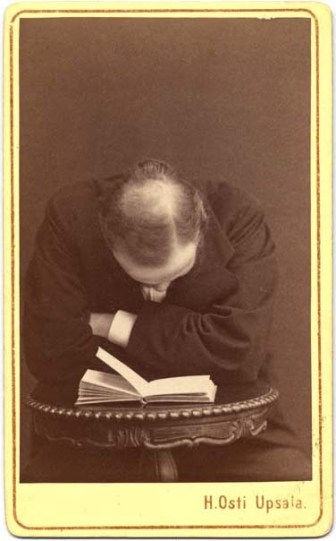
I think working on the blog has made me acutely more interested in the physical image of reading. How could I choose relevant images for a blog taken up with something so ethereal as reading? My avatar came from a library at Upsala University (I think, I can’t remember). I was lasande_man.jpgtaken by the classic image of the hunched body at the desk, but also that it was obviously a middle-aged man, somewhat monkish. Finally, that you couldn’t see the face—which seemed to me to be something about reading and something about what I wanted the blog to be. Reading is a kind of facelessness, a kind of disappearance of the self that is itself enriching and expansive. This is why I think all the focus on reading as creativity and self-assertion among so many poststructuralists—people like Roland Barthes who want to turn reading in to an alternative form of writing—is missing something that’s relatively essential and important. The disappearance of the self in reading is precisely what we desire. The loss of self is goal, not dread outcome of the process of reading.

One thing that struck me in searching for an appropriate avatar—which I pursued by searching Google images—is that images of reading are almost exclusively associated with books. Reading means, so far as the visual imagination is concerned, reading books. I sifted through a couple of dozen pages of images and came up with not one image of a computer or a computer screen. Indeed, realizing that I was interested in pursuing the conjunction of reading and writing, I thought it was a little ironic that my wordpress template has a pen at the top. Of course, I have the option of putting in a computer keyboard, and tried to find one, but perhaps the point is made. In our imaginations, reading and writing is still a matter of pen and paper. As I said yesterday, my colleague is not even certain that what we do on things like this blog is properly called writing. Why call it blogging if it is writing plain and simple. Similarly, we surf the web, we don’t read the web. It’s a new and different process, for which we don’t have adequate visual images.

My same colleague objects that we won’t go with electronic books because we like the physicality of things. Well…I didn’t point out to her that, in fact, Kindles and Sony readers and my 17-inch Macintosh computer screen are all physical to a fault. But somehow we imagine that computers have no physical presence. Without physical presence they cannot image that most insubstantial of things, the reading process. In actual fact, I think that we have constructed a certain kind of “physicality” that we associate with books, while we are only beginning to develop a sense of the physicality of computers.

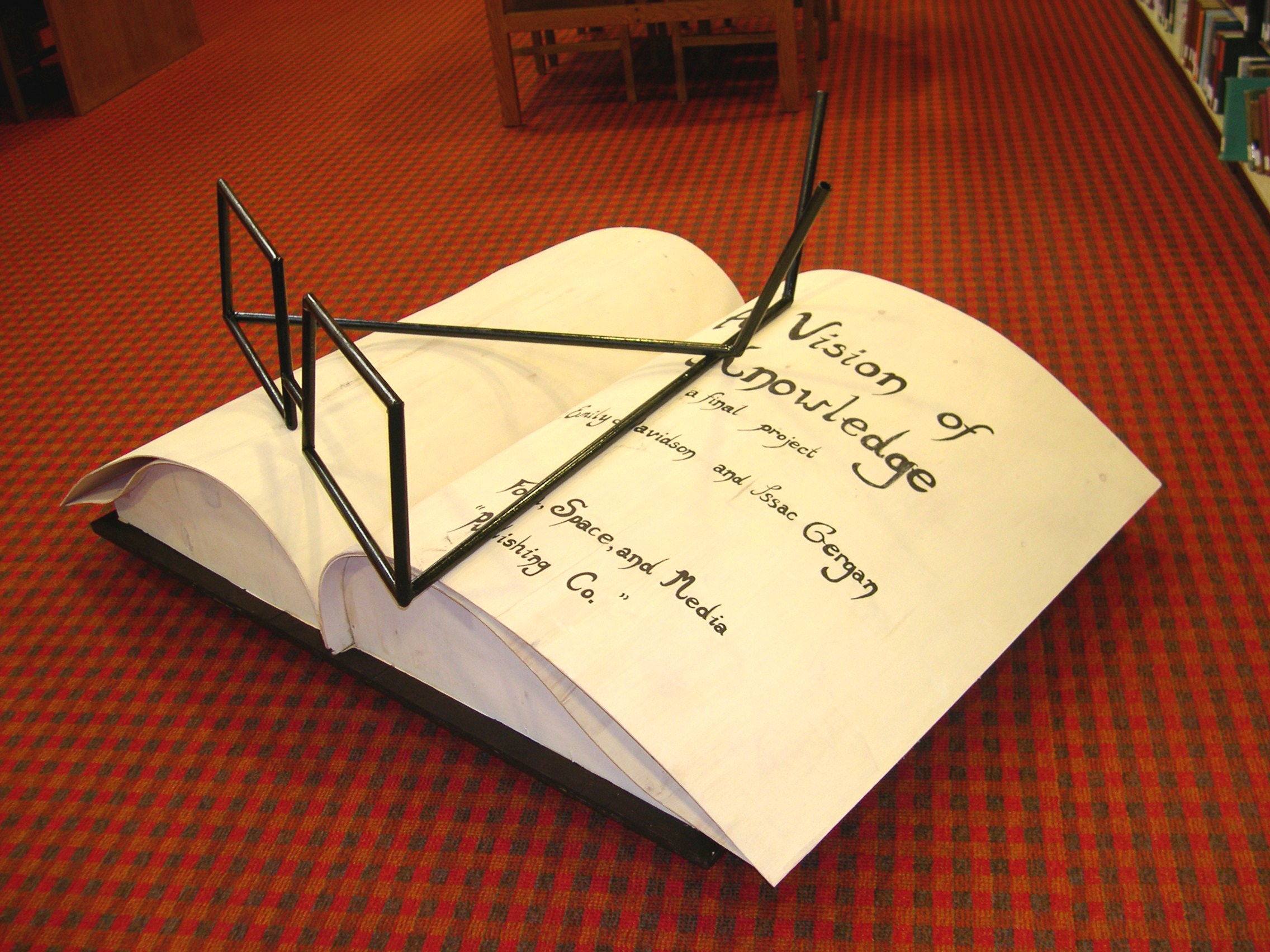
Along these lines, our library at school is hosting a very nice work of art by a couple of our students. A book with reading glasses. I’m having trouble optimizing this to fit on the page, but you can access ” Vision of Knowledge” by clicking on the title. My general sense is that computers make both books and reading glasses anachronistic. We can read on the Internet, and if the text is too small, who needs glasses. Just hit text zoom.

The other interesting thing about this image is the text itself, which, of course, we read. “A vision of knowledge.” My general sense is that despite the tremendous emphasis on the Internet as a resource for knowledge and learning, we continue to imagine, to have visions of knowledge primarily through our cultural repertoire related to books. Again, a quick google search for images related to the word “knowledge” called up dozens of pictures of books, various diagrams of the brain, and a lot of variously dull and variously interesting charts and REading Womengraphs. One thing that didn’t come up were images of computers. I scrolled through about 100 and some odd images before I got to any image of a computer at all.

I’m not sure that there’s any great lesson to be drawn here. However, I think that if we can’t picture something, this means that we don’t quite know what to do with it, that we don’t quite know what it is, at least for us. The digital world is inescapable, but at least with regards to reading and knowledge we still don’t know exactly what it means, how to imagine ourselves as a part of it.

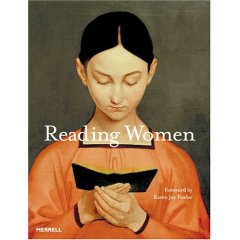
Side note: There’s a lot of stuff out there on the gender of reading, of course. There’s an absolutely fabulous book of images entitled “Reading Women” that I recommend highly. At one point I thought ALL images of reading were women, though this, of course, isn’t true at all.

Stop the hype! Inflationary reading crisis calls for interest cut

One of the features of our current reading crisis is that no one can agree if it even exists.
Jennifer Shuessler at the Nytimes points
with a notable degree of exhaustion at the fact that everyone and their mother seems to be talking about a crisis in reading. The tendency is, I suppose, to be jaded and assume that there is no crisis whatsoever, that it is all hype. A problem in a culture of hype is that when there really is something to pay attention to, we can’t distinguish between the reality and hype. Because we know there is hype, and can’t be sure there’s reality, we tend to think that every new publicized concern is more an issue of publicity than concern.

Shuessler points to Ursula LeGuin’s essay in Harpers, where she makes the case that serious readers have never been more than a minority anyway, so why worry.

“Self-satisfaction with the inability to remain conscious when faced with printed matter seems questionable. But I also want to question the assumption—whether gloomy or faintly gloating—that books are on the way out. I think they’re here to stay. It’s just that not all that many people ever did read them. Why should we think everybody ought to now?”

This strikes me as an instance of jaded cynicism rather than ethical or cultural seriousness unless one views the reading of books as, already, a cultural option of little personal or social consequence. What, Le Guin would also say, then, that it makes no difference that millions of people have a literacy level that can, at best, consume comic books? So they can’t read Toni Morrison? Who cares? Well, I guess this is a position.

More seriously, Shuessler points to Caleb Crain’s blog that points out the many and diverse statements of readerly crisis that have been ongoing throughout the 20th century. Indeed, as I’ve suggested on this blog before, it’s possible to argue that imagining reading in crisis is a condition of reading in Western culture. How those crises are imagined may say a great deal more about the culture than they say about reading, but it is interesting nonetheless. In earlier centuries people worried that too many people were reading, then we believed that the wrong people were reading, then we worried that people read the wrong books. In the latter part of the 19th century and early part of the 20th century, sociologists worried that people read too much, especially men. Since then, we’ve worried that people weren’t reading enough, a crisis that continues apace with renewed vigor in our own era.

I picked up the following titles from quick survey of article titles in the Saturday Review of Literature from mid-century. With a few adjustments, we could imagine them all coming out of interpretations of the latest NEA study.

“Why is it so difficult to interest reading public in good books?” (December 1 1934) p. 324

(Of course, now we are mostly worried about getting them interested in reading books at all. Even Rush Limbaugh. Bill O’Reilly? Please? Anything to ease my mind.)

“Bookless mind.” (November 10 1934) p. 272

(This is absolutely my favorite)

“Influence of books on people who do not read.” (July 24 1937) p. 13.

(I’m assuming this works something like radiation. Rub up next to me and let my literacy rub right off on you.)

“Can college graduates read?” (July 16 1938) p. 3-4+

(The resounding answer in 2007 tends to be no.)

“What a capitalist reads [one man’s literary meat].” (December 4 1943) p. 12-15

(No, I think this is my absolute favorite. I wonder, what is one man’s literary poultry? fruits and vegetables? A new Borgesian system of book classification is in the offing)

“Only half of us read books.”(August 5 1950) p. 22

(So many???)

“How to get time to read a book.”(September 29 1951) p. 5

(And this was before the internet, ipods, and tivo. It truly is miraculous we read at all if they worried about this in an era with three tv channels in black and white)

“Don’t Americans read or write? . “(July 14 1951) p. 24-5.

(No, maybe this is, after all, my truly absolute favorite. Did Americans in 1951 really care what people in Lahore, Pakistan thought about us . This was before the bomb and Osama bin Laden, after all.)

As with hype, the recognition that reading has always been in crisis mode tempts us to think there is no crisis to worry about. Perhaps so. I’m more intrigued by why it is that reading must always be an occasion for crisis. Why have cultures always been so determined that reading is fenced in with all the right cultural taboos or mandates: done in just the right amounts, done by just the right people or by all the people, done with just the right books, carried forward in just the right ways—whether through academic classrooms or community enhancing book clubs.

One tentative hypothesis works better for theories worrying about social control. Reading’s essential isolation means that it must always remain an issue of concern and crisis for human sociality. I say essential isolation, because reading is always an act of the individual mind decoding for oneself. Even when one is reading aloud to others, listeners must affirm an act of faith that what is being read is what is on the page—easier in our age. Not so easy in antiquity where, for instance, in ancient Israel some towns were lucky to have even one person read. Reading’s essential isolation calls in to question or puts our necessary human sociality in to question.

Still, this works better for those eras that worried that the wrong people were reading, or that people were reading too much, or that people were reading the wrong things. Maybe we are in the ironic position in our own era of having become comfortable with the ways we’ve negotiated what was formerly a form of textual chaos. The book has been more or less tamed? The new chaos, the new threat, is the uncontrolled proliferation of text on the internet?

I’m not sure I go with this. A thought experiment. I still think books are less tame than they are sometimes assumed to be by digital utopians. I have yet to be changed by a web page in the ways that I have been changed by dozens of experiences with books that I can point to.

Books are old, but they don’t seem tame. Not yet. Not to me.

Pierre Bayard, Guiltless: Or, Why do French Intellectuals Sound Like Clever American Adolescents?

I’ve finally finished reading Pierre Bayard’s How to Talk About Books You Haven’t Read, and thought I’d talk about it, perhaps for the next couple of days as I think through it.

The first thing to say is that every element of the sentence I just wrote is nonsensical in Bayard’s understanding of reading.

First, one can never really claim to having finished reading a book since, in fact, we don’t actually read books in the first place, though we sometimes fool ourselves into believing that we do. Bayard goes to great lengths to point out that every act of reading is foremost and always an act of forgetting; even as we turn the page—indeed, even as we leave one sentence behind for another—we engage in a gradual process of forgetting most of the details of what we have read. What we retain is not so much the book as an image of the book that corresponds to our general sense of books as such, of the vast panoply of possible and actual books in their real and imagined relations. Every book we have read is, in some fashion, an act and creation of the imagination. We, therefore do not really finish books so much as we use books to engage with this great library of the imagination that lurks within.

Second, and following on the first thesis, I could not really claim to have read Pierre Bayard’s book since in Bayard’s conception we do not really read things that are exterior to ourselves, and we fall in to desperate traps when we let books lead us into thinking that we do. He is much taken in the beginning and end of his book by Oscar Wilde’s great essays “To read, or not to read” and the seminal “The Critic as Artist”–essays that Bayard seems, against the implications of his own theory, to have read closely and been affected by deeply. For Wilde, of course, criticism is not so much a secondary act of reading a prior text as it is an independent creation more on the order of autobiography. (Side note: Bayard would be much intrigued by my use of the phrase “of course” in the sentence just finished) Thus, in spinning out these musings on Bayard, I am in fact engaging more properly and obviously in an extended act of autobiography than in any actual reading of Bayard in and of himself. To some degree this is Roland Barthes lite, especially in his essay “The Death of the Author” wherein Barthes champions reading not as an engagement with the prior authority of an author but an act of creation that celebrates the creative capacities of readers.

Third, and following on this second point, I could not really be talking about Bayard’s book, though, of course, I may fool myself into believing that I am Instead, we are always only talking about books we haven’t read. Much in the spirit of Stanley Fish’s discussion of free speech—There’s no such thing as free speech, and it’s a good thing too—we hear Bayard saying. There’s no such thing as reading books, and it’s a good thing too.

Finally, if all this is true, I cannot really be thinking through Bayard’s book since I will mostly, in fact, be thinking through the activity of my own imagination in the first place.

[A pic of Pierre Bayard looking like an insouciant American teenager. No, wait, it’s a photo Pierre Bayardof an American teenager attempting to look like an insouciant French intellectual. No, wait, Bayard attempting to reflect the idealized image American adolescents have of French intellectuals. No, wait….]

There’s a lot to say about Bayard’s book—or rather about the play of my own imagination—and I hope to get to a few of them over the next day or two. But the first thing I want to note is that though this book has been a splash in the United States, it is a thoroughly French book. In saying this, I am exercising one of Bayard’s dicta that understanding the place of a book within the universe of books is more important than reading it. Be that as it may, it seems to me that this book is more important for the French than it is for Americans, but if this is so, how should we account for its popularity, or at least its press, in the United States.

First, what do I mean by the statement that it is a thoroughly French book? Witness Bayard speaking somewhat self-indulgently of his own courageousness in facing down constraints against admitting the real character of our reading.

“The first of these constraints might be called the obligation to read. We still live in a society, on the decline though it may be, where reading remains the object of a kind of worship. This worship applies particularly to a number of canonical texts—the list varies according to the circles you move in—which it is practically forbidden not to have read if you want to be taken seriously.

“The second constraint, similar to the first but nonetheless distinct, might be called the obligation to read thoroughly. If it’s frowned upon not to read, it’s almost as bad to read quickly or to skim, and especially to say so. For example, it’s virtually unthinkable for literary intellectuals to acknowledge that they have flipped through Proust’s work without having read it in its entirety—though this is certainly the case for most of them.

“The third constraint concerns the way we discuss books. There is a tacit understanding in our culture that one must read a book in order to talk about it with any precision. In my experience, however, it’s totally possible to carry on an engaging conversation about a book you haven’t read—including, and perhaps especially, with someone else who hasn’t read it either. ” (xiv-xv)

It’s possible, of course, to imagine certain narrow circles in the United States where people still feel the obligation to have read, and especially to have read certain texts. However, this surely reflects the educated classes of France far more than the U.S., places where literature still really bears a distinct form of cultural capital. But can that be said of any but the narrowest intellectual circles in the United States? With no apparent compunction, Steve Jobs dismissed the idea of developing an e-book reader, simply on the basis that it is a bad business model. No one reads in the United States anymore, so why bother. This hardly sounds like a man worried about the fact that reading is still worshipped in his culture of reference.

Even with academic circles in the United States, the fragmentation of cultural knowledges means that academics simply accept the fact that they will read a great deal that no one else around them will have read. And the increasingly arcane specialization of literary studies means that even those texts we abstractly share as “Must Reads”–say something from Shakespeare–are hardly shared as forms of cultural capital. My having read Hamlet gets me no points with my colleague who is an expert in Shakespeare—so what, he says, have you read the latest biography theorizing the importance of Shakespeare’s lesbian grandmother? My having read or not read Hamlet gives me no cultural capital with my fellow specialists in African American literature. Haven’t read Hamlet? Good riddance. Americans live in a country where presidents glory in their non-reading and have no shame in their literary ignorance. Indeed, such ignorance can be a badge of honor. The crisis of guilt Bayard pretends to address could only be a foreign crisis of little interest to the actual scene of reading in the United States.

This having been disposed of, the inconsequence of Bayard’s second and third constraints on the American scene must be quite clear. In the United States, we are generally pleased if people read at all, so we could hardly care if they read thoroughly—except for the short and inconsequential spaces of time that students spend within English classes. (Even here, I find most English profs are simply relieved if their students have read the texts at all, much less whether they have read them thoroughly) Finally, of course, we don’t generally talk about books anyway except in very narrow circles that have cult-like characteristics, with the fortunate bonus that they are easily escaped. If I get tired of my book-loving pals in the United States, I can go….well….almost anywhere to find people who think that booklovers are a bit queer, in both the old and new senses of the word.  The guilt that Bayard hopes to rid us of is, in the United States, hard to find.

Why then his book’s splash in all the reviews? I think in part this is because the reviews are the last places in America where people seem to care whether Americans read or not, and where what you have read has some consequence. So Bayard is speaking to that increasingly narrow segment of the American population that bothers to read book reviews of academic books and thinks they are worth thinking about. Secondly, however, the book comes just at that moment when we have had an uptick in media concern with the status of reading generally. While Bayard is attempting to unmask the hidden practices of reading in France where reading continues to carry the force of cultural capital, in the United States he speaks not to our guilt but to our self-affirmation. Oh, we’re not really reading books at all even when we are reading them. Good thing I wasn’t pretending in the first place.

Whereas Bayard’s book functions to unmask an ideology of reading in France, it mostly reaffirms the practice of most 18 year olds in general education literature courses. Haven’t read the book. No problem. Read Spark Notes and bullshit your way through. Bullshitting as a valuable adolescent form of creative self-display.

More later, but first a confession. I haven’t really finished Bayard’s book. I have ten pages to go. I’m wondering why I didn’t follow his advice in the first place.