Tag Archives: Reading

Downing Dostoevsky–Book the First, Part I

Ok, so “Book, the First” sounds pretentious and sooo nineteenth century, but given that my summer is going to be devoted to downing, devouring, deciphering, and otherwise drowning in 19th century Russian depressive Fyodor Dostoevsky, it seemed somhow vaguely appropriate.

(Sidenote, somehow I feel that it must be incumbent on me to make some comment on the fact that I HAVEN’T POSTED A WORD IN FOUR MONTHS, but I guess that I have arrived at the conclusion that, hey, it’s my blog and I’ll go dark if  I want to.  Not that anyone has missed me enough to so much as send a single note asking after my health and well-being.  For all any of you knew I had finally passed away of the heart attack that I must so richly deserve since I spend my days eating donuts and sitting at a computer rather than sweating off my sins like a materialist Puritan.  Ok, enough chastisement of my readers–who are apparently non-existent–for their obvious disinterest in my silent spring.  Back to Dostoevsky.)

Why?  you ask.  Why? Let’s say I ask that myself.  I remember a New Yorker cartoon of a guy on a beach being arrested for reading Dostoevsky, evidence of inappropriate summer time reading. (Yes, it is available on the web--check here;  I wonder if the New Yorker will send me a free subscription for all the traffic I will be sending their way.  I am not wondering too hard.)  Seriously though, I had a lot of things on my agenda this summer, and it looks like reading the gray russian will get in the way.  Among other things, it would be nice to go to the opera in Italy, or parasailing in Florida, or learning to kayak in the Alaskan hinterlands.  Who am I kidding, it would also be also be nice to get a massage at the Y and sleep through the night.  These things being mostly impossible or embarrassing, I do have longings to read.  I’ve wanted to spend a summer reading Vonnegut, or, since my late great hero John Updike died, maybe reading all of Updike never gave myself time to get to.  Or maybe J.D. Salinger, or Joyce Carol Oates, or the latest by Toni Morrison.  Instead I am stuck with Dostoevsky, the grey one, whose novelistic worlds i imagine in shades of black and white.

This verb, “stuck,” is, I realize, something of a heresy, isn’t it.  I feel that I should be a good example of a devoted reader, or at least an English prof–not always the case that these two go together.  Isn’t admitting that as the summer starts I can imagine pleasanter things to do with my days than Dostoevsky a little gauche, something like a gourmand or the food critic admitting that he could do without a weekly repast at Sardi’s, and maybe, just maybe, would be Ok with something a little more middle class like Chili’s or TGI Fridays.  Well, summer is for slumming, and reading Dostoevsky in June is a bit like working for a company that insists on dark suits and ties all summer.  Seriousness.

Still, this doesn’t answer the question.  The basic answer to the question posed is that I am directing an honors project for a worthy student who wants to go to graduate school, and will do well.  What he doesn’t yet know is that graduate school will quickly turn reading and all the intellectual and imaginative excitement that he feels for the world of books in to what Dostoevsky is for me, first and foremost: work, an act of labor, a responsiblity, something that must be done.

To be sure, it is always a great and guilty pleasure to get new books, especially when I can get someone else to pay for them since I am, after all, fulfilling the responsibilities of my position. I’ve taken great joy in the many packages that have arrived over the past couple of weeks bearing those weighty Dostoevskian tomes.  A bunch of Everyman’s library editions, and then other editions for those books no one felt were good enough to be canonized.  Among other things, who knew Dostoevsky wrote so much?  The Brothers K and Crime and Punishment.  The canon within the canon.  That should be enough for anyone, and could take a summer in themselves, but the list is almost endless.

And in order to know Dostoevsky, of course, I must read them all.  I have not yet started counting pages, though there are thousands.  I am like the bird in the old story around the campfire at church camp.  I fly and remove a single grain of sand from the highest mountain in the world, flying to the other side of the world to deposit it in my nest, returning trip after trip for a single grain of sand.  When the mountain has been leveled to  a plain, a single day of eternity shall have passed.

Dostoevsky, my summer’s mountain;  my summer’s eternity.
More signs that the world as we know it has come to an end

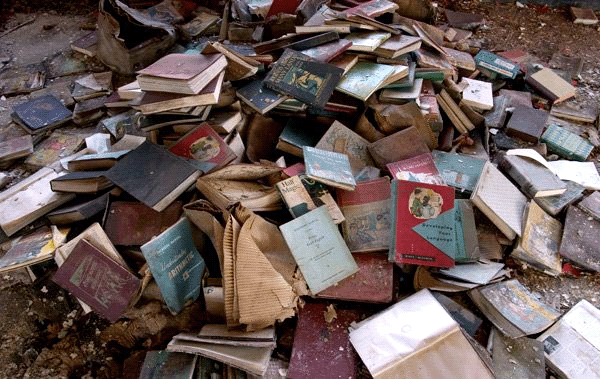
Old news, I know, but I thought I shouldn’t let pass the passing of the Washington Post Book World.  All the old arguments are to be made:  newspapers are cutting their own throats by cutting books since, after all, who reads newspapers anymore other than the people who read books.  On the other hand, my own newspaper, the harrisburg Patriot news pays for a weekly column on graphic novels, but can’t be bothered with reviewing books that depend on words.  Alas and alack.  I am the aficionado of lost causes, the lover of things gone by.  Books among them.

On Reading and Linearity; or, the virtues of disorganization

Ok, I’ve been hardpressed to keep to my commitment to blog at least once a week.  But (he says hopefully) did anyone really miss me.

Gina Barreca has a nice piece over at the Chronicle of Higher Ed, where she talks about her own absolute disorganization as a personal librarian.  According to Barreca, book people fall in to two basic types: the puritanical organizers and the bohemian disorganized.  Both of whom look on the other with something of a pronounced moral disdain.

Personally I think I fall somewhere in the middle.  I am constantly anxious

What my library would look like if I were guilt-free

What my library would look like if I were guilt-free

about the disorganization of my books, which I suppose makes me something of a Calvinist.  Aware of my fallenness away from an ideal order, but also aware of my inability to do anything about.  Oh woeful disorganized man that I am, who will save my books from this body of sin and death.  Perhaps I’ll have to hire a life coach.

I’m actually genuinely interested in how Barreca described the effect of her disorganization on her reading.

So why do I prefer my own disorder to, for example, the brilliant ease offered by the books in my husband’s part of the library — the ones grouped alphabetically within their own periods?

For the same reasons I prefer a real-live bound, paper dictionary or thesaurus to a virtual one, which is the same reason I like libraries and bookstores, which just so happens to be the same reason I like reading promiscuously in the first place: You don’t know what delight an unexpected coupling will offer. There are literally unimagined pleasures arising from the surprising juxtaposition of unlikely words, materials, and texts.

How wonderful to discover what I didn’t know I was searching for, and what fun not to move, always, from A to B.

To some degree Barreca is flogging a distinction made by advocates of hypertext novels etcetera.  Typically, we imagine reading as a linear activity that procedes from beginning to end, and the supposed tyranny of the book reinforces this kind of reading process.  Always getting from point A to point B, no distractions inbetween.

What I like about Barreca’s offhanded comment is it shows how bizarre a picture of reading that actually is.  When advocates of hypertext declaim pompously about the superiority of networked reading in comparison to the tyrannical linear insistence of the book, I always think they have never really read a book, or at least their idea of reading is a game with which I am unfamiliar.

More typically we always read several books at once.  And we don’t read from beginning to end, we skip the dull parts, we read ahead to see if what we’re ploughing through at the moment is really worth it, we attend to the dialogue rather than the description, or vice-versa.  We forget what we read a week ago and start over, or we forget and skip forward to something that looks interesting.  We give up half way through and cast the text aside in despair. The form of the book has always been much more malleable than those hermeneuts of suspicion have allowed.

None of this necessary denies the superiority of hypertext for certain kinds of things, but at least in argumentation, we ought to give accurate pictures of what reading normally entails, so we can know how it is actually changing.

Zits, The Parents Bible

I love the cartoon strip Zits, and am convinced that the creator has a direct line of inspiration from God, or at least is a very good observer of teenage behaviour.  I really love the strip from this Sunday.  Makes me wonder whether the issue with declines in reading comprehension in teenagers and young adults has less to do with internet media per se (there has been some studies done that show that people read a screen differently than they read a page of paper) than with the simple fact of multi-tasking.  People never learn to slow down and read deeply, but do a multitude of things at the same time.

I’m trying to get permission to post the cartoon to my blog, so we’ll see.

Bodies and Books–II

I’ve continued reading Karin Littau’s Theories of Reading.  The second chapter is mostly a schematic History of Reading that will be familiar with anyone who’s read some stuff about that history.  Still, I was struck anew or again by two aspects of that history.

First, Littau rehearses the manifest distinctions between our own (gradually eroding??) views of textual authorship and those of earlier periods.  According to Littau there’s no real way to distinguish the copying of a text from the creation of a text in the Middle Ages (which makes me think that more than a few of our students would be more textually at home in the middle ages than in our contemporary academy).  According to Littau, one reason for the fluidity between “copying” and “creating”  was “‘the common classical and Christian view of poetic inspiration’, in accordance with which ‘the poet does not originate the poem but is the inspired channel for a divine act of creation’ (Selden 1988: 303).  In pre-print culture an author, or auctor, was therefore less a creator of a given work than its assembler, whose rights to the work extended merely to the physical object of the manuscript he or she had produced in the first instance rather than the text as the fruit of his or her private consciousness, as is the case in the copyright law now” (16).

The relationship to our own modes of electronic creation almost don’t bear pointing out.  How many blogs are simply compilations of materials generated elsewhere, and yet we still think of them as something we’ve somehow produced or written, unique only in their assemblage, not in creation?

Still, I’m more interested in the implications of the latter part of the quote.  I wonder especially whether this doesn’t reaffirm the notion that trying to get back to original intention springs from a god-like view of authorship.  However, in the ancient world, the idea that the words were divinely inspired allowed them to be disseminated endlessly into new texts and new assemblages, without worrying fastidiously about the point of historical origin in a particular writer in a particular time and place.  By contrast, our own view of the author as Godlike locates that divine authority in a specific moment of history, to which we have to return to the point of exhaustion.

I wonder how this plays out especially among Christian views of scriptural authority and inspiration.  Our own view of historicism insists that grappling with the historical uniqueness and situatedness of the point of creation–with the author is one can be determined–ironically discards a sense of authorship, authority, and inspiration that would have been common at these earlier points in history. To some degree we make the text captive to history, rather than releasing it to new and unforeseen forms of assemblage and creativity.

Well, this is too much for me to flesh out right now, and I’m not sure it would go anywhere anyway.

We’re really getting desperate now

The Chronicle of Higher Education reports that a man walked into an English class at LeMoyne-Owen College in Memphis Tennessee and robbed 18 students at gunpoint.

Do thieves really have nothing better to do with their time than to rob a bunch of people who are learning how to read and write.  More, these folks will never make any money anyway, as amply demonstrated by their being English majors?

A theoretical side-note.  In my literary theory classes at Duke, I remember fellow students attempting to refute deconstruction by asking, “If someone held you at gunpoint, would you really sit there and deconstruct the gun?”  We may never know, but these students really have the opportunity!  I think the prof should take advantage.  This is one of those infamous “teachable moments,”  by which teachers usually mean “something uncomfortable and really unfortunate just happened, but let’s just turn it in to language!”

“How, John, did you see the gun–as a phenomenon in the moment of its appearance or as sign and symbol of our oppressive political dialectics…No thoughts?…Jane?…Jim…anyone?”

Bodies and Books

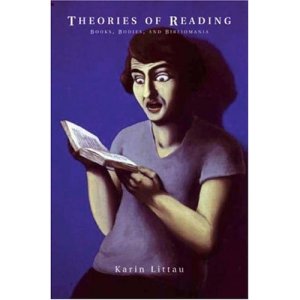
My good friend Julia Kasdorf wrote a book called “The Body and the Book,” broadly taking up the theme of contrast and connections between intellectuality/textuality and embodiment/materiality.  Karin Littau seems tolittau-theories-of-reading be mining a similar territory in Theories of Reading:  Books, Bodies and Bibliomania, a book I just started in on, though Littau is explicitly interested in reading as a bodily or material act, one in which affect more than cognition takes a center stage.

A couple of quotations and impressions from the early going:

Discussing early perspectives on novel reading on page 3–“William Wordsworth saw [the novel providing] ‘deluges of idle and extravagant stories.’ Insofar as ferocious novel reading also fostered disconnected and ‘higgledy-piggledy’ practices of reading (Schenda 1988: 60), it was thought that, ‘if persisted in’, it would have the effect of ‘enfeebling the minds of men and women, making flabby the fibre of their bodies and undermining the vigour of nations’ (Austin 1874: 251).  Like all addictions, those afflicted demanded more and more of the same:  more to read, more excitement, more tears, horror and thrills.  Bibliomania is therefore part of a larger cultural malaise specifically associated with modernity:  sensory overstimulation.  From the perspective of a theory of reading it shows that reading, insofar as it is either bad or good for the reader’s health, is in both instances conceived in physicalist terms.”

I think Littau is right here.  One of my commenters on yesterdays post apparently objected to the notion that we require permission to read.  But I really think I’m write about this for a big swath of Middle America.  There’s a long history of reading being seen as deleterious and slothful.  So in some sense we had to turn it in to a moral activity.  We had to quit reading for pleasure plain and simple and had to start reading for aesthetic experience, or meaning, or as a form or religion, or in order to improve ourselves.  This is deeply endemic to English deparments, and, I think, is one of our biggest failings;  we fail to account adequately for the grosser affective pleasures of narrative art which bring us our students in the first place.  Instead we have to imagine how literature improves their minds in order to justify our budgets.

I think that although I would grant Littau her premises here, that I would go beyond her simple statement of reading’s physicality to point out that these early and later continuing critiques of excessive reading have a moral dimension to them.  The sense that reading might have deleterious effects on the body, or, alternatively, that it awoke the passions and so had a deleterious effect upon self-control, both spoke to a much broader ethos than the simplistic enlightenment division between mind and body really captures.  There is a certain morality of the body associated with Christianity that isn’t captured in the simplistic notion that Christians despise the body.  Rather the body is to be situated and used and built up in particular kinds of ways because it is the temple of the holy spirit, and so forth.  Thus the physicality that Littau notes occasions a moral dilemma for the reader–one, frankly, that I still experience in a way.  Well, I’m reading, but I could really be out helping the homeless, or stumping for Obama, or doing other good works.  Or, more basically, I could be working out and trying to shave off all the pounds that I’ve put on over the course of my 49 years.  I truly suspect that if I read half as much and used the time to work out, I would be healthier (perhaps wealthier, perhaps wiser).  This is a judgment of relative goods, but the critique of reading isn’t as dumb and outmoded as it first appears.  How we use our time is an ethical conundrum, and so the fact of reading isn’t self-evidently justified, however many good moral benefits we may tend to attach to it as devotees of books.

From page 10–“Thus, the bulk of twentieth centiury reader-oriented theories, with some notable exceptions from within feminist theory, are concerned predominantly either with how readers make sense of a text (Culler, Fish, Iser, Jauss, Gadamer), how texts frustrate readers’ attempts at making sense (de Man, Miller, Hartmen, Bloom, Derrida), or how readers resist the meanings of certain texts (Fetterley, Radway, Bobo).  Thus, even when theorists turned away from an overly textualist approach to a more contextual, or politically engaged, approach, the production of meaning is still the primary concern.  By contrast, theories of reading before the twentieth century were also concerned with readers’ sensations.”

I think Littau is really on the mark here.  I remember sitting around with Jim Berger at a coffee shop called Kiari’s when I was teaching at George Mason University.  Jim and I would reflect on the fact that we didn’t know how to talk with students about the pleasure of literature, and didn’t quite know how to lead students into taking pleasure in more complicated and difficult texts.  I know that one of the great benefits of my undergraduate education was certain the ability to make and discover meaning in texts.  However, another huge benefit was learning how to take pleasure in things I could never before have imagined as pleasurable (Joyce’s Ulysses is NOT a natural taste).  I think we’ve shied away from pleasure as beneath the “serious” pursuit of ethical and metaphysical views of literature, but I wonder whether there isn’t an ethical dimension to the means and manner and ranges of our pleasure.  Finding ways to take pleasure in things that aren’t in our inherited bad of tricks is, it seems to me, a sign of growth and maturity and even, in some sense, an act of opening the self to otherness, a kind of ethical stance in and of itself.

I’m interested in how to take our pleasures seriously, how to learn our pleasures and how to learn from them.

Scott McClemee on Rene Girard on Reading and Writing

Scott McLemee cites the following from Rene Girard

“And yet our cultural world is a far cry from Elizabethan England or la cour et la ville in seventeenth-century France. There is a reason for this, so simple and yet so obvious that no one ever mentions it. At the time of Elizabeth and Louis, one percent, perhaps, of the educated people were producers, and ninety-nine percent were consumers. With us, the proportion is curiously reversed. We are supposed to live in a world of consumerism, but in the university there are only producers. We are under a strict obligation to write, and therefore we hardly have the time to read one another’s work. It is very nice, when you give a lecture, to encounter someone who is not publishing, because perhaps that person has not only enough curiosity but enough time to read your books.”

Yes, I think this is right, and perhaps not only in academe.  I’ve mentioned before that I get a fair number of students who are interested in writing stories or poems, but don’t have much interest in reading anything.  How this comes to pass is beyond me, and it seems vaguely narcissistic.  We want desperately to express ourselves–and thus the triumph of blogging–but we have little interest in the expression of others.

Happy Anniversary to Me

Ok, this really happened a couple of days ago since I think I started this blog on January 3rd, a year ago.  In the interim I’ve had a few more than 52,000 hits, well beyond my wildest dreams. I think starting out I was thrilled to get ten people a day dropping by.  Now I’m depressed when I have less than 100 hits, although I realize that 52,000 ain’t squat compared to a lot of people who blog.

Clearly the vast majority of my hits were interested in the politically oriented blogs, so it’s probably fair to say that people are much more interested in reading when it is being done by Barack Obama or John McCain than when it is being done by me.  Also, general browsers are very interested in movies, judging by the random hits I get off of Google.  I don’tknow if all of this confirms my general theses concerning reading in America, since I’m not absolutely sure I’ve my general theses, but there you have it anyway.

The Graphic Marco Polo

Over at A Historian’s Craft, rachel leow has a really neat little project going on, mapping out and annotating the travels of Marco Polo as she reads The Travels of Marco Polo. Of course, it would be really creative if she mapped out the travels of Marco Polo while reading The Travels of William Bartram, but who’s complaining.

Rachel is also the curator of a lovely series of photos entitled BookPorn. This is one of the latest from Lankester Antiques and Books.

Lankester Antiques and Books

Lankester Antiques and Books