Category Archives: literature

Lolita’s Bedroom—Or why marketing directors should read more novels.

What young family wouldn’t hold out the image of a sexually precocious 12-year-old as the image they hope their young daughters will have dancing in their heads as those innocent heads hit the pillow at night. The London Times reports that Woolworths has had to pull a certain ill-named piece of bedroom furniture from the market after a widespread internet protest by offended mothers.Woolworth’s Lolita bed

“The Lolita Midsleeper Combi, a whitewashed wooden bed with pull-out desk and cupboard intended for girls aged about 6, was on sale on the Woolworths website for £395.”
……

“Whereas many mothers were familiar with Vladimir Nabokov and his famous novel, it seems that the Woolworths staff were not. At first they were baffled by the fuss. A spokesman for the company told The Times: “What seems to have happened is the staff who run the website had never heard of Lolita, and to be honest no one else here had either. We had to look it up on Wikipedia. But we certainly know who she is now.””

Lolita book cover full sizeAs my colleague, Matt Roth, suggests it’s hard to know which is worse, that they made the bed in the first place, or that they didn’t know about one of the iconic literary figures of the past half-century.

However, given the international state of our reading crisis, perhaps its worth asking how so many mothers even knew who Lolita was. I wonder if they read the book or saw the movie.

In any case, cultural illiteracy will get you nowhere.

Still, I’m just a tad bit suspicious about Woolworth’s protestations
According to the same Times article, the Brits business community has a penchant for salacious pitches to the preadolescent crowd:

“In 2006 Tesco was removed its pole-dancing kit from the toys and games section of its website after it was accused of destroying children’s innocence.”

A pole-dancing kit. What every nine-year old girl wants for Christmas.

Similarly the BBC reports the following:

“In 2005, WH Smiths came under fire for selling youngsters stationery bearing the Playboy bunny – a symbol of the pornography empire.

“Prior to that Bhs decided to withdraw its Little Miss Naughty range of padded bras and knickers for pre-teen girls after attracting criticism.

I’m not sure what’s naughty about knickers. I thought it was just a weird British word for underwear. And according to the grammar they were padded anyway. Sounds uncomfortable to me. Still, I draw the line at padded bras for pre-teens.

For the record, I did a Google search on women named Lolita. Turns out there are thousands of them. And not just Lolita Davidovitch. And most of them aren’t even on sex sites. I’m sure that the Woolworth’s bedrooms set was probably named after the owner’s great aunt Lolita in Birmingham. And after all, it’s not pole-dancing. Come on people, lighten up!

Anyway, though I’m appalled at the marketing division’s literary illiteracy, isn’t it a great thing to see literature making a difference in the world.

More solid evidence that the NEA is correct in saying readers are more likely to be social activists. 😉

Listening as Reading

Some more about audiobooks today.

I still remember my shock and dismay a couple of years ago when I clicked on to the New York Times book page and found an advertisement of much a younger, more handsome and vaguely Mediterranean-looking young man who oozed sex appeal as he looked out at me from the screen with headphones on his ears.

“Why Read?” asked the caption.

Surely this was the demise of Western Civilization as we knew it, to say nothing of being a poor marketing strategy for a newspaper industry increasingly casting about in vain for new readers.

Nevertheless, it seems to me that audiobooks have developed a generally sexy and sophisticated cache for literary types that other shorthand ways to literature typically lack. As an English professor, I’ve been intrigued lately that a number of colleagues around and about have told me they listen to audiobooks to “keep up on their reading.” To some degree I’ve always imagined this as a slightly more sophisticated version of “I never read the book, but I watched the movie,” which has itself been about on a par with reading Sparknotes.

However, as I mentioned in yesterday’s post, another colleague recently took issue with my general despairing sense that the reading of literature, at least, is on the decline, no matter the degree to which students may be now reading interactively on the web. “Yes,” she said, “but what about audiobooks?” She went on to cite the growth in sales over the past few years as evidence that interest in literature may not be waning after all.

My immediate response is a little bit like that of Scott Esposito over at Conversational reading. In a post a couple of years ago Scott responded to an advocate of audiobooks with the following:

Sorry Jim, but when you listen to a book on your iPod, you are no more reading that book than you are reading a baseball game when you listened to Vin Scully do play-by-play for the Dodgers.

It gets worse:

[Quoting Jim] But audio books, once seen as a kind of oral CliffsNotes for reading lightweights, have seduced members of a literate but busy crowd by allowing them to read while doing something else.

Well, if you’re doing something else then you’re not really reading, now are you? Listen Jim, and all other audiobookphiles out there: If I can barely wrap my little mind around Vollmann while I’m holding the book right before my face and re-reading each sentence 5 times each, how in the hell am I going to understand it if some nitwit is reading it to me while I’m brewing a cappuchino on my at-home Krups unit?

It’s not reading. It’s pretending that you give a damn about books when you really care so little about them that you’ll try to process them at the same time you’re scraping Pookie’s dog craps up off the sidewalk.

I have to grin because Scott is usually so much more polite. Nevertheless, I cite Scott at length because viscerally, in the deepest reaches of my id, I am completely with him and he said it better than I could anyway.

However, it’s worth pausing over the question of audiobooks a little further. I don’t agree with one of Scott’s respondents over at if:book, who describes listening to audiobooks as a kind of reading. But it is an experience related to reading, and so it’s probably worth parsing what kind of experience audiobooks actually provide and how that experience fits in with our understanding of what reading really is.

As I’ve said a couple of times, I think we lose sight of distinctions by having only one word, “reading,” that covers a host of activities. I don’t buy the notion that listening can be understood as the same activity as reading, though the if:book blog rightly points out the significance of audiobooks to the visually impaired. Indeed, one of my own colleagues has a visual disability and relies on audiobooks and other audio versions of printed texts to do his work. Even beyond these understandable exceptions, however, Scott’s definition of reading above privileges a particular model of deep reading that, in actual fact, is relatively recent in book history.

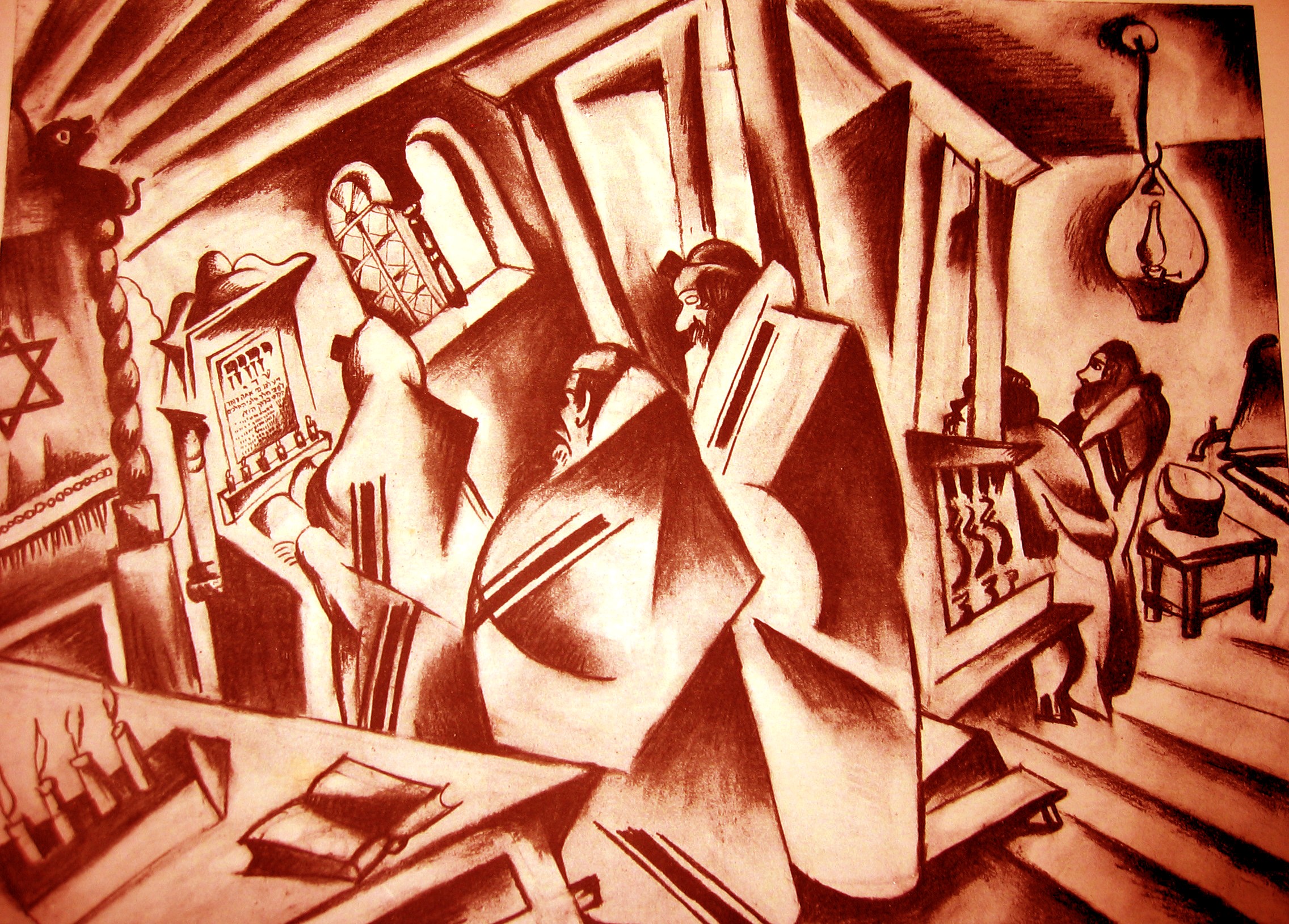
Indeed, going back to the beginnings of writing and reading, what we find is that very few people read books at all. Most people listened to books/scrolls/papyri being read. TheChrist reading in the synagogue temple reader and the town crier are the original of audiobooks and podcasts. In ancient Palestine, for instance, it’s estimated that in even so bibliocentric a culture as that of the Jewish people only 5 to 15% of the population could read at all, and the reading that went on often did not occur in deep intensive reading like that which Scott and I imagine when we think about what reading really is. Instead, much of the experience of reading was through ritual occasions in which scriptures would be read aloud as a part of worship. This is why biblical writers persistently call on people to “Hear the Word.” This model of reading persists in Jewish and Christian worship today, even when large numbers of the religious population are thoroughly literate. See Issachar Ryback’s “In Shul” for an interesting image from the history of Judaism.

Indeed, in the history of writing and reading, listening to reading is more the norm than not if we merely count passing centuries. It wasn’t until the aftermath of the Reformation that the model for receiving texts became predominantly focused on the individuals intense and silent engagement with the written word of the book. In this sense, we might say that the Hebrews of antiquity weren’t bibliocentric so much as logocentric—word-centered but not necessarily book-centered.

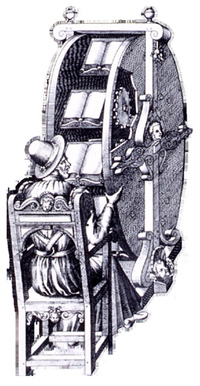
Along these lines, the model of intense engagement—what scholars of book history call “intensive reading”—is only one historical model of how reading should occur. Many scholars in the early modern period used “book wheels” in order to have several books open in front book wheelof them at the same time. This is not exactly the same thing as multi-tasking that Scott abhors in his post, and it’s not exactly internet hypertexting, but it is clearly not the singular absorption in a text that we’ve come to associate with the word “reading.” “Reading” is not just the all-encompassing absorption that I’ve come to treasure and long for in great novels and poems, or even in great and well-written arguments. Indeed, I judge books by whether they can provide this kind of experience. Nevertheless, “Reading” is many things.
But to recognize this is not exactly the same thing as saying “so what” to the slow ascendancy of audiobooks, and the sense that books, if they are to be read at all, will be read as part of a great multi-tasking universe that we now must live in. Instead, I think we need to ask what good things have been gained by the forms of intensive reading that Scott and I and others in the cult of book lovers have come to affirm as the highest form of reading. What is lost or missing if a person or a culture becomes incapable of participating in this kind of reading.

By the same token, we should ask what kinds of things are gained by audiobooks as a form of experience, even if I don’t want to call it a form of reading. I’ve spent some time recently browsing around Librivox.org, which I’ll probably blog about more extensively in a future post. It’s fair to say that a lot of it turns absolutely wonderful literature into mush, the equivalent of listening to your eight-year-old niece play Beethoven on the violin. On the other hand, it’s fair to say that some few of the readers on that service bring poetry alive for me in a way quite different than absorption in silence with the printed page. As I suggested the other day, I found Justin Brett’s renditions of Jabberwocky and Dover Beach, poems I mostly skim over when finding them in a book or on the web, absolutely thrilling, and I wanted to listen to everything I could possibly find that he had read.

This raises a host of interesting questions for a later day. What is “literature.” Is it somehow the thing on the page, or is it more like music, something that exists independently of its graphic representation with pen and ink (or pixel and screen). What is critical thinking and reading? I found myself thrilled by Brett’s reading, but frustrated that I couldn’t easily and in a single glance see how lines and stanzas fit together. I was, in some very real sense, at the mercy of the reader, no matter how much I loved his reading.

This raises necessary questions about the relationship between reader and listener. Could we tolerate a culture in which, like the ancient Greeks and Hebrews, reading is for the elite few while the rest of us listen or try to listen. At the mercy and good will of the literate elite—to say nothing of their abilities and deficiencies as oral interpreters of the works at hand.

More later

Audiobooks: Baritones do it Better

I’m having a little trouble keeping the eyelids open on humpday, so I’ll probably come back to this later. Still, I’ve been away for a couple of days, so I thought I’d ruminate for a few paragraphs.

A conversation with a colleague a couple of weeks back has had me contemplating the status of audiobooks. Conversation turned around the question of whether audiobooks constituted “reading,” an ameliorative factor to the generally dismal view of literary reading that’s been out there ever since the NEA report in 2004.

I’m not convinced, but I am intrigued by the general status of audiobooks and how they relate to the historical practices of reading and listening aloud. It’s worth saying that a characteristic of modern reading practices has idealized silent reading for oneself. Reading out loud, and worse, listening to others read, has largely been a sign of immaturity or deficiency.

But should it be? Not sure. Something I’ll have to come back to.

I recently stumbled across Librivox. Again, something I’m sure many people were already familiar with, but which seems brand new to me. Essentially an archive of open access recordings of various works of literature, the recordings done by volunteers.

Librivox has all the strengths and weaknesses of democratic webdom. I literally could not understand some of the poems I tried to listen to. Some readers sounded vaguely like adenoidal adolescents, slurred words together and substituted speed and volume for earnestness and emotion. Others started well, but seemed to get bored with the poems as they go along. It takes a lot of effort, evidently, to be sonorous and measured and musical, to have a voice worth listening to without making listeners hear the voice more than the poetry itself.

Still, I ran across Justin Brett after listening to about a half dozen recordings of Dover Beach, and immediately became a sucker for his resonant baritone and British accent. I could listen all day.

For several good recordings of Brett’s vocal work, listen to the following:

“Dover Beach”

“Jabberwocky”

“The Collar”

Is it reading? I still don’t think so, but I’ll come back to it. Is it literature? That’s an interestingly different question, that will also await another day. Is the experience of literature linked inextricably to the page, or is it in the word that the page “merely” symbolizes? Is whatever is literary about literature independent of the written word–ink or digital–just as we might think of music as essentially free of and even superior to the page upon which it is composed? I don’t think so, for now, but it’s worth thinking about.

Garrison Keillor and Toni Morrison Tag Team Angelou and Grisham

Garrison Keillor, a personal favorite, has broken for Obama. As I suspected a while back, Obama seems to be doing well with the literary crowd—gathering in Michael Chabon, Toni Morrison, Alice Walker, and now Garrison Keillor. There may be others, but I can’t find them in the five minutes I can afford looking around on the web. Still, it’s not a total lock. Maya Angelou and John Grisham have put in for Clinton, with Angelou putting forth with about as much sagacious pomposity as Morrison mustered for Obama. According to Angelou, embedded below, we should be attracted to Clinton because “she gives herself authority to be in her own skin… to be who she is.” We further discover that Hillary has the honesty to stand up and say “Yes, I am a woman.” And further that she is her mother and grandmother and an great grandmother and great greats. And all women. And she is even Maya Angelou.

Going to be a crowded Lincoln bedroom. And here we thought we were only going to get a two-fer with Hillary and Bill.

Seriously though, I have some trouble with the notion that women ought to vote for Hillary because she’s a woman, any more than a man ought to vote for Obama because he’s a man or because he’s black, or McCain because he’s a man or because he’s white. This being said, I know it happens, consciously and unconsciously. So I don’t have an absolute problem with Angelou being straightforward about it. What strikes me, however, is that Clinton supporters have been quite frank and straightforward in arguing that people ought to vote for Clinton because she’s a woman. I don’t see quite the same straightforward statement by any prominent black supporters of Obama. And of course it would be absolutely politically impossible for someone to get up and say they were voting for Obama or McCain or Huckabee because they were men. So the rhetorical strategies are still interesting. What’s allowed and what’s not allowed. My general sense, still, is that Obama is the wiser in playing down a unique appeal to a “natural” constituency. Can Clinton speak for and to everyone. She doesn’t really try to make that case, and I imagine it will cost her in a general election.

Back to Keillor. Much more understated as befits a Minnesotan. Though, it must be said that Keillor’s understatement is no less strategic or conventional the Angelou’s and Morrison’s self-inflation.

“I’m happy to support your candidacy, which is so full of promise for our country,” the best-selling author and humorist wrote in a letter declaring his support. “Seven years of a failed presidency is a depressing thing, and the country is pressing for a change and looking for someone with clear vision who is determined to break through the rhetorical logjam and find sensible ways to move our country forward. That’s you, friend.”

“And of course it will be exciting to have a president who can speak with grace and power to the American people,” Keillor wrote.

A war that’s left 10s of thousand dead or maimed, and has saddled our grandchildren with crippling debts has left Keillor depressed. Well, perhaps this is self-inflation of a very understated sort. From what I gather though, many things leave the good Lutheran depressed, and for the melancholy another thirty or forty thousand dead is par for the course in the scheme of things.

Keillor’s compliments to Obama’s rhetoric stand out. Obama couldn’t muster a great deal of grace and power in his response, however.

“I’ve been entertained and inspired by Garrison Keillor’s work through the years,” Obama said in a statement. “As president, I will wake up every day thinking about how I can help make life better in places like Lake Wobegon all across the country.”

Umm. Ok. This is EXACTLY why I thought Obama was running. To help all those good folks with white picket fences in the land that time forgot. It’s an interesting contrast, of course, since Keillor, despite his liberalism, has made his literary career on the examination of a white ethnic community as “typically American” in an era when it’s typicality has faded by the hour. Indeed, there is no measure of how atypical Lake Woebegon really is than the candidacy of Barack Obama.

Have they even seen black people in Lake Woebegon. I have my doubts. As much as I love the show. I can’t remember a single one.

Body of Knowledge

Since getting started on this blog I’ve been thinking a lot about how we image reading, and more broadly knowledge. The classic picture of a man or woman, body slumped in a chair or reclining on a bed or laying under a tree, head inclined in to a book. This is our sense of what reading is, and in a larger sense of how knowledge is gained and demonstrated.

It’s a difficult image in some respects because, in fact, we can’t really tell whether reading is going on at all simply from the fact of its physical representation. For all we know the person who seems as if they are half-asleep may in fact be half-asleep. Think of the association of reading fiction with being in dream worlds. The act of reading itself, especially silent reading, is in some respects unimage-able. We can’t see the translations that occur between marks on a page that become letters and words and then are associated with meanings in the mind. We accept on trust that the student with her book open in the back of the room is, in fact, reading, rather than drifting into a half-world as we lecture on at the front of the room.

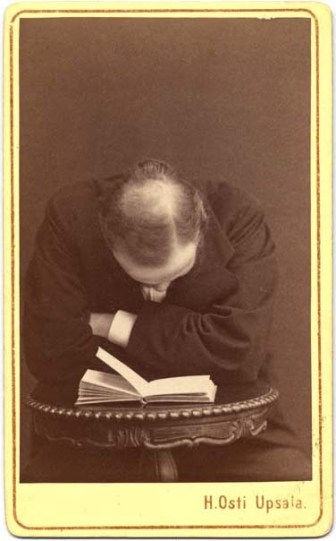
I think working on the blog has made me acutely more interested in the physical image of reading. How could I choose relevant images for a blog taken up with something so ethereal as reading? My avatar came from a library at Upsala University (I think, I can’t remember). I was lasande_man.jpgtaken by the classic image of the hunched body at the desk, but also that it was obviously a middle-aged man, somewhat monkish. Finally, that you couldn’t see the face—which seemed to me to be something about reading and something about what I wanted the blog to be. Reading is a kind of facelessness, a kind of disappearance of the self that is itself enriching and expansive. This is why I think all the focus on reading as creativity and self-assertion among so many poststructuralists—people like Roland Barthes who want to turn reading in to an alternative form of writing—is missing something that’s relatively essential and important. The disappearance of the self in reading is precisely what we desire. The loss of self is goal, not dread outcome of the process of reading.
One thing that struck me in searching for an appropriate avatar—which I pursued by searching Google images—is that images of reading are almost exclusively associated with books. Reading means, so far as the visual imagination is concerned, reading books. I sifted through a couple of dozen pages of images and came up with not one image of a computer or a computer screen. Indeed, realizing that I was interested in pursuing the conjunction of reading and writing, I thought it was a little ironic that my wordpress template has a pen at the top. Of course, I have the option of putting in a computer keyboard, and tried to find one, but perhaps the point is made. In our imaginations, reading and writing is still a matter of pen and paper. As I said yesterday, my colleague is not even certain that what we do on things like this blog is properly called writing. Why call it blogging if it is writing plain and simple. Similarly, we surf the web, we don’t read the web. It’s a new and different process, for which we don’t have adequate visual images.

My same colleague objects that we won’t go with electronic books because we like the physicality of things. Well…I didn’t point out to her that, in fact, Kindles and Sony readers and my 17-inch Macintosh computer screen are all physical to a fault. But somehow we imagine that computers have no physical presence. Without physical presence they cannot image that most insubstantial of things, the reading process. In actual fact, I think that we have constructed a certain kind of “physicality” that we associate with books, while we are only beginning to develop a sense of the physicality of computers.

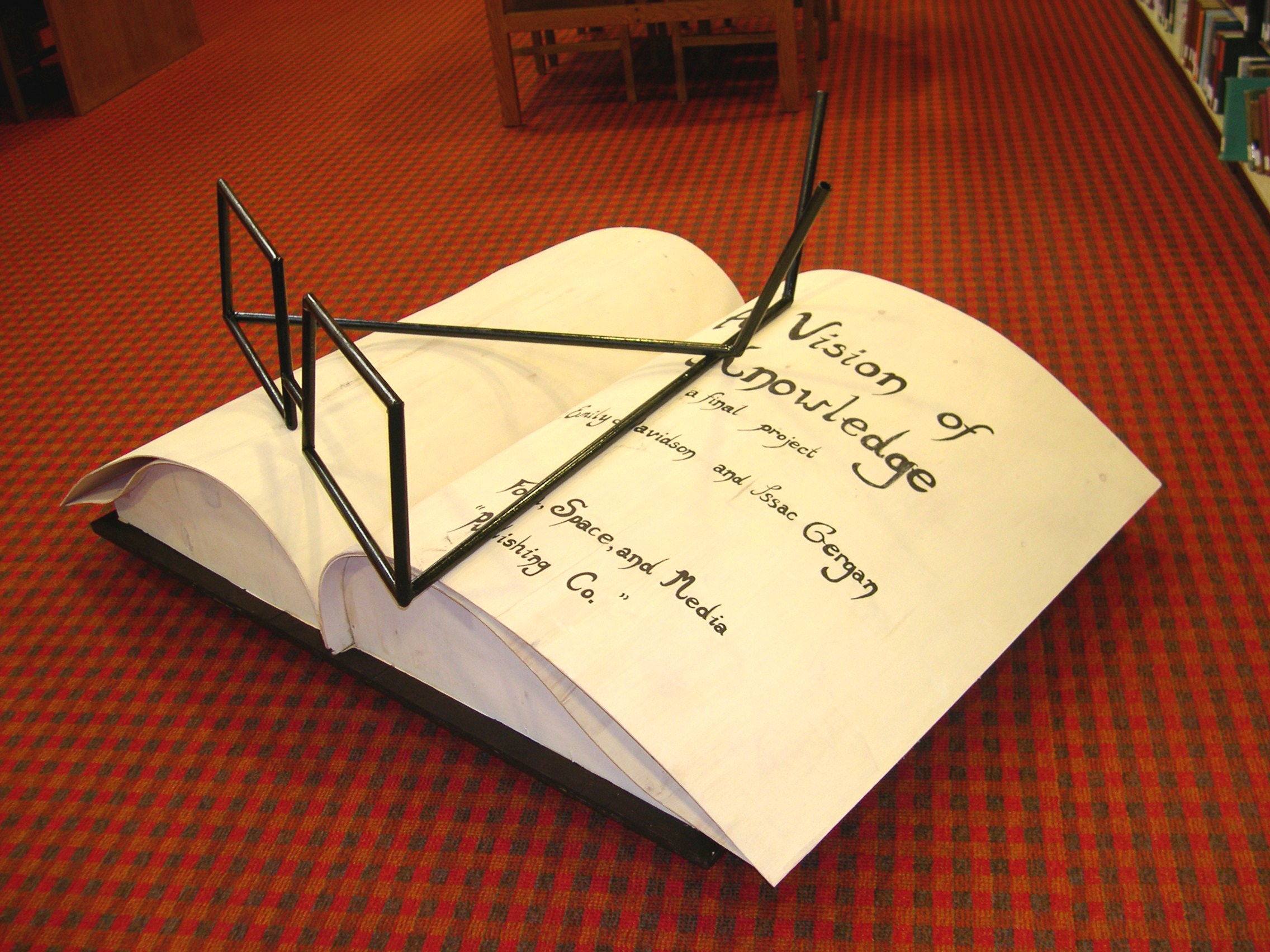
Along these lines, our library at school is hosting a very nice work of art by a couple of our students. A book with reading glasses. I’m having trouble optimizing this to fit on the page, but you can access ” Vision of Knowledge” by clicking on the title. My general sense is that computers make both books and reading glasses anachronistic. We can read on the Internet, and if the text is too small, who needs glasses. Just hit text zoom.

The other interesting thing about this image is the text itself, which, of course, we read. “A vision of knowledge.” My general sense is that despite the tremendous emphasis on the Internet as a resource for knowledge and learning, we continue to imagine, to have visions of knowledge primarily through our cultural repertoire related to books. Again, a quick google search for images related to the word “knowledge” called up dozens of pictures of books, various diagrams of the brain, and a lot of variously dull and variously interesting charts and REading Womengraphs. One thing that didn’t come up were images of computers. I scrolled through about 100 and some odd images before I got to any image of a computer at all.

I’m not sure that there’s any great lesson to be drawn here. However, I think that if we can’t picture something, this means that we don’t quite know what to do with it, that we don’t quite know what it is, at least for us. The digital world is inescapable, but at least with regards to reading and knowledge we still don’t know exactly what it means, how to imagine ourselves as a part of it.

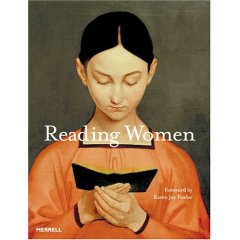
Side note: There’s a lot of stuff out there on the gender of reading, of course. There’s an absolutely fabulous book of images entitled “Reading Women” that I recommend highly. At one point I thought ALL images of reading were women, though this, of course, isn’t true at all.

Stop the hype! Inflationary reading crisis calls for interest cut

One of the features of our current reading crisis is that no one can agree if it even exists.
Jennifer Shuessler at the Nytimes points
with a notable degree of exhaustion at the fact that everyone and their mother seems to be talking about a crisis in reading. The tendency is, I suppose, to be jaded and assume that there is no crisis whatsoever, that it is all hype. A problem in a culture of hype is that when there really is something to pay attention to, we can’t distinguish between the reality and hype. Because we know there is hype, and can’t be sure there’s reality, we tend to think that every new publicized concern is more an issue of publicity than concern.

Shuessler points to Ursula LeGuin’s essay in Harpers, where she makes the case that serious readers have never been more than a minority anyway, so why worry.

“Self-satisfaction with the inability to remain conscious when faced with printed matter seems questionable. But I also want to question the assumption—whether gloomy or faintly gloating—that books are on the way out. I think they’re here to stay. It’s just that not all that many people ever did read them. Why should we think everybody ought to now?”

This strikes me as an instance of jaded cynicism rather than ethical or cultural seriousness unless one views the reading of books as, already, a cultural option of little personal or social consequence. What, Le Guin would also say, then, that it makes no difference that millions of people have a literacy level that can, at best, consume comic books? So they can’t read Toni Morrison? Who cares? Well, I guess this is a position.

More seriously, Shuessler points to Caleb Crain’s blog that points out the many and diverse statements of readerly crisis that have been ongoing throughout the 20th century. Indeed, as I’ve suggested on this blog before, it’s possible to argue that imagining reading in crisis is a condition of reading in Western culture. How those crises are imagined may say a great deal more about the culture than they say about reading, but it is interesting nonetheless. In earlier centuries people worried that too many people were reading, then we believed that the wrong people were reading, then we worried that people read the wrong books. In the latter part of the 19th century and early part of the 20th century, sociologists worried that people read too much, especially men. Since then, we’ve worried that people weren’t reading enough, a crisis that continues apace with renewed vigor in our own era.

I picked up the following titles from quick survey of article titles in the Saturday Review of Literature from mid-century. With a few adjustments, we could imagine them all coming out of interpretations of the latest NEA study.

“Why is it so difficult to interest reading public in good books?” (December 1 1934) p. 324

(Of course, now we are mostly worried about getting them interested in reading books at all. Even Rush Limbaugh. Bill O’Reilly? Please? Anything to ease my mind.)

“Bookless mind.” (November 10 1934) p. 272

(This is absolutely my favorite)

“Influence of books on people who do not read.” (July 24 1937) p. 13.

(I’m assuming this works something like radiation. Rub up next to me and let my literacy rub right off on you.)

“Can college graduates read?” (July 16 1938) p. 3-4+

(The resounding answer in 2007 tends to be no.)

“What a capitalist reads [one man’s literary meat].” (December 4 1943) p. 12-15

(No, I think this is my absolute favorite. I wonder, what is one man’s literary poultry? fruits and vegetables? A new Borgesian system of book classification is in the offing)

“Only half of us read books.”(August 5 1950) p. 22

(So many???)

“How to get time to read a book.”(September 29 1951) p. 5

(And this was before the internet, ipods, and tivo. It truly is miraculous we read at all if they worried about this in an era with three tv channels in black and white)

“Don’t Americans read or write? . “(July 14 1951) p. 24-5.

(No, maybe this is, after all, my truly absolute favorite. Did Americans in 1951 really care what people in Lahore, Pakistan thought about us . This was before the bomb and Osama bin Laden, after all.)

As with hype, the recognition that reading has always been in crisis mode tempts us to think there is no crisis to worry about. Perhaps so. I’m more intrigued by why it is that reading must always be an occasion for crisis. Why have cultures always been so determined that reading is fenced in with all the right cultural taboos or mandates: done in just the right amounts, done by just the right people or by all the people, done with just the right books, carried forward in just the right ways—whether through academic classrooms or community enhancing book clubs.

One tentative hypothesis works better for theories worrying about social control. Reading’s essential isolation means that it must always remain an issue of concern and crisis for human sociality. I say essential isolation, because reading is always an act of the individual mind decoding for oneself. Even when one is reading aloud to others, listeners must affirm an act of faith that what is being read is what is on the page—easier in our age. Not so easy in antiquity where, for instance, in ancient Israel some towns were lucky to have even one person read. Reading’s essential isolation calls in to question or puts our necessary human sociality in to question.

Still, this works better for those eras that worried that the wrong people were reading, or that people were reading too much, or that people were reading the wrong things. Maybe we are in the ironic position in our own era of having become comfortable with the ways we’ve negotiated what was formerly a form of textual chaos. The book has been more or less tamed? The new chaos, the new threat, is the uncontrolled proliferation of text on the internet?

I’m not sure I go with this. A thought experiment. I still think books are less tame than they are sometimes assumed to be by digital utopians. I have yet to be changed by a web page in the ways that I have been changed by dozens of experiences with books that I can point to.

Books are old, but they don’t seem tame. Not yet. Not to me.

Reading and Redemption

I saw Atonement last night, the Oscar-nominated film based on Ian McEwan’s award winning novel. I’m kind of vaguely interested in what happens to novels when they become films, but more so in films and novels that are in some way about the process of reading and writing. I have no idea about McEwan’s novel itself—I hope I can get to it someday—but I found the conceptual interaction between visual and textual storytelling—between viewing and reading—very layered and complex in the film. To some degree compelling, but also troubling.

Because I get to these things about three weeks after everyone’s seen the film, I’m going to assume whoever reads this post has already watched the movie (fair warning if you think the ending is given away). The interplay between reading/viewing and writing/performing is there throughout the film, of course. The main character, Briony, is a budding novelist of 13 whose urgent hormone-driven plays are transparently presented as sublimated efforts to deal with her adolescent crush on a older young man, Robbie, who is in love with her older sister, Cecilia. This love of a young girl for an older man is perversely reversed when another young man about the age of Robbie rapes her young friend.

Briony has seen the rape, but using her well-practiced imagination, and perhaps revenging herself on Robbie for loving her sister instead of her, accuses Robbie of the deed. Briony’s decision to fabricate Robbie’s role is caught in the following clip. Too bad it doesn’t start just a bit earlier, where we see the two girls building a story based on their own fears, needs, and class stereotypes.

“Atonement” is, of course, about whether or not one can atone for the past. Can the past be repaired? Even to some degree, does Briony need to atone for the past? Can a young girl of 13 be held responsible for an act, however reprehensible, that can readily be understood as an act of immaturity rather than an act of adult malice? Even, can any action by a much older and much changed Briony count in any way for atonement of sins by the younger child she resembles but in no way repeats. Are our older selves, in so many ways discontinuous with the children that we were, even capable of repenting for sins that were in some very real sense committed by someone else? This distance is registered in the film by having actresses who are similar in appearance—at least in, implausibly, retaining the same haircut for approximately 60 years—but who are otherwise obviously very different people “playing” the same person. Again, this question of atonement is perversely registered in that the actual adult rapist “atones” for the past by eventually marrying the young girl he raped when she comes of age. While the true agent of brutality goes on to live out the Western mythology of human fulfillment in marriage, Robbie and Cecilia are forever separated by the sins of someone else.

For my purposes I’m interested in the layered question of whether writing and reading—whether an act of and engagement with the imagination—can atone for sins committed in the world. How does the imagination act on the world? This is most pronounced in the conclusion of the film where we cut to a latter-day television interview with an elderly and ill Briony, played by Vanessa Redgrave, who has just written her final novel, final because she has realized that she has incurable and progressive dementia that is gradually destroying her ability to remember and to use language.

We immediately understand as viewers that the movie we have just been watching is this last novel—rendered visually. We have been the reader/viewers of the novel, which is supposedly autobiographical. However Briony/Vanessa Redgrave informs us that the story didn’t really end as she left it in the scenes we had just seen. Robbie did not return from Europe to be with Cecilia. He died on the beaches of Dunkirk from sepsis. Briony is never reconciled to Cecilia—as the film had just made it appear. Instead, Briony had been too cowardly to find her sister and make the attempt at reconciliation. Cecilia character died in the bombing of London, living alone and estranged from her family because she had refused to believe that Robbie was a rapist and had refused to renounce her love for him.

The elder Vanessa Redgrave/Briony explains her decision to give the novel/movie a happy ending for two reasons—readers could not accept the reality, and because the imagined ending was an act of repair, giving Robbie and Cecilia a life of joy together—symbolized by life on Dover Beach—that had eluded them because of Briony’s deception.

The two reasons, I think, work in very different direction, and finally don’t completely hold together. I’m not completely taken with the notion of readers needing the happy ending. It’s true, of course, that Hollywood films and any number of romance novels make their way in the world on the hunger for uncomplicated fantasy. But is it the case that human beings are so unused to the idea that the innocent die while the guilty go free and live happily ever after that we refuse it in our literature? Indeed, isn’t it our literature that teaches us this repeatedly. It feeds the generally tragic sense of reader-geeks that their own nobility is tragically unrecognized in the world at large. It is played out by English professors who grump that their C students get jobs right out of college that pay more than they make as tenured professors.

Still, this notion does comport with the general tenor of the film. Briony’s sin is first and foremost an act of the imagination. She “sees” what she wants to see so that it will reflect her own story in the world. Her refusal to allow the world to be more complicated that her own seeing is the source of her original accusation. In a very real sense, Briony’s imagination is what she must atone for. Imagination is her original sin—her writing is, after all, a particular way of reading the world that refuses to let the world be what it is truthfully. Her imagination is a thirteen-year-old act of violence on the world, and results in very real violence to many people down the line.

And so, can we really buy the elder Vanessa Redgrave/Briony’s assertion that she is somehow redeeming the lives of Cecilia and Robbie, giving them what they couldn’t otherwise have in reality? Something she wants to understand as an act of generosity and even love. I’m not sure. To some degree this could be connected with the work of someone like Ernst Bloch who insisted that the utopian function of art was to say “And Yet” to life, to insist that “reality” did not have the final say if that final say was understood to be beyond the act of human agency, human shaping, human imagination. In the same fashion, if atonement is possible, it seems to me that atonement must be an act that includes the imagination.

Still, is this an act that the imagination can carry out in reference to our own actions in the past? No human action is every finished in and of itself. Rather, it is read and reread, and its meaning accrues and changes by the means and contexts through which it is reread. I sometimes tell students I prefer to understand God as a reader than a writer. Redemption is an act of reading and discovering the possibilities in a life-text that could not have been imagined by those individuals and other historical agents who brought that life-text into being in the first place. But I guess what makes me leery of this particular act is Briony’s act of self-justifying imagination. Can Briony atone for the failures of her imagination by another act of the imagination that further falsifies the lives of those that she has damaged, however “innocently” or unknowingly? I tend to think that this isn’t atonement but self-justification.

On the other hand, what we finally get from Briony-Vanessa Redgrave is not imagination as atonement, but a very different secularized Christian practice—Confession. Briony apparently tells the truth to the reader at the end of the story, and the reader/viewer is the only person in the position to forgive. Briony’s confession of what actually happened is, at least putatively, something that removes her own imagination as an agent in her own redemption. She no longer writes someone different from who she is, but says who she is and what she has done and failed to do, and what the consequences have been. The production of art that moves a reader is no compensation for the evil that produces it. But the frank confession of the truth is a work of art in which we recognize ourselves. We forgive her because we see in her all the unthinking dishonesties by which we have harmed others and ourselves. In her need for us, we recognize our own need for forgiving readers.

Reading Humour (No Smiling Allowed)

The Librarian And Information Science News blog called my attention back to The Onion, which I used to read religiously, but haven’t been back to in a number of years. Once there I found some really hysterical stuff on reading that they’ve put out over the last few years. Some excerpts of the better articles I ran across in just the first fifty or so articles out of about 500 the search engine called up are below. A few laughs for sure, but I’m glad to see that The Onion is still using the laughter for some thoughtful cultural commentary.

Area Eccentric Reads Entire Book
January 19, 2008 | Issue 44•03

GREENWOOD, IN—Sitting in a quiet downtown diner, local hospital administrator Philip Meyer looks as normal and well-adjusted as can be. Yet, there’s more to this 27-year-old than first meets the eye: Meyer has recently finished reading a book.

Even outdoors, Meyer can’t seem to think of anything better to do than flip through some American classic.

Yes, the whole thing.

=====

Even more bizarre, Meyer is believed to have done most of his reading during his spare time—time when the outwardly healthy and stable resident could have literally been doing anything else, be it aimlessly surfing the Internet, taking a nap, or simply just staring at his bedroom wall.

“It’d be nice to read it again at some point,” Meyer continued, as if that were a perfectly natural thing to say.

=====
According to behavioral psychologist Dr. Elizabeth Schulz, Meyer’s reading of entire books is abnormal and may be indicative of a more serious obsession with reading.

“Instead of just zoning out during a bus ride or spending hour after hour watching YouTube videos at night, Mr. Meyer, unlike most healthy males, looks to books for gratification,” Schulz said. “Really, it’s a classic case of deviant behavior.”

=====

As bizarre as it may seem, Meyer isn’t alone. Once a month, he and several other Greenwood residents reportedly gather at night not only to read books all the way through, but also to discuss them at length.

“I don’t know, it’s like this weird ‘book club’ they’re all a part of,” said Brian Cummings, a longtime coworker and friend of Meyer’s. “Seriously, what a bunch of freaks.”:

Comment: I’m glad to see I’m not the only one that recognizes reading is deeply related to deviant psychological profiles. See my post on this very subject.

++++++++++++++++

Reading-Is-Fundamentalists Slaughter 52 Illiterates
October 29, 1997 | Issue 32•13

ROCKVILLE, MD—Militant pro-literacy terrorists struck here Friday night, as a pipe bomb exploded at Rockville Adult Learning Annex, killing 52 illiterates and injuring dozens more. Hours later, RIF, a radical reading-is-fundamentalist terrorist group, claimed responsibility for the attack.

=====
According to the group’s 900-page manifesto, RIF is committed to fighting illiteracy by “first-hand targeting of illiterates.” The manifesto also outlines a three-point plan to achieve its goals by “speaking to schoolchildren about the importance of reading, lobbying Congress for increased funding for literacy-awareness programs, and banishing illiterates to the very bowels of Hell.”

=====

In addition to using terror, RIF has sought to eradicate illiteracy via a series of spots airing on Saturday-morning television, in which a hooded, armed representative of the faction warns children to read “as if your life depends on it—for it does.” The group has also distributed videotapes to over 3,700 U.S. elementary schools featuring footage of abducted illiterates being shot in the back of the head by RIF members, followed by a music video, “Reading Is Where It’s At,” starring the group’s mascot, Pages The Rappin’ Raccoon.

Comment: Little known fact. My blog is a front for the RIF. We’ve merely been in hiding for the past seven years, lulling illiterates into a false sense of security as they descend in to corruption through non-reading. Somewhat like Islamic terrorists who are largely lead by disaffected members of the elite who have been educated in Western societies, RIF is made up of dedicated readers who once worked for Microsoft and Electornic Arts Incorporated , but then found themselves dismayed at the corruption of the technological world around them and longed for a resurrected and glorified literacy. Well known but as yet unidentified members of our group include John Updike, Doris Lessing, Michael Dirda, and many others who keep Barnes and Nobles in business.

++++++++++++++++

Books Don’t Take You Anywhere
December 16, 1997 | Issue 32•19

WASHINGTON, DC—A study released Monday by the U.S. Department of Education revealed that, contrary to the longtime claims of librarians and teachers, books do not take you anywhere.

“For years, countless educators have asserted that books give readers a chance to journey to exotic, far-off lands and meet strange, exciting new people,” Education Secretary Richard Riley told reporters. “We have found this is simply not the case.”

Comment: As I’ve been saying. PhotoSynth is better anyway.

++++++++++++++++

Area Man Well-Versed In First Thirds Of Great Literature
April 27, 2005 | Issue 41•17

KANSAS CITY, MO—Malcolm Seward is a 38-year-old commercial kitchen designer, baseball fan, and avid supporter of public radio, but he said there’s nothing he likes better than hunkering down in a comfortable chair, cracking open a brand-new copy of one of the world’s literary classics, and reading the first 100 pages or so.

“Listen, I’m no book snob,” said Seward, settled into his favorite reading chair and running his hand over a nearly half-well-thumbed copy of Pride and Prejudice. “It’s just that I love cracking the binding on a truly good book and reading until I drift off. I’d say it’s something I do two or three times a week.”

Seward, whose bookshelves house over 500 well-regarded and eagerly begun novels, developed his voracious appetite for starting books at a young age.

Comment: Pierre Bayard’s Ideal Reader. See my post on this topic.

Seriously though–who among us does not have to confess that we start or otherwise partially read a great many more books than we actually finish. On my list of books I have not yet finished (and am unlikely ever to do so)

Denis Johnson’s Tree of Smoke–I know it’s supposed to be a masterpiece, but, frankly, after 100 pages, I didn’t care. I’ll wait for the movie.

Anything by Alice Walker since Possessing the Secret of Joy–Does this really need explanation? I’ve even written essays on the woman and can’t bring myself to open her books anymore. The sad fact is that she was a writer worth listening to before she decided it was more important to be a prophet who sounds vaguely like Shirley McLane.

Dostoevsky’s The Idiot–I tried to read this through DailyLit.com. I did. I really truly did. I got tired of trying to find deleted emails that would remind me who these characters were again. I finally decided the characters weren’t worth the effort. I’ll probably try again, both with Dostoevsky and with DailyLit, though not both at the same time.

Toni Morrison’s Jazz–I’m ashamed to admit it, but yes. I’ve started this book at least a dozen times and am bored to tears every single time. Perhaps it’s not her fault. I think Beloved is one of the two or three great novels of the 20th century. Everything since is disappointing even when it’s good. Felt this way about both Paradise and Love. “Good book,” I’d say to myself, “but it’s no Beloved.” Actually, it may be that I finished Jazz at some point. I think I forced myself, but I honestly can’t remember anything about it. In Pierre Bayard’s universe, I may as well not have read it.

Critical Thinking and Cultural Literacy: Or, Is Unmasking Shakespeare Productive Cultural Work?

Ok, a slightly lame way of doing the blog entry today, but I spent a lot of time commenting on Mark Bauerlein’s blog at the Chronicle today, so I thought I’d just copy some of that and expand just a bit on what I had to say there.

In sum, Bauerlein makes the argument that the arguments in favor of critical thinking as a raison d’etre for literary study are really only half the story for professors in the humanities, and perhaps especially in English. The other half is that we need to pass on an appreciation of a cultural tradition.

As a department chair, I’m used to giving the usual run-down on critical thinking in making arguments for English studies. They generally sell well with provosts and deans because they both seem to comport with traditional practices of the humanities while at the same time being a marketable skill to discuss with skeptical external constituencies. On the other hand, I’m not completely convinced that the humanities are the only place to get critical thinking skills. What, they aren’t doing critical thinking in the hard and social sciences? I think we sometimes assume that because different fields investigate different data sets, they are therefore not developing critical thinking. What is an economist doing but attempting to think critically about received wisdom as applied to sets of data in the economy?

Thus, I fully appreciate, while not going all the way with, Bauerlein’s argument that the humanities have to be about familiarizing students with a substantive subject matter and understanding its active or potential value in the world and for themselves. In my own terms, I think that English studies, especially, has to be more than a critical project; it has to be a constructive project as well.

My comments on Bauerlein’s blog were as follows:

I think the comments above that suggest an exclusive identification of literary or humanistic studies with critique has become strangely vacuous are right on the mark. And, in reality, it’s not clear that critique per se has changed very much over the course of the last two or three decades. This is because critique must always have an object of its attention and is therefore always dependent on some kind of received culture.

In an older form of literary study, criticism meant not simple-minded passing on, nor simple-minded tearing apart, but critical evaluation. That is, what is worth passing on, what is worth reading, and for what reasons? The literary academy and the humanities more broadly have almost entirely defaulted on this particular task because to make an affirmative act of construction is to lay oneself open to the, I guess, humiliating preference for deconstruction or other forms of political critique.

In our curriculum I teach both the courses on literary theory and a course on book reviewing, and in both attempt to get students to think in concrete and critical ways about what’s worth reading and why. I have to say that students find the classes incredibly important to them. Far from feeling like the web—with its massive democratization of product and opinion—has done away with the need for discussion of value, they really find it an important question. Why should I spend my time with this book rather than that book? With Mark Bauerlein’s blog instead of Moby Dick? These are theoretical questions, critical questions, and questions that involve themselves in the construction of traditions and cultures rather than simply critiquing them.

In my own view, I think the current explosion of textual matter on the web—whether blogs, or online fictions, or newspapers, or e-books—has created a critical situation very similar to that which existed after the invention of the printing press. In a certain sense, the invention of the press changes the function of criticism. Prior to widely accessible print and the expansion of both reading audience and authorship beyond the narrow confines of the clerisy and aristocracy, criticism more or less existed to catalogue and discuss the characteristics of good writing. This was not, properly speaking, an evaluative project. Things that were published and preserved were, by and large, already considered good. “Criticism,” such as it was, was more a taxonomic affair, describing the goodness that was already known to exist.

After Gutenberg, criticism became the task of defining what, out of the immense amount of material on hand that could be read, really should be read. What was worth preserving? What things being produced by the new class of writer/readers deserved a status similar to that of the ancients as worthy of being preserved? To some degree, we are still at the dawning moment of that part of the internet revolution. What is really worth reading? Even, what is really worth writing? Is a blog worth doing? Is it real writing or is it conversation. Is real thinking going on, or is it ephemeral. To some degree popularity sites like Technorati or Digg that try to apply the democratic impulses of the web to blogs and the like are trying to serve an evaluative function. The wisdom of crowds applied to the function of criticism. Will this work for the long term? I have my doubts. There’s always been a tendency to try to insist that “best-sellers” are those things that are really valuable, but their value hasn’t been sustainable for more than a generation or two. I suspect that we are still working out the function of criticism at the present time. What shape will criticism take? How will we decide what is worth reading and writing. How will we decide what being written—or perhaps we should now simply say, “being produced—on the web are the kinds of things that should be passed down to our children as we attempt the inevitable human activity of forging a common culture.

After a variety of comments for Bauerlein with varying levels of vitriol in play, I followed up on a comment that made the argument that we need to be teaching things that students are comfortable with, but also things that sting them with their unfamiliarity.

My response:

Tim, I wonder in this day and age whether reading almost anything longer than a blog will be, for many students, a de-familiarizing and unsettling experience. That is, one doesn’t have to buy in to all the hype about a reading crisis to recognize that the nature of reading is changing, and the ability to read extended and complex texts has been eroding among college graduates.

Because we are so habituated by our own reading practices and training, we often make deeply flawed assumptions about what students will find de-familiarizing. And, to be honest, we often default to simple-minded notions of unfamiliar cultural content. “De-familiarization” first developed among formalists as a conception of how literary language served to shock readers from their comfortable linguistic frames of reference. On that score, I think we often find that contemporary students find reading much of anything “literary” at all to be unfamiliar, defamiliarizing, and unsettling. Especially so in poetry, but in a different register in long novels and plays they no longer even bother to try and read. Rather than experiencing the sting of defamiliarization in Shakespeare’s Tempest, students are quite as likely to go get the Sparknotes so they can pass the test and even write their essays.

In this kind of reading context, it seems to me that discussions of how to upset the cultural applecart on the basis of whether folks read Shakespeare or not are increasingly arcane and disconnected from cultural realities in which long form reading is taking place. While I agree that the task can’t be a simple passing on of received tradition, I think the cultural situation does call for engaging students with the question of why certain forms of reading may be valuable, and thinking through what texts might be worth the time required for reading them. In other words, the philosophical conception of “The Good” surely can’t be “Whatever has always been.” But it also surely can’t be, “Whatever I decide might make my students talk in class,” or “Whatever an individual wants it to be.” To go this route is, I think, to give up on the question of “The Good” entirely, something I think most students are still unwilling to do.

This is something I find repeatedly in play among literary intellectuals. It’s almost as if we are so hermetically sealed within the discourses and practices of our discipline that we can’t conceive of a world where the fact of reading a book might be uncomfortable or unfamiliar for students. When I raise this problem at conferences, I repeatedly have professors reply by saying “Everyone I know reads.” I want to say “Duh. You work in an English department.”

This fact, I think, calls in to question some of the basic premises of the canon wars that preoccupied folks at Duke while I was there as a grad student in the late eighties and early nineties. In the world that we are entering and are now in, people who read literature as an important part of their cultural lives are a distinct minority group that all have more in common with one another regardless of ethnicity, sexual identity, religion or gender, than they do with other members of their various identity groups—at least insofar as reading is concerned. That is, reading books, and reading literature especially, marks them out as different, as Other from the culture they inhabit–whether we are thinking of an ethnic, a national, a religious or a sexual culture. We need to recognize that we are quickly entering a world, and are already in it, wherein the simple fact of reading Moby Dick or Shakespeare will be a stinging act of defamiliarization that unsettles the cultural life of students.

This doesn’t mean that Bauerlein is right that we need to be passing on a received tradition—though I think students value that more than we sometimes realize. But it certainly does mean that we have to be involved in a constructive project and not simply a critical project.

Photosynth and the Feebleness of Books

One of my very good students, Colin Chrestay, sent me the attached video of a techie at Microsoft showing off this staggering new software–software seems like too mild a word–in development called Photosynth. If you’re only interested in books, you can watch the first two minutes, but watch the whole thing. You really must watch the whole thing.

Stuff like this is just really staggering to me in seeing what is now possible via the web. (My guess is this is old hat to a great many people; but not to me). I don’t know enough about the specifics, and assume that this kind of thing is still a ways away from every person’s fingertips. But the realization that it isn’t inconceivable that every school child could explore every corner of the earth in three dimensions, from every angle and in the minutest detail to the broadest geographic and geological context…well, when I was my son’s age these were the fantasies of Ray Bradbury. I imagine it will be the normal day to day life of my grandchildren.

Re. books, the feebleness of books. Well, I guess I don’t completely think that books are feeble, but this kind of thing just makes clear to me again that there are many things for which the electronic world is clearly superior to anything that book culture could imagine. To insist otherwise does, I think, verge on a snobbish version of luddite-ism.

For instance, when I was growing up on books, a selling point for reading was that books allowed you to experience multiple places and cultures in the world, to travel to places in your imagination that you could never access with your body. And I don’t think there was anything spurious in that claim. But how this raison d’etre pales in comparison to seeing these worlds in three dimensions. Imagine that you wanted to know about mountain climbing in the Himilayas. I am sure there is still a very big place for books on this subject, but how much more impoverished that experience would be for the students who won’t have access to the kind of experience that photosynth can provide.

As a result, it seems to me that we need to think clearly about just what it is that books give us access to in terms of form or content that can’t be accessed in the same way via these kinds of technology. Among other things, of course, we might say that books are a good source for exploring the possibilities of language. And one traditional distinction between novels and movies seems to me to still hold for the visuality of the internet. Books, texts in language, are better media for exploring the intricacies of the human pscyhe, better access to the interior world than the visual world of technology typically allows for. Perhaps we need both novels and autobiographies by mountain climbers, and photosynth representations of mountain climbing, to get our strongest human approximation of what it must be like to climb in the Himalayas.

Secondly, of course, I’m intrigued by the degree in this video that books and newspapers are a passing mention. Indeed, the brief nod to Dickens’ Bleak House seems to be mostly about the fact that we could put the whole of Bleak House into a simultaneous view, something the presenter agrees is not necessarily a great way to read a book. And the bit on newspapers seems to be about trying to make the experience of reading a traditional newspaper more available for the digital reader. One wants to say why. It’s neat that we can do this, but peculiarity of these moments in the video suggest to me the ways in which these technologies create different forms of experience that are not compatible with books or newspapers as traditionally conceived.

I admit that when I see videos like this, I mostly think that the digital utopians have won the day. That I should fold my tents and go home.

Nevertheless, it still seems to me that the task is to figure out what the precise role of reading traditional texts really is; what particular role do traditional forms of reading and writing have to play in our present moment. What can the reading of texts provide, what skills can it enable, that are difficult (impossible?) to develop in any other way. Of course, we can continue to read without worrying about these things, simply because we like reading books more than other things, but my guess is that this will mean that reading books will become an increasingly arcane hobby–something a little like collecting rare books or writing on typewriters is today. Something that is done and enjoyed, something for which there is even a minimal market, but something that is mostly a curiosity rather than a serious cultural enterprise.