Tag Archives: Books

Tchotchkes R’US: Formerly known as Barnes and Nobles, Booksellers

Like a beaten dog wagging its tail as it returns to the master for one more slap, I keep returning to Barnes and Nobles, hoping for a dry bone or at least a condescending pat on the head. Mostly getting the slap.  I’m wondering lately how much longer B&N can hold on to the subtitle of their name with a straight face. I admit that for purists Barnes and Nobles was never much of a bookseller in the first place, the corporate ambiance just a bit too antiseptic for the crowd that prefers their books straight, preferably with the slightest scent of dust and mold. But as a person that has spent the entirety of his life in flyover country, Barnes and Nobles and its recently deceased cousin Borders seemed something like salvation. If the ambiance was corporate, the books were real, and they were many. If there were too few from independent publishers, there were more than enough good books to last any reader a lifetime, and I spent many hours on my own wandering the shelves, feeling that ache that all readers know, the realization that there are too many good books and one lifetime will never be enough.

Barnes and Nobles became a family affair for us. One way I induced the habit of reading in my kids was to promise them I’d take them to B&N anytime they finished a book and buy them another one. The ploy paid off. My kids read voraciously, son and daughter alike, putting the lie to the notion that kids today have to choose between reading and surfing.  My kids do both just fine, and I think this is attributable in no small part to the fact our family time together was spent wandering the endless aisles of bookstores, imaging the endless possibilities, what the world would be like if we only had enough time to read them all. Other families go on kayak trips; we read books. I’m not sorry for the tradeoffs.

All that is mostly over, for paper books anyway. My son and I still go over to Barnes and Nobles, but the last three trips we’ve come out saying the same thing to one another without prompting–worthless. Aisle after Aisle of bookshelves in our local store are being replaced by toys and tchotchkes designed to…..do what? It’s not even clear. At least when the place was dominated by books it was clear that this was where you went for books. Now it seems like a vaguely upscale Walmart with a vast toy section. I’m waiting for the clothing section to open up soon.

I don’t think we should underestimate the consequence of these changes for booksellers and bookreaders. Although it is the case that readers will still be able to get books via your local Amazon.com, the place of books is changing in radical ways.  The advent of e-books is completely reordering the business of bookselling–and i would say the culture of books as well.  An article in the Economist notes that books are following in the sucking vortex that has swallowed the music and newspaper industries all but whole.  Among the biggest casualties is the books and mortar bookstore, and this is of no small consequence to the effort to sell books in general:

Perhaps the biggest problem, though, is the gradual disappearance of the shop window. Brian Murray, chief executive of HarperCollins, points out that a film may be released with more than $100m of marketing behind it. Music singles often receive radio promotion. Publishers, on the other hand, rely heavily on bookstores to bring new releases to customers’ attention and to steer them to books that they might not have considered buying. As stores close, the industry loses much more than a retail outlet. Publishers are increasingly trying to push books through online social networks. But Mr Murray says he hasn’t seen anything that replicates the experience of browsing a bookstore.

Confession, I actually enjoy browsing Amazon, and I read book reviews endlessly.  But I think this article is right that there is nothing quite like the experience of browsing the shelves at a bookstore, in part because it is a kind of communal event.  It is not that there are more choices–there aren’t, there are far more choices online.  Nor is it necessarily that things are better organized.  I think I have a better chance of finding things relevant to my interests through a search engine than I do by a chance encounter in the stack.   And, indeed, The Strand is a book store that leaves me vaguely nauseous and dizzy, both because there is too much choice and there is too little organization.  But the physical fact of browsing with one’s companions through the stacks, the chance encounter with a book you had heard about but never seen, the excitement of discovery, the anxious calculations–at least if you are an impoverished graduate student or new parent–as to whether you have enough cash on hand to make the purchase now or take a chance that the book will disappear if you wait.  All of these get left behind in the sterility of the online exchange.  The bookstore is finally a cultural location, a location of culture, where bookminded people go for buzz they get from being around other book-minded people.  I can get my books from Amazon, and I actually don’t mind getting them via e-books, avoiding all the fuss of going down and having a face to face transaction with a seller.  But that face to face is part of the point, it seems to me.  Even though book-buying has always fundamentally been about an exchange of cash for commodity, the failure to see that it was also more than that is the cultural poverty of a world that amazon creates.  With books stores dying a rapid death and libraries close upon their heels, I’m feeling a little like a man without a country, since the country of books is the one to which I’ve always been most loyal.

I am, of course, sounding old and crotchety.  The same article in the Economist notes that IKEA is now changing their bookshelf line in the anticipation that people will no longer use them for books.

TO SEE how profoundly the book business is changing, watch the shelves. Next month IKEA will introduce a new, deeper version of its ubiquitous “BILLY” bookcase. The flat-pack furniture giant is already promoting glass doors for its bookshelves. The firm reckons customers will increasingly use them for ornaments, tchotchkes and the odd coffee-table tome—anything, that is, except books that are actually read.

I suspect this may be true.  Bookshelves and books alike may become craft items, things produced by those curious folks who do things by hand, items that you can only buy at craft fairs and auctions, something you can’t find at Wal-Mart, or Barnes and Nobles.

Borders fantasies

Book lovers have always turned a blind eye to the god Mammon, remembering only with regret the fact that the house they live in with their truest love was bought and paid for by the leering uncle down the street. Jonathan Gourlay took up that ill-begotten relationship in a nice personal essay on the demise of Borders. For Gourlay, Borders was an opportunity missed whose demise was figured long ago in it’s decision to skip a flirtation with the labor movement and bend the knee to a corporatist ethos.

“For Borders, which first opened in 1971, the end began when it was sold to K-Mart in 1992. By the time I got there, three years later, only a few of the stalwart Borders believers remained to try to change the store from within. Within a few months of my arrival, Neil gave up and retired to play in his band, The Human Rays. I don’t know if the band was real or Neil just thought it was amusing to retire and join The Human Rays. His friendly management style didn’t jibe with the new owners.

“Neil’s replacement was a guy named Doug. Doug had the personality of a pair of brown corduroy pants. We all hated Doug. We hated him because he was not Neil. Underneath that hatred was a hatred of what Doug represented: corporate masters and the loss of our own identity. With Neil we labored under the impression that we were cool. Under Doug we just labored.

This romantic vision may have a grain of truth.  But it’s worth remembering that scrolls and codexes(codices?) required immense amounts of money–and so wealthy patrons who had to be appeased–to produce. And at some level when you come down to it a book is a commodity as surely as a coke can. So we like to imagine ourselves as counter cultural in our love of texts, but that romantic ethos is purchased at a price like everything else.

The promise of the Internet is in part the idea of thinking and writing and reading without the necessary intervention of the dollar bill. But is that too just a romantic fancy?

Crime and Punishment, The Soundtrack

This article from Julie Bosman at the New York Times convinces me again that the future of books will be as multi-media, multi-layered artifacts rather than script-exclusive texts. Says Bosman:

In the film versions of “Pride and Prejudice” the music jumps and swells at all the right moments, heightening the tension and romance of that classic Jane Austen novel.

Will it do the same in the e-book edition?

Booktrack, a start-up in New York, is planning to release e-books with soundtracks that play throughout the books, an experimental technology that its founders hope will change the way many novels are read.

Its first book featuring a soundtrack is “The Power of Six,” a young-adult novel published by HarperCollins, soon to be followed by “The Adventures of Huckleberry Finn,” “Jane Eyre,” “Romeo and Juliet” and “The Three Musketeers.”

In September and October, Booktrack will release editions of the short stories “In the South,” by Salman Rushdie, and “Solace,” by Jay McInerney.

“It makes a new and engaging way to read and really enhances the experience and enhances your imagination and keeps you in the story longer,” Paul Cameron, Booktrack’s 35-year-old co-founder and chief executive, said in an interview. “And it makes it fun to read again. If you’re not reading all the time, it might help you rediscover reading.”

Elsewhere in the article Bosman points out that this is an extension of the increasingly common expectation that e-books will have embedded images and even videos, and perhaps come with addition documentary footage like DVDs. The linking of text and image and sound is ancient, of course. Think illuminated manuscripts and chanted psalms. To say nothing of the fact that the Homeric odes were probably originally sung. Still, I find myself wondering about our cultures inability to tolerate silence. Distracted from distraction by distraction, as Eliot said a hundred years ago. I think he may have imagined poetry as a cure. He could not have known that someone somewhere was going to enhance our experience Burnt Norton with mood music.

Be that as it may, it seems to me that my colleagues and I at Messiah College and elsewhere who teach students to write had better get used to the fact that we will have to train not only their linguistic sensibilities, but their aural and visual sensibilities as well.

Now, what sound track should we put to Burnt Norton?

Don Delillo: Point Omega

Point OmegaPoint Omega by Don DeLillo

My rating: 5 of 5 stars

I’m learning to trust my son’s literary taste in the same way I do his musical acumen. That is, at 16 he is far hipper and knowing than I have the energy to even try to be, knowing I would fail. He’s also several years past insistently recommending the latest animal fable from Brian Jacques. (A guilty father’s admission: I don’t think I could have taken many more years of toiling through the literally untranslatable renditions of ferrets speaking in what appears to be a working class Scottish brogue.) This faith in my son’s judgment was rewarded again a couple of weeks ago as we were flying out together to see my parents in Oklahoma City. He finished Point Omega on the leg from Cincinnati to Dallas, and said I really needed to read it before we got home.

That the book is readable on a plane flight into flyover country says nothing about the substance, though I will say that there are times Delillo is getting away with being Delillo. Not least is the fact that he can disguise a novella as a novel with large print and widely spaced lines and still get away with charging novel prices. More importantly, I thought the first third to a half of this very short book required a lot of patience, with the reader saying, “I know this must be good; it’s Don Delillo.” The first third is filled with the exceedingly detached and ruminant monologue of a documentary film maker and his subject, an academician who has lent his talents to the government to justify a war. The book as a whole is on one level a meditation on the mystifications that led us to prosecuting the war in Iraq.

“I’ll tell you this much. War creates a closed world and not only for those in combat but for th eplotters, the strategists. Except their war is acronyms, projections, contingencies, methodologies.”

He chanted the words, he intoned liturgically.

“They become paralyzed by the systems at their disposal. Their war is abstract. they think they’re sending an army into a place on a map.”

He was not one of the strategists, he said unnecessarily. I knew what he was, or what he was supposed to be, a defense intellectual, without the usual credentials, and when I used the term it made him tense his jaw with a proud longing for the early weeks and months, before he began to understand that he was occupying an empty seat.

“There were times when no map existed to match the reality we were trying to create.”

“What reality?”

“This is something we do with every eyeblink. Human perception is a saga of created reality. But we were devising entities beyond the agreed-upon limits of recognition or interpretation. Lying is necessary. The state has to lie. There is no lie in war or in preparation for war that can’t be defended. We went beyond this. We tried to create new realities overnight, careful sets of words that resmble advertising slogans in memorability and repeatability. These were words that would yield pictures eventually and then become three-dimensional. The reality stands, it walks, it squats. Except when it doesn’t.”

This is vintage Delillo in a lot of ways, but I’m not sure this dry detachment would have born up for another fifty pages. We get it pretty quickly, the immorality of the abstracted intellectual. What makes the story go, finally, is his having to come face to face with flesh and blood loss, forced in to a recognition that he had become so abstracted from his life that he had only experienced it and those who he should have been caring about as an absence.

Ultimately in novels we care first about relationships and not ideas. Or, rather, we only care about ideas to the degree that they bear the weight of relationships or corrupt relationships or get fleshed out in relationships. And so Raskolnikov, the man of ideas in Crime and Punishment, fascinates not so much because of his ideas but because he makes them flesh and blood and bone. With an axe. What makes Dickens live is not the sociological abstraction of oppressive class circumstance, but the orphaning of Little Nell. Delillo follows in that line in that what makes the novel work is not ultimately the grand ideas of the abstracted intellectual but the ways in which those grand ideas fracture man and wife, father and daughter, man from himself.

That is not in itself profoundly new; if that were as far as Delillo’s book went we’d have to say it was an interesting enough take on the villany of intellectuals. We’ve had that since Faust. But as the book concludes, we recognize that the violence of abstraction is not so much a property of intellectuals as of all living in this twilight of the western world, all those of us who watch the unfolding of images on the screen of our lives, substituting the slow motion replay of dropping bombs and exploding lives for the event, experiencing that violence as an aesthetic object worthy of our repeated fascination, image abstracted from meaning, until the death of others becomes indistinguishable from other means of entertainment in an entertaining world.

Delillo ultimately is a moral visionary. The darkness of his vision is not simply that he sees a world gone bad–though he indeed sees that. Rather it is that one root of that badness lies in the violence we visit on the world through our ways of looking at it. It is in the looking that we can’t escape our own complicity.

View all my reviews

Scott Cairns: Recovered Body

Recovered BodyMy rating: 4 of 5 stars

I admired these poems more than I loved them. Though that may say more about me than about the poems. Believing with the Konstanz school that the work of art is an event occurring only when an object is encountered, reviewers should probably preface what they have to say with self-critique, admitting that, after all, every act of criticism is disguised autobiography, or at least disguised desire. (How else to account for the different ways a person takes a book in the course of a life—thrilled in youth and bemused or embarrassed in middle age that we took the time once to be enthused.) In that spirit I should say that I was tired when I read these poems, and more tired when I read through a second time. It also likely didn’t help matters that I had read through Marie Howe’s “What the Living Do” earlier this week, a collection that left me feeling shaken and undone, as if in counting her losses she had fingered the raw places left by mine. Finally, it may be that in the recesses of my brain I’m carrying the memory of Cairns visit to Messiah College several years ago, delivering a reading that I felt was both profound and down to earth, deeply serious while also good-humoured.

By comparison, these poems seemed to me this time around more accomplished than moving, as if written while attending more to other poems than to readers. This is not to say that there’s not a lot to admire or that there is not a great deal of accomplishment. Indeed, it a poet’s great advantage that if even half a dozen poems that strike the anvil, an entire collection will have been worth the reading. By comparison, fifty good pages in a novel otherwise full of dreck leave me infuriated that the promise in those pages had been such a tease. Cairns is at his best in taking the old, old stories and finding the new thing. His curiosity presses the “Why?” and “What if?” Why, after all, did Lot’s wife look back. Could it have been something like compassion? And, if we were truthful with ourselves, won’t we admit that we are, in the lurid eye of our imaginations, looking back too at smoldering Sodom? What if Jacob slew Isaac after all, the story of rams and angel a good tale to give God a little cover. Perhaps the most moving of these to me was his rendering of Joseph, long after the successes of his life and the moral triumphs of his forgiving spirit, never quite forgetting the terror of that adolescent grave he’d been assigned by his brothers:

“And in succeeding years, through their provocative turns of fortune—false accusations, a little stretch in prison, a developing facility with dreams—Joseph came gradually into his own, famously forgave his own, pretty much had the last laugh, save when, always as late in the day as he could manage, he gave in to sleep and to the return of that blue expanse, before which all accretion—accomplishment, embellishment, all likely interpretations—would drop away as he found himself again in the hollow of that well, naked, stunned, his every power spinning as he lay, and looked, and swam.”

This is old hat defamiliarization. But it is also really good stuff. How absolutely true it must be, or at least could have been, about Joseph. We want triumph without memory, and redemption without regrets. This and other poems like it tear Biblical and historical figures out of the thick mask of their necessary reputations, places where, as Cairns puts it in another poem, they are “all but veiled by chiaroscuro and the prominence.”

All of this is praise, and it may say something that I find myself admiring, and even liking, these poems the more I write about them in this review, writing, after all, an act of thought, an exercise of the imagination on the idea of poetry and literature and these poems and this literature. But in the reading I found all this just a little distancing, as if the manner of these poems was too far from my need. While the technology of the poetry was to make remote figures human for me again, to, as the title of the collection suggestion suggests, give testimony to the “recovered body,” the poems’ achievements seemed primarily intellectual or literary or interpretive, rather than visceral. Someone said they wanted poetry that made them feel as if the top of their heads had been taken off, and I tend to agree. But again, perhaps that only speaks to my own needs, my own place, my own embodiment, the facts of my father’s gradual descent in to dementia and my mother’s grappling with depression, that I miss and worry anxiously about my daughter away at school, or fret and feel tired already at the sense that the past summer never actually began and now it is all but ended. So perhaps it is not surprising that the poem I liked the most in the collection was also clearly the most lyric and personal. The one in which Cairns, remembering the death of his father, struck me as a person more than an imagination:

As we met around him
That last morning—none of us unaware
of what the morning would bring—I was struck
by how quickly he left us. And the room
emptied—comes to me now—far too quickly.
If impiety toward the dead were still
deemed sin, it was that morning our common
trespass, to have imagined too readily
his absence, to have all but denied him
as he lay, simply, present before us.

This poem–unlike the others, all occupying their own form of goodness–made me say Yes.

View all my reviews

Joyce Carol Oates’s Man Crazy

Man CrazyMan Crazy by Joyce Carol Oates
My rating: 3 of 5 stars

Oates is often an artist of extremes. When it works it really, really works. When it doesn’t it can feel like there’s something manipulative going on, and something that feels too close to exploitation in her obsession with human degradation. I wavered throughout this book. The Satanic motorcycle gang feels cheap and obvious, and the resolution was too quick to be genuine. On the other hand, I found the writing compelling, and i care in the end about the lives of Ingrid and her mother, made crazy by the world of violent or inadequate men that they love or think they love.

View all my reviews

Quotes of the Day–Gary Shteyngart–7/18/10

Shteyngart, who could pass for my friend Tim Dawson

“I don’t know how to read anymore. I can only read 20 or 30 words at a time before taking out my iPhone and caressing it and snuggling with it.”

“American fiction is good. It would be nice if somebody read it.”

From Shteyngart’s recent interview with The New York Times Magazine.  Shteyngart’s new novel is on the way.  I’ve only read Absurdistan, but am looking forward to what’s next.

War and Community–Sebastian Junger’s “War”

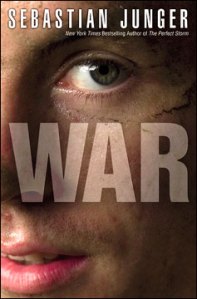
Just got done reading Sebastian Junger’s new book, War.  The title is a little

Sebastian Junger--"War"

grandiose since I don’t think Junger delivers the truth of War, but I do think it is a very good book and certainly the best thing, in a relatively limited sample, that I’ve read about the American experience in Afghanistan.

Junger avoids political pronouncements in preference for a close examination of the individual experience of the soldier at war, and even more particularly on the soldier in the combat zone.   Indeed, I think to some degree that the book might more appropriately have been titled “Combat,” since it is really focused not on the large scale strategy, tactics or mechanics of carrying out a war, but on the men at the point of the spear who live under fire or the threat of it.

I’m interested in a lot of things about this book, but most particularly on Junger’s concentration on the supremacy of the combat unit, the squad or platoon through whom the basic bloody work of military strategy is made real.  Junger emphasizes the fact that survival and success in combat depends on every individual soldier deciding repeatedly, if unconsciously, that the lives of other members of the team are more important than his own.  Indeed, in what was to my mind Junger’s most startling claim,  courage in battle must be understood first and foremost as a form of love:

Combat fog obscures your fate–obscures when and where you might die–and from the unknown is born a desperate bond between the men.  That bond is the core experience of combat and the only thing you can absolutely count on.  the army might screw you and your girlfriend might dump you and the enemy might kill you, but the shared commitment to safeguard one another’s lives is unnegotiable and only deepens with time.  The willingness to die for another person is a form of love that even religions fail to inspire, and the experience of it changes a person profoundly.  What the Army sociologists, with their clipboards and their questions and their endless metanalyses, slowly came to understand was that courage was love.  In war, neither could exist without the other, and that in a sense they were just different ways of saying the same thing.  According to their questionnaries, the primary motivation in combat (other than “ending the task”–which meant they all could go home was “solidarity with the group.”  that far outweighed self-preservation or idealism as a motivator” (239-230).

Junger connects this even to the solidarity of the group in the pursuit of killing.  Killing in war is not primarily about the hatred or dehumanization of the enemy, idealism about causes, patriotism for country.  It is more primordially about saving the lives of those you love.

Junger’s depictions and ruminations here are convincing to me, quite apart from my own convictions about personal or state violence, and they do give me pause over a particular conundrum.  American life is so thoroughly characterized by individualism and self-promotion.   And yet life in combat–which is in some ways also seen as quintessentially American–is by Junger’s accounting absolutely about self-effacement in some profound and existential way.  I was reminded of the controversy over The Hurt Locker

The Hurt Locker Poster

where veterans of bomb squads were deeply troubled by the individualistic and cowboy renegade image that was projected by the protagonist.  Reading Junger, I understand that complaint more clearly now.  The individualistic hero who strikes out on his or her own at apparently great risk to himself and others is a Hollywood figure, but one who, if univeralized, would very quickly mean the absolute destruction of a fighting the unit, the opposite of the kind of sacrificial heroism that Junger believes is a characteristic not of exceptional persons in combat, but the fundamental nature of what makes combat possible at all.

Reading Readers: Notes on Alberto Manguel–I

I’ve been reading Alberto Manguel‘s A Reader on Reading.  Some random thoughts:

A Reader On Reading Alberto manguel

x—“Over the years, my experience, my tastes, my prejudices have changed:  as the days go by, my memory keeps reshelving, cataloguing, discarding the volumes in my library;  my words and my world—except for a few constant landmarks—are never one and the same.  Heraclitus’s bon mot about time applies equally well to my reading:  “you never dip into the same book twice.””

–In my own experience, a central experience, if not THE central experience through which my tastes, prejudices and memories have changed has been the experience of reading itself.  That is, books, are not infinitely malleable pieces of dough to be made in to what the reader wants them to be at a whim—what seems to be Roland Barthes notion in The Death of the Author. On the other hand, neither do books show the same and constant aspect regardless of time and circumstance.   Rather books are agents of change, shaping me in to something different than what I was before.  I do not say, as might seem logical, that books shape us into the readers they need.  This might follow from something like Iser’s notion of the Implied Reader or the Holland’s theory of the Ideal reader.  I don’t think books have that kind of agency or that authors have that kind of knowingness.  But some books are like mountains that must be scaled, others like fires that must be endured, others streams to be forded.  A book’s agency is found in the kind of action it demands of me, and it’s nature changes for me to the degree that I am changed by the action it affords.  I may by turns and by age turn from the mountain as too daunting, gasp and crawl halfway up its face before giving up in or scale it with the ease of an Olympian.  In every case I am experience the mountain as it is, as it shows its face to me.  It is not that the Olympian truly knows the mountain for what it is, because the climber who scales its height without a second breath cannot see what is there to seen by the man crawling in exhaustion, his breath in the dirt.

x—“I believe there is an ethic of reading, a responsibility in how we read, a commitment that is both political and private in the act of turning the pages and following the lines.  And I believe that sometimes, beyond the author’s intentions and beyond the reader’s hopes, a book can make us better and wiser.”

–I wonder, if it is beyond the author’s intentions and the reader’s hopes,  how is it that books make us wiser?  We cannot say, I think, that the words on the page have a power unto themselves apart from their human utterance and reception.  Manguel ridicules this notion as a form of magical thinking elsewhere in the book.  But what is it then, in the experience of books that makes us wiser?  I agree with the sentiment, but can’t define the agency of such making.  Indeed, it often seems to me that when writers—fiction writers at least—set out to impart wisdom they more often  impart tedium and irritation.  Fiction writers should not be oracles; those who try would be better off becoming essayists or preachers.  Nor am I particular taken by readers who approach books as if they contain wisdom, as if Melville or Faulkner or Morrison were a secondary scripture.  If there is wisdom, it does seem to me that the wisdom might come as an accidental gift of the act of reading itself, not in what is read or who is reading or who is being read.  But at this point I may merely be trying to be oracular.

Ink Spilled, and spilled, and spilled

From Frank Donoghue in the April 10, 2010 Chronicle Review.

“Deborah L. Rhode, a professor of law at Stanford University, in her book In Pursuit of Knowledge: Scholars, Status, and Academic Culture, notes a study showing that only 2 percent of published scholarship in the humanities is ever cited.”

Looking back on our own age in academe, I suspect that archeologists of knowledge may remark that there has never been so much sweat and strain on the part of the many–academics that is–for the profit of so few.