Tag Archives: internet

My blog is better than your blog: literature and evaluation on the net

Sebastian Mary over at if:book has a new post that takes up some more about the problematics of trying to “do literature” on the web. Among many other things, Mary says the following:

‘Literature’ here evokes a well-rooted (if not always clearly-defined) ideology. When I say ‘literary’ I mean things fitting a loose cluster of – sometimes self-contradictory – ideas including, but not limited to:

the importance of traceable authorship
the value of ‘proper’ language
the idea that some kinds of writing are better than others
that some kinds of publishing are better than others
that there is a hierarchy of literary quality

And so on. If examined too closely, these ideas tend to complicate and undermine one another, always just beyond the grasp. But they endure. And they remain close to the core of why many people write. Write, as an intransitive verb (Barthes), because another component of the ideology of ‘literary’ is that it’s a broadcast-only model. If you don’t believe me, check out any writers’ community and see how much keener would-be Authors are to post their own work than to critique or review that of others. ‘Literary’ works talk to one another, across generations, but authors talk to readers and readers don’t – or at least have never been expected – to talk back. (Feel free, by the way, to roll your own version of this nexus, or to disagree with mine. One of the reasons it’s so pervasive as a set of ideas is because it’s so damn slippery.)

============

Obviously plenty of print books have no literary value. But the ideology of ‘literary’ is inseparable from print. Authorship is necessary and value-laden at least partly because with no authorship there’s no copyright, and no-one gets paid. The novel packs a massive cultural punch – but arguably 60,000 words just happens to make a book that is long enough to sell for a decent price but short enough to turn out reasonably cheaply. Challenge authorship, remove formal constraints – or create new ones: as O’Reilly’s guides to creating appealing web content will tell you, your online readership is more likely to lose interest if asked to scroll below the fold. Will the forms stay the same? My money says they won’t. And hence much of what’s reified as ‘literary’, online, ceases to carry much weight.

I like a lot of what Mary is groping after here, but I would offer a few caveats. The notion of the “literary” is not coextensive with the creation of books, but came in to being much later than books came in to being. You could trace the notion of the literary to the development of Gutenberg’s press, but even that would be a bit anachronistic. Our current use of the term “literary” doesn’t really fully develop until late in the eighteenth, early in the nineteenth century, and only becomes a full-blow ideology in the middle and late nineteenth century. Cf Raymond Williams in Marxism and Literature.

This suggests that simply doing away with our sense of the literary might not do away with our sense of the need to categorize and create hierarchies. Criticism is as inevitable as breathing, said T.S. Eliot, and he’s right. Even as you read this blog you are evaluating and criticizing, if only to say that this blog is or is not worth the reading time. Cf Barbara herrnstein Smith in Contingencies of Value. To be sure, the methods and means by which we come to determine what is worth doing is very different on the web than it was in Eliot’sSamuel Johnson London, but that doesn’t mean it doesn’t happen. Indeed, literary criticism as we know it began with Samuel Johnson and others who were trying to figure out, among other things, what was worth their time to read.

One response to this, typical on the web, is to say “Well, I can read anything I damn well please. And who are you to think differently?” But this kind of attitude doesn’t hold up for very long. Of course, anyone CAN read anything they want to read, just as people CAN sit in their barcaloungers and drink beer all day. But we constantly evaluate and imagine human activities in terms of what kinds of social worlds they make possible. To admit this isn’t to be an elitist. To do otherwise is to imagine a world where I could care less if Bob down the street never bothers to learn to read a book more difficult than “See Dick Run” since, after all, its his personal preference or part of his culture. That’s fine, but if his kids and grandkids imitate him, we’ve got not a personal preference but a social problem. At least in any society that we are currently living in.

All of this is merely an aside to say criticism happens. And it is and will continue to happen on the web. For instance, this week’s New York Review of Books contains an excellent article, a review of John Broughton’s Wikipedia, The Missing Manual. The review suggests that Wikipedia is entering a mature middle age. One sign of that middle age is a developing set of rules and hierarchies. NicholsonThe Missing manual Baker writes of the chaotic creative destruction–and destructive creativity–that characterized wikipedia in the early days, before going on:

At least, that’s how it used to be. Now there’s a quicker path to proficiency: John Broughton’s Wikipedia: The Missing Manual, part of the Missing Manual series, overseen by The New York Times‘s cheery electronics expert, David Pogue. “This Missing Manual helps you avoid beginners’ blunders and gets you sounding like a pro from your first edit,” the book says on the back. In his introduction, Broughton, who has himself made more than 15,000 Wikipedia edits, putting him in the elite top 1,200 of all editors—promises “the information you absolutely need to avoid running afoul of the rules.” And it’s true: this manual is enlightening, well organized, and full of good sense. Its arrival may mark a new, middle-aged phase in Wikipedia’s history; some who read it will probably have wistful longings for the crazy do-it-yourself days when the whole proj-ect was just getting going. In October 2001, the first Wikipedian rule appeared. It was:

Ignore all rules: If rules make you nervous and depressed, and not desirous of participating in the wiki, then ignore them entirely and go about your business.

The “ignore all rules” rule was written by co-founder Larry Sanger and signed by co-founder Jimbo Wales, along with WojPob, AyeSpy, OprgaG, Invictus, Koyaanis Qatsi, Pinkunicorn, sjc, mike dill, Taw, GWO, and Enchanter. There were two dissenters listed, tbc and AxelBoldt.

Nowadays there are rules and policy banners at every turn—there are strongly urged warnings and required tasks and normal procedures and notability guidelines and complex criteria for various decisions—a symptom of something called instruction creep: defined in Wikipedia as something that happens “when instructions increase in number and size over time until they are unmanageable.” John Broughton’s book, at a mere 477 pages, cuts through the creep. He’s got a whole chapter on how to make better articles (“Don’t Suppress or Separate Controversy”) and one on “Handling Incivility and Personal Attacks.”

To be sure, these rules and hierarchies function differently than they did elsewhere, but they function nonetheless. Among the consequences of these rules and hierarchies is that some things that are written endure in ways that some other things do not. If not forever, then at least for a while.

I think, then, that we might say that we just haven’t developed our understanding yet of what might be possible with the net, and so we haven’t developed aesthetic categories appropriate to writing literature on the net.

The other thing to say here is that Sebastian Mary seems to assume that the inherent and necessary character of the net is the interactive elements of Web 2.0. I’m not sure why we need to make this leap. It is like saying that because something can be done, then doing that thing is the only appropriate thing to do. I kind of buy Mary’s assertion that the literary is about the completed object. But it’s not clear why we can’t imagine the web as a space that has both completed objects and never completed interactive spaces.

Indeed, blogs function in some respects as aspects of both, and I’m intrigued by how this could be a clue to a literature of the future. A blog post is, in some respects a completed object. Admittedly, i go back and rewrite and change things here and there, but at somepoint that kind of revision comes to an end. And in some ways it’s no different than the kind of endless revision that Whitman did, but eventually stopped doing on leaves of grass.

Commentary, however, doesn’t have to come to an end. I’m still getting responses to some of the first blog posts I wrote. Theoretically, these posts could remain objects for commentary for…well…forever. I’m not so vain as to believe that these posts are worth that, but it’s possible to imagine creating a literature that would be more or less permanent and fixed that is accompanied by a commentary that is endless. In this sense, the text would be both fixed and endlessly changing to the degree that people would read not only my fantasized literary post, but also the months, years, decades, centuries…who knows…of commentary that would accompany it.

Thus, I think I disagree with mary’s assumption that the web is inherently interactive and thus opposed to the literary for a variety of reasons, even while I agree that we haven’t quite figured out how to bridge the gap between what’s been in place related to that term, and what may be coming in to being.


Freedom and Submission; or, the reading fetishist

One very big advantage of wireless networks. I can sit here and do this blog while I simultaneously watch American Idol. Yes, I am only partially ashamed to admit that I watch American Idol with my family every week. Listening to Simon disrespect singers for their “monumental lack of personality” is my great guilty pleasure.

Probably goes along with my general sense that we are too tenderfooted in declaring that some things are better than other things.

Thus, one way the net has it all over reading books. I mean I couldn’t sit here and read my new edition of War and Peace while listening to several people sing off key while displaying their lack of personality. Multi-tasking rules. (Who am I kidding; I don’t have a new edition of War and Peace or even an old one. I have no time.)

But today’s blog has nothing to do with that.

Ben Vershbow over at if:book posted a very interesting piece reviewing Hypertextopia, a free web space for writers wanting to explore the possibilities of hypertext for fiction. Says Vershbow:


The site is gorgeously done, applying a fresh coat of Web 2.0 paint to the creaky concepts of classical hypertext. I find myself strangely conflicted, though, as I browse through it. Design-wise, it is a triumph, and really gets my wheels spinning w/r/t the possibilities of online writing systems….


Lovely as it all is though, it doesn’t convince me that hypertext is any more viable a literary form now, on the Web, than it was back in the heyday of Eastgate and Storyspace. Outside its inner circle of devotees, hypertext has always been more interesting in concept than in practice. A necessary thought experiment on narrative’s deconstruction in a post-book future, but not the sort of thing you’d want to read for pleasure.


But those are the days I wish we could put the net back in the box and forget it ever happened. I get a bit of that feeling with literary hypertext — insofar as it reifies the theoretical notion of the death of the author, it is not necessarily doing the reader any favors.

Hypertext’s main offense is that it is boring, in the same way that Choose Your Own Adventure stories are fundamentally boring. I know that I’m meant to feel liberated by my increased agency as reader, but instead I feel burdened. What are offered as choices — possible pathways though the maze — soon start to weigh like chores. It feels like a gimmick, a cheap trick, like it doesn’t really matter which way you go (that the prose tends to be poor doesn’t help). There’s a reason hypertext never found an audience.


Hurrah! And Again. Hurrah. Vershbow has the courage to say that the king has no clothes.

That is, it’s not hip and cool to say, well, frankly, that this is all just a bit dull. But really, it is. It really, really is.

And hypertext fictions are boring in a way that the surfing the internet in general really isn’t. And the way old fashioned books are not. Almost as if the “planned” surprise or randomness or multiplicity of hypertext fictions are more controlling and in some fashion disrespectful of readers than traditional narratives ever were. And less surprising than the almost true randomness of the text or internet.


[Intertext I: Simon Cowell has just determined that the latest singer is “completely forgettable.” She is, she really, really is. Just like almost every hypertext fiction ever written.]

[Intertext II: I have definitely decided that Paula Abdul is irredeemably vapid. Not, I hope, like this post]


Vershbow is right to tie this to a peculiar failure of concept in postmodern views of reading and writing. I have to say that I love reading Roland Barthes. But his understanding of reading in “Death of an Author” completely misses the point of what is most pleasurable and imaginatively enlarging about the reading experience. That is, our self loss, our self-forgetfulness.


I don’t deny the general idea that reading is or can be a creative act. But Barthes tendency to turn every reader into a writer, every reading in to a writing, misses that the great glory of reading is transcendence of the self through loss, transcendence through the dissolution of the ego’s boundary, transcendence through the very submission of the imagination that Barthese hopes to forestall.


As if he were empowering readers by putting them in control. Perhaps he forgets that, as I learned on CSI, the passive partner in an S&M team is always the one who’s really in control, despite appearances.

Finally, equating freedom and creativity with control is….boring. Anyone who has written knows that the most exciting times aren’t those moments when you’re exercising authority over the text, but those when you aren’t. When the words say things you didn’t know or mean.

Reading as control is boring for the same reason hypertext fictions are boring. By giving the reader a job we’re confined by the randomness of our own choices, rather than freed and liberated from ourselves by the prisonhouse of someone else’s language.


Masochism, you say! So be it.

Submit yourselves to the discipline of the text…and be free.

Unless the grain of seed shall die. And so forth.

Fetishists of the text unite!


[Intertext III: Simon thought the last singer was “completely predictable,” but thought Brooke White was great. Paula Abdul says that Brooke White’s song was “really here.” What does that mean? What in the name of all that is good and true does that mean?]


Previews: I’ve gotten a lot of good responses to things lately that I just haven’t been able to get to. What I really hope to get to soon, but in case I don’t, just treat it like a movie that failed its test screening.

Sam Miller, one of my readers (that sounds pretentious, but I’ll say it anyway)has a new essay out at Conversational Quarterley that looks pretty good, but I need to read it more closely before I say more.

My good friend Julia Kasdorf has been up to her usual good stuff with reading and writing up at Penn State.

I’ve also managed to get the folks at MyAccess royally po’d. I think they’ve marshalled their hit squad of professional MyAccess users.

Also passed my two month anniversary as a blogger 3500+ page hits. And some of them are not even from the students I am paying to click through my pages (heh! heh!) Have got to talk about the compulsive addiction to write that is occasioned by anonymous readers.

But all that is for the future. After American Idol is over.


Illuminations and Illustrations; Videowriting for the future

One thing that always struck me as a bit odd in the Harry Potter movies is the moving illustrations of books and newspapers. Odd because, set in the present, there’s a sense in which the internet is already a great deal more magical than that. As things go, indeed, Harry Potter is peculiarly a-chronic, living in the modern world as if he’s never seen a computer. Still, those video books are, in some sense, a continuation and enhancement of the tradition of illuminated manuscript–great textual form of the world of Gothic witches and warlocks.

The attached video I got in my email today reminded me of this, one of many announcements about writing contests that I get as an English professor. This one came with a twist since it’s promoting the use of YouTube as a resource and as a media for creative writing. I checked out the details as much as I could–writing contests are famously cash-cows for journals, requiring entrants to pay anywhere from a 10 to 50 dollar reading fee for what ends up being a one in a thousand chance of being published. Not a con exactly; just a grim fact of how literary culture has to support itself in our society. This looks decently legit, and no fees that I can find.

I’m struck by two things I see here. One is the idea of YouTube as a medium for or at least an enhancement William Blake illuminated manuscriptto traditional creative writing. I’m not much taken by the idea of embedding text in video format–I’ve seen work like this before on the net in multi-media forms of poetry. Touted as an “interactive” form of reading that values the reader, this kind of thing really ends up wresting a lot of control from the reader by controlling how and when the reader will see the text the reader sees.

On the other hand, I am taken by the idea of embedding video in stories. In literary circles we’ve traditionally seen books as opposed to film in some respects, with film usually inferior. But books traditionally have made great use of visuals as supplements to the text. Illuminated manuscripts, of course, but also extensive illustrations in nineteenth century novels. Graphic novels, of course, subordinate the text to the visual, so it’s not quite the same animal, but at least you could say that the exclusively alphabetic text absent all illustration is mostly a 20th century phenomenon.

So I’m wondering how video might make room for an new kind of illuminated text. The video commenting on and enhancing the text rather than being a redaction of it–as occurs so often in films about novels. I’m not familiar with anything like this, so if someone knows about stuff for me to look at, I’d love to see it. Again, one of my pet topics; the visuality of books.

The other thing that strikes me in this is the way that internet culture is changing the culture of books in general. I’ve lamented in the past–and still do lament, to be honest–the ways in which computer culture is gradually fracturing and dispossessing the traditional sites of book culture. Places where readers Uncle Tom’s Beatinggather are increasingly becoming places where computer users gather, clicking away in their separate universes.

On the other hand, it is the case that the internet creates new cultures for readers–and not only in chat rooms and forums devoted to literature. In online book clubs I can chat with authors–at least I assume I can; I’m always wondering if it’s the author on the other end or a poorly paid graduate student doing her best to imitate the voice and interests of the latest author plugged by Barnes and Nobles. Online readings don’t yet substitute for readings in person, but I can imagine them becoming the norm. Already as a department chair I’m seeking the permission of authors to record their readings for replay on our web site. The Lunch Poetry series at UC Berkley is a good example of this on the web. I don’t think it substitutes for the great pleasure of gathering together with other readers, but who could complain that this kind of thing exists.

Of Bloggers, Bookworms, and Bibliomaniacs

Because I’ve been teaching Ralph Waldo Emerson’s essays, “The Poet” and “The American Scholar,” I’ve been spending a good bit of time over at rwe.org, which describes itself as “The Internet’s Complete Guide to the Life and Works of Ralph Waldo Emerson.” The description is awfully modest for a site devoted to a thinker whom literary theorist Harold Bloom described as “God,” but it is also awfully accurate. Indeed, every time I visit rwe.org, I find myself thinking wistfully, “What if everything on the web devoted to literature were actually this good, this complete, this organized, this useful?”

EmersonWould that it were so, but the net’s strength tends to be volume while quality, completeness, and organization are hit and miss. Of course, a lot of these things depend on not only copyright laws, but also on attracting a devoted following willing to do the work necessary. By every evidence, and not just that of Harold Bloom, the cult of Emerson remains strong. The Emersonians over at rwe.org have clearly done a great work for all of us by creating a digital monument to this most seminal of American thinkers.

Which is itself an irony and an occasion for thought. In the first place, Emerson wasn’t much given to monuments or to being monumental. In the second place, what exactly would this thinker who believed immersion in nature was the first responsibility of “Man Thinking” think about our dependence on technology, our bleary-eyed devotion to the glowing screen, our aching backs as we bend over our keyboards, our pasty complexions that testify that we have all but forgotten the existence of the sun.

My first guess is that he would be appalled by both his own monumentuality, and by our unnatural lives. Though, at the same time, it isn’t impossible to imagine Emerson as the God of not only Harold Bloom, but the first progenitor of netizens everywhere.

My sense of Emerson’s displeasure centers on Emerson’s general disease with reading. This from “The American Scholar”:

The theory of books is noble. The scholar of the first age received into him the world around; brooded thereon; gave it the new arrangement of his own mind, and uttered it again. It came into him, life; it went out from him, truth. It came to him, short-lived actions; it went out from him, immortal thoughts. It came to him, business; it went from him, poetry. It was dead fact; now, it is quick thought. It can stand, and it can go. It now endures, it now flies, it now inspires. Precisely in proportion to the depth of mind from which it issued, so high does it soar, so long does it sing.

Yet hence arises a grave mischief. The sacredness which attaches to the act of creation, — the act of thought, — is transferred to the record. The poet chanting, was felt to be a divine man: henceforth the chant is divine also. The writer was a just and wise spirit: henceforward it is settled, the book is perfect; as love of the hero corrupts into worship of his statue. Instantly, the book becomes noxious: the guide is a tyrant. The sluggish and perverted mind of the multitude, slow to open to the incursions of Reason, having once so opened, having once received this book, stands upon it, and makes an outcry, if it is disparaged. Colleges are built on it. Books are written on it by thinkers, not by Man Thinking; by men of talent, that is, who start wrong, who set out from accepted dogmas, not from their own sight of principles. Meek young men grow up in libraries, believing it their duty to accept the views, which Cicero, which Locke, which Bacon, have given, forgetful that Cicero, Locke, and Bacon were only young men in libraries, when they wrote these books.

Hence, instead of Man Thinking, we have the bookworm. Hence, the book-learned class, who value books, as such; not as related to nature and the human constitution, but as making a sort of Third Estate with the world and the soul. Hence, the restorers of readings, the emendators, the bibliomaniacs of all degrees.

(From RWE.org – The Works of Ralph Waldo Emerson)

I wish I had thought of the name “Bibliomaniac” when I was getting my personal blog started. The description is apt. Though for Emerson, of course, a sign of damnation. He would have detested the accompanying image from Northwestern University’s Library, however much I love it. But really, isn’t this more or less the image of not just ManBookworm Northwestern Reading Books, but also Man Reading Computer Screen? (Or even Man Blogging?) Through my devotion to the thoughts and words of others, I drift gradually from my own authenticity, my own innate and good self-expression, my personal experience of the Over-Soul. To be derivative is to be damned, and the only sure way to avoid derivation is to not read at all.

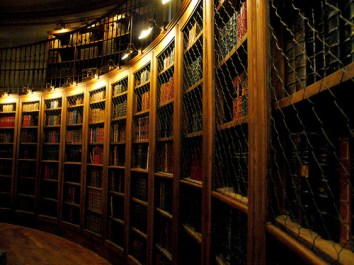

Well, to be sure, Emerson doesn’t go quite this far. But he was suspicious of the obeisance we give to thinkers of old. Written when he was a relatively young man, he probably didn’t give a lot of thought to the fact that he, like all flesh living, was on the way to becoming a thinker of old. And he could not have imagined me poring over and ingesting his words like a bookworm as I prepare to teach a class on him as one of the monumental literary theorist of the nineteenth century.

(Sidebar: What metaphor must we now use in place of bookworm in the world of pixels? A computer virus? Another term like “typewriter” that my someday-grandchildren will not recollect and will marvel at as an index of my age and lack of cool. Who am I kidding—my son already marvels at these things. Of course, if we give up reading altogether, spending all our time blogging, we won’t have to worry about having a different word. )

But there is a place for good reading in Emerson, and as I’ve suggested elsewhere, it has something to do with reading as a creative act. Says Emerson.

I would not be hurried by any love of system, by any exaggeration of instincts, to underrate the Book. We all know, that, as the human body can be nourished on any food, though it were boiled grass and the broth of shoes, so the human mind can be fed by any knowledge. And great and heroic men have existed, who had almost no other information than by the printed page. I only would say, that it needs a strong head to bear that diet. One must be an inventor to read well. As the proverb says, “He that would bring home the wealth of the Indies, must carry out the wealth of the Indies.” There is then creative reading as well as creative writing. When the mind is braced by labor and invention, the page of whatever book we read becomes luminous with manifold allusion. Every sentence is doubly significant, and the sense of our author is as broad as the world. We then see, what is always true, that, as the seer’s hour of vision is short and rare among heavy days and months, so is its record, perchance, the least part of his volume. The discerning will read, in his Plato or Shakspeare, only that least part, — only the authentic utterances of the oracle; — all the rest he rejects, were it never so many times Plato’s and Shakspeare’s.

I think this kind of thing, along with Emerson’s deeply felt sense of the interconnections of the immediate world with a world beyond—and with everything else in the world–is where people get the idea that Emerson was some kind of ancient God of the blogosphere. Indeed, Christopher Lydon a few years back said just this thing in an extended blog post called “A God for Bloggers.” The post at its original site is long gone, but is copied in full here . In part, Lydon argues:

Here’s my point. When we talk about this Internet and this
blogging software, this techno-magic that encourages each of us to be
expressive voices in an open, universal network of across-the-board
conversation, we are speaking of an essentially Emersonian device for
an essentially Emersonian exercise. Starting with the
electronics. “Invent a better mousetrap,” as Emerson wrote, “and the
world will beat a path to your door.”

There’s a part of me that thinks Emerson would have loved the fact that Lydon’s post had disappeared, or almost disappeared. This is the perfect condition of reading as far as Emerson is concerned: let the book/blog have its say and go away.

To Lydon’s actual content, I want to say….yeah, kind of….but not really. In the first place, there’s a way in which the technology of blogging and reading blogs tethers us to society—Emerson’s worst dirty word—in a way that books did not, this despite the aura of freedom that surrounds computerworld.

Even with the magnificence of access, I am struck by how physically limited I am in terms of my mode of access. My computer needs a proximate cord and electricity and connections—electricity even if I have a wireless connection, and reliable wireless connections are still hard to come by. Because I know next to nothing about the workings of this machine I’m writing on, because I can do nothing to control my internet connection, because I have to have access to various levels of anonymous administrators and their vast electronic resources, I am in some sense even more dependent, more inescapably tethered to society and its mores and its conventions than Emerson could have ever imagined.

We have the lovely illusion of independent creativity in our isolation, in our loggorhea of the keyboard, in our incessant speech. It’s a little like cocaine makes the addict think he’s an all powerful sex machine. The real power is the man who provides the fix. Or doesn’t. In this case, my internet administrator, or more dumbly, the squirrel that gets itself electrocuted in the router box or powerline.

By comparison, a book is a model of self-reliance, even compared to e-books with megabatteries. I can drop my copy of Ulysses in a lake, and if I’m quick enough I can probably set it by a fire, let it dry for a while, and be just fine. Then again, if not I have a new and ready supply of toilet paper, Kleenex, and firestarter.

By comparison my daughter’s ipod died irreparably after sitting next to a sweating water bottle for thirty minutes. Sitting in the sauna today, I was wondering—can an e-book stand the heat, stand those rivers of sweat that dripped off my nose into the creases of the cheap newsprint I was perusing. Could be, but I would be afraid to try. If I ruin my newspaper I’m out three bucks. If I ruin my dedicated e-reader—the one I will supposedly buy someday—I would be out 400 plus however many hundreds of dollars of books I stored up. Emerson might well look at bloggers and e-books and the like and see not evidence of infinite expressibility, but of cows in a pen.

Not saying he would be right, but he would have reason. This cow says.

Similarly, I have my doubts about the idea that blogging, simply because it is a form of expression, is the kind of expressiveness that Emerson had in mind. Indeed, for Emerson the deadliest thing for individual authenticity was repetition, was convention. And yet, does it take very much time on the web to realize just how repetitive blogging really is, just how much of it is reaction rather than response. How much of it is profane ejaculation rather than creative reading Indeed, I’m often bemused by how many blogs are largely cut and paste jobs of other blogs. Bloggers not only don’t come up with words of their own, they explicitly and joyfully use the words of others as a substitute for words of their own.

By comparison my own blog is a paen to self-indulgence. I actually write these things myself. Mostly.

At least all this lack of originality orginates with me.

In other words, there’s a part of the net’s emphasis on collaboration and connectivity that speaks to Emerson’s optimistic view of the interconnectivity of all things. There’s another part of it that speaks to Emerson’s sense of “the sluggish and perverted mind of the multitude” , where people let groups think for them rather than thinking, and speaking, for themselves.

You don’t, of course, have to rely on me for this. Rely on yourself…and on the administrators at RWE.org, and on your computer engineer, and on your electrical grid, and on your software engineer… and on…and on. Well you get my drift.

Go over to the folks at RWE.org and read Emerson for yourself.

Let’s get together and read

I ran across this somewhere, probably through another blog, though I don’t remember now. Anyway, now we have the ability to connect with people anywhere in the world who may be reading Shakespeare at this particular moment. As I write this post, 242 people are reading Shakespeare, and I even know that 23 are reading Hamlet, mostly in the United States and Europe, but I have seen several readers of Shakespeare in Japan and China over the past few days. Of course, that’s only people who are intrigued enough by this service to sign up.

I’m vaguely interested in the forms of socialization that are associated with web world. Although it comes across as very individualizing–a place of me doing my own thing–in a different way it can be very clubby and group-think oriented, like a group of high school girls who can’t go to the bathroom without four friends. I see this to some degree in what happens with online reading. Over at Book Glutton–so far as I can tell it has yet to take off, but this is the concept in any case–the idea is to read along through a text with a group of friends, giving you the capacity to read together in real time.

I don’t think there’s anything particularly wrong with this per se. Indeed, it’s sometimes a very good exercise to have a group of students sit together and read the same book silently. It can be a weirdly interesting bonding experience. But rather than being the exception, it’s almost like reading the same thing at the same time as someone else becomes a need in the culture of the web.

Not sure if that’s quite the case, but I can see it everywhere. My daughter is only satisfied being on Facebook if she is at the same time chatting with a dozen of her friends online.  WordPress let’s me know how many people are blogging “right now.” I wonder what need this feeds? Are they trying to reassure me that I am not alone here sitting in front of my computer, despite all evidence to the contrary. We’re all in this together.

Does it make a difference to how people read or write, or even affect their interest in reading and writing? I finally got around to joining up at BookGlutton because I thought it would be an interesting experiment in online reading. Trouble was, I couldn’t find groups that were reading anything I was interested in reading. So I didn’t read at all, despite the fact that there were a lot of different books to choose from. Now this is not a hack on BookGlutton–some few of the folks over at Librivox are still PO’d at me for treading on their territory. (Unintended, but nevertheless quite good for the blog stats). At Book Glutton I have the option of trying to form my own group with other people, just didn’t have the time or inclination. But I also wonder whether services like Book Glutton or other things like this will transform the way reading is practiced as a social experience, even affecting what people choose to read. I would bet that something like Amazon’s Kindle will develop similar kinds of capacities in future incarnations. As a consequence, I can easily imagine people choosing not to read a book because no one happens to be reading it at the same moment. No one there to chat with while I read. Five years ago I would have thought this was a fantasy; I’m not so sure it isn’t a present and growing reality.

There’s some historical precedent; in the classical period, reading often took place at social gatherings of the elite, a necessary corollary to reading aloud. What goes around comes around. Maybe fifty years from now reading alone will seems as odd to our culture as reading-as-online-chat seems to me today.

Miscellany: More Librivox, More Emerson, More Diarrhea

Ok, to get to Diarrhea, you have to read to the end of this post.


MORE LIBRIVOX

I got some very good comments from “Hugh” who is a poobah of some sort over at Librivox. You should go read his comments yourself at my post, “Listening as Reading,” but a couple of excerpts here since I want to think about what he has to say. (And, hey, it’s a cheap way to come up with a post when it’s late at night and I’m having trouble collecting my thoughts.

Says Hugh:

“in pre-radio/tv/recordings days, and when books were relatively expensive, many books were actually written to be read aloud – it was a form of family entertainment: the family & friends gathered around papa (or mama) who read at the fireplace. dickens is a particular example. of course an mp3 audio version read by a stranger isn’t the same thing, but it is another experience of literature, one that has it’s own particular richness, and weakness.”

Yes, a good thing to point out, continuous with my general observation that for the longest part of human history reading was primarily about reading aloud, not reading silently. I’m not quite sure I would go completely down the road that books in the nineteenth century were written to be read out loud. This misconstrues the case. But it is the case that they were commonly read out loud, and there was a great deal of fluidity between the oral presentation and the written. Dickens is a good representative of this fluidity. I’m not quite sure I would say Dicken’s wrote his books in order to read them out loud. He wrote them in order to get them published serially in magazines. But it is absolutely true that he often rewrote and rewrote passages over and over in order to achieve certain kinds of emotional effects in his listening audience. Thus there’s a deep connection between the orality of the word and the writtenness of the word. A fluid interchange of sorts. I still tell students they ought to read their work outloud to themselves in order to hear how things sound. This can be a good guide to the kind of rhetorical affects you are achieving.

Says Hugh again:

“-we are primarily a platform to help people record audiobooks (with an objective of making a complete audio library of public domain books); that the public can download and listen to our files is in a way just a fortunate by-product of what we do.

-and while our collection’s “quality” is, by design, all over the map, the volume of good and extraordinary recordings is daunting…it’s a matter of finding the good stuff. Here are some recommendations:

http://ask.metafilter.com/79067/Librivox-Recommendation”

This last is very helpful, though I wish the list was more organized. I clicked through some of the recommended readings and–on the basis of very short sampling–most of them are superior to some of the detritus I’ve waded through the past few times I’ve strolled through Librivox. I wish that Librivox would provide some kind of ratings system itself–at least one that recognized the popularity of different readings–though I suspect that this would counter the dream of pure democratic participationism that drives this kind of thing on the web.

As for Librivox being primarily about the readers and not the listeners, something Hugh tells me in a second comment, I’m not so sure. (I think Hugh didn’t think it was fair of me to criticize many of the readers for being…well…Dull. Or annoying. Or both). To some degree I think he’s suggesting that Librivox is really more like a blog service where readers can express themselves via recording. Well, OK. But the thrill of doing so is that people will listen in, yes? I mean, if it wasn’t for the fact that people might actually look at this blog, why not just keep it on my computer instead of publishing it for all the world to sneer at.

It’s also the case that in reading a published work, the reader puts himself/herself in the position of performer/artist who is interpreting the work of another artist. There are a lot of opera singers out there who really ought to spare the rest of us and restrict their renditions of Nessun Dorma to the safety of their shower stalls. On the other hand, I don’t begrudge them the right to perform for the world on YouTube. But if they do, I generally think we’ve got a right and responsibility to Puccini and to Pavorotti to say, “You know, that really stinks pretty badly.” There’s no inherent nobility in performing, contrary to what most Americans seem to think.

But enough. Mostly I’m on Hugh’s side here. I’m glad someone’s doing something like Librivox, even if I don’t want to listen to most of the people doing it.


MORE EMERSON:

I blogged a bit about Emerson today on the blog dedicated to my course on literary theory. Just a bit of that from a post I called “Emerson and the Gods of Reading”:

Along these lines, I think there’s a way in which Emerson’s notions of creative reading are embodied in the way we read now. For Emerson, reading was a threatening activity precisely because we were always tending toward submission and passivity, always on the brink of substituting someone else’s creativity or knowledge for our own. This would mean we had failed to be “The Poet” we were meant to be and in fact are if we would only realize it. Instead, reading only exists to a purpose if it inspires us to more writing of our own. Reading must always give forth in to new and different expression, or it is worthless. Reading that absorbs and doesn’t give forth in new creativity, reading that doesn’t come to an end in writing is destructive to rather than an enhancement of our humanity.

What is this if not the reading ethic of blogging. Emerson, the familiar spirit of Facebook culture. Reading for us now is only meaningful if it gives forth in self expression. Indeed, texts become primarily a means of further self-expression. I read other texts or find other materials on the internet in order to “blog” them. The verb in this sense means partly to write about them, but blogging something also connotes making it one’s own, making it an opportunity for self-expression, an opportunity to speak.

I don’t think I want to deride this outright. NPR had someone–maybe the founder of Facebook-?!-on today with a little piece on the glories of connectivity available through self-exposure. It seemed a little facile–by exposing my darkest secrets on the net I’ll be able to develop authentic relationships with people I’ve never met. Umm, maybe. If this were true, why not go expose yourself to your next door neighbor. Still, it is the case that kinds of connections are built through this incessant speaking. Ultimately, for Emerson, our seeking expression at the expense of reading was not a form of self-aggrandizement, though it’s often taken for that. It was ultimately a way of connecting to a broader world. In Emerson’s view, if all people would become The Poet they were meant to be, all the world would be saved and we would all be one. It’s ultimately a platonic evangelical Christian vision without Christ in some sense. If we’ll all individually get right with Jesus, we’ll all be one. The internet says something vaguely similar. If we would all just keep looking for ways of expressing ourselves through the texts of others, we will all be connected through what is, after all, the World Wide Web.

I have no idea if this makes any sense, but it seemed profound at the time. Parents are paying for this stuff. It better be.


MORE DIARRHEA

Ok, this doesn’t refer to the stinky liquid spew that this post is fast becoming. Or not only that.

I often tell my English students that there is a magazine about everything, so they can take their writing skills and find a job anywhere in the world. The last part is a department chair’s fantasy, but there really is a journal about everything in the world.

Witness “Dialogue On Diarrhea.” Yes, there is a journal covering everything you wanted to know about loose stools. Ok, I should say there used to be a journal. In the words of the web site:

Dialogue on Diarrhoea was an international newsletter on the control of diarrhoeal diseases published by Healthlink Worldwide (formerly AHRTAG), a UK-based non-governmental organisation.

The first issue was published in May 1980.The last of a total of 60 issues, during its 15 years, was published in May 1995.

Published four times a year, Dialogue on Diarrhoea offered clear, practical advice on preventing and treating diarrhoeal diseases. It also acted as a forum for readers to exchange ideas and share experiences.

Umm, just what kind of experiences are we sharing here exactly?

Anyway, the print newsletter is no more. And now instead we have “Dialogue On Diarrhea Online”. So the next time you have this problem, you’ll know where to head. Besides the bathroom. I mean.

And, as we think of it, doesn’t this point to the last important remaining geography in which print remains triumphant. Bathroom reading. It’s a bit tragic that the diarrheatics among us will now have to carry their Kindles to the bathroom in order to keep up on the latest and share their experiences. On the other hand, with laptop in hand they will now be able to share their experiences in a much more intimate and immediate way.

Ok, I’ll stop. I’m sure I’ve now insulted all the chronic diarrhea sufferers who regularly read this blog. And none of my students will ever get an internship with this website. That’s for sure.

Final note: I thought for sure I would be the only person on WordPress who used the word “diarrhea” in a tag. No. There are hundreds of us.

Isn’t the web a wonderful place?

Books in a material world–Bookporn and more

I was talking to a couple of students yesterday, one of whom wants to be a librarian because she loves “being around books.” A little bit of a Scrooge, I guess, I told her she better get used to being around computers since that was the real future of libraries, taking her back a bit with my revelation that the library budget at our own college had just been required to move $50,000 from book purchasing to database collections. Small change for a lot of places, but for my smallish college $50,000 is nothing to sneeze at. Indeed, I’ve already felt the squeeze just a bit since English used to depend on the general fund of the library to order contemporary novels and poetry–which we ordered gleefully and at will. Probably partly on the erroneous assumption that availability would somehow translate into their being taken off the shelf. Well, that fund hasn’t disappeared, but we’ve been asked to order not quite so gleefully, and not quite so at will. A concrete manifestation of how a response to a perceived technological need–real or not–will gradually determine or close the future of the book as we’ve known it.

Still, my student was not dissuaded. She feels that books will always be with us because we love their physicality. There’s that body of the book theme again, and there’s something real about it that has to be thought through. Reading is not simply a mental process of decoding letters, not simply a process of getting information off a page or screen and in to our brains. It’s a physical activity to which we attach all kinds of cultural and personal meanings, a kind of spiritual reverence that the attach to the being of books that we cannot yet attach to computers.

We imagine computers too much as tools, and emphasizing their efficiency does too little to address the tactile, even the olfactory meanings that we attach to book culture. The other student who was with us was very intrigued by Amazon’s Kindle, but even she paused and said, “I became an English major when I looked out from the balcony and saw the stacks and stacks of books.” The physicality of books inspires a reverence, whereas the efficiency of computers inspires…what?…a sense of efficiency?

Indeed, I’m intrigued by the growing tendency of laptop users to try and personalize their laptops–recreating their essential impersonality through a kind of personal graffiti. There’s a great newstory on this phenomenon at c/net, along with Personalized laptop.  One of my favorites. 

We do this with books, it seems to me, but not in the same way. We don’t feel compelled to personalize the cover of a book, and our markings in a text are more to memorialize a reading experience than to carve a human personality into what is, after all, a machine. Books are a technology, but at the least we have learned to experience them as extensions of the body rather than as tools.

Along these lines, I’ve been running in to a lot of images of books again. Rachel Leow over at A Historian’s Craft celebrates the one year anniversary of her blog with BookPorn #27, a couple of fabulous images of the Library of the Musee Guimet. Says Rachel:Library Musee Guimet

“There’s a kind of hushed atmosphere when you walk in: the lights are dim and people shuffle about, struck silent with reverence, or perhaps the disconcerting, all-pervading pinkness of the walls and columns. The books lie, untouchable, behind their wire cages, and the smell of old paper lingers about well after you step, blinking, back out into the fluorescent glare of the exhibition outside.”

Nice writing, Rachel. And happy birthday. It seems to me that Rachel gets at this notion of the importance of the physicality of books inspiring a kind of reverence, something I attach even to my tattered paperback crowded onto basement shelves, but which I don’t really attach to my computer. Like nearly everyone else, I’m sure I spend a great deal more time on my computer reading anymore than I do in actually reading books. Like most white collar workers I’m chained here all day, and then blog all night. But feeling reverence for my computer feels a little bit like feeling reverence for my screwdriver. Not impossible, I guess. I’m sure many a carpenter has a deep feeling for his screwdriver. But I also guess that mostly such carpenters are considered weird by everyone else.

Books are tools, but it’s a mistake to think that what counts in reading them is the toolishness. If we only focus on the instrumental qualities associated with text delivery, there is no question that the e-book-o-philes among us are right to scoff at fears of digital libraries. Still, culture is more than instrumental, and always has been.

Along these lines, there’s a humorous and very interesting Giuseppe Acrimboldo Librarianskewering of those of us who are book fetishists over at if:book. Chris Mead has written a song about the history of books along with a lot of great images. My favorite is this from Giuseppe Acrimboldo, “The Librarian.” I love it. The human is text, no a book, a library. What I’ve always thought anyway. I am my books. I don’t yet say, I am my computer. Will I ever.

Chris takes the opportunity to skewer the-sky-is-falling attitude that some of us bring to the changes that are going on

“words: written in silence, muttered in monasteries
have been sung, shouted, acted – now by digital industries

broadcast and mixed for our burgeoning multiculture,

but circled by many a gloom-laden vulture

crying “R.I.P. books: doomed to extinction
by some blinking e-inky, i-evil invention”.
The word spreads and
changes; that’s my belief.
What next for the book?
The future lies overleaf.

Very nice. Dr. Seussian. Ok, only almost. Still, Chris’s poem/song emphasizes an assumption that I think is flatly wrong. That the technology of reading is essentially inconsequential for the act of reading itself. This is clear explicitly in the opening part of his poem.

“Books are what a society carries its words in
and words have been written on stone, silk, slate, parchment,
wax, clay, screen and skin,”

This is superficially true, but the assumption seems to be that reading is only about decoding letters, and books–or parchments or scrolls or screens–are merely delivery systems that are more or less equal except in the efficiency with which they can deliver text to readers. This is flatly false, as any historian of books and reading could point out in half a breath. In some sense, when we went from reading scrolls to reading codexes and then books, the changing technology changed the meaning of the act of reading, not just the techniques of the act of reading. It is this changing meaning that is crucial to try and understand. Techniques of text delivery can merely be learned through users manuals. Meanings and their attendant ways of being human are less easily learned and unlearned. We ought to pay attention to what those changes might be.

Final note: I’m sure everyone’s familiar with this video, but it still makes me smile. It’s a reminder that all of the cultural associations we have with books had to be learned. There’s nothing natural about our sentimental attachments to books. As kids, we’re all in the position of the monk at a loss here, not knowing which way a book sets on the table, which way to turn the pages. Culture is learned. That doesn’t mean the demise of books should be sniffed at. But culture is learned.

Audiobooks: Baritones do it Better

I’m having a little trouble keeping the eyelids open on humpday, so I’ll probably come back to this later. Still, I’ve been away for a couple of days, so I thought I’d ruminate for a few paragraphs.

A conversation with a colleague a couple of weeks back has had me contemplating the status of audiobooks. Conversation turned around the question of whether audiobooks constituted “reading,” an ameliorative factor to the generally dismal view of literary reading that’s been out there ever since the NEA report in 2004.

I’m not convinced, but I am intrigued by the general status of audiobooks and how they relate to the historical practices of reading and listening aloud. It’s worth saying that a characteristic of modern reading practices has idealized silent reading for oneself. Reading out loud, and worse, listening to others read, has largely been a sign of immaturity or deficiency.

But should it be? Not sure. Something I’ll have to come back to.

I recently stumbled across Librivox. Again, something I’m sure many people were already familiar with, but which seems brand new to me. Essentially an archive of open access recordings of various works of literature, the recordings done by volunteers.

Librivox has all the strengths and weaknesses of democratic webdom. I literally could not understand some of the poems I tried to listen to. Some readers sounded vaguely like adenoidal adolescents, slurred words together and substituted speed and volume for earnestness and emotion. Others started well, but seemed to get bored with the poems as they go along. It takes a lot of effort, evidently, to be sonorous and measured and musical, to have a voice worth listening to without making listeners hear the voice more than the poetry itself.

Still, I ran across Justin Brett after listening to about a half dozen recordings of Dover Beach, and immediately became a sucker for his resonant baritone and British accent. I could listen all day.

For several good recordings of Brett’s vocal work, listen to the following:

“Dover Beach”

“Jabberwocky”

“The Collar”

Is it reading? I still don’t think so, but I’ll come back to it. Is it literature? That’s an interestingly different question, that will also await another day. Is the experience of literature linked inextricably to the page, or is it in the word that the page “merely” symbolizes? Is whatever is literary about literature independent of the written word–ink or digital–just as we might think of music as essentially free of and even superior to the page upon which it is composed? I don’t think so, for now, but it’s worth thinking about.

Ephemeral, all too ephemeral; Or, does anybody remember what Russell Jacoby wrote yesterday?

David Rothman over at Teleread announced today that I’ll be blogging for them on a semi-regular basis. As I’ve indicated on this blog in the past, I think Teleread is a very good portal for getting good information about all things reading, with a special emphasis on e-books and the general interface between the digital world and books. Also, though I’m not involved in this whole end of things, they function as an advocacy group for universal computer and open library access. A worthy cause in my estimation.

David wasn’t dissuaded by my protestations that I don’t consider myself an expert on reading, e-books, or blogging. I’ll try to keep it from being too much the amateur hour.

But wait, some people are saying that blogging is THE amateur hour, to the destruction of our civilization. So perhaps I’ll just do my best to contribute to the end of all things.

Seriously though, as this blog reaches its one month anniversary, I’ve realized that I’ve been thinking at least as much about how blogging works as writing as I have about how reading is functioning in our contemporary culture. Russell Jacoby, whom I generally respect for his now somewhat ancient call for a renewal of public intellectual work, wrote a kind of scathing dismissal of the contemporary academy, and along with it a rather sniffy dismissal of blogging.

I think Jacoby’s categorical thinking is part and parcel of our problem in grappling with the nature of reading and writing—and thinking and intellectual work—in the contemporary world. It is true that blogs are somewhat ephemeral, but on the other hand, how many of the many periodical essays of the 1950s do people really remember. Moreover, if blogging specifically eschews the media of print and permanence, we might ask what kind of intellectual work, what kind of cultural work generally, is being done by this kind of writing?

It seems to me to apply the standard of permanent value to any public intellectual work is wrongheaded. The things Edmund Wilson and Lionel Trilling had to say in the 30s, 40s, and 50s can hardly apply to our world at the dawning of the 21st century. But more importantly, they did a specific kind of public intellectual work that was appropriate for the media and age in which they worked.

Blogging can be “id writing” as described in the NyTimes the other day. But it can also be a kind of intellectual and cultural work much different from those that we are used to. The 1950s saw both a lot of what we now envy as influential public intellectual work, and it also saw the explosion on the scene of Playboy magazine. Perhaps this was why people claim even yet today to buy it for the writing.

My point is that magazines and middle to upper middle brow journals were a media through which to do particular kinds of intellectual work. It seems to me that blogs and other kinds of interactive and multimedia formations are the site of potentially important intellectual work today.

But what is the nature of that work. How does it differ from that of the past. Well, for one thing, I think it aspires more to the kind of interchanges that go on in coffeeshop culture of the 18th century, where intellectual work was not yet located (imprisoned?) in as yet undeveloped academy. It’s even much more like the intellectual work that goes on in classrooms or in informal exchanges with colleagues and students after a lecture or reading.

Academics mostly sniff at this kind of thing as beneath their consideration. But it seems to me that it is precisely out of these kinds of exchanges that enduring and important intellectual work comes from. This is why I decided to start blogging a month ago. I wanted to imagine an intellectual space, a conversational space, that wasn’t imprisoned by the conventions of academic work. I also wanted to imagine doing writing that was more like the energy I feel in conversations with good friends about topics I care about deeply.

I think, honestly, that this will lead to another kind of writing that is more conventional. I still want to publish a book on the reading in the contemporary cultural imaginary. On the other hand, just because I continue to envision a more conventional form of intellectual work, I think I’m coming to think that we are mistaken if we think that blogging or other kinds of intellectual exchange on the web can only be justified if they lead to that kind of thing. If they do, great. But if they don’t they are their own kind of good. When Jacoby criticized blogs for the ephemerality, he is holding out the standard of books, and even more books that continue to be read decades after they are written, as the only worthy definition of intellectual work. I dispute that. The immediacy of blogging, the effort to grapple in written words with difficult problems, the opportunity to have friends and strangers read or respond, these are their own goods. This is a kind of intellectual work worth doing regardless of what other forms it may lead to, and regardless of whether it leads anywhere else at all. Just as the engagement I have in my classroom is its own good and produces knowledge worth having in me and in my students, the process of writing, of thinking through issues on a daily or weekly basis, is a knowledge worth pursuing even if it disappears next week or next year.

Well, enough for now. I’ll try to come back later and put in some links for Jacoby’s piece and some other things I refer to in this post. Right now I’ve got to go party with my wife. She thinks I love my blog more than her, so I better go prove her wrong.

Body of Knowledge

Since getting started on this blog I’ve been thinking a lot about how we image reading, and more broadly knowledge. The classic picture of a man or woman, body slumped in a chair or reclining on a bed or laying under a tree, head inclined in to a book. This is our sense of what reading is, and in a larger sense of how knowledge is gained and demonstrated.

It’s a difficult image in some respects because, in fact, we can’t really tell whether reading is going on at all simply from the fact of its physical representation. For all we know the person who seems as if they are half-asleep may in fact be half-asleep. Think of the association of reading fiction with being in dream worlds. The act of reading itself, especially silent reading, is in some respects unimage-able. We can’t see the translations that occur between marks on a page that become letters and words and then are associated with meanings in the mind. We accept on trust that the student with her book open in the back of the room is, in fact, reading, rather than drifting into a half-world as we lecture on at the front of the room.

I think working on the blog has made me acutely more interested in the physical image of reading. How could I choose relevant images for a blog taken up with something so ethereal as reading? My avatar came from a library at Upsala University (I think, I can’t remember). I was lasande_man.jpgtaken by the classic image of the hunched body at the desk, but also that it was obviously a middle-aged man, somewhat monkish. Finally, that you couldn’t see the face—which seemed to me to be something about reading and something about what I wanted the blog to be. Reading is a kind of facelessness, a kind of disappearance of the self that is itself enriching and expansive. This is why I think all the focus on reading as creativity and self-assertion among so many poststructuralists—people like Roland Barthes who want to turn reading in to an alternative form of writing—is missing something that’s relatively essential and important. The disappearance of the self in reading is precisely what we desire. The loss of self is goal, not dread outcome of the process of reading.
One thing that struck me in searching for an appropriate avatar—which I pursued by searching Google images—is that images of reading are almost exclusively associated with books. Reading means, so far as the visual imagination is concerned, reading books. I sifted through a couple of dozen pages of images and came up with not one image of a computer or a computer screen. Indeed, realizing that I was interested in pursuing the conjunction of reading and writing, I thought it was a little ironic that my wordpress template has a pen at the top. Of course, I have the option of putting in a computer keyboard, and tried to find one, but perhaps the point is made. In our imaginations, reading and writing is still a matter of pen and paper. As I said yesterday, my colleague is not even certain that what we do on things like this blog is properly called writing. Why call it blogging if it is writing plain and simple. Similarly, we surf the web, we don’t read the web. It’s a new and different process, for which we don’t have adequate visual images.

My same colleague objects that we won’t go with electronic books because we like the physicality of things. Well…I didn’t point out to her that, in fact, Kindles and Sony readers and my 17-inch Macintosh computer screen are all physical to a fault. But somehow we imagine that computers have no physical presence. Without physical presence they cannot image that most insubstantial of things, the reading process. In actual fact, I think that we have constructed a certain kind of “physicality” that we associate with books, while we are only beginning to develop a sense of the physicality of computers.

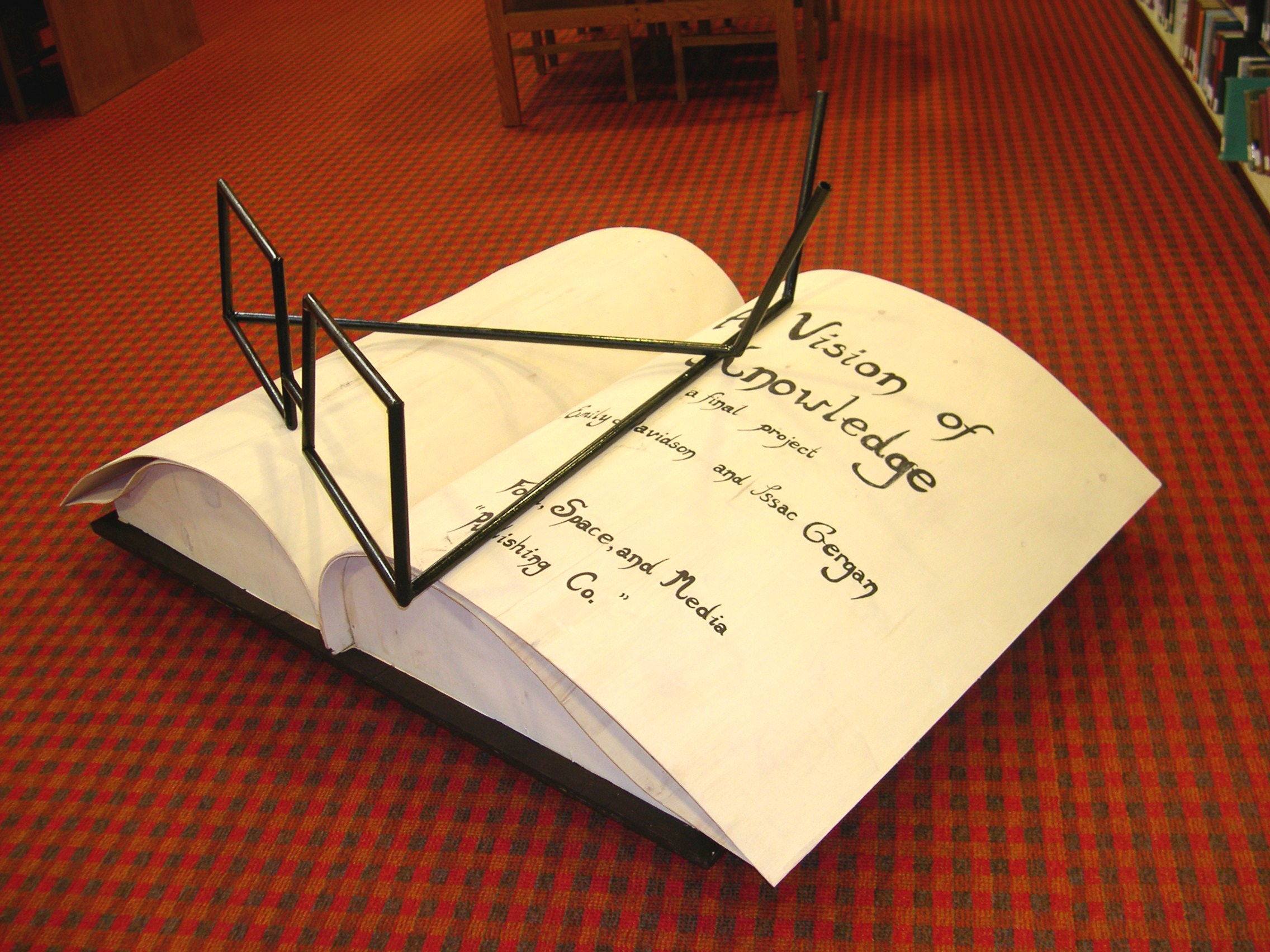
Along these lines, our library at school is hosting a very nice work of art by a couple of our students. A book with reading glasses. I’m having trouble optimizing this to fit on the page, but you can access ” Vision of Knowledge” by clicking on the title. My general sense is that computers make both books and reading glasses anachronistic. We can read on the Internet, and if the text is too small, who needs glasses. Just hit text zoom.

The other interesting thing about this image is the text itself, which, of course, we read. “A vision of knowledge.” My general sense is that despite the tremendous emphasis on the Internet as a resource for knowledge and learning, we continue to imagine, to have visions of knowledge primarily through our cultural repertoire related to books. Again, a quick google search for images related to the word “knowledge” called up dozens of pictures of books, various diagrams of the brain, and a lot of variously dull and variously interesting charts and REading Womengraphs. One thing that didn’t come up were images of computers. I scrolled through about 100 and some odd images before I got to any image of a computer at all.

I’m not sure that there’s any great lesson to be drawn here. However, I think that if we can’t picture something, this means that we don’t quite know what to do with it, that we don’t quite know what it is, at least for us. The digital world is inescapable, but at least with regards to reading and knowledge we still don’t know exactly what it means, how to imagine ourselves as a part of it.

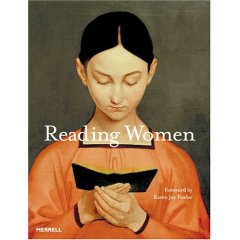
Side note: There’s a lot of stuff out there on the gender of reading, of course. There’s an absolutely fabulous book of images entitled “Reading Women” that I recommend highly. At one point I thought ALL images of reading were women, though this, of course, isn’t true at all.