Tag Archives: Reading

Daumier on Reading

There’s a lovely online exhibition devoted to Honore Daumier’s representations of reading in his work as the kind of grand pere of editorial cartooning. I’m struck by the way in which Daumier represents reading as a

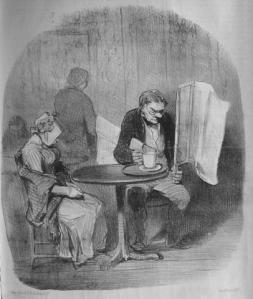
Not now, dearest, I'm reading

Not now, dearest, I'm Reading

social activity. Of course, there are a number of representations of reading as something that draws people into isolation. As, for instance, this piece on what appears to be man and wife together in a cafe.  This seems to fit what I’ve often taken to be the individualistic character of reading in the modern world (and, to be frank, this doesn’t seem all that different from someone sitting at a table texting or reading email while ignoring his wife or girlfriend or friends;  reading draws us elsewhere, so all the fretting that goes on about the internet damaging our social relationships may be nothing new)

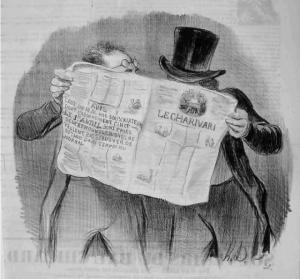
On the other hand, I’m struck by the number of Daumier pieces that emphasize what I would describe as the sociality of reading, the ways in which reading is an occasion for bringing people together.  For instance, this piece with two men reading the paper together:

She did What????!!!

She did What????!!!

There are actually more of these kinds of images in the exhibit, suggesting that reading becomes a kind of occasion for sociality rather than isolation.  (Of course, it’s France, right?  Hard to know if similar images could have played in Peoria).  Still, I’m intrigued by the ways in which reading becomes a social event.  I’ve suggested in some of my work in progress that book readers in contemporary society represent a kind of social subculture with a variety of signs and forms of cultural currency.  Are you reading, what are your reading, with whom are you reading, where are you reading.  All these form a system of signification that allows readers to form a kind of social sub-group within and around their taste for books.  Far from being individualistic, reading is a cultural practice with its own distinct forms of sociality.

Holiday Inn Priorities in Place

I don’t use this blog to flack for businesses (I think it’s illegal on WordPress anyway).  However, I thought I’d point to this program that Holiday Inn Express helps sponsor that supports Reading is Fundamental.  (I’ve elsewhere complained that reading isn’t really fundamental in any precise sense, but who’s complaining).

Too bad I didn’t know that my recent stay at HIE in Philadelphia could have helped the readers of tomorrow.

Side note:  The Holiday Inn Express in midtown philly was really an exceptionally nice stay.  Great and friendly service, good breakfast, comfortable rooms, everything really close.  And they aren’t even paying me to say this.

Obama, Prissy Prince Charming; Or, why it is possible to be an Obamabot and have a sense of humour

I’m not much convinced that The New Yorker cover works as satire (more on that below), but I think the guys over at JibJab have another hit with this take on the political campaign.

More later on why I think this works and the New Yorker cover fails, but first I have to say I’m so glad that the world is abuzz with cultural theory! Ok, not so much. But the New Yorker’s ill-fated attempt at satire has the chattering classes hard at work trying to parse questions of genre, reader response, aesthetic taste and various other kinds of folderol. If it was satire, would people get it? If people didn’t get it, could it really be considered satire. Does the message of the image depend upon it’s intended audience as David Remnick

Satire or New Yorker inbreeding?  You Decide

Satire or New Yorker inbreeding? You Decide

seems to suggest it does when he asserts that it’s intended, after all for “Readers-of-the-New-Yorker,” that snooty bunch. But is the meaning of the visual text here determined by the intention of the artists and the reading capabilities of an intended-and-oh-so-sophisticated-audience? In this day an age? When ANY text has no chance of being targeted exclusively at an intended audience because it will immediately be spewed endlessly into the blogosphere. What is an intended audience in such a world?

I’m impressed by the degree to which the discourse has revolved around criticisms of readings and possible readings. Maureen Dowd–I liked her much more when she was being smug and condescending about Hillary Clinton–smirks that obama is prissy and humourless and should just realize that COME ON, everyone in New York knows its just a joke. This seems just like the kind of answer a New Yorker would give, believing as they do, and apparently Maureen does, that the world is their oyster.

Philip Kennicott has a more interesting take on this same general idea over at the Washington Post. Agreeing with Dowd that Obama may be a bit too prissy in his response to the cover, he goes further and links it to the particular aura of printed material in comparison to our video-oriented imagination. Satire lives, but only in the bawdy possibilities of the moving image.

On “Saturday Night Live,” a sketch in which Michelle Obama tossed the flag in the fireplace and Barack Obama took off the pinstripes to reveal a flowing white robe would be seen as outrageous — and funny. Print cartoonists, unfortunately, find themselves working in an oxygen-free environment that is increasingly akin to the atmosphere of academia, or PBS. Cable television makes print seem like something ancient and sacred, a rule-bound sanctum fraught with the ever-present risk of sacrilege. Print is becoming a strange land where the solitary reader might easily go astray.

“People say, well, I get it, but I’m afraid that so-and-so is not going to get it,” said a mildly exasperated Remnick.

Which is to say that even as we pride ourselves on our media sophistication, as debunkers and decoders of the visual, we fret about the power of the printed image to circulate beyond the comforting control of television’s continuous interpretation and contextualization. In the age of YouTube — where for the most part we can still laugh at each other and ourselves — we are increasingly becoming print-humor iconoclasts, terrified that someone might be worshiping images in the wrong way.

I can really only go part way with him on this. Do we really think print is sacred. Just the other day in my reflections on Hard Times I was suggesting that we are so super saturated with “print”–broadly considered–that print has lost it’s aura. I think the same applies to the image.

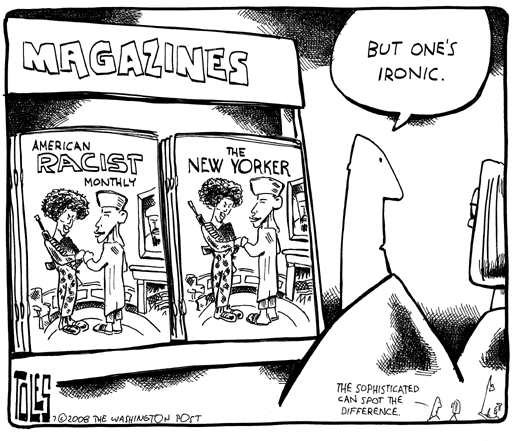
Tom Toles, The Washington Post, July 16 2008

Tom Toles, The Washington Post, July 16 2008

[Side note: I can see the point that everyone can be a little condescending to readers in fly-over country, still, I think this take from Tom Toles on the controversy is a lot smarter than the original and a lot better satire too. Score one for the post, and tom Toles.]

It may, of course, be that a good number of lefties have been holding Obama sacred, and The New Yorker cover doesn’t work for the same reason that jokes about Jesus mother don’t play in the Vatican.

But really, I don’t think the real issue is that all the Obamabots are humorless. I thought the JibJab video was hysterical–and not just because it’s skewers are equal opportunity. It’s because the satire reveals and revels in something that is kind of really true about Obama, who is the subject of the piece. By contrast, the real subject of the satire on the New Yorker cover is nowhere to be seen–and, to be honest, nowhere in consciousness. We could, of course, satirize the reader of the The New Yorker because the reader is at the scene of reading and so, in viewing the image, would view something grotesquely true about themselves. Instead, the New Yorker cover tries to laugh at someone else without referencing that someone else anywhere in the image. Thus the image seems to be “about” Obama even when we pause and have to say “No, it really can’t be.”

This is not a lack of irony on the part of readers, as Remnick and others have lamented. Rather, the image is not ironic at all, playing off a doubleness contained within the image or within the readers’ experience of themselves viewing the image. Instead, it is a kind of postmodern archness which is anything but ironic. Indeed, I think it’s kind of smug.

On the other hand, the JibJab video really does reveal something that’s kind of true about Obama, as much as I love him. If stretched and distorted and made into a grotesque–which is what satire does, witness Swift–then you really feel the truth of the criticism that Obama is just a little too good to be true, and that too good to be trueness depends heavily on a lack of specificity that lets us project our fairy tales on to him. He will inevitable disappoint (witness Dowd’s grouchiness). In this sense, the video becomes not only about something that seems vaguely real about the Obama candidacy, it becomes about us as the viewers of the video (and more specifically as viewers of Obama). We see the truth about ourselves and our fantasies in ways that make us uncomfortable but also make us want to laugh.

None of this necessarily makes me happy, about the New Yorker, I mean. I used to think that The New Yorker was the repository of all that was smart and superior and intelligent in the world. But the guys over at JibJab are way smarter. Score another one for video. Where the smart people are.

Schlockey Books or Schlockey Television

Today at the New York Times Gail Collins reflects on a series of novels for teenage girls called The Twilight Saga:

I read the first two Twilights, searching for the key to their success. (This is where the part about being not all that deep comes in handy.) The attraction is clearly the vampire hero, who is a perfect gentleman, eternally faithful and — as the author points out repeatedly — quite a hunk. (“He lay perfectly still in the grass, his shirt open over his sculpted, incandescent chest, his scintillating arms bare … A perfect statue, carved in some unknown stone, smooth like marble, glittering like crystal.”)

Before you make fun of this, I want you to seriously consider whether you’re interested in denigrating people who spend their leisure time actually reading books rather than watching “America’s Got Talent.”

A lot of times Collins makes me grimace.  I mean, just how long can one write for the New York Times and maintain the naive midwestern outsider pose.  On the other hand, this essay made me howl.  And she raises the interesting point that N+1 dismissed a couple of years back in its own analysis of our reading crises. According to N+1 we’ve been so obsessed with the reading crisis that we’re just thrilled people read anything at all, and they go on in good, and dare I say it snobby and Ivy-educated fashion, to dismiss the readerly pleasures of the hoi-polloi.

Still, I think Collins has a point.  The choice isn’t between the Twilight novels and Herman Melville, the choice is between Harry Potter and I Survived a Japanese Game show.  Given this choice, I’m glad my daughter chooses the Twilight novels–or their ilk.

(Side note:  A friend of mine who used to work regularly in Japan says Japanese regularly gather in parks to ridicule and laugh at American tourists.  Why do we even need a game show to accomodate them?)

Of course, I still hold out desperate hope that she’ll choose Melville or Shakespeare or Austen or Chopin or just anything that might get anthologized rather than forgotten.  But even if this hope is not delivered on, I still think there’s something better about having her read several ten thousands of words and exercise her imagination on the page than spend her time watching people consume cockroaches in the name of entertainment.

Summer’s Guilty Pleasures: Hard Times with Hard Times

Charles Dickens

Charles Dickens

Hard Times is one of those books that English teachers make you feel bad about not liking.

Oh, I forgot. I am an English teacher. What to do that I found what some people call Dickens greatest novel so dull that it was not even engaging enough to be a soporific (Side note about falling asleep to books, books make us fall asleep best not when they are dull but when they are engaging enough that they take us to the edge of dreaming).

Seriously though, consider the first lines “Now, what I want is Facts. Teach these boys and girls nothing but Facts. Facts alone are wanted in life. Plant nothing else, and root out everything else.”

Isn’t it plain from this moment that the game is rigged. Who could not know that the speaker is a grind–well actually a Gradgrind–that he will get his comeuppance, and that the virtues of truth beauty and the imagination will out.

And, not to put too fine a point on it, that’s mostly what you get in this novel. The Gradgrinds, Bounderby, the Blackpool’s, they exist to tell us that industrialization has made the world go awry reducing everything to its material usefulness and leaving no room for the more spiritual world of the imagination embodied in things like–surprise!–imaginative literature. Of course there are details. Louisa Gradgrind marries the much older Mr. Bounderby on the basis of the practicalities of the facts and her father’s wishes, and we’re quite sure that she will be ground to nearly nothing, which she nearly is. She ameliorates her desperation by trying to help the laborer Stephen Blackpool and we’re nearly sure that Blackpool will die, which he nearly does. And then does. All parties concerned learn their lessons, including Mr. Gradgrind, who comes to realize that there’s more to life than facts, like his love for his daughter and his wayward son. Still, the love seems mostly to exist to make a point, and the point seems too familiar.

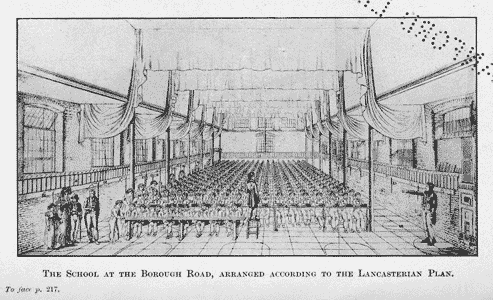
Industrialized Education

There’s nothing wrong with a thesis in a novel–I say this against all those who say novels don’t make points; I agree with those from Kenneth Burke to Wayne Booth who see fiction as a kind of rhetoric. But there is a problem with a novel whose thesis is baldly stated like an essay and whose thesis is never complicated, decomposed, challenged, reconfigured, or developed beyond what we can gather from the first sentence. (For that matter, there’s a problem with an essay written in a similar fashion).

I felt myself slogging along through the mud of the obvious and predictable, waking up just a bit when we finally get to the figure of Stephen Blackpool but descending again in to readerly despair when it’s obvious that Stephen is mostly a foil for the display of Louisa Bounderby’s sentimental charity, and later for the display of the pusillanimity and bourgeois moral corruption of Tom Gradgrind.

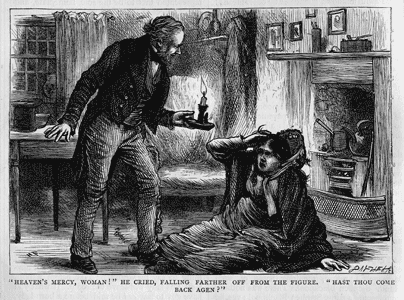
Stephen Blackpool and his mad wife

Stephen Blackpool and his mad wife

Stephen Blackpool, cog in Dickens’ sentimental machine.

On the other hand, I found myself wondering whether I found this all so predictable because so much has been built on a Dickensian edifice. In other words, would Dickens’ early readers have found his book dull and predictable or perhaps instead appalling, thrilling in its view of human degradation. Do we have a responsibility as readers to recover the shock of the new in classic works when they are no longer new?

I’m not sure. And I may be trying to cut Dickens too much of a break. I have read both Uncle Tom’s Cabin and Douglass’s Narrative a multitude of times, and both are rife with moral sentimentalism, obvious bad guys, and endings that surprise only in their predictability. Yet I never find them dull. I will still be moved to tears by sections of both. So what it is it about Hard Times that leaves me cold, in the grip of something I feel I already know and don’t need to learn again, while I can read Stowe and Douglass (and Faulkner, and Hemingway, and at least some of Toni Morrison) as I read the Psalms, an ever renewing source even when I know everything that will happen.

Side Note: An interesting bit from Hard Times about reading. From the chapter where the town is beginning to hunt the falsely accused Blackpool, believing him guilty of robbing Bounderby’s safe.

“The factory-bells had need to ring their loudest that morning to disperse the groups of workers who stood in the tardy daybreak, collected round the placards, devouring them with eager eyes of those who could not read. These people, as they listened to the friendly voice that read aloud–there was always some such ready to help them–stared at the characters which meant so much with a vague awe and respect that would have been half ludicrous, if any aspect of public ignorance could ever be otherwise than threatening and full of evil. Many ears and eyes were busy with a vision of the matter of these placards among turning spindles, rattling looms, and whirling wheels, for hours afterwards; and when the Hands cleared out again into the streets, there were still as many readers as before.”

Me and My Aura

This is perhaps a fairly typical view of oral reading that occurred with regularity up until the 20th century. Now the only people who sit and listen to someone else read are either children or tony types who attend poetry readings. Still, I’m struck by the mystical aura of the word, the mystery and power that written discourse must have held for the masses of the illiterate underclass. Perhaps still holds for that matter. Still, it seems to me that the ubiquity of print has been bought at the price of its own devaluation. Indeed, the inflated presence of the word everywhere around us, where everyone and their mother can write–and indeed, where everyone does write, so much and so often, that no one really has time left to read–this glut of written verbiage has been bought at the price of writing’s (and reading’s) triviality.

Not that this dismal view applies to my own blog, of course. It’s infinitely valuable and more than worth your time. I’m sure it even has an aura.

For More of my summer’s guilty pleasures, see

Summer’s Guilty Pleasures: Black Snake Moan–June 30th

Cryptomnesia: Originality, thy name is plagiarism

For the past several years I’ve used the Footprints poem in my literary theory class to discuss theories evaluation and aesthetic quality. (For those of you unfamiliar with the Footprints poem, I want to say first, “What planet have you been living on?” There is, after all, no more popular item of American religious kitsch than the Footprints poem. My very conservative guess is that is has been shellacked to about 14 million pieces of 1X4 plank board pieces at Vacation Bible Schools across the country.–For those of you unfamiliar with Vacation Bible School…well…bear with me. This may be a my culture/your culture sort of thing. In any case, just enter Footprints poem in any search engine and prepare to be inundated.)

As I was saying, I’ve used this “poem”–in some versions it’s kind of more of a paragraph–to talk about theories of aesthetic distinction. My very good English majors are often aghast that there could be a serious debate about the aesthetic qualities of such a piece of tripe. On the other hand, they are often very chary of the notion that someone could tell them that some things are better than others. Good Americans all, their instincts tell them that it is elitist in a sad and undemocratic fashion to assert that Wagner is “better” muscially than Eminem, or that some things are just inherently better than other things. Brought home to them through Sunday School poetry, however, we deal with the question of why they believe that the Footprints poem is inferior. If it is inferior, what justification to we use for saying that some things are better than other things. Is making this claim an objective claim or is it merely a subjective preference they’ve developed through their years of being elitist English majors. If Hopkins really is better than the Footprints poem, should we take it upon ourselves to teach people that love the Footprints poem that they are really rotting their aesthetic brains and ought to be reading Gerard Manley Hopkins. And if we really believe people would be better off reading Hopkins, why is it such a leap to believe that Wagner really is better than LL Cool J, or that in general everyone would be better off listening to opera than to Country and Western or Rock and Roll.

Found out today that I can now use the Footprints poem to also teach about the philosophy and history of authorship, another main topic of the course. Hank Stuever over at the Washington Post has written a great piece on the contested authorship of the Footprints poem. Turns out that lawsuits abound, and that no less than 3 people are claiming ownership over the text, though one of them also claims to have written the words to a famous Beatles tune when she was a pre-teen. There are claims and counterclaims, with drafts and manuscripts and other forensic evidence.

And we only thought Shakespeare worthy of this attention.

One academic has even traced the basic essence of the poem back to a sermon in the 1880s and has asserted that it’s possible that nobody actually wrote the poem. Says Stuever:

Last fall, in an online article for the Poetry Foundation, a Brooklyn journalist and literary sleuth named Rachel Aviv traced elements of “Footprints” to a sermon delivered in 1880, and raised the tantalizing possibility that nobody really wrote “Footprints in the Sand.” Those who have claimed to, Aviv noted, may be suffering from the collective “accidental plagiarism” that Carl Jung explored in his paper “Cryptomnesia” more than a century ago.

Everyone knows a cryptomnesiast, of one sort or another. It’s your cousin who stood up at Peepaw’s funeral and tried to pass off the “Do not cry, I did not die” poem as his own; or those crafty tykes who keep submitting bits of Shel Silverstein as original verse to The Post’s kids’ poetry contest. It’s the woman who sends you a sympathy card after your dog dies, with her handwritten version of the (also disputed) fable about dogs waiting for their masters in Heaven. It’s your church pastor or corporate motivational speaker who keeps coming up with those amazing “I-recently-met-a-man-who” anecdotes to illustrate his point.

Something can be so profound, so true, (so “duh”) that the cryptomnesiast is sure she thought it up herself. There is very little you can buy at a crafts fair or in the self-help section at Barnes & Noble that doesn’t have a whiff of the unattributed.

This happens to me ALL the time. I’m always running across published stuff out there on the internet that I KNOW I came up with first. My brain is the great unacknowledged source of most of the intellectual creativity out there in the last couple of decades.

Ok, seriously though, I do have this experience of feverishly working out an idea only to discover someone else has already done it, and much better than I could even if given world enough and time. Cryptomnesia is apparently a specific form of memory in which you recall what you don’t know that you’ve forgotten and don’t remember ever learning or reading.

A new explanation for Borgeses story about the rewritten version of the Don Quixote.

I find, in fact, as I get older that I do this all the time. I was reading in the Chronicle of Higher Education earlier today, and ran across a blog about an aging professor who talks about how he downloaded an article and wrote feverish and exalted notes about it, thrilled at these new ideas and contributions to his own work until he discovered somewhat later that he had already read the article, and had written feverish and exalted notes about it thrilled at these new ideas and contributions to his own work.

Okay, I really have done this. And at 48 I don’t really consider myself aged. I’m reading Dicken’s Hard Times at the moment, and I keep having the nagging suspicion that I’ve read it before, but I can’t remember enough to know what is going to happen next. Does this count as a memory?

Although it’s laughable on one level to think of the many people wanting to claim ownership of the Footprints poem, I wonder if there’s not some more serious relationship between cryptomnesia and creativity. It’s not an original thing to say that creativity is primarily a matter of rearrangement, of finding creative connections between the many things that are rather than a discovery or manufacture of the absolutely new. There are people out there with absolutely unerring memories, who remember the details of their lives from many years ago–what they had for breakfast, how long it took to eat, whether they burped or sniffled after downing the last bit of egg. I suspect, though I cannot know, that such people would find it intensely difficult to be “original.” They would experience themselves self-consciously plagiarizing or replicating experiences all the time. If I could not forget that I had read something, I would find myself less free to combine it anew with other things that I have forgotten that I learned. Recombination is made possible by dislocation, by tearing something away from it’s original context. My guess is that Crypotmnesia makes that possible.

In the same fashion, we imagine ourselves as unique and original individuals until we awake in our forties to discover that we like the same kind of socks as our fathers, that we scratch our noses in the same way between sentences, that our lower lips protrude while thinking just like his, and that we roll our thumbs around one another in precisely the same annoying way that he rolled his thumbs when we were teenagers.

Not that any of that has ever happened to me. But I’m sure if we had to live in a constant awareness of all the ways our lives are imitative, we would never be able to allow ourselves to invent new contexts and meanings for all the things we’ve plagiarized from others.

But I’m sure that someone already said this better.

In the Valley of Elah; or suffer the little ones

I watched “In the Valley of Elah” on DVD last night. As with most things, I find the pace of my life puts me about 4 steps and six months behind the rest of the world, and most often my very long list of things I’m going to get to later ends up being a private fantansy. Still, I’m glad I actually did get to this film. Most of In the Valley of Elahthe commentary in the immediate aftermath of it’s release was relatively laudatory, especially of Tommy Lee Jones performance, but also noted the distaste of the American populace for hard and depressing films about the war. One wants to say, “duh.” This is unsurprising. Several reviews I’ve read since last night take Haggis to task for disjointed storytelling and for not making his references clear. A number of folks complain that the title of the movie makes no sense.

Au contraire.

I think what’s central to the film is not the question of David’s heroism against Goliath in the Valley of Elah. What’s central is that old men send children to fight their wars without armor and without weapons. The film is, of course, an essay against war in general and the war in Iraq in particular, and if you can’t stand films that have a thesis, however poignantly rendered, then you’re not likely to enjoy the film. But more specifically the film is a powerful meditation on the notion that old men start wars and young men, or children, fight them. Several reviewers comment on how old Tommy Lee Jones looked. Well, of course. He is, and magnificently so. But almost no one remarks on just how young and unprotected the soldiers look, childlike even when drunk and hanging out in topless bars and strip clubs. Perhaps the most chilling scene of the film isn’t anything to do with Iraq and the immediacy of its violence. The most chilling scene for me was watching the young man–who looked mostly like an all star blond high school quarterback–confess to killing Tommy Lee Jones’s son, Mike, and then laugh as he reflected on how Mike would torture prisoners by probing their open wounds, a practice that earned him the Menglesque nickname of “Doc”.

The point of the Valley of Elah is that the mythology of David and Goliath is a lie, that children do not destroy giants in war. They kill and maim and destroy one another, and in the process destroy themselves. We discover that in the first week of his tour of duty, Mike, had run down a small Iraqi boy who appears to be throwing a stone at his Humvee. And while there is a certain domestic delight in seeing Hank Deerfield tell Charlize Theron’s son the story of the story of David and Goliath, in the context of the film as a whole this is a terrifying scene, showing that the mythologies of domestic safety are actually the training ground of a violent imagination, one that would encourage this small boy to believe that he too, perhaps, could throw stone at Goliath, or at a Humvee, and emerge unscathed. The same imagination requires us, of course, to imagine that a small boy throwing stones at a Humvee is really a Goliath to be destroyed.

On this score, I think several people have misread the scene where Jones tries but fails to read “The Lion, The Witch, and the Wardrobe” to Charlize Theron’s son. It is yet another story where children are encouraged to believe that they should be at the forefront of the fight against evil. I’m not completely sure myself of what to make of that particular reference, but Hank Deerfield/Tommy Lee Jones does say he can’t Deerfield trying to read Lewisunderstand a word of it. In my own view, this book has a confused take on the role of violence in confronting evil–on the one hand insisting that Aslan self-sacrifice is the key to victory and on the other using his resurrection as a means of wreaking a satisfactory bloody end on all the evildoers. Still, in the context of the movie as a whole, I think what Hank Deerfield can’t read in the book is that Aslan would lie down on the altar to take the knife willingly, rather than take up a stone or a gun to destroy the White Witch. I’m not sure about this, again, because of the confused take on violence and self-sacrifice that I think is at the heart of the tale. Still, it does strike me that the book is a book about children at war, and yet it is a partially different take than that offered by the story of David and Goliath.

A final note, given that this blog is mostly about reading and writing. I was struck by the role of text and reading and visuality and orality in this film. Notably, the father and the son are in touch with each other less through words than through images. In the film itself, we are shown emails that we can’t really read (or at least I couldn’t), but the email is merely a pretext for the really important stuff, the images that the son sends to his father and through which he attempts to communicate with him. I was struck watching this film how much email and media files had changed the war film convention of the letter home from the front. Soldiers don’t send letters home, they call home, they email home, and most importantly in this film, they send images home.

The failure of text, and of language more generally, is a central trope of the film. Hank Deerfield can’t really talk with his son on the phone. The soldiers lie repeatedly. Deerfield can’t read The Lion, The Witch,and the Wardrobe–indeed, for a moment I wondered if Deerfield were really illiterate in some way, though I knew it was impossible given other moments in the film. On the other hand, it’s not clear that images are any better. The files are corrupted. They are without context. Deerfield can’t understand what to make of theDeerfield asks for an image to be explained pictures until he has some of Mike’s comrades explain them to him. The only genuine communication in the movie–or at least the appearance of communication–is in those moments when first Jones and then Theron are talking with the little boy about David and Goliath. And this communication itself is, in the context of the film as a whole, based on a lie that the rest of the film everywhere exposes.

In the end, Deerfield is left with what feels like a futile gesture (and to be honest, the only one in the film to my mind that was absolutely over thesis-like) when he hangs the American flag upside down on a local flag pole. Earlier in the film Deerfield told an El Salvadoran immigrant that hanging the flag upside down was the ultimate distress signal, a sign telling others that you were in “deep shit” with absolutely no way out unless someone came to get you. The film as a whole suggests that it is America itself that is in “deep shit” with no way out.

Who will see this sign and come to save us?

Tales of the Toilet; or, W(h)ither Fiction?

A couple of days ago, The Los Angeles Times reported the following

MADISON, Wis. — Two children and their mother lived for about two months withToilet Art from Jacob Earl the decaying body of a 90-year-old woman on the toilet of their home’s only bathroom, on the advice of a religious “superior” who claimed the corpse would come back to life, authorities said Friday.

===========When Deputy Leigh Neville-Neil …. opened the last closed door, she smelled “decaying matter” and noticed something piled on what appeared to be a toilet. Lewis told her it was Middlesworth’s body, the complaint said.

Lewis told the deputy that Middlesworth had died about two months earlier, but that God told her Middlesworth would come to life if she prayed hard enough.

She said she couldn’t say anything more until she spoke with her “superior” — Bushey, 57, also known as Bishop John Peter Bushey

She said she propped Middlesworth on the toilet and left the room to call Bushey, who told her to leave the woman alone and pray for her, the complaint said. He said he had received signs that God would raise her from the dead with a miracle.

The story, wretched as it is, reminded me of another tale of the toilet from a couple of months ago in which a horribly obese woman was found to have been living on a toilet in Kansas for two years, having been fed and tended to by her boyfriend as she refused to leave the bathroom. According to EMT reports she had literally grown to the toilet seat, which had to be removed and transported with her to the emergency room.

It’s hard to know what is more astonishing to the imagination, a disturbed woman who could not bring herself to move as she felt her body melding with porcelain, or the boyfriend who brought her breakfast every morning as he pleaded with her to leave the bathroom. A kind of prayer, to be sure, though one less literal than those of the woman and her children in Wisconsin. One wonders what neural snyapse firing in the boyfriend’s brain finally signaled the end of faith, a loss of hope. Why two years instead of two months? Or why not three years instead of two? What finally says to the self, let’s make an end of it. In any case, a synapse firing that had not yet occurred in Wisconsin as a woman watched her mother decay into “something piled on what appeared to be a toilet.”

One gapes, shudders, cries, or gags. And, yes, one laughs. Hopelessly, hysterically, apologetically. When you are at the bottom of the human drain, what else is left to do but laugh at horrors that we come to.

I remember my own shuddering sense of horror and delight and sorrow at first reading “A Rose for Emily” and saw in my minds eye the decaying corpse in the bed, imagined Emily there in bed beside her imaginary lover. Or Miss Havisham, Emily’s literary avatar, in Dickens Great Expectations. Or the perverse grotesques in O’Connor’s fiction–especially Norton, the grieving boy who hangs himself in “The Lame Shall Enter First” in a twisted and in some sense literal leap of faith.

But one looks at this stuff published daily and has to say helplessly that Dickens and O’Connor and Faulkner have nothing on this. Stephen King could do no better in calling up the bizarre extremes of human existence. No wonder contemporary readers have little taste for fiction, and novelists feel compelled to present their fictions as spurious memoir. With a world as it already is beyond all imagining, what role for the writer who wants to imagine what is not.

Of course, I still hold out hope that one role of fiction is to redeem the time. Imagination isn’t just an effort to invoke the extreme, but to shape it, to tame it to a tale. I think most contemporary fiction has given up on that part of the task, perhaps disbelieving that the rotting something on a toilet stool that is our material can be wrestled into meaning. Itself a kind of collective loss of faith.

Other toilets in the news:

According to Reuters, “A woman in Germany put an end to her troubled marriage by chopping up her husband and flushing parts of him down the toilet, authorities said on Tuesday. ‘You won’t find him, I’ve flushed him down the toilet,’ is what she told (her children).” And Hitchcock thought he was imaginative by having a man bury his wife in a Garden?

The airline Jet Blue apparently required a man to sit in the toilet, discovering after takeoff–after takeoff!!–that the flight was ovebooked. The man is suing… because the toilet had no seatbelts and he was bounced around during turbulence. A man who clearly has his priorities in place

Officials in Montgomery Country Maryland have announced a plan to save money by rationing toilet paper for prison inmates. They are using the savings to requisition more body armor in anticipation of the ensuing riots.

Not to be outdone, a family in Manhattan is going without toilet paper for a year in order to be environmentally friendly. They are also going without friends. Not to be outdone, Will Smith proudly points to his new paperless toilets that clean and dry you. I’ve used a bidet, but I admit that the blow dry effect of Will Smith’s Japanese toilets seems just a bit much. Who knew that toilets would be the cutting edge of greenToilet instructions in Japan awareness.

We can also be glad that some enterprising young fellow has given us the following clever visual instructions for toilet usage. (Is it just me or do some of these look like positions from the Kama Sutra).

Aspiring MFA students take note, I see the makings a collection of short stories here. That they are all factual and more imaginative than anything you could dream up on your own should not stop you. There is still no law against writing the world as it is as if you came up with it on your own.

A final news note: Computer Keyboards can be dirtier than toilets.

On that note, I think I’ll go wash my hands. If I’m gone for two years, please come check on me.

Book Glutton: Two Thumbs Sideways

Ok, I’m finally getting back to talk about Book Glutton, and I’m probably not being fair to them since I actually finished Treasure Island more than three weeks ago. I’ve probably been delaying because it’s always easier to review or talk about something that you love or hate. Easier to get exercised and visceral when you want to damn things to perdition, or when you think we’ve arrived at A-MOMENT-OF-WORLD-HISTORICAL-REVOLUTION. Perhaps unfortunately for Book Glutton, it strikes me as neither world-historical or revolutionary. It is–in that damnably tepid turn of phrase–“OK.” Or as I sometimes say on my student’s papers: “Not Too Bad.” No wonder they hate me.

First what is Book Glutton? On the one hand it is just another of many online sites where one can get full-text versions of literary classics and not-so-classics, though they also promise to be a publishing venture for contemporary writers. The books are loaded into a reader in your computer browser. The reader is the approximate size of a typical paperback, and through several nifty features the reader gives human readers a lot of options that aren’t available either through other e-book services and readers or via traditional board and paper books. For one thing, I can join an online club reading the book I choose, and we can leave each other notes filled with our readerly wisdom. We can also communicate in real time via a chat window attached right to the reader window itself. Thus I can talk and read at the same time, something my children and my students seem to find unexceptional but which I still find somewhat like patting my head and rubbing my stomach at the same time.

I’ve been on record as having my doubts about e-books, so let me go on record first with what I liked or found interesting about the whole experience. The first thing to say is that reading the book itself was, well, surprising like reading anything else, at least insofar as the story itself was concerned. I liked the yellowish-white cast of reader’s pages since it looked a little bit like a slowly aging paperback, and it reduced eyestrain to boot. I also liked the page-like feel of the presentation itself. One problem with many online texts is something we might otherwise think would make them convenient, the scrolling itself. I’m not alone in finding the long lines and the unending page of text in a lot of online e-texts completely maddening. There is something comforting and rhythmic about completing 30-40 medium size lines of text and turning a page, the sense of completion somehow necessary to the process of going on. A little bit like  breathing in a swimming stroke.

Book Glutton accomplishes this in much the same way as dedicated ebook readers, recreating the approximate page size of a normal books such that I can attend to the text, complete it and move on. And for the most part, the story was still the story that I could read and absorb and be absorbed by just as I might any other novel. As I suggested in my last post on Treasure Island, I found the book great fun. As an academic, I found it thought provoking in ways no one else would probably care to find thought provoking. In other words, its being an e-book by itself didn’t do too much to alter my reading experience as such.

I think I would go so far as to say that there are a couple of features of Book Glutton’s presentation that I even liked better than traditional books. The scroll bar at the bottom of the page told me how much further I had to go in a particular chapter. Thus the reader has both the best features of a traditional book–page length chunks of prose–while also overcoming one of the few annoying features of traditional books. When I get bored with a book I’m reading, I’m given to flipping through pages to see just how many pages I have to the end of the chapter. It can be vaguely exasperating to flip and not find what I’m looking for, whereas Book Glutton let’s me know exactly how far I have to go, and I can determine whether it’s worth my time to just plow on through or give up for the day until I can get more interested.

I also have to say I liked the fact that at the click of a button I could enlarge the text so that my aging eyes could read just a little more easily.  The text automatically reorients while still retaining page length chunks of prose, just less prose per page.

Some features of Book Glutton hold a lot of promise, but didn’t work too well for me. I created a book club, but no one came. I invited the entire faculty of my college to join me. I think three people said they would, but I don’t think anyone actually read it. I had three anonymous online folks say they wanted to be part of the group, and I signed them up, but they were never on when I was reading, and I couldn’t find that they left me any nifty notes with pearls of wisdom.

Clearly Book Glutton requires a more hands on and somewhat fascist book group leader than I am. Someone who demand more participation. Maybe someone who would get everyone on board to be reading at the same time. Theoretically I can see an interesting place for this kind of thing. Studies show that people who read with groups or who at least are around other people who read are more likely to keep reading through their adult lives. This, in general, is a great service the web provides, connecting readers from around the world. Book Glutton is another take on this general principle, enabling real time participation in common reading. I could see this kind of thing as being really useful for secondary and even college classrooms, and especially for the task of getting kids interested in reading. In this age driven by buzz, it’s not the thing itself that is inherently cool, it’s the fact that everyone around you is in to it. So Book Glutton or similar services could be a route toward making books “the bomb” so to speak. But it just didn’t work out for me.

There were some negatives. I found lugging my computer around, booting it up, connecting to Book Glutton all just a little bit tiresome and inefficient. Why can’t I just open my books and start reading, I wondered. I also had the problem of connecting. I brought my laptop several places and tried to get connections while I was waiting around for something else to happen–a common time to spend reading. Problem is that Wifi isn’t everywhere, no matter what the TV commercials tell me.

The heating pad effect of my laptop lying on my capacious belly was also a bit unnerving. I’m not used to getting belly sweat from a novel.

As I suggested above, most of the reading experiences themselves were not terribly different from a regular novel, but I did find the lure of the internet a bit astonishing even for an incipient codger such as myself. In the normal course of reading a section of a book that started to bore me, I’d skim through until my interest picked up again. With BookGlutton, however, the ready availability of email or other texts was all but irresistable. Rather than skimming through the book, a way of sticking with it, I would abandon the book and go read my email for a half hour. At the end of which I couldn’t quite pick up the thread of the reading again.

Similarly, the chat mechanism is promising, but I also found it insidiously distracting.  I actually had a conversation online with one of the poohbah’s an BookGlutton.  A really nice and helpful guy who was very receptive to some of my suggestions.  Sorry, I can’t remember his name.  It was the only chat time I got during the whole experience, and I found after thirty seconds or so that i was more interested in chatting than in reading.  This is, of course, a common feature of book groups.  They don’t actually talk about books, if they even read them.  However, it is a peculiar thing to have this happening while you’re reading.  It’s almost as if you’re in a library but people you don’t know come up and start talking to you about the book you’re reading.  Many of the people who do this in library, of course, are either homeless or otherwise imbalanced, so what does this say about denizens of Book Glutton.  No, just kidding.  However, I did actually end up disciplining myself to not open the chat feature while I read a chapter, only opening it at the end of chapters.  The temptation to keep seeing if anyone else was around was compelling, a feature of the internet that interferes with the kind of absorption typically associated with literary reading.

This distraction is an important consequence of reading online I think, something that digital utopians champion as a “new literacy.”

Maybe.

I tend to think that describing the frantic skimming that goes with reading on the web as “new literacy” is a little bit like me saying my belly fat is a form of stored energy. It is, but does that really tell me anything or make me feel any better. No, but it does give me a convenient reason for not working out. Call it conservation.

In a similar fashion I think all the discussion of new literacy is a somewhat fancy name for the inability to attend.

Still, overall this is not too many negatives associated with BookGlutton. So why only two thumbs sideways?

I guess I feel like e-books need to demonstrate a clear superiority to board and paper books, a reason that this technology is clearly superior to the technology I already have in hand. At this stage they don’t present themselves to me as such. While there’s some nifty things associated with Book Glutton, I’m not sure most committed readers are really interested in being nifty persons. Book Glutton is kind of neat, but not neat enough to make me spend my time on Book Glutton instead of in a book store.

It’s a little like a decent three star summer movie. Kind of glad I went to see it, and might go see another one, but I don’t feel like my life will miss much if I had missed it.

Or even more, it’s almost as if we’ve got a good television show that a movie theater decides to show on a big screen. It might be kind of neat to watch “Lost” on the big screen, but at some point will you really start watching all your television shows down at the theater. I kind of doubt it.

Treasure Island, Buried

As some may remember from the distant past of this blog, I set out to actually read a whole e-book from start to finish on Book Glutton, all this in honor of read a book month, or read an e-book month, or some other kind of month. Given that most Americans don’t even read one book a year, e or otherwise, I am so proud of myself for managing to fulfill my quota in a mere three weeks. Or so. Anyway, I finished Treasure Island about a couple of weeks ago, but have been too swamped with work (and my kids soccer games) to collect any thoughts. And, of course by now, given that I am uncomfortably close to my fiftieth birthday, I have actually forgotten most of the experience. So the comments that follow are no doubt not anywhere nearly an accurate reflection of my experiences but more a kind of fiction of what I construe could have happened in my reading experience. Pierre Bayard and Roland Barthes would be so proud.

First Treasure Island itself. What a romp! One consequence of being an academic is that works in my specialization I am always reading as an academic. Which probably means dully and ponderously. So when I read for pleasure…well, I never really do read for pleasure. But let’s just say that in order to re-activate the pleasure zones in my reading brain, I often have to get far away from stuff I have to teach or write about in my official capacities.

Treasure Island is surely a boys book in a certain sense of that word. For all the sturm and drang about about the dominance of masculine narratives in the canon, it’s worth saying that boys books aren’t much appreciated as boys books per se. They have to first be turned in to “LITERATURE.” That is, something ponderous and masculine rather than, well, rompish. If “rompish” even qualifies as a term of analysis. And much of what we talk about as literature–things like The Great Gatsby as exhibit A; things like The Scarlet Letter as exhibit B–are really chick flicks dressed up to go out on the town. No wonder boys don’t read.

But then there are boys books. Romps that lose their fun in becoming literature, or which are ignored because they seem resistant to literary seriousness. Huckleberry Finn used to be sold as a boys book, in fact, though now it is banned from high schools. For my money Melville’s most readable works are Typee, Omoo, and Redburn. Works written for adolescent boys, and adolescent men, who were looking for a little tittilation in thinking about naked polynesian breasts. Let’s be truthful folks. How many of us really truly loved Moby Dick. Confession of the week. I can’t bring myself to finish Pierre. And I did my master’s exams on Melville. I think I read the Cliff’s notes. Perhaps if either book did more to foreground Polynesian breasts I would get more interested.

In any case, Treasure Island, falls into the category of a boys book so stereotypical that we now can hardly feel it as anything but predictable. The boy in search of a father since he’s lost his own. And finding fathers in all the wrong places, especially among barely disguised pirates who everyone and their mother knows are pirates except apparently Jim Hawkins himself.

I was struck in reading it by how much Jim is the characteristic “good boy.” The loyal son to his mother. Although the novel is often described as a coming of age story, there’s a peculiar sense in which jim is already aged. He is already formed as the good man that he will become, protector of his mother becomes protector of his friends and ultimately, even, the protector of his erstwhile enemy, Long John Silver.

In other words, Jim is already his own father, a boy seeking for a father he doesn’t really need or want. Thus, explaining Jim’s constant penchant for running off for no good reason, whether in to the apple barrel or jumping ship to gain the Island ahead of the others, or stealing the ship out from under the noses of the pirates themselves. Jim is a boy who doesn’t need a father because he is a father already, the one who can save those even whom he despises. Sprung whole and righteous from his own loins. (This is, of course, also a description of Milton’s Satan, but I won’t press the point).

For my money, this makes Treasure Island more of an adventure story than a coming of age story or bildungsroman. Jim is already who he is or will become. He is threatened by evil, but he is not tempted by it. Huckleberry Finn could worry about whether he is going to hell, and he could play his pranks on the slave Jim on the raft for his own selfish ends and pleasures, but Jim Hawkins always chooses the good and we always know he will. And perhaps more importantly, he always knows he will. Thus the story is not about whether Jim will be good and will grow as a human being–he doesn’t grow at all. It is more about whether goodness will out. Does goodness pay off in the end? Is goodness the treasure that we can have without seeking.?Will goodness save our own necks from the noose, and perhaps the necks of Long John Silver as well?

Well Stevenson seemed to think so. I’m tempted to say it’s a vapid vision of the world, where the mutineers of the world exist not to tell me that I too might be one, but as foils for my own moral self-display. Nevertheless, this criticism is awfully literary and ponderous. So I’ll stop before I lose sight of the fact that I actually loved reading it.

Of course, I also weep when watching Brian’s Song. What does this prove?

More later about the actual experience of reading on book glutton.