Tag Archives: writing

Scott McClemee on Rene Girard on Reading and Writing

Scott McLemee cites the following from Rene Girard

“And yet our cultural world is a far cry from Elizabethan England or la cour et la ville in seventeenth-century France. There is a reason for this, so simple and yet so obvious that no one ever mentions it. At the time of Elizabeth and Louis, one percent, perhaps, of the educated people were producers, and ninety-nine percent were consumers. With us, the proportion is curiously reversed. We are supposed to live in a world of consumerism, but in the university there are only producers. We are under a strict obligation to write, and therefore we hardly have the time to read one another’s work. It is very nice, when you give a lecture, to encounter someone who is not publishing, because perhaps that person has not only enough curiosity but enough time to read your books.”

Yes, I think this is right, and perhaps not only in academe.  I’ve mentioned before that I get a fair number of students who are interested in writing stories or poems, but don’t have much interest in reading anything.  How this comes to pass is beyond me, and it seems vaguely narcissistic.  We want desperately to express ourselves–and thus the triumph of blogging–but we have little interest in the expression of others.

Summer’s Guilty Pleasures: Hard Times with Hard Times

Charles Dickens

Charles Dickens

Hard Times is one of those books that English teachers make you feel bad about not liking.

Oh, I forgot. I am an English teacher. What to do that I found what some people call Dickens greatest novel so dull that it was not even engaging enough to be a soporific (Side note about falling asleep to books, books make us fall asleep best not when they are dull but when they are engaging enough that they take us to the edge of dreaming).

Seriously though, consider the first lines “Now, what I want is Facts. Teach these boys and girls nothing but Facts. Facts alone are wanted in life. Plant nothing else, and root out everything else.”

Isn’t it plain from this moment that the game is rigged. Who could not know that the speaker is a grind–well actually a Gradgrind–that he will get his comeuppance, and that the virtues of truth beauty and the imagination will out.

And, not to put too fine a point on it, that’s mostly what you get in this novel. The Gradgrinds, Bounderby, the Blackpool’s, they exist to tell us that industrialization has made the world go awry reducing everything to its material usefulness and leaving no room for the more spiritual world of the imagination embodied in things like–surprise!–imaginative literature. Of course there are details. Louisa Gradgrind marries the much older Mr. Bounderby on the basis of the practicalities of the facts and her father’s wishes, and we’re quite sure that she will be ground to nearly nothing, which she nearly is. She ameliorates her desperation by trying to help the laborer Stephen Blackpool and we’re nearly sure that Blackpool will die, which he nearly does. And then does. All parties concerned learn their lessons, including Mr. Gradgrind, who comes to realize that there’s more to life than facts, like his love for his daughter and his wayward son. Still, the love seems mostly to exist to make a point, and the point seems too familiar.

Industrialized Education

There’s nothing wrong with a thesis in a novel–I say this against all those who say novels don’t make points; I agree with those from Kenneth Burke to Wayne Booth who see fiction as a kind of rhetoric. But there is a problem with a novel whose thesis is baldly stated like an essay and whose thesis is never complicated, decomposed, challenged, reconfigured, or developed beyond what we can gather from the first sentence. (For that matter, there’s a problem with an essay written in a similar fashion).

I felt myself slogging along through the mud of the obvious and predictable, waking up just a bit when we finally get to the figure of Stephen Blackpool but descending again in to readerly despair when it’s obvious that Stephen is mostly a foil for the display of Louisa Bounderby’s sentimental charity, and later for the display of the pusillanimity and bourgeois moral corruption of Tom Gradgrind.

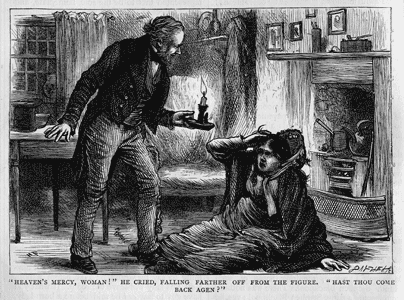
Stephen Blackpool and his mad wife

Stephen Blackpool and his mad wife

Stephen Blackpool, cog in Dickens’ sentimental machine.

On the other hand, I found myself wondering whether I found this all so predictable because so much has been built on a Dickensian edifice. In other words, would Dickens’ early readers have found his book dull and predictable or perhaps instead appalling, thrilling in its view of human degradation. Do we have a responsibility as readers to recover the shock of the new in classic works when they are no longer new?

I’m not sure. And I may be trying to cut Dickens too much of a break. I have read both Uncle Tom’s Cabin and Douglass’s Narrative a multitude of times, and both are rife with moral sentimentalism, obvious bad guys, and endings that surprise only in their predictability. Yet I never find them dull. I will still be moved to tears by sections of both. So what it is it about Hard Times that leaves me cold, in the grip of something I feel I already know and don’t need to learn again, while I can read Stowe and Douglass (and Faulkner, and Hemingway, and at least some of Toni Morrison) as I read the Psalms, an ever renewing source even when I know everything that will happen.

Side Note: An interesting bit from Hard Times about reading. From the chapter where the town is beginning to hunt the falsely accused Blackpool, believing him guilty of robbing Bounderby’s safe.

“The factory-bells had need to ring their loudest that morning to disperse the groups of workers who stood in the tardy daybreak, collected round the placards, devouring them with eager eyes of those who could not read. These people, as they listened to the friendly voice that read aloud–there was always some such ready to help them–stared at the characters which meant so much with a vague awe and respect that would have been half ludicrous, if any aspect of public ignorance could ever be otherwise than threatening and full of evil. Many ears and eyes were busy with a vision of the matter of these placards among turning spindles, rattling looms, and whirling wheels, for hours afterwards; and when the Hands cleared out again into the streets, there were still as many readers as before.”

Me and My Aura

This is perhaps a fairly typical view of oral reading that occurred with regularity up until the 20th century. Now the only people who sit and listen to someone else read are either children or tony types who attend poetry readings. Still, I’m struck by the mystical aura of the word, the mystery and power that written discourse must have held for the masses of the illiterate underclass. Perhaps still holds for that matter. Still, it seems to me that the ubiquity of print has been bought at the price of its own devaluation. Indeed, the inflated presence of the word everywhere around us, where everyone and their mother can write–and indeed, where everyone does write, so much and so often, that no one really has time left to read–this glut of written verbiage has been bought at the price of writing’s (and reading’s) triviality.

Not that this dismal view applies to my own blog, of course. It’s infinitely valuable and more than worth your time. I’m sure it even has an aura.

For More of my summer’s guilty pleasures, see

Summer’s Guilty Pleasures: Black Snake Moan–June 30th

Illuminations and Illustrations; Videowriting for the future

One thing that always struck me as a bit odd in the Harry Potter movies is the moving illustrations of books and newspapers. Odd because, set in the present, there’s a sense in which the internet is already a great deal more magical than that. As things go, indeed, Harry Potter is peculiarly a-chronic, living in the modern world as if he’s never seen a computer. Still, those video books are, in some sense, a continuation and enhancement of the tradition of illuminated manuscript–great textual form of the world of Gothic witches and warlocks.

The attached video I got in my email today reminded me of this, one of many announcements about writing contests that I get as an English professor. This one came with a twist since it’s promoting the use of YouTube as a resource and as a media for creative writing. I checked out the details as much as I could–writing contests are famously cash-cows for journals, requiring entrants to pay anywhere from a 10 to 50 dollar reading fee for what ends up being a one in a thousand chance of being published. Not a con exactly; just a grim fact of how literary culture has to support itself in our society. This looks decently legit, and no fees that I can find.

I’m struck by two things I see here. One is the idea of YouTube as a medium for or at least an enhancement William Blake illuminated manuscriptto traditional creative writing. I’m not much taken by the idea of embedding text in video format–I’ve seen work like this before on the net in multi-media forms of poetry. Touted as an “interactive” form of reading that values the reader, this kind of thing really ends up wresting a lot of control from the reader by controlling how and when the reader will see the text the reader sees.

On the other hand, I am taken by the idea of embedding video in stories. In literary circles we’ve traditionally seen books as opposed to film in some respects, with film usually inferior. But books traditionally have made great use of visuals as supplements to the text. Illuminated manuscripts, of course, but also extensive illustrations in nineteenth century novels. Graphic novels, of course, subordinate the text to the visual, so it’s not quite the same animal, but at least you could say that the exclusively alphabetic text absent all illustration is mostly a 20th century phenomenon.

So I’m wondering how video might make room for an new kind of illuminated text. The video commenting on and enhancing the text rather than being a redaction of it–as occurs so often in films about novels. I’m not familiar with anything like this, so if someone knows about stuff for me to look at, I’d love to see it. Again, one of my pet topics; the visuality of books.

The other thing that strikes me in this is the way that internet culture is changing the culture of books in general. I’ve lamented in the past–and still do lament, to be honest–the ways in which computer culture is gradually fracturing and dispossessing the traditional sites of book culture. Places where readers Uncle Tom’s Beatinggather are increasingly becoming places where computer users gather, clicking away in their separate universes.

On the other hand, it is the case that the internet creates new cultures for readers–and not only in chat rooms and forums devoted to literature. In online book clubs I can chat with authors–at least I assume I can; I’m always wondering if it’s the author on the other end or a poorly paid graduate student doing her best to imitate the voice and interests of the latest author plugged by Barnes and Nobles. Online readings don’t yet substitute for readings in person, but I can imagine them becoming the norm. Already as a department chair I’m seeking the permission of authors to record their readings for replay on our web site. The Lunch Poetry series at UC Berkley is a good example of this on the web. I don’t think it substitutes for the great pleasure of gathering together with other readers, but who could complain that this kind of thing exists.

Of Bloggers, Bookworms, and Bibliomaniacs

Because I’ve been teaching Ralph Waldo Emerson’s essays, “The Poet” and “The American Scholar,” I’ve been spending a good bit of time over at rwe.org, which describes itself as “The Internet’s Complete Guide to the Life and Works of Ralph Waldo Emerson.” The description is awfully modest for a site devoted to a thinker whom literary theorist Harold Bloom described as “God,” but it is also awfully accurate. Indeed, every time I visit rwe.org, I find myself thinking wistfully, “What if everything on the web devoted to literature were actually this good, this complete, this organized, this useful?”

EmersonWould that it were so, but the net’s strength tends to be volume while quality, completeness, and organization are hit and miss. Of course, a lot of these things depend on not only copyright laws, but also on attracting a devoted following willing to do the work necessary. By every evidence, and not just that of Harold Bloom, the cult of Emerson remains strong. The Emersonians over at rwe.org have clearly done a great work for all of us by creating a digital monument to this most seminal of American thinkers.

Which is itself an irony and an occasion for thought. In the first place, Emerson wasn’t much given to monuments or to being monumental. In the second place, what exactly would this thinker who believed immersion in nature was the first responsibility of “Man Thinking” think about our dependence on technology, our bleary-eyed devotion to the glowing screen, our aching backs as we bend over our keyboards, our pasty complexions that testify that we have all but forgotten the existence of the sun.

My first guess is that he would be appalled by both his own monumentuality, and by our unnatural lives. Though, at the same time, it isn’t impossible to imagine Emerson as the God of not only Harold Bloom, but the first progenitor of netizens everywhere.

My sense of Emerson’s displeasure centers on Emerson’s general disease with reading. This from “The American Scholar”:

The theory of books is noble. The scholar of the first age received into him the world around; brooded thereon; gave it the new arrangement of his own mind, and uttered it again. It came into him, life; it went out from him, truth. It came to him, short-lived actions; it went out from him, immortal thoughts. It came to him, business; it went from him, poetry. It was dead fact; now, it is quick thought. It can stand, and it can go. It now endures, it now flies, it now inspires. Precisely in proportion to the depth of mind from which it issued, so high does it soar, so long does it sing.

Yet hence arises a grave mischief. The sacredness which attaches to the act of creation, — the act of thought, — is transferred to the record. The poet chanting, was felt to be a divine man: henceforth the chant is divine also. The writer was a just and wise spirit: henceforward it is settled, the book is perfect; as love of the hero corrupts into worship of his statue. Instantly, the book becomes noxious: the guide is a tyrant. The sluggish and perverted mind of the multitude, slow to open to the incursions of Reason, having once so opened, having once received this book, stands upon it, and makes an outcry, if it is disparaged. Colleges are built on it. Books are written on it by thinkers, not by Man Thinking; by men of talent, that is, who start wrong, who set out from accepted dogmas, not from their own sight of principles. Meek young men grow up in libraries, believing it their duty to accept the views, which Cicero, which Locke, which Bacon, have given, forgetful that Cicero, Locke, and Bacon were only young men in libraries, when they wrote these books.

Hence, instead of Man Thinking, we have the bookworm. Hence, the book-learned class, who value books, as such; not as related to nature and the human constitution, but as making a sort of Third Estate with the world and the soul. Hence, the restorers of readings, the emendators, the bibliomaniacs of all degrees.

(From RWE.org – The Works of Ralph Waldo Emerson)

I wish I had thought of the name “Bibliomaniac” when I was getting my personal blog started. The description is apt. Though for Emerson, of course, a sign of damnation. He would have detested the accompanying image from Northwestern University’s Library, however much I love it. But really, isn’t this more or less the image of not just ManBookworm Northwestern Reading Books, but also Man Reading Computer Screen? (Or even Man Blogging?) Through my devotion to the thoughts and words of others, I drift gradually from my own authenticity, my own innate and good self-expression, my personal experience of the Over-Soul. To be derivative is to be damned, and the only sure way to avoid derivation is to not read at all.

Well, to be sure, Emerson doesn’t go quite this far. But he was suspicious of the obeisance we give to thinkers of old. Written when he was a relatively young man, he probably didn’t give a lot of thought to the fact that he, like all flesh living, was on the way to becoming a thinker of old. And he could not have imagined me poring over and ingesting his words like a bookworm as I prepare to teach a class on him as one of the monumental literary theorist of the nineteenth century.

(Sidebar: What metaphor must we now use in place of bookworm in the world of pixels? A computer virus? Another term like “typewriter” that my someday-grandchildren will not recollect and will marvel at as an index of my age and lack of cool. Who am I kidding—my son already marvels at these things. Of course, if we give up reading altogether, spending all our time blogging, we won’t have to worry about having a different word. )

But there is a place for good reading in Emerson, and as I’ve suggested elsewhere, it has something to do with reading as a creative act. Says Emerson.

I would not be hurried by any love of system, by any exaggeration of instincts, to underrate the Book. We all know, that, as the human body can be nourished on any food, though it were boiled grass and the broth of shoes, so the human mind can be fed by any knowledge. And great and heroic men have existed, who had almost no other information than by the printed page. I only would say, that it needs a strong head to bear that diet. One must be an inventor to read well. As the proverb says, “He that would bring home the wealth of the Indies, must carry out the wealth of the Indies.” There is then creative reading as well as creative writing. When the mind is braced by labor and invention, the page of whatever book we read becomes luminous with manifold allusion. Every sentence is doubly significant, and the sense of our author is as broad as the world. We then see, what is always true, that, as the seer’s hour of vision is short and rare among heavy days and months, so is its record, perchance, the least part of his volume. The discerning will read, in his Plato or Shakspeare, only that least part, — only the authentic utterances of the oracle; — all the rest he rejects, were it never so many times Plato’s and Shakspeare’s.

I think this kind of thing, along with Emerson’s deeply felt sense of the interconnections of the immediate world with a world beyond—and with everything else in the world–is where people get the idea that Emerson was some kind of ancient God of the blogosphere. Indeed, Christopher Lydon a few years back said just this thing in an extended blog post called “A God for Bloggers.” The post at its original site is long gone, but is copied in full here . In part, Lydon argues:

Here’s my point. When we talk about this Internet and this
blogging software, this techno-magic that encourages each of us to be
expressive voices in an open, universal network of across-the-board
conversation, we are speaking of an essentially Emersonian device for
an essentially Emersonian exercise. Starting with the
electronics. “Invent a better mousetrap,” as Emerson wrote, “and the
world will beat a path to your door.”

There’s a part of me that thinks Emerson would have loved the fact that Lydon’s post had disappeared, or almost disappeared. This is the perfect condition of reading as far as Emerson is concerned: let the book/blog have its say and go away.

To Lydon’s actual content, I want to say….yeah, kind of….but not really. In the first place, there’s a way in which the technology of blogging and reading blogs tethers us to society—Emerson’s worst dirty word—in a way that books did not, this despite the aura of freedom that surrounds computerworld.

Even with the magnificence of access, I am struck by how physically limited I am in terms of my mode of access. My computer needs a proximate cord and electricity and connections—electricity even if I have a wireless connection, and reliable wireless connections are still hard to come by. Because I know next to nothing about the workings of this machine I’m writing on, because I can do nothing to control my internet connection, because I have to have access to various levels of anonymous administrators and their vast electronic resources, I am in some sense even more dependent, more inescapably tethered to society and its mores and its conventions than Emerson could have ever imagined.

We have the lovely illusion of independent creativity in our isolation, in our loggorhea of the keyboard, in our incessant speech. It’s a little like cocaine makes the addict think he’s an all powerful sex machine. The real power is the man who provides the fix. Or doesn’t. In this case, my internet administrator, or more dumbly, the squirrel that gets itself electrocuted in the router box or powerline.

By comparison, a book is a model of self-reliance, even compared to e-books with megabatteries. I can drop my copy of Ulysses in a lake, and if I’m quick enough I can probably set it by a fire, let it dry for a while, and be just fine. Then again, if not I have a new and ready supply of toilet paper, Kleenex, and firestarter.

By comparison my daughter’s ipod died irreparably after sitting next to a sweating water bottle for thirty minutes. Sitting in the sauna today, I was wondering—can an e-book stand the heat, stand those rivers of sweat that dripped off my nose into the creases of the cheap newsprint I was perusing. Could be, but I would be afraid to try. If I ruin my newspaper I’m out three bucks. If I ruin my dedicated e-reader—the one I will supposedly buy someday—I would be out 400 plus however many hundreds of dollars of books I stored up. Emerson might well look at bloggers and e-books and the like and see not evidence of infinite expressibility, but of cows in a pen.

Not saying he would be right, but he would have reason. This cow says.

Similarly, I have my doubts about the idea that blogging, simply because it is a form of expression, is the kind of expressiveness that Emerson had in mind. Indeed, for Emerson the deadliest thing for individual authenticity was repetition, was convention. And yet, does it take very much time on the web to realize just how repetitive blogging really is, just how much of it is reaction rather than response. How much of it is profane ejaculation rather than creative reading Indeed, I’m often bemused by how many blogs are largely cut and paste jobs of other blogs. Bloggers not only don’t come up with words of their own, they explicitly and joyfully use the words of others as a substitute for words of their own.

By comparison my own blog is a paen to self-indulgence. I actually write these things myself. Mostly.

At least all this lack of originality orginates with me.

In other words, there’s a part of the net’s emphasis on collaboration and connectivity that speaks to Emerson’s optimistic view of the interconnectivity of all things. There’s another part of it that speaks to Emerson’s sense of “the sluggish and perverted mind of the multitude” , where people let groups think for them rather than thinking, and speaking, for themselves.

You don’t, of course, have to rely on me for this. Rely on yourself…and on the administrators at RWE.org, and on your computer engineer, and on your electrical grid, and on your software engineer… and on…and on. Well you get my drift.

Go over to the folks at RWE.org and read Emerson for yourself.

Insomniac dreams; boys who love language

I’m not sure blogging is good for insomnia, but when I lay awake at night I find myself thinking of things to blog about. So why waste all those synapses firing in a haze of sleep-deprived wakefulness. Following up on my post of earlier this evening where I despaired of the new (or not so old, perhaps ancient?) mechanistic view of both reading and writing that seemed, well, deadly, I remembered the following video that I stumbled over at Hopping Into Puddles.

Here at least language is not a machine. I realize that if these kids were older it would play right in to Gilbert and Gubar’s thesis that language, in the hands of men and boys at least, is a phallus. Which also calls all kinds of other things to mind. Still, better this than the dead metaphors of language as a tool, a medium, an interface. If it is, let’s at least say that language is the vehicle of the heart, the hands of one soul reaching out to another.

As Michael over at Hopping Into Puddles observes, this classroom too exemplifies a lot of what could be stereotypically wrong with an educational setting. The teacher reading that private speech aloud says that the only thing the classroom is for is the instrumentality of public speech. Any word that passes sideways is called in to public account. No doubt some techie out there would like a computer to grade this young Romeo’s note for word choice, sentence variation and paragraph length.

Anything so we forget that language is first and foremost a means of touching. My pen is the tongue of a ready scribe. Indeed.

One of my great failed experiments as a teacher of composition was to ask my students to go home and write the most beautiful sentence they could muster and come back prepared to tell why they experienced it as beautiful.

I had forgotten these kids attended high schools in America. Ah well. I’ve also learned not to assign a particularly beautiful bit of prose to my composition classes and ask them to comment on what makes it an effective or ineffective piece of prose. To a man or woman they destroy my icons by describing them as “wordy,” “unclear,” clogged with long sentences, or damaged by short sentences.

My question is, who damages kids this way, having dulled their imaginations, their inner ears into insensitivity to language? It can’t be their fault, surely. They are only 17 or 18 at the most. Too young to think the only thing important in the world is getting the job done as efficiently as possible. Or probably not. This is why we send them to school no doubt.

The boys especially struggle with this assignment, confirming my general sense that the literary theories emphasizing the masculinist and misogynistic biases of language have never been around a teenaged boy who loved poetry. This is a love won at the cost–society tells him–of his manhood, not a way of winning it. What the video above leaves out is the mocking laughter the boy will face at recess, no less from girls than from the boys. And why? Words expose, exposure disarms, potentially humiliates. James Baldwin truly believed that confession of one’s hidden self was the surest way to freedom, but it’s not clear that this wasn’t a romantic dream after all. The Hemingways and Norman Mailers of the world are not exceptions that prove the rule. They are more like men so unsure of their own sexuality they have to posture and preen; their viciousness with words reassures them that, loving words, they are men none the less for that.

Writing by numbers: Who needs an audience?

A colleague who is a librarian and shares a lot of my interests in writing and reading sent me the following from a friends blog:

In a previous post my daughter blew me away with her use of eLocker to access her school files from home. Last night my son used MyAccess to write an essay online. Big whoop – right? Get this – it analyzed and graded it in an instant. Took about 3 seconds tops and he was looking at a score that broke out scoring elements not only in spelling and grammar (Word can do that) – things like content and delivery, organization, completeness of development. It was like having my 5th grade English teacher right there – red pen in hand. It saves all of his essays and projects and graphs out a cumulative progression over time, showing improvements and areas to work on. Incredible.

Here’s a snip from the site :

“With MY Access!®, students are motivated to write more and attain higher scores on statewide writing assessments. By using MY Access! in the classroom, teachers can provide students with the practice they need to improve their writing skills. The program’s powerful scoring engine grades students’ essays instantly and provides targeted feedback, freeing teachers from grading thousands of papers by hand and giving them more time to conduct differentiated instruction and curriculum planning.”

I wish I could share the enthusiasm, but I am more than a little skeptical. It may be the science/humanities divide in play, but there is no getting past the fact that a lot of this represents some of the absolutely worst things that are happening with writing in our secondary schools. And we continue to wonder why our kids can’t write and prefer to do anything but read. When we treat writing like filling in the blanks on a mindless test, and treat reading as a mechanical process that any computer can do for us, what message can our kids get but that language is something to be dispensed with as efficiently as possible, rather than one of the essential elements of our being human in the world. Something to be treasured and embraced and explored and played with; not something to slot in to the appropriate input on a machine

Just to be sure I wouldn’t go off on a completely uninformed screed (who would care? this is a blog after all), I did take some time to visit the MyAccess web site and go through the student demonstration. It is clearly more sophisticated than such programs used to be, and it does go beyond simple grammar and spell checkers. Still, it’s clearly caught up in a formal approach to writing that completely removes writing from the intentions and language of the writer, as well as from the interests and concerns of any particular reader or audience. The site makes a point of saying that it will grade for development and organization–as if these elements of writing existed somehow independently of the particular concerns and creativity of the writer, and as if we could address all audiences in a similar fashion. These folks claim that they grade “more accurately” than human readers. What could this possibly mean in grading a persuasive essay? How can a computer be more accurately persuaded than a human being. Absurdity.

One thing that the program grades for is sentence variation, vocabulary, and paragraph length. I admit this makes me nauseated. My daughter, a decent writer in part because she has learned to read a lot in our household, is asked by her teachers to write ten sentence paragraphs. If she has one sentence too many or too few she is graded down. This is done explicitly because of expectations of standardized tests–which I am sure will soon be graded by computer programs like MyAccess, to ensure that we are all standardized. There is no such thing as an acceptable length for a well-developed paragraph, and paragraph length in general is dependent upon genre and media. One of my big problems as a blogger and emailer is that I’ve learned to write for paper and ink, and my paragraphs are impossibly long for this particular media. Similarly, when I write for newspapers, I’m consistently reminded to keep my paragraphs in bounds. Same things go for sentences and sentence variations. First year students are stunned when I tell them a three word sentence can be perfectly OK. or that you can use a fragment. For effect, people, for effect. As if you were a human being instead of a machine. Some of them have actually been told by teachers to not use short sentences at all, and certainly never two in a row. Sentence variation depends deeply upon the kinds of emotional effects you are trying to achieve with readers, not on an abstract calculus that can tell you your sentence variation is good because you have X number of short sentences, X number of complex sentences, X number of such and so.

As for vocabulary. Students seem surprised when I tell them clever words can’t substitute for good writing. They assume a thesaurus indicated sophistication. I tell them to be sophisticated with the language that they know, and read and read and read to become sophisticated in the language that they don’t.

To some degree, indeed, I think this kind of write by numbers approach is designed to bypass the simple fact that kids no longer read enough–if they ever did–to become sophisticated writers and thinkers. Rather than give them the linguistic tools they need to become writers, we give them a formula to make sure they become the machines they are intended to be in this society. MyAccess isn’t part of the solution. It’s a sign of the problem.

(Bizarre sidenote: MyAccess tries to sell itself by saying it will provide 24 hour tutors at a low cost. Does anyone stop to think that in the world of the internet you can get free 24 hour “tutors” in online writing communities–or, if you really want to you can pay for it. At least you’ll be writing for other human beings rather than believing a computer program can substitute for someone that actually uses the language with which you have to communicate).

Ephemeral, all too ephemeral; Or, does anybody remember what Russell Jacoby wrote yesterday?

David Rothman over at Teleread announced today that I’ll be blogging for them on a semi-regular basis. As I’ve indicated on this blog in the past, I think Teleread is a very good portal for getting good information about all things reading, with a special emphasis on e-books and the general interface between the digital world and books. Also, though I’m not involved in this whole end of things, they function as an advocacy group for universal computer and open library access. A worthy cause in my estimation.

David wasn’t dissuaded by my protestations that I don’t consider myself an expert on reading, e-books, or blogging. I’ll try to keep it from being too much the amateur hour.

But wait, some people are saying that blogging is THE amateur hour, to the destruction of our civilization. So perhaps I’ll just do my best to contribute to the end of all things.

Seriously though, as this blog reaches its one month anniversary, I’ve realized that I’ve been thinking at least as much about how blogging works as writing as I have about how reading is functioning in our contemporary culture. Russell Jacoby, whom I generally respect for his now somewhat ancient call for a renewal of public intellectual work, wrote a kind of scathing dismissal of the contemporary academy, and along with it a rather sniffy dismissal of blogging.

I think Jacoby’s categorical thinking is part and parcel of our problem in grappling with the nature of reading and writing—and thinking and intellectual work—in the contemporary world. It is true that blogs are somewhat ephemeral, but on the other hand, how many of the many periodical essays of the 1950s do people really remember. Moreover, if blogging specifically eschews the media of print and permanence, we might ask what kind of intellectual work, what kind of cultural work generally, is being done by this kind of writing?

It seems to me to apply the standard of permanent value to any public intellectual work is wrongheaded. The things Edmund Wilson and Lionel Trilling had to say in the 30s, 40s, and 50s can hardly apply to our world at the dawning of the 21st century. But more importantly, they did a specific kind of public intellectual work that was appropriate for the media and age in which they worked.

Blogging can be “id writing” as described in the NyTimes the other day. But it can also be a kind of intellectual and cultural work much different from those that we are used to. The 1950s saw both a lot of what we now envy as influential public intellectual work, and it also saw the explosion on the scene of Playboy magazine. Perhaps this was why people claim even yet today to buy it for the writing.

My point is that magazines and middle to upper middle brow journals were a media through which to do particular kinds of intellectual work. It seems to me that blogs and other kinds of interactive and multimedia formations are the site of potentially important intellectual work today.

But what is the nature of that work. How does it differ from that of the past. Well, for one thing, I think it aspires more to the kind of interchanges that go on in coffeeshop culture of the 18th century, where intellectual work was not yet located (imprisoned?) in as yet undeveloped academy. It’s even much more like the intellectual work that goes on in classrooms or in informal exchanges with colleagues and students after a lecture or reading.

Academics mostly sniff at this kind of thing as beneath their consideration. But it seems to me that it is precisely out of these kinds of exchanges that enduring and important intellectual work comes from. This is why I decided to start blogging a month ago. I wanted to imagine an intellectual space, a conversational space, that wasn’t imprisoned by the conventions of academic work. I also wanted to imagine doing writing that was more like the energy I feel in conversations with good friends about topics I care about deeply.

I think, honestly, that this will lead to another kind of writing that is more conventional. I still want to publish a book on the reading in the contemporary cultural imaginary. On the other hand, just because I continue to envision a more conventional form of intellectual work, I think I’m coming to think that we are mistaken if we think that blogging or other kinds of intellectual exchange on the web can only be justified if they lead to that kind of thing. If they do, great. But if they don’t they are their own kind of good. When Jacoby criticized blogs for the ephemerality, he is holding out the standard of books, and even more books that continue to be read decades after they are written, as the only worthy definition of intellectual work. I dispute that. The immediacy of blogging, the effort to grapple in written words with difficult problems, the opportunity to have friends and strangers read or respond, these are their own goods. This is a kind of intellectual work worth doing regardless of what other forms it may lead to, and regardless of whether it leads anywhere else at all. Just as the engagement I have in my classroom is its own good and produces knowledge worth having in me and in my students, the process of writing, of thinking through issues on a daily or weekly basis, is a knowledge worth pursuing even if it disappears next week or next year.

Well, enough for now. I’ll try to come back later and put in some links for Jacoby’s piece and some other things I refer to in this post. Right now I’ve got to go party with my wife. She thinks I love my blog more than her, so I better go prove her wrong.

Blog on, readers, blog on

Sarah Boxer has a review of books on blogging in the most recent issue of New York Review of Books. Ok, at least it’s interesting to me since I am a relative latecomer to blogs and blogdom. In any case, it’s evident that blogs have become a major seller in the book industry, no matter how much those of us who are book aficionados worry that blogs are contributing to the demise of books and reading of books.

Who after all, has time for reading any more. I certainly don’t; I’ve got to get this blog written.

Anyway, a healthy sampling of the industry covered in Boxer’s review. These include, among many others:

We’ve Got Blog: How Weblogs Are Changing Our Culture compiled and edited by John Rodzvilla,

Against the Machine: Being Human in the Age of the Electronic Mob by Lee Siegel

Republic.com 2.0by Cass R. Sunstein

Blogwars by David D. Perlmutter

The Future of Reputation: Gossip, Rumor, and Privacy on the Internet by Daniel J. Solove

We’re All Journalists Now: The Transformation of the Press and Reshaping of the Law in the Internet Age by Scott Gant

Blog: Understanding the Information Reformation That’s Changing Your World by Hugh Hewitt

The Cult of the Amateur: How Today’s Internet Is Killing Our Culture by Andrew Keen

Naked Conversations: How Blogs Are Changing the Way Businesses Talk with Customers by Robert Scoble and Shel Israel, foreword by Tom Peters

Blog! How the Newest Media Revolution Is Changing Politics, Business, and Cultureby David Kline and Dan Burstein

I’ve read none of these save for some excerpts on the web, but what I can gather from the titles and from those excerpts, as well as from a few extant interviews with several of these authors, most of them view the blogosphere with some fear and loathing. From what I’ve seen, this is unfair, but I did pick up a couple of good interviews that you can judge for yourselves, a video interview with Lee Siegel and a radio interview with Daniel Solove.

Get the interview with Solove here

Anyway, back to Boxer’s review. I’m most interested in what she has to say about the ways in which blogs change writing and reading. This, after all, is why I got started on this blog in the first place, thinking that it would be an interesting way to keep myself writing and thinking about reading—thinking all the while that I would be pointing toward a conventional book. I still think that, but I’m not quite so sure about how natural or inevitable the connections are. As one of my colleagues pointed out, we don’t even call it writing. We call it “blogging” as if we had to come up with a different verb to get at the phenomenon itself.

In Boxer’s words:

“Are they a new literary genre? Do they have their own conceits, forms, and rules? Do they have an essence?

“Reading blogs, it’s pretty clear, is not like reading a newspaper article or a book. Blog readers jump around. They follow links. They move from blogs to news clips to videos on YouTube, and they do it more easily than you can turn a newspaper page. They are always getting carried away—somewhere. Bloggers thrive on fragmented attention and dole it out too—one-liners, samples of songs, summary news, and summary judgments. Sometimes they don’t even stop to punctuate. And if they can’t put quite the right inflection on a sentence, they’ll often use an OMG (Oh my god!) or an emoticon, e.g., a smiley face 🙂 or a wink 😉 or a frown 😦 instead of words. (Tilt your head to the left to see the emoticons here.)

“Many bloggers really don’t write much at all. They are more like impresarios, curators, or editors, picking and choosing things they find on line, occasionally slapping on a funny headline or adding a snarky (read: snotty and catty) comment. Some days, the only original writing you see on a blog is the equivalent of “Read this…. Take a look…. But, seriously, this is lame…. Can you believe this?”

I’ve noticed all this, of course, in my own digital peregrinations, and it makes me think that I’m really not writing a blog at all. As I told a friend earlier today, I don’t think I really blog at all. I write too much, there are no pictures—or too few—and I don’t use four letter words with aplomb.

I also use words like “aplomb,” which is a sure sign of geekishness in blogworld.

I am also, in my general estimation, too organized for my own good. Thirty years of English studies have left me incapable of writing in something other than paragraph form. The one sentence paragraph still strikes me as an oxymoron, save for the occasional literary effect.

(Secret confession—I also go back and correct my blog grammar. Cardinal sin, I know, but I can’t help myself. I wish I could throw off subject/verb or number disagreements with the same aplomb—there’s that word again—that I see throughout the blogosphere, but I’m appalled when I find a misplaced modifier and wonder what kind of example I am setting for all those students whose lives are being ruined by poor grammar.)

More seriously though, I do think that the fragmentary and fluid quality of blogging is very different from the things we normally consider when thinking about critical reading and coherent argument. Does this matter? I tend to think it does. My guess is that students increasingly have difficult times making arguments, or having patience with extended arguments elsewhere, because they are more used to the kind of ad hominem and ejaculatory declamations they get on the web. “Dude, check out the moron talking about evolution on YouTube.” Of course, they get this from Bill O’Reilly any more as well, so perhaps we can’t blame blogging.

Secret confession II: I only use the word “ejaculatory” in written prose. Perhaps I am afraid my late adolescent students will start snickering in class. Perhaps I am afraid my inner adolescent will start snickering in class.

I have also noticed the tendency of bloggers to cite and not write. I’m intrigued by this. I see two things happening with the tendency for many blogs to be compilations of text and image pulled in from elsewhere. On the one hand, it’s the part of blogging that’s much more like conversation than it is traditional expository writing. It’s like sitting down with friends and saying, “Dude, check out this cartoon in the newspaper.”

Ok, so most people who use the word “dude” don’t read newspapers anymore, but you get my general drift. This part of blogging is like sharing things with friends. Correlatively, reading blogs is a little bit like sitting down to talk with friends.

The other thing that I think is going on is that the compilations are a kind of sampling. As I’ve written elsewhere on this blog, there’s a sense in which texts and images in the current world are more like raw materials that have to be compiled in new and interesting ways. Just as collage is interesting partly for the individual elements, but even more for the way those bits come together in a new whole. Whereas writing has usually been conceived of as commentary on or representation of an external world, there’s a way in which blogs are reorganizations of or recreations of the visual, verbal, and audible text of the internet. The internet is the external world and the blog is its recreation. A kind of perfect self-referentiality to the degree that bloggers eventually start sampling one another, as even I have done in this blog. Bloggers sample other bloggers, and one sign of your importance is the number of times others will say check this out, and then copy your whole blog in to theirs.

Boxer goes on to note the pervasive emphasis in the blogosphere on scatology, pornography, and profane invective. As she puts it.

“Blog writing is id writing—grandiose, dreamy, private, free-associative, infantile, sexy, petty, dirty. Whether bloggers tell the truth or really are who they claim to be is another matter, but WTF. They are what they write. And you can’t fake that. ;-)”

Well, she’s not wrong here, to the degree that I’ve bothered to plough around the blogosphere. On the other hand, I have noticed a generally different tone in blogs devoted to books and reading. They generally don’t get their work done with profanity or inane references to enlarged or swollen body parts. It may be that I don’t get out enough, but I see no books-and-reading bloggers out there making their way by telling people they disagree with to go do an anatomically impossible act to themselves or by telling the authors whose books they dislike to put their texts where the sun don’t shine.

(You see, I am far to polite, discreet, and refined to even spell out the bad words)

Seriously though, it seems to me that Boxer is wrong to make as grand and encompassing a characterization as she does. Blogs strike me as being as various as …well…books or conversation. Different regions of the blogosphere develop different tendencies and propensities, different likes and dislikes. One thing I like about blogs on books is that they don’t pretend that using profanity is somehow inherently useful, don’t assume that dirty jokes necessarily communicate anything worth thinking about, don’t assume that being shocking is the same thing as being insightful.

My guess is that book readers have reconciled themselves to their anonymity and have less need to be noticed on their blogs. By contrast, some bloggers are the internet equivalent of Brittany Spears. Anything to get attention.

I have no proof of any of this, but it seems to me that blogging is something like a third sphere, something different from either orality or literacy. Combining some aspects of both, but going beyond either with its nearly infinite ability to play the bricoleur.

AT least this is what I see as the possibility. I am a hopeless essayist. I need to let out my inner id. Let the blog flow. Death to the paragraph. Vive la Fragment. Spoken with a good French accent.

Reading and Redemption

I saw Atonement last night, the Oscar-nominated film based on Ian McEwan’s award winning novel. I’m kind of vaguely interested in what happens to novels when they become films, but more so in films and novels that are in some way about the process of reading and writing. I have no idea about McEwan’s novel itself—I hope I can get to it someday—but I found the conceptual interaction between visual and textual storytelling—between viewing and reading—very layered and complex in the film. To some degree compelling, but also troubling.

Because I get to these things about three weeks after everyone’s seen the film, I’m going to assume whoever reads this post has already watched the movie (fair warning if you think the ending is given away). The interplay between reading/viewing and writing/performing is there throughout the film, of course. The main character, Briony, is a budding novelist of 13 whose urgent hormone-driven plays are transparently presented as sublimated efforts to deal with her adolescent crush on a older young man, Robbie, who is in love with her older sister, Cecilia. This love of a young girl for an older man is perversely reversed when another young man about the age of Robbie rapes her young friend.

Briony has seen the rape, but using her well-practiced imagination, and perhaps revenging herself on Robbie for loving her sister instead of her, accuses Robbie of the deed. Briony’s decision to fabricate Robbie’s role is caught in the following clip. Too bad it doesn’t start just a bit earlier, where we see the two girls building a story based on their own fears, needs, and class stereotypes.

“Atonement” is, of course, about whether or not one can atone for the past. Can the past be repaired? Even to some degree, does Briony need to atone for the past? Can a young girl of 13 be held responsible for an act, however reprehensible, that can readily be understood as an act of immaturity rather than an act of adult malice? Even, can any action by a much older and much changed Briony count in any way for atonement of sins by the younger child she resembles but in no way repeats. Are our older selves, in so many ways discontinuous with the children that we were, even capable of repenting for sins that were in some very real sense committed by someone else? This distance is registered in the film by having actresses who are similar in appearance—at least in, implausibly, retaining the same haircut for approximately 60 years—but who are otherwise obviously very different people “playing” the same person. Again, this question of atonement is perversely registered in that the actual adult rapist “atones” for the past by eventually marrying the young girl he raped when she comes of age. While the true agent of brutality goes on to live out the Western mythology of human fulfillment in marriage, Robbie and Cecilia are forever separated by the sins of someone else.

For my purposes I’m interested in the layered question of whether writing and reading—whether an act of and engagement with the imagination—can atone for sins committed in the world. How does the imagination act on the world? This is most pronounced in the conclusion of the film where we cut to a latter-day television interview with an elderly and ill Briony, played by Vanessa Redgrave, who has just written her final novel, final because she has realized that she has incurable and progressive dementia that is gradually destroying her ability to remember and to use language.

We immediately understand as viewers that the movie we have just been watching is this last novel—rendered visually. We have been the reader/viewers of the novel, which is supposedly autobiographical. However Briony/Vanessa Redgrave informs us that the story didn’t really end as she left it in the scenes we had just seen. Robbie did not return from Europe to be with Cecilia. He died on the beaches of Dunkirk from sepsis. Briony is never reconciled to Cecilia—as the film had just made it appear. Instead, Briony had been too cowardly to find her sister and make the attempt at reconciliation. Cecilia character died in the bombing of London, living alone and estranged from her family because she had refused to believe that Robbie was a rapist and had refused to renounce her love for him.

The elder Vanessa Redgrave/Briony explains her decision to give the novel/movie a happy ending for two reasons—readers could not accept the reality, and because the imagined ending was an act of repair, giving Robbie and Cecilia a life of joy together—symbolized by life on Dover Beach—that had eluded them because of Briony’s deception.

The two reasons, I think, work in very different direction, and finally don’t completely hold together. I’m not completely taken with the notion of readers needing the happy ending. It’s true, of course, that Hollywood films and any number of romance novels make their way in the world on the hunger for uncomplicated fantasy. But is it the case that human beings are so unused to the idea that the innocent die while the guilty go free and live happily ever after that we refuse it in our literature? Indeed, isn’t it our literature that teaches us this repeatedly. It feeds the generally tragic sense of reader-geeks that their own nobility is tragically unrecognized in the world at large. It is played out by English professors who grump that their C students get jobs right out of college that pay more than they make as tenured professors.

Still, this notion does comport with the general tenor of the film. Briony’s sin is first and foremost an act of the imagination. She “sees” what she wants to see so that it will reflect her own story in the world. Her refusal to allow the world to be more complicated that her own seeing is the source of her original accusation. In a very real sense, Briony’s imagination is what she must atone for. Imagination is her original sin—her writing is, after all, a particular way of reading the world that refuses to let the world be what it is truthfully. Her imagination is a thirteen-year-old act of violence on the world, and results in very real violence to many people down the line.

And so, can we really buy the elder Vanessa Redgrave/Briony’s assertion that she is somehow redeeming the lives of Cecilia and Robbie, giving them what they couldn’t otherwise have in reality? Something she wants to understand as an act of generosity and even love. I’m not sure. To some degree this could be connected with the work of someone like Ernst Bloch who insisted that the utopian function of art was to say “And Yet” to life, to insist that “reality” did not have the final say if that final say was understood to be beyond the act of human agency, human shaping, human imagination. In the same fashion, if atonement is possible, it seems to me that atonement must be an act that includes the imagination.

Still, is this an act that the imagination can carry out in reference to our own actions in the past? No human action is every finished in and of itself. Rather, it is read and reread, and its meaning accrues and changes by the means and contexts through which it is reread. I sometimes tell students I prefer to understand God as a reader than a writer. Redemption is an act of reading and discovering the possibilities in a life-text that could not have been imagined by those individuals and other historical agents who brought that life-text into being in the first place. But I guess what makes me leery of this particular act is Briony’s act of self-justifying imagination. Can Briony atone for the failures of her imagination by another act of the imagination that further falsifies the lives of those that she has damaged, however “innocently” or unknowingly? I tend to think that this isn’t atonement but self-justification.

On the other hand, what we finally get from Briony-Vanessa Redgrave is not imagination as atonement, but a very different secularized Christian practice—Confession. Briony apparently tells the truth to the reader at the end of the story, and the reader/viewer is the only person in the position to forgive. Briony’s confession of what actually happened is, at least putatively, something that removes her own imagination as an agent in her own redemption. She no longer writes someone different from who she is, but says who she is and what she has done and failed to do, and what the consequences have been. The production of art that moves a reader is no compensation for the evil that produces it. But the frank confession of the truth is a work of art in which we recognize ourselves. We forgive her because we see in her all the unthinking dishonesties by which we have harmed others and ourselves. In her need for us, we recognize our own need for forgiving readers.

Fish Redux

A response of mine to Fish’s latest arguments about the Humanities was posted today in the comments section of the Times at Fish’s blog. I think I’m going to write my parents and tell them I’ve now been published in the New York Times! However, they think it’s a liberal rag. I doubt they will mention it to their friends at church. (Side note:  What exactly is a liberal rag in digital world–liberal pixels?  liberal electrons?  Maybe an e-rag.  I like it.)
My comment ran as follows:

I wonder whether the refutation of Dr. Fish’s position lies within the framework of his own argument, at least insofar as English studies is concerned. He begins with a marvelous disquisition on the way language works and means–or does not mean what we think it means–in Herbert’s poem. He ends by saying “I can remember countless times when I’ve read a poem (like Herbert’s ‘Matins’) and said ‘Wow!’ or ‘Isn’t that just great?’”

The rhetorical shape of his argument–to say nothing of its length–makes us conflate these two moments, and we find ourselves agreeing with him when he says, “I cannot believe, as much as I would like to, that the world can be persuaded to subsidize my moments of aesthetic wonderment.”

However, these are two very different moments of response, two very different pleasures, we might say. In the final instance, who, after all, would pay for us to say to one another “Gee whiz, isn’t literature grand.” The first instance, however, is an exemplary instance of close reading learned through a substantial amount of reading,training, and practice (in both reading and writing). Fish’s close reading points to the particular role that literary studies can play–though it often fails to play–in understanding the nature, history and possibilities of written language.

If I am right about this, a rationale for this kind of study lies not in Fish’s aesthetic wonderment, but in rhetoric and philology. Surely the way written language works in the world deserves the kind of careful scrutiny we give to bacteria and to economics. We don’t need to think of the utility of this kind of study in immediate terms. The study of pure science or mathematics, for instance, proceeds without any clear sense of it’s immediate utility, and students are required to study chemistry even when the day to day practice of their lives rarely requires it’s application.

Similary, we might say the careful study of how written language works need not be justified by it’s immediate application, but by a general sense that it is better to have human beings in the modern world educated in the ways language has functioned and can function and may function. A related gesture would be to return to a recognition that the study of literature can exist in part to create better writers–something that most English departments these days choose to see as beneath the seriousness of their enterprise. However, undergraduates that have understood the textual dimensions of complex, dense, and difficult texts may be in a better position to apply that understanding to their own writing in the future.

This might be a pleasure worth paying for.