Author Archives: Peter Kerry Powers

Unknown's avatar

About Peter Kerry Powers

Director, Center for Public Humanities Professor of English Messiah University

Obama, Prissy Prince Charming; Or, why it is possible to be an Obamabot and have a sense of humour

I’m not much convinced that The New Yorker cover works as satire (more on that below), but I think the guys over at JibJab have another hit with this take on the political campaign.

More later on why I think this works and the New Yorker cover fails, but first I have to say I’m so glad that the world is abuzz with cultural theory! Ok, not so much. But the New Yorker’s ill-fated attempt at satire has the chattering classes hard at work trying to parse questions of genre, reader response, aesthetic taste and various other kinds of folderol. If it was satire, would people get it? If people didn’t get it, could it really be considered satire. Does the message of the image depend upon it’s intended audience as David Remnick

Satire or New Yorker inbreeding?  You Decide

Satire or New Yorker inbreeding? You Decide

seems to suggest it does when he asserts that it’s intended, after all for “Readers-of-the-New-Yorker,” that snooty bunch. But is the meaning of the visual text here determined by the intention of the artists and the reading capabilities of an intended-and-oh-so-sophisticated-audience? In this day an age? When ANY text has no chance of being targeted exclusively at an intended audience because it will immediately be spewed endlessly into the blogosphere. What is an intended audience in such a world?

I’m impressed by the degree to which the discourse has revolved around criticisms of readings and possible readings. Maureen Dowd–I liked her much more when she was being smug and condescending about Hillary Clinton–smirks that obama is prissy and humourless and should just realize that COME ON, everyone in New York knows its just a joke. This seems just like the kind of answer a New Yorker would give, believing as they do, and apparently Maureen does, that the world is their oyster.

Philip Kennicott has a more interesting take on this same general idea over at the Washington Post. Agreeing with Dowd that Obama may be a bit too prissy in his response to the cover, he goes further and links it to the particular aura of printed material in comparison to our video-oriented imagination. Satire lives, but only in the bawdy possibilities of the moving image.

On “Saturday Night Live,” a sketch in which Michelle Obama tossed the flag in the fireplace and Barack Obama took off the pinstripes to reveal a flowing white robe would be seen as outrageous — and funny. Print cartoonists, unfortunately, find themselves working in an oxygen-free environment that is increasingly akin to the atmosphere of academia, or PBS. Cable television makes print seem like something ancient and sacred, a rule-bound sanctum fraught with the ever-present risk of sacrilege. Print is becoming a strange land where the solitary reader might easily go astray.

“People say, well, I get it, but I’m afraid that so-and-so is not going to get it,” said a mildly exasperated Remnick.

Which is to say that even as we pride ourselves on our media sophistication, as debunkers and decoders of the visual, we fret about the power of the printed image to circulate beyond the comforting control of television’s continuous interpretation and contextualization. In the age of YouTube — where for the most part we can still laugh at each other and ourselves — we are increasingly becoming print-humor iconoclasts, terrified that someone might be worshiping images in the wrong way.

I can really only go part way with him on this. Do we really think print is sacred. Just the other day in my reflections on Hard Times I was suggesting that we are so super saturated with “print”–broadly considered–that print has lost it’s aura. I think the same applies to the image.
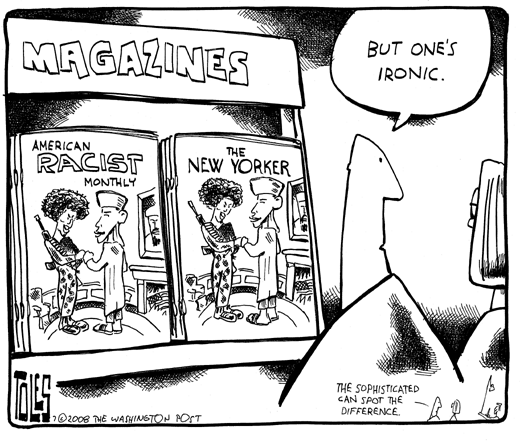
Tom Toles, The Washington Post, July 16 2008

Tom Toles, The Washington Post, July 16 2008

[Side note: I can see the point that everyone can be a little condescending to readers in fly-over country, still, I think this take from Tom Toles on the controversy is a lot smarter than the original and a lot better satire too. Score one for the post, and tom Toles.]

It may, of course, be that a good number of lefties have been holding Obama sacred, and The New Yorker cover doesn’t work for the same reason that jokes about Jesus mother don’t play in the Vatican.

But really, I don’t think the real issue is that all the Obamabots are humorless. I thought the JibJab video was hysterical–and not just because it’s skewers are equal opportunity. It’s because the satire reveals and revels in something that is kind of really true about Obama, who is the subject of the piece. By contrast, the real subject of the satire on the New Yorker cover is nowhere to be seen–and, to be honest, nowhere in consciousness. We could, of course, satirize the reader of the The New Yorker because the reader is at the scene of reading and so, in viewing the image, would view something grotesquely true about themselves. Instead, the New Yorker cover tries to laugh at someone else without referencing that someone else anywhere in the image. Thus the image seems to be “about” Obama even when we pause and have to say “No, it really can’t be.”

This is not a lack of irony on the part of readers, as Remnick and others have lamented. Rather, the image is not ironic at all, playing off a doubleness contained within the image or within the readers’ experience of themselves viewing the image. Instead, it is a kind of postmodern archness which is anything but ironic. Indeed, I think it’s kind of smug.

On the other hand, the JibJab video really does reveal something that’s kind of true about Obama, as much as I love him. If stretched and distorted and made into a grotesque–which is what satire does, witness Swift–then you really feel the truth of the criticism that Obama is just a little too good to be true, and that too good to be trueness depends heavily on a lack of specificity that lets us project our fairy tales on to him. He will inevitable disappoint (witness Dowd’s grouchiness). In this sense, the video becomes not only about something that seems vaguely real about the Obama candidacy, it becomes about us as the viewers of the video (and more specifically as viewers of Obama). We see the truth about ourselves and our fantasies in ways that make us uncomfortable but also make us want to laugh.

None of this necessarily makes me happy, about the New Yorker, I mean. I used to think that The New Yorker was the repository of all that was smart and superior and intelligent in the world. But the guys over at JibJab are way smarter. Score another one for video. Where the smart people are.
Summer’s Guilty Pleasures: A Movie Miscellany

Several movies and DVDs with my astute and incisive observations so that I can keep up my hard-won reputation as a connoseur of film.

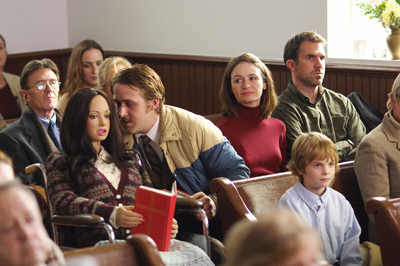
Lars and the Real Girl: This flick is so good it had me crying twice. At the beginning I laughed so hard tears were dripping down my nose. At the end I sniffled at the funeral of a life-size doll designed to be a

Lars and Love Interest in Church

Lars and Love Interest in Church

sex-toy. Ok, this doesn’t sound too promising. Ryan Gosling is compelling as a man with a deeply disturbed psyche damaged by accumulated guilt at his mother having died during childbirth. His own childbirth. Ok, this also doesn’t sound promising, but the Gosling character compensates for his inability to connect with others by falling in love with life-size female doll he orders from an online sex-toy company. Ok, none of this sounds promising at all, but you still really have to see it. The film isn’t so much about sex-toys as it is about the need for love, the need to connect, and the redeeming possibilities of love. In some ways, though Gosling is astonishing, the center of film is the way the rest of the town responds to his need, the way it bucks up, overcomes its squeamishness, and helps Gosling’s character find the healing he needs. In some ways the film feeds that weird human response to crisis, our welcoming of crisis when we find in it that human beings can respond in ways that love and build up rather than tear down. The way a soldier, perversely, misses war because he or she remembers the ways others stood up for him, or the way she stood up for others. (Side note: I wonder if female soldiers experience this nostalgia for war in the same way that men do; I have a suspicion not since the crisis of war forces connection upon men in the way the rest of society seems to disallow). Gosling’s crisis is the occasion not only for his healing, but also for the rest of the town to become more human because they choose to care. A winner.

The poster is more interesting

The poster is more interesting

The Happening–There’s a reason that M. Night Shyamalan is considered a has-been at the age of 38. This movie was atrocious. I kept hope alive as long as I could, but was tempted to look at my watch. Wait, I don’t wear a watch anymore. A metaphor that will go the way of the dodo bird, and M. Night Shyamalan. The acting is almost universally bad. Even Mark Wahlberg, who I normally really like, is bad beyond reckoning. Every line is delivered as if the actors are saying under their breath, “I really can’t believe I’m in this sucky movie saying these sucky lines. But, hey, it’s M. Night Shyamalan; maybe this will all work out.”

By the way, did you know that his real name is Manoj Nelliyattu Shyamalan. I think that someone who would rename himself M. Night is probably just pretentious enough to be a bad film maker. Leave the name changes to the actors.

The Orphanage–This was also an astonishingly good film. I like well-made horror films, but this wasn’t even a horror pic, though it is often advertised as such. Yes, it is a ghost story, but that’s a little like saying Henry James’s Turn of the Screw is a horror story or a ghost story. The dismissiveness implied by the generic name doesn’t get at the emotional complexity of the film. It’s a horror story like Guillermo Del Toro’s Pan’s Labyrinth is a horror story–Horrifying, but in the way humanity is horrifying and life can be horrifying, not because we make

The Orphanage

The Orphanage

up monsters in our brains. The film traces what happens after a boy’s disappearance as his mother seeks to find him, convinced that he has been somehow abducted by ghosts who inhabit the orphanage where she grew up. In the process of that search what she discovers is the relentless ways that human beings can be cruel and vicious to one another, and most especially to those who are most defenseless among us. In the end the film resorts to the cliche that a mother’s love transcends death, even her own, but that conclusion seemed compelling in the end. As with Lars and the Real Girl, the film offers hope that there’s a way to transcend our pettiness and mindless cruelties to one another. That we can give ourselves to others and be given to in return.

For more of my Summer’s Guilty Pleasures see:
Hard Times with Hard Times–July 10
Summer’s Guilty Pleasures: Black Snake Moan–June 30

Schlockey Books or Schlockey Television

Today at the New York Times Gail Collins reflects on a series of novels for teenage girls called The Twilight Saga:

I read the first two Twilights, searching for the key to their success. (This is where the part about being not all that deep comes in handy.) The attraction is clearly the vampire hero, who is a perfect gentleman, eternally faithful and — as the author points out repeatedly — quite a hunk. (“He lay perfectly still in the grass, his shirt open over his sculpted, incandescent chest, his scintillating arms bare … A perfect statue, carved in some unknown stone, smooth like marble, glittering like crystal.”)

Before you make fun of this, I want you to seriously consider whether you’re interested in denigrating people who spend their leisure time actually reading books rather than watching “America’s Got Talent.”

A lot of times Collins makes me grimace.  I mean, just how long can one write for the New York Times and maintain the naive midwestern outsider pose.  On the other hand, this essay made me howl.  And she raises the interesting point that N+1 dismissed a couple of years back in its own analysis of our reading crises. According to N+1 we’ve been so obsessed with the reading crisis that we’re just thrilled people read anything at all, and they go on in good, and dare I say it snobby and Ivy-educated fashion, to dismiss the readerly pleasures of the hoi-polloi.

Still, I think Collins has a point.  The choice isn’t between the Twilight novels and Herman Melville, the choice is between Harry Potter and I Survived a Japanese Game show.  Given this choice, I’m glad my daughter chooses the Twilight novels–or their ilk.

(Side note:  A friend of mine who used to work regularly in Japan says Japanese regularly gather in parks to ridicule and laugh at American tourists.  Why do we even need a game show to accomodate them?)

Of course, I still hold out desperate hope that she’ll choose Melville or Shakespeare or Austen or Chopin or just anything that might get anthologized rather than forgotten.  But even if this hope is not delivered on, I still think there’s something better about having her read several ten thousands of words and exercise her imagination on the page than spend her time watching people consume cockroaches in the name of entertainment.

Summer’s Guilty Pleasures: Hard Times with Hard Times

Charles Dickens

Charles Dickens

Hard Times is one of those books that English teachers make you feel bad about not liking.

Oh, I forgot. I am an English teacher. What to do that I found what some people call Dickens greatest novel so dull that it was not even engaging enough to be a soporific (Side note about falling asleep to books, books make us fall asleep best not when they are dull but when they are engaging enough that they take us to the edge of dreaming).

Seriously though, consider the first lines “Now, what I want is Facts. Teach these boys and girls nothing but Facts. Facts alone are wanted in life. Plant nothing else, and root out everything else.”

Isn’t it plain from this moment that the game is rigged. Who could not know that the speaker is a grind–well actually a Gradgrind–that he will get his comeuppance, and that the virtues of truth beauty and the imagination will out.

And, not to put too fine a point on it, that’s mostly what you get in this novel. The Gradgrinds, Bounderby, the Blackpool’s, they exist to tell us that industrialization has made the world go awry reducing everything to its material usefulness and leaving no room for the more spiritual world of the imagination embodied in things like–surprise!–imaginative literature. Of course there are details. Louisa Gradgrind marries the much older Mr. Bounderby on the basis of the practicalities of the facts and her father’s wishes, and we’re quite sure that she will be ground to nearly nothing, which she nearly is. She ameliorates her desperation by trying to help the laborer Stephen Blackpool and we’re nearly sure that Blackpool will die, which he nearly does. And then does. All parties concerned learn their lessons, including Mr. Gradgrind, who comes to realize that there’s more to life than facts, like his love for his daughter and his wayward son. Still, the love seems mostly to exist to make a point, and the point seems too familiar.

Industrialized Education

There’s nothing wrong with a thesis in a novel–I say this against all those who say novels don’t make points; I agree with those from Kenneth Burke to Wayne Booth who see fiction as a kind of rhetoric. But there is a problem with a novel whose thesis is baldly stated like an essay and whose thesis is never complicated, decomposed, challenged, reconfigured, or developed beyond what we can gather from the first sentence. (For that matter, there’s a problem with an essay written in a similar fashion).

I felt myself slogging along through the mud of the obvious and predictable, waking up just a bit when we finally get to the figure of Stephen Blackpool but descending again in to readerly despair when it’s obvious that Stephen is mostly a foil for the display of Louisa Bounderby’s sentimental charity, and later for the display of the pusillanimity and bourgeois moral corruption of Tom Gradgrind.

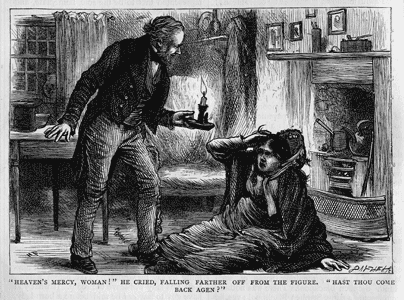
Stephen Blackpool and his mad wife

Stephen Blackpool and his mad wife

Stephen Blackpool, cog in Dickens’ sentimental machine.

On the other hand, I found myself wondering whether I found this all so predictable because so much has been built on a Dickensian edifice. In other words, would Dickens’ early readers have found his book dull and predictable or perhaps instead appalling, thrilling in its view of human degradation. Do we have a responsibility as readers to recover the shock of the new in classic works when they are no longer new?

I’m not sure. And I may be trying to cut Dickens too much of a break. I have read both Uncle Tom’s Cabin and Douglass’s Narrative a multitude of times, and both are rife with moral sentimentalism, obvious bad guys, and endings that surprise only in their predictability. Yet I never find them dull. I will still be moved to tears by sections of both. So what it is it about Hard Times that leaves me cold, in the grip of something I feel I already know and don’t need to learn again, while I can read Stowe and Douglass (and Faulkner, and Hemingway, and at least some of Toni Morrison) as I read the Psalms, an ever renewing source even when I know everything that will happen.

Side Note: An interesting bit from Hard Times about reading. From the chapter where the town is beginning to hunt the falsely accused Blackpool, believing him guilty of robbing Bounderby’s safe.

“The factory-bells had need to ring their loudest that morning to disperse the groups of workers who stood in the tardy daybreak, collected round the placards, devouring them with eager eyes of those who could not read. These people, as they listened to the friendly voice that read aloud–there was always some such ready to help them–stared at the characters which meant so much with a vague awe and respect that would have been half ludicrous, if any aspect of public ignorance could ever be otherwise than threatening and full of evil. Many ears and eyes were busy with a vision of the matter of these placards among turning spindles, rattling looms, and whirling wheels, for hours afterwards; and when the Hands cleared out again into the streets, there were still as many readers as before.”

Me and My Aura

This is perhaps a fairly typical view of oral reading that occurred with regularity up until the 20th century. Now the only people who sit and listen to someone else read are either children or tony types who attend poetry readings. Still, I’m struck by the mystical aura of the word, the mystery and power that written discourse must have held for the masses of the illiterate underclass. Perhaps still holds for that matter. Still, it seems to me that the ubiquity of print has been bought at the price of its own devaluation. Indeed, the inflated presence of the word everywhere around us, where everyone and their mother can write–and indeed, where everyone does write, so much and so often, that no one really has time left to read–this glut of written verbiage has been bought at the price of writing’s (and reading’s) triviality.

Not that this dismal view applies to my own blog, of course. It’s infinitely valuable and more than worth your time. I’m sure it even has an aura.

For More of my summer’s guilty pleasures, see

Summer’s Guilty Pleasures: Black Snake Moan–June 30th

Happy Anniversary To Me!

I should probably write something more substantial than this, but all I have to say is that six months and 15,000 hits ago I started this blog and it’s been an enjoyable ride. A few of you–a very few–have bothered to notice I’m not writing quite so much these days, one or two posts a week instead of four or five. A function of sanity, no doubt. The desire to keep it along with other things like my house and marriage, that is. But what began as a lark that I thought I’d try while on sabbatical has really become something I look forward to as a way of interacting with readers and just plain thinking out loud on paper. Er…on pixels. Or something. And actually its thinking silently. When you stop to think about it.

Thanks to all of you who bother to stop by for a few seconds on your way to something more interesting and worth your time.

Summer’s Guilty Pleasures: Black Snake Moan

Like most of the American world, I take summer to catch up on all the things I didn’t have time for in the past year, or twenty years as the case may be. Books I haven’t read that I wish I had or know I should, or someone somewhere says I should. Movies no red-blooded American can appear at cocktail parties without having seen. Or sometimes just shlockey stuff–other than TV–that I never give myself the time to enjoy because it’s…well…shlockey. Thought it might be fun this summer as I drift in to my new job as interim dean at the college to blog a bit about some of this year’s guilty summer pleasures. Guilty either because I have to admit that I haven’t gotten around to some of these things until now (“WHAT!!! YOU NEVER READ MADAME BOVARY???” I admit, in fact, that I haven’t. Maybe I’ll get around to it this summer.) or guilt because I have to admit that I like every tawdry thing that tells me a halfway decent story. Guilt, I am good at.Black Snake Moan Poster

Black Snake Moan with Samuel Jackson falls in to the latter of these I guess. But I can’t bring myself to describe it as shlockey exactly. On the one hand it’s a film that sells itself to all our most prurient desires. You know, the desire to see Christina Ricci in her underwear, or less…the desire to see Samuel L. Jackson dragging her around chains, which plays I guess to the lurking fetishist in all of us. And the title, “Black Snake Moan”? That speaks for itself, I guess.

Still, I found the film weirdly compelling for the way it commented on and reorganized our American obsessions with the combination of sex, race and violence…a combination that goes back in literature to, SURPRISE!, Harriet Beecher Stowe’s Uncle Tom’s Cabin. Probably before, but UTC is the signature bit in American literature on this score as far as I’m concerned. And Black Snake Moan strikes me as a kind of revisionary commentary on Stowe’s masterpiece. The parallels are so obvious to me that I looked around on the web for a half hour or so but could find only one glancing comment on a blog that saw the connection.

Uncle Tom’s Cabin, in this case, is Samuel L. Jackson’s cabin on his farm in the depths of Mississippi. Christina Ricci is a perverse Little Eva, almost as if the repressed sexuality that made Little Eva saintly in UTC comes bursting out in rage in the nymphomaniacal performance by Ricci. It’s a testimony to Ricci’s performance that after a while you stop wondering about whether she’s going to remove the rest of her clothes and actually start to care about her character’s development and healing. Which may be part of the commentary on UTC I guess. One of the problems with UTC is that all the good people in the novel are too good for the world. They demonstrate this goodness primarily in two ways, by being asexual and by dying. The two seem to go hand in hand. Craig Brewer, the director, says in the special features on the DVD that he felt he was making a religious movie. It’s certainly a film about redemption and healing, and also a film about the saints of this world rather than the next. In other words saints riven, and sometimes lacerated, by desire but who manage after all to keep on living.

Tom and little EvaThe film flirts more overtly with a barely repressed pedophelia that lurks around UTC, and with the cross racial sexual taboos that the novel merely hints at. Eva fainting evermore on Tom’s welcoming breast, he laying her ever gently into bed. The relationship between Legree and his mistress. Ricci, of course, is hardly a child, but her deeply damaged psyche as a result of child abuse, and her self-abuse through drugs and promiscuity render her weirdly innocent and vulnerable, tended to by Jackson’s inexplicable kindness. Indeed, I worried that Jackson was too much the Uncle Tom character in his resistance to Ricci’s sexual advances. The big hack on Tom is that he’s sexless, a reassuring white fantasy that black religion renders black men neuter. Still, I thought the movie negotiated that by having Jackson have a separate flirtation, and through his guitar playing and blues singing, which, for an actor who hadn’t played guitar before this film, I thought was absolutely phenomenal.

So I guess I thought this reading of UTC was actually really interesting. Building recognizably off of the themes and imagery of the original, but inverting all of them in a way that critiques them. Showing that the white mania with black sexuality is a perversion of both instinct and generosity, and not one that will be healed through sexlessness, but through a healthy embrace of life. One that Brewer finds equally in the blues bar and in conventional marriage–which may have been a too conventional way to end the film, but one that again replicates the sentimentality of a UTC original–equally in the steam of eros and the prayers of the church.

The whole earth is moaning, awaiting its redemption. Black Snake Moan, indeed.

Barbara Ehrenreich Solves Fuel Crisis

Ok, this has nothing whatsoever to do with reading, but I do think Barbara Ehrenreich over at the Huffington Post is to be commended for thinking outside the box.

I say to my fellow humans: It’s time to stop feeding off the dead and grow up! I don’t know about food, but I have a plan for achieving fuel self-suffiency in less time than it takes to say “Arctic National Wildlife Refuge.” The idea came to me from reports of the growing crime of French fry oil theft: Certain desperate individuals are stealing restaurants’ discarded cooking oil, which can then be used to fuel cars. So the idea is: why not could skip the French fry phase and harvest high-energy hydrocarbons right from ourselves?

I’m talking about liposuction, of course, and it’s a mystery to me why it hasn’t occurred to any of those geniuses who are constantly opining about fuel prices on MSNBC. The average liposuction removes about half a gallon of liquid fat, which may not seem like much. But think of the vast reserves our nation is literally sitting on! Thirty percent of Americans are obese, or about 90 million individuals or 45 million gallons of easily available fat — not from dead diatoms but from our very own bellies and butts.

One thing Ehrenreich leaves out is all that all that reduced weight will result in much higher gas mileage. According to a study by Sheldon Jacobsen at the University of Illinois,

Since 1960…the consumption of no less than 938 million gallons of gasoline annually can be attributed to weight gains of drivers and passengers. Of that total no less than 272 million gallons are consumed annually as a result of weight gains since 1988.

“The key finding is that nearly 1 billion gallons of fuel are consumed each year because of the average weight gain of people living in the United States since 1960 – nearly three times the total amount of fuel consumed by all passenger vehicles each day based on current driving habits,” McLay and Jacobson wrote.

Yet one more incentive for me to start my diet. It could pay for my vacation.

Satyagraha: Goodness and Stasis

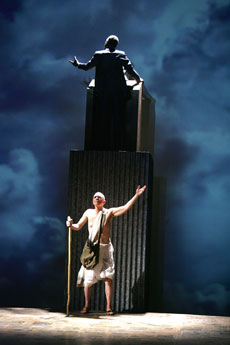
In the New York Review of Books, Daniel Mendelsohn’s review of Philip Glass’s new opera, Satyagraha, raises a number of interesting issues about the relationships between language and narrative and ethics. Of course, I no doubt think they are particularly good because I’veGhandi and MLK in Glass\'s Satyagraha puzzled over them before. Also a few of you know that my Batman alter-ego is an operatic tenor (No, seriously. You laugh? Why does everyone laugh? What, pray tell, is laughable about an English professor who sings opera? And not in the shower. When I was a kid I told my Dad I was going to be President of the United States and play pro basketball at night. Now my dream life is to be a college professor by day and a member of Met chorus–at least my fantasies are vaguely realistic–by the light of the full moon. Hint, that’s not me in the photo).

Anyway, back to Mendelsohn:

Good people do not, generally speaking, make good subjects for operas. Like the Greek tragedies that the sixteenth-century Venetian inventors of opera sought to recreate, Western musical drama has tended to be preoccupied with the darker extremes of human emotions: excessive passion and wild jealousy, smoldering resentment and implacable rage. These, after all, are the emotions that spark the kinds of actions—adultery, betrayal, revenge, murder—that make for gripping drama. Unpleasant as they may be in real life, such actions are essential to the Western idea of theater itself, in which the very notion of plot is deeply connected to difficulties, problems, disasters. Aristotle, in his Poetics, refers to plot as a knot tied by the author (he calls it a dêsis, a “binding up”) out of the manifold strands representing competing wills or desires or ideologies; an ugly and worrisome knot that will, in due course, ultimately come undone in a climactic moment of loosening or release of tension (the lysis, or “undoing”)—a concept that survives in our term “dénouement.”

There can, that is to say, be no theater unless bad things happen, unless there are terrible problems, insoluble knots; without them, there would be nothing for the characters to do. That “doing” gives us the very word by which we refer to what happens on stage: “drama” comes from the Greek drân, “to do” or “to act.” When we go to the theater, we want to see characters doing things. Bad things, preferably.

I’ve pointed out to my students that for those of us who love literature, Augustine’s felix culpa/felix peccatum is the only possible game in town. Without sin there is no story, there is no conflict, there is no drama–of redemption or anything else.

Apparently Tolkien thought something similar. According to Verlyn Flieger in her (his?) book Splintered Light: Logos and Language in Tolkien’s World.

“Tolkien felt that the Separation, the Fall, was tragic and that the splintering of light and language were the result of the Fall. But he surely felt, too, with Augustine, the possibilities for beauty that derived from the felix peccatum Adae, the fortunate sin of Adam. Given light and language, it is our right to ‘make still by that law in which we’re made’ and by making to ‘assist in the effoliation and multiple enrichment of creation.’ He felt just as surely also with Barfield that in the hands of th epoets, the makers, the ‘disease of mythology’ called language will be the instrument whereby sub-creation will finally reunite humanity with the Maker.

Well, I don’t know about all of this, but a lot of it I love. One might say that our imperfection is the condition of our creativity. Death is the Mother of all beauty, as Stevens says and I’ve noted.

And thus, as Philip Glass’s opera apparently explores in evoking the life of Mahatma Ghandi, the very difficult process of trying to create narrative art about virtue. The Romantics complained that Milton’s God is not only autocratic and oppressive of individual initiative, he’s much worse than that from the artists point of view. He’s boring. The evil man flailing against the imperturbable stone face of goodness at leastWilliam Blake\'s Satan arousing the fallen angels gives us something to hang our aesthetic hat on. Or at least the imperturbable stone face of something. Think Ahab and Moby Dick. Milton himself tried his hand at dramatizing goodness in Paradise Regained, showing that the essence of Jesus righteousness in the desert–indeed the root of his triumph over evil–is that he avoids doing anything in the face of temptation. Not so far from the traditional Christian vision of redemptive suffering which triumphs over evil not by striking it down, but by taking it upon oneself. This idea leads to the theological disputes as to whether the Christian God is impassive. If he can be moved to change–by suffering or by desire–can he be God.

Mendelsohn makes the case that Glass dramatizes Ghandi’s goodness through a kind of meditative stasis, the use of tonal repetitions mimicking the practices of meditation in a way that transcends time–a kind of act, even a kind of drama, overcoming time, but one that can’t be represented narratively. In this view of things, the essence of goodness is achronic, in time but not of it, perhaps (You can hear some clips at amazon.com here). As Mendelsohn puts it,

If, indeed, what Satyagraha aims at, in both its text and its music, is a kind of meditative state of spiritual elevation that allows us to think clearly about Gandhi’s goodness and its effects rather than to get wrapped up in his “drama,” the use of these incantatory texts only enhances our sense that we’re participating in a kind of exalting ritual, rather than spending a couple of hours at the theatre. Many New Yorkers I know, opera lovers, balked at the idea of “sitting through four hours of Sanskrit”; but those same people would happpily sit through a Te Deum (or bar mitzvah) while understanding little of the text. It’s when you see Satyagraha as a symbolic action that you can begin to appreciate it.

Side note: for some time I’ve been mulling over the idea that the experience of opera–singing as well as listening–is not unlike the experience of glossolalia, or speaking in tongues found in pentecostal churches. Understanding, in any traditional sense, is not entirely the point since God could just as well speak to us in words we do understand. So why the idea that we need a language that is other. Somehow it is the experience of language that does not mean for us that is at the center of this experience. Similarly, I think people who think opera would be more popular if they understood the language are only half correct. There is something about the fact of words that one does not experience as words but as sounds that have the shape of words that lends opera its transcendent moment for listener and singer alike.

One of my colleagues has objected vehemently to the idea that evil is necessary to literature and has insisted on the importance of lyric poetry as a means of representing it. This well could be, though I think the choice is itself interesting. Lyric is literature out of time and, to my mind, essentially non-dramatic, again like glossolalia. Almost, again, as if goodness can only be imagined and experienced in a world other than the narrative world of longing and loss that we live in.

Barack Obama Secretly Married to Hillary Rodham Clinton. Who knew?

This just in from the New York Times as of 6:07 p.m. on Saturday afternoon:

But out on the campaign trail, Mr. Obama, of Illinois, was warmer and cozier, sometimes adopting the Bill Clintonesque I-feel-your-pain message used to such great effect by his wife, Senator Hillary Rodham Clinton, in swing states.

Now I really hate to do this because everyone and their grandmother thinks that all an English professor does is check grammar. Still, I MUST point out that in this case “his wife” refers all the way back to the proper noun “Mr. Obama” since in fact “Bill Clintonesque” is an adjective modifying the noun “message.” And for you grammar hounds out there, a possessive pronoun cannot refer back to an adjective. No doubt the error was overlooked by an Ivy League undergraduate who is interning as a copy editing assistant and who never had to learn grammar since it is skipped in honors classes. Of course, writers mostly don’t bother with grammar anyway. Too far beneath them. Especially if they write for the New York Times.

However, one is intrigued by the possibility that this is NOT in error. Maybe Barack and Hillary did secretly tie the knot in Utah somewhere, or at least somewhere wherein the fact that you may already be married doesn’t matter very much. This gives a whole new angle on the tensions between Barack and Hillary on the campaign trail. What we all merely took for underhanded politics was really romantic and sexual tension gone awry. Hillary’s anger at Barack’s sexism was no doubt given an extra edge by the fact that he skipped doing the dishes and left the seat up the last time they were together. And what about this intriguing photo of the two love-birds together. Party unity, indeed! As for that evening of reconciliation at the home of Diane Feinstein where she said knowingly that she would “leave the two of them alone together”? No doubt with a wink and a nod. Inquiring minds want to know.

Political Enemies or Love-birds? You Decide
Combatants or Love-Birds? You Decide!

Cryptomnesia revisited (is this even possible?)

I mentioned in my last post that I had an intuitive sense that cryptomnesia must somehow be deeply important to creativity, but that I was also sure that someone else had already said it.

Turns out I was right on both score, or at least on the score that someone already said it. Siri Carpenter reports in the Monitor on Psychology that four psychologists have conducted tests whose results suggest the process of forgetting that one has learned something is important to creativity:

The mechanisms that underlie cryptomnesia also have important implications for creativity, Marsh believes. Recently, he, Landau, Hicks and psychologist Thomas B. Ward, PhD, of Texas A&M University, have examined how unconscious learning affects the creative process. In one series of experiments, for example, the researchers asked participants to draw novel space creatures. They found that when participants were first shown a few examples of space creatures that all contained some features in common, such as four legs, antennae and a tail, participants reliably included those features in their own drawings–even though they were instructed not to copy any of the features used in the examples.

“If we want to understand how it is that people design skyscrapers, or write music, or write a New York Times best seller,” Marsh concludes, “I think we need to acknowledge that nothing we design is ever truly novel–every creative effort contains vestiges of what we have experienced in the past.”

I admit that this particular experiment and its definition of creativity strike me as kind of lame, but it still gets at the fact that creation is a cobbling together of things we’ve already known rather than a fashioning tout court. My earlier intuition is more along the lines that people we view as truly creative have the ability to forget, which is as important as the ability to remember. By absorbing ideas, stories, images, and yet forgetting their original context, we are freed to recombine them in new and interesting ways more readily than those who remain slaves to context and origin.

This is, of course, no respecter of intellectual property rights, but don’t forget that Shakespeare’s best ideas were plagiarism–perhaps both conscious and unconscious–of other less accomplished playwrights.

There are apparently a couple of other documented literary cases of cryptomnesia, one pretty definite, the other speculative. At the New York Observer, Ron Rosenbaum wrote an essay about the speculation of a professor that Nabokov’s clear use of someone else’s lolita-like story represents a case not so much of conscious plagiarism as of cryptomnesia. Professor Michael Marr provides some pretty well-documented evidence that Robert Musil recognized his own cryptomensia in a couple of scenes of Man Without Qualities.

There’s also an interesting claim at Andrew Brown, Queen’s Counsel, an intellectual property web-site, to the effect that creative people are especially susceptible to Cryptomnesia.

The psychiatrist C G Jung in his book Man and His Symbols outlines that the brain never forgets an impression, no matter how slight. The mind has an ability to recall old impressions particularly during a creative process and what is perceived as a “new” creation can in fact be past memories subconsciously recalled. This can give rise to subconscious plagiarism or what psychiatrists call cryptomnesia.

Those with left brain creativity such as artists, composers or fashion designers can all be particularly susceptible to subconscious copying.

I also ran across a number of writers who say they are terrified of cryptomnesia. I suspect that in part, it’s graduate student sydrome. Always frantic to keep track of the last footnote to demonstrate the three sentences of ideas that you actually have are really your own, most dissertations ever written are more dully derivative that a sophomore’s thesis. I, at least, didn’t feel like I was really becoming a scholar until I knew the field well enough to forget where I had learned things. This started happening about 10 years after I finished graduate school.

In general I suspect that the books of folks worried about cryptomnesia aren’t all that good. They are so obsessed with the question of whether they are original that they don’t leave themselves any space to be creative.