Tag Archives: literature

Summer’s Guilty Pleasures: Hard Times with Hard Times

Charles Dickens

Charles Dickens

Hard Times is one of those books that English teachers make you feel bad about not liking.

Oh, I forgot. I am an English teacher. What to do that I found what some people call Dickens greatest novel so dull that it was not even engaging enough to be a soporific (Side note about falling asleep to books, books make us fall asleep best not when they are dull but when they are engaging enough that they take us to the edge of dreaming).

Seriously though, consider the first lines “Now, what I want is Facts. Teach these boys and girls nothing but Facts. Facts alone are wanted in life. Plant nothing else, and root out everything else.”

Isn’t it plain from this moment that the game is rigged. Who could not know that the speaker is a grind–well actually a Gradgrind–that he will get his comeuppance, and that the virtues of truth beauty and the imagination will out.

And, not to put too fine a point on it, that’s mostly what you get in this novel. The Gradgrinds, Bounderby, the Blackpool’s, they exist to tell us that industrialization has made the world go awry reducing everything to its material usefulness and leaving no room for the more spiritual world of the imagination embodied in things like–surprise!–imaginative literature. Of course there are details. Louisa Gradgrind marries the much older Mr. Bounderby on the basis of the practicalities of the facts and her father’s wishes, and we’re quite sure that she will be ground to nearly nothing, which she nearly is. She ameliorates her desperation by trying to help the laborer Stephen Blackpool and we’re nearly sure that Blackpool will die, which he nearly does. And then does. All parties concerned learn their lessons, including Mr. Gradgrind, who comes to realize that there’s more to life than facts, like his love for his daughter and his wayward son. Still, the love seems mostly to exist to make a point, and the point seems too familiar.
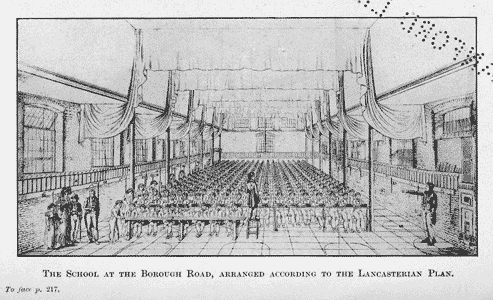
Industrialized Education

There’s nothing wrong with a thesis in a novel–I say this against all those who say novels don’t make points; I agree with those from Kenneth Burke to Wayne Booth who see fiction as a kind of rhetoric. But there is a problem with a novel whose thesis is baldly stated like an essay and whose thesis is never complicated, decomposed, challenged, reconfigured, or developed beyond what we can gather from the first sentence. (For that matter, there’s a problem with an essay written in a similar fashion).

I felt myself slogging along through the mud of the obvious and predictable, waking up just a bit when we finally get to the figure of Stephen Blackpool but descending again in to readerly despair when it’s obvious that Stephen is mostly a foil for the display of Louisa Bounderby’s sentimental charity, and later for the display of the pusillanimity and bourgeois moral corruption of Tom Gradgrind.
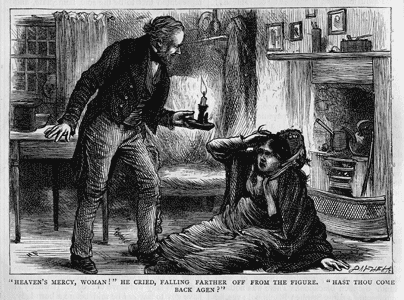
Stephen Blackpool and his mad wife

Stephen Blackpool and his mad wife

Stephen Blackpool, cog in Dickens’ sentimental machine.

On the other hand, I found myself wondering whether I found this all so predictable because so much has been built on a Dickensian edifice. In other words, would Dickens’ early readers have found his book dull and predictable or perhaps instead appalling, thrilling in its view of human degradation. Do we have a responsibility as readers to recover the shock of the new in classic works when they are no longer new?

I’m not sure. And I may be trying to cut Dickens too much of a break. I have read both Uncle Tom’s Cabin and Douglass’s Narrative a multitude of times, and both are rife with moral sentimentalism, obvious bad guys, and endings that surprise only in their predictability. Yet I never find them dull. I will still be moved to tears by sections of both. So what it is it about Hard Times that leaves me cold, in the grip of something I feel I already know and don’t need to learn again, while I can read Stowe and Douglass (and Faulkner, and Hemingway, and at least some of Toni Morrison) as I read the Psalms, an ever renewing source even when I know everything that will happen.

Side Note: An interesting bit from Hard Times about reading. From the chapter where the town is beginning to hunt the falsely accused Blackpool, believing him guilty of robbing Bounderby’s safe.

“The factory-bells had need to ring their loudest that morning to disperse the groups of workers who stood in the tardy daybreak, collected round the placards, devouring them with eager eyes of those who could not read. These people, as they listened to the friendly voice that read aloud–there was always some such ready to help them–stared at the characters which meant so much with a vague awe and respect that would have been half ludicrous, if any aspect of public ignorance could ever be otherwise than threatening and full of evil. Many ears and eyes were busy with a vision of the matter of these placards among turning spindles, rattling looms, and whirling wheels, for hours afterwards; and when the Hands cleared out again into the streets, there were still as many readers as before.”

Me and My Aura

This is perhaps a fairly typical view of oral reading that occurred with regularity up until the 20th century. Now the only people who sit and listen to someone else read are either children or tony types who attend poetry readings. Still, I’m struck by the mystical aura of the word, the mystery and power that written discourse must have held for the masses of the illiterate underclass. Perhaps still holds for that matter. Still, it seems to me that the ubiquity of print has been bought at the price of its own devaluation. Indeed, the inflated presence of the word everywhere around us, where everyone and their mother can write–and indeed, where everyone does write, so much and so often, that no one really has time left to read–this glut of written verbiage has been bought at the price of writing’s (and reading’s) triviality.

Not that this dismal view applies to my own blog, of course. It’s infinitely valuable and more than worth your time. I’m sure it even has an aura.

For More of my summer’s guilty pleasures, see

Summer’s Guilty Pleasures: Black Snake Moan–June 30th

Summer’s Guilty Pleasures: Black Snake Moan

Like most of the American world, I take summer to catch up on all the things I didn’t have time for in the past year, or twenty years as the case may be. Books I haven’t read that I wish I had or know I should, or someone somewhere says I should. Movies no red-blooded American can appear at cocktail parties without having seen. Or sometimes just shlockey stuff–other than TV–that I never give myself the time to enjoy because it’s…well…shlockey. Thought it might be fun this summer as I drift in to my new job as interim dean at the college to blog a bit about some of this year’s guilty summer pleasures. Guilty either because I have to admit that I haven’t gotten around to some of these things until now (“WHAT!!! YOU NEVER READ MADAME BOVARY???” I admit, in fact, that I haven’t. Maybe I’ll get around to it this summer.) or guilt because I have to admit that I like every tawdry thing that tells me a halfway decent story. Guilt, I am good at.Black Snake Moan Poster

Black Snake Moan with Samuel Jackson falls in to the latter of these I guess. But I can’t bring myself to describe it as shlockey exactly. On the one hand it’s a film that sells itself to all our most prurient desires. You know, the desire to see Christina Ricci in her underwear, or less…the desire to see Samuel L. Jackson dragging her around chains, which plays I guess to the lurking fetishist in all of us. And the title, “Black Snake Moan”? That speaks for itself, I guess.

Still, I found the film weirdly compelling for the way it commented on and reorganized our American obsessions with the combination of sex, race and violence…a combination that goes back in literature to, SURPRISE!, Harriet Beecher Stowe’s Uncle Tom’s Cabin. Probably before, but UTC is the signature bit in American literature on this score as far as I’m concerned. And Black Snake Moan strikes me as a kind of revisionary commentary on Stowe’s masterpiece. The parallels are so obvious to me that I looked around on the web for a half hour or so but could find only one glancing comment on a blog that saw the connection.

Uncle Tom’s Cabin, in this case, is Samuel L. Jackson’s cabin on his farm in the depths of Mississippi. Christina Ricci is a perverse Little Eva, almost as if the repressed sexuality that made Little Eva saintly in UTC comes bursting out in rage in the nymphomaniacal performance by Ricci. It’s a testimony to Ricci’s performance that after a while you stop wondering about whether she’s going to remove the rest of her clothes and actually start to care about her character’s development and healing. Which may be part of the commentary on UTC I guess. One of the problems with UTC is that all the good people in the novel are too good for the world. They demonstrate this goodness primarily in two ways, by being asexual and by dying. The two seem to go hand in hand. Craig Brewer, the director, says in the special features on the DVD that he felt he was making a religious movie. It’s certainly a film about redemption and healing, and also a film about the saints of this world rather than the next. In other words saints riven, and sometimes lacerated, by desire but who manage after all to keep on living.

Tom and little EvaThe film flirts more overtly with a barely repressed pedophelia that lurks around UTC, and with the cross racial sexual taboos that the novel merely hints at. Eva fainting evermore on Tom’s welcoming breast, he laying her ever gently into bed. The relationship between Legree and his mistress. Ricci, of course, is hardly a child, but her deeply damaged psyche as a result of child abuse, and her self-abuse through drugs and promiscuity render her weirdly innocent and vulnerable, tended to by Jackson’s inexplicable kindness. Indeed, I worried that Jackson was too much the Uncle Tom character in his resistance to Ricci’s sexual advances. The big hack on Tom is that he’s sexless, a reassuring white fantasy that black religion renders black men neuter. Still, I thought the movie negotiated that by having Jackson have a separate flirtation, and through his guitar playing and blues singing, which, for an actor who hadn’t played guitar before this film, I thought was absolutely phenomenal.

So I guess I thought this reading of UTC was actually really interesting. Building recognizably off of the themes and imagery of the original, but inverting all of them in a way that critiques them. Showing that the white mania with black sexuality is a perversion of both instinct and generosity, and not one that will be healed through sexlessness, but through a healthy embrace of life. One that Brewer finds equally in the blues bar and in conventional marriage–which may have been a too conventional way to end the film, but one that again replicates the sentimentality of a UTC original–equally in the steam of eros and the prayers of the church.

The whole earth is moaning, awaiting its redemption. Black Snake Moan, indeed.

Satyagraha: Goodness and Stasis

In the New York Review of Books, Daniel Mendelsohn’s review of Philip Glass’s new opera, Satyagraha, raises a number of interesting issues about the relationships between language and narrative and ethics. Of course, I no doubt think they are particularly good because I’veGhandi and MLK in Glass\'s Satyagraha puzzled over them before. Also a few of you know that my Batman alter-ego is an operatic tenor (No, seriously. You laugh? Why does everyone laugh? What, pray tell, is laughable about an English professor who sings opera? And not in the shower. When I was a kid I told my Dad I was going to be President of the United States and play pro basketball at night. Now my dream life is to be a college professor by day and a member of Met chorus–at least my fantasies are vaguely realistic–by the light of the full moon. Hint, that’s not me in the photo).

Anyway, back to Mendelsohn:

Good people do not, generally speaking, make good subjects for operas. Like the Greek tragedies that the sixteenth-century Venetian inventors of opera sought to recreate, Western musical drama has tended to be preoccupied with the darker extremes of human emotions: excessive passion and wild jealousy, smoldering resentment and implacable rage. These, after all, are the emotions that spark the kinds of actions—adultery, betrayal, revenge, murder—that make for gripping drama. Unpleasant as they may be in real life, such actions are essential to the Western idea of theater itself, in which the very notion of plot is deeply connected to difficulties, problems, disasters. Aristotle, in his Poetics, refers to plot as a knot tied by the author (he calls it a dêsis, a “binding up”) out of the manifold strands representing competing wills or desires or ideologies; an ugly and worrisome knot that will, in due course, ultimately come undone in a climactic moment of loosening or release of tension (the lysis, or “undoing”)—a concept that survives in our term “dénouement.”

There can, that is to say, be no theater unless bad things happen, unless there are terrible problems, insoluble knots; without them, there would be nothing for the characters to do. That “doing” gives us the very word by which we refer to what happens on stage: “drama” comes from the Greek drân, “to do” or “to act.” When we go to the theater, we want to see characters doing things. Bad things, preferably.

I’ve pointed out to my students that for those of us who love literature, Augustine’s felix culpa/felix peccatum is the only possible game in town. Without sin there is no story, there is no conflict, there is no drama–of redemption or anything else.

Apparently Tolkien thought something similar. According to Verlyn Flieger in her (his?) book Splintered Light: Logos and Language in Tolkien’s World.

“Tolkien felt that the Separation, the Fall, was tragic and that the splintering of light and language were the result of the Fall. But he surely felt, too, with Augustine, the possibilities for beauty that derived from the felix peccatum Adae, the fortunate sin of Adam. Given light and language, it is our right to ‘make still by that law in which we’re made’ and by making to ‘assist in the effoliation and multiple enrichment of creation.’ He felt just as surely also with Barfield that in the hands of th epoets, the makers, the ‘disease of mythology’ called language will be the instrument whereby sub-creation will finally reunite humanity with the Maker.

Well, I don’t know about all of this, but a lot of it I love. One might say that our imperfection is the condition of our creativity. Death is the Mother of all beauty, as Stevens says and I’ve noted.

And thus, as Philip Glass’s opera apparently explores in evoking the life of Mahatma Ghandi, the very difficult process of trying to create narrative art about virtue. The Romantics complained that Milton’s God is not only autocratic and oppressive of individual initiative, he’s much worse than that from the artists point of view. He’s boring. The evil man flailing against the imperturbable stone face of goodness at leastWilliam Blake\'s Satan arousing the fallen angels gives us something to hang our aesthetic hat on. Or at least the imperturbable stone face of something. Think Ahab and Moby Dick. Milton himself tried his hand at dramatizing goodness in Paradise Regained, showing that the essence of Jesus righteousness in the desert–indeed the root of his triumph over evil–is that he avoids doing anything in the face of temptation. Not so far from the traditional Christian vision of redemptive suffering which triumphs over evil not by striking it down, but by taking it upon oneself. This idea leads to the theological disputes as to whether the Christian God is impassive. If he can be moved to change–by suffering or by desire–can he be God.

Mendelsohn makes the case that Glass dramatizes Ghandi’s goodness through a kind of meditative stasis, the use of tonal repetitions mimicking the practices of meditation in a way that transcends time–a kind of act, even a kind of drama, overcoming time, but one that can’t be represented narratively. In this view of things, the essence of goodness is achronic, in time but not of it, perhaps (You can hear some clips at amazon.com here). As Mendelsohn puts it,

If, indeed, what Satyagraha aims at, in both its text and its music, is a kind of meditative state of spiritual elevation that allows us to think clearly about Gandhi’s goodness and its effects rather than to get wrapped up in his “drama,” the use of these incantatory texts only enhances our sense that we’re participating in a kind of exalting ritual, rather than spending a couple of hours at the theatre. Many New Yorkers I know, opera lovers, balked at the idea of “sitting through four hours of Sanskrit”; but those same people would happpily sit through a Te Deum (or bar mitzvah) while understanding little of the text. It’s when you see Satyagraha as a symbolic action that you can begin to appreciate it.

Side note: for some time I’ve been mulling over the idea that the experience of opera–singing as well as listening–is not unlike the experience of glossolalia, or speaking in tongues found in pentecostal churches. Understanding, in any traditional sense, is not entirely the point since God could just as well speak to us in words we do understand. So why the idea that we need a language that is other. Somehow it is the experience of language that does not mean for us that is at the center of this experience. Similarly, I think people who think opera would be more popular if they understood the language are only half correct. There is something about the fact of words that one does not experience as words but as sounds that have the shape of words that lends opera its transcendent moment for listener and singer alike.

One of my colleagues has objected vehemently to the idea that evil is necessary to literature and has insisted on the importance of lyric poetry as a means of representing it. This well could be, though I think the choice is itself interesting. Lyric is literature out of time and, to my mind, essentially non-dramatic, again like glossolalia. Almost, again, as if goodness can only be imagined and experienced in a world other than the narrative world of longing and loss that we live in.

Cryptomnesia revisited (is this even possible?)

I mentioned in my last post that I had an intuitive sense that cryptomnesia must somehow be deeply important to creativity, but that I was also sure that someone else had already said it.

Turns out I was right on both score, or at least on the score that someone already said it. Siri Carpenter reports in the Monitor on Psychology that four psychologists have conducted tests whose results suggest the process of forgetting that one has learned something is important to creativity:

The mechanisms that underlie cryptomnesia also have important implications for creativity, Marsh believes. Recently, he, Landau, Hicks and psychologist Thomas B. Ward, PhD, of Texas A&M University, have examined how unconscious learning affects the creative process. In one series of experiments, for example, the researchers asked participants to draw novel space creatures. They found that when participants were first shown a few examples of space creatures that all contained some features in common, such as four legs, antennae and a tail, participants reliably included those features in their own drawings–even though they were instructed not to copy any of the features used in the examples.

“If we want to understand how it is that people design skyscrapers, or write music, or write a New York Times best seller,” Marsh concludes, “I think we need to acknowledge that nothing we design is ever truly novel–every creative effort contains vestiges of what we have experienced in the past.”

I admit that this particular experiment and its definition of creativity strike me as kind of lame, but it still gets at the fact that creation is a cobbling together of things we’ve already known rather than a fashioning tout court. My earlier intuition is more along the lines that people we view as truly creative have the ability to forget, which is as important as the ability to remember. By absorbing ideas, stories, images, and yet forgetting their original context, we are freed to recombine them in new and interesting ways more readily than those who remain slaves to context and origin.

This is, of course, no respecter of intellectual property rights, but don’t forget that Shakespeare’s best ideas were plagiarism–perhaps both conscious and unconscious–of other less accomplished playwrights.

There are apparently a couple of other documented literary cases of cryptomnesia, one pretty definite, the other speculative. At the New York Observer, Ron Rosenbaum wrote an essay about the speculation of a professor that Nabokov’s clear use of someone else’s lolita-like story represents a case not so much of conscious plagiarism as of cryptomnesia. Professor Michael Marr provides some pretty well-documented evidence that Robert Musil recognized his own cryptomensia in a couple of scenes of Man Without Qualities.

There’s also an interesting claim at Andrew Brown, Queen’s Counsel, an intellectual property web-site, to the effect that creative people are especially susceptible to Cryptomnesia.

The psychiatrist C G Jung in his book Man and His Symbols outlines that the brain never forgets an impression, no matter how slight. The mind has an ability to recall old impressions particularly during a creative process and what is perceived as a “new” creation can in fact be past memories subconsciously recalled. This can give rise to subconscious plagiarism or what psychiatrists call cryptomnesia.

Those with left brain creativity such as artists, composers or fashion designers can all be particularly susceptible to subconscious copying.

I also ran across a number of writers who say they are terrified of cryptomnesia. I suspect that in part, it’s graduate student sydrome. Always frantic to keep track of the last footnote to demonstrate the three sentences of ideas that you actually have are really your own, most dissertations ever written are more dully derivative that a sophomore’s thesis. I, at least, didn’t feel like I was really becoming a scholar until I knew the field well enough to forget where I had learned things. This started happening about 10 years after I finished graduate school.

In general I suspect that the books of folks worried about cryptomnesia aren’t all that good. They are so obsessed with the question of whether they are original that they don’t leave themselves any space to be creative.

Tales of the Toilet; or, W(h)ither Fiction?

A couple of days ago, The Los Angeles Times reported the following

MADISON, Wis. — Two children and their mother lived for about two months withToilet Art from Jacob Earl the decaying body of a 90-year-old woman on the toilet of their home’s only bathroom, on the advice of a religious “superior” who claimed the corpse would come back to life, authorities said Friday.

===========When Deputy Leigh Neville-Neil …. opened the last closed door, she smelled “decaying matter” and noticed something piled on what appeared to be a toilet. Lewis told her it was Middlesworth’s body, the complaint said.

Lewis told the deputy that Middlesworth had died about two months earlier, but that God told her Middlesworth would come to life if she prayed hard enough.

She said she couldn’t say anything more until she spoke with her “superior” — Bushey, 57, also known as Bishop John Peter Bushey

She said she propped Middlesworth on the toilet and left the room to call Bushey, who told her to leave the woman alone and pray for her, the complaint said. He said he had received signs that God would raise her from the dead with a miracle.

The story, wretched as it is, reminded me of another tale of the toilet from a couple of months ago in which a horribly obese woman was found to have been living on a toilet in Kansas for two years, having been fed and tended to by her boyfriend as she refused to leave the bathroom. According to EMT reports she had literally grown to the toilet seat, which had to be removed and transported with her to the emergency room.

It’s hard to know what is more astonishing to the imagination, a disturbed woman who could not bring herself to move as she felt her body melding with porcelain, or the boyfriend who brought her breakfast every morning as he pleaded with her to leave the bathroom. A kind of prayer, to be sure, though one less literal than those of the woman and her children in Wisconsin. One wonders what neural snyapse firing in the boyfriend’s brain finally signaled the end of faith, a loss of hope. Why two years instead of two months? Or why not three years instead of two? What finally says to the self, let’s make an end of it. In any case, a synapse firing that had not yet occurred in Wisconsin as a woman watched her mother decay into “something piled on what appeared to be a toilet.”

One gapes, shudders, cries, or gags. And, yes, one laughs. Hopelessly, hysterically, apologetically. When you are at the bottom of the human drain, what else is left to do but laugh at horrors that we come to.

I remember my own shuddering sense of horror and delight and sorrow at first reading “A Rose for Emily” and saw in my minds eye the decaying corpse in the bed, imagined Emily there in bed beside her imaginary lover. Or Miss Havisham, Emily’s literary avatar, in Dickens Great Expectations. Or the perverse grotesques in O’Connor’s fiction–especially Norton, the grieving boy who hangs himself in “The Lame Shall Enter First” in a twisted and in some sense literal leap of faith.

But one looks at this stuff published daily and has to say helplessly that Dickens and O’Connor and Faulkner have nothing on this. Stephen King could do no better in calling up the bizarre extremes of human existence. No wonder contemporary readers have little taste for fiction, and novelists feel compelled to present their fictions as spurious memoir. With a world as it already is beyond all imagining, what role for the writer who wants to imagine what is not.

Of course, I still hold out hope that one role of fiction is to redeem the time. Imagination isn’t just an effort to invoke the extreme, but to shape it, to tame it to a tale. I think most contemporary fiction has given up on that part of the task, perhaps disbelieving that the rotting something on a toilet stool that is our material can be wrestled into meaning. Itself a kind of collective loss of faith.

Other toilets in the news:

According to Reuters, “A woman in Germany put an end to her troubled marriage by chopping up her husband and flushing parts of him down the toilet, authorities said on Tuesday. ‘You won’t find him, I’ve flushed him down the toilet,’ is what she told (her children).” And Hitchcock thought he was imaginative by having a man bury his wife in a Garden?

The airline Jet Blue apparently required a man to sit in the toilet, discovering after takeoff–after takeoff!!–that the flight was ovebooked. The man is suing… because the toilet had no seatbelts and he was bounced around during turbulence. A man who clearly has his priorities in place

Officials in Montgomery Country Maryland have announced a plan to save money by rationing toilet paper for prison inmates. They are using the savings to requisition more body armor in anticipation of the ensuing riots.

Not to be outdone, a family in Manhattan is going without toilet paper for a year in order to be environmentally friendly. They are also going without friends. Not to be outdone, Will Smith proudly points to his new paperless toilets that clean and dry you. I’ve used a bidet, but I admit that the blow dry effect of Will Smith’s Japanese toilets seems just a bit much. Who knew that toilets would be the cutting edge of greenToilet instructions in Japan awareness.

We can also be glad that some enterprising young fellow has given us the following clever visual instructions for toilet usage. (Is it just me or do some of these look like positions from the Kama Sutra).

Aspiring MFA students take note, I see the makings a collection of short stories here. That they are all factual and more imaginative than anything you could dream up on your own should not stop you. There is still no law against writing the world as it is as if you came up with it on your own.

A final news note: Computer Keyboards can be dirtier than toilets.

On that note, I think I’ll go wash my hands. If I’m gone for two years, please come check on me.

Treasure Island, Buried

As some may remember from the distant past of this blog, I set out to actually read a whole e-book from start to finish on Book Glutton, all this in honor of read a book month, or read an e-book month, or some other kind of month. Given that most Americans don’t even read one book a year, e or otherwise, I am so proud of myself for managing to fulfill my quota in a mere three weeks. Or so. Anyway, I finished Treasure Island about a couple of weeks ago, but have been too swamped with work (and my kids soccer games) to collect any thoughts. And, of course by now, given that I am uncomfortably close to my fiftieth birthday, I have actually forgotten most of the experience. So the comments that follow are no doubt not anywhere nearly an accurate reflection of my experiences but more a kind of fiction of what I construe could have happened in my reading experience. Pierre Bayard and Roland Barthes would be so proud.

First Treasure Island itself. What a romp! One consequence of being an academic is that works in my specialization I am always reading as an academic. Which probably means dully and ponderously. So when I read for pleasure…well, I never really do read for pleasure. But let’s just say that in order to re-activate the pleasure zones in my reading brain, I often have to get far away from stuff I have to teach or write about in my official capacities.

Treasure Island is surely a boys book in a certain sense of that word. For all the sturm and drang about about the dominance of masculine narratives in the canon, it’s worth saying that boys books aren’t much appreciated as boys books per se. They have to first be turned in to “LITERATURE.” That is, something ponderous and masculine rather than, well, rompish. If “rompish” even qualifies as a term of analysis. And much of what we talk about as literature–things like The Great Gatsby as exhibit A; things like The Scarlet Letter as exhibit B–are really chick flicks dressed up to go out on the town. No wonder boys don’t read.

But then there are boys books. Romps that lose their fun in becoming literature, or which are ignored because they seem resistant to literary seriousness. Huckleberry Finn used to be sold as a boys book, in fact, though now it is banned from high schools. For my money Melville’s most readable works are Typee, Omoo, and Redburn. Works written for adolescent boys, and adolescent men, who were looking for a little tittilation in thinking about naked polynesian breasts. Let’s be truthful folks. How many of us really truly loved Moby Dick. Confession of the week. I can’t bring myself to finish Pierre. And I did my master’s exams on Melville. I think I read the Cliff’s notes. Perhaps if either book did more to foreground Polynesian breasts I would get more interested.

In any case, Treasure Island, falls into the category of a boys book so stereotypical that we now can hardly feel it as anything but predictable. The boy in search of a father since he’s lost his own. And finding fathers in all the wrong places, especially among barely disguised pirates who everyone and their mother knows are pirates except apparently Jim Hawkins himself.

I was struck in reading it by how much Jim is the characteristic “good boy.” The loyal son to his mother. Although the novel is often described as a coming of age story, there’s a peculiar sense in which jim is already aged. He is already formed as the good man that he will become, protector of his mother becomes protector of his friends and ultimately, even, the protector of his erstwhile enemy, Long John Silver.

In other words, Jim is already his own father, a boy seeking for a father he doesn’t really need or want. Thus, explaining Jim’s constant penchant for running off for no good reason, whether in to the apple barrel or jumping ship to gain the Island ahead of the others, or stealing the ship out from under the noses of the pirates themselves. Jim is a boy who doesn’t need a father because he is a father already, the one who can save those even whom he despises. Sprung whole and righteous from his own loins. (This is, of course, also a description of Milton’s Satan, but I won’t press the point).

For my money, this makes Treasure Island more of an adventure story than a coming of age story or bildungsroman. Jim is already who he is or will become. He is threatened by evil, but he is not tempted by it. Huckleberry Finn could worry about whether he is going to hell, and he could play his pranks on the slave Jim on the raft for his own selfish ends and pleasures, but Jim Hawkins always chooses the good and we always know he will. And perhaps more importantly, he always knows he will. Thus the story is not about whether Jim will be good and will grow as a human being–he doesn’t grow at all. It is more about whether goodness will out. Does goodness pay off in the end? Is goodness the treasure that we can have without seeking.?Will goodness save our own necks from the noose, and perhaps the necks of Long John Silver as well?

Well Stevenson seemed to think so. I’m tempted to say it’s a vapid vision of the world, where the mutineers of the world exist not to tell me that I too might be one, but as foils for my own moral self-display. Nevertheless, this criticism is awfully literary and ponderous. So I’ll stop before I lose sight of the fact that I actually loved reading it.

Of course, I also weep when watching Brian’s Song. What does this prove?

More later about the actual experience of reading on book glutton.

Printosaurus

There’s a funny and insightful piece from Leah McLaren at the Globe and Mail about being out of step with the times as a thirty something who still reads the newspaper. The occasion for her fretting is a recent piece in the New Yorker on the end of newspapers. An excerpt from McLaren’s ruminations on being an anachronism.

There’s nothing left to do but give up and donate myself to the Newseum of printPrintosaurus journalism, which is about to reopen in multimillion-dollar digs in Washington. They can encase me in glass, under a plaque that reads Female Printosaurus Rex, last known example of the now-extinct species: newspaper columnist.

But maybe the situation is not quite so bad. After all, it seems a bit ironic that all this agonizing about the death of our literary culture has occurred in the pages of newspapers, books and magazines. As Ursula Le Guin pointed out in her Harper’s rebuttal to the New Yorker piece, the haute bourgeoisie (also affectionately known, in Web generation parlance, as “white people”) have always revelled smugly in the knowledge that only an anointed minority enjoyed the same privileges they did. In fact, the only thing educated upper-middle-class white people seem to enjoy more than reading books and newspapers is discussing the fact that no one else but them appears to enjoy reading books and newspapers.

Well, I have to say that I take some comfort in the fact that being a paper junkie still links me to other generations. And in observing my kids, it seems to me that things are really not so absolutely definitive as technophobes or digital utopians would have it. To some degree this kind of either/or–either everyone will give up paper or everyone will eventually recognize that digital texts are a waste of good silicon–is a little like what passes for debate on Fox News. Get the most extreme positions imaginable since people seem to like conflicts between clearly defined goods and evils.

Still, my son, 13, gets up every morning and reads the sports page. He even goes out in the morning and gets the paper if his trusty dog…er, I mean his parents…haven’t brought it in yet. He also reads an extraordinary amount of old fashioned books, wedging it in around the extraordinary amount of time he spends skateboarding and watching YouTube videos. My daughter facebooks more than I care for her to, but she also reads quite a bit and enjoys good old fashioned books.

In some ways my kids are unusual, but they aren’t unique. I suspect that books–even good old fashioned print books– are going to end up somewhere on a continuum of entertainment and educational choices. No longer dominant but still important. Same for newspapers. Just as television didn’t bring movies to and end, and movies didn’t bring novels to an end. More a menu of choices rather than stark divisions.

I am interested in McLaren’s take on Ursula Le Guin. It does seem to me that the readers of “serious” fiction, alongside “serious” readers of fiction–two groups that are by no means coextensive–have always been an influential minority. Maybe what’s at stake in a reading crisis, then, is not so much the sense that no one will read books anymore, but that books are losing the aura of necessity. Even if serious reading has always been the province of a minority, book readers have had the pleasure of social prestige. People always felt like they should read more even if they didn’t. Now, however, that perception has passed.

Death of the (Paid) Author?

The London Times reports a great deal of panic on the part of British writers as they contemplate the gradual demise of the longstanding business model associated with print books. E-books legitimate and illegitimate are apparently the main culprit, or at least the main cause of fear. Writers note that digital piracy is rampant, not unlike the problems that the artists associated with the music industry have been complaining about for several years.

Google is doing something that appears more legitimate since it’s pursued by a big company, but if the universal library is successful without any form of compensation for writers, it’s hard to see what incentive will continue to exist for compensating writers at all.

Of course, it’s hard to remember now, but the “professional” writer who makes his or her living by the word is a relatively new invention. Samuel Johnson was, perhaps, the first, and was a rarity then. Writers used to be people who did their work as moonlighting, or because they had the money and the time, or else as officials of the court. In a more ancient vein, poets were troubadours, making their money through performance rather than through commodities.

I wonder whether we are entering a period when the very idea of a professional writer is coming to an end. And I’m not sure whether to be sanguine about that or not. I’m not a member of the cult of the amateur, even though I value anyone writing whatever may be on their minds and imagination. Still, there’s something to be said about the tradition of craftsmanship, the guild of writers that, at its best, professionalization managed to maintain on some level. Of course, there’s always been a lot of crap out there, but I’m not certain that craftsmanship will maintain the same aura in digital forms.

Maybe. Maybe.

My blog is better than your blog: literature and evaluation on the net

Sebastian Mary over at if:book has a new post that takes up some more about the problematics of trying to “do literature” on the web. Among many other things, Mary says the following:

‘Literature’ here evokes a well-rooted (if not always clearly-defined) ideology. When I say ‘literary’ I mean things fitting a loose cluster of – sometimes self-contradictory – ideas including, but not limited to:

the importance of traceable authorship
the value of ‘proper’ language
the idea that some kinds of writing are better than others
that some kinds of publishing are better than others
that there is a hierarchy of literary quality

And so on. If examined too closely, these ideas tend to complicate and undermine one another, always just beyond the grasp. But they endure. And they remain close to the core of why many people write. Write, as an intransitive verb (Barthes), because another component of the ideology of ‘literary’ is that it’s a broadcast-only model. If you don’t believe me, check out any writers’ community and see how much keener would-be Authors are to post their own work than to critique or review that of others. ‘Literary’ works talk to one another, across generations, but authors talk to readers and readers don’t – or at least have never been expected – to talk back. (Feel free, by the way, to roll your own version of this nexus, or to disagree with mine. One of the reasons it’s so pervasive as a set of ideas is because it’s so damn slippery.)

============

Obviously plenty of print books have no literary value. But the ideology of ‘literary’ is inseparable from print. Authorship is necessary and value-laden at least partly because with no authorship there’s no copyright, and no-one gets paid. The novel packs a massive cultural punch – but arguably 60,000 words just happens to make a book that is long enough to sell for a decent price but short enough to turn out reasonably cheaply. Challenge authorship, remove formal constraints – or create new ones: as O’Reilly’s guides to creating appealing web content will tell you, your online readership is more likely to lose interest if asked to scroll below the fold. Will the forms stay the same? My money says they won’t. And hence much of what’s reified as ‘literary’, online, ceases to carry much weight.

I like a lot of what Mary is groping after here, but I would offer a few caveats. The notion of the “literary” is not coextensive with the creation of books, but came in to being much later than books came in to being. You could trace the notion of the literary to the development of Gutenberg’s press, but even that would be a bit anachronistic. Our current use of the term “literary” doesn’t really fully develop until late in the eighteenth, early in the nineteenth century, and only becomes a full-blow ideology in the middle and late nineteenth century. Cf Raymond Williams in Marxism and Literature.

This suggests that simply doing away with our sense of the literary might not do away with our sense of the need to categorize and create hierarchies. Criticism is as inevitable as breathing, said T.S. Eliot, and he’s right. Even as you read this blog you are evaluating and criticizing, if only to say that this blog is or is not worth the reading time. Cf Barbara herrnstein Smith in Contingencies of Value. To be sure, the methods and means by which we come to determine what is worth doing is very different on the web than it was in Eliot’sSamuel Johnson London, but that doesn’t mean it doesn’t happen. Indeed, literary criticism as we know it began with Samuel Johnson and others who were trying to figure out, among other things, what was worth their time to read.

One response to this, typical on the web, is to say “Well, I can read anything I damn well please. And who are you to think differently?” But this kind of attitude doesn’t hold up for very long. Of course, anyone CAN read anything they want to read, just as people CAN sit in their barcaloungers and drink beer all day. But we constantly evaluate and imagine human activities in terms of what kinds of social worlds they make possible. To admit this isn’t to be an elitist. To do otherwise is to imagine a world where I could care less if Bob down the street never bothers to learn to read a book more difficult than “See Dick Run” since, after all, its his personal preference or part of his culture. That’s fine, but if his kids and grandkids imitate him, we’ve got not a personal preference but a social problem. At least in any society that we are currently living in.

All of this is merely an aside to say criticism happens. And it is and will continue to happen on the web. For instance, this week’s New York Review of Books contains an excellent article, a review of John Broughton’s Wikipedia, The Missing Manual. The review suggests that Wikipedia is entering a mature middle age. One sign of that middle age is a developing set of rules and hierarchies. NicholsonThe Missing manual Baker writes of the chaotic creative destruction–and destructive creativity–that characterized wikipedia in the early days, before going on:

At least, that’s how it used to be. Now there’s a quicker path to proficiency: John Broughton’s Wikipedia: The Missing Manual, part of the Missing Manual series, overseen by The New York Times‘s cheery electronics expert, David Pogue. “This Missing Manual helps you avoid beginners’ blunders and gets you sounding like a pro from your first edit,” the book says on the back. In his introduction, Broughton, who has himself made more than 15,000 Wikipedia edits, putting him in the elite top 1,200 of all editors—promises “the information you absolutely need to avoid running afoul of the rules.” And it’s true: this manual is enlightening, well organized, and full of good sense. Its arrival may mark a new, middle-aged phase in Wikipedia’s history; some who read it will probably have wistful longings for the crazy do-it-yourself days when the whole proj-ect was just getting going. In October 2001, the first Wikipedian rule appeared. It was:

Ignore all rules: If rules make you nervous and depressed, and not desirous of participating in the wiki, then ignore them entirely and go about your business.

The “ignore all rules” rule was written by co-founder Larry Sanger and signed by co-founder Jimbo Wales, along with WojPob, AyeSpy, OprgaG, Invictus, Koyaanis Qatsi, Pinkunicorn, sjc, mike dill, Taw, GWO, and Enchanter. There were two dissenters listed, tbc and AxelBoldt.

Nowadays there are rules and policy banners at every turn—there are strongly urged warnings and required tasks and normal procedures and notability guidelines and complex criteria for various decisions—a symptom of something called instruction creep: defined in Wikipedia as something that happens “when instructions increase in number and size over time until they are unmanageable.” John Broughton’s book, at a mere 477 pages, cuts through the creep. He’s got a whole chapter on how to make better articles (“Don’t Suppress or Separate Controversy”) and one on “Handling Incivility and Personal Attacks.”

To be sure, these rules and hierarchies function differently than they did elsewhere, but they function nonetheless. Among the consequences of these rules and hierarchies is that some things that are written endure in ways that some other things do not. If not forever, then at least for a while.

I think, then, that we might say that we just haven’t developed our understanding yet of what might be possible with the net, and so we haven’t developed aesthetic categories appropriate to writing literature on the net.

The other thing to say here is that Sebastian Mary seems to assume that the inherent and necessary character of the net is the interactive elements of Web 2.0. I’m not sure why we need to make this leap. It is like saying that because something can be done, then doing that thing is the only appropriate thing to do. I kind of buy Mary’s assertion that the literary is about the completed object. But it’s not clear why we can’t imagine the web as a space that has both completed objects and never completed interactive spaces.

Indeed, blogs function in some respects as aspects of both, and I’m intrigued by how this could be a clue to a literature of the future. A blog post is, in some respects a completed object. Admittedly, i go back and rewrite and change things here and there, but at somepoint that kind of revision comes to an end. And in some ways it’s no different than the kind of endless revision that Whitman did, but eventually stopped doing on leaves of grass.

Commentary, however, doesn’t have to come to an end. I’m still getting responses to some of the first blog posts I wrote. Theoretically, these posts could remain objects for commentary for…well…forever. I’m not so vain as to believe that these posts are worth that, but it’s possible to imagine creating a literature that would be more or less permanent and fixed that is accompanied by a commentary that is endless. In this sense, the text would be both fixed and endlessly changing to the degree that people would read not only my fantasized literary post, but also the months, years, decades, centuries…who knows…of commentary that would accompany it.

Thus, I think I disagree with mary’s assumption that the web is inherently interactive and thus opposed to the literary for a variety of reasons, even while I agree that we haven’t quite figured out how to bridge the gap between what’s been in place related to that term, and what may be coming in to being.

Ethics of Reading

Published the following letter to the editor in this week’s Chronicle of Higher Education. Yes, I am becoming “that guy.” You know, the odd ball, slightly unkempt if not unwashed, who writes letters to the editor. As I think of it, blogging is a bit like letters to the editor on roids. Roid rage and all.

=========

Deconstruction and Reading

To the Editor:

Peter Brooks begins “The Ethics of Reading” (The Chronicle Review, February 8) by noting his dismay at J.M. Coetzee’s association of torture with the reading practices of “the academy of the humanities in its postmodernist phase.” Coetzee’s association is less surprising than Brooks’s shock; the link between reading and violence is nothing new.

The purported existence of links between how we read and ethical corruption or political violence is a commonplace in complaints about contemporary theory. Indeed, the link between reading and moral corruption goes back much further than this, found as it is throughout Western history — especially since Gutenberg. Faust is, after all, nothing if not a reader.

The opening line of Brooks’s essay points to a peculiar construal of both reading and ethics — one that, I think, can be found in a variety of other “ethics of reading” theories, particularly that of J. Hillis Miller. Says Brooks, “I’ve long been invested in the notion that teaching to read literature carefully, seriously, reflectively can be an ethical act.” Reading here seems to be conceived of primarily as a procedure or a technique; rigorously following correct procedures ensures or at least encourages an ethical outcome.

Brooks casts about to find an appropriate place to lay the blame for reading practices that have led to the infamous memo on torture allegedly written by John Yoo. He comes up with inept graduate students, or perhaps just people who didn’t attend Yale: “It must be admitted that the lessons of deconstruction in the wrong hands — less adept than its original practitioners — led to facile untetherings of meaning.” Ironically, he then points to Paul de Man as a practitioner of “essentially ethical” reading in his attempts “to understand how texts mean and how language works.”

To be fair, Brooks is pointing yet further back to Reuben Brower, de Man’s own mentor in the skills of reading. However, I have my doubts that de Man’s close reading skills did much to save him from his own readings of Jewish existence in Europe.

I have no interest in attacking de Man’s character or revisiting his history. But maybe part of the problem is, in fact, how he taught us to imagine reading. Why would we begin to imagine that pursuing a rigorous technique to its endpoint is inherently ethical? Fascists were certainly champions of the rigorous pursuit of techniques and industrious in their pursuit of efficiency.

While the ability to read closely and industriously and with technical proficiency may further the ends of people seeking to do good, it seems just as plausible that the ability to do so can serve the ends of those who seek to do ill. We accept that great artists may not be great people, and that their art may even serve both good and bad ends at the same time. Why should we believe differently about great readers?

http://chronicle.com
Section: The Chronicle Review
Volume 54, Issue 26, Page B29