Tag Archives: Reading

Giving students what they want whether they want it or not

The Chronicle of Higher Education recently reported that one study shows that in some cases e-textbooks are saving students the grand total of one greenback per course. Figuring in the costs of hardware, tech support, infrastructure, and etcetera that are adding immensely to the cost of tuition anyway—not to mention the disappearance of a secondary market where they can resell their textbooks–I really wonder whether, so far, e-textbooks might not be costing students money in the short run. Until there is a much larger economy of scale I suspect that cost savings will remain negligible. Even then, it’s not clear. Though general consumption of e-books has skyrocketed in relative terms over the past couple of years, the cost of e-books has actually crept upward such that the difference between the cost of an e-book and the cost of a paperback on Amazon is small, and clearly costs more than a good used paperback available easily through Amazon’s resellers or through good used bookstores like my favorite, Midtown Scholar here in Harrisburg.

In some ways I’m even more interested in the practical and usability costs that students are experiencing. According to the Chronicle, many students struggled to know how to use the technology effectively and lacked the basic computing skills necessary. Professors were called upon to be IT instructors. This flies in the face of our ideological conviction that young people naturally adapt to technology in a way their professors do not. I don’t have a grasp of the details here, but it surely seems that some professors are being required to spend time away from their disciplines in order to get students up to speed on how to use the technology.

The electronic rental model caused a few other headaches for students and professors at the college, according to the study. Some students struggled to use the e-textbooks, thanks to disparities in basic computing skills. Those problems led some professors to spend class time conducting their own in-class tutorials, and even afterward a few said it was unclear who should be providing continuing technical instruction—faculty, campus IT staff, or representatives from the publishers.

And, of course, predictably, there are massive infrastructure issues involved with swift changes to e-books as the basic tool of the university.

Even students who adapted to the technology quickly sometimes struggled to open up the digital course materials during lectures. Wireless networks in classrooms where several students were using e-textbooks at once sometimes became overwhelmed, making access to publishers’ sites inconsistent.

I should probably say that this is not a screed against technology or e-books. I do almost all my own occasional reading on my iPad, and I do read e-books, though I continue to prefer the old codex for anything over about 20 pages long. I do think, though, that we ought to proceed cautiously with the notion that technology is the salvation for better learning at a lower cost. Once we add in the infrastructure necessary to make sure students can use the technology effectively—hardware, software, sufficient bandwidth, tech support and training for students and teachers on a permanent and consistent basis (really 24 hours a day given the way education is heading)–its unclear that students will have really saved anything, because to be sure it will be the students or their parents who are paying for it.

I think, to be frank, that there is a certain inevitability about this transformation to which we will all have to adapt and are already adapting. But we really ought to justify that transformation on the basis of whether students are learning more or not rather than on costs savings that I don’t think are really happening. I just think we need to get clearer on the advantages or e-books to students learning, if they are there, before we give students even more of what they want whether they want it or not.

Libraries of the self: Or, are print books more ephemeral than e-books, and is it a bad thing if they are?

There’s a remarkable consistency in the way that readers write about their libraries.  Tropes of friendship, solace, and refuge abound, as well as metaphors of journey and travel that tell the tale of intellectual sojourn that books can occasion and recall for their readers.  Though I cannot recall the details of their first readings, I still treasure my Princeton paperback editions of the work of Soren Kierkegaard, the now ratty Vintage-Random House versions of Faulkner with their stark

Man made of books

white on black covers and yellowing pages,  my tattered and now broken copies of T.S. Eliot’s The Waste Land and Other Poems, and his Selected Essays, held together by a rubber band, the band itself now so old it threatens to crumble into dust.  I keep these books now, not so much because of the information they contain.  Even the notes I’ve written in them aren’t all that entertaining and hold only a little nostalgic value:  I was a much more earnest reader as a younger person, but also duller, less informed, and more predictable, at least to my 51 year old eyes.  Still, these books are the talismans of a journey, and I keep them as stones set up to my memory of that journey, of the intellectual and imaginative places I’ve come to inhabit and the doorways I passed through to get here.  In that sense, a library represents both time passages and the attendant loss as much or more than they represent the knowledge and the information that has been gained.

Ariel Dorfman has a very nice meditation on the relationship between his library and his intellectual, political, and material journey in the September 23rd edition of the Chronicle Review.  In it Dorfman tells the story of his lost library, a library that he had to leave behind in Chile at the beginning of his exile.  The library was partially destroyed in a flood during his absence, and then partially recovered again when he returned to Chile in 1990.  As with many memoirs of reading, Dorfman understands the library as a symbol of the self.

Those books, full of scribbled notes in the margins, had been my one luxury in Chile, companions of my intellectual voyages, my best friends in the world. During democratic times, before the military takeover, I had poured any disposable income into that library, augmenting it with hundreds of volumes my doting parents acquired for me. It was a collection that overflowed in every impossible direction, piling up even in the bathroom and the kitchen.

It was a daily comfort, in the midst of our dispossession in exile, to imagine that cosmic biblioteca back home, gathering nothing more lethal than dust. That was my true self, my better self, that was the life of reading and writing I aspired to, the space where I had been at my most creative, penning a prize-winning novel, many short stories, innumerable articles and poems and analyses, in spite of my own doubts as to whether literature had any place at all in a revolution where reality itself was more challenging than my wildest imaginings. To pack the books away once we fled from the country would have been to acknowledge our wandering as everlasting. Even buying a book was proof that we intended to stay away long enough to begin a new library.

But, of course, Dorfman did begin a new library in his many years of exile, and his Chilean library was altered not only by the natural disaster of the flood, but also by the human transience whereby Dorfman himself changed and so changed his relationship with his books.  The changing shape of Dorfman’s library becomes an image of historical and personal change that must finally be embraced since it is unavoidable.

Six months later I had left Chile again, this time of my own free will, this time for good. I have puzzled often how I could have spent 17 years trying to go back and then, when I did indeed return, I forced myself to leave. It is still not clear to me if it was the country itself that had changed too much or if I was the one who had been so drastically altered by my exile that I no longer fit in, but whatever the cause, it left me forever divided, aware that my search for purity, simplicity, one country and one language and one set of allegiances was no longer possible.

It also left me with two libraries: the one I had rescued back home and the one that I have built outside Chile over the years and that is already so large that not one more new book fits in the shelves. I have had to start giving hundreds of books away and boxing many others in order to donate them to Duke University, where I teach. But no matter how many I get rid of, it does not look likely that there will ever be space to bring my whole Chilean library over.

And yet, I had already lost it once when I left my country and then regained half when that phone call came in 1982, and rescued what was left yet again in 1990 and can dream therefore that perhaps, one day, I will unite some books from Santiago with the thousands of books bought during my long exile. I can only hope and dream that before I die, a day will come when I will look up from the desk where I write these words, and my whole library, from here and there, from outside and inside Chile, will greet me, I can only hope and dream and pray that I will not remain divided forever.

It’s possible, of course, to lament our losses, and I suppose in some sense the vision of a library of the self is a utopian dream of resurrection wherein all our books, all the intellectual and imaginative doorways that we’ve passed through, will be gathered together in a room without loss.  But I also sense in Dorfman’s essay a sense that loss and fragility is one part of the meaningfulness of his books and his library.  I know that in some sense I love my books because they are old and fragile, or they will become that way.  They are treasured not only for the information they contain, but for the remembered self to which they testify.

I started this post thinking I would focus on the ways we sometimes talk about the ephemera of electronic digital texts.  There is something to that, and we’ve discussed that some over at my other group blog on the Digital Humanities.  At the same time, there is another sense in which e-texts are not ephemeral enough.  They do not grow old, they are always the same, they cannot show me the self I’ve become because that implies a history that e-texts do not embody.  While looking at my aging and increasingly dusty library, I feel them as a mirror to the person I’ve become.  Looking at my e-books stored on my iPad I see…..texts.  Do they mirror me?  Perhaps in a way, but they do not embody my memories.

If I give a book away to  a student, I always miss it with a certain imaginative ache, knowing that what was once mine is now gone and won’t be retrieved.  Somehow I’ve given that student something of my self, and so I don’t give away books lightly or easily.  If I give a student a gift card for iTunes….well, perhaps this requires no explanation.  And if I delete a book from my iBooks library I can retrieve it any time I want, until the eschaton, one imagines, or at least as long as my iTunes account exists.

Uncreative Writing: Kenneth Goldsmith and Liz Laribee on Originality in the Digital Age

Professors have endless angst over the new possibilities for plagiarism and other forms of intellectual property theft in the digital age.  But according to Kenneth Goldsmith in the Chronicle Review, such anxiety misses the point that we long entered a new age of uncreative creativity, a fact to be celebrated rather than lamented since it points to our having gotten beyond simplisitic and romantic or modernist notions of the creative individual.  Of course, Goldsmith is promoting his new book, which I guess he would to take to be some kind of act of creation and for which I’m guessing he will gain his portion of individual profits—though if he wants to share the profits with all those from whom his ideas derive in an uncreative fashion, I’m sure they will oblige.

My snarky comment aside, I think there’s something to Goldsmith’s ideas, encapsulated in his title “It’s Not Plagiarism. In the Digital Age, It’s ‘Repurposing.’”  As Goldsmith puts it.

The prominent literary critic Marjorie Perloff has recently begun using the term “unoriginal genius” to describe this tendency emerging in literature. Her idea is that, because of changes brought on by technology and the Internet, our notion of the genius—a romantic, isolated figure—is outdated. An updated notion of genius would have to center around one’s mastery of information and its dissemination. Perloff has coined another term, “moving information,” to signify both the act of pushing language around as well as the act of being emotionally moved by that process. She posits that today’s writer resembles more a programmer than a tortured genius, brilliantly conceptualizing, constructing, executing, and maintaining a writing machine.

Perloff’s notion of unoriginal genius should not be seen merely as a theoretical conceit but rather as a realized writing practice, one that dates back to the early part of the 20th century, embodying an ethos in which the construction or conception of a text is as important as what the text says or does. Think, for example, of the collated, note-taking practice of Walter Benjamin’s Arcades Project or the mathematically driven constraint-based works by Oulipo, a group of writers and mathematicians.

Today technology has exacerbated these mechanistic tendencies in writing (there are, for instance, several Web-based versions of Raymond Queneau’s 1961 laboriously hand-constructed Hundred Thousand Billion Poems), inciting younger writers to take their cues from the workings of technology and the Web as ways of constructing literature. As a result, writers are exploring ways of writing that have been thought, traditionally, to be outside the scope of literary practice: word processing, databasing, recycling, appropriation, intentional plagiarism, identity ciphering, and intensive programming, to name just a few.

I really do think there is something to this notion that there is a mark of “creativity”—sanitized or put under erasure (to use that hoary old theoretical term) by the quotation marks—in the ways in which we appropriate and redeploy sources from other areas on the internet.  We create personae through citation, quotation, sharing, and commentary rather than through creative acts that spring fully formed from our minds and imagination.  What we choose to cite and how we choose to comment on it, who we share it with, what other citations we assemble together with it in a kind of linguistic collage.  On one level this is old stuff, as Goldsmith points out, stretching back to a particular strand of modernism and even beyond.  Indeed, to go with a different reference to Benjamin, the figure of the storyteller is one who is best understood under the sign of repetition and appropriation, retelling stories that take on new meanings through their performance within particular contexts, rather than creating novel stories that exist on the page in the effort to create their own context.

Good behavior is the proper posture of the weak. (or, Jamaica Kincaid)

I’m reminded in this of some of the work of my friend and former student Liz Laribee, whose art I find visually provocative and surprisingly moving on an emotional scale, made up out of assemblage of leftovers.  About her work, Liz says the following:

My work almost always involves the repurposing of something else, and it’s in this process that I am trying to find meaning. Here, I used discarded bits and overlooked scraps of this bookstore to continue telling stories. The authors I’ve chosen are layered in my life in ways I can’t even quite tell you about. The dime novel poems force a new meaning to make room for a cheekier, sleuthier past

I’m not exactly sure what Liz means by a cheekier, sleuthier past, but what I take from it is that detritus, the schlocky stuff our commercial culture seems to vomit out and then shovel in to a corner is not something to be lamented so much as it is to be viewed as an opportunity, an occasion for a new kind of creativity that takes the vacuous surfaces of that commercial culture and creates a surprising visual and emotional depth.

Goldsmith thinks we are still too absolutely captive to old forms of doing things and thinks writing and literature has descended into irrelevance as a result.  He advocated for the development of a writing machine that moves us beyond the cult of personality and intended effect and into a realm of fortuitous and occasional affect.  Students need to be forced, he thinks, not to be original in the old sense, but to be repetitive and find whatever newness there is through this act of what Liz calls “repurposing.”

All this, of course, is technology-driven. When the students arrive in class, they are told that they must have their laptops open and connected. And so we have a glimpse into the future. And after seeing what the spectacular results of this are, how completely engaged and democratic the classroom is, I am more convinced that I can never go back to a traditional classroom pedagogy. I learn more from the students than they can ever learn from me. The role of the professor now is part party host, part traffic cop, full-time enabler.

The secret: the suppression of self-expression is impossible. Even when we do something as seemingly “uncreative” as retyping a few pages, we express ourselves in a variety of ways. The act of choosing and reframing tells us as much about ourselves as our story about our mother’s cancer operation. It’s just that we’ve never been taught to value such choices.

After a semester of my forcibly suppressing a student’s “creativity” by making her plagiarize and transcribe, she will tell me how disappointed she was because, in fact, what we had accomplished was not uncreative at all; by not being “creative,” she had produced the most creative body of work in her life. By taking an opposite approach to creativity—the most trite, overused, and ill-defined concept in a writer’s training—she had emerged renewed and rejuvenated, on fire and in love again with writing.

Having worked in advertising for many years as a “creative director,” I can tell you that, despite what cultural pundits might say, creativity—as it’s been defined by our culture, with its endless parade of formulaic novels, memoirs, and films—is the thing to flee from, not only as a member of the “creative class” but also as a member of the “artistic class.” At a time when technology is changing the rules of the game in every aspect of our lives, it’s time for us to question and tear down such clichés and reconstruct them into something new, something contemporary, something—finally—relevant.

I think there is something to this, although I doubt traditional novels and stories will disappear or should, any more than the writing of novels did away with storytelling in the old sense in any absolute way.  But I do think we need to think through, and not only in creative writing classes, what we might mean in encouraging our students to come up with their own original ideas, their personal arguments.

How might this notion change what we are doing, recognizing that we are in a period in which creative work, either artistic or academic, is primarily an act of redeploying, distributing, and remaking, rather than being original in the old sense of that word?

In Praise of Reviews, Reviewing, and Reviewers

I think if I was born again by the flesh and not the spirit, I might choose to become a book reviewer in my second life.  Perhaps this is “true confessions” since academics and novelists alike share their disdain for the review as a subordinate piece of work, and so the reviewer as a lowly creature to be scorned.  However, I love the review as a form, see it as a way of exercising creativity, rhetorical facility, and critical consciousness.  In other words, with reviews I feel like I bring together all the different parts of myself.  The creativity and the rhetorical facility I developed through and MFA, and the critical consciousness of my scholarly self developed in graduate school at Duke.  I developed my course on book-reviewing here at Messiah College precisely because I think it is one of the most  challenging forms to do well.  To write engagingly and persuasively for a generally educated audience while also with enough informed intelligence for an academic audience.

Like Jeffrey Wasserstrom in the  Chronicle Review, I also love reading book reviews, and often spend vacation days not catching up on the latest novel or theoretical tome, but on all the book reviews I’ve seen and collected on Instapaper.  Wasserstrom’s piece goes against the grain of a lot of our thinking about book reviews, even mine, and it strikes me that he’s absolutely right about a lot of what he says.  First, I often tell students that one of the primary purposes of book reviewers is to help sift wheat from chafe and tell other readers what out there is worth the reading.  This is true, but only partially so.

Another way my thinking diverges from Lutz’s relates to his emphasis on positive reviews’ influencing sales. Of course they can, especially if someone as influential as, say, Michiko Kakutani (whose New York Times reviews I often enjoy) or Margaret Atwood (whose New York Review of Books essays I never skip) is the one singing a book’s praises. When I write reviews, though, I often assume that most people reading me will not even consider buying the book I’m discussing, even if I enthuse. And as a reader, I gravitate toward reviews of books I don’t expect to buy, no matter how warmly they are praised.

Consider the most recent batch of TLS issues. As usual, I skipped the reviews of mysteries, even though these are precisely the works of fiction I tend to buy. And I read reviews of nonfiction books that I wasn’t contemplating purchasing. For instance, I relished a long essay by Toby Lichtig (whose TLS contributions I’d enjoyed in the past) that dealt with new books on vampires. Some people might have read the essay to help them decide which Dracula-related book to buy. Not me. I read it because I was curious to know what’s been written lately about vampires—but not curious enough to tackle any book on the topic.

What’s true regarding vampires is—I should perhaps be ashamed to say—true of some big fields of inquiry. Ancient Greece and Rome, for example. I like to know what’s being written about them but rarely read books about them. Instead, I just read Mary Beard’s lively TLS reviews of publications in her field.

Reviews do influence my book buying—just in a roundabout way. I’m sometimes inspired to buy books by authors whose reviews impress me. I don’t think Lichtig has a book out yet, but when he does, I’ll buy it. The last book on ancient Greece I purchased wasn’t one Mary Beard reviewed but one she wrote.

I can only say yes to this.  It’s very clear that I don’t just read book reviews in order to make decisions as a consumer.  I read book reviews because I like them for themselves, if they are well-done, but also just to keep some kind of finger on the pulse of what’s going on.  In other words, there’s a way in which I depend on good reviewers not to read in order to tell me what to buy, but to read in my place since I can’t possibly read everything.  I can remain very glad, though, that some very good reader-reviewers out there are reading the many good things that there are out there to read.  I need them so I have a larger sense of the cultural landscape than I could possibly achieve by trying to read everything on my own.

Wasserstrom also champions the short review, and speculates on the tweeted review and its possibilities:

I’ve even been musing lately about the potential for tweet-length reviews. I don’t want those to displace other kinds, especially because they can too easily seem like glorified blurbs. But the best nuggets of some reviews could work pretty well within Twitter’s haiku-like constraints. Take my assessment of Kissinger’s On China. When I reviewed it for the June 13 edition of Time’s Asian edition, I was happy that the editors gave me a full-page spread. Still, a pretty nifty Twitter-friendly version could have been built around the best line from the Time piece: “Skip bloated sections on Chinese culture, focus on parts about author’s time in China—a fat book w/ a better skinnier one trying to get out.”

The basic insight here is critical.  Longer is not always better.  I’m even tempted to say not often better, the usual length of posts to this blog notwithstanding.  My experiences on facebook suggest to me that we may be in a new era of the aphorism, as well as one that may exalt the wit of the 18th  century, in which the pithy riposte may be more telling than the blowsy dissertation.

A new challenge for my students in the next version of my book-reviewing class, write a review that is telling accurate and rhetorically effective in 160 characters or less.

Create or Die: Humanities and the Boardroom

A couple of years ago when poet and former head of the NEA, Dana Gioia, came to Messiah College to speak to our faculty and the honors program, I asked him if he felt there were connections between his work as a poet and his other careers as a high-level government administrator and business executive.  Gioia hemmed and hawed a bit, but finally said no;  he thought he was probably working out of two different sides of his brain.

I admit to thinking the answer was a little uncreative for so creative  a person.  I’ve always been a bit bemused by and interested in the various connections that I make between the different parts of myself.  Although I’m not a major poet like Gioia, I did complete an MFA and continue to think of myself in one way or another as a writer, regardless of what job I happen to be doing at the time.  And I actually think working on an MFA for those two years back in Montana has had a positive effect on my life as an academic and my life as an administrator.  Some day I plan to write an essay on the specifics, but it is partially related to the notion that my MFA did something to cultivate my creativity, to use the title of a very good article in the Chronicle review by Steven Tepper and George Kuh.  According to Tepper and Kuh,

To fuel the 21st-century economic engine and sustain democratic values, we must unleash and nurture the creative impulse that exists within every one of us, or so say experts like Richard Florida, Ken Robinson, Daniel Pink, Keith Sawyer, and Tom Friedman. Indeed, just as the advantages the United States enjoyed in the past were based in large part on scientific and engineering advances, today it is cognitive flexibility, inventiveness, design thinking, and nonroutine approaches to messy problems that are essential to adapt to rapidly changing and unpredictable global forces; to create new markets; to take risks and start new enterprises; and to produce compelling forms of media, entertainment, and design.

Tepper and Kuh , a sociologist and professor education respectively, argue forcefully that creativity is not doled out by the forces of divine or genetic fate, but something that can be learned through hard work.  An idea supported by recent findings that what musical and other artistic prodigies share is not so much genetic markers as practice, according to Malcolm Gladwell 10,000 hours of it.  Tepper and Kuh believe the kinds of practice and discipline necessary for cultivating a creative mindset are deeply present in the arts, but only marginally present in many other popular disciplines on campus.

Granted, other fields, like science and engineering, can nurture creativity. That is one reason collaborations among artists, scientists, and engineers spark the powerful breakthroughs described by the Harvard professor David Edwards (author of Artscience, Harvard University Press, 2008); Xerox’s former chief scientist, John Seely Brown; and the physiologist Robert Root-Bernstein. It is also the case that not all arts schools fully embrace the creative process. In fact, some are so focused on teaching mastery and artistic conventions that they are far from hotbeds of creativity. Even so, the arts might have a special claim to nurturing creativity.

A recent national study conducted by the Curb Center at Vanderbilt University, with Teagle Foundation support, found that arts majors integrate and use core creative abilities more often and more consistently than do students in almost all other fields of study. For example, 53 percent of arts majors say that ambiguity is a routine part of their coursework, as assignments can be taken in multiple directions. Only 9 percent of biology majors say that, 13 percent of economics and business majors, 10 percent of engineering majors, and 7 percent of physical-science majors. Four-fifths of artists say that expressing creativity is typically required in their courses, compared with only 3 percent of biology majors, 16 percent of economics and business majors, 13 percent of engineers, and 10 percent of physical-science majors. And arts majors show comparative advantages over other majors on additional creativity skills—reporting that they are much more likely to have to make connections across different courses and reading; more likely to deploy their curiosity and imagination; more likely to say their coursework provides multiple ways of looking at a problem; and more likely to say that courses require risk taking.

Tepper and Kuh focus on the arts for their own purposes, and I realized that in thinking about the ways that an MFA had helped me I was thinking about an arts discipline in many respects.  However, the fact that the humanities is nowhere in their article set me to thinking.  How do the humanities stack up in cultivating creativity, and is this a selling point for parents and prospective students to consider as they imagine what their kids should study in college.  These are my reflections on the seven major “creative” qualities that Kepper and Kuh believe we should cultivate, and how the humanities might do in each of them.

  1. the ability to approach problems in nonroutine ways using analogy and metaphor;
    • I think the humanities excel in this area for a variety of reasons.  For some disciplines like English and Modern Languages, we focus on the way language works with analogy and metaphor and we encourage its effective use in writing.  But more than that, I think many humanities disciplines can encourage nonroutine ways of approaching problems—though, of course, many professors in any discipline can be devoted to doing the same old things the same old way.
  2. conditional or abductive reasoning (posing “what if” propositions and reframing problems);
    • Again, I think a lot of our humanities disciplines approach things in this fashion.  To some degree this is because of a focus on narrative.  One way of getting at how narrative works and understanding the meaning of a narrative at hand is to pose alternative scenarios.  What if we had not dropped the bomb on Japan?  What if Lincoln had not been shot?  How would different philosophical assumptions lead to different outcomes to an ethical problem.
  3. keen observation and the ability to see new and unexpected patterns;
    • I think we especially excel in this area.  Most humanities disciplines are deeply devoted to close and careful readings that discover patterns that are beneath the surface.  The patterns of imagery in a poem, the connections between statecraft and everyday life, the relationship between dialogue and music in a film.  And so forth.  Recognizing patterns in problems can lead to novel and inventive solutions.
  4. the ability to risk failure by taking initiative in the face of ambiguity and uncertainty;
    • I’m not sure if the humanities put a premium on this inherently or not.  I know a lot of professors (or at least I as a professor) prefer their students take a risk in doing something different on a project and have it not quite work than to do the predictable thing.  But I don’t know that this is something inherent to our discipline.  I do think, however, that our disciplines inculcate a high level of comfort with uncertainty and ambiguity.  Readings of novels or the complexities of history require us to not go for easy solutions but to recognize and work within the ambiguity of situations.
  5. the ability to heed critical feedback to revise and improve an idea;
    • Again, I would call this a signature strength, especially as it manifests itself in writing in our discipline and in the back and forth exchange between students and student and teacher.  Being willing to risk and idea or an explanation, have it critiqued, and then to revise one’s thinking in response to more persuasive arguments.
  6. a capacity to bring people, power, and resources together to implement novel ideas; and
    • I admit that on this one I kind of think the humanities might be weaker than we should be, at least as manifested in our traditional way of doing things.   Humanists in most of our disciplines are notorious individualists who would rather spend their time in libraries.  We don’t get much practice at gathering people together with the necessary resources to work collaboratively.  This can happen, but instinctively humanists often want to be left alone.  This is an area where I think a new attention to collaborative and project based learning could help the humanities a great deal, something we could learn from our colleagues in the sciences and arts like theatre and music.  I’m hopeful that some of the new attention we are giving to digital humanities at Messiah College will lead us in this direction.
  7. the expressive agility required to draw on multiple means (visual, oral, written, media-related) to communicate novel ideas to others.
    • A partial strength.  I do think we inculcate good expressive abilities in written and moral communication, and we value novel ideas.  Except for our folks in film and communication—as well as our cousins in art history—we are less good at working imaginatively with visual and other media related resources.  This has been one of my priorities as dean, but something that’s hard to generate from the ground up.

Well, that’s my take.  I wonder what others think?

Read two poems and call me in the morning

I freely admit that we literary types are wont to say everything comes back to story and that words can change the world.  (We are also given to words like “wont” but that is another matter).  This is mostly just the self-aggrandizement that accompanies any disciplinary passion.  But I also really think there is something serious to the idea that stories can make a big difference to hearts and minds, and therefore our bodies.  This might be that this is because my father was a practicing physician, but also a storyteller, and somehow it seemed to me that these things always fit together in my mind:   The well-told story fixed something, put something broken back together, almost as literally as my father set a bone or wrapped a cast.

Some of you know that I have a growing interest in what is sometimes called the medical humanities, and I have been deeply interested in how the literary arts have been used in healing practices in everything from psych wards to cancer wards to Alzheimer’s facilities.  The recent lovely piece from Kristin Sanner in the  Chronicle Review, “The Literature Cure” is not quite so officially about the medical humanities, but it gets at this idea that somehow literature can be involved in our healing and our wholeness, even in the midst of dying and disease.  A few notes from Sanner,  on how her battle with breast cancer both changed her sense of literature and on how her commitment to literature changed her understanding of and response to her disease.

English majors and reluctant students of literature in my general-education courses often ask me questions like: “What exactly can you do with a degree in English?” “Why read all of these books from the past?” Before my cancer diagnosis, I would answer the English majors with practical examples. You could go into publishing or journalism, I told them, or go to graduate or law school. To the general-education students, I would answer with a vague “literature enriches our lives and makes us more well-rounded individuals.”

After my cancer diagnosis, my responses changed, becoming more universal and less practical. We read and study literature, I told my students, because it helps us understand how to live and how to die. It shows us how to persevere in the face of adversity, how to reach into our personal depths and find both meaning and will. It reminds us of the dichotomous fragility and tenacity of earthly living. It also teaches us how to care for those who suffer.

At a time when colleges and universities are making unilateral cuts to humanities programs, these reasons seem pertinent. Each of us, unfortunately, will experience adversity at some point in our lives. Many of us will find ourselves facing a tragedy, a trauma, or a loss that cannot be explained in simple terms. Conventional medicine and science may help us cope in a practical, physical sense—they may even cure us of our illnesses and pain. Religious faith will temper the suffering for some. But it is our universal stories—written, oral, and visual—that help us navigate through these adversities with grace and courage. For many of us, stories give us the hope that we may be able to bear the burdens of our afflictions and live fully, even as we are dying. Stories teach us that suffering and perseverance unify us as humans in a way that transcends race, religion, and class.

…………………………………………….

Throughout my battle with cancer, I have turned to literature and writing to make sense of this miserable and mysterious disease. Books help me understand that human suffering is universal. They have also taught me empathy—how to reach out to others who suffer. In a world where spite and hatred mark the rhetoric of so many, such an intangible attribute should be a vital, required outcome of every student’s educational experience.

Indeed.

Tchotchkes R’US: Formerly known as Barnes and Nobles, Booksellers

Like a beaten dog wagging its tail as it returns to the master for one more slap, I keep returning to Barnes and Nobles, hoping for a dry bone or at least a condescending pat on the head. Mostly getting the slap.  I’m wondering lately how much longer B&N can hold on to the subtitle of their name with a straight face. I admit that for purists Barnes and Nobles was never much of a bookseller in the first place, the corporate ambiance just a bit too antiseptic for the crowd that prefers their books straight, preferably with the slightest scent of dust and mold. But as a person that has spent the entirety of his life in flyover country, Barnes and Nobles and its recently deceased cousin Borders seemed something like salvation. If the ambiance was corporate, the books were real, and they were many. If there were too few from independent publishers, there were more than enough good books to last any reader a lifetime, and I spent many hours on my own wandering the shelves, feeling that ache that all readers know, the realization that there are too many good books and one lifetime will never be enough.

Barnes and Nobles became a family affair for us. One way I induced the habit of reading in my kids was to promise them I’d take them to B&N anytime they finished a book and buy them another one. The ploy paid off. My kids read voraciously, son and daughter alike, putting the lie to the notion that kids today have to choose between reading and surfing.  My kids do both just fine, and I think this is attributable in no small part to the fact our family time together was spent wandering the endless aisles of bookstores, imaging the endless possibilities, what the world would be like if we only had enough time to read them all. Other families go on kayak trips; we read books. I’m not sorry for the tradeoffs.

All that is mostly over, for paper books anyway. My son and I still go over to Barnes and Nobles, but the last three trips we’ve come out saying the same thing to one another without prompting–worthless. Aisle after Aisle of bookshelves in our local store are being replaced by toys and tchotchkes designed to…..do what? It’s not even clear. At least when the place was dominated by books it was clear that this was where you went for books. Now it seems like a vaguely upscale Walmart with a vast toy section. I’m waiting for the clothing section to open up soon.

I don’t think we should underestimate the consequence of these changes for booksellers and bookreaders. Although it is the case that readers will still be able to get books via your local Amazon.com, the place of books is changing in radical ways.  The advent of e-books is completely reordering the business of bookselling–and i would say the culture of books as well.  An article in the Economist notes that books are following in the sucking vortex that has swallowed the music and newspaper industries all but whole.  Among the biggest casualties is the books and mortar bookstore, and this is of no small consequence to the effort to sell books in general:

Perhaps the biggest problem, though, is the gradual disappearance of the shop window. Brian Murray, chief executive of HarperCollins, points out that a film may be released with more than $100m of marketing behind it. Music singles often receive radio promotion. Publishers, on the other hand, rely heavily on bookstores to bring new releases to customers’ attention and to steer them to books that they might not have considered buying. As stores close, the industry loses much more than a retail outlet. Publishers are increasingly trying to push books through online social networks. But Mr Murray says he hasn’t seen anything that replicates the experience of browsing a bookstore.

Confession, I actually enjoy browsing Amazon, and I read book reviews endlessly.  But I think this article is right that there is nothing quite like the experience of browsing the shelves at a bookstore, in part because it is a kind of communal event.  It is not that there are more choices–there aren’t, there are far more choices online.  Nor is it necessarily that things are better organized.  I think I have a better chance of finding things relevant to my interests through a search engine than I do by a chance encounter in the stack.   And, indeed, The Strand is a book store that leaves me vaguely nauseous and dizzy, both because there is too much choice and there is too little organization.  But the physical fact of browsing with one’s companions through the stacks, the chance encounter with a book you had heard about but never seen, the excitement of discovery, the anxious calculations–at least if you are an impoverished graduate student or new parent–as to whether you have enough cash on hand to make the purchase now or take a chance that the book will disappear if you wait.  All of these get left behind in the sterility of the online exchange.  The bookstore is finally a cultural location, a location of culture, where bookminded people go for buzz they get from being around other book-minded people.  I can get my books from Amazon, and I actually don’t mind getting them via e-books, avoiding all the fuss of going down and having a face to face transaction with a seller.  But that face to face is part of the point, it seems to me.  Even though book-buying has always fundamentally been about an exchange of cash for commodity, the failure to see that it was also more than that is the cultural poverty of a world that amazon creates.  With books stores dying a rapid death and libraries close upon their heels, I’m feeling a little like a man without a country, since the country of books is the one to which I’ve always been most loyal.

I am, of course, sounding old and crotchety.  The same article in the Economist notes that IKEA is now changing their bookshelf line in the anticipation that people will no longer use them for books.

TO SEE how profoundly the book business is changing, watch the shelves. Next month IKEA will introduce a new, deeper version of its ubiquitous “BILLY” bookcase. The flat-pack furniture giant is already promoting glass doors for its bookshelves. The firm reckons customers will increasingly use them for ornaments, tchotchkes and the odd coffee-table tome—anything, that is, except books that are actually read.

I suspect this may be true.  Bookshelves and books alike may become craft items, things produced by those curious folks who do things by hand, items that you can only buy at craft fairs and auctions, something you can’t find at Wal-Mart, or Barnes and Nobles.

Borders fantasies

Book lovers have always turned a blind eye to the god Mammon, remembering only with regret the fact that the house they live in with their truest love was bought and paid for by the leering uncle down the street. Jonathan Gourlay took up that ill-begotten relationship in a nice personal essay on the demise of Borders. For Gourlay, Borders was an opportunity missed whose demise was figured long ago in it’s decision to skip a flirtation with the labor movement and bend the knee to a corporatist ethos.

“For Borders, which first opened in 1971, the end began when it was sold to K-Mart in 1992. By the time I got there, three years later, only a few of the stalwart Borders believers remained to try to change the store from within. Within a few months of my arrival, Neil gave up and retired to play in his band, The Human Rays. I don’t know if the band was real or Neil just thought it was amusing to retire and join The Human Rays. His friendly management style didn’t jibe with the new owners.

“Neil’s replacement was a guy named Doug. Doug had the personality of a pair of brown corduroy pants. We all hated Doug. We hated him because he was not Neil. Underneath that hatred was a hatred of what Doug represented: corporate masters and the loss of our own identity. With Neil we labored under the impression that we were cool. Under Doug we just labored.

This romantic vision may have a grain of truth.  But it’s worth remembering that scrolls and codexes(codices?) required immense amounts of money–and so wealthy patrons who had to be appeased–to produce. And at some level when you come down to it a book is a commodity as surely as a coke can. So we like to imagine ourselves as counter cultural in our love of texts, but that romantic ethos is purchased at a price like everything else.

The promise of the Internet is in part the idea of thinking and writing and reading without the necessary intervention of the dollar bill. But is that too just a romantic fancy?

Conrad’s Typhoon: or, An Ode to My iPad

Joseph Conrad

Typhoon by Conrad, Joseph

My rating: 4 of 5 stars

Conrad’s Typhoon: or, An Ode to My iPad

I think one reason I don’t write and publish more than I do is because I am far too slow on the trigger. The ubiquity of blogging hasn’t helped this any since I usually find that someone else much more intelligent and articulate than I has blogged on what I think of as MY SUBJECT in a manner far more perspicacious, acute and interesting than I could manage. Take Charles Simic’s meditation on boredom during the recent power outages along the east coast, blogged over at the NYRB. I had several of those, Yes-that-is-exactly-what-was-on-the-tip-of-my-tongue moments reading lines like these:

“We sit with our heads bowed as if trying to summon spirits, while in truth struggling to see what’s on our dinner plates. Being temporarily unable to use the technology we’ve grown dependent on to inform ourselves about the rest of the world, communicate with others, and pass the time, is a reminder of our alarming dependence on them.”

Of course, these words weren’t actually on the tip of my tongue, but by imagining that the poet is only telling us what we have always known but could not say so well, we are able to give ourselves credit for a lot of intelligence and imagination that we don’t actually possess. Simic goes on to talk about the notable demise of reading and other delights like radio in the fact of our ubiquitous gadgets. Now, of course, reading books on a rainy afternoon or listening to a radio show has the faint reek of quaintness when we can’t manage to champion with a straight face these distractions as relics of authenticity. Simic reminds us that reading too was a form of distraction as surely as an i-phone.

“All of this reminded me of the days of my youth when my family, like so many others, lived in a monastic solitude when the weather was bad, since we had no television. It wasn’t in church, but on dark autumn days and winter nights that I had an inkling of what they meant when they spoke about eternity. Everyone read in order to escape boredom. I had friends so addicted to books, their parents were convinced they were going crazy with so many strange stories and ideas running like fever through their brains, not to mention becoming hard of hearing, after failing to perform the simplest household chores like letting the cat out.

“Living in a quiet neighborhood made it even worse. Old people stared out of windows at all hours, when they were not staring at the walls. There were radios, but their delights—with the exception of a few programs—were reserved for the grownups only. Thousands died of ennui in such homes. Others joined the navy, got married, or moved to California. Even so, looking back now, I realize how much I owe to my boredom. Drowning in it, I came face to face with myself as if in a mirror.”

Be that as it may, I lived out this boredom during the last hurricane by taking up Conrad’s Typhoon, the Project Gutenberg version, on the recommendation I received via my facebook friending of the New Yorker Magazine. (Let’s be frank, folks.  Oprah’s book club is absolutely yesterday).  Too dark to read, yes, but unlike the youthful Simic I had one gadget in hand that bore its own light to me in hand, my trusty iPad, fully charged and functioning.

When I began blogging three years ago at Read, Write, Now (a title I have come to detest, so future bloggers choose carefully), I had a suspicious and doubtful mindset about e-books, e-readers, and many things e-in-general. To be sure, I saw the advantages of blogging as a means of immediate intellectual self-gratification, and even then I think I felt that a great deal of writing and reading, especially in the academic world, would migrate effectively online. But I could not imagine, then, that an electronic gadget could take the place of paper. I wrote about the fact that I freely took my paper books in to saunas and bathtubs, that I could find my way through paper books more quickly and simply than with a scrolling sidebar, that I didn’t have to worry about whether it was sunny outside. And the smell, the smell, the smell. E-books were sterile, it seemed to me. In a word inauthentic.

I may still believe some of this, but I believe it less than I used to, largely due to my i-Pad. To come back to the

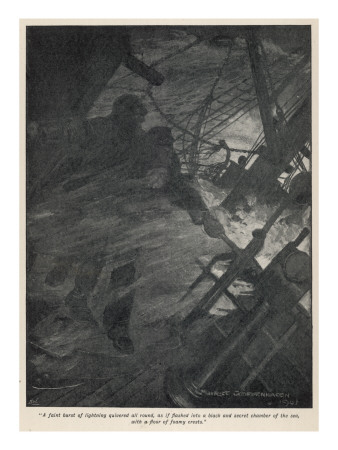
The steamer Nan Shan in the Storm

ostensible purpose of this review, Conrad’s Typhoon, it was the first full book I had read on my IPad, if a novella of 100 some odd pages can be thought of as a full book. And the verdict is that it was like reading…well…a book. The interface felt book like, I can adjust the light to the needs of my aging eyes, and can read more clearly than I could have managed by candlelight. I’ve always worried about the ability to personalize the texts, but iBooks lets me underline, and if anything I personalized the text more than I might have some others since my handwriting is unreadable and my notes in paperbooks cryptic and unintelligible. By contrast, the marginalia tool in iBooks is clean and my notes copious. Perhaps above all, I loved my iPad for remaining charged and working when everything else failed, leaving in the dark and to my own devices. Scary what I might find in that mirror. I read the entire book undistracted by facebook or my email apps, but I took comfort in knowing they were available for my distraction should I need them.

Now as to Typhoon itself. I want to say “Yes,” with qualifications. The story is gripping and intense, a naturalist drama of man against nature that becomes a kind of paean to stoic and pedestrian endurance, though one that is ironic and complicated in the end. The main human character is Captain MacWhirr, whose name betokens a machine-like efficiency. He is a man of small intellect, little imagination, and no intellectual curiosity. Because of this it is hard to describe him as actually courageous in the teeth of the hurricane. While a more imaginative man might have hidden his response to the terrors of the outrageous sea in cryptic understatement, MacWhirr is mostly just given to small emotion and small imagination.

Captain MacWhirr was trying to do up the top button of his oilskin coat with unwonted haste. The hurricane, with its power to madden the seas, to sink ships, to uproot trees, to overturn strong walls and dash the very birds of the air to the ground, had found this taciturn man in its path, and, doing its utmost, had managed to wring out a few words. Before the renewed wrath of winds swooped on his ship, Captain MacWhirr was moved to declare, in a tone of vexation, as it were: “I wouldn’t like to lose her.”

One doesn’t come away from this novel feeling grand and heroic and triumphant about human beings. On the other hand, one doesn’t come away feeling like human beings are small and accidental as you do, for instance in reading Stephen Crane’s “The Open Boat”. Instead endurance seems something to be achieved, and we end up happy for MacWhirr that he has achieved it, knowing we’d rather have him dull and unimaginative, but steady, were we caught in the writhing seas ourselves.

The story as a whole is gripping and seems to reveal something about both our human frailty and our strength and complexity, making it more than just a good adventure story. If I had read it first, I’m sure I would say that The Perfect Storm reminded me of it in being only partly a book about humans against the storm, and as much or more about humans against themselves.

One thing keeps me from a whole hearted endorsement. It really is the case that the depictions of Chinese in the book are deeply troubling. Passages in which Chinese are cast a jabbering animals or as writhing forces of nature are offensive and hard to find a way to redeem. I have always thought the criticism of Heart of Darkness was perhaps unearned since the thesis of that book had always seemed to me to be the evils of imperialism. But there is no redeeming theme that I can find for the representation of the Chinese coolies as brutes, and I found myself less inclined to defend Conrad, either here or for Heart of Darkness than I was before I began. To say this is not to say that the book is not worth reading, since there is no good human thing that is free of the scent of corruption, but it is to say that the goodness in the book does not overcome that corruption and reminds this reader at least that human beings are mixed creations, leaving us to admire and cringe in the same moment.

View all my reviews

The Devil’s Party

My continuing devotion to The New York Review of Books probably signifies nothing so much as my being an archaic throwback, born out of sync with my time. In a way, it seems to me that NYRB has become countercultural in part simply by just staying the same. The world has passed it by–who has time, after all, for a thought that requires an argument?–but in so doing I wonder whether we won’t long at last for just its kind of sober and articulate seriousness that tries to comprehend our troubles, tiring finally of the jokey popculturism of the web that seems mostly content to glide glibly along our surfaces, troubles merely another occasion for self display.

NYRB seems to revel in this archaic status, reprinting as it does forgotten masterpieces through its press and classic articles for it’s archives, apparently insisting pugnaciously that literature and thought really do remain news against the ephemera of what passes for the hot things of the moment.

Of course, it does this on the web now too, like everyone else. Most recently I picked up “A Modern Master by Paul de Man”  off the Facebook page that I have “liked.” A good “classic” essay on Borges, though as with a lot of deconstructionists it becomes impossible to know whether I am supposed to appreciate what de Man is saying or the prolix way in which he goes about saying it. And, of course, it’s sometimes hard to know with these guys whether I’m learning something about Borges or about Paul de Man reading Borges. De Man is primarily interested in the thesis that villainy becomes in some sense a poetic and aesthetic principle for Borges, one that he explores and unfolds throughout his career.

It is true that, especially in his earlier works, Borges writes about villains: The collection History of Infamy (Historia universal de la infamia, 1935) contains an engaging gallery of scoundrels. But Borges does not consider infamy primarily as a moral theme; the stories in now way suggest an indictment of society or of human nature or of destiny. Nor do they suggest the lighthearted view of Gide’s Nietzschean hero Lafcadio. Instead, infamy functions here as an aesthetic, formal principle. The fictions literally could not have taken shape but for the presence of villainy at their very heart. Many different worlds are conjured up—cotton plantations along the Mississippi, pirate-infested South seas, the Wild West, the slums of New York, Japanese courts, the Arabian desert, etc.—all of which would be shapeless without the ordering presence of a villain at the center.

A good illustration can be taken from the imaginary essays on literary subjects that Borges was writing at the same time as the History of Infamy. Borrowing the stylistic conventions of scholarly critical writing, the essays read like a combination of Empson, Paulhan, and PMLA, except that they are a great deal more succinct and devious. In an essay on the translations of The Thousand and One Nights, Borges quotes an impressive list of examples showing how translator after translator mercilessly cut, expanded, distorted, and falsified the original in order to make it conform to his own and his audience’s artistic and moral standards. The list, which amounts in fact to a full catalogue of human sins, culminates in the sterling character of Enna Littmann, whose 1923-1928 edition is scrupulously exact: “Incapable, like George Washington, of telling a lie, his work reveals nothing but German candor.” This translation is vastly inferior, in Borges’s eyes, to all others. It lacks the wealth of literary associations that allows the other, villainous translators to give their language depth, suggestiveness, ambiguity—in a word, style. The artist has to wear the mask of the villain or order to create a style.

So far, so good. All of us know that the poet is of the devil’s party and that sin makes for better stories than virtue. It takes some effort to prefer La nouvelle Héloise to Les liaisons dangereuses or, for that matter, to prefer the second part of the Nouvelle Héloise to the first. Borges’s theme of infamy could be just another form of fin-de-siècle aestheticism, a late gasp of romantic agony. Or, perhaps worse, he might be writing out of moral despair as an escape from the trappings of style. But such assumptions go against the grain of a writer whose commitment to style remains unshakable; whatever Borges’s existential anxieties may be, they have little in common with Sartre’s robustly prosaic view of literature, with the earnestness of Camus’s moralism, or with the weighty profundity of German existential thought. Rather, they are the consistent expansion of a purely poetic consciousness to its furthest limits.

The line “the poet is of the devil’s party” stood out to me, even though de Man’s “All of us know” sets it up sniffily as a throwaway line that demarcates the star-bellied sneeches from their know-nothing cousins. In part I think I seized on this line because it suddenly struck me that it really is the case that everyone I’ve know has mostly assumed that poet’s were of the devil’s party. It’s an issue I’ve thought about for a very long time, maybe for as long as I’ve engaged literature. As I wrote in my book, encountering literature has been, for me, always been fraught with the question of whether or not I was encountering the devil’s party in some metaphorical sense or another. From the time my parents forbid me to go to see The Great Gatsby with friends, or the year I was not allowed to read The Catcher in the Rye along with all my classmates. In some longer range and more significant way, this idea goes all the way back to Plato’s restriction of the poet from the Republic in the belief that poets served merely to inflame the passions, the devil’s party for the rationalist Greek. In my literary theory and other classes, I’ve often invoked the authority of Augustine’s notion of the felix peccatum, the happy fall, to suggest the notion that literature depends on the fact of fallenness, the fact of evil. If the poet is not of the devil’s party, he is at least secretly glad–along with all his readers–that the devil had his way if only for a moment.

An unsettling notion, that our pleasures, even our highest intellectual and aesthetic pleasures depend in some deep sense upon our and the world’s brokenness and violence. At the deepest level, I think this speaks to something unsettling about literature and art in general, something that goes beyond the question of offensiveness, and may go deeper than PLato’s concerns with the surface manifestations of inflamed aesthetic passions. Literature–perhaps other arts, but literature especially–unsettles because it depends so thoroughly and obviously and completely on brokenness and struggle and conflict and, yes, sometimes, violence as a condition of its existence. And it is most unsettling in that it makes takes these and makes them pleasurable, moving, beautiful. I think this is unsettling not on the simple level that we feel moralistically that literature shouldn’t do this, but the fact that it does do this has the force of revelation, showing us something about how we are built to experience the world. We exclude the poet from the city walls because by her fictions she shows us the fictions of our virtues.

As tiresome as I often find the deconstructionists–the tendency to find an infinity in a phrase often being nothing more than making a mountain our of a molehill–it still seems to me that this conundrum is something they troubled over endlessly and rightly.