Category Archives: literature

Teaching Humanities to digital natives who may know more than we do.

I remember a story about the advent of the New Criticism where one of those famous critic/scholar/teachers–I forget which one, but I want to say Cleanth Brooks or perhaps John Crowe Ransom–admitted to rushing home at night to read feverishly ahead in the texts he was teaching so that he was ready to go the following day.  On the one hand, this is a familiar story to any new (or not so new) professor who’s trying to stay one step ahead of the onrushing train.  On the other hand, its also the case that part of this was demanded by the fact that Brooks and others were trying to do something totally new for a literature classroom, the close perspicacious reading whose minutest detail nevertheless resulted miraculously in a coherent organic whole.  That kind of textual analysis was the meat of my own education, and to be honest, it hasn’t really changed all that much despite all the new (and now new old theories) that came in with the advent of deconstruction and its descendants.  We still, more or less, on the undergraduate level do the close reading, even if we now look for the way things fall apart or for hints and allegations of this or that cultural depravity.

But I am intrigued by just how hard Brooks/Ransom (or whomever it was) had to work to stay ahead of his students, in part because he really didn’t know entirely what he was doing.  He wasn’t building on the secure  corpus of knowledge that previous literary scholastics had received and passed on.  Despite the mythic and quasi-priestly status that some New Critics projected–turning the critic into an all-knowing seer, and thus setting the stage for the later assertions that critics were really the equals or superiors of the novelists and poets they read and critiqued, knowing what those poor souls could only allude to and  evoke–there was a very real sense in which the New Criticism was much more democratic than the literary scholasticism that preceded it.  (I am sure Frank Lentricchia is exploding about now, or would be if he ever actually would bother to read me).  While it may not have been more democratic in the sense that the New Critics seemed to cast a mysterious aura about all they did, developing a new and arcane ritual language to accompany it, it was more democratic in the sense that the method was potentially available to everyone.  Not everyone could have the time to read all the histories and all the letters and delve in to the archives and read the vast quantities of literature required for the literary scholasticism that characterized old style literary history .  But everyone could read the poem or the novel set in front of them.  And potentially a smart undergraduate could see a good deal that the prof had missed, or point out the problems in particular interpretations.  When the evidence of the poem was simply the poem itself, all the cards were on the table.  No longer could a professor say to the quivering undergraduate “Well, yes, but if you had bothered to read x,y, and z you would understand why your assertions about this poems place in literary history are totally asinine.”  The average undergraduate is never in a place to dispute with a professor on the place of this or that figure in literary history, but they could, in fact, argue that a professor had gotten a poem wrong, that an interpretation didn’t hold up to a closer scrutiny of the fact.  The feverish late night work of my Brooks/Ransom avatar, like the feverish late-night work of many a new and not so new professor, is sometimes cast as a noble inclination to truth or knowledge, or the discipline.  It is in truth, very often the quest to avoid embarrassment at the hands of our smarter undergraduates, the quest for just enough knowledge or just enough preparation to make sure we justify our authority in the eyes of our skeptical younger charges.

I was thinking about his again while attending the Re:Humanities undergraduate DH conference at Swarthmore/Bryn Mawr/Haverford Thursday and Friday. Clearly, one of the biggest challenges to bringing DH fully onboard in Humanities disciplines is the simple fact that undergraduates often know as much, and often know a great deal more, about the tools we are trying to employ.  On the one hand, this is a tremendous challenge to mid-career academics who understandably have little interest in abandoning the approaches to scholarship, teaching, and learning that they have developed, that they understand, and that they continue to use effectively given the assumptions and possibilities of those tools as they are.  It was ever thus and to some degree colleges remain always one step behind the students they are attempting to educate, figuring out on the fly how our own education and experience can possibly apply in this day and hour.

However, I also wonder whether the democratization of the technological environment in the classroom isn’t a newly permanent state of affairs.  The pace of technological change–at least for the present, and why would we assume that should stop in the near or mediate future–means that there is some sense in which we are entering an period in the history of education in which educators will, in some sense, never know any more about the possibilities of the tools they are using than do the students that they are teaching.  Indeed, given the nature of the tools, it is quite likely that collectively the students know a great deal more about how to use the tools available to them and that they are likely to be more attuned more quickly to the latest technological developments.  What they don’t know–and what we as educators don’t know either–is how to best deploy those resources to do different kinds of humanistic work.  The teleology of learning used to be fairly, if undemocratically, straightforward.  The basic educational goal was to learn how to do what your teacher could do–with reading, with texts, with research.  In our current age that teleology is completely, perhaps appropriately, disrupted.  But that doesn’t alleviate the sense that we don’t know entirely what we should be teaching our students to do when we don’t entirely know what to do or how to do it ourselves.

Mortimer Adler famously wrote a book on “How to Read a Book”  and though people bemoaned Adler as an elitist and a snob, the basic idea was still important.  Some people knew how to read books and others did not.  I still think its the case that we take a tremendous amount for granted if we assume an undergraduate actually knows how to read an old-fashioned codex well.  They don’t.  On the other hand, we have no equivalent book that tells us “how to read….”, in part because we don’t know how to fill in the blank, though perhaps “digital artifacts” comes as close as anything.  We’re not even sure what tools we should be using to do whatever it is we are doing as humanists in this day and age.  No wonder most professors choose to continue to use books, even though I think the day is fast approaching when students won’t tolerate that, anymore than an ancient would have tolerated the continued use of scrolls when a perfectly good codex was available at hand.  What the current technological changes are doing is radically democratizing the classroom on the level of the tool.

I did have a couple of signs of hope this past week at the Re:Humanities conference at Swarthmore. In the first place, if the educational system in the humanities is becoming radically democratized at the level of structure, I think it is safe to say there are many, many, many people using that democracy well.  The students at the conference were doings stunningly good and creative work that was clearly contributing to our knowledge of the world around us–sometimes pursuing these projects independently or, most often, in partnership with and in mentoring relationships with committed faculty.  (It is, of course, also the case that people can use democracy poorly, as I’ve suggested elsewhere;  this would be true in both the classroom and the body politic, so we should ask whether and where the democratization of our educational system is being used well, rather than assuming that because we use the word democracy we have named a substantive good).

Secondarily, one of the chief insights I drew from the different speakers was that if we put the tools on the table as possibilities, students will surprise and amaze us with what they can manage to come up with.  What if we found ways to encourage students to get beyond the research paper and asked that they do serious creative and critical work with the tools that they have everyday at hand on their iPhones, laptops, and etcetera.  What is we encouraged them to say we have to find the best way to answer the kind of questions humanists have always asked, and to identify the new questions and potential answers that new (and now not so new) technologies make possible.  We will have to do this regardless, I think.  The age demands it.  And I suspect that there will be many many more frantic late nights for faculty ahead.  But I think those frantic late nights will be built less and less on the belief that we have to get on top of “the material” and “stay ahead” of our students.  When they can bring in material we’ve never heard of with the touch of a finger on their iPhones, we have no hope of being on top of the material or staying ahead in a meaningful sense.  Perhaps what we can do is inspire them to charge ahead, guide them to the edges of the landscape that we already know, and partner with them in the exploration of the landscapes that we haven’t yet discovered.

What is the future of the book?–Anthony Grafton’s Keynote lecture at Messiah College

This past February we had the privilege of hearing from Dr. Anthony Grafton from Princeton University at our Humanities Symposium at Messiah College.  Grafton is a formidable scholar and intellect, and a generous soul, a too rare combination.  The following video is his keynote lecture for the Symposium.  Grafton’s instincts are conservative, readily admitting his undying love for the codex and its manifold cultural institutions (libraries, used bookstores, even Barnes and Nobles).  At the same time, he is under no illusions that the future of the book lies elsewhere.  His lecture looks at what is threatened, what should be valued and protected from the fast, but also what might be a potential for the future of the book, and what values we should bring to bear to shape the book, which is, after all, a human institution.

Many thanks to Derick Esch, my work study student, for his work in filming and producing this video.  Other videos from the symposium can be found at the same vimeo page.

Dr. Anthony Grafton: 2012 Humanities Symposium Keynote Address from Messiah Humanities on Vimeo.

Mark Sandel–The commodification of everything

I’ve enjoyed listening occasionally to Mark Sandel’s lectures in philosophy via iTunes.  He has an interesting new article in the April Atlantic focusing on the ways in which nearly everything in American life, at least, has been reduced to a market value.  Despite the admonition that money can’t buy me love, we are pretty sure that it can buy everything else, and that we are willing to sell just about anything, including body parts and personal dignity, for whatever the market will bear.

Sandel somewhat peculiarly to my mind traces this to a post-Cold War phenomenon.

WE LIVE IN A TIME when almost everything can be bought and sold. Over the past three decades, markets—and market values—have come to govern our lives as never before. We did not arrive at this condition through any deliberate choice. It is almost as if it came upon us.

As the Cold War ended, markets and market thinking enjoyed unrivaled prestige, and understandably so. No other mechanism for organizing the production and distribution of goods had proved as successful at generating affluence and prosperity. And yet even as growing numbers of countries around the world embraced market mechanisms in the operation of their economies, something else was happening. Market values were coming to play a greater and greater role in social life. Economics was becoming an imperial domain. Today, the logic of buying and selling no longer applies to material goods alone. It increasingly governs the whole of life.

The last gasp Marxists I studied with at Duke had a word for what Sandel sees and descries, commodification, and it didn’t mysterious just come upon us in the 1980s.  Commodification, the rendering of every bit of life as a commodity that can bought and sold, is the central thrust of capitalist economies in the 20th century, perhaps the central feature of capitalism per se.  The essential act of commodification is at the center of Marx’s understanding that the worker in some very real sense sells him or herself through selling his or her labor power.  Thus, human beings were commodified well before people became willing to sell tattoos on their foreheads to advertise products.  So Sandel’s perplexity and astonishment at this state of affairs in our contemporary economy strikes me as the perplexity of someone who has only recently awakened from a dream.

On the other hand, I do think Sandel is on to something.  It is the case that despite this thrust of capitalist economies (and, to be frank, I’m not sure that Marxist economies were all that different), there have been sectors of culture and their accompanying institutions that resisted their own commodification.  The edifice of modernism in the arts and literature is built on the notion that the arts could be a transcendent world apart from degradations of the social world, including perhaps especially its markets.  The difficulty and density of modern art and literature was built in part out of a desire that it not be marketable in any typical sense.  Modern art was sometimes ugly precisely to draw attention to the difficulty and difference of its aesthetic and intellectual properties.  It was meant not to sell, or at least not to sell too well.  Remember that the next time a Picasso sells for millions.  Similarly, the church and in a different way educational institutions retained a relative independence form the marketplace, or at least resisted the notion that they could be reduced to market forces.  Whether claiming to provide access to the sacred or to enduring human values, religious institutions and educational institutions served–even when they were corrupt or banal–to remind the culture that there was a world apart, something that called us to be better than ourselves, or at least reminded us that our present values were not all the values that there were.

Sandel rightly notes that that residue has all but disappeared, and the result has been an hollowing out of our public life, and a debasement of our humanity.

In hopes of avoiding sectarian strife, we often insist that citizens leave their moral and spiritual convictions behind when they enter the public square. But the reluctance to admit arguments about the good life into politics has had an unanticipated consequence. It has helped prepare the way for market triumphalism, and for the continuing hold of market reasoning.

In its own way, market reasoning also empties public life of moral argument. Part of the appeal of markets is that they don’t pass judgment on the preferences they satisfy. They don’t ask whether some ways of valuing goods are higher, or worthier, than others. If someone is willing to pay for sex, or a kidney, and a consenting adult is willing to sell, the only question the economist asks is “How much?” Markets don’t wag fingers. They don’t discriminate between worthy preferences and unworthy ones. Each party to a deal decides for him- or herself what value to place on the things being exchanged.

This nonjudgmental stance toward values lies at the heart of market reasoning, and explains much of its appeal. But our reluctance to engage in moral and spiritual argument, together with our embrace of markets, has exacted a heavy price: it has drained public discourse of moral and civic energy, and contributed to the technocratic, managerial politics afflicting many societies today.

Sandel wonders about a way to connect to some kind of moral discourse to inform public life, something that will reach beyond the reach of markets, but he clearly despairs that such a connection can be found.  I think there’s good reason.  Rapidly our educational institutions have become factories that shamelessly advertise themselves as places where people can make themselves in to better commodities than they were before, and which build programs designed to sell themselves to the highest number of student-customers possible.  Our religious institutions are floundering.  Only today I read in Time magazine that the rise of so-called “nones”–people who claim to have no religious affiliation–is one of the most notable developments in our spiritual culture.  Such people often seek to be spiritual but not religious on the grounds that religions are dogmatic and inflexible.  I have come to wonder whether that dogmatism and inflexibility points to the hard won truth that it is not good enough to just go along to get along.

One wonders, in fact, whether a spirituality based on getting along really provides a hard point of resistance to the tendency to see everything in life–whether my beliefs or my ethics–as an investment that must pay off if it is to be worth keeping.  I wonder, too, whether our educational systems and institutions are up to the task of providing an education that isn’t just another instance of the market.  As for art, writing, and literature.  Well, who knows?  Modernism was not always commodified, though it very quickly became  so.  I do find it intriguing that this point of hyper-commodification is also a time when there has been an explosion of free or relatively free writing and music on the internet.  There is a small return to the notion of the artist as a community voice, with musician and poets producing work for free on the internet, and making their living through performance or through other jobs–escaping or at least partially escaping the notion that we produce work primarily to sell it.  This is a small resistance, but worth thinking about.

I wonder if there are other ways our culture is equipped to resist in a larger collective fashion, the turning of our lives in to the image of a can of soup?

Living in an e-plus world: Students now prefer digital texts when given a choice

A recent blog by Nick DeSantis in the Chronicle points to a survey by the Pearson Foundation that suggests Tablet ownership is on the rise.  That’s not surprising, but more significant is the fact that among tablet users there’s a clear preference for digital texts over the traditional paper codex, something we haven’t seen before even among college students of this wired generation:

One-fourth of the college students surveyed said they owned a tablet, compared with just 7 percent last year. Sixty-three percent of college students believe tablets will replace textbooks in the next five years—a 15 percent increase over last year’s survey. More than a third said they intended to buy a tablet sometime in the next six months.

This year’s poll also found that the respondents preferred digital books over printed ones. It’s a reversal of last year’s results and goes against findings of other recent studies, which concluded that students tend to choose printed textbooks. The new survey found that nearly six in 10 students preferred digital books when reading for class, compared with one-third who said they preferred printed textbooks.

I find this unsurprising as it matches up pretty well with my own experience.  5 years ago I could never imagine doing any significant reading on a tablet.  Now I do all my reading of scholarly journals and long form journalism–i.e The Atlantic, the New York Review of Books, The Chronicle Review–on my iPad.  And while I still tend to prefer the codex for the reading of novels and other book length works, the truth is that preference is slowly eroding as well.  As I become more familiar with the forms of e-reading, the notions of its inherent inferiority, like the notions of any unreflective prejudice, gradually fade in the face of familiarity.

And yet I greet the news of this survey with a certain level of panic, not panic that it should happen at all, but panic that the pace of change is quickening and we are hardly prepared, by we I mean we in the humanities here in small colleges and elsewhere.  I’ve blogged on more than one occasion about my doubts about e-books and yet my sense of their inevitable ascendancy.  For instance here on the question of whether e-books are being foisted on students by a cabal of publishers and administrators like myself out to save a buck (or make a buck as the case may be), and here on the nostalgic but still real feeling that I have that print codex forms of books have an irreplaceable individuality and physicality that the mere presence of text in a myriad of e-forms does not suffice to replace.

But though I’ve felt the ascendancy of e-books was inevitable, I think I imagined a 15 or 20 year time span in which print and e-books would mostly live side by side.  Our own librarians here at Messiah College talk about a “print-plus” model for libraries, as if e-book will remain primarily an add on for some time to come.  I wonder.  Just as computing power increases exponentially, it seems to me that the half-life of print books is rapidly diminishing.  I now wonder whether we will have five years before students will expect their books to be in print–all their books, not just their hefty tomes for CHEM 101 that can be more nicely illustrated with iBook Author–but also their books for English and History classes as well.  This is an “e-plus”  world  where print will increasingly not be the norm, but the supplement to fill whatever gaps e-books have not yet bridged, whatever textual landscapes have not yet been digitized.

Despite warnings, we aren’t yet ready for an e-plus world.  Not only do we not know how to operate the apps that make these books available, we don’t even know how to critically study books in tablet form.  Yet learning what forms of critical engagement are possible and necessary will be required.  I suspect, frankly, that our current methods developed out of a what was made possible by the forms that texts took, rather than forms following our methodological urgencies.  This means that the look of critical study in the classroom will change radically in the next ten years.  What will it look like?

Tonguecat by Peter Verhelst

TonguecatTonguecat by Peter Verhelst

My rating: 3 of 5 stars

I admire this book more than I like it. That is, I understand that Verhelst is pulling off a kind of writerly virtuosity and I applaud appropriately. But I feel about it like I feel about a good bit of contemporary music that appeals to the musical theorist rather than the musical ear. It’s possible to feel intellectually compelled, but viscerally unmoved; that’s kind of where I end up with Verhelst and his cast of characters. The book recounts fantastical and horrific events in the aftermath of the apocalyptic end of an empire, but the books surfaces are icy, a little like the frigid ice age that descends on the countryside as a major event of the novel. The characters are frozen and statuesque, a little like the frozen corpses that litter the landscape. They remain untouchable, and so untouched and untouching. As a result, Verhlest’s story works like an allegory, but one from which I remain mostly removed and uncaring. I’m not sorry I read the book, but why go back. Given that the book is at least in part about terror, terrorism, empire, and totalitarianism, I’m not sure this is a great way to feel

View all my reviews

The United States–Land of the Second Language Illiterates

Approximately 80% of American citizens are monolingual, and the largest part of the rest are immigrants and their children. This statistic from Russell Berman, outgoing President of the MLA, in his valedictory message to the MLA convention in Seattle this past January. Berman’s address is a rousing and also practical defense of the humanities in general, and especially of the role of second language learning in developing a society fully capable of engaging the global culture within which it is situated. From his address:

Let us remember the context. According to the National Foreign Language Center, some 80% of the US population is monolingual. Immigrant populations and heritage speakers probably make up the bulk of the rest. Americans are becoming a nation of second-language illiterates, thanks largely to the mismanagement of our educational system from the Department of Education on down. In the European Union, 50% of the population older than 15 reports being able to carry on a conversation in a non-native language, and the EU has set a goal of two non-native languages for all its citizens.

Second language learning enhances first language understanding: many adults can recall how high school Spanish, French, or German—still the three main languages offered—helped them gain a perspective on English—not only in terms of grammar but also through insights into the complex shift in semantic values across cultural borders. For this reason, we in the MLA should rally around a unified language learning agenda: teachers of English and teachers of other languages alike teach the same students, and we should align our pedagogies to contribute cooperatively to holistic student learning. We are all language teachers. For this reason, I call on English departments to place greater importance on second language knowledge, perhaps most optimally in expectations for incoming graduate students. Literature in English develops nowhere in an English-only environment; writing in any language always takes place in a dialectic with others. With that in mind, I want to express my gratitude to the American Studies Association for recently adopting a statement supportive of the MLA’s advocacy for language learning.

Berman goes on to recognize, however, that this strong and reasonable call for educated people to be conversant in more than one language is largely sent echoless in to the void. Less than .1% of the discretionary budget of the Department of Education goes to support Language learning. Indeed, I suspect this is because so many of us, even in higher education, are dysfunctional in a second language. I often tell people grimly that I can ask how to go to the bathroom in four different languages.

Nevertheless, in an age where we call for global engagement and in which we imagine the importance of preparedness for a global marketplace and want our students to be citizens of the world, it is irresponsible to continue to imagine that world will conveniently learn to speak English for our sakes.


Borders fantasies

Book lovers have always turned a blind eye to the god Mammon, remembering only with regret the fact that the house they live in with their truest love was bought and paid for by the leering uncle down the street. Jonathan Gourlay took up that ill-begotten relationship in a nice personal essay on the demise of Borders. For Gourlay, Borders was an opportunity missed whose demise was figured long ago in it’s decision to skip a flirtation with the labor movement and bend the knee to a corporatist ethos.

“For Borders, which first opened in 1971, the end began when it was sold to K-Mart in 1992. By the time I got there, three years later, only a few of the stalwart Borders believers remained to try to change the store from within. Within a few months of my arrival, Neil gave up and retired to play in his band, The Human Rays. I don’t know if the band was real or Neil just thought it was amusing to retire and join The Human Rays. His friendly management style didn’t jibe with the new owners.

“Neil’s replacement was a guy named Doug. Doug had the personality of a pair of brown corduroy pants. We all hated Doug. We hated him because he was not Neil. Underneath that hatred was a hatred of what Doug represented: corporate masters and the loss of our own identity. With Neil we labored under the impression that we were cool. Under Doug we just labored.

This romantic vision may have a grain of truth.  But it’s worth remembering that scrolls and codexes(codices?) required immense amounts of money–and so wealthy patrons who had to be appeased–to produce. And at some level when you come down to it a book is a commodity as surely as a coke can. So we like to imagine ourselves as counter cultural in our love of texts, but that romantic ethos is purchased at a price like everything else.

The promise of the Internet is in part the idea of thinking and writing and reading without the necessary intervention of the dollar bill. But is that too just a romantic fancy?

Conrad’s Typhoon: or, An Ode to My iPad

Joseph Conrad

Typhoon by Conrad, Joseph

My rating: 4 of 5 stars

Conrad’s Typhoon: or, An Ode to My iPad

I think one reason I don’t write and publish more than I do is because I am far too slow on the trigger. The ubiquity of blogging hasn’t helped this any since I usually find that someone else much more intelligent and articulate than I has blogged on what I think of as MY SUBJECT in a manner far more perspicacious, acute and interesting than I could manage. Take Charles Simic’s meditation on boredom during the recent power outages along the east coast, blogged over at the NYRB. I had several of those, Yes-that-is-exactly-what-was-on-the-tip-of-my-tongue moments reading lines like these:

“We sit with our heads bowed as if trying to summon spirits, while in truth struggling to see what’s on our dinner plates. Being temporarily unable to use the technology we’ve grown dependent on to inform ourselves about the rest of the world, communicate with others, and pass the time, is a reminder of our alarming dependence on them.”

Of course, these words weren’t actually on the tip of my tongue, but by imagining that the poet is only telling us what we have always known but could not say so well, we are able to give ourselves credit for a lot of intelligence and imagination that we don’t actually possess. Simic goes on to talk about the notable demise of reading and other delights like radio in the fact of our ubiquitous gadgets. Now, of course, reading books on a rainy afternoon or listening to a radio show has the faint reek of quaintness when we can’t manage to champion with a straight face these distractions as relics of authenticity. Simic reminds us that reading too was a form of distraction as surely as an i-phone.

“All of this reminded me of the days of my youth when my family, like so many others, lived in a monastic solitude when the weather was bad, since we had no television. It wasn’t in church, but on dark autumn days and winter nights that I had an inkling of what they meant when they spoke about eternity. Everyone read in order to escape boredom. I had friends so addicted to books, their parents were convinced they were going crazy with so many strange stories and ideas running like fever through their brains, not to mention becoming hard of hearing, after failing to perform the simplest household chores like letting the cat out.

“Living in a quiet neighborhood made it even worse. Old people stared out of windows at all hours, when they were not staring at the walls. There were radios, but their delights—with the exception of a few programs—were reserved for the grownups only. Thousands died of ennui in such homes. Others joined the navy, got married, or moved to California. Even so, looking back now, I realize how much I owe to my boredom. Drowning in it, I came face to face with myself as if in a mirror.”

Be that as it may, I lived out this boredom during the last hurricane by taking up Conrad’s Typhoon, the Project Gutenberg version, on the recommendation I received via my facebook friending of the New Yorker Magazine. (Let’s be frank, folks.  Oprah’s book club is absolutely yesterday).  Too dark to read, yes, but unlike the youthful Simic I had one gadget in hand that bore its own light to me in hand, my trusty iPad, fully charged and functioning.

When I began blogging three years ago at Read, Write, Now (a title I have come to detest, so future bloggers choose carefully), I had a suspicious and doubtful mindset about e-books, e-readers, and many things e-in-general. To be sure, I saw the advantages of blogging as a means of immediate intellectual self-gratification, and even then I think I felt that a great deal of writing and reading, especially in the academic world, would migrate effectively online. But I could not imagine, then, that an electronic gadget could take the place of paper. I wrote about the fact that I freely took my paper books in to saunas and bathtubs, that I could find my way through paper books more quickly and simply than with a scrolling sidebar, that I didn’t have to worry about whether it was sunny outside. And the smell, the smell, the smell. E-books were sterile, it seemed to me. In a word inauthentic.

I may still believe some of this, but I believe it less than I used to, largely due to my i-Pad. To come back to the

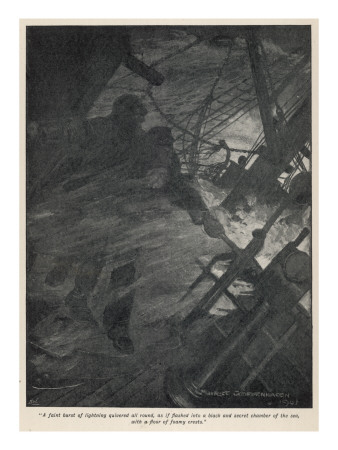
The steamer Nan Shan in the Storm

ostensible purpose of this review, Conrad’s Typhoon, it was the first full book I had read on my IPad, if a novella of 100 some odd pages can be thought of as a full book. And the verdict is that it was like reading…well…a book. The interface felt book like, I can adjust the light to the needs of my aging eyes, and can read more clearly than I could have managed by candlelight. I’ve always worried about the ability to personalize the texts, but iBooks lets me underline, and if anything I personalized the text more than I might have some others since my handwriting is unreadable and my notes in paperbooks cryptic and unintelligible. By contrast, the marginalia tool in iBooks is clean and my notes copious. Perhaps above all, I loved my iPad for remaining charged and working when everything else failed, leaving in the dark and to my own devices. Scary what I might find in that mirror. I read the entire book undistracted by facebook or my email apps, but I took comfort in knowing they were available for my distraction should I need them.

Now as to Typhoon itself. I want to say “Yes,” with qualifications. The story is gripping and intense, a naturalist drama of man against nature that becomes a kind of paean to stoic and pedestrian endurance, though one that is ironic and complicated in the end. The main human character is Captain MacWhirr, whose name betokens a machine-like efficiency. He is a man of small intellect, little imagination, and no intellectual curiosity. Because of this it is hard to describe him as actually courageous in the teeth of the hurricane. While a more imaginative man might have hidden his response to the terrors of the outrageous sea in cryptic understatement, MacWhirr is mostly just given to small emotion and small imagination.

Captain MacWhirr was trying to do up the top button of his oilskin coat with unwonted haste. The hurricane, with its power to madden the seas, to sink ships, to uproot trees, to overturn strong walls and dash the very birds of the air to the ground, had found this taciturn man in its path, and, doing its utmost, had managed to wring out a few words. Before the renewed wrath of winds swooped on his ship, Captain MacWhirr was moved to declare, in a tone of vexation, as it were: “I wouldn’t like to lose her.”

One doesn’t come away from this novel feeling grand and heroic and triumphant about human beings. On the other hand, one doesn’t come away feeling like human beings are small and accidental as you do, for instance in reading Stephen Crane’s “The Open Boat”. Instead endurance seems something to be achieved, and we end up happy for MacWhirr that he has achieved it, knowing we’d rather have him dull and unimaginative, but steady, were we caught in the writhing seas ourselves.

The story as a whole is gripping and seems to reveal something about both our human frailty and our strength and complexity, making it more than just a good adventure story. If I had read it first, I’m sure I would say that The Perfect Storm reminded me of it in being only partly a book about humans against the storm, and as much or more about humans against themselves.

One thing keeps me from a whole hearted endorsement. It really is the case that the depictions of Chinese in the book are deeply troubling. Passages in which Chinese are cast a jabbering animals or as writhing forces of nature are offensive and hard to find a way to redeem. I have always thought the criticism of Heart of Darkness was perhaps unearned since the thesis of that book had always seemed to me to be the evils of imperialism. But there is no redeeming theme that I can find for the representation of the Chinese coolies as brutes, and I found myself less inclined to defend Conrad, either here or for Heart of Darkness than I was before I began. To say this is not to say that the book is not worth reading, since there is no good human thing that is free of the scent of corruption, but it is to say that the goodness in the book does not overcome that corruption and reminds this reader at least that human beings are mixed creations, leaving us to admire and cringe in the same moment.

View all my reviews

Miscellany: More Librivox, More Emerson, More Diarrhea

Ok, to get to Diarrhea, you have to read to the end of this post.


MORE LIBRIVOX

I got some very good comments from “Hugh” who is a poobah of some sort over at Librivox. You should go read his comments yourself at my post, “Listening as Reading,” but a couple of excerpts here since I want to think about what he has to say. (And, hey, it’s a cheap way to come up with a post when it’s late at night and I’m having trouble collecting my thoughts.

Says Hugh:

“in pre-radio/tv/recordings days, and when books were relatively expensive, many books were actually written to be read aloud – it was a form of family entertainment: the family & friends gathered around papa (or mama) who read at the fireplace. dickens is a particular example. of course an mp3 audio version read by a stranger isn’t the same thing, but it is another experience of literature, one that has it’s own particular richness, and weakness.”

Yes, a good thing to point out, continuous with my general observation that for the longest part of human history reading was primarily about reading aloud, not reading silently. I’m not quite sure I would go completely down the road that books in the nineteenth century were written to be read out loud. This misconstrues the case. But it is the case that they were commonly read out loud, and there was a great deal of fluidity between the oral presentation and the written. Dickens is a good representative of this fluidity. I’m not quite sure I would say Dicken’s wrote his books in order to read them out loud. He wrote them in order to get them published serially in magazines. But it is absolutely true that he often rewrote and rewrote passages over and over in order to achieve certain kinds of emotional effects in his listening audience. Thus there’s a deep connection between the orality of the word and the writtenness of the word. A fluid interchange of sorts. I still tell students they ought to read their work outloud to themselves in order to hear how things sound. This can be a good guide to the kind of rhetorical affects you are achieving.

Says Hugh again:

“-we are primarily a platform to help people record audiobooks (with an objective of making a complete audio library of public domain books); that the public can download and listen to our files is in a way just a fortunate by-product of what we do.

-and while our collection’s “quality” is, by design, all over the map, the volume of good and extraordinary recordings is daunting…it’s a matter of finding the good stuff. Here are some recommendations:

http://ask.metafilter.com/79067/Librivox-Recommendation”

This last is very helpful, though I wish the list was more organized. I clicked through some of the recommended readings and–on the basis of very short sampling–most of them are superior to some of the detritus I’ve waded through the past few times I’ve strolled through Librivox. I wish that Librivox would provide some kind of ratings system itself–at least one that recognized the popularity of different readings–though I suspect that this would counter the dream of pure democratic participationism that drives this kind of thing on the web.

As for Librivox being primarily about the readers and not the listeners, something Hugh tells me in a second comment, I’m not so sure. (I think Hugh didn’t think it was fair of me to criticize many of the readers for being…well…Dull. Or annoying. Or both). To some degree I think he’s suggesting that Librivox is really more like a blog service where readers can express themselves via recording. Well, OK. But the thrill of doing so is that people will listen in, yes? I mean, if it wasn’t for the fact that people might actually look at this blog, why not just keep it on my computer instead of publishing it for all the world to sneer at.

It’s also the case that in reading a published work, the reader puts himself/herself in the position of performer/artist who is interpreting the work of another artist. There are a lot of opera singers out there who really ought to spare the rest of us and restrict their renditions of Nessun Dorma to the safety of their shower stalls. On the other hand, I don’t begrudge them the right to perform for the world on YouTube. But if they do, I generally think we’ve got a right and responsibility to Puccini and to Pavorotti to say, “You know, that really stinks pretty badly.” There’s no inherent nobility in performing, contrary to what most Americans seem to think.

But enough. Mostly I’m on Hugh’s side here. I’m glad someone’s doing something like Librivox, even if I don’t want to listen to most of the people doing it.


MORE EMERSON:

I blogged a bit about Emerson today on the blog dedicated to my course on literary theory. Just a bit of that from a post I called “Emerson and the Gods of Reading”:

Along these lines, I think there’s a way in which Emerson’s notions of creative reading are embodied in the way we read now. For Emerson, reading was a threatening activity precisely because we were always tending toward submission and passivity, always on the brink of substituting someone else’s creativity or knowledge for our own. This would mean we had failed to be “The Poet” we were meant to be and in fact are if we would only realize it. Instead, reading only exists to a purpose if it inspires us to more writing of our own. Reading must always give forth in to new and different expression, or it is worthless. Reading that absorbs and doesn’t give forth in new creativity, reading that doesn’t come to an end in writing is destructive to rather than an enhancement of our humanity.

What is this if not the reading ethic of blogging. Emerson, the familiar spirit of Facebook culture. Reading for us now is only meaningful if it gives forth in self expression. Indeed, texts become primarily a means of further self-expression. I read other texts or find other materials on the internet in order to “blog” them. The verb in this sense means partly to write about them, but blogging something also connotes making it one’s own, making it an opportunity for self-expression, an opportunity to speak.

I don’t think I want to deride this outright. NPR had someone–maybe the founder of Facebook-?!-on today with a little piece on the glories of connectivity available through self-exposure. It seemed a little facile–by exposing my darkest secrets on the net I’ll be able to develop authentic relationships with people I’ve never met. Umm, maybe. If this were true, why not go expose yourself to your next door neighbor. Still, it is the case that kinds of connections are built through this incessant speaking. Ultimately, for Emerson, our seeking expression at the expense of reading was not a form of self-aggrandizement, though it’s often taken for that. It was ultimately a way of connecting to a broader world. In Emerson’s view, if all people would become The Poet they were meant to be, all the world would be saved and we would all be one. It’s ultimately a platonic evangelical Christian vision without Christ in some sense. If we’ll all individually get right with Jesus, we’ll all be one. The internet says something vaguely similar. If we would all just keep looking for ways of expressing ourselves through the texts of others, we will all be connected through what is, after all, the World Wide Web.

I have no idea if this makes any sense, but it seemed profound at the time. Parents are paying for this stuff. It better be.


MORE DIARRHEA

Ok, this doesn’t refer to the stinky liquid spew that this post is fast becoming. Or not only that.

I often tell my English students that there is a magazine about everything, so they can take their writing skills and find a job anywhere in the world. The last part is a department chair’s fantasy, but there really is a journal about everything in the world.

Witness “Dialogue On Diarrhea.” Yes, there is a journal covering everything you wanted to know about loose stools. Ok, I should say there used to be a journal. In the words of the web site:

Dialogue on Diarrhoea was an international newsletter on the control of diarrhoeal diseases published by Healthlink Worldwide (formerly AHRTAG), a UK-based non-governmental organisation.

The first issue was published in May 1980.The last of a total of 60 issues, during its 15 years, was published in May 1995.

Published four times a year, Dialogue on Diarrhoea offered clear, practical advice on preventing and treating diarrhoeal diseases. It also acted as a forum for readers to exchange ideas and share experiences.

Umm, just what kind of experiences are we sharing here exactly?

Anyway, the print newsletter is no more. And now instead we have “Dialogue On Diarrhea Online”. So the next time you have this problem, you’ll know where to head. Besides the bathroom. I mean.

And, as we think of it, doesn’t this point to the last important remaining geography in which print remains triumphant. Bathroom reading. It’s a bit tragic that the diarrheatics among us will now have to carry their Kindles to the bathroom in order to keep up on the latest and share their experiences. On the other hand, with laptop in hand they will now be able to share their experiences in a much more intimate and immediate way.

Ok, I’ll stop. I’m sure I’ve now insulted all the chronic diarrhea sufferers who regularly read this blog. And none of my students will ever get an internship with this website. That’s for sure.

Final note: I thought for sure I would be the only person on WordPress who used the word “diarrhea” in a tag. No. There are hundreds of us.

Isn’t the web a wonderful place?

Books in a material world–Bookporn and more

I was talking to a couple of students yesterday, one of whom wants to be a librarian because she loves “being around books.” A little bit of a Scrooge, I guess, I told her she better get used to being around computers since that was the real future of libraries, taking her back a bit with my revelation that the library budget at our own college had just been required to move $50,000 from book purchasing to database collections. Small change for a lot of places, but for my smallish college $50,000 is nothing to sneeze at. Indeed, I’ve already felt the squeeze just a bit since English used to depend on the general fund of the library to order contemporary novels and poetry–which we ordered gleefully and at will. Probably partly on the erroneous assumption that availability would somehow translate into their being taken off the shelf. Well, that fund hasn’t disappeared, but we’ve been asked to order not quite so gleefully, and not quite so at will. A concrete manifestation of how a response to a perceived technological need–real or not–will gradually determine or close the future of the book as we’ve known it.

Still, my student was not dissuaded. She feels that books will always be with us because we love their physicality. There’s that body of the book theme again, and there’s something real about it that has to be thought through. Reading is not simply a mental process of decoding letters, not simply a process of getting information off a page or screen and in to our brains. It’s a physical activity to which we attach all kinds of cultural and personal meanings, a kind of spiritual reverence that the attach to the being of books that we cannot yet attach to computers.

We imagine computers too much as tools, and emphasizing their efficiency does too little to address the tactile, even the olfactory meanings that we attach to book culture. The other student who was with us was very intrigued by Amazon’s Kindle, but even she paused and said, “I became an English major when I looked out from the balcony and saw the stacks and stacks of books.” The physicality of books inspires a reverence, whereas the efficiency of computers inspires…what?…a sense of efficiency?

Indeed, I’m intrigued by the growing tendency of laptop users to try and personalize their laptops–recreating their essential impersonality through a kind of personal graffiti. There’s a great newstory on this phenomenon at c/net, along with Personalized laptop.  One of my favorites. 

We do this with books, it seems to me, but not in the same way. We don’t feel compelled to personalize the cover of a book, and our markings in a text are more to memorialize a reading experience than to carve a human personality into what is, after all, a machine. Books are a technology, but at the least we have learned to experience them as extensions of the body rather than as tools.

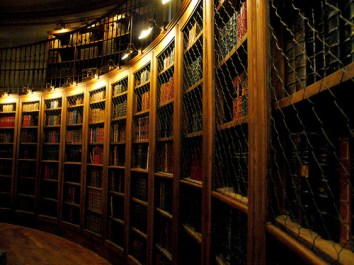
Along these lines, I’ve been running in to a lot of images of books again. Rachel Leow over at A Historian’s Craft celebrates the one year anniversary of her blog with BookPorn #27, a couple of fabulous images of the Library of the Musee Guimet. Says Rachel:Library Musee Guimet

“There’s a kind of hushed atmosphere when you walk in: the lights are dim and people shuffle about, struck silent with reverence, or perhaps the disconcerting, all-pervading pinkness of the walls and columns. The books lie, untouchable, behind their wire cages, and the smell of old paper lingers about well after you step, blinking, back out into the fluorescent glare of the exhibition outside.”

Nice writing, Rachel. And happy birthday. It seems to me that Rachel gets at this notion of the importance of the physicality of books inspiring a kind of reverence, something I attach even to my tattered paperback crowded onto basement shelves, but which I don’t really attach to my computer. Like nearly everyone else, I’m sure I spend a great deal more time on my computer reading anymore than I do in actually reading books. Like most white collar workers I’m chained here all day, and then blog all night. But feeling reverence for my computer feels a little bit like feeling reverence for my screwdriver. Not impossible, I guess. I’m sure many a carpenter has a deep feeling for his screwdriver. But I also guess that mostly such carpenters are considered weird by everyone else.

Books are tools, but it’s a mistake to think that what counts in reading them is the toolishness. If we only focus on the instrumental qualities associated with text delivery, there is no question that the e-book-o-philes among us are right to scoff at fears of digital libraries. Still, culture is more than instrumental, and always has been.

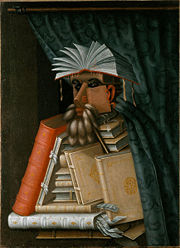
Along these lines, there’s a humorous and very interesting Giuseppe Acrimboldo Librarianskewering of those of us who are book fetishists over at if:book. Chris Mead has written a song about the history of books along with a lot of great images. My favorite is this from Giuseppe Acrimboldo, “The Librarian.” I love it. The human is text, no a book, a library. What I’ve always thought anyway. I am my books. I don’t yet say, I am my computer. Will I ever.

Chris takes the opportunity to skewer the-sky-is-falling attitude that some of us bring to the changes that are going on

“words: written in silence, muttered in monasteries
have been sung, shouted, acted – now by digital industries

broadcast and mixed for our burgeoning multiculture,

but circled by many a gloom-laden vulture

crying “R.I.P. books: doomed to extinction
by some blinking e-inky, i-evil invention”.
The word spreads and
changes; that’s my belief.
What next for the book?
The future lies overleaf.

Very nice. Dr. Seussian. Ok, only almost. Still, Chris’s poem/song emphasizes an assumption that I think is flatly wrong. That the technology of reading is essentially inconsequential for the act of reading itself. This is clear explicitly in the opening part of his poem.

“Books are what a society carries its words in
and words have been written on stone, silk, slate, parchment,
wax, clay, screen and skin,”

This is superficially true, but the assumption seems to be that reading is only about decoding letters, and books–or parchments or scrolls or screens–are merely delivery systems that are more or less equal except in the efficiency with which they can deliver text to readers. This is flatly false, as any historian of books and reading could point out in half a breath. In some sense, when we went from reading scrolls to reading codexes and then books, the changing technology changed the meaning of the act of reading, not just the techniques of the act of reading. It is this changing meaning that is crucial to try and understand. Techniques of text delivery can merely be learned through users manuals. Meanings and their attendant ways of being human are less easily learned and unlearned. We ought to pay attention to what those changes might be.

Final note: I’m sure everyone’s familiar with this video, but it still makes me smile. It’s a reminder that all of the cultural associations we have with books had to be learned. There’s nothing natural about our sentimental attachments to books. As kids, we’re all in the position of the monk at a loss here, not knowing which way a book sets on the table, which way to turn the pages. Culture is learned. That doesn’t mean the demise of books should be sniffed at. But culture is learned.