Category Archives: Reading

Create or Die: Humanities and the Boardroom

A couple of years ago when poet and former head of the NEA, Dana Gioia, came to Messiah College to speak to our faculty and the honors program, I asked him if he felt there were connections between his work as a poet and his other careers as a high-level government administrator and business executive.  Gioia hemmed and hawed a bit, but finally said no;  he thought he was probably working out of two different sides of his brain.

I admit to thinking the answer was a little uncreative for so creative  a person.  I’ve always been a bit bemused by and interested in the various connections that I make between the different parts of myself.  Although I’m not a major poet like Gioia, I did complete an MFA and continue to think of myself in one way or another as a writer, regardless of what job I happen to be doing at the time.  And I actually think working on an MFA for those two years back in Montana has had a positive effect on my life as an academic and my life as an administrator.  Some day I plan to write an essay on the specifics, but it is partially related to the notion that my MFA did something to cultivate my creativity, to use the title of a very good article in the Chronicle review by Steven Tepper and George Kuh.  According to Tepper and Kuh,

To fuel the 21st-century economic engine and sustain democratic values, we must unleash and nurture the creative impulse that exists within every one of us, or so say experts like Richard Florida, Ken Robinson, Daniel Pink, Keith Sawyer, and Tom Friedman. Indeed, just as the advantages the United States enjoyed in the past were based in large part on scientific and engineering advances, today it is cognitive flexibility, inventiveness, design thinking, and nonroutine approaches to messy problems that are essential to adapt to rapidly changing and unpredictable global forces; to create new markets; to take risks and start new enterprises; and to produce compelling forms of media, entertainment, and design.

Tepper and Kuh , a sociologist and professor education respectively, argue forcefully that creativity is not doled out by the forces of divine or genetic fate, but something that can be learned through hard work.  An idea supported by recent findings that what musical and other artistic prodigies share is not so much genetic markers as practice, according to Malcolm Gladwell 10,000 hours of it.  Tepper and Kuh believe the kinds of practice and discipline necessary for cultivating a creative mindset are deeply present in the arts, but only marginally present in many other popular disciplines on campus.

Granted, other fields, like science and engineering, can nurture creativity. That is one reason collaborations among artists, scientists, and engineers spark the powerful breakthroughs described by the Harvard professor David Edwards (author of Artscience, Harvard University Press, 2008); Xerox’s former chief scientist, John Seely Brown; and the physiologist Robert Root-Bernstein. It is also the case that not all arts schools fully embrace the creative process. In fact, some are so focused on teaching mastery and artistic conventions that they are far from hotbeds of creativity. Even so, the arts might have a special claim to nurturing creativity.

A recent national study conducted by the Curb Center at Vanderbilt University, with Teagle Foundation support, found that arts majors integrate and use core creative abilities more often and more consistently than do students in almost all other fields of study. For example, 53 percent of arts majors say that ambiguity is a routine part of their coursework, as assignments can be taken in multiple directions. Only 9 percent of biology majors say that, 13 percent of economics and business majors, 10 percent of engineering majors, and 7 percent of physical-science majors. Four-fifths of artists say that expressing creativity is typically required in their courses, compared with only 3 percent of biology majors, 16 percent of economics and business majors, 13 percent of engineers, and 10 percent of physical-science majors. And arts majors show comparative advantages over other majors on additional creativity skills—reporting that they are much more likely to have to make connections across different courses and reading; more likely to deploy their curiosity and imagination; more likely to say their coursework provides multiple ways of looking at a problem; and more likely to say that courses require risk taking.

Tepper and Kuh focus on the arts for their own purposes, and I realized that in thinking about the ways that an MFA had helped me I was thinking about an arts discipline in many respects.  However, the fact that the humanities is nowhere in their article set me to thinking.  How do the humanities stack up in cultivating creativity, and is this a selling point for parents and prospective students to consider as they imagine what their kids should study in college.  These are my reflections on the seven major “creative” qualities that Kepper and Kuh believe we should cultivate, and how the humanities might do in each of them.

  1. the ability to approach problems in nonroutine ways using analogy and metaphor;
    • I think the humanities excel in this area for a variety of reasons.  For some disciplines like English and Modern Languages, we focus on the way language works with analogy and metaphor and we encourage its effective use in writing.  But more than that, I think many humanities disciplines can encourage nonroutine ways of approaching problems—though, of course, many professors in any discipline can be devoted to doing the same old things the same old way.
  2. conditional or abductive reasoning (posing “what if” propositions and reframing problems);
    • Again, I think a lot of our humanities disciplines approach things in this fashion.  To some degree this is because of a focus on narrative.  One way of getting at how narrative works and understanding the meaning of a narrative at hand is to pose alternative scenarios.  What if we had not dropped the bomb on Japan?  What if Lincoln had not been shot?  How would different philosophical assumptions lead to different outcomes to an ethical problem.
  3. keen observation and the ability to see new and unexpected patterns;
    • I think we especially excel in this area.  Most humanities disciplines are deeply devoted to close and careful readings that discover patterns that are beneath the surface.  The patterns of imagery in a poem, the connections between statecraft and everyday life, the relationship between dialogue and music in a film.  And so forth.  Recognizing patterns in problems can lead to novel and inventive solutions.
  4. the ability to risk failure by taking initiative in the face of ambiguity and uncertainty;
    • I’m not sure if the humanities put a premium on this inherently or not.  I know a lot of professors (or at least I as a professor) prefer their students take a risk in doing something different on a project and have it not quite work than to do the predictable thing.  But I don’t know that this is something inherent to our discipline.  I do think, however, that our disciplines inculcate a high level of comfort with uncertainty and ambiguity.  Readings of novels or the complexities of history require us to not go for easy solutions but to recognize and work within the ambiguity of situations.
  5. the ability to heed critical feedback to revise and improve an idea;
    • Again, I would call this a signature strength, especially as it manifests itself in writing in our discipline and in the back and forth exchange between students and student and teacher.  Being willing to risk and idea or an explanation, have it critiqued, and then to revise one’s thinking in response to more persuasive arguments.
  6. a capacity to bring people, power, and resources together to implement novel ideas; and
    • I admit that on this one I kind of think the humanities might be weaker than we should be, at least as manifested in our traditional way of doing things.   Humanists in most of our disciplines are notorious individualists who would rather spend their time in libraries.  We don’t get much practice at gathering people together with the necessary resources to work collaboratively.  This can happen, but instinctively humanists often want to be left alone.  This is an area where I think a new attention to collaborative and project based learning could help the humanities a great deal, something we could learn from our colleagues in the sciences and arts like theatre and music.  I’m hopeful that some of the new attention we are giving to digital humanities at Messiah College will lead us in this direction.
  7. the expressive agility required to draw on multiple means (visual, oral, written, media-related) to communicate novel ideas to others.
    • A partial strength.  I do think we inculcate good expressive abilities in written and moral communication, and we value novel ideas.  Except for our folks in film and communication—as well as our cousins in art history—we are less good at working imaginatively with visual and other media related resources.  This has been one of my priorities as dean, but something that’s hard to generate from the ground up.

Well, that’s my take.  I wonder what others think?

Read two poems and call me in the morning

I freely admit that we literary types are wont to say everything comes back to story and that words can change the world.  (We are also given to words like “wont” but that is another matter).  This is mostly just the self-aggrandizement that accompanies any disciplinary passion.  But I also really think there is something serious to the idea that stories can make a big difference to hearts and minds, and therefore our bodies.  This might be that this is because my father was a practicing physician, but also a storyteller, and somehow it seemed to me that these things always fit together in my mind:   The well-told story fixed something, put something broken back together, almost as literally as my father set a bone or wrapped a cast.

Some of you know that I have a growing interest in what is sometimes called the medical humanities, and I have been deeply interested in how the literary arts have been used in healing practices in everything from psych wards to cancer wards to Alzheimer’s facilities.  The recent lovely piece from Kristin Sanner in the  Chronicle Review, “The Literature Cure” is not quite so officially about the medical humanities, but it gets at this idea that somehow literature can be involved in our healing and our wholeness, even in the midst of dying and disease.  A few notes from Sanner,  on how her battle with breast cancer both changed her sense of literature and on how her commitment to literature changed her understanding of and response to her disease.

English majors and reluctant students of literature in my general-education courses often ask me questions like: “What exactly can you do with a degree in English?” “Why read all of these books from the past?” Before my cancer diagnosis, I would answer the English majors with practical examples. You could go into publishing or journalism, I told them, or go to graduate or law school. To the general-education students, I would answer with a vague “literature enriches our lives and makes us more well-rounded individuals.”

After my cancer diagnosis, my responses changed, becoming more universal and less practical. We read and study literature, I told my students, because it helps us understand how to live and how to die. It shows us how to persevere in the face of adversity, how to reach into our personal depths and find both meaning and will. It reminds us of the dichotomous fragility and tenacity of earthly living. It also teaches us how to care for those who suffer.

At a time when colleges and universities are making unilateral cuts to humanities programs, these reasons seem pertinent. Each of us, unfortunately, will experience adversity at some point in our lives. Many of us will find ourselves facing a tragedy, a trauma, or a loss that cannot be explained in simple terms. Conventional medicine and science may help us cope in a practical, physical sense—they may even cure us of our illnesses and pain. Religious faith will temper the suffering for some. But it is our universal stories—written, oral, and visual—that help us navigate through these adversities with grace and courage. For many of us, stories give us the hope that we may be able to bear the burdens of our afflictions and live fully, even as we are dying. Stories teach us that suffering and perseverance unify us as humans in a way that transcends race, religion, and class.

…………………………………………….

Throughout my battle with cancer, I have turned to literature and writing to make sense of this miserable and mysterious disease. Books help me understand that human suffering is universal. They have also taught me empathy—how to reach out to others who suffer. In a world where spite and hatred mark the rhetoric of so many, such an intangible attribute should be a vital, required outcome of every student’s educational experience.

Indeed.

Humanities and the workplace: or, bodysurfing the Tsunami.

As I suggested in my last post on the demise of Borders, book lovers have lived in an eternal tension between the transcendent ideals their reading often fosters and the commercial realities upon which widespread literacy has depended. The same tension is broadly evident in the Humanities response to professional programs or just more broadly the question of career preparation. We are not wrong to say that an education in history or English is much more than career preparation; nor are we wrong to insist that a college education has to be about much more than pre-professional training. (Not least because most college graduates end up doing things a long distance from their original preparation, and we ought to see that humanities in combination with other knowledges in arts and sciences is at least as good at preparing students for the twists and turns of their eventual career, and perhaps even better, than fields focused on narrower practical preparations

However we are absolutely wrong to assume that questions of career are extraneous or ought to be secondary to our students or our thinking about how we approach curricula.

Daniel Everett, dean of Arts and sciences at Bentley University offers a provocative refection on the need to integrate humanities in to professional education. According to Everett

“Programs that take in students without proper concern for their future or provision for post-graduate opportunities — how they can use what they have learned in meaningful work — need to think about the ethics of their situation. Students no longer come mainly from the leisured classes that were prominent at the founding of higher education. Today they need to find gainful employment in which to apply all the substantive things they learn in college. Majors that give no thought to that small detail seem to assume that since the humanities are good for you, the financial commitment and apprenticeship between student and teacher is fully justified. But in these cases, the numbers of students benefit the faculty and particular programs arguably more than they benefit the students themselves. This is a Ponzi scheme. Q.E.D.”

These are harsh words, but worth considering. I tend to not like Bentley’s particular solutions to the degree that they reduce the humanities to an enriching complement to the important business of, well, business. However, I do think we need to think of new ways of creating our majors that will prepare students for the realities of 21st century employment. Majors that allowed for concentrations in digital humanities would prepare students to engage the changing nature of our disciplines while also gaining technical skills that could serve them well in business. New joint programs with the sciences like those found in medical humanities programs could prepare students in new ways for work in the health care industry. Everett warns of what may happen of humanities programs don’t creatively remake themselves to meet the changing needs of our contemporary world:

“If, like me, you believe that the humanities do have problems to solve, I hope you agree that they are not going to be solved by lamenting the change in culture and exhorting folks to get back on course. That’s like holding your finger up to stop a tidal wave. Thinking like this could mean that new buildings dedicated to the humanities will wind up as mausoleums for the mighty dead rather than as centers of engagement with modern culture and the building of futures in contemporary society.”

Again, I don’t like all of the particular responses Everett has advocated, but I do agree that there is a problem to be addressed that continued proclamations about transferable skills is unlikely to solve. What is sometimes called the applied humanities may be a way of riding the wave rather than being drowned by it.

Borders fantasies

Book lovers have always turned a blind eye to the god Mammon, remembering only with regret the fact that the house they live in with their truest love was bought and paid for by the leering uncle down the street. Jonathan Gourlay took up that ill-begotten relationship in a nice personal essay on the demise of Borders. For Gourlay, Borders was an opportunity missed whose demise was figured long ago in it’s decision to skip a flirtation with the labor movement and bend the knee to a corporatist ethos.

“For Borders, which first opened in 1971, the end began when it was sold to K-Mart in 1992. By the time I got there, three years later, only a few of the stalwart Borders believers remained to try to change the store from within. Within a few months of my arrival, Neil gave up and retired to play in his band, The Human Rays. I don’t know if the band was real or Neil just thought it was amusing to retire and join The Human Rays. His friendly management style didn’t jibe with the new owners.

“Neil’s replacement was a guy named Doug. Doug had the personality of a pair of brown corduroy pants. We all hated Doug. We hated him because he was not Neil. Underneath that hatred was a hatred of what Doug represented: corporate masters and the loss of our own identity. With Neil we labored under the impression that we were cool. Under Doug we just labored.

This romantic vision may have a grain of truth.  But it’s worth remembering that scrolls and codexes(codices?) required immense amounts of money–and so wealthy patrons who had to be appeased–to produce. And at some level when you come down to it a book is a commodity as surely as a coke can. So we like to imagine ourselves as counter cultural in our love of texts, but that romantic ethos is purchased at a price like everything else.

The promise of the Internet is in part the idea of thinking and writing and reading without the necessary intervention of the dollar bill. But is that too just a romantic fancy?

Conrad’s Typhoon: or, An Ode to My iPad

Joseph Conrad

Typhoon by Conrad, Joseph

My rating: 4 of 5 stars

Conrad’s Typhoon: or, An Ode to My iPad

I think one reason I don’t write and publish more than I do is because I am far too slow on the trigger. The ubiquity of blogging hasn’t helped this any since I usually find that someone else much more intelligent and articulate than I has blogged on what I think of as MY SUBJECT in a manner far more perspicacious, acute and interesting than I could manage. Take Charles Simic’s meditation on boredom during the recent power outages along the east coast, blogged over at the NYRB. I had several of those, Yes-that-is-exactly-what-was-on-the-tip-of-my-tongue moments reading lines like these:

“We sit with our heads bowed as if trying to summon spirits, while in truth struggling to see what’s on our dinner plates. Being temporarily unable to use the technology we’ve grown dependent on to inform ourselves about the rest of the world, communicate with others, and pass the time, is a reminder of our alarming dependence on them.”

Of course, these words weren’t actually on the tip of my tongue, but by imagining that the poet is only telling us what we have always known but could not say so well, we are able to give ourselves credit for a lot of intelligence and imagination that we don’t actually possess. Simic goes on to talk about the notable demise of reading and other delights like radio in the fact of our ubiquitous gadgets. Now, of course, reading books on a rainy afternoon or listening to a radio show has the faint reek of quaintness when we can’t manage to champion with a straight face these distractions as relics of authenticity. Simic reminds us that reading too was a form of distraction as surely as an i-phone.

“All of this reminded me of the days of my youth when my family, like so many others, lived in a monastic solitude when the weather was bad, since we had no television. It wasn’t in church, but on dark autumn days and winter nights that I had an inkling of what they meant when they spoke about eternity. Everyone read in order to escape boredom. I had friends so addicted to books, their parents were convinced they were going crazy with so many strange stories and ideas running like fever through their brains, not to mention becoming hard of hearing, after failing to perform the simplest household chores like letting the cat out.

“Living in a quiet neighborhood made it even worse. Old people stared out of windows at all hours, when they were not staring at the walls. There were radios, but their delights—with the exception of a few programs—were reserved for the grownups only. Thousands died of ennui in such homes. Others joined the navy, got married, or moved to California. Even so, looking back now, I realize how much I owe to my boredom. Drowning in it, I came face to face with myself as if in a mirror.”

Be that as it may, I lived out this boredom during the last hurricane by taking up Conrad’s Typhoon, the Project Gutenberg version, on the recommendation I received via my facebook friending of the New Yorker Magazine. (Let’s be frank, folks.  Oprah’s book club is absolutely yesterday).  Too dark to read, yes, but unlike the youthful Simic I had one gadget in hand that bore its own light to me in hand, my trusty iPad, fully charged and functioning.

When I began blogging three years ago at Read, Write, Now (a title I have come to detest, so future bloggers choose carefully), I had a suspicious and doubtful mindset about e-books, e-readers, and many things e-in-general. To be sure, I saw the advantages of blogging as a means of immediate intellectual self-gratification, and even then I think I felt that a great deal of writing and reading, especially in the academic world, would migrate effectively online. But I could not imagine, then, that an electronic gadget could take the place of paper. I wrote about the fact that I freely took my paper books in to saunas and bathtubs, that I could find my way through paper books more quickly and simply than with a scrolling sidebar, that I didn’t have to worry about whether it was sunny outside. And the smell, the smell, the smell. E-books were sterile, it seemed to me. In a word inauthentic.

I may still believe some of this, but I believe it less than I used to, largely due to my i-Pad. To come back to the

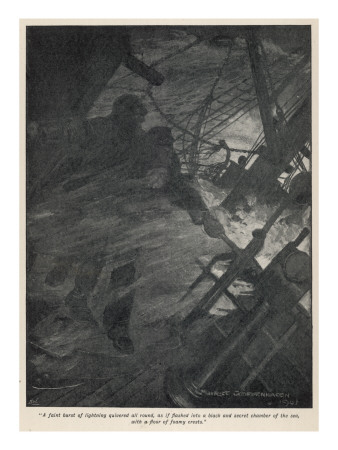
The steamer Nan Shan in the Storm

ostensible purpose of this review, Conrad’s Typhoon, it was the first full book I had read on my IPad, if a novella of 100 some odd pages can be thought of as a full book. And the verdict is that it was like reading…well…a book. The interface felt book like, I can adjust the light to the needs of my aging eyes, and can read more clearly than I could have managed by candlelight. I’ve always worried about the ability to personalize the texts, but iBooks lets me underline, and if anything I personalized the text more than I might have some others since my handwriting is unreadable and my notes in paperbooks cryptic and unintelligible. By contrast, the marginalia tool in iBooks is clean and my notes copious. Perhaps above all, I loved my iPad for remaining charged and working when everything else failed, leaving in the dark and to my own devices. Scary what I might find in that mirror. I read the entire book undistracted by facebook or my email apps, but I took comfort in knowing they were available for my distraction should I need them.

Now as to Typhoon itself. I want to say “Yes,” with qualifications. The story is gripping and intense, a naturalist drama of man against nature that becomes a kind of paean to stoic and pedestrian endurance, though one that is ironic and complicated in the end. The main human character is Captain MacWhirr, whose name betokens a machine-like efficiency. He is a man of small intellect, little imagination, and no intellectual curiosity. Because of this it is hard to describe him as actually courageous in the teeth of the hurricane. While a more imaginative man might have hidden his response to the terrors of the outrageous sea in cryptic understatement, MacWhirr is mostly just given to small emotion and small imagination.

Captain MacWhirr was trying to do up the top button of his oilskin coat with unwonted haste. The hurricane, with its power to madden the seas, to sink ships, to uproot trees, to overturn strong walls and dash the very birds of the air to the ground, had found this taciturn man in its path, and, doing its utmost, had managed to wring out a few words. Before the renewed wrath of winds swooped on his ship, Captain MacWhirr was moved to declare, in a tone of vexation, as it were: “I wouldn’t like to lose her.”

One doesn’t come away from this novel feeling grand and heroic and triumphant about human beings. On the other hand, one doesn’t come away feeling like human beings are small and accidental as you do, for instance in reading Stephen Crane’s “The Open Boat”. Instead endurance seems something to be achieved, and we end up happy for MacWhirr that he has achieved it, knowing we’d rather have him dull and unimaginative, but steady, were we caught in the writhing seas ourselves.

The story as a whole is gripping and seems to reveal something about both our human frailty and our strength and complexity, making it more than just a good adventure story. If I had read it first, I’m sure I would say that The Perfect Storm reminded me of it in being only partly a book about humans against the storm, and as much or more about humans against themselves.

One thing keeps me from a whole hearted endorsement. It really is the case that the depictions of Chinese in the book are deeply troubling. Passages in which Chinese are cast a jabbering animals or as writhing forces of nature are offensive and hard to find a way to redeem. I have always thought the criticism of Heart of Darkness was perhaps unearned since the thesis of that book had always seemed to me to be the evils of imperialism. But there is no redeeming theme that I can find for the representation of the Chinese coolies as brutes, and I found myself less inclined to defend Conrad, either here or for Heart of Darkness than I was before I began. To say this is not to say that the book is not worth reading, since there is no good human thing that is free of the scent of corruption, but it is to say that the goodness in the book does not overcome that corruption and reminds this reader at least that human beings are mixed creations, leaving us to admire and cringe in the same moment.

View all my reviews

Illuminations and Illustrations; Videowriting for the future

One thing that always struck me as a bit odd in the Harry Potter movies is the moving illustrations of books and newspapers. Odd because, set in the present, there’s a sense in which the internet is already a great deal more magical than that. As things go, indeed, Harry Potter is peculiarly a-chronic, living in the modern world as if he’s never seen a computer. Still, those video books are, in some sense, a continuation and enhancement of the tradition of illuminated manuscript–great textual form of the world of Gothic witches and warlocks.

The attached video I got in my email today reminded me of this, one of many announcements about writing contests that I get as an English professor. This one came with a twist since it’s promoting the use of YouTube as a resource and as a media for creative writing. I checked out the details as much as I could–writing contests are famously cash-cows for journals, requiring entrants to pay anywhere from a 10 to 50 dollar reading fee for what ends up being a one in a thousand chance of being published. Not a con exactly; just a grim fact of how literary culture has to support itself in our society. This looks decently legit, and no fees that I can find.

I’m struck by two things I see here. One is the idea of YouTube as a medium for or at least an enhancement William Blake illuminated manuscriptto traditional creative writing. I’m not much taken by the idea of embedding text in video format–I’ve seen work like this before on the net in multi-media forms of poetry. Touted as an “interactive” form of reading that values the reader, this kind of thing really ends up wresting a lot of control from the reader by controlling how and when the reader will see the text the reader sees.

On the other hand, I am taken by the idea of embedding video in stories. In literary circles we’ve traditionally seen books as opposed to film in some respects, with film usually inferior. But books traditionally have made great use of visuals as supplements to the text. Illuminated manuscripts, of course, but also extensive illustrations in nineteenth century novels. Graphic novels, of course, subordinate the text to the visual, so it’s not quite the same animal, but at least you could say that the exclusively alphabetic text absent all illustration is mostly a 20th century phenomenon.

So I’m wondering how video might make room for an new kind of illuminated text. The video commenting on and enhancing the text rather than being a redaction of it–as occurs so often in films about novels. I’m not familiar with anything like this, so if someone knows about stuff for me to look at, I’d love to see it. Again, one of my pet topics; the visuality of books.

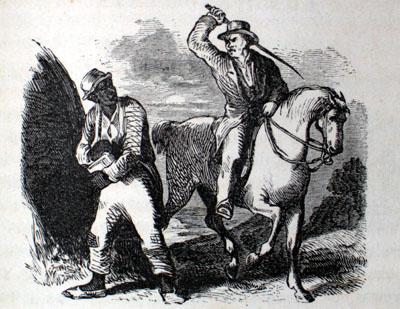
The other thing that strikes me in this is the way that internet culture is changing the culture of books in general. I’ve lamented in the past–and still do lament, to be honest–the ways in which computer culture is gradually fracturing and dispossessing the traditional sites of book culture. Places where readers Uncle Tom’s Beatinggather are increasingly becoming places where computer users gather, clicking away in their separate universes.

On the other hand, it is the case that the internet creates new cultures for readers–and not only in chat rooms and forums devoted to literature. In online book clubs I can chat with authors–at least I assume I can; I’m always wondering if it’s the author on the other end or a poorly paid graduate student doing her best to imitate the voice and interests of the latest author plugged by Barnes and Nobles. Online readings don’t yet substitute for readings in person, but I can imagine them becoming the norm. Already as a department chair I’m seeking the permission of authors to record their readings for replay on our web site. The Lunch Poetry series at UC Berkley is a good example of this on the web. I don’t think it substitutes for the great pleasure of gathering together with other readers, but who could complain that this kind of thing exists.

Miscellany: More Librivox, More Emerson, More Diarrhea

Ok, to get to Diarrhea, you have to read to the end of this post.


MORE LIBRIVOX

I got some very good comments from “Hugh” who is a poobah of some sort over at Librivox. You should go read his comments yourself at my post, “Listening as Reading,” but a couple of excerpts here since I want to think about what he has to say. (And, hey, it’s a cheap way to come up with a post when it’s late at night and I’m having trouble collecting my thoughts.

Says Hugh:

“in pre-radio/tv/recordings days, and when books were relatively expensive, many books were actually written to be read aloud – it was a form of family entertainment: the family & friends gathered around papa (or mama) who read at the fireplace. dickens is a particular example. of course an mp3 audio version read by a stranger isn’t the same thing, but it is another experience of literature, one that has it’s own particular richness, and weakness.”

Yes, a good thing to point out, continuous with my general observation that for the longest part of human history reading was primarily about reading aloud, not reading silently. I’m not quite sure I would go completely down the road that books in the nineteenth century were written to be read out loud. This misconstrues the case. But it is the case that they were commonly read out loud, and there was a great deal of fluidity between the oral presentation and the written. Dickens is a good representative of this fluidity. I’m not quite sure I would say Dicken’s wrote his books in order to read them out loud. He wrote them in order to get them published serially in magazines. But it is absolutely true that he often rewrote and rewrote passages over and over in order to achieve certain kinds of emotional effects in his listening audience. Thus there’s a deep connection between the orality of the word and the writtenness of the word. A fluid interchange of sorts. I still tell students they ought to read their work outloud to themselves in order to hear how things sound. This can be a good guide to the kind of rhetorical affects you are achieving.

Says Hugh again:

“-we are primarily a platform to help people record audiobooks (with an objective of making a complete audio library of public domain books); that the public can download and listen to our files is in a way just a fortunate by-product of what we do.

-and while our collection’s “quality” is, by design, all over the map, the volume of good and extraordinary recordings is daunting…it’s a matter of finding the good stuff. Here are some recommendations:

http://ask.metafilter.com/79067/Librivox-Recommendation”

This last is very helpful, though I wish the list was more organized. I clicked through some of the recommended readings and–on the basis of very short sampling–most of them are superior to some of the detritus I’ve waded through the past few times I’ve strolled through Librivox. I wish that Librivox would provide some kind of ratings system itself–at least one that recognized the popularity of different readings–though I suspect that this would counter the dream of pure democratic participationism that drives this kind of thing on the web.

As for Librivox being primarily about the readers and not the listeners, something Hugh tells me in a second comment, I’m not so sure. (I think Hugh didn’t think it was fair of me to criticize many of the readers for being…well…Dull. Or annoying. Or both). To some degree I think he’s suggesting that Librivox is really more like a blog service where readers can express themselves via recording. Well, OK. But the thrill of doing so is that people will listen in, yes? I mean, if it wasn’t for the fact that people might actually look at this blog, why not just keep it on my computer instead of publishing it for all the world to sneer at.

It’s also the case that in reading a published work, the reader puts himself/herself in the position of performer/artist who is interpreting the work of another artist. There are a lot of opera singers out there who really ought to spare the rest of us and restrict their renditions of Nessun Dorma to the safety of their shower stalls. On the other hand, I don’t begrudge them the right to perform for the world on YouTube. But if they do, I generally think we’ve got a right and responsibility to Puccini and to Pavorotti to say, “You know, that really stinks pretty badly.” There’s no inherent nobility in performing, contrary to what most Americans seem to think.

But enough. Mostly I’m on Hugh’s side here. I’m glad someone’s doing something like Librivox, even if I don’t want to listen to most of the people doing it.


MORE EMERSON:

I blogged a bit about Emerson today on the blog dedicated to my course on literary theory. Just a bit of that from a post I called “Emerson and the Gods of Reading”:

Along these lines, I think there’s a way in which Emerson’s notions of creative reading are embodied in the way we read now. For Emerson, reading was a threatening activity precisely because we were always tending toward submission and passivity, always on the brink of substituting someone else’s creativity or knowledge for our own. This would mean we had failed to be “The Poet” we were meant to be and in fact are if we would only realize it. Instead, reading only exists to a purpose if it inspires us to more writing of our own. Reading must always give forth in to new and different expression, or it is worthless. Reading that absorbs and doesn’t give forth in new creativity, reading that doesn’t come to an end in writing is destructive to rather than an enhancement of our humanity.

What is this if not the reading ethic of blogging. Emerson, the familiar spirit of Facebook culture. Reading for us now is only meaningful if it gives forth in self expression. Indeed, texts become primarily a means of further self-expression. I read other texts or find other materials on the internet in order to “blog” them. The verb in this sense means partly to write about them, but blogging something also connotes making it one’s own, making it an opportunity for self-expression, an opportunity to speak.

I don’t think I want to deride this outright. NPR had someone–maybe the founder of Facebook-?!-on today with a little piece on the glories of connectivity available through self-exposure. It seemed a little facile–by exposing my darkest secrets on the net I’ll be able to develop authentic relationships with people I’ve never met. Umm, maybe. If this were true, why not go expose yourself to your next door neighbor. Still, it is the case that kinds of connections are built through this incessant speaking. Ultimately, for Emerson, our seeking expression at the expense of reading was not a form of self-aggrandizement, though it’s often taken for that. It was ultimately a way of connecting to a broader world. In Emerson’s view, if all people would become The Poet they were meant to be, all the world would be saved and we would all be one. It’s ultimately a platonic evangelical Christian vision without Christ in some sense. If we’ll all individually get right with Jesus, we’ll all be one. The internet says something vaguely similar. If we would all just keep looking for ways of expressing ourselves through the texts of others, we will all be connected through what is, after all, the World Wide Web.

I have no idea if this makes any sense, but it seemed profound at the time. Parents are paying for this stuff. It better be.


MORE DIARRHEA

Ok, this doesn’t refer to the stinky liquid spew that this post is fast becoming. Or not only that.

I often tell my English students that there is a magazine about everything, so they can take their writing skills and find a job anywhere in the world. The last part is a department chair’s fantasy, but there really is a journal about everything in the world.

Witness “Dialogue On Diarrhea.” Yes, there is a journal covering everything you wanted to know about loose stools. Ok, I should say there used to be a journal. In the words of the web site:

Dialogue on Diarrhoea was an international newsletter on the control of diarrhoeal diseases published by Healthlink Worldwide (formerly AHRTAG), a UK-based non-governmental organisation.

The first issue was published in May 1980.The last of a total of 60 issues, during its 15 years, was published in May 1995.

Published four times a year, Dialogue on Diarrhoea offered clear, practical advice on preventing and treating diarrhoeal diseases. It also acted as a forum for readers to exchange ideas and share experiences.

Umm, just what kind of experiences are we sharing here exactly?

Anyway, the print newsletter is no more. And now instead we have “Dialogue On Diarrhea Online”. So the next time you have this problem, you’ll know where to head. Besides the bathroom. I mean.

And, as we think of it, doesn’t this point to the last important remaining geography in which print remains triumphant. Bathroom reading. It’s a bit tragic that the diarrheatics among us will now have to carry their Kindles to the bathroom in order to keep up on the latest and share their experiences. On the other hand, with laptop in hand they will now be able to share their experiences in a much more intimate and immediate way.

Ok, I’ll stop. I’m sure I’ve now insulted all the chronic diarrhea sufferers who regularly read this blog. And none of my students will ever get an internship with this website. That’s for sure.

Final note: I thought for sure I would be the only person on WordPress who used the word “diarrhea” in a tag. No. There are hundreds of us.

Isn’t the web a wonderful place?

Books in a material world–Bookporn and more

I was talking to a couple of students yesterday, one of whom wants to be a librarian because she loves “being around books.” A little bit of a Scrooge, I guess, I told her she better get used to being around computers since that was the real future of libraries, taking her back a bit with my revelation that the library budget at our own college had just been required to move $50,000 from book purchasing to database collections. Small change for a lot of places, but for my smallish college $50,000 is nothing to sneeze at. Indeed, I’ve already felt the squeeze just a bit since English used to depend on the general fund of the library to order contemporary novels and poetry–which we ordered gleefully and at will. Probably partly on the erroneous assumption that availability would somehow translate into their being taken off the shelf. Well, that fund hasn’t disappeared, but we’ve been asked to order not quite so gleefully, and not quite so at will. A concrete manifestation of how a response to a perceived technological need–real or not–will gradually determine or close the future of the book as we’ve known it.

Still, my student was not dissuaded. She feels that books will always be with us because we love their physicality. There’s that body of the book theme again, and there’s something real about it that has to be thought through. Reading is not simply a mental process of decoding letters, not simply a process of getting information off a page or screen and in to our brains. It’s a physical activity to which we attach all kinds of cultural and personal meanings, a kind of spiritual reverence that the attach to the being of books that we cannot yet attach to computers.

We imagine computers too much as tools, and emphasizing their efficiency does too little to address the tactile, even the olfactory meanings that we attach to book culture. The other student who was with us was very intrigued by Amazon’s Kindle, but even she paused and said, “I became an English major when I looked out from the balcony and saw the stacks and stacks of books.” The physicality of books inspires a reverence, whereas the efficiency of computers inspires…what?…a sense of efficiency?

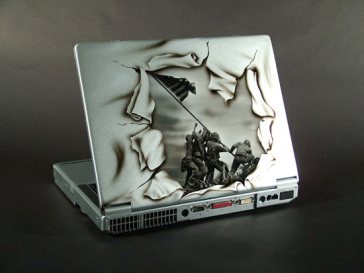
Indeed, I’m intrigued by the growing tendency of laptop users to try and personalize their laptops–recreating their essential impersonality through a kind of personal graffiti. There’s a great newstory on this phenomenon at c/net, along with Personalized laptop.  One of my favorites. 

We do this with books, it seems to me, but not in the same way. We don’t feel compelled to personalize the cover of a book, and our markings in a text are more to memorialize a reading experience than to carve a human personality into what is, after all, a machine. Books are a technology, but at the least we have learned to experience them as extensions of the body rather than as tools.

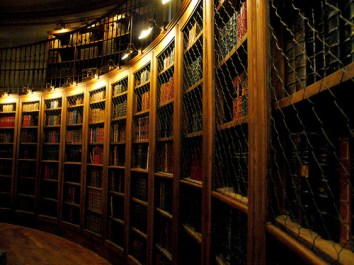
Along these lines, I’ve been running in to a lot of images of books again. Rachel Leow over at A Historian’s Craft celebrates the one year anniversary of her blog with BookPorn #27, a couple of fabulous images of the Library of the Musee Guimet. Says Rachel:Library Musee Guimet

“There’s a kind of hushed atmosphere when you walk in: the lights are dim and people shuffle about, struck silent with reverence, or perhaps the disconcerting, all-pervading pinkness of the walls and columns. The books lie, untouchable, behind their wire cages, and the smell of old paper lingers about well after you step, blinking, back out into the fluorescent glare of the exhibition outside.”

Nice writing, Rachel. And happy birthday. It seems to me that Rachel gets at this notion of the importance of the physicality of books inspiring a kind of reverence, something I attach even to my tattered paperback crowded onto basement shelves, but which I don’t really attach to my computer. Like nearly everyone else, I’m sure I spend a great deal more time on my computer reading anymore than I do in actually reading books. Like most white collar workers I’m chained here all day, and then blog all night. But feeling reverence for my computer feels a little bit like feeling reverence for my screwdriver. Not impossible, I guess. I’m sure many a carpenter has a deep feeling for his screwdriver. But I also guess that mostly such carpenters are considered weird by everyone else.

Books are tools, but it’s a mistake to think that what counts in reading them is the toolishness. If we only focus on the instrumental qualities associated with text delivery, there is no question that the e-book-o-philes among us are right to scoff at fears of digital libraries. Still, culture is more than instrumental, and always has been.

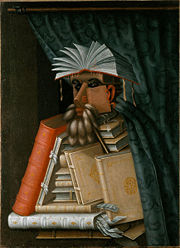
Along these lines, there’s a humorous and very interesting Giuseppe Acrimboldo Librarianskewering of those of us who are book fetishists over at if:book. Chris Mead has written a song about the history of books along with a lot of great images. My favorite is this from Giuseppe Acrimboldo, “The Librarian.” I love it. The human is text, no a book, a library. What I’ve always thought anyway. I am my books. I don’t yet say, I am my computer. Will I ever.

Chris takes the opportunity to skewer the-sky-is-falling attitude that some of us bring to the changes that are going on

“words: written in silence, muttered in monasteries
have been sung, shouted, acted – now by digital industries

broadcast and mixed for our burgeoning multiculture,

but circled by many a gloom-laden vulture

crying “R.I.P. books: doomed to extinction
by some blinking e-inky, i-evil invention”.
The word spreads and
changes; that’s my belief.
What next for the book?
The future lies overleaf.

Very nice. Dr. Seussian. Ok, only almost. Still, Chris’s poem/song emphasizes an assumption that I think is flatly wrong. That the technology of reading is essentially inconsequential for the act of reading itself. This is clear explicitly in the opening part of his poem.

“Books are what a society carries its words in
and words have been written on stone, silk, slate, parchment,
wax, clay, screen and skin,”

This is superficially true, but the assumption seems to be that reading is only about decoding letters, and books–or parchments or scrolls or screens–are merely delivery systems that are more or less equal except in the efficiency with which they can deliver text to readers. This is flatly false, as any historian of books and reading could point out in half a breath. In some sense, when we went from reading scrolls to reading codexes and then books, the changing technology changed the meaning of the act of reading, not just the techniques of the act of reading. It is this changing meaning that is crucial to try and understand. Techniques of text delivery can merely be learned through users manuals. Meanings and their attendant ways of being human are less easily learned and unlearned. We ought to pay attention to what those changes might be.

Final note: I’m sure everyone’s familiar with this video, but it still makes me smile. It’s a reminder that all of the cultural associations we have with books had to be learned. There’s nothing natural about our sentimental attachments to books. As kids, we’re all in the position of the monk at a loss here, not knowing which way a book sets on the table, which way to turn the pages. Culture is learned. That doesn’t mean the demise of books should be sniffed at. But culture is learned.

Lolita’s Bedroom—Or why marketing directors should read more novels.

What young family wouldn’t hold out the image of a sexually precocious 12-year-old as the image they hope their young daughters will have dancing in their heads as those innocent heads hit the pillow at night. The London Times reports that Woolworths has had to pull a certain ill-named piece of bedroom furniture from the market after a widespread internet protest by offended mothers.Woolworth’s Lolita bed

“The Lolita Midsleeper Combi, a whitewashed wooden bed with pull-out desk and cupboard intended for girls aged about 6, was on sale on the Woolworths website for £395.”
……

“Whereas many mothers were familiar with Vladimir Nabokov and his famous novel, it seems that the Woolworths staff were not. At first they were baffled by the fuss. A spokesman for the company told The Times: “What seems to have happened is the staff who run the website had never heard of Lolita, and to be honest no one else here had either. We had to look it up on Wikipedia. But we certainly know who she is now.””

Lolita book cover full sizeAs my colleague, Matt Roth, suggests it’s hard to know which is worse, that they made the bed in the first place, or that they didn’t know about one of the iconic literary figures of the past half-century.

However, given the international state of our reading crisis, perhaps its worth asking how so many mothers even knew who Lolita was. I wonder if they read the book or saw the movie.

In any case, cultural illiteracy will get you nowhere.

Still, I’m just a tad bit suspicious about Woolworth’s protestations
According to the same Times article, the Brits business community has a penchant for salacious pitches to the preadolescent crowd:

“In 2006 Tesco was removed its pole-dancing kit from the toys and games section of its website after it was accused of destroying children’s innocence.”

A pole-dancing kit. What every nine-year old girl wants for Christmas.

Similarly the BBC reports the following:

“In 2005, WH Smiths came under fire for selling youngsters stationery bearing the Playboy bunny – a symbol of the pornography empire.

“Prior to that Bhs decided to withdraw its Little Miss Naughty range of padded bras and knickers for pre-teen girls after attracting criticism.

I’m not sure what’s naughty about knickers. I thought it was just a weird British word for underwear. And according to the grammar they were padded anyway. Sounds uncomfortable to me. Still, I draw the line at padded bras for pre-teens.

For the record, I did a Google search on women named Lolita. Turns out there are thousands of them. And not just Lolita Davidovitch. And most of them aren’t even on sex sites. I’m sure that the Woolworth’s bedrooms set was probably named after the owner’s great aunt Lolita in Birmingham. And after all, it’s not pole-dancing. Come on people, lighten up!

Anyway, though I’m appalled at the marketing division’s literary illiteracy, isn’t it a great thing to see literature making a difference in the world.

More solid evidence that the NEA is correct in saying readers are more likely to be social activists. 😉

Listening as Reading

Some more about audiobooks today.

I still remember my shock and dismay a couple of years ago when I clicked on to the New York Times book page and found an advertisement of much a younger, more handsome and vaguely Mediterranean-looking young man who oozed sex appeal as he looked out at me from the screen with headphones on his ears.

“Why Read?” asked the caption.

Surely this was the demise of Western Civilization as we knew it, to say nothing of being a poor marketing strategy for a newspaper industry increasingly casting about in vain for new readers.

Nevertheless, it seems to me that audiobooks have developed a generally sexy and sophisticated cache for literary types that other shorthand ways to literature typically lack. As an English professor, I’ve been intrigued lately that a number of colleagues around and about have told me they listen to audiobooks to “keep up on their reading.” To some degree I’ve always imagined this as a slightly more sophisticated version of “I never read the book, but I watched the movie,” which has itself been about on a par with reading Sparknotes.

However, as I mentioned in yesterday’s post, another colleague recently took issue with my general despairing sense that the reading of literature, at least, is on the decline, no matter the degree to which students may be now reading interactively on the web. “Yes,” she said, “but what about audiobooks?” She went on to cite the growth in sales over the past few years as evidence that interest in literature may not be waning after all.

My immediate response is a little bit like that of Scott Esposito over at Conversational reading. In a post a couple of years ago Scott responded to an advocate of audiobooks with the following:

Sorry Jim, but when you listen to a book on your iPod, you are no more reading that book than you are reading a baseball game when you listened to Vin Scully do play-by-play for the Dodgers.

It gets worse:

[Quoting Jim] But audio books, once seen as a kind of oral CliffsNotes for reading lightweights, have seduced members of a literate but busy crowd by allowing them to read while doing something else.

Well, if you’re doing something else then you’re not really reading, now are you? Listen Jim, and all other audiobookphiles out there: If I can barely wrap my little mind around Vollmann while I’m holding the book right before my face and re-reading each sentence 5 times each, how in the hell am I going to understand it if some nitwit is reading it to me while I’m brewing a cappuchino on my at-home Krups unit?

It’s not reading. It’s pretending that you give a damn about books when you really care so little about them that you’ll try to process them at the same time you’re scraping Pookie’s dog craps up off the sidewalk.

I have to grin because Scott is usually so much more polite. Nevertheless, I cite Scott at length because viscerally, in the deepest reaches of my id, I am completely with him and he said it better than I could anyway.

However, it’s worth pausing over the question of audiobooks a little further. I don’t agree with one of Scott’s respondents over at if:book, who describes listening to audiobooks as a kind of reading. But it is an experience related to reading, and so it’s probably worth parsing what kind of experience audiobooks actually provide and how that experience fits in with our understanding of what reading really is.

As I’ve said a couple of times, I think we lose sight of distinctions by having only one word, “reading,” that covers a host of activities. I don’t buy the notion that listening can be understood as the same activity as reading, though the if:book blog rightly points out the significance of audiobooks to the visually impaired. Indeed, one of my own colleagues has a visual disability and relies on audiobooks and other audio versions of printed texts to do his work. Even beyond these understandable exceptions, however, Scott’s definition of reading above privileges a particular model of deep reading that, in actual fact, is relatively recent in book history.

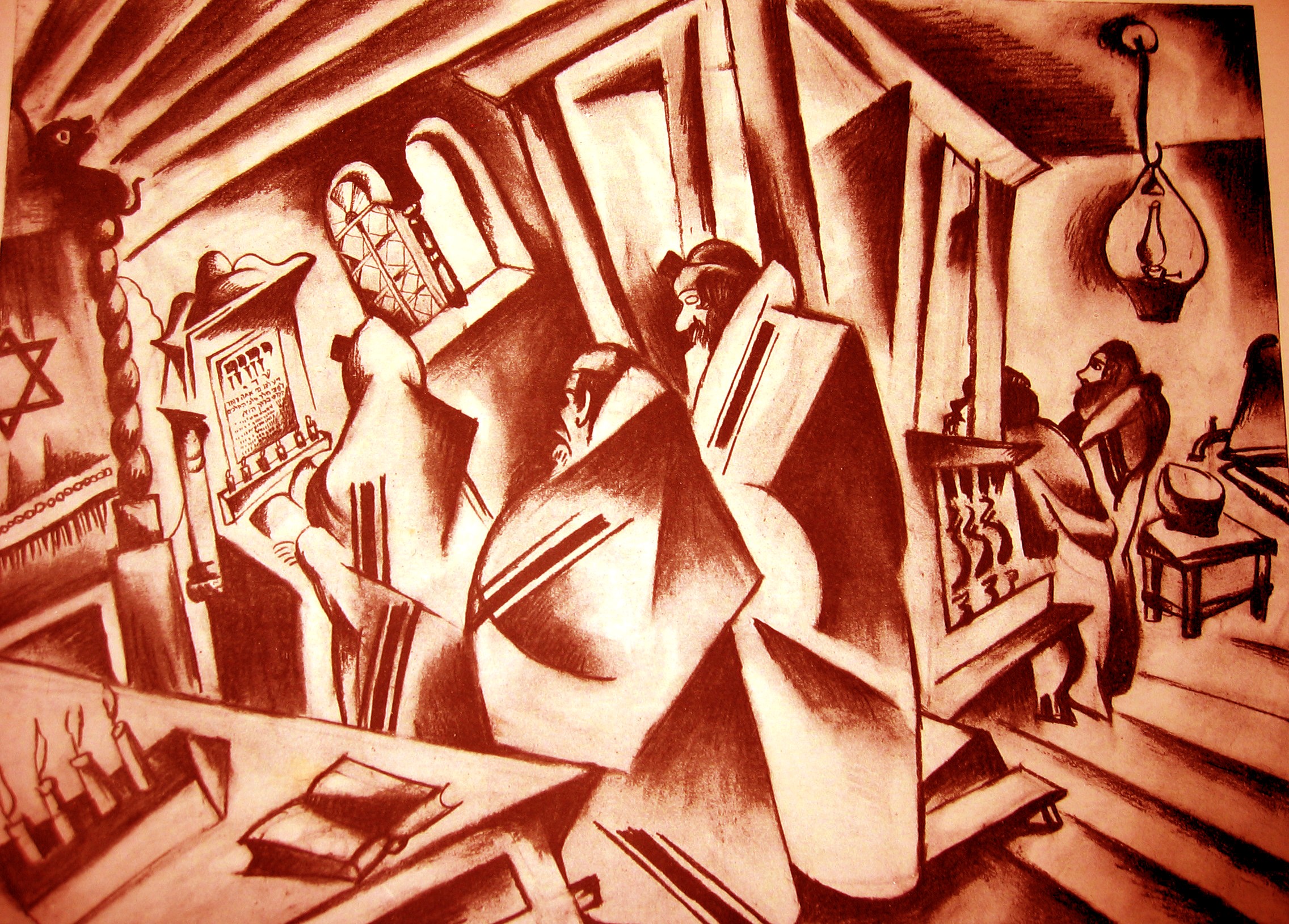
Indeed, going back to the beginnings of writing and reading, what we find is that very few people read books at all. Most people listened to books/scrolls/papyri being read. TheChrist reading in the synagogue temple reader and the town crier are the original of audiobooks and podcasts. In ancient Palestine, for instance, it’s estimated that in even so bibliocentric a culture as that of the Jewish people only 5 to 15% of the population could read at all, and the reading that went on often did not occur in deep intensive reading like that which Scott and I imagine when we think about what reading really is. Instead, much of the experience of reading was through ritual occasions in which scriptures would be read aloud as a part of worship. This is why biblical writers persistently call on people to “Hear the Word.” This model of reading persists in Jewish and Christian worship today, even when large numbers of the religious population are thoroughly literate. See Issachar Ryback’s “In Shul” for an interesting image from the history of Judaism.
Indeed, in the history of writing and reading, listening to reading is more the norm than not if we merely count passing centuries. It wasn’t until the aftermath of the Reformation that the model for receiving texts became predominantly focused on the individuals intense and silent engagement with the written word of the book. In this sense, we might say that the Hebrews of antiquity weren’t bibliocentric so much as logocentric—word-centered but not necessarily book-centered.

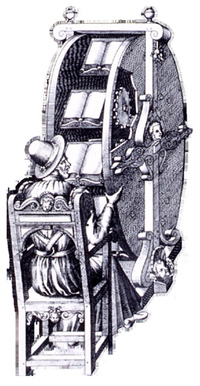
Along these lines, the model of intense engagement—what scholars of book history call “intensive reading”—is only one historical model of how reading should occur. Many scholars in the early modern period used “book wheels” in order to have several books open in front book wheelof them at the same time. This is not exactly the same thing as multi-tasking that Scott abhors in his post, and it’s not exactly internet hypertexting, but it is clearly not the singular absorption in a text that we’ve come to associate with the word “reading.” “Reading” is not just the all-encompassing absorption that I’ve come to treasure and long for in great novels and poems, or even in great and well-written arguments. Indeed, I judge books by whether they can provide this kind of experience. Nevertheless, “Reading” is many things.

But to recognize this is not exactly the same thing as saying “so what” to the slow ascendancy of audiobooks, and the sense that books, if they are to be read at all, will be read as part of a great multi-tasking universe that we now must live in. Instead, I think we need to ask what good things have been gained by the forms of intensive reading that Scott and I and others in the cult of book lovers have come to affirm as the highest form of reading. What is lost or missing if a person or a culture becomes incapable of participating in this kind of reading.

By the same token, we should ask what kinds of things are gained by audiobooks as a form of experience, even if I don’t want to call it a form of reading. I’ve spent some time recently browsing around Librivox.org, which I’ll probably blog about more extensively in a future post. It’s fair to say that a lot of it turns absolutely wonderful literature into mush, the equivalent of listening to your eight-year-old niece play Beethoven on the violin. On the other hand, it’s fair to say that some few of the readers on that service bring poetry alive for me in a way quite different than absorption in silence with the printed page. As I suggested the other day, I found Justin Brett’s renditions of Jabberwocky and Dover Beach, poems I mostly skim over when finding them in a book or on the web, absolutely thrilling, and I wanted to listen to everything I could possibly find that he had read.

This raises a host of interesting questions for a later day. What is “literature.” Is it somehow the thing on the page, or is it more like music, something that exists independently of its graphic representation with pen and ink (or pixel and screen). What is critical thinking and reading? I found myself thrilled by Brett’s reading, but frustrated that I couldn’t easily and in a single glance see how lines and stanzas fit together. I was, in some very real sense, at the mercy of the reader, no matter how much I loved his reading.

This raises necessary questions about the relationship between reader and listener. Could we tolerate a culture in which, like the ancient Greeks and Hebrews, reading is for the elite few while the rest of us listen or try to listen. At the mercy and good will of the literate elite—to say nothing of their abilities and deficiencies as oral interpreters of the works at hand.

More later