Category Archives: technology

Why digital humanities is already a basic skill, not just a specialist niche–Matthew Kirschenbaum

Sometimes I think we humanists “of a certain age,” to put the issue politely, imagine digital humanities as an optional activity that will be filled by an interesting niche of young professors who take their place in the academy as yet another niche sub-discipline, something that research universities hire for and small colleges struggle hopelessly to replicate.  It may be indeed that small colleges will struggle to integrate digital humanities in to their own infrastructures, but I think the general picture of Digital Humanities as an optional sub-discipline will simply be unsustainable.  The argument smells a little of the idea that e-books are a nice sub-genre of texts, but not something the average humanist has to worry that much about.  I think, to the contrary, that digital humanities and the multitude of techniques that it entails, will become deeply integrated in a fundament way with the basic methodologies of how we go about doing business, akin to knowing how to do close reading or how to maneuver our way through libraries.

Although pointing out this fact is not his main point, Matthew Kirschenbaum–already a Digital Humanities patron saint in many respects–has an essay in The Chronicle that points to this fact.  Kirschenbaum is currently interested in how we preserve digital material, and the problems are just as complex if not moreso than the general question of how and when to save print materials.  Moreso to the degree that we cannot be sure that the current forms in which we place our digital intelligence will actually be usable five years from now.  The consequences for humanities research and writing are profound and must be considered. From Kirschenbaum:

Digital preservation is the sort of problem we like to assume others are thinking about. Surely someone, somewhere, is on the job. And, in lots of ways, that is true. Dire warnings of an approaching “digital dark ages” appear periodically in the media: Comparisons are often made to the early years of cinema—roughly half of the films made before 1950 have been lost because of neglect. 

But the fact is that enormous resources—government, industry, and academic—are being marshaled to attack the problem. In the United States, for example, the Library of Congress has been proactive through its National Digital Information Infrastructure and Preservation Program. Archivists of all stripes now routinely receive training in not only appraisal and conservation of digital materials but also metadata (documentation and description) and even digital forensics, through which we can stabilize and authenticate electronic records. (I now help teach such a course at the University of Virginia’s renowned Rare Book School.) Because of the skills of digital archivists, you can read former presidents’ e-mail messages and examine at Emory University Libraries a virtual recreation of Salman Rushdie’s first computer. Jason Scott’s Archive Team, meanwhile, working without institutional support, leaps into action to download and redistribute imperiled Web content.

What this suggests is that Rushdie’s biographers will have to not so much know how to sift through piles of letters, but how to recreate digital archives that authors themselves may not be interested in preserving.  Biographers of the present and surely the future, will have to be Digital technicians, as well as close readers of the digital archives they are able to recover.

Kirschenbaum goes on to suggest that most of us must do this work on our own, and must do this work for ourselves, in preserving our own archives.

But despite those heroic efforts, most individuals must still be their own digital caretakers. You and I must take responsibility for our own personal digital legacy. There are no drive-through windows (like the old photo kiosks) where you can drop off your old floppies and pick up fresh files a day or two later. What commercial services are available tend to assume data are being recovered from more recent technology (like hard drives), and these also can be prohibitively expensive for average consumers. (Organizations like the Library of Congress occasionally sponsor public-information sessions and workshops to teach people how to retrieve data from old machines, but those are obviously catch as catch can.)

Research shows that many of us just put our old disks, CD’s, and whatnot into shoeboxes and hope that if we need them again, we’ll figure out how to retrieve the data they contain when the time comes. (In fact, researchers such as Cathy Marshall, at Microsoft Research, have found that some people are not averse to data loss—that the mishaps of digital life provide arbitrary and not entirely unwelcome opportunities for starting over with clean slates.)

This last, of course, is an interesting problem.  Authors have often been notoriously averse to having their mail probed and prodded for signs of the conflicts and confessions, preferring that the “work” stand on its own. Stories of authors burning their letters and manuscripts are legion, nightmarishly so for  the literary scholar.   Such literary self-immolations are both harder and easier in a digital world.  My drafts and emails can disappear at the touch of a button.  On the other hand, I am told that a hard drive is never actually erased for those who are really in the know.  Then again, the task of scholar who sees a writers computer as his archive is in some ways vastly more difficult than that of the writer who was an assiduous collector of his type-written drafts.  Does every deletion and spell correct count as a revision.  What should we trace as an important change, and what should we disregard as detritus.  These are, of course, the standard archival questions, but it seems to me they are exponentially more complicated in a digital archive where a text may change a multitude of times in a single sitting, something not so possible in a typewritten world.
Well, these are the kinds of things Kirschenbaum takes up.  And having the tools to apply to such questions will be the task for every humanist in the future, not a narrow coterie.

Should Humanities students learn to code?

One of the big questions that’s been on our mind in the digital humanities working group is whether and to what degree humanities students (and faculty!) need to have digital literacy or even fluency.  Should students be required to move beyond the ability to write a blog or create a wiki toward understanding and even implementing the digital tools that make blogs and wikis and databases possible.  This essay from Anastasia Salter takes up the issue, largely in the affirmative, in a review of Douglas Rushikoff’s Program or be Programmed:  Read more at…Should Humanities students learn to code?.

Tchotchkes R’US: Formerly known as Barnes and Nobles, Booksellers

Like a beaten dog wagging its tail as it returns to the master for one more slap, I keep returning to Barnes and Nobles, hoping for a dry bone or at least a condescending pat on the head. Mostly getting the slap.  I’m wondering lately how much longer B&N can hold on to the subtitle of their name with a straight face. I admit that for purists Barnes and Nobles was never much of a bookseller in the first place, the corporate ambiance just a bit too antiseptic for the crowd that prefers their books straight, preferably with the slightest scent of dust and mold. But as a person that has spent the entirety of his life in flyover country, Barnes and Nobles and its recently deceased cousin Borders seemed something like salvation. If the ambiance was corporate, the books were real, and they were many. If there were too few from independent publishers, there were more than enough good books to last any reader a lifetime, and I spent many hours on my own wandering the shelves, feeling that ache that all readers know, the realization that there are too many good books and one lifetime will never be enough.

Barnes and Nobles became a family affair for us. One way I induced the habit of reading in my kids was to promise them I’d take them to B&N anytime they finished a book and buy them another one. The ploy paid off. My kids read voraciously, son and daughter alike, putting the lie to the notion that kids today have to choose between reading and surfing.  My kids do both just fine, and I think this is attributable in no small part to the fact our family time together was spent wandering the endless aisles of bookstores, imaging the endless possibilities, what the world would be like if we only had enough time to read them all. Other families go on kayak trips; we read books. I’m not sorry for the tradeoffs.

All that is mostly over, for paper books anyway. My son and I still go over to Barnes and Nobles, but the last three trips we’ve come out saying the same thing to one another without prompting–worthless. Aisle after Aisle of bookshelves in our local store are being replaced by toys and tchotchkes designed to…..do what? It’s not even clear. At least when the place was dominated by books it was clear that this was where you went for books. Now it seems like a vaguely upscale Walmart with a vast toy section. I’m waiting for the clothing section to open up soon.

I don’t think we should underestimate the consequence of these changes for booksellers and bookreaders. Although it is the case that readers will still be able to get books via your local Amazon.com, the place of books is changing in radical ways.  The advent of e-books is completely reordering the business of bookselling–and i would say the culture of books as well.  An article in the Economist notes that books are following in the sucking vortex that has swallowed the music and newspaper industries all but whole.  Among the biggest casualties is the books and mortar bookstore, and this is of no small consequence to the effort to sell books in general:

Perhaps the biggest problem, though, is the gradual disappearance of the shop window. Brian Murray, chief executive of HarperCollins, points out that a film may be released with more than $100m of marketing behind it. Music singles often receive radio promotion. Publishers, on the other hand, rely heavily on bookstores to bring new releases to customers’ attention and to steer them to books that they might not have considered buying. As stores close, the industry loses much more than a retail outlet. Publishers are increasingly trying to push books through online social networks. But Mr Murray says he hasn’t seen anything that replicates the experience of browsing a bookstore.

Confession, I actually enjoy browsing Amazon, and I read book reviews endlessly.  But I think this article is right that there is nothing quite like the experience of browsing the shelves at a bookstore, in part because it is a kind of communal event.  It is not that there are more choices–there aren’t, there are far more choices online.  Nor is it necessarily that things are better organized.  I think I have a better chance of finding things relevant to my interests through a search engine than I do by a chance encounter in the stack.   And, indeed, The Strand is a book store that leaves me vaguely nauseous and dizzy, both because there is too much choice and there is too little organization.  But the physical fact of browsing with one’s companions through the stacks, the chance encounter with a book you had heard about but never seen, the excitement of discovery, the anxious calculations–at least if you are an impoverished graduate student or new parent–as to whether you have enough cash on hand to make the purchase now or take a chance that the book will disappear if you wait.  All of these get left behind in the sterility of the online exchange.  The bookstore is finally a cultural location, a location of culture, where bookminded people go for buzz they get from being around other book-minded people.  I can get my books from Amazon, and I actually don’t mind getting them via e-books, avoiding all the fuss of going down and having a face to face transaction with a seller.  But that face to face is part of the point, it seems to me.  Even though book-buying has always fundamentally been about an exchange of cash for commodity, the failure to see that it was also more than that is the cultural poverty of a world that amazon creates.  With books stores dying a rapid death and libraries close upon their heels, I’m feeling a little like a man without a country, since the country of books is the one to which I’ve always been most loyal.

I am, of course, sounding old and crotchety.  The same article in the Economist notes that IKEA is now changing their bookshelf line in the anticipation that people will no longer use them for books.

TO SEE how profoundly the book business is changing, watch the shelves. Next month IKEA will introduce a new, deeper version of its ubiquitous “BILLY” bookcase. The flat-pack furniture giant is already promoting glass doors for its bookshelves. The firm reckons customers will increasingly use them for ornaments, tchotchkes and the odd coffee-table tome—anything, that is, except books that are actually read.

I suspect this may be true.  Bookshelves and books alike may become craft items, things produced by those curious folks who do things by hand, items that you can only buy at craft fairs and auctions, something you can’t find at Wal-Mart, or Barnes and Nobles.

We’re all pre-professional now

I’ve been catching up this evening on backlog of reading I’ve stored on Instapaper.  (I’m thinking “backlog” might be the right word:  I don’t think you can have a “stack” on an iPad).  A few weeks back Cathy Davidson down at Duke University had an interesting piece on whether College is for everyone.  Davidson’s basic thesis, as the title suggests, is no.  Despite the nationalist rhetoric that attends our discussions of higher education–we will be a stronger America if every Tom Dick and Henrietta has a four year degree–maybe, Davidson suggests, maybe we’d have a better society if we attended to and nurtured the multiple intelligences and creativities that abound in our society, and recognized that many of those were best nurtured somewhere else than in a college or university:

The world of work — the world we live in — is so much more complex than the quite narrow scope of learning measured and tested by college entrance exams and in college courses. There are so many viable and important and skilled professions that cannot be outsourced to either an exploitative Third World sweatshop or a computer, that require face-to-face presence, and a bucketload of skills – but that do not require a college education: the full range of IT workers, web designers, body workers (such as deep tissue massage), yoga and Pilates instructors, fitness educators, hairdressers, retail workers, food industry professionals, entertainers and entertainment industry professionals, construction workers, dancers, artists, musicians, entrepreneurs, landscapers, nannies, elder-care professionals, nurse’s aides, dog trainers, cosmetologists, athletes, sales people, fashion designers, novelists, poets, furniture makers, auto mechanics, and on and on.

All those jobs require specialized knowledge and intelligence, but most people who end up in those jobs have had to fight for the special form their intelligence takes because, throughout their lives, they have seen never seen their particular ability and skill set represented as a discipline, rewarded with grades, put into a textbook, or tested on an end-of-grade exam. They have had to fight for their identity and dignity, their self-worth and the importance of their particular genius in the world, against a highly structured system that makes knowledge into a hierarchy with creativity, imagination, and the array of so-called “manual skills” not just at the bottom but absent.

Moreover, Davidson argues that not only is our current educational system not recognizing and valuing these kinds of skills on the front end, when we actually get students in to college we narrow students interests yet further:

All of the multiple ways that we learn in the world, all the multiple forms of knowing we require in order to succeed in a life of work, is boiled down to an essential hierarchical subject matter tested in a way to get one past the entrance requirements and into a college. Actually, I agree with Ken Robinson that, if we are going to be really candid, we have to admit that it’s actually more narrow even than that: we’re really, implicitly training students to be college professors. That is our tacit criterion for “brilliance.” For, once you obtain the grail of admission to higher ed, you are then disciplined (put into majors and minors) and graded as if the only end of your college work were to go on to graduate school where the end is to prepare you for a profession, with university teaching of the field at the pinnacle of that profession.

Which brings me to my title.  We’re all pre-professional now.  Since the advent of the university if not before there’s been a partisan debate between growing pre-professional programs and what are defined as the “traditional liberal arts,”  though in current practice given the cache of  science programs in the world of work this argument is sometimes really between humanities and the rest of the world.

Nevertheless, I think Davidson points out that in actual practice of the humanities in many departments around the country, this distinction is specious.  Many humanities programs conceive of themselves as preparing students for grad school.  In the humanities.  In other words, we imagine ourselves as ideally preparing students who are future professionals in our profession.  These are the students who receive our attention, the students we hold up as models, the students we teach to, and the students for whom we construct our curricula, offer our honors and save our best imaginations.  What is this, if not a description of a pre-professional program?  So captive are we to this conceptual structure that it becomes hard to imagine what it would mean to form an English major, History major, or Philosophy major whose primary implicit or explicit goal was not to reproduce itself, but to produce individuals who will work in the world of business–which most of them will do–or in non-profit organizations, or in churches and synagogues, or somewhere else that we cannot even begin to imagine.  We get around this with a lot of talk with transferable skills, but we actually don’t do a great deal to help our students understand what those skills are or what they might transfer to.  So I think Davidson is right to point this out and to suggest that there’s something wrongheaded going on.

That having been said, a couple of points of critique:

Davidson rightly notes these multiple intelligences and creativities, and she rightly notes that we have a drastically limited conception of society if we imagine a four year degree is the only way to develop these intelligences and creativities in an effective fashion.  But Davidson remains silent on the other roles of higher education, the forming of an informed citizenry being only one.  Some other things I’ve seen from Davidson, including her new book Now You See It, suggests she’s extremely excited about all the informal ways that students are educating themselves, and seems to doubt the traditional roles of higher education;  higher education’s traditional role as a producer and disseminator of knowledge has been drastically undermined.  I have my doubts.  It is unclear that a couple of decades of the internet have actually produced a more informed citizenry.  Oh, yes, informed in all kinds of ways about all kinds of stuff, like the four thousand sexual positions in the Kama Sutra, but informed in a way that allows for effective participation in the body politic?  I’m not so sure.

I think this is so because to be informed is not simply to possess information, but to be shaped, to be in-formed.  In higher education this means receiving a context for how to receive and understand information, tools for analysing, evaluating, and using information,  the means for creating new knowledge for oneself.  To be sure, the institutions of higher education are not the only place that this happens, but it is clear that this doesn’t just automatically happen willy-nilly just because people have a Fios connection.

What higher education can and should give, then, is a lot of the values and abilities that are associated with a liberal arts education traditionally conceived–as opposed to being conceived as a route to a professorship–and these are values, indeed, that everyone should possess.  Whether it requires everyone to have a four year degree is an open question.  It may be that we need to rethink our secondary educational programs in such a way that they inculcate liberal arts learning in a much more rigorous and effective way than they do now.  But I still doubt that the kind of learning I’m talking about can be achieved simply by 17 year olds in transformed high schools.  Higher education should be a place for the maturing and transformation of young minds toward a larger understanding of the world and their responsibilities to it, which it sometimes is today, but should be more often.

Humanities and the workplace: or, bodysurfing the Tsunami.

As I suggested in my last post on the demise of Borders, book lovers have lived in an eternal tension between the transcendent ideals their reading often fosters and the commercial realities upon which widespread literacy has depended. The same tension is broadly evident in the Humanities response to professional programs or just more broadly the question of career preparation. We are not wrong to say that an education in history or English is much more than career preparation; nor are we wrong to insist that a college education has to be about much more than pre-professional training. (Not least because most college graduates end up doing things a long distance from their original preparation, and we ought to see that humanities in combination with other knowledges in arts and sciences is at least as good at preparing students for the twists and turns of their eventual career, and perhaps even better, than fields focused on narrower practical preparations

However we are absolutely wrong to assume that questions of career are extraneous or ought to be secondary to our students or our thinking about how we approach curricula.

Daniel Everett, dean of Arts and sciences at Bentley University offers a provocative refection on the need to integrate humanities in to professional education. According to Everett

“Programs that take in students without proper concern for their future or provision for post-graduate opportunities — how they can use what they have learned in meaningful work — need to think about the ethics of their situation. Students no longer come mainly from the leisured classes that were prominent at the founding of higher education. Today they need to find gainful employment in which to apply all the substantive things they learn in college. Majors that give no thought to that small detail seem to assume that since the humanities are good for you, the financial commitment and apprenticeship between student and teacher is fully justified. But in these cases, the numbers of students benefit the faculty and particular programs arguably more than they benefit the students themselves. This is a Ponzi scheme. Q.E.D.”

These are harsh words, but worth considering. I tend to not like Bentley’s particular solutions to the degree that they reduce the humanities to an enriching complement to the important business of, well, business. However, I do think we need to think of new ways of creating our majors that will prepare students for the realities of 21st century employment. Majors that allowed for concentrations in digital humanities would prepare students to engage the changing nature of our disciplines while also gaining technical skills that could serve them well in business. New joint programs with the sciences like those found in medical humanities programs could prepare students in new ways for work in the health care industry. Everett warns of what may happen of humanities programs don’t creatively remake themselves to meet the changing needs of our contemporary world:

“If, like me, you believe that the humanities do have problems to solve, I hope you agree that they are not going to be solved by lamenting the change in culture and exhorting folks to get back on course. That’s like holding your finger up to stop a tidal wave. Thinking like this could mean that new buildings dedicated to the humanities will wind up as mausoleums for the mighty dead rather than as centers of engagement with modern culture and the building of futures in contemporary society.”

Again, I don’t like all of the particular responses Everett has advocated, but I do agree that there is a problem to be addressed that continued proclamations about transferable skills is unlikely to solve. What is sometimes called the applied humanities may be a way of riding the wave rather than being drowned by it.

Borders fantasies

Book lovers have always turned a blind eye to the god Mammon, remembering only with regret the fact that the house they live in with their truest love was bought and paid for by the leering uncle down the street. Jonathan Gourlay took up that ill-begotten relationship in a nice personal essay on the demise of Borders. For Gourlay, Borders was an opportunity missed whose demise was figured long ago in it’s decision to skip a flirtation with the labor movement and bend the knee to a corporatist ethos.

“For Borders, which first opened in 1971, the end began when it was sold to K-Mart in 1992. By the time I got there, three years later, only a few of the stalwart Borders believers remained to try to change the store from within. Within a few months of my arrival, Neil gave up and retired to play in his band, The Human Rays. I don’t know if the band was real or Neil just thought it was amusing to retire and join The Human Rays. His friendly management style didn’t jibe with the new owners.

“Neil’s replacement was a guy named Doug. Doug had the personality of a pair of brown corduroy pants. We all hated Doug. We hated him because he was not Neil. Underneath that hatred was a hatred of what Doug represented: corporate masters and the loss of our own identity. With Neil we labored under the impression that we were cool. Under Doug we just labored.

This romantic vision may have a grain of truth.  But it’s worth remembering that scrolls and codexes(codices?) required immense amounts of money–and so wealthy patrons who had to be appeased–to produce. And at some level when you come down to it a book is a commodity as surely as a coke can. So we like to imagine ourselves as counter cultural in our love of texts, but that romantic ethos is purchased at a price like everything else.

The promise of the Internet is in part the idea of thinking and writing and reading without the necessary intervention of the dollar bill. But is that too just a romantic fancy?

Conrad’s Typhoon: or, An Ode to My iPad

Joseph Conrad

Typhoon by Conrad, Joseph

My rating: 4 of 5 stars

Conrad’s Typhoon: or, An Ode to My iPad

I think one reason I don’t write and publish more than I do is because I am far too slow on the trigger. The ubiquity of blogging hasn’t helped this any since I usually find that someone else much more intelligent and articulate than I has blogged on what I think of as MY SUBJECT in a manner far more perspicacious, acute and interesting than I could manage. Take Charles Simic’s meditation on boredom during the recent power outages along the east coast, blogged over at the NYRB. I had several of those, Yes-that-is-exactly-what-was-on-the-tip-of-my-tongue moments reading lines like these:

“We sit with our heads bowed as if trying to summon spirits, while in truth struggling to see what’s on our dinner plates. Being temporarily unable to use the technology we’ve grown dependent on to inform ourselves about the rest of the world, communicate with others, and pass the time, is a reminder of our alarming dependence on them.”

Of course, these words weren’t actually on the tip of my tongue, but by imagining that the poet is only telling us what we have always known but could not say so well, we are able to give ourselves credit for a lot of intelligence and imagination that we don’t actually possess. Simic goes on to talk about the notable demise of reading and other delights like radio in the fact of our ubiquitous gadgets. Now, of course, reading books on a rainy afternoon or listening to a radio show has the faint reek of quaintness when we can’t manage to champion with a straight face these distractions as relics of authenticity. Simic reminds us that reading too was a form of distraction as surely as an i-phone.

“All of this reminded me of the days of my youth when my family, like so many others, lived in a monastic solitude when the weather was bad, since we had no television. It wasn’t in church, but on dark autumn days and winter nights that I had an inkling of what they meant when they spoke about eternity. Everyone read in order to escape boredom. I had friends so addicted to books, their parents were convinced they were going crazy with so many strange stories and ideas running like fever through their brains, not to mention becoming hard of hearing, after failing to perform the simplest household chores like letting the cat out.

“Living in a quiet neighborhood made it even worse. Old people stared out of windows at all hours, when they were not staring at the walls. There were radios, but their delights—with the exception of a few programs—were reserved for the grownups only. Thousands died of ennui in such homes. Others joined the navy, got married, or moved to California. Even so, looking back now, I realize how much I owe to my boredom. Drowning in it, I came face to face with myself as if in a mirror.”

Be that as it may, I lived out this boredom during the last hurricane by taking up Conrad’s Typhoon, the Project Gutenberg version, on the recommendation I received via my facebook friending of the New Yorker Magazine. (Let’s be frank, folks.  Oprah’s book club is absolutely yesterday).  Too dark to read, yes, but unlike the youthful Simic I had one gadget in hand that bore its own light to me in hand, my trusty iPad, fully charged and functioning.

When I began blogging three years ago at Read, Write, Now (a title I have come to detest, so future bloggers choose carefully), I had a suspicious and doubtful mindset about e-books, e-readers, and many things e-in-general. To be sure, I saw the advantages of blogging as a means of immediate intellectual self-gratification, and even then I think I felt that a great deal of writing and reading, especially in the academic world, would migrate effectively online. But I could not imagine, then, that an electronic gadget could take the place of paper. I wrote about the fact that I freely took my paper books in to saunas and bathtubs, that I could find my way through paper books more quickly and simply than with a scrolling sidebar, that I didn’t have to worry about whether it was sunny outside. And the smell, the smell, the smell. E-books were sterile, it seemed to me. In a word inauthentic.

I may still believe some of this, but I believe it less than I used to, largely due to my i-Pad. To come back to the

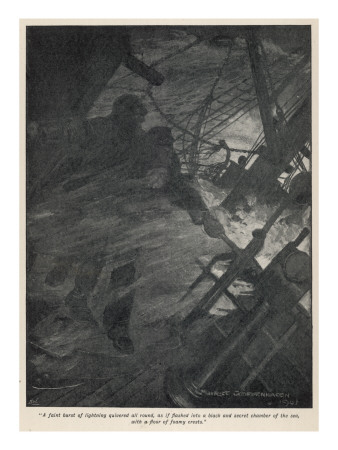
The steamer Nan Shan in the Storm

ostensible purpose of this review, Conrad’s Typhoon, it was the first full book I had read on my IPad, if a novella of 100 some odd pages can be thought of as a full book. And the verdict is that it was like reading…well…a book. The interface felt book like, I can adjust the light to the needs of my aging eyes, and can read more clearly than I could have managed by candlelight. I’ve always worried about the ability to personalize the texts, but iBooks lets me underline, and if anything I personalized the text more than I might have some others since my handwriting is unreadable and my notes in paperbooks cryptic and unintelligible. By contrast, the marginalia tool in iBooks is clean and my notes copious. Perhaps above all, I loved my iPad for remaining charged and working when everything else failed, leaving in the dark and to my own devices. Scary what I might find in that mirror. I read the entire book undistracted by facebook or my email apps, but I took comfort in knowing they were available for my distraction should I need them.

Now as to Typhoon itself. I want to say “Yes,” with qualifications. The story is gripping and intense, a naturalist drama of man against nature that becomes a kind of paean to stoic and pedestrian endurance, though one that is ironic and complicated in the end. The main human character is Captain MacWhirr, whose name betokens a machine-like efficiency. He is a man of small intellect, little imagination, and no intellectual curiosity. Because of this it is hard to describe him as actually courageous in the teeth of the hurricane. While a more imaginative man might have hidden his response to the terrors of the outrageous sea in cryptic understatement, MacWhirr is mostly just given to small emotion and small imagination.

Captain MacWhirr was trying to do up the top button of his oilskin coat with unwonted haste. The hurricane, with its power to madden the seas, to sink ships, to uproot trees, to overturn strong walls and dash the very birds of the air to the ground, had found this taciturn man in its path, and, doing its utmost, had managed to wring out a few words. Before the renewed wrath of winds swooped on his ship, Captain MacWhirr was moved to declare, in a tone of vexation, as it were: “I wouldn’t like to lose her.”

One doesn’t come away from this novel feeling grand and heroic and triumphant about human beings. On the other hand, one doesn’t come away feeling like human beings are small and accidental as you do, for instance in reading Stephen Crane’s “The Open Boat”. Instead endurance seems something to be achieved, and we end up happy for MacWhirr that he has achieved it, knowing we’d rather have him dull and unimaginative, but steady, were we caught in the writhing seas ourselves.

The story as a whole is gripping and seems to reveal something about both our human frailty and our strength and complexity, making it more than just a good adventure story. If I had read it first, I’m sure I would say that The Perfect Storm reminded me of it in being only partly a book about humans against the storm, and as much or more about humans against themselves.

One thing keeps me from a whole hearted endorsement. It really is the case that the depictions of Chinese in the book are deeply troubling. Passages in which Chinese are cast a jabbering animals or as writhing forces of nature are offensive and hard to find a way to redeem. I have always thought the criticism of Heart of Darkness was perhaps unearned since the thesis of that book had always seemed to me to be the evils of imperialism. But there is no redeeming theme that I can find for the representation of the Chinese coolies as brutes, and I found myself less inclined to defend Conrad, either here or for Heart of Darkness than I was before I began. To say this is not to say that the book is not worth reading, since there is no good human thing that is free of the scent of corruption, but it is to say that the goodness in the book does not overcome that corruption and reminds this reader at least that human beings are mixed creations, leaving us to admire and cringe in the same moment.

View all my reviews

Books in a material world–Bookporn and more

I was talking to a couple of students yesterday, one of whom wants to be a librarian because she loves “being around books.” A little bit of a Scrooge, I guess, I told her she better get used to being around computers since that was the real future of libraries, taking her back a bit with my revelation that the library budget at our own college had just been required to move $50,000 from book purchasing to database collections. Small change for a lot of places, but for my smallish college $50,000 is nothing to sneeze at. Indeed, I’ve already felt the squeeze just a bit since English used to depend on the general fund of the library to order contemporary novels and poetry–which we ordered gleefully and at will. Probably partly on the erroneous assumption that availability would somehow translate into their being taken off the shelf. Well, that fund hasn’t disappeared, but we’ve been asked to order not quite so gleefully, and not quite so at will. A concrete manifestation of how a response to a perceived technological need–real or not–will gradually determine or close the future of the book as we’ve known it.

Still, my student was not dissuaded. She feels that books will always be with us because we love their physicality. There’s that body of the book theme again, and there’s something real about it that has to be thought through. Reading is not simply a mental process of decoding letters, not simply a process of getting information off a page or screen and in to our brains. It’s a physical activity to which we attach all kinds of cultural and personal meanings, a kind of spiritual reverence that the attach to the being of books that we cannot yet attach to computers.

We imagine computers too much as tools, and emphasizing their efficiency does too little to address the tactile, even the olfactory meanings that we attach to book culture. The other student who was with us was very intrigued by Amazon’s Kindle, but even she paused and said, “I became an English major when I looked out from the balcony and saw the stacks and stacks of books.” The physicality of books inspires a reverence, whereas the efficiency of computers inspires…what?…a sense of efficiency?

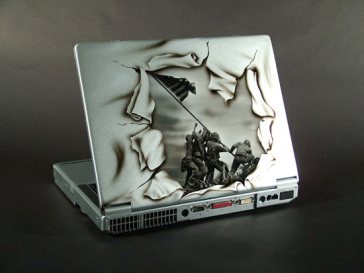
Indeed, I’m intrigued by the growing tendency of laptop users to try and personalize their laptops–recreating their essential impersonality through a kind of personal graffiti. There’s a great newstory on this phenomenon at c/net, along with Personalized laptop.  One of my favorites. 

We do this with books, it seems to me, but not in the same way. We don’t feel compelled to personalize the cover of a book, and our markings in a text are more to memorialize a reading experience than to carve a human personality into what is, after all, a machine. Books are a technology, but at the least we have learned to experience them as extensions of the body rather than as tools.

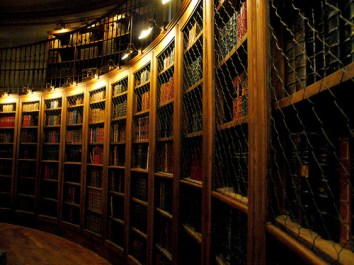
Along these lines, I’ve been running in to a lot of images of books again. Rachel Leow over at A Historian’s Craft celebrates the one year anniversary of her blog with BookPorn #27, a couple of fabulous images of the Library of the Musee Guimet. Says Rachel:Library Musee Guimet

“There’s a kind of hushed atmosphere when you walk in: the lights are dim and people shuffle about, struck silent with reverence, or perhaps the disconcerting, all-pervading pinkness of the walls and columns. The books lie, untouchable, behind their wire cages, and the smell of old paper lingers about well after you step, blinking, back out into the fluorescent glare of the exhibition outside.”

Nice writing, Rachel. And happy birthday. It seems to me that Rachel gets at this notion of the importance of the physicality of books inspiring a kind of reverence, something I attach even to my tattered paperback crowded onto basement shelves, but which I don’t really attach to my computer. Like nearly everyone else, I’m sure I spend a great deal more time on my computer reading anymore than I do in actually reading books. Like most white collar workers I’m chained here all day, and then blog all night. But feeling reverence for my computer feels a little bit like feeling reverence for my screwdriver. Not impossible, I guess. I’m sure many a carpenter has a deep feeling for his screwdriver. But I also guess that mostly such carpenters are considered weird by everyone else.

Books are tools, but it’s a mistake to think that what counts in reading them is the toolishness. If we only focus on the instrumental qualities associated with text delivery, there is no question that the e-book-o-philes among us are right to scoff at fears of digital libraries. Still, culture is more than instrumental, and always has been.

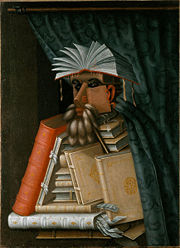
Along these lines, there’s a humorous and very interesting Giuseppe Acrimboldo Librarianskewering of those of us who are book fetishists over at if:book. Chris Mead has written a song about the history of books along with a lot of great images. My favorite is this from Giuseppe Acrimboldo, “The Librarian.” I love it. The human is text, no a book, a library. What I’ve always thought anyway. I am my books. I don’t yet say, I am my computer. Will I ever.

Chris takes the opportunity to skewer the-sky-is-falling attitude that some of us bring to the changes that are going on

“words: written in silence, muttered in monasteries
have been sung, shouted, acted – now by digital industries

broadcast and mixed for our burgeoning multiculture,

but circled by many a gloom-laden vulture

crying “R.I.P. books: doomed to extinction
by some blinking e-inky, i-evil invention”.
The word spreads and
changes; that’s my belief.
What next for the book?
The future lies overleaf.

Very nice. Dr. Seussian. Ok, only almost. Still, Chris’s poem/song emphasizes an assumption that I think is flatly wrong. That the technology of reading is essentially inconsequential for the act of reading itself. This is clear explicitly in the opening part of his poem.

“Books are what a society carries its words in
and words have been written on stone, silk, slate, parchment,
wax, clay, screen and skin,”

This is superficially true, but the assumption seems to be that reading is only about decoding letters, and books–or parchments or scrolls or screens–are merely delivery systems that are more or less equal except in the efficiency with which they can deliver text to readers. This is flatly false, as any historian of books and reading could point out in half a breath. In some sense, when we went from reading scrolls to reading codexes and then books, the changing technology changed the meaning of the act of reading, not just the techniques of the act of reading. It is this changing meaning that is crucial to try and understand. Techniques of text delivery can merely be learned through users manuals. Meanings and their attendant ways of being human are less easily learned and unlearned. We ought to pay attention to what those changes might be.

Final note: I’m sure everyone’s familiar with this video, but it still makes me smile. It’s a reminder that all of the cultural associations we have with books had to be learned. There’s nothing natural about our sentimental attachments to books. As kids, we’re all in the position of the monk at a loss here, not knowing which way a book sets on the table, which way to turn the pages. Culture is learned. That doesn’t mean the demise of books should be sniffed at. But culture is learned.

Audiobooks: Baritones do it Better

I’m having a little trouble keeping the eyelids open on humpday, so I’ll probably come back to this later. Still, I’ve been away for a couple of days, so I thought I’d ruminate for a few paragraphs.

A conversation with a colleague a couple of weeks back has had me contemplating the status of audiobooks. Conversation turned around the question of whether audiobooks constituted “reading,” an ameliorative factor to the generally dismal view of literary reading that’s been out there ever since the NEA report in 2004.

I’m not convinced, but I am intrigued by the general status of audiobooks and how they relate to the historical practices of reading and listening aloud. It’s worth saying that a characteristic of modern reading practices has idealized silent reading for oneself. Reading out loud, and worse, listening to others read, has largely been a sign of immaturity or deficiency.

But should it be? Not sure. Something I’ll have to come back to.

I recently stumbled across Librivox. Again, something I’m sure many people were already familiar with, but which seems brand new to me. Essentially an archive of open access recordings of various works of literature, the recordings done by volunteers.

Librivox has all the strengths and weaknesses of democratic webdom. I literally could not understand some of the poems I tried to listen to. Some readers sounded vaguely like adenoidal adolescents, slurred words together and substituted speed and volume for earnestness and emotion. Others started well, but seemed to get bored with the poems as they go along. It takes a lot of effort, evidently, to be sonorous and measured and musical, to have a voice worth listening to without making listeners hear the voice more than the poetry itself.

Still, I ran across Justin Brett after listening to about a half dozen recordings of Dover Beach, and immediately became a sucker for his resonant baritone and British accent. I could listen all day.

For several good recordings of Brett’s vocal work, listen to the following:

“Dover Beach”

“Jabberwocky”

“The Collar”

Is it reading? I still don’t think so, but I’ll come back to it. Is it literature? That’s an interestingly different question, that will also await another day. Is the experience of literature linked inextricably to the page, or is it in the word that the page “merely” symbolizes? Is whatever is literary about literature independent of the written word–ink or digital–just as we might think of music as essentially free of and even superior to the page upon which it is composed? I don’t think so, for now, but it’s worth thinking about.

Body of Knowledge

Since getting started on this blog I’ve been thinking a lot about how we image reading, and more broadly knowledge. The classic picture of a man or woman, body slumped in a chair or reclining on a bed or laying under a tree, head inclined in to a book. This is our sense of what reading is, and in a larger sense of how knowledge is gained and demonstrated.

It’s a difficult image in some respects because, in fact, we can’t really tell whether reading is going on at all simply from the fact of its physical representation. For all we know the person who seems as if they are half-asleep may in fact be half-asleep. Think of the association of reading fiction with being in dream worlds. The act of reading itself, especially silent reading, is in some respects unimage-able. We can’t see the translations that occur between marks on a page that become letters and words and then are associated with meanings in the mind. We accept on trust that the student with her book open in the back of the room is, in fact, reading, rather than drifting into a half-world as we lecture on at the front of the room.

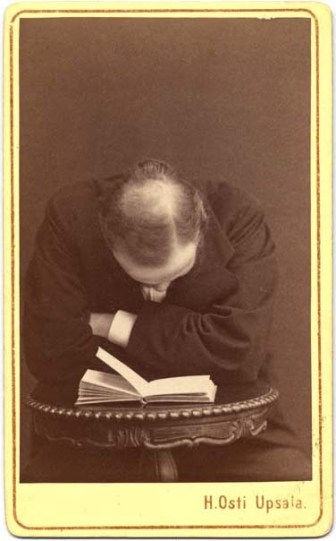
I think working on the blog has made me acutely more interested in the physical image of reading. How could I choose relevant images for a blog taken up with something so ethereal as reading? My avatar came from a library at Upsala University (I think, I can’t remember). I was lasande_man.jpgtaken by the classic image of the hunched body at the desk, but also that it was obviously a middle-aged man, somewhat monkish. Finally, that you couldn’t see the face—which seemed to me to be something about reading and something about what I wanted the blog to be. Reading is a kind of facelessness, a kind of disappearance of the self that is itself enriching and expansive. This is why I think all the focus on reading as creativity and self-assertion among so many poststructuralists—people like Roland Barthes who want to turn reading in to an alternative form of writing—is missing something that’s relatively essential and important. The disappearance of the self in reading is precisely what we desire. The loss of self is goal, not dread outcome of the process of reading.
One thing that struck me in searching for an appropriate avatar—which I pursued by searching Google images—is that images of reading are almost exclusively associated with books. Reading means, so far as the visual imagination is concerned, reading books. I sifted through a couple of dozen pages of images and came up with not one image of a computer or a computer screen. Indeed, realizing that I was interested in pursuing the conjunction of reading and writing, I thought it was a little ironic that my wordpress template has a pen at the top. Of course, I have the option of putting in a computer keyboard, and tried to find one, but perhaps the point is made. In our imaginations, reading and writing is still a matter of pen and paper. As I said yesterday, my colleague is not even certain that what we do on things like this blog is properly called writing. Why call it blogging if it is writing plain and simple. Similarly, we surf the web, we don’t read the web. It’s a new and different process, for which we don’t have adequate visual images.

My same colleague objects that we won’t go with electronic books because we like the physicality of things. Well…I didn’t point out to her that, in fact, Kindles and Sony readers and my 17-inch Macintosh computer screen are all physical to a fault. But somehow we imagine that computers have no physical presence. Without physical presence they cannot image that most insubstantial of things, the reading process. In actual fact, I think that we have constructed a certain kind of “physicality” that we associate with books, while we are only beginning to develop a sense of the physicality of computers.

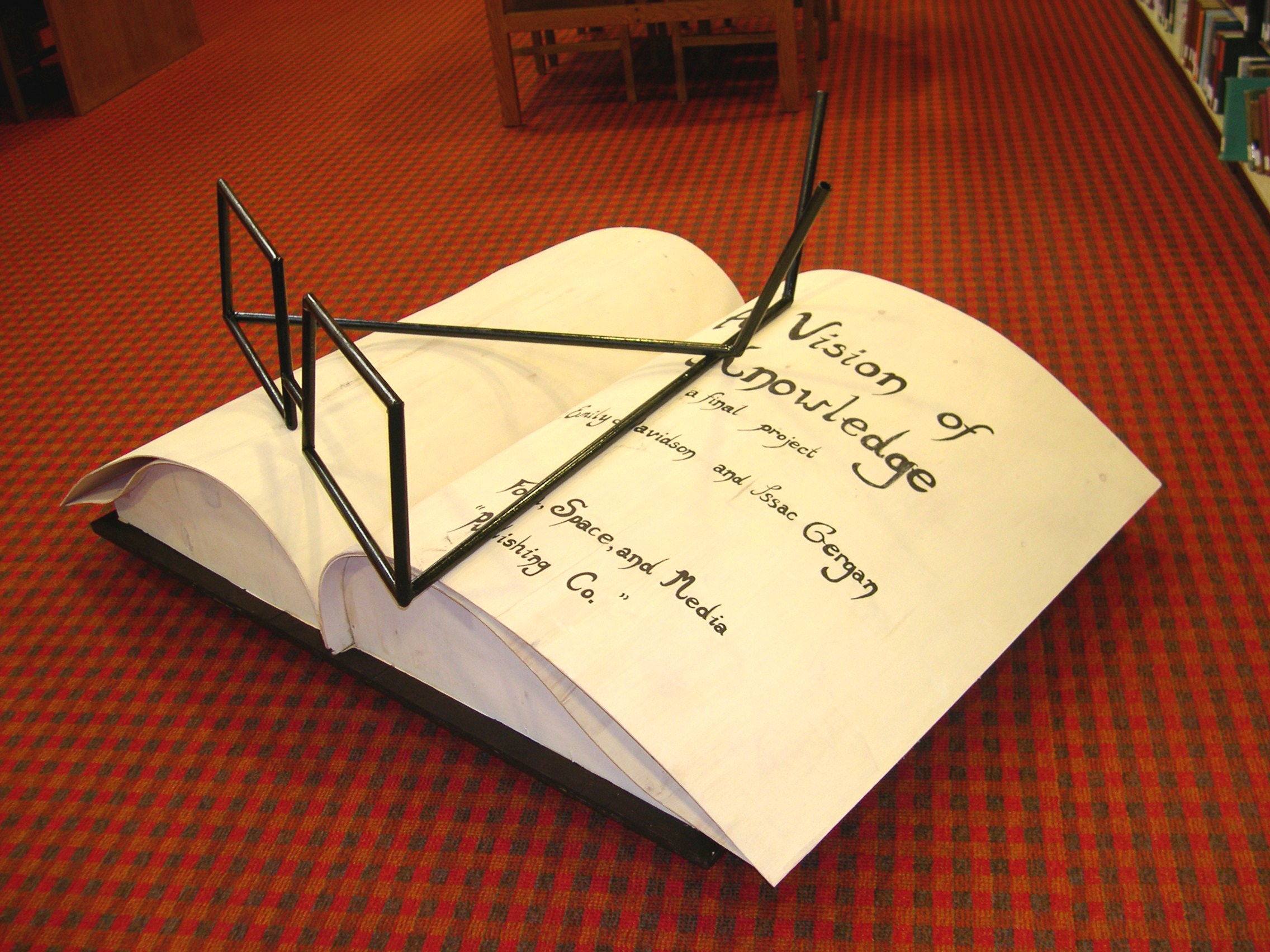
Along these lines, our library at school is hosting a very nice work of art by a couple of our students. A book with reading glasses. I’m having trouble optimizing this to fit on the page, but you can access ” Vision of Knowledge” by clicking on the title. My general sense is that computers make both books and reading glasses anachronistic. We can read on the Internet, and if the text is too small, who needs glasses. Just hit text zoom.

The other interesting thing about this image is the text itself, which, of course, we read. “A vision of knowledge.” My general sense is that despite the tremendous emphasis on the Internet as a resource for knowledge and learning, we continue to imagine, to have visions of knowledge primarily through our cultural repertoire related to books. Again, a quick google search for images related to the word “knowledge” called up dozens of pictures of books, various diagrams of the brain, and a lot of variously dull and variously interesting charts and REading Womengraphs. One thing that didn’t come up were images of computers. I scrolled through about 100 and some odd images before I got to any image of a computer at all.

I’m not sure that there’s any great lesson to be drawn here. However, I think that if we can’t picture something, this means that we don’t quite know what to do with it, that we don’t quite know what it is, at least for us. The digital world is inescapable, but at least with regards to reading and knowledge we still don’t know exactly what it means, how to imagine ourselves as a part of it.

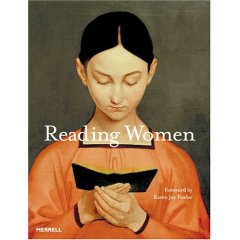
Side note: There’s a lot of stuff out there on the gender of reading, of course. There’s an absolutely fabulous book of images entitled “Reading Women” that I recommend highly. At one point I thought ALL images of reading were women, though this, of course, isn’t true at all.